REVIEW 3 major objections 4 minor 39 references
motif2vec: Motif Aware Node Representation Learning for Heterogeneous Networks
T0 review · 3 major / 4 minor · reviewed 2026-08-14 · deepseek-v4-flash
Pith's one-line read Transforming a heterogeneous network into motif graphs yields better embeddings than metapath- or metagraph-guided walks, according to this paper.
desk verdict Plausible and novel motif-graph transformation approach to heterogeneous network embedding, but the paper's own Table II contradicts its 'consistent superiority' claim, and the absence of error bars makes the significance claims unsupported. read the letter →
The pith
A machine-rendered reading of the paper's core claim, the machinery that carries it, and where it could break.
The reading
What carries the argument
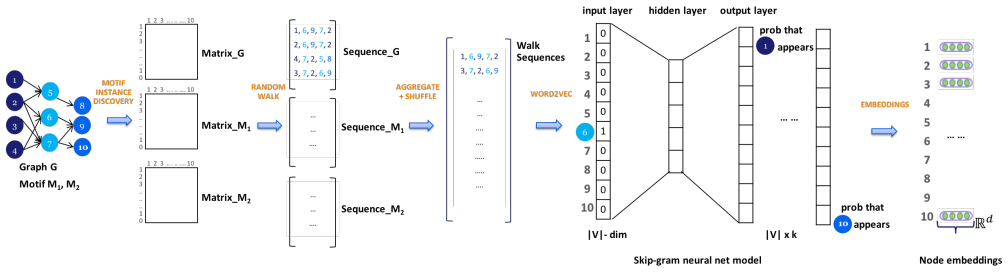
The central object is the motif graph, defined through the weighted motif adjacency matrix: for a motif M, the (i,j) entry counts how many instances of M contain both nodes i and j. This matrix is symmetric, can be weighted or binary, and defines a new graph over the same node set. Motif2vec computes one such graph per motif, runs biased random walks (with return and in-out parameters) over each motif graph and over the original graph, aggregates and shuffles the walks, and feeds them to a heterogeneous skip-gram model; including the original graph is what ensures coverage of nodes that do not appear in the motif.
What would settle it
Run an ablation that removes the motif graph and performs the same biased random walks and skip-gram training on the original heterogeneous network only, with identical parameters; if classification and link-prediction accuracy stay at the same level, then the motif transformation is not what produces the reported gains.
Extended reading notes
Core claim
The central discovery is that motifs, defined as recurring, statistically significant directed subgraphs, can serve as a representation medium for heterogeneous network embedding. The paper builds a weighted motif adjacency matrix for a chosen motif, where each entry counts the number of motif instances in which the two nodes co-occur, then generates biased random walks over both the motif graph and the original graph, and trains a heterogeneous skip-gram model on the shuffled walk sequences. In the experiments, this pipeline outperforms metapath2vec, metapath2vec++, metagraph2vec, and metagraph2vec++ on DBLP-P and AMiner-CS node classification and on Yelp-Restaurant and Amazon-Electronics link prediction under identical parameter settings. The paper attributes the gain to the motif graph's ability to encode higher-order structural and semantic heterogeneity that symmetric meta-structures miss, while walking the original graph preserves coverage for nodes absent from the chosen motif.
Load-bearing premise
The claim of consistent superiority rests on the comparison being fair: the hand-picked motif is assumed to carry the same semantics as the baselines' metapath or metagraph, and the motif-discovery step is assumed to respect node and link types; if either fails, the reported gains could come from an easier setup rather than from the method itself.
Editorial extensions
If this is right
- A single hand-picked motif is enough to beat all four baselines on all four datasets, with relative gains up to 24% for classification and 34% for link prediction.
- The method handles heterogeneous schemas with more than three node types because motif graphs do not require the symmetric structure that metapaths and metagraphs rely on.
- Walking both the original graph and the motif graph gives embeddings for nodes that never appear in the chosen motif, addressing a coverage gap of meta-structure-only walks.
- Naively combining all motifs of a fixed size can lower accuracy, so the choice of motif matters; the paper leaves automatic motif selection open.
Reading between the lines
- The motif-graph transformation is independent of the embedding learner, so it could plausibly be paired with other objectives such as matrix factorization or graph neural networks; the paper only demonstrates it with random-walk skip-gram.
- The paper's observation that the union of all motifs underperforms the single best motif suggests that automatic per-task motif weighting, which the authors flag as future work, could improve on both single-motif and all-motif choices.
- On schemas with four node types, the argument implies motifs are more expressive than symmetric meta-structures; a baseline that accommodates four node types in its metapath or metagraph would separate motif semantics from the removal of the symmetric-walk constraint.
Signed reviews
Editorial analysis
A structured set of objections, weighed in public.
Referee Report
Summary. The paper proposes motif2vec, a heterogeneous network embedding method that (i) discovers instances of a chosen network motif, (ii) transforms the original graph into one or more motif graphs, (iii) generates biased random walks on both the original and motif graphs, and (iv) trains a heterogeneous skip-gram model on the aggregated and shuffled sequences. The method is evaluated on four datasets (DBLP-P, AMiner-CS, Yelp-Restaurant, Amazon-Electronics) for multi-class node classification and link prediction, against metapath2vec, metapath2vec++, metagraph2vec, and metagraph2vec++. The central claim is that motif2vec 'consistently and significantly outperforms' all baselines on both tasks across all four datasets.
Significance. If the central claim were fully supported, the paper would make a useful contribution to heterogeneous network embedding: the idea of replacing meta-structure-guided random walks with a motif-based graph transformation is a plausible and interesting departure from prior work, and the evaluation includes a large-scale AMiner-CS experiment. The paper also provides a useful per-motif ablation in Table III and a credible efficiency analysis. However, the significance is undercut by three issues: the paper's own Table II contradicts the 'consistent superiority' claim, no variance information or significance tests are reported to support the word 'significantly', and the fairness of the comparison depends on an unsubstantiated semantic-equivalence claim between a hand-picked motif and the baselines' metapath/metagraph. These concerns are load-bearing, so the significance as stated is not yet established.
major comments (3)
- [Section IV.B, Table II] The sentence 'we observe that our algorithm motif2vec consistently and significantly outperforms the baseline methods for both tasks and across all four datasets' is contradicted by the Amazon-Electronics column, where metagraph2vec++ achieves 60.02% while motif2vec achieves 58.90%. Additionally, the table reports only averages of five runs, with no standard deviations, confidence intervals, or significance tests, so the word 'significantly' is unsupported even in the datasets where the mean accuracy is higher. Please either report error bars and statistical tests, or revise the claim to acknowledge the Amazon-Electronics result.
- [Section IV.C, Table III] The assertion that the chosen motif M4 has the same semantics as the baselines' metapath A-P-V-P-A and metagraph is not substantiated. Table III shows that classification accuracy varies from 77.75% to 78.80% depending on the motif or motif set, meaning the choice of M4 is consequential. Without a formal definition of semantic equivalence or a sensitivity analysis over alternative motifs, the reported gains could reflect favorable motif selection rather than a general advantage of motif2vec. Please either justify the equivalence explicitly or report results for multiple motifs.
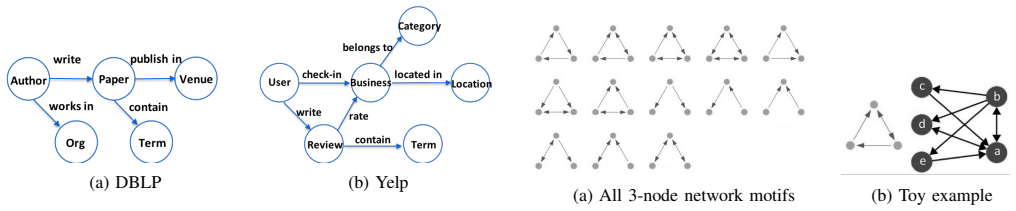
- [Definition 2.3 and Section IV.D] The definition of a heterogeneous network motif requires that the motif frequency be 'statistically significant,' but the paper never describes or applies the randomization test that would establish significance; in practice the motifs used in the experiments are hand-selected. Moreover, the motif discovery step relies on NetworkX's subgraph isomorphism routines, which operate on homogeneous graphs, and the manuscript does not explain how node-type and link-type constraints are enforced during instance enumeration. Because the method's claim to preserve heterogeneity rests on typed motif discovery, this gap needs to be addressed.
minor comments (4)
- [Section IV.A.5] The sentence 'All codes are implemented in Python All experiments are conducted on a Linux machine' is missing a period after 'Python', and '2.60GHz' should be written as '2.60 GHz'.
- [Section I] The phrase 'over the past demi decade' is nonstandard; consider replacing it with 'over the past five years' or 'in recent years'.
- [Algorithm 1, Section III] The pseudo-code is under-specified: 'Initialize sequences' appears after the walk-generation loop but 'sequences' is not initialized before the shuffle, and the loop header 'for G and WM1, WM2, ..., WMT do' would be clearer if written as a loop over the set of graphs.
- [Figure 2(b)] The text refers to 'Figure 2(b)(right)' and 'Figure 2(b)(left)' but the subpanels are not explicitly labeled; please label them or rephrase to avoid ambiguity.
Circularity Check
No significant circularity: the embeddings are unsupervised and evaluated on held-out downstream tasks, with no load-bearing self-citation.
full rationale
The paper's central claim is an empirical comparison of embedding methods. motif2vec transforms each graph into motif graph(s), runs biased random walks, and trains a heterogeneous skip-gram model (Eq. 3); the embeddings themselves are unsupervised. Node classification and link prediction are evaluated on held-out data: the paper uses a standard 70:30 split and removes test links before learning embeddings (Section IV.A.3). There is no parameter fitted to the task labels and then renamed as a prediction. The only task-dependent input is the manual motif choice, and Section IV.C states that one motif, M4, is selected 'in order to ensure a fair comparison with the baseline methods which consider one metapath and one metagraph with the same semantics (as M4)'; this is a deliberate fairness control, not a definition of the reported accuracy. The motif discovery routine is attributed to NetworkX [9], an external tool, and no load-bearing self-citation appears: the authors do not invoke their own prior results to justify the method's premises. The headline claim that motif2vec 'consistently and significantly outperforms' is undermined by Table II on Amazon-Electronics (metagraph2vec++ 60.02% vs motif2vec 58.90%) and by the absence of reported variance or significance tests, but that is an internal-consistency and statistical-support problem, not circularity. None of the enumerated circularity patterns can be exhibited from the text, so the appropriate score is 0.
Assumptions & free parameters
free parameters (2)
- Motif selection per dataset =
M4 for DBLP-P/AMiner-CS; one hand-picked motif for Yelp/Amazon
- Random walk and skip-gram hyperparameters =
d=128, l=80, r=10, c=10, p=1, q=1
assumptions (4)
- domain assumption Co-occurrence in random walks on the motif graph and the original graph captures the node neighborhoods needed for downstream classification and link prediction.
- domain assumption The weighted motif adjacency matrix (motif co-occurrence counts) encodes higher-order heterogeneous connectivity patterns.
- ad hoc to paper NetworkX's subgraph-isomorphism motif discovery can enumerate typed heterogeneous motif instances.
- ad hoc to paper The selected motif M4 is semantically equivalent to the baselines' metapath A-P-V-P-A and metagraph, making the comparison fair.
Cite this review
Pith. "Pith review of motif2vec: Motif Aware Node Representation Learning for Heterogeneous Networks." pith.science (2026). https://pith.science/paper/MEYVQQYC
@misc{pith2026190808227,
  author       = {Pith},
  title        = {Pith review of: motif2vec: Motif Aware Node Representation Learning for Heterogeneous Networks},
  year         = {2026},
  howpublished = {\url{https://pith.science/paper/MEYVQQYC}},
  note         = {Machine review of arXiv:1908.08227}
}
read the original abstract
Recent years have witnessed a surge of interest in machine learning on graphs and networks with applications ranging from vehicular network design to IoT traffic management to social network recommendations. Supervised machine learning tasks in networks such as node classification and link prediction require us to perform feature engineering that is known and agreed to be the key to success in applied machine learning. Research efforts dedicated to representation learning, especially representation learning using deep learning, has shown us ways to automatically learn relevant features from vast amounts of potentially noisy, raw data. However, most of the methods are not adequate to handle heterogeneous information networks which pretty much represents most real-world data today. The methods cannot preserve the structure and semantic of multiple types of nodes and links well enough, capture higher-order heterogeneous connectivity patterns, and ensure coverage of nodes for which representations are generated. We propose a novel efficient algorithm, motif2vec that learns node representations or embeddings for heterogeneous networks. Specifically, we leverage higher-order, recurring, and statistically significant network connectivity patterns in the form of motifs to transform the original graph to motif graph(s), conduct biased random walk to efficiently explore higher order neighborhoods, and then employ heterogeneous skip-gram model to generate the embeddings. Unlike previous efforts that uses different graph meta-structures to guide the random walk, we use graph motifs to transform the original network and preserve the heterogeneity. We evaluate the proposed algorithm on multiple real-world networks from diverse domains and against existing state-of-the-art methods on multi-class node classification and link prediction tasks, and demonstrate its consistent superiority over prior work.
Figures

Figures from the paper (4 more)


Reference graph
Works this paper leans on
-
[1]
Narayanamurthy, Vanja Josifovski, and Alexander J
Amr Ahmed, Nino Shervashidze, Shravan M. Narayanamurthy, Vanja Josifovski, and Alexander J. Smola. Distributed large-scale natural graph factorization. In Proceedings of the 22nd WWW International Conference on World Wide Web, 2013
work page 2013
-
[2]
Yoshua Bengio, Aaron C. Courville, and Pascal Vincent. Representation learning: A review and new perspectives. IEEE Transactions on Pattern Analysis and Machine Intelligence , 35(8):1798–1828, 2013
work page 2013
-
[3]
Austin R. Benson, David F. Gleich, and Jure Leskovec. Higher-order organization of complex networks. Science Magazine, 353(6295):163– 166, 2016
work page 2016
-
[4]
Shiyu Chang, Wei Han, Jiliang Tang, Guo-Jun Qi, Charu C. Aggarwal, and Thomas S. Huang. Heterogeneous network embedding via deep architectures. In Proceedings of the 21st ACM SIGKDD International Conference on Knowledge Discovery and Data Mining
-
[5]
HARP: hierarchical representation learning for networks
Haochen Chen, Bryan Perozzi, Yifan Hu, and Steven Skiena. HARP: hierarchical representation learning for networks. In Proceedings of the 32nd AAAI International Conference on Artificial Intelligence
-
[6]
Yuxiao Dong, Nitesh V . Chawla, and Ananthram Swami. metap- ath2vec: Scalable representation learning for heterogeneous networks. In Proceedings of the 23rd ACM SIGKDD International Conference on Knowledge Discovery and Data Mining
-
[7]
Graph embedding techniques, applica- tions, and performance: A survey
Palash Goyal and Emilio Ferrara. Graph embedding techniques, applica- tions, and performance: A survey. Knowledge-Based Systems, 151:78– 94, 2018
work page 2018
-
[8]
node2vec: Scalable feature learning for networks
Aditya Grover and Jure Leskovec. node2vec: Scalable feature learning for networks. In Proceedings of the 22nd ACM SIGKDD International Conference on Knowledge Discovery and Data Mining
Show all 39 references
-
[9]
Hagberg, Daniel A
Aric A. Hagberg, Daniel A. Schult, and Pieter J. Swart. Exploring net- work structure, dynamics, and function using networkx. In Proceedings of the 7th Python in Science Conference
-
[10]
Ups and downs: Modeling the visual evolution of fashion trends with one-class collaborative filtering
Ruining He and Julian McAuley. Ups and downs: Modeling the visual evolution of fashion trends with one-class collaborative filtering. In Proceedings of the 25th WWW International Conference on World Wide Web
-
[11]
Label informed attributed network embedding
Xiao Huang, Jundong Li, and Xia Hu. Label informed attributed network embedding. In Proceedings of the 10th ACM WSDM International Conference on Web Search and Data Mining
-
[12]
A comparative study on network motif discovery algorithms
Yusuf Kavurucu. A comparative study on network motif discovery algorithms. International Journal of Data Mining and Bioinformatics , 11(2), 2015
2015
-
[13]
Yu, Ying Ding, and David J
Xiangnan Kong, Bokai Cao, Philip S. Yu, Ying Ding, and David J. Wild. Meta path-based collective classification in heterogeneous information networks. In Proceedings of the 25th ACM CIKM International Conference on Information and Knowledge Management
-
[14]
Automating the construction of internet portals with machine learning
Andrew McCallum, Kamal Nigam, Jason Rennie, and Kristie Seymore. Automating the construction of internet portals with machine learning. Information Retrieval, 3(2):127–163, 2000
2000
-
[15]
Efficient estimation of word representations in vector space
Tomas Mikolov, Kai Chen, Greg Corrado, and Jeffrey Dean. Efficient estimation of word representations in vector space. In ICLR Workshop, 2013
2013
-
[16]
Corrado, and Jeffrey Dean
Tomas Mikolov, Ilya Sutskever, Kai Chen, Gregory S. Corrado, and Jeffrey Dean. Distributed representations of words and phrases and their compositionality. In Proceedings of NIPS International Conference on Neural Information Processing Systems
-
[17]
Asymmetric transitivity preserving graph embedding
Mingdong Ou, Peng Cui, Jian Pei, Ziwei Zhang, and Wenwu Zhu. Asymmetric transitivity preserving graph embedding. In Proceedings of the 22nd ACM SIGKDD International Conference on Knowledge Discovery and Data Mining , 2016
2016
-
[18]
Deepwalk: online learning of social representations
Bryan Perozzi, Rami Al-Rfou, and Steven Skiena. Deepwalk: online learning of social representations. In Proceedings of the 20th ACM SIGKDD International Conference on Knowledge Discovery and Data Mining
-
[19]
Software framework for topic modelling with large corpora
Radim ˇReh˚uˇrek and Petr Sojka. Software framework for topic modelling with large corpora. In Proceedings of the LREC Workshop on New Challenges for NLP Frameworks
-
[20]
Rossi, Nesreen K
Ryan A. Rossi, Nesreen K. Ahmed, and Eunyee Koh. Higher-order net- work representation learning. In Companion of the WWW International Conference on World Wide Web
-
[21]
Motif- based convolutional neural network on graphs
Aravind Sankar, Xinyang Zhang, and Kevin Chen-Chuan Chang. Motif- based convolutional neural network on graphs. CoRR, abs/1711.05697, 2017
2017 arXiv
-
[22]
Chuan Shi, Yitong Li, Jiawei Zhang, Yizhou Sun, and Philip S. Yu. A survey of heterogeneous information network analysis. IEEE Transac- tions on Knowledge and Data Engineering , 29(1):17–37, 2017
2017
-
[23]
Kaplan, and Jiawei Han
Yu Shi, Huan Gui, Qi Zhu, Lance M. Kaplan, and Jiawei Han. Aspem: Embedding learning by aspects in heterogeneous information networks. In Proceedings of the SIAM SDM International Conference on Data Mining
-
[24]
Mining Heterogeneous Information Networks: Principles and Methodologies
Yizhou Sun and Jiawei Han. Mining Heterogeneous Information Networks: Principles and Methodologies . Synthesis Lectures on Data Mining and Knowledge Discovery. Morgan & Claypool Publishers, 2012
2012
-
[25]
Aggarwal, and Nitesh V
Yizhou Sun, Jiawei Han, Charu C. Aggarwal, and Nitesh V . Chawla. When will it happen?: relationship prediction in heterogeneous infor- mation networks. In Proceedings of the 15th ACM WSDM International Conference on Web Search and Web Data Mining
-
[26]
Yu, and Tianyi Wu
Yizhou Sun, Jiawei Han, Xifeng Yan, Philip S. Yu, and Tianyi Wu. Pathsim: Meta path-based top-k similarity search in heterogeneous information networks. PVLDB, 4(11):992–1003, 2011
2011
-
[27]
Yu, and Xiao Yu
Yizhou Sun, Brandon Norick, Jiawei Han, Xifeng Yan, Philip S. Yu, and Xiao Yu. Integrating meta-path selection with user-guided object clustering in heterogeneous information networks. In Proceedings of the 18th ACM SIGKDD International Conference on Knowledge Discovery and Da...
-
[28]
PTE: predictive text embedding through large-scale heterogeneous text networks
Jian Tang, Meng Qu, and Qiaozhu Mei. PTE: predictive text embedding through large-scale heterogeneous text networks. In Proceedings of the 21th ACM SIGKDD International Conference on Knowledge Discovery and Data Mining
-
[29]
LINE: large-scale information network embedding
Jian Tang, Meng Qu, Mingzhe Wang, Ming Zhang, Jun Yan, and Qiaozhu Mei. LINE: large-scale information network embedding. In Proceedings of the 24th WWW International Conference on World Wide Web
-
[30]
Leveraging social media networks for classifica- tion
Lei Tang and Huan Liu. Leveraging social media networks for classifica- tion. Journal of Data Mining and Knowledge Discovery, 23(3):447–478, 2011
2011
-
[31]
Tsourakakis
Charalampos E. Tsourakakis. Motif-driven graph analysis. In Proceed- ings of 54th Annual Allerton Conference on Communication, Control, and Computing, 2016
2016
-
[32]
Tsourakakis, Jakub Pachocki, and Michael Mitzen- macher
Charalampos E. Tsourakakis, Jakub Pachocki, and Michael Mitzen- macher. Scalable motif-aware graph clustering. In Proceedings of the 26th WWW International Conference on World Wide Web , pages 1451– 1460, 2017
2017
-
[33]
APATE: A novel approach for automated credit card transaction fraud detection using network-based extensions
V ´eronique Van Vlasselaer, Cristi ´an Bravo, Olivier Caelen, Tina Eliassi- Rad, Leman Akoglu, Monique Snoeck, and Bart Baesens. APATE: A novel approach for automated credit card transaction fraud detection using network-based extensions. Decision Support Systems , 75:38–48, 2015
2015
-
[34]
Guan Wang, Sihong Xie, Bing Liu, and Philip S. Yu. Review graph based online store review spammer detection. In Proceedings of the 11th IEEE ICDM International Conference on Data Mining
-
[35]
Billion-scale commodity embedding for e-commerce recommendation in alibaba
Jizhe Wang, Pipei Huang, Huan Zhao, Zhibo Zhang, Binqiang Zhao, and Dik Lun Lee. Billion-scale commodity embedding for e-commerce recommendation in alibaba. In Proceedings of the 24th ACM SIGKDD International Conference on Knowledge Discovery & Data Mining
-
[36]
Benson, Jure Leskovec, and David F
Hao Yin, Austin R. Benson, Jure Leskovec, and David F. Gleich. Local higher-order graph clustering. In Proceedings of the 23rd ACM SIGKDD International Conference on Knowledge Discovery and Data Mining
-
[37]
Meta- graph2vec: Complex semantic path augmented heterogeneous network embedding
Daokun Zhang, Jie Yin, Xingquan Zhu, and Chengqi Zhang. Meta- graph2vec: Complex semantic path augmented heterogeneous network embedding. In Advances in Knowledge Discovery and Data Mining - Proceedings of the 22nd PAKDD International Pacific-Asia Conference
-
[38]
Explicit factor models for explainable recommendation based on phrase-level sentiment analysis
Yongfeng Zhang, Guokun Lai, Min Zhang, Yi Zhang, Yiqun Liu, and Shaoping Ma. Explicit factor models for explainable recommendation based on phrase-level sentiment analysis. In Proceedings of the 37th ACM SIGIR International Conference on Research and Development in Information...
-
[39]
Meta-graph based recommendation fusion over heterogeneous information networks
Huan Zhao, Quanming Yao, Jianda Li, Yangqiu Song, and Dik Lun Lee. Meta-graph based recommendation fusion over heterogeneous information networks. In Proceedings of the 23rd ACM SIGKDD International Conference on Knowledge Discovery and Data Mining
Reviewed August 14, 2026 · model on record in the stance chip above.
Discussion (0). Continue with ORCID to comment.