REVIEW 2 major objections 5 minor 54 references
Kastor: An efficient fine-tuning strategy for generative emulation of PDE simulations
T0 review · 2 major / 5 minor · reviewed 2026-08-07 · deepseek-v4-flash
Pith's one-line read A fine-tuning recipe turns a deterministic physics model into a generative surrogate, cutting forecasting error by 42.9 percent on average across ten 2D PDE simulation datasets.
desk verdict Kastor is a solid empirical contribution to generative PDE surrogate training, but the headline 42.9% fCRPS win is anchored to a self-reproduced baseline and a τ=4-subsampled evaluation that never scores the upsampler's intermediate frames. read the letter →
The pith
A machine-rendered reading of the paper's core claim, the machinery that carries it, and where it could break.
The reading
What carries the argument
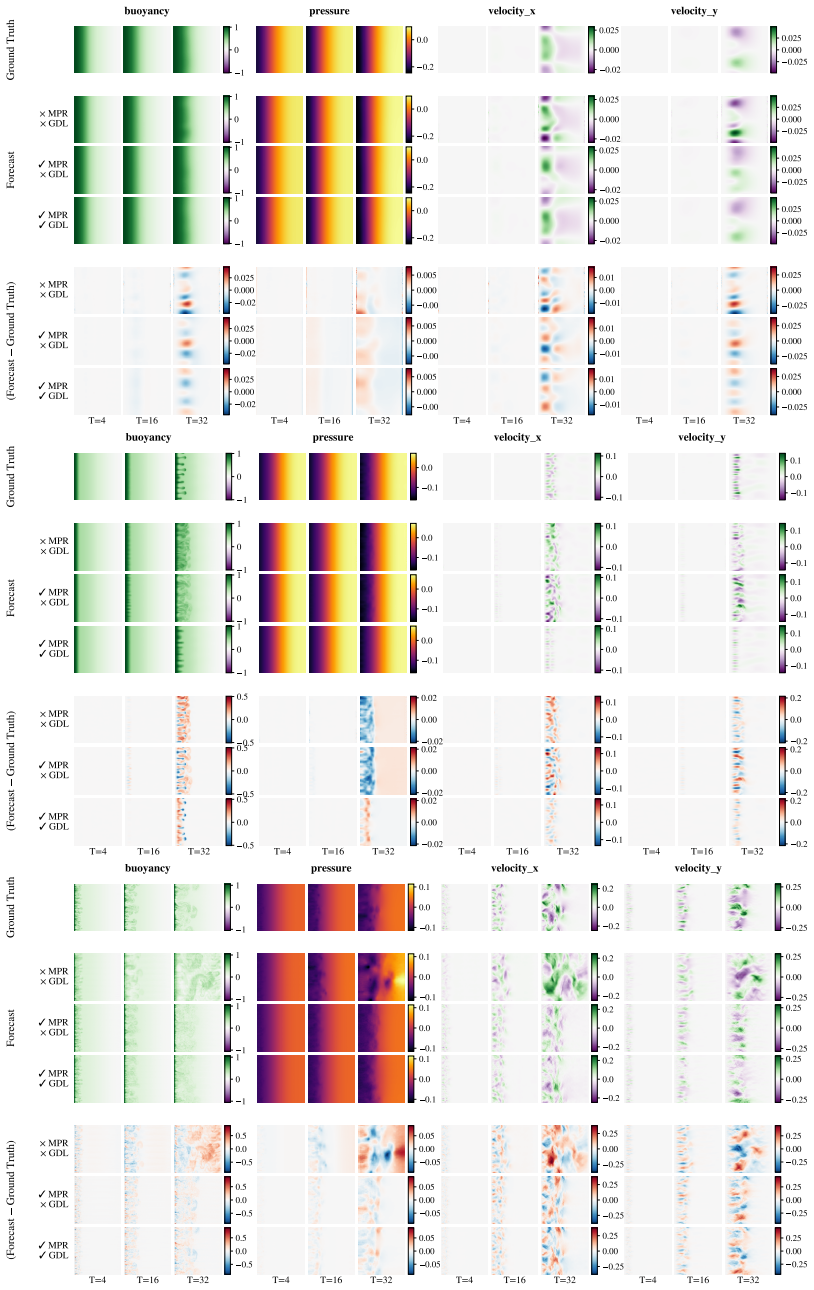
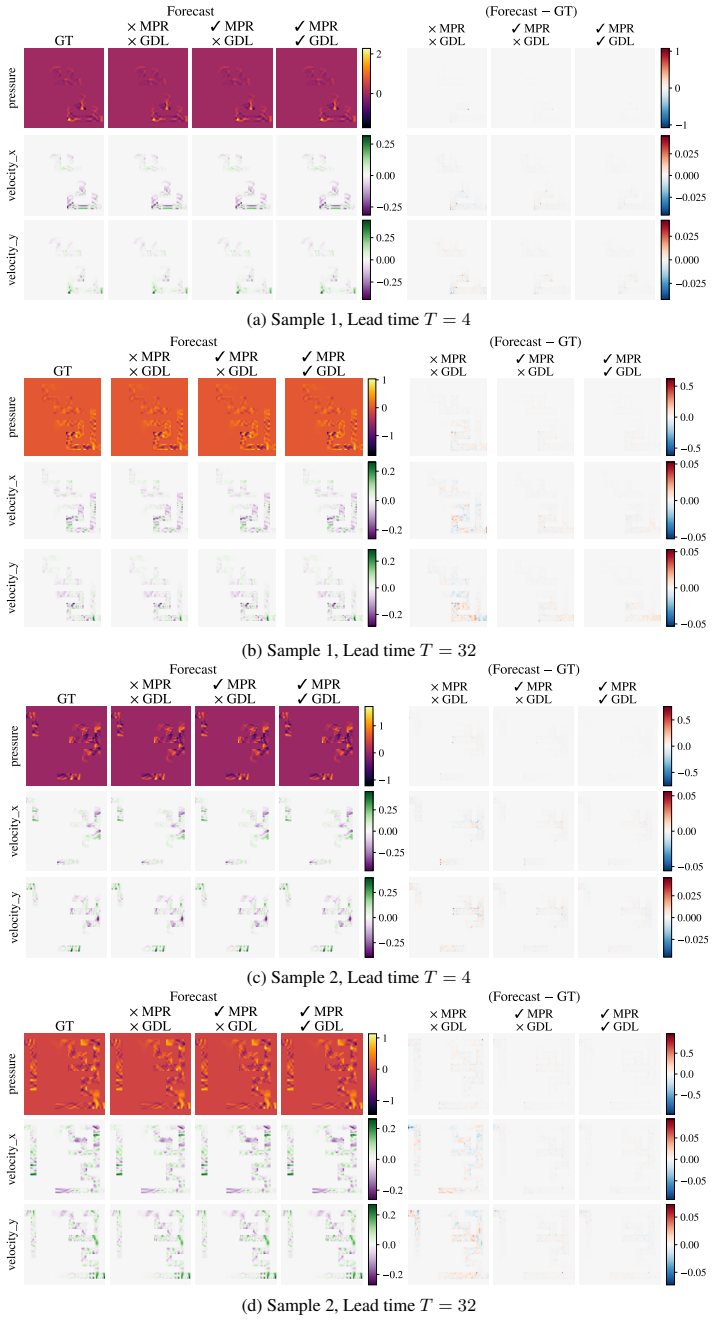
The argument runs on three mechanisms. First, a two-stage inference scheme: a causal transformer predicts states every $\tau$ frames ($\tau = 4$), and a half-size non-causal transformer fills the missing intermediate states using surrounding context, which cuts error accumulation and reduces rollout cost by roughly 37.5 percent at long horizons. Second, Mean Prediction Regularization (MPR): the generative model is trained so that conditioning on null noise $\epsilon = 0$ yields the conditional mean of the next-state distribution, supervised by an $\ell^1$ loss to the ground-truth state difference; this stabilizes both FGN and diffusion variants and is what makes FGN competitive. Third, the Gradient Difference Loss (GDL), which adds a loss on spatial derivatives of the predicted field, improving accuracy and bringing the radially-averaged power spectrum closer to the ground truth. These are implemented on the Walrus backbone with AdaLN noise injection, patch jittering as a second stochasticity source, and a CRPS scoring rule for the generative objective.
What would settle it
Re-run the same evaluation protocol (eight ensemble members, 32-step rollouts, two starting contexts per trajectory) on the official Walrus checkpoint; if the official baseline matches or beats the reproduction on Acoustic Scattering Discontinuity, Acoustic Scattering Maze, and PlanetSWE, the averaged 42.9 percent fCRPS reduction will not hold.
Extended reading notes
Core claim
On its own terms, the paper's discovery is that the failure modes of generative PDE emulators are largely training and inference choices, not an inherent limit of the backbone. Casting the pretrained Walrus architecture as a single-pass generative model trained with the CRPS scoring rule works only when the model is also constrained to predict the deterministic mean at zero noise; without this Mean Prediction Regularization, the FGN variant is worse than a simple mean-absolute-error baseline. With that constraint, plus spatial gradient matching and a strided rollout with temporal super-resolution, the authors obtain a model that beats their retrained Walrus fine-tuning reference on forecasting error, ensemble calibration, and spectral error, and does so with fewer autoregressive steps. The 42.9 percent average fCRPS reduction and the 8-of-10 datasets VRMSE win are the paper's headline numbers.
Load-bearing premise
The headline 42.9 percent reduction is computed against the authors' retrained version of the Walrus fine-tuning baseline, not against the official published Walrus checkpoint, and that reproduction performs noticeably worse on three datasets.
Editorial extensions
If this is right
- Pretrained deterministic physics models can be converted into generative ensemble emulators without architectural changes, so the recipe transfers to any backbone with attention layers.
- Strided rollouts with temporal super-resolution reduce both error accumulation and inference cost, making long-horizon ensembles practical.
- MPR is a general regularizer: it improves both FGN and diffusion models, and likely applies to other generative families trained with scoring rules or denoising objectives.
- Gradient matching restores high-frequency content, so models trained with it produce power spectra closer to ground truth than their unregularized counterparts.
- The improved calibration and spectral fidelity make the emulator usable for uncertainty quantification and for computing time-integrated statistics over full trajectories.
Reading between the lines
- The success of MPR suggests that in PDE emulation the generative component should be anchored to the deterministic mode; extending the null-noise constraint to flow-matching or latent diffusion objectives is a direct test.
- Because the time-stride optimum varies by dataset and lead time, a rollout policy that starts with $\tau=1$ for the first few steps and switches to $\tau=4$ later could beat either fixed stride; the paper notes this combination as future work.
- The headline 42.9 percent gain is relative to the authors' reproduction of the Walrus fine-tuning baseline; if the official checkpoint is used instead, the gain on acoustic scattering and PlanetSWE is likely to be smaller, though the directional improvements from MPR and GDL should persist.
- GDL on spatial gradients could be extended to divergence or curl matching for incompressible flows, where those quantities are conserved and would directly penalize unphysical artifacts.
Editorial analysis
A structured set of objections, weighed in public.
Referee Report
Summary. The paper proposes Kastor, a recipe for fine-tuning the Walrus physics foundation model into a generative ensemble emulator for PDE simulation data. Three components are introduced: a two-stage inference scheme that first rolls out a causal model with a large time stride and then fills in intermediate states with a smaller non-causal upsampler; Mean Prediction Regularization (MPR), which adds a regression loss on the network output at zero noise conditioning; and a Gradient Difference Loss (GDL) that matches spatial gradients of forecasts. The authors report a 42.9% average reduction in fCRPS relative to their re-trained Walrus fine-tuning baseline across ten 2D datasets from The Well, along with improved ensemble calibration and spectral fidelity at lower inference cost, and they show through ablations that MPR and GDL improve both FGN and diffusion emulators.
Significance. Strengths: the paper includes extensive per-dataset and per-lead-time ablation figures, a transparent cost model in Appendix B.2, and an honest limitations section. The MPR and GDL ablations in Figures 7 and 9 provide internal support for the proposed components, and the use of the public The Well benchmark makes the empirical claims reproducible in principle. If the headline comparison were made against the official Walrus checkpoint and dense trajectories, the claimed 42.9% improvement would be a practically significant result. At present, however, the headline number is tied to a self-retrained baseline and to sub-sampled lead times, so the external significance is not yet fully established.
major comments (2)
- [Section 3.6, Tables 1-2] The headline 42.9% fCRPS reduction is computed on trajectories sub-sampled at tau=4, i.e., only lead times 4,8,...,32. This excludes lead times 1-3, where Section 4.1 and Figure 23 show the tau=1 baseline is often better, and it never scores the interpolated frames produced by the non-causal upsampler that is central to the proposed two-stage inference scheme. Consequently, the abstract's claim that Kastor 'reduces forecasting error' is not yet established for complete trajectories. Please report the skill scores on dense full-length trajectories (all lead times 1..32, including the upsampler outputs) and state explicitly whether the 42.9% figure refers only to sub-sampled lead times.
- [Appendix C.1, Figure 21] The reference model in the skill score is the authors' reproduction of the Walrus fine-tuning methodology, not an official Walrus checkpoint. Appendix C.1 concedes that the reproduction performs noticeably worse than reported for Acoustic Scattering Discontinuity, Acoustic Scattering Maze, and PlanetSWE; for Acoustic Scattering Maze, Kastor-L (VRMSE 0.038) lies between the reproduction (0.047) and the reported Walrus (0.035), and for PlanetSWE the reproduction gap is large. Since the headline 42.9% fCRPS reduction and the 8/10 VRMSE claim are both measured against this reproduction, the advantage over the published Walrus model may be materially smaller on those datasets. Please evaluate against the official Walrus checkpoint or, if it is unavailable, provide a second analysis using the reported Walrus numbers as a reference.
minor comments (5)
- [Section 3.6] The sentence 'For consistency across datasets and experiments, we always report aggregated metrics on trajectories sub-sampled at tau=4' should be moved into the abstract or headline claim so readers are not surprised when Tables 1-2 list only tau=4,8,...
- [Section 3.2, Eq. (2)] MPR is presented as a novel regularization, but it is essentially a consistency constraint between the generative output at null noise and a regression target; please discuss its relation to consistency training and to the residual modeling baselines in Appendix C.8.
- [Figure 4 caption] The per-lead-time curves for tau>1 use different evaluation protocols (sub-sampled versus upsampled), and the figure caption should state clearly how lead times 1-3 are obtained for those models.
- [Appendix B.2] The cost comparison assumes KV caching for the causal baseline and a half-size upsampler; please include a sensitivity analysis around the upsampler size and the caching assumptions.
- [Abstract and Table 2] The abstract says 'outperforms Walrus for 8 out of 10 datasets on VRMSE', but Table 2 reports Ensemble Mean RMSE, not VRMSE; clarify the metric used for the 8/10 claim.
Circularity Check
No circular reduction found; fCRPS headline is empirical but anchored to a self-retrained Walrus baseline and sub-sampled trajectories.
full rationale
We walked the claimed derivation chain. The two-stage inference scheme (Sec. 3.1) trains a strided causal model and a non-causal upsampler against ground-truth states with standard losses; it contains no step where the predicted quantity is defined in terms of the evaluation metric. MPR (Eqs. 1-2) is an L1 regression loss on the null-noise output, supervised directly by the ground-truth state difference; GDL (Eq. 5) is a spatial-gradient matching loss; and the FGN/CRPS objective (Eqs. 3-4) is a strictly proper scoring rule trained on ground-truth references. None of these reduce, by construction, to the reported fCRPS or VRMSE improvements; the gains are empirical outcomes of training, not identities. The main caveat is benchmark anchoring, not circularity: the 42.9% fCRPS reduction is computed against the authors' retrained Walrus fine-tuning baseline (Sec. 3.7), and Appendix C.1 acknowledges that this reproduction performs "noticeably worse" than the reported Walrus on Acoustic Scattering Discontinuity, Acoustic Scattering Maze, and PlanetSWE. If the official checkpoint were used, the headline gap would likely shrink. This is a baseline-fairness/external-validity concern, not a by-construction equivalence. Similarly, Sec. 3.6 states that aggregated metrics are always reported on trajectories sub-sampled at tau=4, and Tables 1-2 list only lead times 4,8,...,32; this may overstate full-trajectory benefit and skips early lead times where the paper admits tau=1 is better. Again, this is a reporting/evaluation gap rather than a circular reduction. Self-citations appear in Appendix C.8 (residual models, Couairon et al. 2026) and Appendix B.4 (distillation, Jacq et al. 2026), but they are minor baselines or forward-looking mentions, not load-bearing premises. No uniqueness theorem is imported from the authors' prior work, no ansatz is smuggled in via citation, and no known result is merely renamed. We therefore find no significant circularity; the score of 2 reflects the minor self-citations and the externally anchored baseline caveat, not a circular derivation.
Assumptions & free parameters
free parameters (5)
- per-dataset time stride tau =
tau=4 for 8 of 10 datasets; tau=1 for Active Matter and Rayleigh-Benard
- MPR loss weight lambda_MPR =
100
- CRPS loss weight lambda_CRPS =
100
- GDL loss weight lambda_GDL =
2000
- diffusion baseline step count =
5
assumptions (5)
- domain assumption Walrus pretrained weights provide a useful prior for all 10 The Well datasets used.
- domain assumption The conditional distribution of the next PDE state can be represented by injecting a 32-dimensional Gaussian noise via AdaLN plus patch jittering.
- standard math CRPS computed against a single ground-truth sample with the fair correction is a valid training signal.
- domain assumption Global mean and standard deviation normalization is the right fine-tuning choice despite the pretrained model using sample-wise normalization.
- domain assumption The 10 selected Well datasets are representative of the target PDE emulation use cases.
Cite this review
Pith. "Pith review of Kastor: An efficient fine-tuning strategy for generative emulation of PDE simulations." pith.science (2026). https://pith.science/paper/MFK6II73
@misc{pith2026260806107,
  author       = {Pith},
  title        = {Pith review of: Kastor: An efficient fine-tuning strategy for generative emulation of PDE simulations},
  year         = {2026},
  howpublished = {\url{https://pith.science/paper/MFK6II73}},
  note         = {Machine review of arXiv:2608.06107}
}
read the original abstract
Machine learning offers a promising avenue to accelerate physical simulations by replacing computationally expensive traditional Partial Differential Equation (PDE) solvers with fast, differentiable surrogate models. However, standard auto-regressive ML emulators often suffer from error accumulation over long horizons and struggle to capture the stochasticity of complex physical systems. In this paper, we propose Kastor, a comprehensive methodology to adapt a deterministic physics foundation model into a highly efficient and accurate generative surrogate. First, we introduce a two-stage inference scheme that combines a large-stride causal auto-regressive model with a non-causal temporal super-resolution network, significantly reducing error accumulation while minimizing computational cost. Second, we present Mean prediction regularization (MPR), a novel training objective that constrains the generative model to predict the deterministic distribution mean under null noise conditioning. This regularization dramatically improves the performance and stability of both Functional Generative Networks (FGN) and diffusion-based emulators. Finally, we demonstrate that incorporating spatial gradient matching improves the accuracy and physical fidelity of the simulations as measured by power spectrum density. Extensive evaluations on diverse simulation datasets of the benchmark The Well show that with these components, our model outperforms competing methods in forecasting accuracy, spectral consistency, and computational efficiency. Our model achieves a 42.9% average reduction in forecasting compared to our reference based on the Walrus finetuning methodology, and outperforms Walrus for 8 out of 10 datasets on variance-normalized RMSE (VRMSE).
Figures


Figures from the paper (28 more)






Reference graph
Works this paper leans on
-
[1]
2023 , eprint=
Attention Is All You Need , author=. 2023 , eprint=
2023
-
[2]
Walrus: A Cross-Domain Foundation Model for Continuum Dynamics , author=. 2025 , journal=
work page 2025
-
[3]
Ohana, Ruben and McCabe, Michael and Meyer, Lucas and Morel, Rudy and Agocs, Fruzsina J and Beneitez, Miguel and Berger, Marsha and Burkhart, Blakesley and Dalziel, Stuart B and Fielding, Drummond B and others , booktitle=. The
-
[4]
International Conference on Learning Representations , editor =
Overtone: Cyclic Patch Modulation for Clean, Efficient, and Flexible Physics Emulators , author=. International Conference on Learning Representations , editor =
-
[5]
arXiv preprint arXiv:2603.05598 , year=
On the Value of Tokeniser Pretraining in Physics Foundation Models , author=. arXiv preprint arXiv:2603.05598 , year=
-
[6]
arXiv preprint arXiv:2602.00884 , year=
Test-time Generalization for Physics through Neural Operator Splitting , author=. arXiv preprint arXiv:2602.00884 , year=
-
[7]
Lightweight Fourier Neural Operator for Time-Dependent Partial Differential Equations , author=. 2025 , organization=
work page 2025
-
[8]
Advances in Neural Information Processing Systems , editor=
Mixture-of-experts operator transformer for large-scale pde pre-training , author=. Advances in Neural Information Processing Systems , editor=
Show all 54 references
-
[9]
arXiv preprint arXiv:2509.21670 , year=
MORPH: PDE foundation models with arbitrary data modality , author=. arXiv preprint arXiv:2509.21670 , year=
-
[10]
JMLR , volume =
Nikola Kovachki and Zongyi Li and Burigede Liu and Kamyar Azizzadenesheli and Kaushik Bhattacharya and Andrew Stuart and Anima Anandkumar , title =. JMLR , volume =
-
[11]
Advances in Neural Information Processing Systems , editor=
Multiple Physics Pretraining for Spatiotemporal Surrogate Models , author=. Advances in Neural Information Processing Systems , editor=. 2024 , volume=
2024
-
[12]
Forty-third International Conference on Machine Learning , year=
Probabilistic Retrofitting of Learned Simulators , author=. Forty-third International Conference on Machine Learning , year=
-
[13]
Advances in Neural Information Processing Systems , editor=
ENMA: Tokenwise Autoregression for Continuous Neural PDE Operators , author=. Advances in Neural Information Processing Systems , editor=
-
[14]
arXiv preprint arXiv:2606.30414 , year=
Diffusion Fine-tuning with Rewarded Moment Matching Distillation , author=. arXiv preprint arXiv:2606.30414 , year=
-
[15]
arXiv preprint arXiv:2506.17774 , year=
Physix: A foundation model for physics simulations , author=. arXiv preprint arXiv:2506.17774 , year=
-
[16]
Ye, Zhanhong and Liu, Zining and Wu, Bingyang and Jiang, Hongjie and Chen, Leheng and Zhang, Minyan and Huang, Xiang and Zou, Qinghe Meng and Liu, Hongsheng and Dong, Bin and others , journal=
-
[17]
arXiv preprint arXiv:2511.21861 , year=
Towards a Foundation Model for Partial Differential Equations Across Physics Domains , author=. arXiv preprint arXiv:2511.21861 , year=
-
[18]
arXiv preprint arXiv:2509.13805 , year=
Towards a physics foundation model , author=. arXiv preprint arXiv:2509.13805 , year=
-
[19]
arXiv preprint arXiv:2604.09041 , year=
U-Cast: A Surprisingly Simple and Efficient Frontier Probabilistic AI Weather Forecaster , author=. arXiv preprint arXiv:2604.09041 , year=
-
[20]
Advances in Neural Information Processing Systems , editor=
Lost in latent space: An empirical study of latent diffusion models for physics emulation , author=. Advances in Neural Information Processing Systems , editor=
-
[21]
arXiv preprint arXiv:2506.10772 , year=
Skillful joint probabilistic weather forecasting from marginals , author=. arXiv preprint arXiv:2506.10772 , year=
-
[22]
Quarterly Journal of the Royal Meteorological Society , volume=
Fair scores for ensemble forecasts , author=. Quarterly Journal of the Royal Meteorological Society , volume=. 2014 , publisher=
2014
-
[23]
Journal of the American statistical Association , volume=
Strictly proper scoring rules, prediction, and estimation , author=. Journal of the American statistical Association , volume=. 2007 , publisher=
2007
-
[24]
Perez, Ethan and Strub, Florian and De Vries, Harm and Dumoulin, Vincent and Courville, Aaron , booktitle=. Fi
-
[25]
The Fourth International Conference on Learning Representations , year=
Deep multi-scale video prediction beyond mean square error , author=. The Fourth International Conference on Learning Representations , year=
-
[26]
BCAT: A block causal transformer for
Liu, Yuxuan and Sun, Jingmin and Schaeffer, Hayden , journal=. BCAT: A block causal transformer for
-
[27]
2025 , editor=
Morel, Rudy and Han, Jiequn and Oyallon, Edouard , booktitle=. 2025 , editor=
2025
-
[28]
2026 , publisher=
Foundation neural operators: A survey on pretraining methods, the data ecosystem, and efficient adaptation , author=. 2026 , publisher=
2026
-
[29]
arXiv preprint arXiv:2511.20798 , year=
Physics Steering: Causal Control of Cross-Domain Concepts in a Physics Foundation Model , author=. arXiv preprint arXiv:2511.20798 , year=
-
[30]
Proceedings of the IEEE/CVF Conference on Computer Vision and Pattern Recognition , pages=
NESTOR: A Nested MOE-based Neural Operator for Large-Scale PDE Pre-Training , author=. Proceedings of the IEEE/CVF Conference on Computer Vision and Pattern Recognition , pages=
-
[31]
Liu, Yuxuan and Sun, Jingmin and He, Xinjie and Pinney, Griffin and Zhang, Zecheng and Schaeffer, Hayden , journal=
-
[32]
arXiv preprint arXiv:2512.23056 , year=
PI-MFM: Physics-informed multimodal foundation model for solving partial differential equations , author=. arXiv preprint arXiv:2512.23056 , year=
-
[33]
arXiv preprint arXiv:2606.11657 , year=
Sparse probes and murky physics: a case study of interpretability challenges in a foundation model for continuum dynamics , author=. arXiv preprint arXiv:2606.11657 , year=
-
[34]
Science Advances , volume =
Guillaume Couairon and Renu Singh and Anastase Charantonis and Christian Lessig and Claire Monteleoni , title =. Science Advances , volume =. 2026 , doi =
2026
-
[35]
2024 , url =
Keller Jordan and Yuchen Jin and Vlado Boza and Jiacheng You and Franz Cesista and Laker Newhouse and Jeremy Bernstein , title =. 2024 , url =
2024
-
[36]
arXiv preprint arXiv:1412.6980 , year=
Adam: A method for stochastic optimization , author=. arXiv preprint arXiv:1412.6980 , year=
-
[37]
Geoscientific Model Development , volume=
An evolving Coupled Model Intercomparison Project phase 7 (CMIP7) and Fast Track in support of future climate assessment , author=. Geoscientific Model Development , volume=. 2025 , publisher=
2025
-
[38]
Nature Reviews Physics , volume=
Accelerating fusion research via supercomputing , author=. Nature Reviews Physics , volume=. 2025 , publisher=
2025
-
[39]
2005 , publisher=
Numerical solution of partial differential equations: an introduction , author=. 2005 , publisher=
2005
-
[40]
Science , volume=
Learning skillful medium-range global weather forecasting , author=. Science , volume=. 2023 , publisher=
2023
-
[41]
International Journal of Hydromechatronics , volume=
Surrogate models in machine learning for computational stochastic multi-scale modelling in composite materials design , author=. International Journal of Hydromechatronics , volume=. 2022 , publisher=
2022
-
[42]
Renewable Energy , volume=
Data-driven modal parameterization for robust aerodynamic shape optimization of wind turbine blades , author=. Renewable Energy , volume=. 2024 , publisher=
2024
-
[43]
Advances in Neural Information Processing Systems , volume=
Sobolev training for neural networks , author=. Advances in Neural Information Processing Systems , volume=
-
[44]
arXiv preprint arXiv:2511.20455 , year=
Fluid Intelligence: A Forward Look on AI Foundation Models in Computational Fluid Dynamics , author=. arXiv preprint arXiv:2511.20455 , year=
-
[45]
Communication, Simulation, and Intelligent Agents: Implications of Personal Intelligent Machines for Medical Education
Clancey, William J. Communication, Simulation, and Intelligent Agents: Implications of Personal Intelligent Machines for Medical Education. Proceedings of the Eighth International Joint Conference on Artificial Intelligence (IJCAI-83)
-
[46]
Classification Problem Solving
Clancey, William J. Classification Problem Solving. Proceedings of the Fourth National Conference on Artificial Intelligence
-
[47]
, title =
Robinson, Arthur L. , title =. 1980 , doi =. https://science.sciencemag.org/content/208/4447/1019.full.pdf , journal =
1980
-
[48]
New Ways to Make Microcircuits Smaller---Duplicate Entry
Robinson, Arthur L. New Ways to Make Microcircuits Smaller---Duplicate Entry. Science
-
[49]
Clancey and Glenn Rennels , abstract =
Diane Warner Hasling and William J. Clancey and Glenn Rennels , abstract =. Strategic explanations for a diagnostic consultation system , journal =. 1984 , issn =. doi:https://doi.org/10.1016/S0020-7373(84)80003-6 , url =
1984 doi
-
[50]
and Rennels, Glenn R
Hasling, Diane Warner and Clancey, William J. and Rennels, Glenn R. and Test, Thomas. Strategic Explanations in Consultation---Duplicate. The International Journal of Man-Machine Studies
-
[51]
Poligon: A System for Parallel Problem Solving
Rice, James. Poligon: A System for Parallel Problem Solving
-
[52]
Transfer of Rule-Based Expertise through a Tutorial Dialogue
Clancey, William J. Transfer of Rule-Based Expertise through a Tutorial Dialogue
-
[53]
The Engineering of Qualitative Models
Clancey, William J. The Engineering of Qualitative Models
-
[54]
Pluto: The 'Other' Red Planet
NASA. Pluto: The 'Other' Red Planet
Reviewed August 7, 2026 · model on record in the stance chip above.
Discussion (0). Continue with ORCID to comment.