REVIEW 3 major objections 5 minor 43 references
DistillH-Mamba: A Hypergraph-Mamba-Based Knowledge Distillation Model for Efficient Impact Fall Detection
T0 review · 3 major / 5 minor · reviewed 2026-07-12 · grok-4.5
Pith's one-line read A hypergraph-Mamba student model detects the ground-impact frame of a fall at 97.38% accuracy while cutting inference time 73.8%.
desk verdict Solid engineering baseline for impact-frame detection with dual-order Hypergraph-Mamba + RKD; numbers are real on the acted data but the domain gap to elderly falls is the load-bearing soft spot. read the letter →
The pith
A machine-rendered reading of the paper's core claim, the machinery that carries it, and where it could break.
The reading
What carries the argument
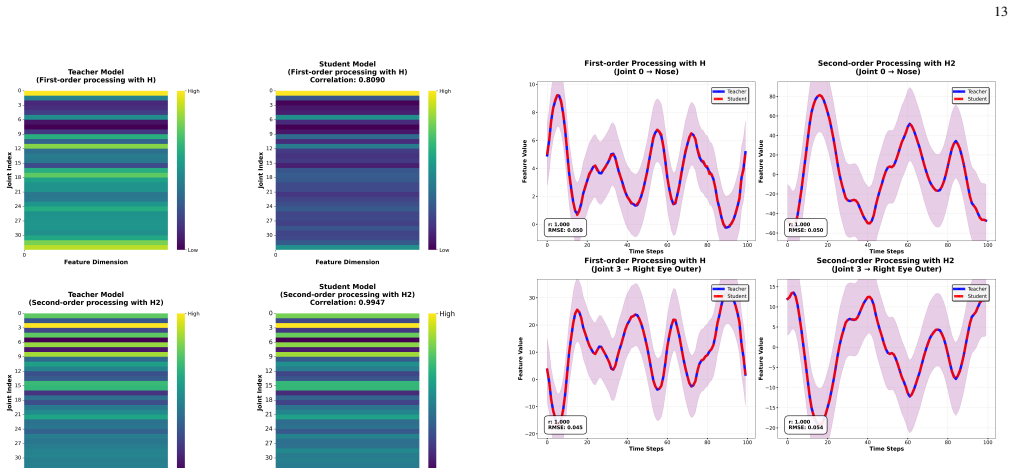
DistillH-Mamba: dual-pathway Hypergraph-Mamba blocks (first-order incidence matrix H plus second-order H2 = HHT) whose selective state-space kernels are guided by hyperedge attention, compressed by a relational knowledge-distillation loss that matches both hypergraph features and their temporal differences between teacher and student.
What would settle it
Retrain and re-evaluate the same student architecture on a large corpus of real, annotated elderly falls recorded in homes or care facilities; if impact-frame accuracy drops substantially below the 97% range or specificity collapses, the central transfer claim fails.
Extended reading notes
Core claim
The authors show that combining dual-order hypergraph joint relations with Mamba state-space temporal modeling, then transferring those relations via spatial and temporal distillation losses, yields a compact student network that both surpasses its teacher on impact-frame detection accuracy and reduces inference latency by nearly three-quarters on the evaluated skeleton fall datasets.
Load-bearing premise
Impact labels and MediaPipe skeletons taken from simulated falls by young adults are assumed to be representative enough of real elderly falls for the reported accuracy and transfer numbers to hold in naturalistic settings.
Editorial extensions
If this is right
- Impact-frame timestamps become available as an additional clinical signal for fall-severity triage and automated alert systems.
- The distilled student (roughly 23 M parameters, 93 MB footprint) fits on typical edge and wearable platforms used in continuous elderly monitoring.
- Relational distillation that preserves hypergraph structure can be reused for other skeleton tasks that need both multi-joint coordination and low latency.
- Cross-dataset transfer without fine-tuning already exceeds several methods trained on the target set, suggesting the dual-order representation generalizes across recording conditions.
Reading between the lines
- If real-world elderly validation succeeds, the same dual-order hypergraph + Mamba recipe could be applied to other abrupt multi-joint events such as slips or seizures.
- The fact that the student can outperform the teacher under relational losses implies that structural regularization may be more valuable than raw capacity for short, high-signal impact events.
- Label noise visible in public fall folders (non-fall clips inside fall sequences) may be mitigated by the hypergraph's ability to require coordinated multi-joint signatures rather than single-joint thresholds.
Editorial analysis
A structured set of objections, weighed in public.
Referee Report
Summary. The paper proposes DistillH-Mamba for detecting the precise ground-impact frame within fall sequences from 3D skeletal data. It combines a dual-order hypergraph representation of multi-joint anatomical/functional relations, Mamba-style selective state-space blocks (HyperS4Kernel + HyperSSM) for linear-complexity temporal modeling, multi-scale temporal convolutions, and relational knowledge distillation (spatial + temporal Frobenius losses on first- and second-order hypergraph features) that compresses a teacher into a lighter student. On the authors’ 3D Skeletons UP-Fall set the student reports 97.38% accuracy / 97.51% F1 with 73.8% lower inference time than the teacher; cross-dataset and self-recorded checks are also provided, and ablations (Tables I, V, VI) isolate the contribution of each component.
Significance. If the numbers hold under realistic conditions, the work supplies a concrete, deployable pipeline that simultaneously (i) targets the clinically more useful impact instant rather than whole-sequence fall classification and (ii) reduces compute enough for edge devices. The dual-order hypergraph + Mamba design and the explicit spatial/temporal relational distillation losses are clear technical contributions relative to standard ST-GCN or vanilla KD baselines; the efficiency table (parameters, FLOPs, memory, latency) and the multi-scale TCN ablation are useful for practitioners. The main caveat is that all quantitative claims rest on acted young-adult falls and MediaPipe skeletons, so clinical transfer remains unproven.
major comments (3)
- Section IV.A and Conclusion: every headline metric (97.38% accuracy, 73.8% latency cut, cross-dataset 94%) is measured on MediaPipe 33-joint skeletons extracted from young-adult acted falls (UP-Fall 3D Skeletons, UMAFall, 300-frame self-recording). Table X already shows a drop to 91.33% accuracy / 88.20% specificity on the authors’ own uncontrolled sequence. Because impact is defined as the precise ground-contact frame, systematic differences in contact dynamics, frailty, or MediaPipe noise between young acted falls and real elderly falls would inflate both absolute numbers and transfer claims. The domain gap is acknowledged but not quantified; without at least a sensitivity study (e.g., added joint noise, speed scaling, or a small real-elderly pilot) the central claim of real-world impact-detection performance cannot be accepted at face value.
- Section III.E / Table VI: the student (23 M params) exceeds the teacher (70 M) on every metric, most dramatically specificity (99.73% vs 92.14%). The text offers the usual regularization / structural-transfer explanations, yet no confidence intervals, multiple random seeds, or statistical test is reported, and the impact labels themselves are never independently verified. Given that the student > teacher gap is load-bearing for the claim that RKD both compresses and improves, the result needs either error bars or an explicit analysis of label noise / over-fitting before it can be treated as robust.
- Section III.B / Fig. 2: the dual-order hypergraph is presented as the key modeling innovation, yet the concrete hyperedge set (anatomical groups) is only illustrated by three examples and never listed or ablated. Because the free parameters of the method include these hyperedge definitions, and because the first-order-only vs second-order-only rows of Table V already differ by ~0.3 points, a short sensitivity experiment (or at least a complete enumeration of the hyperedges used) is required to show that the reported gains are not an artifact of a particular hand-crafted topology.
minor comments (5)
- Abstract and Table VII: several competing methods are marked as lacking impact detection; the comparison would be clearer if the authors also reported whole-sequence fall accuracy of DistillH-Mamba so that numbers are apples-to-apples.
- Eqs. (14)–(16): the distillation weights α, λ_spatial, λ_temporal are free parameters; their chosen values (or a short grid-search note) should be stated for reproducibility.
- Fig. 1 caption and surrounding text: the claim of “incoherent labelling” in UP-Fall is important for motivation; a quantitative estimate of label noise would strengthen the argument.
- Notation: H_norm is called both “normalized hypergraph Laplacian” and “normalized incidence matrix”; a single consistent term would avoid confusion.
- Table XI: STGCN FLOPs and latency appear higher than expected for a re-implementation; confirming the exact configuration (batch size, sequence length) would help readers interpret the efficiency gains.
Circularity Check
No circularity: purely empirical architecture + held-out evaluation; performance metrics are measured, not derived by construction from inputs.
full rationale
DistillH-Mamba is an empirical deep-learning paper whose central claims (97.38 % impact accuracy, 73.8 % inference-time reduction, outperformance of SOTA) are obtained by training a dual-pathway Hypergraph-Mamba teacher, distilling it via explicit spatial/temporal relational losses (Eqs. 14–16) into a lighter student, and measuring accuracy/F1/specificity/FLOPs/inference time on held-out splits of the 3D Skeletons UP-Fall and UMAFall datasets plus a small self-recorded set. The hypergraph incidence matrices H and H2, the selective SSM kernels, the multi-scale TCN kernels, and the RKD objectives are design choices whose utility is demonstrated by ablation (Tables V–VI) rather than by algebraic identity with the reported metrics. Self-citations ([20], [28]) introduce the authors’ prior accelerometer work and their own MediaPipe-extracted skeleton dataset; neither citation supplies a uniqueness theorem, a fitted parameter that is later re-labeled a prediction, nor a definition that forces the accuracy numbers. The student occasionally exceeds the teacher—an acknowledged regularization effect of relational distillation—yet this is an empirical observation, not a tautology. Consequently the derivation chain contains no self-definitional step, no fitted-input-called-prediction, and no load-bearing self-citation circularity.
Assumptions & free parameters
free parameters (4)
- distillation weight alpha and lambdas (spatial/temporal)
- Mamba d_state sizes (teacher 128/64, student 64/32)
- temporal kernel sizes {9,15,20}
- hyperedge definitions for anatomical groups
assumptions (3)
- domain assumption MediaPipe 3-D joint estimates are accurate enough proxies for true skeletal kinematics during falls
- domain assumption Simulated falls by young adults on mattresses produce impact dynamics transferable to real elderly falls
- ad hoc to paper Higher-order hyperedges capture the biomechanically relevant multi-joint coordination at impact better than pairwise graphs
invented entities (2)
-
HyperS4Kernel + HyperSSM dual-order blocks
-
spatial and temporal relational distillation losses (Eqs. 14-15)
Cite this review
Pith. "Pith review of DistillH-Mamba: A Hypergraph-Mamba-Based Knowledge Distillation Model for Efficient Impact Fall Detection." pith.science (2026). https://pith.science/paper/MFM6MOXV
@misc{pith2026260703156,
  author       = {Pith},
  title        = {Pith review of: DistillH-Mamba: A Hypergraph-Mamba-Based Knowledge Distillation Model for Efficient Impact Fall Detection},
  year         = {2026},
  howpublished = {\url{https://pith.science/paper/MFM6MOXV}},
  note         = {Machine review of arXiv:2607.03156}
}
read the original abstract
Falls among the elderly represent a significant public health concern due to their prevalence, consequences, and societal burden. While deep learning has improved fall detection, accurately identifying impact moments (when an individual hits the ground) remains challenging. Additionally, current algorithms often rely on complex models with high computational demands, limiting real-time deployment feasibility. In this work, we propose DistillH-Mamba, a novel architecture for impact fall detection that addresses these challenges through three key innovations: First, we introduce a hypergraph-based approach that captures higher-order relationships between multiple joints simultaneously, enabling more accurate modeling of complex interactions during impact falls. Second, we integrate the Mamba architecture with hypergraphs for impact detection, significantly accelerating processing speed while efficiently capturing both long-term dependencies and sudden skeletal motion changes. Third, we employ relational knowledge distillation that preserves crucial spatial-temporal relationships while reducing computational demands for real-time impact fall detection. Evaluated on the 3D Skeletons UP-Fall and UMAFall datasets, our DistillH-Mamba model achieves 97.38% accuracy in detecting impact within fall events and 73.8% reduction in inference time compared to its teacher model, outperforming state-of-the-art methods in both precision and efficiency.
Figures


Figures from the paper (4 more)


Reference graph
Works this paper leans on
-
[1]
Fall-induced injuries and deaths among older adults,
P. Kannus, J. Parkkari, S. Koskinen, S. Niemi, M. Palvanen, M. J ¨arvinen, and I. Vuori, “Fall-induced injuries and deaths among older adults,” Jama, vol. 281, no. 20, pp. 1895–1899, 1999
1999
-
[2]
Up-fall detection dataset: A multimodal approach,
L. Mart ´ınez-Villase˜nor, H. Ponce, J. Brieva, E. Moya-Albor, J. N ´u˜nez- Mart´ınez, and C. Pe ˜nafort-Asturiano, “Up-fall detection dataset: A multimodal approach,”Sensors, vol. 19, no. 9, p. 1988, 2019
1988
-
[3]
Fusion of machine learning and threshold-based approaches for fall detection in healthcare using inertial sensors
Y . Wang, P. A. Sarvari, and D. Khadraoui, “Fusion of machine learning and threshold-based approaches for fall detection in healthcare using inertial sensors.” inBIOSTEC (1), 2024, pp. 573–582
2024
-
[4]
Research of fall detection and fall prevention technologies: A systematic review,
L. Ren and Y . Peng, “Research of fall detection and fall prevention technologies: A systematic review,”IEEE Access, vol. 7, pp. 77 702– 77 722, 2019
2019
-
[5]
Real-time fall detection using uncalibrated fisheye cameras,
K. N. Kottari, K. K. Delibasis, and I. G. Maglogiannis, “Real-time fall detection using uncalibrated fisheye cameras,”IEEE transactions on cognitive and developmental systems, vol. 12, no. 3, pp. 588–600, 2019
2019
-
[6]
Fall detection based on key points of human-skeleton using openpose,
W. Chen, Z. Jiang, H. Guo, and X. Ni, “Fall detection based on key points of human-skeleton using openpose,”Symmetry, vol. 12, no. 5, p. 744, 2020
2020
-
[7]
Image segmentation based on community detection approach,
Y . Mourchid, M. El Hassouni, and H. Cherif, “Image segmentation based on community detection approach,”International Journal of Computer Information Systems and Industrial Management Applications, vol. 8, pp. 10–10, 2016
2016
-
[8]
Graph neural networks: A review of methods and applications,
J. Zhou, G. Cui, S. Hu, Z. Zhang, C. Yang, Z. Liu, L. Wang, C. Li, and M. Sun, “Graph neural networks: A review of methods and applications,” AI open, vol. 1, pp. 57–81, 2020
2020
Show all 43 references
-
[9]
Connectivity in hypergraphs,
M. Dewar, D. Pike, and J. Proos, “Connectivity in hypergraphs,” Canadian Mathematical Bulletin, vol. 61, no. 2, pp. 252–271, 2018
2018
-
[10]
Transformer-based fall detection in videos,
A. N ´u˜nez-Marcos and I. Arganda-Carreras, “Transformer-based fall detection in videos,”Engineering Applications of Artificial Intelligence, vol. 132, p. 107937, 2024
2024
-
[11]
Deep learning on spatiotemporal graphs: a systematic review, methodological landscape, and research opportunities,
A. Zeghina, A. Leborgne, F. Le Ber, and A. Vacavant, “Deep learning on spatiotemporal graphs: a systematic review, methodological landscape, and research opportunities,”Neurocomputing, p. 127861, 2024
2024
-
[12]
A review of transformer-based models for computer vision tasks: Capturing global context and spatial relation- ships,
G. A. Pereira and M. Hussain, “A review of transformer-based models for computer vision tasks: Capturing global context and spatial relation- ships,”arXiv preprint arXiv:2408.15178, 2024
2024 arXiv
-
[13]
A survey of mamba,
H. Qu, L. Ning, R. An, W. Fan, T. Derr, H. Liu, X. Xu, and Q. Li, “A survey of mamba,”arXiv preprint arXiv:2408.01129, 2024
2024 arXiv
-
[14]
A survey on knowledge distillation: Recent advancements,
A. Moslemi, A. Briskina, Z. Dang, and J. Li, “A survey on knowledge distillation: Recent advancements,”Machine Learning with Applications, p. 100605, 2024
2024
-
[15]
Learning spatial-preserved skeleton representations for few- shot action recognition,
N. Ma, H. Zhang, X. Li, S. Zhou, Z. Zhang, J. Wen, H. Li, J. Gu, and J. Bu, “Learning spatial-preserved skeleton representations for few- shot action recognition,” inEuropean Conference on Computer Vision. Springer, 2022, pp. 174–191
2022
-
[16]
Joint temporal pooling for improving skeleton-based action recognition,
S. R. Gunasekara, W. Li, J. Yang, and P. Ogunbona, “Joint temporal pooling for improving skeleton-based action recognition,” in2023 In- ternational Conference on Digital Image Computing: Techniques and Applications (DICTA). IEEE, 2023, pp. 403–410
2023
-
[17]
Relational knowledge distilla- tion,
W. Park, D. Kim, Y . Lu, and M. Cho, “Relational knowledge distilla- tion,” inProceedings of the IEEE/CVF conference on computer vision and pattern recognition, 2019, pp. 3967–3976
2019
-
[18]
Sensor-based fall detection systems: a review,
S. Nooruddin, M. M. Islam, F. A. Sharna, H. Alhetari, and M. N. Kabir, “Sensor-based fall detection systems: a review,”Journal of Ambient Intelligence and Humanized Computing, vol. 13, no. 5, pp. 2735–2751, 2022
2022
-
[19]
Fall detec- tion using machine learning algorithms,
P. Vallabh, R. Malekian, N. Ye, and D. C. Bogatinoska, “Fall detec- tion using machine learning algorithms,” in2016 24th international conference on software, telecommunications and computer networks (SoftCOM). IEEE, 2016, pp. 1–9
2016
-
[20]
Machine learning and feature ranking for impact fall detection event using multisensor data,
T. Y . Koffi, Y . Mourchid, M. Hindawi, and Y . Dupuis, “Machine learning and feature ranking for impact fall detection event using multisensor data,” in2023 IEEE 25th International Workshop on Multimedia Signal Processing (MMSP). IEEE, 2023, pp. 1–6
2023
-
[21]
Deep learning for vision-based fall detection system: Enhanced optical dynamic flow,
S. Chhetri, A. Alsadoon, T. Al-Dala’in, P. Prasad, T. A. Rashid, and A. Maag, “Deep learning for vision-based fall detection system: Enhanced optical dynamic flow,”Computational Intelligence, vol. 37, no. 1, pp. 578–595, 2021
2021
-
[22]
A vision-based approach for fall detection using multiple cameras and convolutional neural networks: A case study using the up-fall detection dataset,
R. Espinosa, H. Ponce, S. Guti ´errez, L. Mart ´ınez-Villase˜nor, J. Brieva, and E. Moya-Albor, “A vision-based approach for fall detection using multiple cameras and convolutional neural networks: A case study using the up-fall detection dataset,”Computers in biology and medi...
2019
-
[23]
Fall detection with cnn-casual lstm network,
J. Wu, J. Wang, A. Zhan, and C. Wu, “Fall detection with cnn-casual lstm network,”Information, vol. 12, no. 10, p. 403, 2021
2021
-
[24]
Skeleton-based fall detection using spatial temporal graph convolutional networks with learnable edges,
A. Liang, “Skeleton-based fall detection using spatial temporal graph convolutional networks with learnable edges,” 2024
2024
-
[25]
Self-knowledge distillation: an efficient approach for falling detection,
Q. V . Duc, T. Phung, M. Nguyen, B. Y . Nguyen, and T. H. Nguyen, “Self-knowledge distillation: an efficient approach for falling detection,” inInternational Conference on Artificial Intelligence and Big Data in Digital Era. Springer, 2021, pp. 369–380
2021
-
[26]
Prefallkd: Pre-impact fall detection via cnn-vit knowledge distillation,
T.-H. Chi, K.-C. Liu, C.-Y . Hsieh, Y . Tsao, and C.-T. Chan, “Prefallkd: Pre-impact fall detection via cnn-vit knowledge distillation,” inICASSP 2023-2023 IEEE International Conference on Acoustics, Speech and Signal Processing (ICASSP). IEEE, 2023, pp. 1–5
2023
-
[27]
When object detection meets knowledge distillation: A survey,
Z. Li, P. Xu, X. Chang, L. Yang, Y . Zhang, L. Yao, and X. Chen, “When object detection meets knowledge distillation: A survey,”IEEE Transactions on Pattern Analysis and Machine Intelligence, vol. 45, no. 8, pp. 10 555–10 579, 2023
2023
-
[28]
An improved 3d skeletons up-fall dataset: enhancing data quality for efficient impact fall detection,
T. Y . Koffi, Y . Mourchid, M. Hindawi, and Y . Dupuis, “An improved 3d skeletons up-fall dataset: enhancing data quality for efficient impact fall detection,” inSeventeenth International Conference on Machine Vision (ICMV 2024), vol. 13517. SPIE, 2025, pp. 215–222
2024
-
[29]
Umafall: A multisensor dataset for the research on automatic fall detection,
E. Casilari, J. A. Santoyo-Ram ´on, and J. M. Cano-Garc ´ıa, “Umafall: A multisensor dataset for the research on automatic fall detection,” Procedia Computer Science, vol. 110, pp. 32–39, 2017
2017
-
[30]
Multi-camera, multi-person, and real-time fall detection using long short term mem- ory,
M. Taufeeque, S. Koita, N. Spicher, and T. M. Deserno, “Multi-camera, multi-person, and real-time fall detection using long short term mem- ory,” inMedical Imaging 2021: Imaging Informatics for Healthcare, Research, and Applications, vol. 11601. SPIE, 2021, pp. 35–42
2021
-
[31]
A multimodal approach using deep learning for fall detection,
Y . M. Galv ˜ao, J. Ferreira, V . A. Albuquerque, P. Barros, and B. J. Fer- nandes, “A multimodal approach using deep learning for fall detection,” Expert Systems with Applications, vol. 168, p. 114226, 2021
2021
-
[32]
Sdfa: Structure-aware discrim- inative feature aggregation for efficient human fall detection in video,
S. Zahan, G. M. Hassan, and A. Mian, “Sdfa: Structure-aware discrim- inative feature aggregation for efficient human fall detection in video,” IEEE Transactions on Industrial Informatics, vol. 19, no. 8, pp. 8713– 8721, 2022
2022
-
[33]
Skeleton-based fall detection with multiple inertial sensors using spatial-temporal graph convolutional networks,
J. Yan, X. Wang, J. Shi, and S. Hu, “Skeleton-based fall detection with multiple inertial sensors using spatial-temporal graph convolutional networks,”Sensors, vol. 23, no. 4, p. 2153, 2023
2023
-
[34]
Bert for activity recognition using sequences of skeleton features and data augmentation with gan,
H. Ramirez, S. A. Velastin, S. Cuellar, E. Fabregas, and G. Farias, “Bert for activity recognition using sequences of skeleton features and data augmentation with gan,”Sensors, vol. 23, no. 3, p. 1400, 2023
2023
-
[35]
Multimodal spatiotemporal skeletal kinematic gait feature fusion for vision-based fall detection,
M. Amsaprabhaaet al., “Multimodal spatiotemporal skeletal kinematic gait feature fusion for vision-based fall detection,”Expert Systems with Applications, vol. 212, p. 118681, 2023
2023
-
[36]
Fl-fd: Federated learning-based fall detection with multimodal data fusion,
P. Qi, D. Chiaro, and F. Piccialli, “Fl-fd: Federated learning-based fall detection with multimodal data fusion,”Information fusion, vol. 99, p. 101890, 2023
2023
-
[37]
A novel vision-based fall detection scheme using keypoints of human skeleton with long short- term memory network,
A. R. Inturi, V . Manikandan, and V . Garrapally, “A novel vision-based fall detection scheme using keypoints of human skeleton with long short- term memory network,”Arabian Journal for Science and Engineering, vol. 48, no. 2, pp. 1143–1155, 2023
2023
-
[38]
Fall detection method based on spatio-temporal coordinate attention for high-resolution networks,
X. Zhang, Q. Xie, W. Sun, and T. Wang, “Fall detection method based on spatio-temporal coordinate attention for high-resolution networks,” Complex & Intelligent Systems, vol. 11, no. 1, p. 1, 2025
2025
-
[39]
Xai-fall: Explainable ai for fall de- tection on wearable devices using sequence models and xai techniques,
H. Mankodiya, D. Jadav, R. Gupta, S. Tanwar, A. Alharbi, A. Tolba, B.-C. Neagu, and M. S. Raboaca, “Xai-fall: Explainable ai for fall de- tection on wearable devices using sequence models and xai techniques,” Mathematics, vol. 10, no. 12, p. 1990, 2022
1990
-
[40]
Fallnext: A deep residual model based on multi-branch aggregation for sensor-based fall detec- tion,
S. Mekruksavanich and A. Jitpattanakul, “Fallnext: A deep residual model based on multi-branch aggregation for sensor-based fall detec- tion,”ECTI Transactions on Computer and Information Technology (ECTI-CIT), vol. 16, no. 4, pp. 352–364, 2022
2022
-
[41]
Vision-based fall detection using st-gcn,
O. Keskes and R. Noumeir, “Vision-based fall detection using st-gcn,” IEEE Access, vol. 9, pp. 28 224–28 236, 2021
2021
-
[42]
Smartphones and attention, curse or blessing?-a review on the effects of smartphone usage on attention, inhibition, and working memory,
M. Liebherr, P. Schubert, S. Antons, C. Montag, and M. Brand, “Smartphones and attention, curse or blessing?-a review on the effects of smartphone usage on attention, inhibition, and working memory,” Computers in Human Behavior Reports, vol. 1, p. 100005, 2020
2020
-
[43]
Performance evaluation of raspberry pi 4 and stm32 nucleo boards for security- related operations in iot environments,
K. Rzepka, P. Szary, K. Cabaj, and W. Mazurczyk, “Performance evaluation of raspberry pi 4 and stm32 nucleo boards for security- related operations in iot environments,”Computer Networks, vol. 242, p. 110252, 2024
2024
Reviewed July 12, 2026 · model on record in the stance chip above.
Discussion (0). Sign in to comment.