REVIEW 3 major objections 5 minor 47 references
Neural Spline Operators for Risk Quantification in Stochastic Systems
T0 review · 3 major / 5 minor · reviewed 2026-08-15 · deepseek-v4-flash
Pith's one-line read Neural Spline Operators learn direct maps from dynamics functions to safety probabilities, with a universal approximation guarantee.
desk verdict A genuinely new architecture with decent empirical results, but the universal approximation theorem as written is not proven. read the letter →
The pith
A machine-rendered reading of the paper's core claim, the machinery that carries it, and where it could break.
The reading
What carries the argument
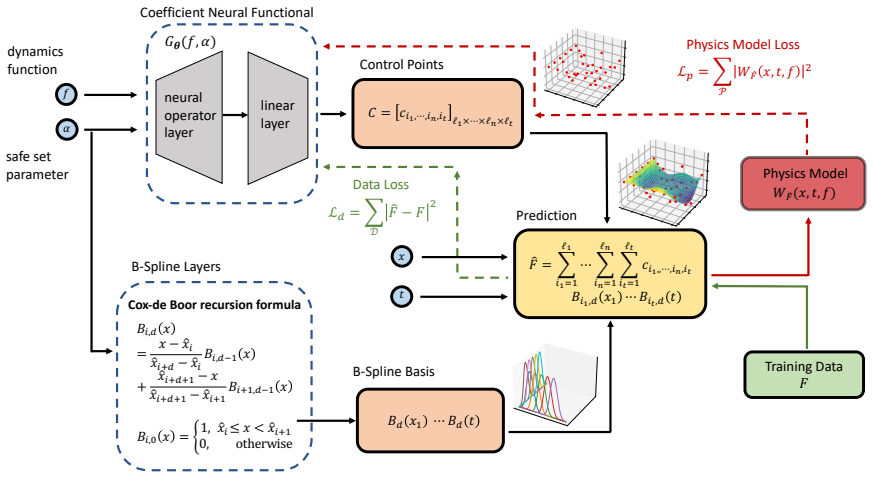
The load-bearing object is the B-spline basis paired with learned control points. The safety probability is represented as $\hat F(x,t)=C\cdot B_{\ell,d}(x,t)$, where $C$ is a control-point tensor produced by a coefficient neural functional $G_\theta(f,\alpha)$ and $B_{\ell,d}$ is a tensor product of univariate B-spline bases in each state coordinate and in time. Two structural facts do the work: B-splines have closed-form derivatives, so the convection-diffusion residual can be formed without automatic differentiation, and the boundary control points of the tensor directly encode the initial condition and Dirichlet boundary conditions, so those constraints are enforced exactly rather than learned. The proof combines universal approximation of the neural operator layer with the fact that orthogonal projection onto the B-spline subspace is a bounded linear map that a feedforward network can reproduce.
What would settle it
Run a numerical experiment along a family of smooth dynamics functions that converge uniformly to a limit with a sharp drift change; compute the safety probability for each member with a high-accuracy PDE or sampling solver and check whether the probabilities converge. If they do not converge despite uniform convergence of the dynamics, the continuity premise behind the theorem fails, and NeSO would lose its guarantee on that family.
Extended reading notes
Core claim
On its own terms, the paper's discovery is that the risk-quantification problem can be reorganized as an operator learning problem: instead of re-solving the convection-diffusion equation for each dynamics function, a network learns the mapping $(f,\alpha)\mapsto F$. The network output is a tensor of B-spline control points; multiplying this tensor by the B-spline basis functions produces the predicted safety probability surface. B-spline derivatives are available in closed form, so the physics-based residual is cheap to evaluate, and the endpoint control points can be set by hand to satisfy initial and Dirichlet boundary conditions exactly. Theorem 1 asserts that for any accuracy $\varepsilon>0$ there exist B-spline counts and orders and network parameters $\theta$ such that $|F(x,t)-G_\theta(f,\alpha)(x,t)|\le\varepsilon$ uniformly over $f$, $\alpha$, $x$, and $t$, assuming the map from dynamics and safe sets to safety probabilities is continuous.
Load-bearing premise
The proof assumes that small changes in the dynamics function and safe-set parameters produce small changes in the safety probability; if that map has a jump, the universal approximation guarantee no longer applies.
Editorial extensions
If this is right
- A single trained NeSO can evaluate safety probabilities for new, unseen dynamics functions in milliseconds, replacing repeated sampling or PDE solves with one forward pass.
- Because it accepts a function as input, NeSO covers dynamics families whose functional form changes, rather than only parameterized variants of a fixed form.
- Assigning initial and boundary conditions through B-spline control points removes the need for additional penalty terms that enforce those constraints during training.
- The universal approximation theorem transfers to other PDE-constrained operator learning problems whose solution depends continuously on an input function.
- In the multi-agent case, factorizing the full safety probability into sub-system probabilities lets NeSO reconstruct a 14-dimensional safety landscape from low-dimensional solves.
Reading between the lines
- A stress test would push NeSO toward dynamics families that approach a discontinuous limit; the error behavior there would reveal whether the continuity assumption, not the architecture, is the operative bottleneck.
- If the B-spline control-point trick is as generic as the proof suggests, the same construction could be applied to other PDE-constrained operators, fixing boundary conditions in the representation rather than through penalty terms.
- The product-form reconstruction in the multi-agent study inherits an exact modal decoupling assumption; for non-symmetric or time-varying interaction graphs that factorization breaks, and NeSO would need a different decomposition to keep working.
- The reported speed comparisons include training time for NeSO; a fair deployment comparison would amortize training across the number of query systems, which the paper's own cost formula starts to do.
Signed reviews
Editorial analysis
A structured set of objections, weighed in public.
Referee Report
Summary. The paper proposes Neural Spline Operators (NeSO), a physics-informed neural operator framework for estimating long-term safety probabilities of stochastic systems with varying functional dynamics. The safety probability is characterized as the solution of a convection-diffusion PDE, and NeSO maps the dynamics function f and safe-set parameter α to B-spline control points through a coefficient neural functional; the control points are multiplied by B-spline bases to produce the safety probability field. A universal approximation theorem (Theorem 1, Eq. (19)) is claimed. Two case studies are presented: a one-dimensional recovery-probability problem with randomly parameterized sinusoidal dynamics, and a 14-dimensional multi-agent mass-spring-damper system whose safety probability is reconstructed as a product of per-mode probabilities. The reported results show that NeSO improves accuracy and training time over FNO in the first case and achieves substantial online speedups over Monte Carlo and PDE solvers in the second.
Significance. If the universal approximation theorem were established as stated, the paper would be a meaningful step: it would be the first physics-informed operator learning method for risk quantification, with a B-spline output representation that enforces initial and boundary conditions and enables analytical derivatives. The experimental comparison is useful, the code is provided, and the online speedup claim is concrete. However, the theorem as written is not proven: the proof contains a category error in the approximation of the coefficient map, an unjustified uniformity over noncompact α∈R^ξ, and a false statement about orthogonality of B-splines. These are load-bearing because they support Eq. (19), the paper's central theoretical guarantee. The experimental claims are not deeply affected by these proof gaps, but the advertised guarantee currently exceeds what the proof establishes.
major comments (3)
- [Appendix A, proof of Theorem 1, Eq. (61)] The proof invokes the MLP universal approximation theorem [47] to assert that the coefficient map C*(·): Y→R^N can be approximated by a neural network, but [47] applies to continuous functions on finite-dimensional Euclidean spaces. Here Y=H^k(Ω2;R) is infinite-dimensional, and the proposed coefficient neural functional receives h=(f,α), not the function gh=W(h) on which C* is evaluated. No argument shows that the composition h↦C*(W(h)) is approximable by a neural operator layer followed by a linear layer. Since this step is used to bound the term ∥C*(gh)-Ĉ*(ĝh)∥ in Eq. (62), the proof does not establish the advertised universal approximation in Eq. (19).
- [Section V, Theorem 1 and Appendix A, Eq. (41)] The theorem quantifies uniformly over all α∈R^ξ and over f in a class that is not made precise, whereas the FNO universal approximation theorem [43] used in Eq. (41) requires the input set to be compact and the operator W to be continuous on that set. The manuscript only assumes that K1 and K2 are subsets of Sobolev spaces and states in footnote 2 that continuity 'holds with regularity conditions,' without stating those conditions. To make Eq. (19) follow from [43], the statement must restrict (f,α) to a compact product set K1×K2 and state the regularity conditions under which (f,α)↦F is continuous.
- [Appendix A, footnote 4 and Eqs. (42)-(47)] The footnote claims that B-spline basis functions are orthogonal to each other; this is false. B-spline bases are locally supported and linearly independent but not orthogonal in L2, so the asserted invertibility of B_φ 'since φ_j are orthogonal' is not justified. The argument can be repaired by using the positive definiteness of the Gram matrix of a B-spline basis, but as written the proof contains a false mathematical claim at a point used to define the optimal coefficients C*(gh).
minor comments (5)
- [Section I] The word 'inital' in the introduction should be corrected to 'initial.'
- [Section V, Theorem 1] The statement 'for any function f∈F' uses an undefined symbol F; it should be f∈K1 or another explicitly defined class, and the notation should be made consistent with the earlier assumption f∈K1⊂C(Ω1;R^n).
- [Section IV, Eq. (14)] The PDE residual uses d/dx and d^2/dx^2 notation for a vector state x; this should be written with ∇_x and trace(σσ^T ∇_x^2 F) so that the residual is well-defined for n>1 as well as for the scalar case.
- [Section VI-A, Eqs. (21) and (25)] The dynamics function in Eq. (21) depends only on t, while the problem formulation in Eq. (1) allows x-dependence; the paper should state explicitly that this case study uses time-dependent dynamics, so that S(τ) in Eq. (25) is independent of the state trajectory.
- [Section VI-B, Table II] The reported NeSO online time of 56.47 s should be separated into the network evaluation time and any additional reconstruction overhead, and the 3999 s training time should be clearly labeled as offline, since the advertised speedup depends on this offline/online split.
Circularity Check
No significant circularity: the universal approximation claim is supported by external approximation theorems, not by fitting or by self-defined targets.
full rationale
The paper's central claim, Theorem 1, is an approximation guarantee for the NeSO architecture. Its proof in Appendix A reduces the problem to two external ingredients: the universal approximation theorem for neural operators (FNO/DeepONet, cited as [43] and [27]) and the classical approximation power of B-spline bases. The proof then uses a projection argument to convert a neural-operator approximation of the input-to-solution map into a spline-coefficient representation. This is a derivation from established results rather than a circular definition. The self-citations in the paper—[3] for the PDE characterization of safety probabilities, [5] for B-spline approximation, and [46] for the modal decomposition in the multi-agent case—are to published or externally checkable results whose assumptions do not include the theorem being proved. The multi-agent prediction is reconstructed from sub-system probabilities using the external factorization of [46, Theorem 1] and is validated against independent Monte Carlo simulation, not against the training target. No parameter is fitted to a subset of data and then renamed as a prediction. The proof does contain gaps that are correctness risks, notably the invocation of the finite-dimensional MLP universal approximation theorem [47] for the infinite-dimensional coefficient map C* : Y -> R^N, and the quantification over noncompact alpha in R^xi. However, those are mathematical-rigor issues, not circularity: they do not make the conclusion equivalent to the inputs by construction. Under the hard rules, proof gaps and nonstandard-consensus concerns are not circularity findings. Therefore an honest non-finding is appropriate, with score 0.
Assumptions & free parameters
free parameters (4)
- Loss weights w_p, w_d, w_ICBC =
w_p=1, w_d=3, w_ICBC=10 in case study VI-A; not specified for VI-B
- B-spline knot count and order =
not reported in text
- FNO architecture hyperparameters =
8 Fourier modes, width 32, 3 spectral layers
- Training configuration =
Adam, lr=0.001, 500 epochs
assumptions (6)
- standard math Universal approximation theorems for neural operators (FNO [43], DeepONet [27]) and MLPs [47]
- domain assumption Continuity of the map (f,α) -> F
- domain assumption Safety probability satisfies convection-diffusion equation (4) with ICBC (5)
- domain assumption Modal decomposition F = Π_k F_k from [46, Theorem 1]
- standard math B-splines are universal approximators
- standard math B-spline Gram matrix is positive definite
Cite this review
Pith. "Pith review of Neural Spline Operators for Risk Quantification in Stochastic Systems." pith.science (2026). https://pith.science/paper/MFNUJKS3
@misc{pith2026250820288,
  author       = {Pith},
  title        = {Pith review of: Neural Spline Operators for Risk Quantification in Stochastic Systems},
  year         = {2026},
  howpublished = {\url{https://pith.science/paper/MFNUJKS3}},
  note         = {Machine review of arXiv:2508.20288}
}
read the original abstract
Accurately quantifying long-term risk probabilities in diverse stochastic systems is essential for safety-critical control. However, existing sampling-based and partial differential equation (PDE)-based methods often struggle to handle complex varying dynamics. Physics-informed neural networks learn surrogate mappings for risk probabilities from varying system parameters of fixed and finite dimensions, yet can not account for functional variations in system dynamics. To address these challenges, we introduce physics-informed neural operator (PINO) methods to risk quantification problems, to learn mappings from varying \textit{functional} system dynamics to corresponding risk probabilities. Specifically, we propose Neural Spline Operators (NeSO), a PINO framework that leverages B-spline representations to improve training efficiency and achieve better initial and boundary condition enforcements, which are crucial for accurate risk quantification. We provide theoretical analysis demonstrating the universal approximation capability of NeSO. We also present two case studies, one with varying functional dynamics and another with high-dimensional multi-agent dynamics, to demonstrate the efficacy of NeSO and its significant online speed-up over existing methods. The proposed framework and the accompanying universal approximation theorem are expected to be beneficial for other control or PDE-related problems beyond risk quantification.
Figures


Reference graph
Works this paper leans on
-
[47]
Multilayer feedforward networks are universal approximators,
K. Hornik, M. Stinchcombe, and H. White, “Multilayer feedforward networks are universal approximators,” Neural networks, vol. 2, no. 5, pp. 359–366, 1989. APPENDIX A. Proof of Theorem 1 Proof. (Theorem 1) We state the general proof of the universal approximation property of neural operators with basis functions, for learning continuous mappings between So...
work page 1989
-
[43]
On universal approximation and error bounds for fourier neural operators,
N. Kovachki, S. Lanthaler, and S. Mishra, “On universal approximation and error bounds for fourier neural operators,” Journal of Machine Learning Research, vol. 22, no. 290, pp. 1–76, 2021
work page 2021
-
[1]
Myopi- cally verifiable probabilistic certificate for long-term safety,
Z. Wang, H. Jing, C. Kurniawan, A. Chern, and Y . Nakahira, “Myopi- cally verifiable probabilistic certificate for long-term safety,” in 2022 American Control Conference (ACC) . IEEE, 2022, pp. 4894–4900
work page 2022
-
[2]
G. Rubino and B. Tuffin, Rare event simulation using Monte Carlo methods. John Wiley & Sons, 2009
work page 2009
-
[3]
Safe control in the presence of stochastic uncertainties,
A. Chern, X. Wang, A. Iyer, and Y . Nakahira, “Safe control in the presence of stochastic uncertainties,” in 2021 60th IEEE Conference on Decision and Control (CDC) . IEEE, 2021, pp. 6640–6645
work page 2021
-
[4]
A generalizable physics-informed learning framework for risk probability estimation,
Z. Wang and Y . Nakahira, “A generalizable physics-informed learning framework for risk probability estimation,” in Learning for Dynamics and Control Conference. PMLR, 2023, pp. 358–370
work page 2023
-
[5]
Physics- informed deep b-spline networks for dynamical systems,
Z. Wang, R. Romagnoli, J. Ratchford, and Y . Nakahira, “Physics- informed deep b-spline networks for dynamical systems,” arXiv preprint arXiv:2503.16777, 2025
arXiv 2025
-
[6]
Neural operator: Learning maps be- tween function spaces with applications to pdes,
N. Kovachki, Z. Li, B. Liu, K. Azizzadenesheli, K. Bhattacharya, A. Stuart, and A. Anandkumar, “Neural operator: Learning maps be- tween function spaces with applications to pdes,” Journal of Machine Learning Research, vol. 24, no. 89, pp. 1–97, 2023
work page 2023
Show all 47 references
-
[7]
Physics-informed neural operator for learning partial differential equations,
Z. Li, H. Zheng, N. Kovachki, D. Jin, H. Chen, B. Liu, K. Aziz- zadenesheli, and A. Anandkumar, “Physics-informed neural operator for learning partial differential equations,” ACM/JMS Journal of Data Science, vol. 1, no. 3, pp. 1–27, 2024
2024
-
[8]
Neural operators for accelerating scientific simulations and design,
K. Azizzadenesheli, N. Kovachki, Z. Li, M. Liu-Schiaffini, J. Kossaifi, and A. Anandkumar, “Neural operators for accelerating scientific simulations and design,” Nature Reviews Physics , vol. 6, no. 5, pp. 320–328, 2024
2024
-
[9]
J. H. Ahlberg, E. N. Nilson, and J. L. Walsh, The Theory of Splines and Their Applications: Mathematics in Science and Engineering: A Series of Monographs and Textbooks, Vol. 38. Elsevier, 2016, vol. 38
2016
-
[10]
Physics-informed neural networks: A deep learning framework for solving forward and inverse problems involving nonlinear partial differential equations,
M. Raissi, P. Perdikaris, and G. E. Karniadakis, “Physics-informed neural networks: A deep learning framework for solving forward and inverse problems involving nonlinear partial differential equations,” Journal of Computational physics , vol. 378, pp. 686–707, 2019
2019
-
[11]
Adaptive safe con- trol for driving in uncertain environments,
S. Gangadhar, Z. Wang, H. Jing, and Y . Nakahira, “Adaptive safe con- trol for driving in uncertain environments,” in 2022 IEEE Intelligent Vehicles Symposium (IV). IEEE, 2022, pp. 1662–1668
2022
-
[12]
3d dynamic walking on stepping stones with control barrier functions,
Q. Nguyen, A. Hereid, J. W. Grizzle, A. D. Ames, and K. Sreenath, “3d dynamic walking on stepping stones with control barrier functions,” in 2016 IEEE 55th Conference on Decision and Control (CDC) . IEEE, 2016, pp. 827–834
2016
-
[13]
Monte-carlo based uncertainty analysis: Sampling effi- ciency and sampling convergence,
H. Janssen, “Monte-carlo based uncertainty analysis: Sampling effi- ciency and sampling convergence,” Reliability Engineering & System Safety, vol. 109, pp. 123–132, 2013
2013
-
[14]
Sequential monte carlo for rare event estimation,
F. C ´erou, P. Del Moral, T. Furon, and A. Guyader, “Sequential monte carlo for rare event estimation,” Statistics and computing , vol. 22, no. 3, pp. 795–808, 2012
2012
-
[15]
Estimation of small failure probabilities in high dimensions by subset simulation,
S.-K. Au and J. L. Beck, “Estimation of small failure probabilities in high dimensions by subset simulation,” Probabilistic engineering mechanics, vol. 16, no. 4, pp. 263–277, 2001
2001
-
[16]
Multilevel monte carlo methods,
M. B. Giles, “Multilevel monte carlo methods,” Acta numerica, vol. 24, pp. 259–328, 2015
2015
-
[17]
Dhatt, E
G. Dhatt, E. Lefranc ¸ois, and G. Touzot, Finite element method. John Wiley & Sons, 2012
2012
-
[18]
Finite volume methods,
R. Eymard, T. Gallou ¨et, and R. Herbin, “Finite volume methods,” Handbook of numerical analysis , vol. 7, pp. 713–1018, 2000
2000
-
[19]
An assessment of solvers for algebraically stabilized discretizations of convection–diffusion– reaction equations,
A. Jha, O. P ´artl, N. Ahmed, and D. Kuzmin, “An assessment of solvers for algebraically stabilized discretizations of convection–diffusion– reaction equations,” Journal of Numerical Mathematics, vol. 31, no. 2, pp. 79–103, 2023
2023
-
[20]
Eliminating gibbs phenomena: A non-linear petrov–galerkin method for the convection– diffusion–reaction equation,
P. Houston, S. Roggendorf, and K. G. van der Zee, “Eliminating gibbs phenomena: A non-linear petrov–galerkin method for the convection– diffusion–reaction equation,” Computers & Mathematics with Appli- cations, vol. 80, no. 5, pp. 851–873, 2020
2020
-
[21]
Four- castnet: A global data-driven high-resolution weather model using adaptive fourier neural operators,
J. Pathak, S. Subramanian, P. Harrington, S. Raja, A. Chattopadhyay, M. Mardani, T. Kurth, D. Hall, Z. Li, K. Azizzadenesheli et al., “Four- castnet: A global data-driven high-resolution weather model using adaptive fourier neural operators,” arXiv preprint arXiv:2202.11214 , 2022
2022 arXiv
-
[22]
Fourier neural operator approach to large eddy simulation of three-dimensional turbulence,
Z. Li, W. Peng, Z. Yuan, and J. Wang, “Fourier neural operator approach to large eddy simulation of three-dimensional turbulence,” Theoretical and Applied Mechanics Letters , vol. 12, no. 6, p. 100389, 2022
2022
-
[23]
Learning the solution operator of parametric partial differential equations with physics-informed deeponets,
S. Wang, H. Wang, and P. Perdikaris, “Learning the solution operator of parametric partial differential equations with physics-informed deeponets,” Science advances, vol. 7, no. 40, p. eabi8605, 2021
2021
-
[24]
Fourier neural operator for parametric partial differential equations,
Z. Li, N. Kovachki, K. Azizzadenesheli, B. Liu, K. Bhattacharya, A. Stuart, and A. Anandkumar, “Fourier neural operator for parametric partial differential equations,” arXiv preprint arXiv:2010.08895, 2020
2010 arXiv
-
[25]
Neural operator: Graph kernel network for partial differential equations,
——, “Neural operator: Graph kernel network for partial differential equations,” arXiv preprint arXiv:2003.03485 , 2020
2003 arXiv
-
[26]
Spectral neural operators,
V . S. Fanaskov and I. V . Oseledets, “Spectral neural operators,” in Doklady Mathematics , vol. 108, no. Suppl 2. Springer, 2023, pp. S226–S232
2023
-
[27]
Deeponet: Learning non- linear operators for identifying differential equations based on the universal approximation theorem of operators,
L. Lu, P. Jin, and G. E. Karniadakis, “Deeponet: Learning non- linear operators for identifying differential equations based on the universal approximation theorem of operators,” arXiv preprint arXiv:1910.03193, 2019
1910 arXiv
-
[28]
Improving physics-informed deeponets with hard constraints,
R. Brecht, D. R. Popovych, A. Bihlo, and R. O. Popovych, “Improving physics-informed deeponets with hard constraints,” arXiv preprint arXiv:2309.07899, 2023
2023 arXiv
-
[29]
Reproducing kernel triangular b-spline-based fem for solving pdes,
Y . Jia, Y . Zhang, G. Xu, X. Zhuang, and T. Rabczuk, “Reproducing kernel triangular b-spline-based fem for solving pdes,” Computer Methods in Applied Mechanics and Engineering , vol. 267, pp. 342– 358, 2013
2013
-
[30]
Variational formulation based on duality to solve partial differential equations: Use of b-splines and machine learning approximants,
N. Sukumar and A. Acharya, “Variational formulation based on duality to solve partial differential equations: Use of b-splines and machine learning approximants,” arXiv preprint arXiv:2412.01232 , 2024
2024 arXiv
-
[31]
Functional networks for b- spline surface reconstruction,
A. Iglesias, G. Echevarr ´ıa, and A. G ´alvez, “Functional networks for b- spline surface reconstruction,” Future Generation Computer Systems , vol. 20, no. 8, pp. 1337–1353, 2004
2004
-
[32]
Modeling nonlinear systems using the tensor network b-spline and the multi-innovation identification the- ory,
Y . Wang, S. Tang, and M. Deng, “Modeling nonlinear systems using the tensor network b-spline and the multi-innovation identification the- ory,” International Journal of Robust and Nonlinear Control , vol. 32, no. 13, pp. 7304–7318, 2022
2022
-
[33]
Dif- ferentiable spline approximations,
M. Cho, A. Balu, A. Joshi, A. Deva Prasad, B. Khara, S. Sarkar, B. Ganapathysubramanian, A. Krishnamurthy, and C. Hegde, “Dif- ferentiable spline approximations,” Advances in neural information processing systems, vol. 34, pp. 20 270–20 282, 2021
2021
-
[34]
Learning feedforward control using a dilated b-spline network: Frequency domain analysis and design,
Y . Chen, K. L. Moore, and V . Bahl, “Learning feedforward control using a dilated b-spline network: Frequency domain analysis and design,” IEEE Transactions on neural networks , vol. 15, no. 2, pp. 355–366, 2004
2004
-
[35]
Building hybrid b- spline and neural network operators,
R. Romagnoli, J. Ratchford, and M. H. Klein, “Building hybrid b- spline and neural network operators,” in 2024 IEEE 63rd Conference on Decision and Control (CDC) . IEEE, 2024, pp. 3611–3617
2024
-
[36]
Deep neural networks for smooth approximation of physics with higher order and continuity b-spline base functions,
K. Doległo, A. Paszy ´nska, M. Paszy ´nski, and L. Demkowicz, “Deep neural networks for smooth approximation of physics with higher order and continuity b-spline base functions,” arXiv preprint arXiv:2201.00904, 2022
2022 arXiv
-
[37]
A best-fitting b-spline neural network approach to the prediction of advection– diffusion physical fields with absorption and source terms,
X. Zhu, J. Liu, X. Ao, S. He, L. Tao, and F. Gao, “A best-fitting b-spline neural network approach to the prediction of advection– diffusion physical fields with absorption and source terms,” Entropy, vol. 26, no. 7, p. 577, 2024
2024
-
[38]
Multipole graph neural operator for parametric partial differential equations,
Z. Li, N. Kovachki, K. Azizzadenesheli, B. Liu, A. Stuart, K. Bhat- tacharya, and A. Anandkumar, “Multipole graph neural operator for parametric partial differential equations,” Advances in Neural Infor- mation Processing Systems , vol. 33, pp. 6755–6766, 2020
2020
-
[39]
U-no: U-shaped neural operators,
M. A. Rahman, Z. E. Ross, and K. Azizzadenesheli, “U-no: U-shaped neural operators,” arXiv preprint arXiv:2204.11127 , 2022
2022 arXiv
-
[40]
Seismic wave propagation and inversion with neural operators,
Y . Yang, A. F. Gao, J. C. Castellanos, Z. E. Ross, K. Azizzadenesheli, and R. W. Clayton, “Seismic wave propagation and inversion with neural operators,” The Seismic Record , vol. 1, no. 3, pp. 126–134, 2021
2021
-
[41]
Broadband ground-motion synthesis via generative adver- sarial neural operators: Development and validation,
Y . Shi, G. Lavrentiadis, D. Asimaki, Z. E. Ross, and K. Azizzade- nesheli, “Broadband ground-motion synthesis via generative adver- sarial neural operators: Development and validation,” Bulletin of the Seismological Society of America , vol. 114, no. 4, pp. 2151–2171, 2024
2024
-
[42]
The computation of all the derivatives of a b-spline basis,
K. R. Butterfield, “The computation of all the derivatives of a b-spline basis,” IMA Journal of Applied Mathematics, vol. 17, no. 1, pp. 15–25, 1976
1976
-
[44]
L. C. Evans, Partial differential equations. American mathematical society, 2022, vol. 19
2022
-
[45]
N. V . Krylov, Lectures on elliptic and parabolic equations in H ¨older spaces. American Mathematical Soc., 1996, vol. 12
1996
-
[46]
Orthogonal modal representa- tion in long-term risk quantification for dynamic multi-agent systems,
R. Yasunaga, Y . Nakahira, and Y . Hori, “Orthogonal modal representa- tion in long-term risk quantification for dynamic multi-agent systems,” IEEE Control Systems Letters , 2024
2024
Reviewed August 15, 2026 · model on record in the stance chip above.
Discussion (0). Continue with ORCID to comment.