REVIEW 1 major objections 22 references
Reliable Adaptive Stopping for Krylov-Shadow Quantum Fisher Information Estimation
T0 review · 1 major / 0 minor · reviewed 2026-06-30 · grok-4.3
Pith's one-line read AKS-QFI separates Krylov truncation from sampling error to avoid false stopping decisions in shadow QFI estimation.
desk verdict The paper frames adaptive stopping for Krylov-shadow QFI as two separate reliability components and shows lower false-stop rates than width-only rules on an n=4 benchmark, but the recalibration step lacks a clear ground-truth-free procedure. read the letter →
The pith
A machine-rendered reading of the paper's core claim, the machinery that carries it, and where it could break.
The reading
What carries the argument
AKS-QFI, the component-aware adaptive stopping interface that decouples Krylov truncation error from finite-sample uncertainty for Krylov-shadow QFI estimators.
What would settle it
On a system whose exact QFI is known by other means, run AKS-QFI until it declares success at the claimed tolerance and verify whether the actual relative error is below 5 percent while width-only stopping declares success on estimates whose true error exceeds that threshold.
Extended reading notes
Core claim
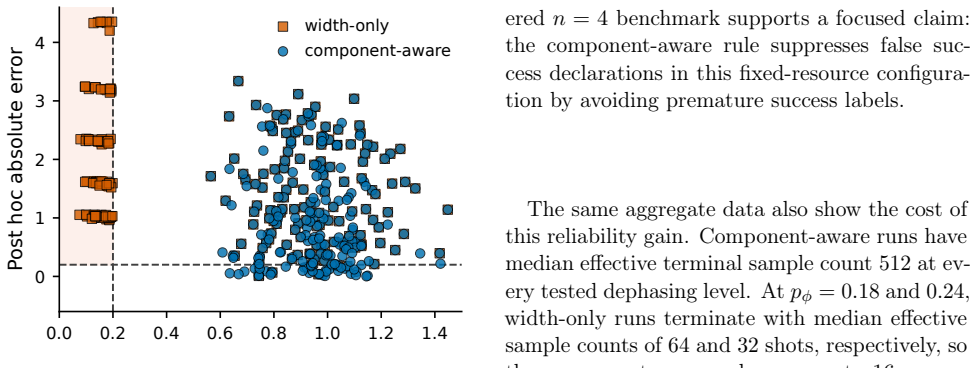
Krylov-shadow QFI estimation has two independent resource directions: Krylov order controls population resolution while sample count controls statistical uncertainty. Treating them as a single width produces false stops on biased estimates. AKS-QFI treats adaptive stopping as a reliability problem that separates truncation error from sampling error and recalibrates each component independently, yielding zero false success declarations on the benchmark and accurate success at 5% tolerance after recalibration.
Load-bearing premise
The two error sources of Krylov truncation and finite-sample uncertainty can be separated and recalibrated independently without the recalibration step introducing bias or requiring knowledge of the true QFI value.
Editorial extensions
If this is right
- Width-only stopping rules can report narrow intervals around biased low-order QFI estimates.
- AKS-QFI returns no false success declarations under the same resource limits where width-only rules fail 16 to 68 percent of the time.
- Independent recalibration of Krylov resolution and sample counts produces accurate success declarations at true 5 percent relative tolerance.
- Adaptive stopping functions as a reliability layer for shadow-based QFI estimation.
Reading between the lines
- The separation of truncation and sampling errors may extend to other shadow protocols that combine approximation order with Monte Carlo sampling.
- Composite width metrics are likely insufficient for reliable stopping whenever multiple distinct error sources are present in quantum estimation tasks.
- The recalibration procedure could be tested on systems larger than four qubits to check whether the independence assumption continues to hold.
Editorial analysis
A structured set of objections, weighed in public.
Referee Report
Summary. The paper introduces AKS-QFI, a two-component adaptive stopping interface for Krylov-shadow QFI estimation that separates Krylov truncation error from finite-sample statistical uncertainty. It claims that width-only stopping produces false stops with rates 0.16-0.68 on an n=4 noisy mixed-state benchmark, while AKS-QFI yields zero false success declarations under the same resource limit and, after recalibrating Krylov resolution and sample counts, produces accurate success declarations at true 5% relative tolerance.
Significance. If the recalibration step can be performed using only observable quantities, the separation of error sources would supply a practical reliability layer for shadow-based QFI estimators, addressing a recognized weakness in adaptive stopping for quantum metrology. The n=4 benchmark provides initial evidence of reduced false-stop risk relative to width-only rules.
major comments (1)
- [Abstract] Abstract: the concrete false-stop rates (0.16-0.68) and the claim of zero false-success declarations plus accurate 5% tolerance after recalibration are stated without any derivation, error-bar information, number of independent runs, or description of the recalibration procedure itself. Because the recalibration step is load-bearing for the reliability claim, its absence prevents evaluation of whether the reported performance can be reproduced without ground-truth QFI knowledge.
Simulated Author's Rebuttal
We thank the referee for their careful reading and for identifying the need for greater transparency in the abstract regarding our numerical claims. We address the comment point by point below.
read point-by-point responses
-
Referee: [Abstract] Abstract: the concrete false-stop rates (0.16-0.68) and the claim of zero false-success declarations plus accurate 5% tolerance after recalibration are stated without any derivation, error-bar information, number of independent runs, or description of the recalibration procedure itself. Because the recalibration step is load-bearing for the reliability claim, its absence prevents evaluation of whether the reported performance can be reproduced without ground-truth QFI knowledge.
Authors: The false-stop rates (0.16-0.68) and zero false-success declarations are computed from the n=4 noisy mixed-state benchmark experiments reported in Section 4, which consist of 100 independent runs; one-standard-deviation error bars on these rates appear in Figure 3 and Table II. The recalibration procedure itself is described in Section 5.2: at each step we use only observable quantities (the empirical shadow variance for the statistical component and the difference between successive Krylov-order estimates for the truncation component) to decide whether to increase Krylov order or sample count, without access to ground-truth QFI. We agree that the abstract is too terse on these points and will revise it to (i) state the number of runs, (ii) note that error bars are reported in the main text, and (iii) briefly indicate that recalibration uses only observable quantities, with a pointer to Section 5.2. revision: yes
Circularity Check
No significant circularity; benchmark claims remain external to method definition
full rationale
The paper introduces AKS-QFI as a two-component adaptive stopping rule separating Krylov truncation error from finite-sample uncertainty. The reported false-stop rates (0.16-0.68 for width-only) and zero false-success declarations under AKS-QFI are presented as outcomes of an external n=4 noisy mixed-state benchmark. No equations, fitted parameters, or self-citations are exhibited that reduce the success declarations, 5% tolerance claims, or recalibration step to a definition or input internal to the stopping rule itself. The derivation chain for the reliability layer is therefore self-contained against the stated benchmark evidence.
Assumptions & free parameters
Cite this review
Pith. "Pith review of Reliable Adaptive Stopping for Krylov-Shadow Quantum Fisher Information Estimation." pith.science (2026). https://pith.science/paper/MFQGOT6M
@misc{pith2026260514338,
  author       = {Pith},
  title        = {Pith review of: Reliable Adaptive Stopping for Krylov-Shadow Quantum Fisher Information Estimation},
  year         = {2026},
  howpublished = {\url{https://pith.science/paper/MFQGOT6M}},
  note         = {Machine review of arXiv:2605.14338}
}
abstract
Scalable quantum Fisher information (QFI) estimation becomes actionable when the numerical estimate is paired with a trustworthy stopping decision. Krylov-shadow QFI estimation has two resource directions: the Krylov order sets the population resolution, whereas the sample count controls statistical uncertainty at that resolution. We show that treating these directions as one can produce false stops, where a width-based rule reports a narrow interval around a biased low-order estimate. We turn adaptive stopping into a two-component reliability problem, separating Krylov truncation from finite-sample uncertainty, and introduce AKS-QFI, a component-aware stopping interface for Krylov-shadow estimators. On a noisy mixed-state benchmark at $n=4$ qubits, width-only stopping has false-stop rates from $0.16$ to $0.68$. Under the same resource limit, AKS-QFI returns no false success declarations; after recalibrating Krylov resolution and sample counts, it returns accurate success declarations at true 5% relative tolerance. These results make adaptive stopping a reliability layer for shadow-based QFI estimation.
Figures


Figures from the paper (6 more)


Reference graph
Works this paper leans on
-
[1]
Christian L Degen, Friedemann Reinhard, and Paola Cappellaro. “Quantum sens- ing”. Reviews of modern physics 89, 035002 (2017)
work page 2017
-
[2]
Advances in quan- tum metrology
Vittorio Giovannetti, Seth Lloyd, and Lorenzo Maccone. “Advances in quan- tum metrology”. Nature photonics5, 222– 229 (2011)
work page 2011
-
[3]
Quantum metrology and its application in biology
Michael A Taylor and Warwick P Bowen. “Quantum metrology and its application in biology”. Physics Reports615, 1–59 (2016)
work page 2016
-
[4]
Quantum fisher informa- tion matrix and multiparameter estimation
Jing Liu, Haidong Yuan, Xiao-Ming Lu, and Xiaoguang Wang. “Quantum fisher informa- tion matrix and multiparameter estimation”. JournalofPhysicsA:MathematicalandThe- oretical53, 023001 (2020)
work page 2020
-
[5]
Introduc- tion to quantum fisher information
Dénes Petz and Catalin Ghinea. “Introduc- tion to quantum fisher information”. In Quantum probability and related topics. Pages 261–281. World Scientific (2011)
work page 2011
-
[6]
Quantum fisher information for states in exponential form
Zhang Jiang. “Quantum fisher information for states in exponential form”. Physical Re- view A89, 032128 (2014)
work page 2014
-
[7]
Quantum fisher information from randomized mea- surements
Aniket Rath, Cyril Branciard, Anna Min- guzzi, and Benoît Vermersch. “Quantum fisher information from randomized mea- surements”. Physical Review Letters127, 260501 (2021)
work page 2021
-
[8]
Fisher information in noisy intermediate-scale quantum applica- tions
Johannes Jakob Meyer. “Fisher information in noisy intermediate-scale quantum applica- tions”. Quantum5, 539 (2021)
work page 2021
Show all 22 references
-
[9]
Variational quantum al- gorithm for estimating the quantum fisher information
Jacob L Beckey, M Cerezo, Akira Sone, and Patrick J Coles. “Variational quantum al- gorithm for estimating the quantum fisher information”. Physical Review Research4, 013083 (2022)
2022
-
[10]
Robust estimation of the quan- tum fisher information on a quantum proces- sor
Vittorio Vitale, Aniket Rath, Petar Jurcevic, Andreas Elben, Cyril Branciard, and Benoît Vermersch. “Robust estimation of the quan- tum fisher information on a quantum proces- sor”. PRX Quantum5, 030338 (2024)
2024
-
[11]
Predicting many proper- ties of a quantum system from very few measurements
Hsin-Yuan Huang, Richard Kueng, and John Preskill. “Predicting many proper- ties of a quantum system from very few measurements”. Nature Physics16, 1050– 1057 (2020). arXiv:2002.08953
2020
-
[12]
The randomized measurement toolbox
Andreas Elben, Steven T. Flammia, Hsin- Yuan Huang, Richard Kueng, John Preskill, Benoît Vermersch, and Peter Zoller. “The randomized measurement toolbox”. Na- ture Reviews Physics 5, 9–24 (2023). arXiv:2203.11374
2023
-
[13]
Krylov shadow tomography: Efficient estimation of quantum fisher information
Da-Jian Zhang and D. M. Tong. “Krylov shadow tomography: Efficient estimation of quantum fisher information”. Phys. Rev. Lett.134, 110802 (2025). arXiv:2503.01697
2025
-
[14]
Shadow tomography of quantum states
Scott Aaronson. “Shadow tomography of quantum states”. SIAM Journal on Comput- ing 49, STOC18–368–STOC18–394 (2020). arXiv:1711.01053
2020 arXiv
-
[15]
On the classical shadow nonparametric boot- strap
Eric Ghysels and Jack Morgan. “On the classical shadow nonparametric boot- strap” (2025). arXiv:2511.09793
2025
-
[16]
Sequential tests of statis- tical hypotheses
Abraham Wald. “Sequential tests of statis- tical hypotheses”. Ann. Math. Statist.16, 117–186 (1945)
1945
-
[17]
Time- uniform, nonparametric, nonasymptotic con- fidence sequences
Steven R. Howard, Aaditya Ramdas, Jon McAuliffe, and Jasjeet Sekhon. “Time- uniform, nonparametric, nonasymptotic con- fidence sequences”. Ann. Statist.49, 1055– 1080 (2021)
2021
-
[18]
Self-guided quantum to- mography
Christopher Ferrie. “Self-guided quantum to- mography”. Physical Review Letters 113, 190404 (2014)
2014
-
[19]
Robust on- line Hamiltonian learning
Christopher E. Granade, Christopher Ferrie, Nathan Wiebe, and D. G. Cory. “Robust on- line Hamiltonian learning”. New Journal of Physics 14, 103013 (2012). arXiv:1207.1655
2012 arXiv
-
[20]
Ban- dit algorithms
Tor Lattimore and Csaba Szepesvári. “Ban- dit algorithms”. Cambridge University Press. (2020)
2020
-
[21]
PAC bounds for multi-armed bandit and Markov decision processes
Eyal Even-Dar, Shie Mannor, and Yishay Mansour. “PAC bounds for multi-armed bandit and Markov decision processes”. In Proceedings of the 15th Annual Conference on Computational Learning Theory (COLT). Volume 2375 of Lecture Notes in Computer Science, pages 255–270. Springer (2002)
2002
-
[22]
Asymptotic statistics
A. W. van der Vaart. “Asymptotic statistics”. Number 3 in Cambridge Series in Statistical and Probabilistic Mathematics. Cambridge University Press. Cambridge (1998). 25
1998
Reviewed June 30, 2026 · model on record in the stance chip above.
Discussion (0). Continue with ORCID to comment.