Scaling Behaviors of Work Cumulants in Slow Isothermal Processes
Pith reviewed 2026-06-27 14:56 UTC · model grok-4.3
The pith
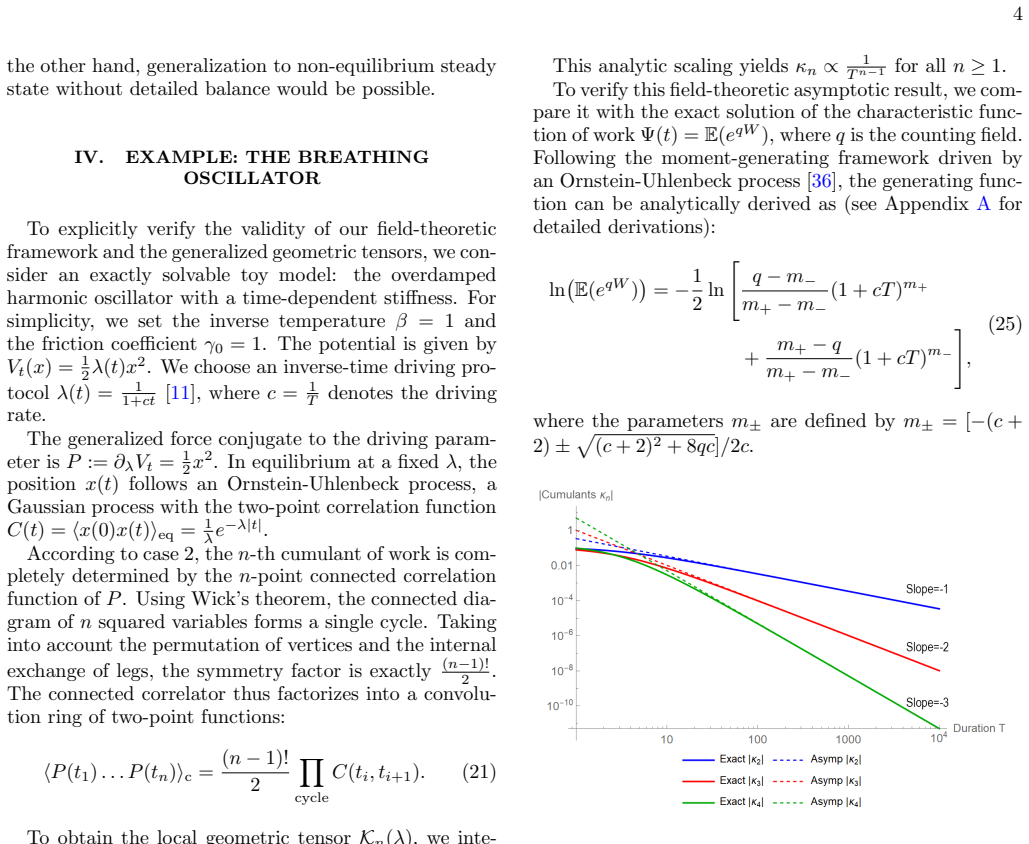
The nth cumulant of work scales as 1/T to the power n-1 in slow isothermal processes for gapped systems.
A machine-rendered reading of the paper's core claim, the machinery that carries it, and where it could break.
Core claim
In slow isothermal processes for gapped systems, the n-th cumulant of work scales as 1/T^{n-1}, where T is the time duration. This result holds generally for arbitrary smooth protocols. The coefficients of the cumulants are derived from equilibrium properties and are relevant to thermodynamic geometric tensors.
What carries the argument
The scaling relation that ties the nth cumulant of work directly to the inverse power of the total process duration T.
Load-bearing premise
The systems remain gapped throughout and the driving stays slow and isothermal, so that no extra correction terms appear in the scaling.
What would settle it
A measurement showing that the variance of work in a slow isothermal process on a gapped system fails to decrease proportionally to 1/T would falsify the claimed scaling.
Figures
read the original abstract
We study the cumulants of work in a slow isothermal process for gapped systems. Using the Martin-Siggia-Rose-De Dominicis-Janssen (MSRDJ) formalism and the properties of connected correlation functions, we show that in this process, the $n$-th cumulant of work scales as $1/T^{n-1}$ , where $T$ is the time duration. This result holds generally for arbitrary smooth protocols. Furthermore, we derive the coefficients of the cumulants from equilibrium properties. These coefficients are found to be relevant to thermodynamic geometric tensors.
Editorial analysis
A structured set of objections, weighed in public.
Referee Report
Summary. The paper claims that for gapped systems in slow isothermal processes, the n-th cumulant of work scales as 1/T^{n-1} (T the process duration) for arbitrary smooth protocols. This follows from the MSRDJ formalism combined with the exponential decay of equilibrium connected correlation functions; the coefficients of these cumulants are derived from equilibrium properties and shown to relate to thermodynamic geometric tensors.
Significance. If the derivation holds, the result supplies a protocol-independent scaling law for work fluctuations that follows directly from the short-ranged nature of gapped equilibrium correlations after time rescaling, together with an explicit link between the prefactors and equilibrium geometric tensors. This strengthens the connection between near-equilibrium stochastic thermodynamics and thermodynamic geometry.
minor comments (1)
- [Abstract] The abstract states that the coefficients 'are found to be relevant to thermodynamic geometric tensors' without naming the tensors or the precise relation; a short clarifying sentence in the introduction or conclusion would improve readability.
Simulated Author's Rebuttal
We thank the referee for their positive summary, significance assessment, and recommendation to accept the manuscript. We are pleased that the derivation and its connection to thermodynamic geometry are viewed as strengthening the link between near-equilibrium stochastic thermodynamics and geometric approaches.
Circularity Check
Derivation is self-contained; scaling follows from equilibrium correlation decay
full rationale
The claimed scaling of the n-th work cumulant as 1/T^{n-1} is obtained by rescaling time with the slow duration T and using the exponential decay of connected n-point functions guaranteed by the gap in isothermal equilibrium. Each additional connected correlator contributes one 1/T factor from the relative-time integrals; this is a direct, parameter-free consequence of the MSRDJ representation plus standard properties of gapped equilibrium correlations. No fitted parameters are renamed as predictions, no self-citation chain is load-bearing for the central result, and the link to thermodynamic geometric tensors is presented as an independent derivation from equilibrium quantities. The argument applies to arbitrary smooth protocols without additional assumptions that would create circularity.
Axiom & Free-Parameter Ledger
Reference graph
Works this paper leans on
-
[1]
O. Mazonka and C. Jarzynski, Exactly solvable model illustrating far-from-equilibrium predictions (1999), arXiv:cond-mat/9912121 [cond-mat.stat-mech]
Pith/arXiv arXiv 1999
-
[2]
van Zon and E
R. van Zon and E. G. D. Cohen, Phys. Rev. E67, 046102 (2003)
2003
-
[3]
Speck and U
T. Speck and U. Seifert, Physical Review E70, 066112 (2004)
2004
-
[4]
Baiesi, T
M. Baiesi, T. Jacobs, C. Maes, and N. S. Skantzos, Phys. Rev. E74, 021111 (2006)
2006
-
[5]
Imparato, L
A. Imparato, L. Peliti, G. Pesce, G. Rusciano, and A. Sasso, Phys. Rev. E76, 050101(R) (2007)
2007
-
[6]
Saha and A
A. Saha and A. M. Jayannavar, Phys. Rev. E77, 022105 (2008)
2008
-
[7]
Taniguchi and E
T. Taniguchi and E. G. D. Cohen, Journal of Statistical Physics130, 1 (2008)
2008
-
[8]
Then and A
H. Then and A. Engel, Phys. Rev. E77, 041105 (2008)
2008
-
[9]
Engel, Phys
A. Engel, Phys. Rev. E80, 021120 (2009)
2009
-
[10]
A. Saha, J. K. Bhattacharjee, and S. Chakraborty, Phys. Rev. E83, 011104 (2011)
2011
-
[11]
C. Kwon, J. D. Noh, and H. Park, Phys. Rev. E88, 062102 (2013)
2013
-
[12]
Saha and S
B. Saha and S. Mukherji, Journal of Statistical Mechan- ics: Theory and Experiment2014, P08014 (2014)
2014
-
[13]
Holubec, M
V. Holubec, M. Dierl, M. Einax, P. Maass, P. Chvosta, and A. Ryabov, Physica Scripta2015, 014024 (2015)
2015
-
[14]
Z. Gong, Y. Lan, and H. T. Quan, Phys. Rev. Lett.117, 180603 (2016)
2016
-
[15]
Li and Z
G. Li and Z. C. Tu, Phys. Rev. E100, 012127 (2019)
2019
-
[16]
D. S. P. Salazar, Phys. Rev. E101, 030101(R) (2020)
2020
-
[17]
Fei and C
Z. Fei and C. P. Sun, Physical Review B103, 144204 (2021)
2021
-
[18]
Chen and H
J.-F. Chen and H. T. Quan, Phys. Rev. E107, 024135 (2023)
2023
-
[19]
Salamon, A
P. Salamon, A. Nitzan, B. Andresen, and R. S. Berry, Phys. Rev. A21, 2115 (1980)
1980
-
[20]
G. E. Crooks, Phys. Rev. Lett.99, 100602 (2007)
2007
-
[21]
Schmiedl and U
T. Schmiedl and U. Seifert, Europhysics Letters81, 20003 (2007)
2007
-
[22]
Esposito, R
M. Esposito, R. Kawai, K. Lindenberg, and C. Van den Broeck, Phys. Rev. Lett.105, 150603 (2010)
2010
-
[23]
D. A. Sivak and G. E. Crooks, Physical Review Letters 108, 190602 (2012)
2012
-
[24]
Mandal and C
D. Mandal and C. Jarzynski, Journal of Statistical Me- chanics: Theory and Experiment2016, 063204 (2016)
2016
-
[25]
Ma, R.-X
Y.-H. Ma, R.-X. Zhai, J. Chen, C. P. Sun, and H. Dong, Physical Review Letters125, 210601 (2020)
2020
-
[26]
Blaber and D
S. Blaber and D. A. Sivak, The Journal of Chemical Physics153, 244119 (2020)
2020
-
[27]
Silva, Physical Review Letters101, 120603 (2008)
A. Silva, Physical Review Letters101, 120603 (2008)
2008
-
[28]
Z. Fei, N. Freitas, V. Cavina, H. T. Quan, and M. Espos- ito, Physical Review Letters124, 170603 (2020)
2020
-
[29]
Zhang and H
F. Zhang and H. T. Quan, Physical Review E105, 024101 (2022)
2022
-
[30]
Shitara, Geometric Approach to Nonequilibrium Sta- 6 tistical Mechanics (2018)
T. Shitara, Geometric Approach to Nonequilibrium Sta- 6 tistical Mechanics (2018)
2018
-
[31]
Mallick, M
K. Mallick, M. Moshe, and H. Orland, Journal of Physics A: Mathematical and Theoretical44, 095002 (2011)
2011
-
[32]
Bertini, E
L. Bertini, E. N. M. Cirillo, and E. Olivieri, Journal of Statistical Physics115, 395 (2004)
2004
-
[33]
Spohn, Communications In Mathematical Physics 103, 1 (1986)
H. Spohn, Communications In Mathematical Physics 103, 1 (1986)
1986
-
[34]
Glimm and A
J. Glimm and A. Jaffe,Quantum Physics(Springer New York, New York, NY, 1987)
1987
-
[35]
Ruelle,Statistical Mechanics: Rigorous Results(CO- PUBLISHED WITH IMPERIAL COLLEGE PRESS, 1999)
D. Ruelle,Statistical Mechanics: Rigorous Results(CO- PUBLISHED WITH IMPERIAL COLLEGE PRESS, 1999)
1999
-
[36]
Speck, Journal of Physics A: Mathematical and The- oretical44, 305001 (2011)
T. Speck, Journal of Physics A: Mathematical and The- oretical44, 305001 (2011)
2011
discussion (0)
Sign in with ORCID, Apple, or X to comment. Anyone can read and Pith papers without signing in.