REVIEW 3 major objections 6 minor 23 references
RKKY coupling in Weyl semimetal thin films
T0 review · 3 major / 6 minor · reviewed 2026-08-14 · deepseek-v4-flash
Pith's one-line read The paper claims that impurity spins on opposite surfaces of a Weyl-semimetal thin film couple strongly through Fermi arcs and bulk states, with the coupling peaking at an optimum thickness set by the Weyl-node separation.
desk verdict Solid theory paper on RKKY in WSM slabs with a genuine new intersurface effect; the Lc ~ 1/k0 scaling is only single-separation data and needs a second test or softer wording. read the letter →
The pith
A machine-rendered reading of the paper's core claim, the machinery that carries it, and where it could break.
The reading
What carries the argument
The argument is carried by two complementary tools. Analytically, the authors solve the low-energy Dirac Hamiltonian of each time-reversed block in a slab with infinite-mass boundary conditions at the two surfaces; the resulting transcendental equation labels a family of $n=0$ bands that contain both the Fermi-arc surface states and the low-energy bulk states, and the penetration length of the arc states diverges as the surface momentum approaches the Weyl-node projection. Numerically, a recursive Green's function scheme built from the layer structure of the tight-binding Hamiltonian computes the surface-to-surface Green's function elements $G_{1,N_z}$ and $G_{N_z,1}$, as well as the intrasurface ones, essentially exactly, allowing the full RKKY tensor to be evaluated for a slab of arbitrary thickness. The matching of these two methods is what lets the paper attribute the non-monotonic thickness dependence to Fermi-arc penetration and bulk-state competition.
What would settle it
Measure the thickness dependence of the magnetic correlation between impurities on opposite surfaces of a Weyl-semimetal slab, for example in TaAs thin films at low temperature; the claim fails if the coupling decays monotonically with thickness without any maximum, or if the opposite-surface coupling is orders of magnitude weaker than same-surface coupling at all thicknesses. A less demanding check is to compute the same RKKY tensor in a material-specific model with curved or differently connected Fermi arcs and see whether the non-monotonic peak survives.
Extended reading notes
Core claim
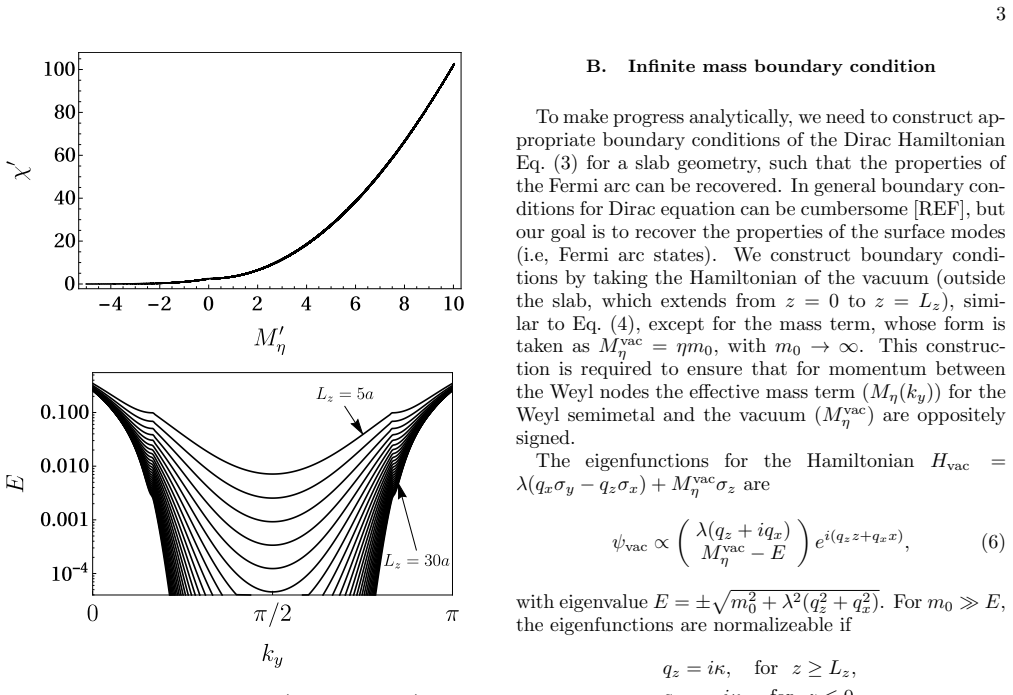
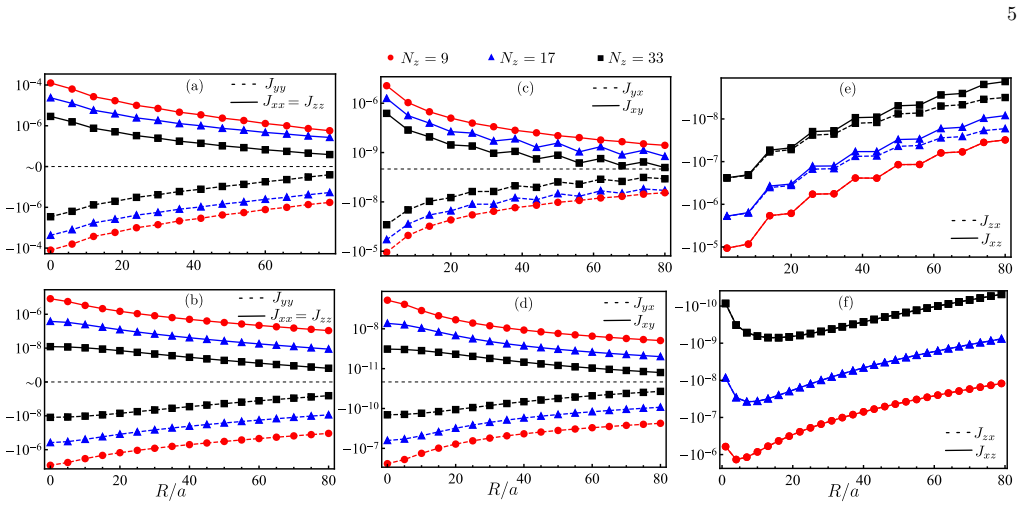
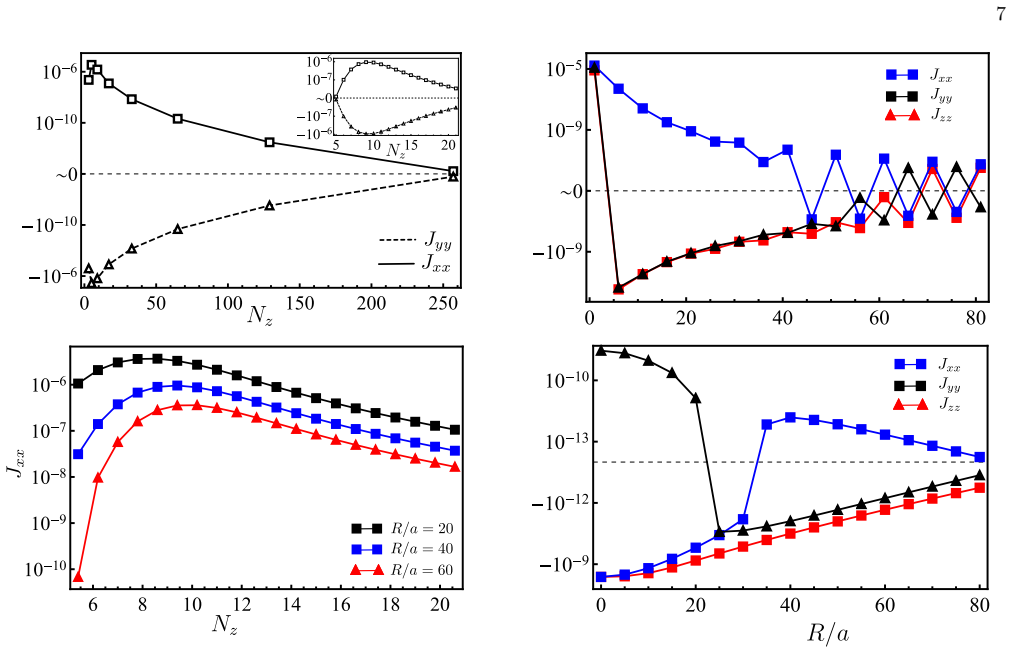
On the paper's own terms, the central discovery is that the RKKY coupling between impurity spins on opposite surfaces of a Weyl-semimetal slab is neither weak nor monotonic: it grows as the film thickens, peaks at an optimum thickness $L_c$, and then decays rapidly as bulk-state dominance sets in. The maximum exists because the Fermi-arc states localize more firmly on their surfaces as the thickness increases, raising the surface density of states, while the number of conduction-electron states sensitive to both surfaces decreases; the competition defines a thin-film limit with $L_c \sim 1/k_0$, where $k_0$ is the momentum-space separation of the Weyl nodes. For fixed thickness the opposite-surface coupling falls off roughly as $(R^2+L_z^2)^{-\alpha/2}$ with $\alpha$ between 3 and 4, and for large thickness as $L_z^{-\gamma}$ with $\gamma\approx 5$, the same falloff as bulk Weyl RKKY. A related result is that the same-surface component $J_{xx}$, which vanishes for straight Fermi arcs in a single-surface model, remains nonzero in a finite slab and disappears with increasing thickness, showing that the second surface is responsible.
Load-bearing premise
The load-bearing premise is that the minimal tight-binding model with two straight, spin-polarized Fermi arcs per surface, and the low-energy states derived from it, faithfully represent a real Weyl-semimetal thin film; if real Fermi-arc connectivity, spin texture, or penetration behavior differs substantially, the predicted strong opposite-surface coupling and its optimum thickness could change qualitatively.
Editorial extensions
If this is right
- For films thinner than the critical thickness $L_c\sim 1/k_0$, RKKY calculations that model only a single surface are incomplete: the opposite surface contributes even to same-surface spin couplings like $J_{xx}$.
- Opposite-surface RKKY coupling can be strong and long-ranged enough to favor ferromagnetic ordering between the two surfaces, with parallel surface magnetizations in the ground state.
- In materials such as TaAs, with Weyl-node separation $k_0\approx 0.1\pi/a$, the predicted critical thickness is tens to a hundred lattice spacings, placing the effect in experimentally accessible thin films.
- At finite chemical potential the RKKY coupling acquires the usual $2k_F$ oscillations while the non-monotonic thickness envelope survives, so the optimum-thickness phenomenon is not an artifact of the nodal limit.
Reading between the lines
- The divergent penetration of Fermi-arc states near Weyl-node projections suggests that the optimum thickness and peak coupling should depend on where the impurity spins sit laterally on the surface relative to the node projections; mapping $L_c$ as a function of position could image the arcs' real-space extent.
- If a real material has curved Fermi arcs or a different spin texture, the non-monotonic peak may shift to a different thickness, split among spin components, or weaken; a material-specific tight-binding calculation would show which of these happens.
- Because the coupling strength is controlled by thickness, a WSM slab could act as a tunable magnetic coupler: changing the film thickness by a few lattice spacings near $L_c$ would switch the effective intersurface spin interaction from small to maximal.
Signed reviews
Editorial analysis
A structured set of objections, weighed in public.
Referee Report
Summary. This paper studies RKKY interactions between impurity spins placed on the surfaces of a thin-film Weyl semimetal. The authors use a minimal four-node time-reversal-symmetric tight-binding model and a low-energy Dirac model with infinite-mass boundary conditions. They show that spins on the same surface couple through Fermi arc states with pronounced anisotropy, while spins on opposite surfaces couple through both Fermi arcs and bulk states. The central claim is that the opposite-surface coupling is unexpectedly strong and non-monotonic in film thickness, with a maximum at an optimum thickness. Results are obtained both from analytical wavefunctions of the slab and from a recursive Green's function computation on the tight-binding model, and the authors further claim that the critical thickness scales approximately as 1/k0, where k0 is the separation of the Weyl nodes.
Significance. If the central claims hold, the paper identifies a concrete thin-film regime in which intersurface RKKY coupling is strong and controllable by thickness, with possible consequences for magnetic ordering on WSM surfaces and for the interpretation of future experiments. The paper has real strengths: it provides two independent calculational methods that agree qualitatively, the recursive Green's function scheme is efficient and well suited to the two-surface problem, and the symmetry analysis in Appendix A is a useful reference for the structure of the spin susceptibility matrix. The analytical derivation in Sec. II is self-contained, and the comparison between the low-energy wavefunction approach and the tight-binding numerics gives confidence in the qualitative behavior. The main quantitative claim, however, namely the Lc ~ 1/k0 scaling and the associated material estimate for TaAs, rests on a single lateral separation and therefore needs additional support before it can be regarded as established.
major comments (3)
- [Appendix B, Fig. 8; Fig. 5 (bottom)] The claim that the critical thickness scales as Lc ~ 1/k0 is tested for only one lateral separation, R = 40a, in Fig. 8, while Fig. 5 (bottom) shows that the peak thickness shifts with R. Since R·k0 changes by roughly a factor of four across the three values of m/λ studied (about 55 for m/λ = 0.2 versus about 13 for m/λ = 0.95), the apparent collapse of Lc·k0 onto a constant could be a coincidental consequence of the fixed R rather than evidence for an intrinsic 1/k0 scale. Please provide a two-parameter study varying both R and k0, or at least show that the extracted Lc is independent of R at fixed k0, before using this scaling to define the thin-film limit and to estimate the critical thickness for TaAs in Section V.
- [Section V and Fig. 7] The non-monotonic thickness dependence and the existence of an optimum thickness are demonstrated only at µ = 0. The finite-µ results in Fig. 7 are shown for a single thickness (Nz = 33), so the statement in Section V that the envelopes 'behave rather similarly' to the µ = 0 case is not supported by a thickness scan. Since the abstract states the thickness maximum without a µ qualifier, and since real materials may not be at the nodal energy, the persistence of the optimum thickness at finite doping is an open point. Either a finite-µ thickness sweep or an explicit qualification of the claim is needed.
- [Eq. (1) and Section V] The quantitative material prediction for TaAs in Section V assumes that the minimal four-node model with straight, spin-polarized Fermi arcs captures the essential intersurface physics of a real WSM. This is a reasonable starting point, but it is a nontrivial assumption: real Fermi arcs can have different connectivity, curvature, and spin texture, and the penetration behavior near the Weyl node projections may differ. Because the TaAs thickness estimate is the most actionable claim, the authors should either soften it to an explicit model-based estimate or test the sensitivity of Lc to the arc structure, for example by using a model with curved arcs or a TaAs-derived surface spectrum.
minor comments (6)
- [Eq. (24)] The bottom-right entry of the 2x2 matrix G' should be G_{N_z N_z}, not G_{1 N_z}; as written the matrix is inconsistent with the stated goal of computing both surface-to-surface propagators.
- [Section II.B] The text contains an unresolved placeholder '[REF]' in the discussion of boundary conditions for the Dirac equation; a proper citation is needed.
- [Abstract] The phrase 'as well using a two-surface recursive Green's function analysis' should read 'as well as using'.
- [References] Reference 15 lists the year as '20015'; it should be 2015.
- [Fig. 2 caption] The caption says 'The energy values decreases exponentially'; this should be 'decrease'.
- [Eq. (35)] The argument of the cosine contains 'π y' with y appearing to be a dimensioned coordinate; the notation should specify that lattice spacing a is set to unity or otherwise define the dimensionless combination.
Circularity Check
No circularity: RKKY results and Lc ~ 1/k0 scaling emerge from self-contained standard formalism and numerical inversion of Eq. (1); the sole self-citation (Ref. 23) is non-load-bearing.
full rationale
The derivation chain is self-contained. The RKKY formula, Eq. (18), is the standard linear-response expression, with no parameter fitted to the target results. The analytical wavefunctions in Sec. II B are obtained by an explicit infinite-mass boundary condition applied to the low-energy Hamiltonian, leading to the transcendental equation (12) and to Eq. (15); these states are not defined in terms of the RKKY couplings. The numerical results are obtained by inverting the tight-binding Hamiltonian, Eq. (1), with a recursive Green's function scheme whose recursion relations, Eqs. (25)-(28), are written out in Sec. III rather than merely imported from a citation. The citation of Ref. 23 is therefore supporting but not load-bearing. The central opposite-surface claims (strong coupling, non-monotonic thickness dependence, maximum at a critical thickness) are emergent outputs of the Green's function integrals, and no quantity equivalent to those outputs is inserted as an input. The Lc ~ 1/k0 scaling is presented first as a dimensional expectation ('k0 is the only relevant momentum scale') and then checked in Appendix B by locating maxima in computed data for three values of m/lambda; this is a hypothesis tested against calculation, not a fitted parameter renamed as a prediction. The robustness caveat that Appendix B uses a single R = 40a and mu = 0 is a limitation or uncertainty, not a circularity, because the computed data could have failed to obey the claimed collapse. The only relevant self-citation is Ref. 23, and it is not load-bearing, so the paper warrants a low circularity score.
Assumptions & free parameters
free parameters (6)
- m_over_lambda =
0.5 (also 0.2 and 0.95 in Appendix B)
- mu =
0 for most results; finite in Fig. 7
- alpha_same_surface =
approximately 2.53 (Nz=9), 2.29 (Nz=17), 2.26 (Nz=33)
- alpha_opposite_surface =
approximately 3.28 (Nz=9), 3.33 (Nz=17), 3.24 (Nz=33)
- beta_opposite_surface =
approximately 2.36, 2.39, 2.32 for Nz=9, 17, 33
- gamma_opposite_surface =
approximately 4.96 (R=20), 5.02 (R=40), 5.06 (R=60)
assumptions (5)
- standard math Second-order RKKY perturbation theory in the sd exchange coupling J (Eq. 18) describes the effective spin-spin interaction.
- domain assumption The four-node time-reversal-symmetric tight-binding model (Eq. 1) represents a Weyl semimetal thin film.
- ad hoc to paper The infinite mass boundary condition (Sec. II B), with vacuum mass m0 tending to infinity, reproduces the Fermi arc surface states.
- domain assumption Impurity spins are exchange-coupled to the same orbital of the two-orbital model (Sec. III).
- domain assumption In the analytical calculation, only the n=0 bands of the transcendental solution (Eq. 13) are retained.
Cite this review
Pith. "Pith review of RKKY coupling in Weyl semimetal thin films." pith.science (2026). https://pith.science/paper/MG75NNWY
@misc{pith2026190804554,
  author       = {Pith},
  title        = {Pith review of: RKKY coupling in Weyl semimetal thin films},
  year         = {2026},
  howpublished = {\url{https://pith.science/paper/MG75NNWY}},
  note         = {Machine review of arXiv:1908.04554}
}
read the original abstract
We consider the effective coupling between impurity spins on surfaces of a thin-film Weyl semimetal within Ruderman-Kittel-Kasuya-Yoshida (RKKY) theory. If the spins are on the same surface, their coupling reflects the anisotropy and the spin-momentum locking of the Fermi arcs. By contrast when the spins are on opposite surfaces, their coupling is mediated by the Fermi arcs as well as by bulk states. In this case the coupling is both surprisingly strong and strongly thickness dependent, with a maximum at an optimum thickness. We demonstrate our results using analytical solutions of states in the thin-film geometry, as well using a two-surface recursive Green's function analysis of the tight-binding model.
Figures


Figures from the paper (4 more)


Reference graph
Works this paper leans on
-
[1]
For reviews see: N. P. Armitage, E. J. Mele, and A. Vishwanath, Rev. Mod. Phys. 90, 015001 (2018); Nature S. Jia, S.-Y. Xu, and M. Z. Hasan, Nature Materials 15, 1140–1144 (2016); S. Rao, Journal of the Indian Institute of Science, 96, 2 (2016)
work page 2018
-
[2]
M. A. Ruderman and C. Kittel, Phys. Rev. 96 , 99 (1954); T. Kasuya, Prog. Theor. Phys. 16 , 45 (1956); K. Yosida, Phys. Rev. 106 , 893 (1957)
work page 1954
- [3]
- [4]
- [5]
- [6]
-
[7]
Mir Vahid Hosseini and Mehdi Askari, Phys. Rev. B 92, 224435 (2015)
work page 2015
-
[8]
J. Gao, W. Chen, X. C. Xie, and F.-C. Zhang, Phys. Rev. B 60 , 241302(R) (2009)
work page 2009
Show all 23 references
-
[9]
Yang, C.-H
G. Yang, C.-H. Hsu, P. Stano, J. Klinovaja, and D. Loss, Phys. Rev. B 93 , 075301 (2016)
2016
-
[10]
J. Gao, W. Chen, X. C. Xie, and F.C. Zhang, Phys. Rev. B 80 , 241302(R) (2009)
2009
-
[11]
Liu, C.-X
Q. Liu, C.-X. Liu, C. Xu, X.-L Qi, and S.-C. Zhang, \ 102 , 156603 (2009)
2009
-
[12]
C.-H. Hsu, P. Stano, J. Klinovaja, and D. Loss, \ 96 , 081405(R) (2017)
2017
-
[13]
C.-H. Hsu, P. Stano, J. Klinovaja, and D. Loss, 97 , 125432 (2018)
2018
-
[14]
Lee and Y.-L
Y.-W. Lee and Y.-L. Lee, Phys. Rev. B 91 , 214431 (20015)
-
[15]
Fertig, L
Sahinur Reja, H.A. Fertig, L. Brey, and Shixiong Zhang, Phys. Rev. B 96 , 201111 (2017)
2017
-
[16]
Fertig, and L
Sahinur Reja, H.A. Fertig, and L. Brey, Phys. Rev. B 99 , 045427 (2019)
2019
-
[17]
Sonu Verma and Arijit Kundu, Phys. Rev. B 99, 121409(R) (2019)
2019
-
[18]
Kaladzhyan, A
V. Kaladzhyan, A. A. Zyuzin, and P. Simon, Phys. Rev. B 99, 165302 (2019)
2019
-
[19]
Hou-Jian Duan, Shi-Han Zheng, Pei-Hao Fu, Rui-Qiang Wang, Jun-Feng Liu, Guang-Hui Wang, and Mou Yang, New J. Phys. 20, 103008 (2018)
2018
-
[20]
Da Ma, Hua Chen, Haiwen Liu, and X. C. Xie, Phys. Rev. B 97, 045148 (2018)
2018
-
[21]
M. M. Vazifeh and M. Franz, Phys. Rev. Lett. 111, 027201 (2013)
2013
-
[22]
Keshav Pareek and Arijit Kundu, arXiv:1812.05504 (unpublished)
-
[23]
B. Q. Lv, H. M. Weng, B. B. Fu, X. P. Wang, H. Miao, J. Ma, P. Richard, X. C. Huang, L. X. Zhao, G. F. Chen, Z. Fang, X. Dai, T. Qian, and H. Ding, Phys. Rev. X 5, 031013 (2015)
2015
Reviewed August 14, 2026 · model on record in the stance chip above.
Discussion (0). Continue with ORCID to comment.