REVIEW 3 major objections 6 minor 1 cited by
Chiral Graviton Modes in Fermionic Fractional Chern Insulators
T0 review · 3 major / 6 minor · reviewed 2026-08-03 · deepseek-v4-flash
Pith's one-line read The paper claims that chiral graviton modes—spin-2 geometric collective excitations—exist as long-lived excitations in fermionic fractional Chern insulators and are adiabatically connected to their fractional quantum Hall counterparts.
desk verdict A well-executed numerical study that makes the strongest current case for long-lived chiral graviton modes in fermionic FCIs, with a genuine caveat about the lattice graviton operator definition. read the letter →
The pith
A machine-rendered reading of the paper's core claim, the machinery that carries it, and where it could break.
The reading
What carries the argument
The central object is the lattice quadrupolar density operator O_nn^{±} = Σ_{r,δ} e^{±2i arg δ} f_G(δ) n_r n_{r+δ}, with f_G(δ)=1/|δ| and a cutoff at |δ|=2√2 (chosen to include next-nearest-neighbour pairs on the checkerboard super-lattice). It is a short-range, chiral, spin-2 probe of the dynamics of the correlation hole; in the Landau-level limit the paper proves it flows to the continuum stress-tensor operator of a V1 pseudopotential interaction, using the identity ∂_{q*} F_G(|q|)=q² V_G(|q|). The lattice stress tensor T^{ab} itself, derived from i[H, j^a], is the other device; the two operators give overlapping spectra whose distance vanishes as n_φ³ in the continuum limit. The lifetime
What would settle it
One decisive check: in a Chern band with the same flatness and interactions but with the Berry curvature artificially made uniform (e.g. by tuning hoppings along a path that keeps the band flat), compute I_nn^{±}. If the peak position, chirality, or decay rate fails to track the change in quantum geometry, then the operator is capturing a generic short-range density mode rather than the geometric graviton. A second check: measure the linewidth as a function of interaction V; the paper predicts Γ_G ∝ V at large V—if the mode instead broadens faster than linearly or disappears as V increases wit
Extended reading notes
Core claim
On its own terms, the paper establishes that 'a well-defined chiral graviton mode exists in FCI phases and is adiabatically connected to FQH graviton-modes.' The proof strategy is to exhibit the mode, not to derive it from a symmetry. Starting from the fermionic Harper–Hofstadter model at 1/8 flux per plaquette—a lattice limit that reproduces lowest-Landau-level physics—the authors derive a lattice stress tensor operator from the Heisenberg equation of the current, and show analytically that it coincides in the continuum limit with a chiral quadrupolar density–density operator O_nn carrying phase e^{±2i arg δ}. They then use that operator to compute spectral functions across an interpolation
Load-bearing premise
The load-bearing premise is that the quadrupolar density operator with the chosen weight 1/r and cutoff 2√2 faithfully represents the emergent-metric fluctuation (graviton) in a generic Chern band; its identification with the stress tensor is proven only in the Landau-level limit, and there is no independent lattice definition of the graviton away from that limit.
Editorial extensions
If this is right
- A chiral, spin-2 graviton peak should be visible in the dynamical density response of FCI phases, including in moiré materials and cold-atom implementations, even though the mode sits inside the two-magnetoroton continuum.
- The graviton mode is adiabatically connected between FQH and FCI limits, so its existence does not require continuous translation or rotation symmetry; the lattice merely broadens it.
- The ratio of integrated chiral weights N−/N+ of this operator can serve as a phase witness separating FCI from Fermi-liquid behaviour.
- The intrinsic decay rate Γ_G/ω_G stays small (≈0.1) toward the thermodynamic limit at the checkerboard point, with no strong N-dependence up to the sizes studied.
- Because the quadrupolar operator reduces to the stress tensor in the continuum limit, short-range density correlators are a legitimate substitute for the stress tensor in generic Chern bands with non-uniform Berry curvature.
Reading between the lines
- If the operator equivalence holds beyond the Landau-level limit, then the 'emergent metric' of an FCI can be read off from short-range density correlations alone; one could test this by computing the same correlator in a band whose quantum geometry is tuned independently of its flatness, e.g. via artificial Berry-curvature engineering.
- The paper leaves open what protects the mode: the suppression of scattering matrix elements despite a large density of states. Identifying that selection rule could predict when the decay rate will diverge in other Chern bands or at other fillings.
- The same probe could be applied to non-Abelian lattice phases (e.g. bosonic Pfaffian-type states) or to the fractional quantum Hall nematic transition, where the graviton gap closing is the expected mechanism; measurement of Γ_G across the transition would be a direct test.
- The 1/4-flux interpolation comparison suggests a trade-off between band flatness and quantum geometry for graviton lifetime; a controlled study varying one at a time could turn this qualitative observation into a quantitative criterion.
Editorial analysis
A structured set of objections, weighed in public.
Referee Report
Summary. The paper claims to demonstrate the existence of long-lived chiral graviton modes in fermionic fractional Chern insulators (FCIs) and their adiabatic connection to the fractional quantum Hall (FQH) graviton. The authors derive a lattice stress tensor operator for the Harper–Hofstadter model, show that a quadrupolar density–density operator reduces to the same continuum stress tensor in the Landau-level limit, and then use exact diagonalization, projected ED, and MPS/TDVP simulations to track the spectral peak of this operator along an interpolation from a low-flux Harper–Hofstadter model to a checkerboard-lattice FCI. A finite-size analysis of the peak width is used to extract an intrinsic decay rate Γ_G/ω_G ≈ 0.1 in the checkerboard limit.
Significance. If correct, the result would settle an open question about the survival of geometric collective modes in lattice topological phases and would provide a practical spectroscopic probe for FCIs. The numerical work is extensive and carefully cross-checked: full ED and pED are complemented by MPS/TDVP with bond-dimension and evolution-time convergence tests; twisted-boundary-condition averaging is used; and the dependence on the graviton operator parameters is explored in Appendix F. The analytic connection between the quadrupolar density operator and the continuum stress tensor in the LL limit (Eqs. 22–25) is a clean and useful contribution. The chiral spectral response as a phase witness (Fig. 9) is also a valuable observation. However, the central claims—that the FCI peak is the genuine metric graviton and that it remains long-lived in the thermodynamic limit—rest on assumptions that the authors themselves flag but do not fully resolve.
major comments (3)
- [Sec. II C, Eq. (14); Sec. IV B, Fig. 6] The identification of the CB spectral peak as the chiral graviton depends entirely on O_nn (Eq. 14) with the hand-chosen f_G(r)=1/r and r_G=2√2. The analytic equivalence of O_nn to the continuum stress tensor is derived only in the LL limit (Eqs. 22–25). Away from that limit there is no independent lattice definition of the emergent metric or of the graviton, as the paper itself states in Sec. II ('no consensus has been reached') and Sec. V (emergent-metric theory left to future work). The comparison between O_s and O_nn (Eq. 29, Fig. 3) is a comparison between two operators both constructed to flow to the same continuum operator; it does not constitute independent validation at finite flux. Therefore the adiabatic continuity of the peak along R demonstrates continuity of some quadrupolar density excitation, not necessarily that this excitation is the metric graviton. To support the abst
- [Sec. IV C, Fig. 7(d)] The claim of a long-lived mode in the FCI limit rests on the 1/N extrapolation of Γ_G/ω_G shown in Fig. 7(d). The data are limited to N=6,8,10,12 for the CB point and N=6,8,10 for HH*, and show pronounced oscillations with no clear convergence. The authors themselves state in Sec. IV C that 'we cannot completely exclude the divergence of the decay rate at system sizes outside the range of current state-of-the-art numerical methods.' The extraction of Γ_G via Eq. (32) assumes a simple additive decay model Γ_tot = Γ_G + η, which is not derived; the chosen η* = 0.02 for CB is ad hoc, and Eq. (33) only samples a factor of two in η. Given that 'long-lived' is a central claim, this extrapolation is not sufficiently controlled. The authors should either provide a more systematic scaling analysis (e.g., larger N, a specific scaling ansatz, or a collapse of Γ_tot(η) for all N), or soften the clai
- [Sec. II B, Eq. (13); App. A] The lattice stress tensor O_s is derived in the limit V→∞ (nearest-neighbor hard-core constraint) and for nearest-neighbor interactions only (Sec. II B, App. A). The simulations, however, use finite V=2 and finite-range interactions V(r)=1/r up to r_c=2 (Sec. III A, Fig. 2). No argument is given that the operator expression in Eq. (13) remains the stress tensor away from the constrained limit. The numerical similarity between O_s and O_nn at n_φ=1/4 (Fig. 3) suggests some robustness, but the derivation gap means the interpretation of O_s as 'the lattice stress tensor' at the simulated parameters is an assumption. The authors should either extend the derivation to finite V or explicitly state and justify the extrapolation from the hard-core limit.
minor comments (6)
- [Abstract and Sec. I] The bullet list in the introduction repeats the abstract almost verbatim; some redundancy could be removed.
- [Sec. II C, Eq. (17)] The projected density operator expression appears typographically garbled: 'e − iq 2 z∗ j − iq∗ 2 z' is hard to parse. Please use standard notation such as e^{-i(q/2) z_j^* - i(q^*/2) z_j}.
- [Sec. III A, Fig. 2 caption] The caption says 'N=4 for all panels' but N is also used for the Hilbert-space dimension in the text ('N ∼ 2·10^4'). Please use distinct symbols (e.g., N_p for particle number, dim for Hilbert-space dimension).
- [Sec. III A, Eq. (29)] In the definition of the overlap distance, the state |ψ_O> is written with O^+ and O^-; for the negative-chirality overlap, it should be made explicit which combination of chiralities is used (presumably O^+ acting on the ground state to create the negative-chirality mode).
- [Sec. IV A, Eq. (36)] The notation t, t', t'', t''' is defined in the text but the relation to the hoppings in Eq. (36) is not fully explicit; a short clarifying sentence would help.
- [Appendix F, Fig. 21] The caption says 'R=1' and 'R=0' for the Harper–Hofstadter and checkerboard points, respectively, but in the main text R=0 is HH* and R=1 is CB. Please check the labeling in the appendix.
Circularity Check
No significant circularity: the central adiabatic-connection claim is carried by an explicit LL-limit calibration of the operator plus a numerical continuity argument; remaining caveats are identification risks, not definitional loops.
full rationale
The paper's derivation chain is largely self-contained and does not reduce its central claim to its inputs. The lattice stress tensor O_s is derived directly from the Heisenberg equation and Ward identity (Sec. II B, App. A), not merely imported from prior work. The quadrupolar operator O_nn (Eq. 14) is analytically shown to flow to the continuum stress-tensor response in the Landau-level limit (Eqs. 22-25), with the fermionic leading term identified as the V1 pseudopotential contribution. The FQH side is therefore calibrated by an explicit calculation, not by definition. The FCI identification is then carried by the adiabatic-continuity argument in Sec. IV B: the spectral peak is tracked continuously from the calibrated HH* limit (R=0) to the checkerboard FCI limit (R=1), with the band gap preserved along the path. This is a genuine numerical output, not a fitted parameter renamed as a prediction. The lifetime analysis similarly extracts Gamma_G from the measured FWHM via Gamma_tot = eta + Gamma_G and extrapolates in 1/N; while this involves a model for the line shape, it is an observable extraction rather than a self-referential construction. The paper itself flags the main limitation: Sec. II states 'no consensus has been reached' on graviton operators in FCIs, Sec. III A states the density operator's 'justification ... is also clear only in the LL limit', Sec. IV C admits 'we cannot completely exclude the divergence of the decay rate' at larger sizes, and Sec. V defers a direct emergent-metric theory to future work. These are acknowledged correctness/identification risks (the CB peak could in principle be a different neutral mode), but they are not circularity: the operator's validity is not assumed at the FCI point, it is transported there by an explicit adiabatic path after being verified in the continuum limit. The self-citations (Refs. [24] and [50]) are used to motivate the operator construction and the stress-tensor procedure, but the present paper reproduces the derivations and adds the analytic LL-limit equivalence, so the self-citations are not load-bearing. Overall, the central claim has independent numerical and analytic grounding; the residual concern is about operator identity at the FCI point, which the paper explicitly leaves for future effective-theory work.
Assumptions & free parameters
free parameters (3)
- eta* (lifetime-extraction broadening) =
0.16 n_phi (HH), 0.02 (CB), 0.01V (interaction scans)
- Quadrupolar operator weight f_G(r)=1/r^alpha, alpha=1, cutoff r_G=2*sqrt(2)
- Interaction range r_c=2
assumptions (6)
- domain assumption Low-flux Harper-Hofstadter model reproduces continuum Landau-level physics (psi(r) ~ c_i/a0, m=1/(2t a0^2))
- ad hoc to paper The lattice stress tensor derived under V->infinity nearest-neighbor hard-core constraints remains a valid probe at finite V and for finite-range V(r)=1/r interactions
- ad hoc to paper The quadrupolar density operator O_nn (Eq. 14) with f_G=1/r, r_G=2*sqrt(2) captures the chiral graviton in generic Chern bands
- domain assumption The single-particle interpolation H0(R)=R H0,cb+(1-R)H0,hh is adiabatic in the many-body sense, i.e., the nu=1/3 state remains an FCI along R
- domain assumption The two-magnetoroton continuum onset is estimated as 2 times the first excited state in the ground-state momentum sector
- domain assumption DMRG/TDVP with bond dimensions up to 2700 (DMRG) and up to 600 (TDVP) provides converged ground states and time-dependent spectral functions
invented entities (1)
-
No new physical entities introduced
Cite this review
Pith. "Pith review of Chiral Graviton Modes in Fermionic Fractional Chern Insulators." pith.science (2026). https://pith.science/paper/MGDZD4DP
@misc{pith2026260105196,
  author       = {Pith},
  title        = {Pith review of: Chiral Graviton Modes in Fermionic Fractional Chern Insulators},
  year         = {2026},
  howpublished = {\url{https://pith.science/paper/MGDZD4DP}},
  note         = {Machine review of arXiv:2601.05196}
}
read the original abstract
Chiral graviton modes are hallmark collective excitations of Fractional Quantum Hall (FQH) liquids. However, their existence on the lattice, where continuum symmetries that protect them from decay are lost, is still an open and urgent question, especially considering the recent advances in the realization of Fractional Chern Insulators (FCI) in transition metal dichalcogenides and rhombohedral pentalayer graphene. Here we present a comprehensive theoretical and numerical study of graviton-modes in fermionic FCI, and thoroughly demonstrate their existence. We first derive a lattice stress tensor operator in the context of the fermionic Harper-Hofstadter(HH) model which captures the graviton in the flat band limit. Importantly, we discover that such lattice stress-tensor operators are deeply connected to lattice quadrupolar density correlators, readily generalizable to generic Chern bands. We then explicitly show the adiabatic connection between FQH and FCI chiral graviton modes by interpolating from a low flux HH model to a Checkerboard lattice model that hosts a topological flat band. In particular, using state-of-the-art matrix product state and exact diagonalization simulations, we provide strong evidence that chiral graviton modes are long-lived excitations in FCIs despite the lack of continuous symmetries and the scattering with a two-magnetoroton continuum. By means of a careful finite-size analysis, we show that the lattice generates a finite but small intrinsic decay rate for the graviton mode. We discuss the relevance of our results for the exploration of graviton modes in FCI phases realized in solid state settings, as well as cold atom experiments.
Figures


Figures from the paper (16 more)




Forward citations
Cited by 1 Pith paper
-
Chiral Graviton Modes in Non-Abelian lattice Fractional Quantum Hall states
Chiral graviton modes are shown to exist as long-lived excitations in non-Abelian lattice fractional quantum Hall states, detectable in small cold-atom droplets via geometric quenches.
Reference graph
Works this paper leans on
-
[24]
Lu, H.-Q
H. Lu, H.-Q. Wu, B.-B. Chen, and Z. Y. Meng, Contin- uous transition and gapless roton inside fractional quan- tum anomalous Hall states, Newton , 100300 (2025)
2025
-
[1]
Tang, J.-W
E. Tang, J.-W. Mei, and X.-G. Wen, High-Temperature Fractional Quantum Hall States, Phys. Rev. Lett.106, 236802 (2011)
2011
-
[2]
andt ′′′ =−1/(2 + 2 √
-
[3]
Many-body paradigm in quantum moir´ e material research
[18]. These choices of tight-binding parameters realize the adiabatic path where the lowest band evolves from a LL-like band to a generic Chern band, as shown in Fig. 5 (c) and (d). Importantly, the phasesϕ i,j andϕ I,J give a non-trivial topological nature to the band structure. In order to interpolate to CB lattice with 0 net flux,−2πflux is threaded in...
-
[4]
= 1 rα andf G(r >2 √
-
[5]
= 0 (F1) Note that for theR= 0 case, ther= 2 √ 2 distance corresponds to the next nearest neighbor, while for the R= 1 it is the 5 th nearest neighbor. In Fig. 21 we show a sample of band-projected ED results obtained for a small system ofN= 6 particles. In particular, we explore a wide range of values ofα, from negative to positive. Noteα= 1 has been use...
-
[6]
D. Xiao, W. Zhu, Y. Ran, N. Nagaosa, and S. Okamoto, Interface engineering of quantum Hall effects in digital transition metal oxide heterostructures, Nature Commu- nications2, 596 (2011)
2011
-
[8]
Neupert, L
T. Neupert, L. Santos, C. Chamon, and C. Mudry, Frac- tional Quantum Hall States at Zero Magnetic Field, Phys. Rev. Lett.106, 236804 (2011)
2011
Show all 87 references
-
[10]
Regnault and B
N. Regnault and B. A. Bernevig, Fractional Chern Insu- lator, Phys. Rev. X1, 021014 (2011)
2011
-
[11]
H. Park, J. Cai, E. Anderson, Y. Zhang, J. Zhu, X. Liu, C. Wang, W. Holtzmann, C. Hu, Z. Liu, T. Taniguchi, K. Watanabe, J.-H. Chu, T. Cao, L. Fu, W. Yao, C.- Z. Chang, D. Cobden, D. Xiao, and X. Xu, Observation of fractionally quantized anomalous Hall effect, Nature 622, 74 (2023)
2023
-
[12]
Y.-H. Wu, J. K. Jain, and K. Sun, Adiabatic continu- ity between Hofstadter and Chern insulator states, Phys. Rev. B86, 165129 (2012)
2012
-
[13]
K. Sun, Z. Gu, H. Katsura, and S. Das Sarma, Nearly Flatbands with Nontrivial Topology, Phys. Rev. Lett. 106, 236803 (2011)
2011
-
[14]
We note in this paper the FQAH and FCI are synonyms
-
[15]
J. Cai, E. Anderson, C. Wang, X. Zhang, X. Liu, W. Holtzmann, Y. Zhang, F. Fan, T. Taniguchi, K. Watanabe, Y. Ran, T. Cao, L. Fu, D. Xiao, W. Yao, and X. Xu, Signatures of fractional quantum anomalous Hall states in twisted MoTe2, Nature622, 63 (2023)
2023
-
[16]
J. Wang, J. Cano, A. J. Millis, Z. Liu, and B. Yang, Exact Landau Level Description of Geometry and Interaction in a Flatband, Phys. Rev. Lett.127, 246403 (2021)
2021
-
[17]
Y. Zeng, Z. Xia, K. Kang, J. Zhu, P. Kn¨ uppel, C. Vaswani, K. Watanabe, T. Taniguchi, K. F. Mak, and J. Shan, Thermodynamic evidence of fractional Chern insulator in moir´ e MoTe2, Nature622, 69 (2023)
2023
-
[18]
F. Xu, Z. Sun, T. Jia, C. Liu, C. Xu, C. Li, Y. Gu, K. Watanabe, T. Taniguchi, B. Tong, J. Jia, Z. Shi, S. Jiang, Y. Zhang, X. Liu, and T. Li, Observation of In- teger and Fractional Quantum Anomalous Hall Effects in Twisted Bilayer MoTe2, Phys. Rev. X13, 031037 (2023)
2023
-
[19]
Z. Lu, T. Han, Y. Yao, A. P. Reddy, J. Yang, J. Seo, K. Watanabe, T. Taniguchi, L. Fu, and L. Ju, Fractional quantum anomalous Hall effect in multilayer graphene, Nature626, 759 (2024)
2024
-
[20]
Roy, Band geometry of fractional topological insula- tors, Phys
R. Roy, Band geometry of fractional topological insula- tors, Phys. Rev. B90, 165139 (2014)
2014
-
[21]
X. Shen, C. Wang, X. Hu, R. Guo, H. Yao, C. Wang, W. Duan, and Y. Xu, Magnetorotons in Moir´ e Fractional Chern Insulators, arXiv e-prints , arXiv:2412.01211 (2024)
2024 arXiv
-
[22]
P. J. Ledwith, A. Vishwanath, and D. E. Parker, Vor- texability: A unifying criterion for ideal fractional Chern insulators, Phys. Rev. B108, 205144 (2023)
2023
-
[23]
Lu, B.-B
H. Lu, B.-B. Chen, H.-Q. Wu, K. Sun, and Z. Y. Meng, Thermodynamic Response and Neutral Excitations in In- teger and Fractional Quantum Anomalous Hall States Emerging from Correlated Flat Bands, Phys. Rev. Lett. 132, 236502 (2024)
2024
-
[25]
Lu, H.-Q
H. Lu, H.-Q. Wu, B.-B. Chen, K. Sun, and Z. Y. Meng, Interaction-driven Roton Condensation in C = 2/3 Frac- tional Quantum Anomalous Hall State, arXiv e-prints , arXiv:2403.03258 (2024)
2024 arXiv
-
[26]
F. D. M. Haldane, Geometrical Description of the Frac- tional Quantum Hall Effect, Phys. Rev. Lett.107, 116801 (2011)
2011
-
[27]
Repellin, T
C. Repellin, T. Neupert, Z. Papi´ c, and N. Regnault, Single-mode approximation for fractional Chern insula- tors and the fractional quantum Hall effect on the torus, Phys. Rev. B90, 045114 (2014)
2014
-
[28]
X.-Y. Dong, A. G. Grushin, J. Motruk, and F. Pollmann, Charge Excitation Dynamics in Bosonic Fractional Chern Insulators, Phys. Rev. Lett.121, 086401 (2018)
2018
-
[29]
M. Long, H. Lu, H.-Q. Wu, and Z. Y. Meng, Spectra of magnetoroton and chiral graviton modes of the fractional Chern insulator, Physical Review B113, Phys. Rev. B 113, L041108 (2026)
2026
- [30]
-
[31]
Z. Liu, A. Gromov, and Z. Papi´ c, Geometric quench and nonequilibrium dynamics of fractional quantum Hall states, Phys. Rev. B98, 155140 (2018). 23
2018
-
[32]
B. Yang, Z. Papi´ c, E. H. Rezayi, R. N. Bhatt, and F. D. M. Haldane, Band mass anisotropy and the in- trinsic metric of fractional quantum Hall systems, Phys. Rev. B85, 165318 (2012)
2012
-
[33]
Ippoliti, R
M. Ippoliti, R. N. Bhatt, and F. D. M. Haldane, Geome- try of flux attachment in anisotropic fractional quantum Hall states, Phys. Rev. B98, 085101 (2018)
2018
-
[34]
Golkar, D
S. Golkar, D. X. Nguyen, and D. T. Son, Spectral sum rules and magneto-roton as emergent graviton in frac- tional quantum Hall effect, J. High Energy Phys. 1 (2016) 1–15
2016
-
[35]
Gromov and D
A. Gromov and D. T. Son, Bimetric Theory of Fractional Quantum Hall States, Phys. Rev. X7, 041032 (2017)
2017
-
[36]
Y. Liu, T. Zhao, and T. Xiang, Resolving geometric ex- citations of fractional quantum Hall states, Phys. Rev. B 110, 195137 (2024)
2024
-
[37]
S.-F. Liou, F. D. M. Haldane, K. Yang, and E. H. Rezayi, Chiral Gravitons in Fractional Quantum Hall Liquids, Phys. Rev. Lett.123, 146801 (2019)
2019
-
[38]
D. X. Nguyen, F. D. M. Haldane, E. H. Rezayi, D. T. Son, and K. Yang, Multiple Magnetorotons and Spectral Sum Rules in Fractional Quantum Hall Systems, Phys. Rev. Lett.128, 246402 (2022)
2022
-
[39]
Kumar and F
P. Kumar and F. D. M. Haldane, Neutral excitations of quantum Hall states: A density matrix renormalization group study, Phys. Rev. B106, 075116 (2022)
2022
-
[40]
Yang, Acoustic wave absorption as a probe of dy- namical geometrical response of fractional quantum Hall liquids, Phys
K. Yang, Acoustic wave absorption as a probe of dy- namical geometrical response of fractional quantum Hall liquids, Phys. Rev. B93, 161302 (2016)
2016
-
[41]
Yuzhu and Y
W. Yuzhu and Y. Bo, Geometric fluctuation of confor- mal Hilbert spaces and multiple graviton modes in frac- tional quantum Hall effect, Nature Communications14, 10.1038/s41467-023-38036-0 (2023)
2023 doi
-
[43]
Yang, Z.-X
B. Yang, Z.-X. Hu, Z. Papi´ c, and F. D. M. Haldane, Model Wave Functions for the Collective Modes and the Magnetoroton Theory of the Fractional Quantum Hall Effect, Phys. Rev. Lett.108, 256807 (2012)
2012
-
[44]
D. X. Nguyen and D. T. Son, Dirac composite fermion theory of general Jain sequences, Physical Review Re- search3, 10.1103/physrevresearch.3.033217 (2021)
2021 doi
-
[46]
Liang, Z
J. Liang, Z. Liu, Z. Yang, Y. Huang, U. Wurstbauer, C. R. Dean, K. W. West, L. N. Pfeiffer, L. Du, and A. Pinczuk, Evidence for chiral graviton modes in frac- tional quantum Hall liquids, Nature628, 78 (2024)
2024
- [48]
-
[49]
D. X. Nguyen and D. T. Son, Probing the spin struc- ture of the fractional quantum Hall magnetoroton with polarized Raman scattering, Phys. Rev. Res.3, 023040 (2021)
2021
-
[50]
Kumar and F
P. Kumar and F. D. M. Haldane, A numerical study of bounds in the correlations of fractional quantum Hall states, SciPost Phys.16, 117 (2024)
2024
-
[51]
S. M. Girvin, A. H. MacDonald, and P. M. Platzman, Magneto-roton theory of collective excitations in the frac- tional quantum Hall effect, Phys. Rev. B33, 2481 (1986)
1986
-
[52]
L´ eonard, S
J. L´ eonard, S. Kim, J. Kwan, P. Segura, F. Grusdt, C. Repellin, N. Goldman, and M. Greiner, Realization of a fractional quantum Hall state with ultracold atoms, Nature619, 495 (2023)
2023
-
[53]
P. Lunt, P. Hill, J. Reiter, P. M. Preiss, M. Ga lka, and S. Jochim, Realization of a Laughlin State of Two Rapidly Rotating Fermions, Phys. Rev. Lett.133, 253401 (2024)
2024
-
[54]
Wang, F.-M
C. Wang, F.-M. Liu, M.-C. Chen, H. Chen, X.-H. Zhao, C. Ying, Z.-X. Shang, J.-W. Wang, Y.-H. Huo, C.-Z. Peng, X. Zhu, C.-Y. Lu, and J.-W. Pan, Realization of fractional quantum Hall state with interacting photons, Science384, 579 (2024)
2024
-
[55]
H. B. Xavier, Z. Bacciconi, T. Chanda, D. T. Son, and M. Dalmonte, Chiral Graviton Modes on the Lattice, Phys. Rev. Lett.135, 196501 (2025)
2025
-
[56]
Aidelsburger, M
M. Aidelsburger, M. Atala, M. Lohse, J. T. Barreiro, B. Paredes, and I. Bloch, Realization of the Hofstadter Hamiltonian with Ultracold Atoms in Optical Lattices, Phys. Rev. Lett.111, 185301 (2013)
2013
-
[57]
Yang, Quantum geometric fluctuations in fractional quantum Hall fluids, Physical Review B 10.1103/rxy9- 4dr8 (2025)
B. Yang, Quantum geometric fluctuations in fractional quantum Hall fluids, Physical Review B 10.1103/rxy9- 4dr8 (2025)
2025 doi
-
[58]
Y. Wang, J. Huxford, D. X. Nguyen, G. Ji, Y. B. Kim, and B. Yang, Dynamics and lifetime of geometric excita- tions in moir´ e systems, arXiv e-prints , arXiv:2502.02640 (2025)
2025 arXiv
-
[59]
D. R. Hofstadter, Energy levels and wave functions of Bloch electrons in rational and irrational magnetic fields, Phys. Rev. B14, 2239 (1976)
1976
-
[60]
Jaksch and P
D. Jaksch and P. Zoller, Creation of effective magnetic fields in optical lattices: the Hofstadter butterfly forcold neutral atoms, New J. Phys.5, 56 (2003)
2003
-
[61]
Gerster, M
M. Gerster, M. Rizzi, P. Silvi, M. Dalmonte, and S. Mon- tangero, Fractional quantum Hall effect in the interacting Hofstadter model via tensor networks, Phys. Rev. B96, 195123 (2017)
2017
-
[62]
Mancini, G
M. Mancini, G. Pagano, G. Cappellini, L. Livi, M. Rider, J. Catani, C. Sias, P. Zoller, M. Inguscio, M. Dalmonte, and L. Fallani, Observation of chiral edge states with neutral fermions in synthetic Hall ribbons, Science349, 1510 (2015)
2015
-
[63]
Hafezi, A
M. Hafezi, A. S. Sørensen, E. Demler, and M. D. Lukin, Fractional quantum Hall effect in optical lattices, Phys. Rev. A76, 023613 (2007)
2007
-
[64]
Bauer, T
D. Bauer, T. S. Jackson, and R. Roy, Quantum geometry and stability of the fractional quantum Hall effect in the Hofstadter model, Physical Review B93, 10.1103/phys- revb.93.235133 (2016)
2016 doi
-
[65]
Motruk, M
J. Motruk, M. P. Zaletel, R. S. K. Mong, and F. Poll- mann, Density matrix renormalization group on a cylin- der in mixed real and momentum space, Physical Review B93, 10.1103/physrevb.93.155139 (2016)
2016 doi
-
[66]
S. R. White, Density matrix formulation for quantum renormalization groups, Phys. Rev. Lett.69, 2863 (1992)
1992
-
[67]
Wang, Y.-K
Y. Wang, Y.-K. Wu, Y. Jiang, M.-L. Cai, B.-W. Li, Q.- X. Mei, B.-X. Qi, Z.-C. Zhou, and L.-M. Duan, Realizing Synthetic Dimensions and Artificial Magnetic Flux in a Trapped-Ion Quantum Simulator, Phys. Rev. Lett.132, 130601 (2024)
2024
-
[68]
R.-Z. Qiu, F. D. M. Haldane, X. Wan, K. Yang, and S. Yi, Model anisotropic quantum Hall states, Phys. Rev. B85, 115308 (2012)
2012
-
[69]
Pavarini, E
E. Pavarini, E. Koch, and S. Zhang, Many-Body Methods for Real Materials : Autumn School organized by the Institute for Advanced Simulation at Forschungszentrum J¨ ulich, 16 - 20 September 2019 : Lecture Notes of the Autumn School on Correlated Electrons 2019, Autumn School on...
2019
-
[70]
Weiße, G
A. Weiße, G. Wellein, A. Alvermann, and H. Fehske, The kernel polynomial method, Rev. Mod. Phys.78, 275 24 (2006)
2006
-
[71]
Sheng, Z.-C
D. Sheng, Z.-C. Gu, K. Sun, and L. Sheng, Fractional quantum Hall effect in the absence of Landau levels, Na- ture Communications2, 389 (2011)
2011
-
[72]
S. R. White, Density-matrix algorithms for quantum renormalization groups, Phys. Rev. B48, 10345 (1993)
1993
-
[73]
Haegeman, J
J. Haegeman, J. I. Cirac, T. J. Osborne, I. Piˇ zorn, H. Ver- schelde, and F. Verstraete, Time-Dependent Variational Principle for Quantum Lattices, Phys. Rev. Lett.107, 070601 (2011)
2011
-
[74]
Haegeman, C
J. Haegeman, C. Lubich, I. Oseledets, B. Vandereycken, and F. Verstraete, Unifying time evolution and optimiza- tion with matrix product states, Phys. Rev. B94, 165116 (2016)
2016
-
[75]
To the best of our knowledge, apart from the experimen- tally reportedν= 1/3 graviton peak width in continuum LLL of about 2Γ G ∼30µeVwithω G ∼0.65 meV[46], no other estimate is currently available in the literature
-
[76]
We thank Bo Yang for pointing out this perspective to us
-
[77]
Impertro, S
A. Impertro, S. Huh, S. Karch, J. F. Wienand, I. Bloch, and M. Aidelsburger, Realization of strongly-interacting Meissner phases in large bosonic flux ladders, arXiv 10.48550/arXiv.2412.09481 (2024)
2024 doi
-
[78]
Bacciconi, H
Z. Bacciconi, H. B. Xavier, I. Carusotto, T. Chanda, and M. Dalmonte, Theory of Fractional Quantum Hall Liq- uids Coupled to Quantum Light and Emergent Graviton- Polaritons, Phys. Rev. X15, 021027 (2025)
2025
-
[79]
G. M. Andolina, M. Ceccanti, B. Turini, R. Riolo, M. Polini, M. Schir´ o, and F. H. L. Koppens, Quan- tum Electrodynamics of graphene Landau levels in a deep-subwavelength hyperbolic phonon polariton cavity, arXiv:2501.04133
-
[80]
Appugliese, J
F. Appugliese, J. Enkner, G. L. Paravicini-Bagliani, M. Beck, C. Reichl, W. Wegscheider, G. Scalari, C. Ciuti, and J. Faist, Breakdown of topological protection by cav- ity vacuum fields in the integer quantum Hall effect, Sci- ence375, 1030 (2022)
2022
-
[81]
A. P. Reddy, N. Paul, A. Abouelkomsan, and L. Fu, Non-Abelian Fractionalization in Topological Minibands, Phys. Rev. Lett.133, 166503 (2024)
2024
-
[82]
A. C. Balram, Z. Liu, A. Gromov, and Z. Papi´ c, Very- High-Energy Collective States of Partons in Fractional Quantum Hall Liquids, Phys. Rev. X12, 021008 (2022)
2022
-
[83]
F. A. Palm, M. Buser, J. L´ eonard, M. Aidelsburger, U. Schollw¨ ock, and F. Grusdt, Bosonic Pfaffian state in the Hofstadter-Bose-Hubbard model, Phys. Rev. B103, L161101 (2021)
2021
-
[84]
Boesl, R
J. Boesl, R. Dilip, F. Pollmann, and M. Knap, Character- izing fractional topological phases of lattice bosons near the first Mott lobe, Phys. Rev. B105, 075135 (2022)
2022
-
[85]
Chen, W.-W
F. Chen, W.-W. Luo, W. Zhu, and D. N. Sheng, Robust non-Abelian even-denominator fractional Chern insula- tor in twisted bilayer MoTe2, Nature Communications 16, 2115 (2025)
2025
-
[86]
Beijing PARATERA Tech CO.,Ltd
-
[87]
C.-E. Ahn, W. Lee, K. Yananose, Y. Kim, and G. Y. Cho, Non-Abelian fractional quantum anomalous Hall states and first Landau level physics of the second moir´ e band of twisted bilayer MoTe 2, Phys. Rev. B110, L161109 (2024)
2024
-
[88]
Herviou and F
L. Herviou and F. Mila, Numerical investigation of the structure factors of the Read-Rezayi series, Physical Re- view B110, 045143 (2024)
2024
-
[89]
S. Pu, A. C. Balram, J. Taylor, E. Fradkin, and Z. Papi´ c, Microscopic Model for Fractional Quantum Hall Nemat- ics, Phys. Rev. Lett.132, 236503 (2024)
2024
-
[90]
HPC2021, Information Technology Services, The Univer- sity of Hong Kong
-
[92]
TensorKit,https://jutho.github.io/TensorKit.jl/ stable/, accessed: December 21, 2024
2024
-
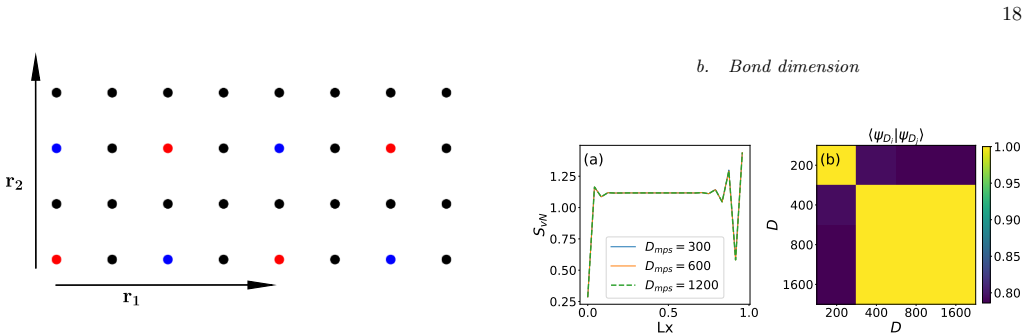
[300]
We also examine the graviton spec- trum obtained at different bond dimensions to check the convergence
For example, the difference 1− ⟨ψD=300|ψD=1200⟩is smaller than 10 −4. We also examine the graviton spec- trum obtained at different bond dimensions to check the convergence. In Fig. 16, we display the graviton spec- trum at both chiralities obtained at different bond di- mensi...
Reviewed August 3, 2026 · model on record in the stance chip above.
Discussion (0). Sign in to comment.