Edge Assisted Multi-Camera Vehicle Tracking Framework for Real-Time and Scalable Deployment
Pith reviewed 2026-05-25 07:42 UTC · model grok-4.3
The pith
A distributed edge-server framework tracks vehicles across multiple cameras in real time by sending only lightweight metadata for cross-camera association.
A machine-rendered reading of the paper's core claim, the machinery that carries it, and where it could break.
Core claim
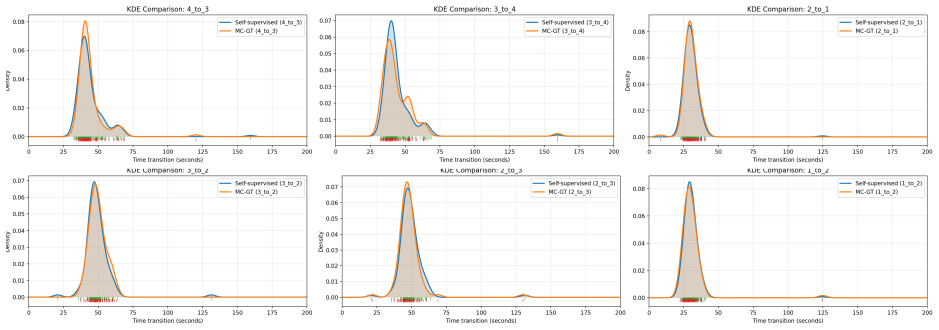
EASE-MCVT is the first MCVT framework explicitly designed to address both real-time performance and scalability in a distributed edge-server setting. On the edge side, each camera stream is processed through object detection, single-camera tracking, geo-mapping and feature extraction, while only lightweight metadata, including vehicle locations and appearance features, is sent to the central server for cross-camera association. Algorithmic optimizations include a dynamic workload scheme for tracklet-level feature extraction, a server-side re-match module to reconnect fragmented tracklets, and a self-supervised camera link model that learns spatio-temporal constraints. System components for (
What carries the argument
The edge-server split where local edge processing extracts and forwards only vehicle locations and appearance features, with server-side re-match and self-supervised camera link model handling cross-camera association.
If this is right
- Enables city-wide real-time traffic management by supporting scalable operation across large camera networks.
- Reduces data transmission load through metadata-only exchange between edges and server.
- Improves association stability via the self-supervised camera link model that incorporates spatio-temporal constraints.
- Standardizes deployment and data exchange for production-scale intelligent transportation systems.
Where Pith is reading between the lines
- The metadata-only approach could lower network bandwidth demands enough to support denser camera deployments than video-streaming methods allow.
- Keeping raw video on the edge devices may reduce privacy exposure compared to centralized full-video processing.
- The same edge-server split with learned camera links could apply to multi-camera tracking of other road users such as pedestrians or cyclists.
Load-bearing premise
Lightweight metadata of vehicle locations and appearance features suffices for the server modules to reconnect tracklets and learn effective constraints without critical loss of visual information.
What would settle it
Deploy the system on a network of over 100 cameras and check whether cross-camera tracking accuracy drops below the levels reported on RoundaboutHD and CityFlow or whether end-to-end latency exceeds real-time thresholds.
Figures

read the original abstract
Cameras are a core sensing modality in modern intelligent transportation systems (ITS), providing rich visual information on road-user activities. Multi-Camera Vehicle Tracking (MCVT) uses this data to reconstruct vehicle trajectories across camera networks, supporting applications such as traffic flow prediction and optimisation. However, most existing MCVT studies emphasise tracking accuracy while paying limited attention to real-time performance and scalability, both essential for real-world and city-scale deployment. To address this gap, we propose Edge-Assisted, Scalable and Efficient MCVT (EASE-MCVT), a distributed edge--server framework designed for real-time throughput and scalable operation. On the edge side, each camera stream is processed through object detection, single-camera tracking, geo-mapping and feature extraction, while only lightweight metadata, including vehicle locations and appearance features, is sent to the central server for cross-camera association. To improve both tracking accuracy and system efficiency, EASE-MCVT is optimised from algorithmic and system perspectives. Algorithmically, it introduces a dynamic workload scheme for tracklet-level feature extraction, a server-side re-match module to reconnect fragmented tracklets, and a self-supervised camera link model that learns spatio-temporal constraints to accelerate and stabilise cross-camera association. Systemically, it integrates production-oriented data engineering components to standardise deployment and data exchange for large-scale operation. To the best of our knowledge, EASE-MCVT is the first MCVT framework explicitly designed to address both real-time performance and scalability in a distributed edge--server setting. Experiments on the RoundaboutHD and CityFlow datasets demonstrate real-time throughput with competitive tracking accuracy, paving the way for city-wide real-time traffic management.
Editorial analysis
A structured set of objections, weighed in public.
Referee Report
Summary. The paper proposes EASE-MCVT, a distributed edge-server framework for multi-camera vehicle tracking (MCVT) in intelligent transportation systems. On the edge, each camera performs detection, single-camera tracking, geo-mapping and feature extraction, sending only lightweight metadata (vehicle locations and appearance features) to a central server for cross-camera association. Algorithmic optimizations include a dynamic workload scheme for tracklet-level feature extraction, a server-side re-match module for fragmented tracklets, and a self-supervised camera link model for spatio-temporal constraints. System components standardize large-scale deployment. The authors claim it is the first MCVT framework explicitly designed for both real-time performance and scalability in an edge-server setting, with experiments on RoundaboutHD and CityFlow demonstrating real-time throughput and competitive tracking accuracy.
Significance. If the performance claims hold with supporting quantitative evidence, this work would address a practical gap in MCVT by enabling city-scale, real-time deployment through edge distribution and metadata-only transmission, which could reduce bandwidth demands while supporting applications like traffic optimization. The integration of algorithmic modules (re-match, camera-link) with production data engineering components strengthens its potential for scalable ITS.
major comments (2)
- [Abstract] Abstract: The central claim that 'Experiments on the RoundaboutHD and CityFlow datasets demonstrate real-time throughput with competitive tracking accuracy' supplies no quantitative metrics (e.g., FPS, MOTA, IDF1), baselines, ablation results, or error analysis. This absence makes it impossible to verify the headline assertions of real-time performance and competitive accuracy that underpin the framework's contribution.
- [Abstract] Abstract: The framework's core premise—that transmitting only lightweight metadata (locations and appearance features) suffices for competitive cross-camera accuracy—rests on the untested assumption that the server-side re-match module and self-supervised camera link model can fully recover information lost from edge-side feature extraction. No ablation isolating the effect of metadata-only transmission versus full visual cues is referenced, which directly bears on whether the accuracy claims generalize beyond the reported datasets.
Simulated Author's Rebuttal
We thank the referee for the constructive comments. We address each major comment below and will revise the manuscript to strengthen the presentation of results.
read point-by-point responses
-
Referee: [Abstract] Abstract: The central claim that 'Experiments on the RoundaboutHD and CityFlow datasets demonstrate real-time throughput with competitive tracking accuracy' supplies no quantitative metrics (e.g., FPS, MOTA, IDF1), baselines, ablation results, or error analysis. This absence makes it impossible to verify the headline assertions of real-time performance and competitive accuracy that underpin the framework's contribution.
Authors: We agree that the abstract would be strengthened by including specific quantitative metrics. In the revised version we will update the abstract to report key results such as achieved FPS, MOTA and IDF1 scores on both datasets together with explicit baseline comparisons drawn from the experimental section. revision: yes
-
Referee: [Abstract] Abstract: The framework's core premise—that transmitting only lightweight metadata (locations and appearance features) suffices for competitive cross-camera accuracy—rests on the untested assumption that the server-side re-match module and self-supervised camera link model can fully recover information lost from edge-side feature extraction. No ablation isolating the effect of metadata-only transmission versus full visual cues is referenced, which directly bears on whether the accuracy claims generalize beyond the reported datasets.
Authors: The experiments on RoundaboutHD and CityFlow already demonstrate that the metadata-only pipeline, augmented by the re-match module and self-supervised camera link model, yields competitive cross-camera accuracy. We acknowledge that an explicit ablation isolating metadata-only transmission from full visual cues is not currently referenced. We will add this ablation study in the revision to quantify the contribution of the server-side components and to further support generalizability. revision: yes
Circularity Check
No circularity: framework assembles standard CV modules with new optimizations, validated on independent public datasets
full rationale
The paper describes an engineering integration of object detection, single-camera tracking, feature extraction, and cross-camera association, augmented by three new modules (dynamic workload, re-match, self-supervised camera link). All performance claims are tied to experiments on the external RoundaboutHD and CityFlow datasets rather than any fitted parameter or self-referential definition. No equations, uniqueness theorems, or self-citations are invoked to force the central result. The derivation chain is therefore self-contained against external benchmarks.
Axiom & Free-Parameter Ledger
axioms (1)
- domain assumption Cameras are calibrated and time-synchronized sufficiently for geo-mapping and cross-camera association.
Reference graph
Works this paper leans on
-
[1]
arXiv preprint arXiv:2206.14651
Bot-sort: Robust associations multi-pedestrian tracking. arXiv preprint arXiv:2206.14651 . 12 Amosa, T.I., Sebastian, P., Izhar, L.I., Ibrahim, O., Ayinla, L.S., Bahashwan, A.A., Bala, A., Samaila, Y .A.,
-
[2]
Qwen technical report. arXiv preprint arXiv:2309.16609 . Balamuralidhar, N., Tilon, S., Nex, F.,
work page internal anchor Pith review Pith/arXiv arXiv
-
[3]
Simple online and realtime tracking, in: 2016 IEEE international conference on image processing (ICIP), Ieee. pp. 3464–3468. Broström, M.,
work page 2016
-
[4]
Commit version used: v13.0.17 (July 2025)
BoxMOT: Pluggable sota multi-object tracking modules for segmentation, object detection, and pose estimation.https://github.com/mikel-brostrom/boxmot. Commit version used: v13.0.17 (July 2025). Cao, J., Pang, J., Weng, X., Khirodkar, R., Kitani, K.,
work page 2025
-
[5]
arXiv preprint arXiv:2003.09003
Mot20: A benchmark for multi object tracking in crowded scenes. arXiv preprint arXiv:2003.09003 . Gaikwad, B., Karmakar, A.,
-
[6]
Journal of real-time image processing 18, 1993–2007
Smart surveillance system for real-time multi-person multi-camera tracking at the edge. Journal of real-time image processing 18, 1993–2007. Gerum, R., Richter, S., Winterl, A., Fabry, B., Zitterbart, D.,
work page 1993
-
[7]
arXiv preprint arXiv:1712.07438
Cameratransform: a scientific python package for perspective camera corrections. arXiv preprint arXiv:1712.07438 . Girshick, R.,
-
[8]
YOLOv11: An Overview of the Key Architectural Enhancements
Yolov11: An overview of the key architectural enhancements. arXiv preprint arXiv:2410.17725 . Lashkov, I., Yuan, R., Zhang, G.,
work page internal anchor Pith review Pith/arXiv arXiv
- [9]
-
[10]
Microsoft coco: Common objects in context, in: Computer vision–ECCV 2014: 13th European conference, zurich, Switzerland, September 6-12, 2014, proceedings, part v 13, Springer. pp. 740–755. Lin, Y ., Lockyer, S., Evans, A., Zarbock, M., Zhang, N., 2025a. Ablation study for multicamera vehicle tracking using cityflow dataset, in: Seventeenth International ...
-
[11]
YOLOv12: Attention-Centric Real-Time Object Detectors
Yolov12: Attention-centric real-time object detectors. arXiv preprint arXiv:2502.12524 . Varghese, R., Sambath, M.,
work page internal anchor Pith review Pith/arXiv arXiv
-
[12]
Yolov8: A novel object detection algorithm with enhanced performance and robustness, in: 2024 International conference on advances in data engineering and intelligent computing systems (ADICS), IEEE. pp. 1–6. Wojke, N., Bewley, A., Paulus, D.,
work page 2024
-
[13]
Simple online and realtime tracking with a deep association metric, in: 2017 IEEE international conference on image processing (ICIP), IEEE. pp. 3645–3649. Wu, M., Qian, Y ., Wang, C., Yang, M.,
work page 2017
-
[14]
2019 IEEE Visual Communications and Image Processing (VCIP) , 1–4
Real-time multi-target multi-camera tracking with spatial-temporal information. 2019 IEEE Visual Communications and Image Processing (VCIP) , 1–4. Zhang, X., Yu, H., Qin, Y ., Zhou, X., Chan, S.,
work page 2019
-
[15]
A real-time framework of multi-camera vehicle tracking system, in: 2024 IEEE International Conference on Real-time Computing and Robotics (RCAR), IEEE. pp. 149–154. 15
work page 2024
discussion (0)
Sign in with ORCID, Apple, or X to comment. Anyone can read and Pith papers without signing in.