REVIEW 2 major objections 42 references
BitFair: A 12nm Bit-Serial CNN Accelerator with Learnable Early Termination and Adaptive Bit Ordering for Ultra-Low-Power XR Vision
T0 review · 2 major / 0 minor · reviewed 2026-07-11 · grok-4.5
Pith's one-line read BitFair shows that ordinary CNNs can match SNN-style efficiency for always-on XR vision by learning when to stop computing weight bits.
desk verdict Solid 12 nm bit-serial CNN co-design with learnable early-stop and adaptive bit order; absolute post-layout numbers are useful, but the 4–22× headline multipliers over SNN chips are soft under cross-node bit-normalized metrics. read the letter →
The pith
A machine-rendered reading of the paper's core claim, the machinery that carries it, and where it could break.
The reading
What carries the argument
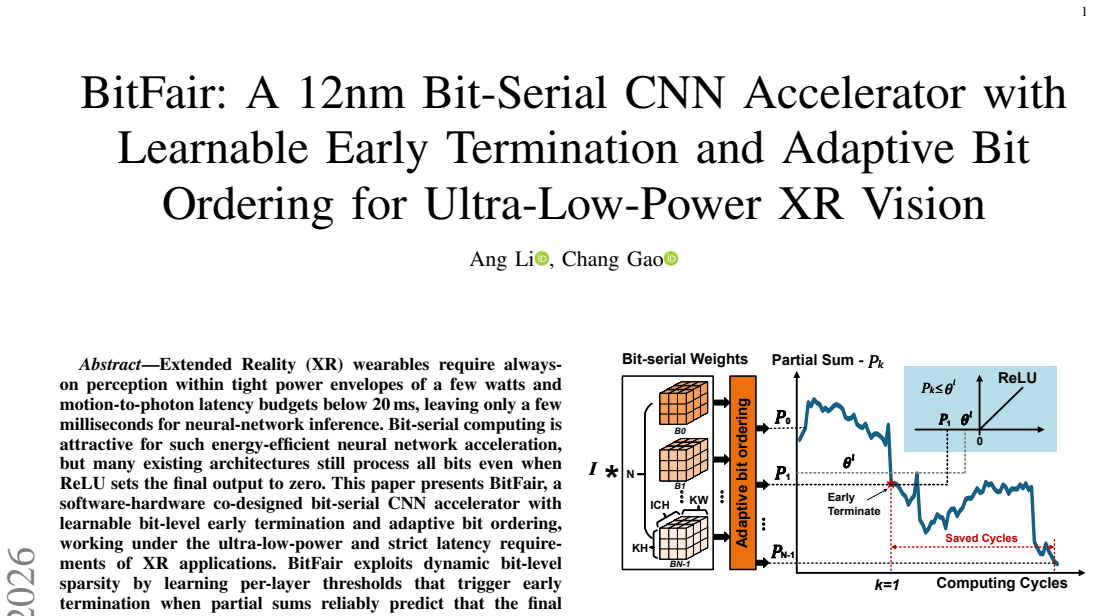
Learnable bit-level early termination: after each bit plane the running partial sum is compared with a trained layer threshold θ_l; if it falls below θ_l the remaining bits are skipped and the ReLU output is forced to zero. Adaptive bit ordering (greedy search) rearranges which weight bit is processed next so informative bits appear early, maximizing the chance of a correct early stop.
What would settle it
Measure ReLU activation sparsity and cycle speed-up on a dense non-ReLU network or a task whose pre-activations stay mostly positive; if speed-up collapses to ~1× while accuracy is preserved only by never terminating, the claimed efficiency source is absent.
Extended reading notes
Core claim
A software-hardware co-designed bit-serial CNN can exploit ReLU-induced dynamic sparsity at bit granularity by learning per-layer early-termination thresholds and layer-wise bit orders, yielding 4.0–22.1× better energy efficiency and up to 9.2% higher accuracy than prior fabricated XR vision accelerators while meeting sub-millisecond latency and milliwatt power budgets.
Load-bearing premise
Enough layer outputs become negative under ReLU that a partial sum after only a few bits reliably predicts the final zero, so early termination actually saves cycles without hurting accuracy.
Editorial analysis
A structured set of objections, weighed in public.
Referee Report
Summary. BitFair is a software–hardware co-designed bit-serial CNN accelerator for ultra-low-power XR vision. It processes sign-magnitude weights bit-serially under a learned layer-wise order ω_l, and early-terminates remaining bit planes when the partial sum P_k falls below a learned per-layer threshold θ_l, predicting a ReLU-zero output (Eqs. 3–4, §III-A/B). Thresholds are trained end-to-end via a temperature-annealed soft gate and a bit-survival regularizer (Eqs. 7–13); bit orders are chosen by a greedy search that scores ETR/(AccLoss+ε) on a calibration set (Alg. 1, §III-C). A 16 imes16 output-stationary PE array with per-PE termination is implemented in GF 12 nm (0.34 mm^{2}, 104 KB SRAM, 0.55–0.70 V). Post-layout results report sub-ms latency, up to 117.0 BTOPS/W and 0.07 pJ/SOP, with 96.5%/97.7% accuracy on DVSGesture/N-MNIST and claimed 4.0–22.1 imes energy-efficiency and up to 9.2% accuracy gains over prior fabricated XR vision accelerators (Table III, §V-E).
Significance. The work is a solid, well-specified co-design contribution for always-on XR perception. Learnable bit-level early termination plus adaptive bit ordering is a clear advance over fixed-threshold MSB-first schemes (BitSET-style baselines in Table IV), and the ablations (Figs. 5–6) and offline-cost comparison (Table V) support the accuracy–speed trade-off. Post-layout multi-V/F characterization with activity from functional simulation, sub-ms DVSGesture latency, and explicit sparsity bounds in §VI are strengths. If the absolute 12 nm numbers and same-workload accuracy/FPS/EDP hold, the paper is a useful reference for edge bit-serial CNN accelerators targeting event and frame vision under tight power/latency envelopes.
major comments (2)
- Abstract and §V-E headline the 4.0–22.1 imes energy-efficiency improvement primarily via pJ/SOP and BTOPS/W ratios in Table III. Footnotes 1–2 define SOP for 1-bit spike×weight and BTOPS as #Wbits×#Abits×TOPS, then reduce BitFair to #Abits×TOPS because it processes one weight bit per cycle. This bit-normalization is not workload-equivalent between a bit-serial CNN and SNN designs with different coding, dataflows, and technology nodes (22–130 nm), and node differences are un-normalized. The paper correctly cautions that the metric should be read with accuracy/FPS/EDP, yet the abstract and §V-E still treat the multipliers as the primary efficiency claim. Please reframe the headline around absolute post-layout power/latency/EDP and same-workload accuracy/FPS, and present BTOPS/W and pJ/SOP only as secondary, precision-aware references with explicit caveats.
- §VI and the SVHN/DVSGesture sparsity numbers (≈55% vs ≈68% ReLU sparsity) correctly state that speed-up is bounded by negative pre-activations and degrades toward 1× when sparsity is low or activations lack a hard-zero region. The central claim that early termination yields large cycle savings without material accuracy loss therefore depends on this regime. Please make the sparsity dependence more prominent in the abstract/results (not only in Limitations), and report per-layer or model-level ReLU sparsity and early-termination rates for all five datasets so readers can judge how far the gains generalize beyond event-camera workloads.
Circularity Check
No significant circularity: thresholds and bit orders are offline-optimized then measured on held-out accuracy and cycle counts; efficiency claims rest on post-layout numbers versus external chips, not definitional identities.
full rationale
BitFair's core claims are empirical hardware-software results, not first-principles derivations. Learnable thresholds (Eqs. 6–13) and the greedy ABO search (Alg. 1, score = ETR/(AccLoss+ε)) are standard regularized fits and offline search; they are evaluated by task accuracy and bit-cycle speed-up against a vanilla bit-serial baseline and against BitSET-style fixed thresholds (Tables II, IV; Figs. 5–6). The soft-gate training objective L = L_CE + λ_bit L_bit is an ordinary accuracy–efficiency trade-off, not a tautology that forces the reported numbers. Post-layout area, power, latency, and the Table III comparisons to prior fabricated SNN/CNN accelerators are external measurements; the bit-normalized BTOPS/W and pJ/SOP definitions (footnotes 1–2) are metric choices that may be non-equivalent across coding schemes, but they do not make the reported ratios true by construction of the paper's own equations. No self-definitional loop, no fitted parameter renamed as an independent prediction of the same quantity, and no load-bearing uniqueness theorem imported from the authors. Score 1 only for the minor, non-load-bearing self-contained metric framing; the derivation chain is self-contained against external benchmarks.
Assumptions & free parameters
free parameters (6)
- per-layer early-termination thresholds θ_l (offset θ_l_x)
- bit-survival regularizer weight λ_bit
- temperature annealing schedule T0=1.0 → TE=0.05
- layer-wise bit orderings ω_l from greedy search
- calibration set sizes and network channel configs
- voltage/frequency operating points for peak metrics
assumptions (5)
- domain assumption ReLU clamps negative pre-activations to exact zero, creating dynamic sparsity that can be predicted from partial sums.
- standard math Sign-magnitude N-bit weights can be processed bit-serially with positional significance 2^ω(j) under a custom order ω.
- ad hoc to paper If partial sum P_k ≤ θ_l after k bit planes, the final ReLU output can be treated as zero for the remaining bits.
- ad hoc to paper Greedy sequential bit selection with MSB-first fill of remaining slots is a sufficient proxy for good orderings.
- domain assumption Bit-normalized BTOPS/W and pJ/SOP allow meaningful efficiency comparison between this bit-serial CNN and prior SNN edge chips.
invented entities (3)
-
BitFair soft early-termination gate and prefix survival product S_k
-
Adaptive bit-ordering score ETR/(AccLoss+ε) and greedy search procedure
-
BitFair 16×16 output-stationary bit-serial PE array with per-PE termination control
Cite this review
Pith. "Pith review of BitFair: A 12nm Bit-Serial CNN Accelerator with Learnable Early Termination and Adaptive Bit Ordering for Ultra-Low-Power XR Vision." pith.science (2026). https://pith.science/paper/MGIDWVEN
@misc{pith2026260705445,
  author       = {Pith},
  title        = {Pith review of: BitFair: A 12nm Bit-Serial CNN Accelerator with Learnable Early Termination and Adaptive Bit Ordering for Ultra-Low-Power XR Vision},
  year         = {2026},
  howpublished = {\url{https://pith.science/paper/MGIDWVEN}},
  note         = {Machine review of arXiv:2607.05445}
}
read the original abstract
Extended Reality (XR) wearables require always-on perception within tight power envelopes of a few watts and motion-to-photon latency budgets below 20 ms, leaving only a few milliseconds for neural-network inference. Bit-serial computing is attractive for such energy-efficient neural network acceleration, but many existing architectures still process all bits even when ReLU sets the final output to zero. This paper presents BitFair, a software-hardware co-designed bit-serial CNN accelerator with learnable bit-level early termination and adaptive bit ordering, working under the ultra-low-power and strict latency requirements of XR applications. BitFair exploits dynamic bit-level sparsity by learning per-layer thresholds that trigger early termination when partial sums reliably predict that the final ReLU output will be zero. Furthermore, it searches for layer-wise bit orders that prioritize informative bits, maximizing early termination without sacrificing accuracy. A GlobalFoundries 12nm FinFET implementation with a core area of 0.34 mm^2, 104 KB on-chip memory, and voltage scaling from 0.55 to 0.70 V achieves sub-millisecond latency, up to 117.0 BTOPS/W, and 0.07 pJ/SOP. On IBM DVS128 Gesture and N-MNIST, BitFair achieves 96.5% and 97.7% accuracy, respectively, while improving effective energy efficiency by 4.0-22.1x and accuracy by up to 9.2% over prior fabricated XR vision accelerators.
Figures


Figures from the paper (6 more)


Reference graph
Works this paper leans on
-
[1]
A low power, fully event-based gesture recognition system,
A. Amir, B. Taba, D. Berg, T. Melano, J. McKinstry, C. Di Nolfo, T. Nayak, A. Andreopoulos, G. Garreau, M. Mendozaet al., “A low power, fully event-based gesture recognition system,” inProceedings of the IEEE conference on computer vision and pattern recognition, 2017, pp. 7243–7252
2017
-
[2]
Reckon: A 28nm sub-mm2 task-agnostic spiking recurrent neural network processor enabling on-chip learning over second-long timescales,
C. Frenkel and G. Indiveri, “Reckon: A 28nm sub-mm2 task-agnostic spiking recurrent neural network processor enabling on-chip learning over second-long timescales,” in2022 IEEE International Solid-State Circuits Conference (ISSCC), vol. 65. IEEE, 2022, pp. 1–3
2022
-
[3]
22.6 anp-i: A 28nm 1.5 pj/sop asynchronous spiking neural network processor enabling sub-o. 1µj/sample on-chip learning for edge-ai applications,
J. Zhang, D. Huo, J. Zhang, C. Qian, Q. Liu, L. Pan, Z. Wang, N. Qiao, K.-T. Tang, and H. Chen, “22.6 anp-i: A 28nm 1.5 pj/sop asynchronous spiking neural network processor enabling sub-o. 1µj/sample on-chip learning for edge-ai applications,” in2023 IEEE International Solid- State Circuits Conference (ISSCC). IEEE, 2023, pp. 21–23
2023
-
[4]
A wearable biosensing system with in-sensor adaptive machine learning for hand gesture recognition,
A. Moin, A. Zhou, A. Rahimi, A. Menon, S. Benatti, G. Alexandrov, S. Tamakloe, J. Ting, N. Yamamoto, Y . Khanet al., “A wearable biosensing system with in-sensor adaptive machine learning for hand gesture recognition,”Nature Electronics, vol. 4, no. 1, pp. 54–63, 2021
2021
-
[5]
Edge assisted real-time object detec- tion for mobile augmented reality,
L. Liu, H. Li, and M. Gruteser, “Edge assisted real-time object detec- tion for mobile augmented reality,” inThe 25th annual international conference on mobile computing and networking, 2019, pp. 1–16
2019
-
[6]
Quantization and training of neural networks for efficient integer-arithmetic-only inference,
B. Jacob, S. Kligys, B. Chen, M. Zhu, M. Tang, A. Howard, H. Adam, and D. Kalenichenko, “Quantization and training of neural networks for efficient integer-arithmetic-only inference,”Proceedings of the IEEE Conference on Computer Vision and Pattern Recognition, pp. 2704– 2713, 2018
2018
-
[7]
Unpu: An energy-efficient deep neural network accelerator with fully variable weight bit precision,
J. Lee, C. Kim, S. Kang, D. Shin, S. Kim, and H.-J. Yoo, “Unpu: An energy-efficient deep neural network accelerator with fully variable weight bit precision,”IEEE Journal of Solid-State Circuits, vol. 54, no. 1, pp. 173–185, 2018
2018
-
[8]
Quest 3 power usage tests and approximate battery life,
Meta Community Forums, “Quest 3 power usage tests and approximate battery life,” https://communityforums.atmeta.com/t5/Talk-VR/ Quest-3-Power-Usage-Tests-and-Approximate-Battery-Life/td-p/ 1094433, 2024, accessed: 2025-03-15
2024
Show all 42 references
-
[9]
Apple vision pro – technical specifications,
Apple Inc., “Apple vision pro – technical specifications,” https://www. apple.com/apple-vision-pro/specs/, 2024, accessed: 2025-03-15
2024
-
[10]
Measuring and understanding motion-to-photon latency in immersive virtual reality systems,
M. Di Lucaet al., “Measuring and understanding motion-to-photon latency in immersive virtual reality systems,”Frontiers in Virtual Reality, vol. 4, p. 1280493, 2023
2023
-
[11]
Visual wake words dataset,
A. Chowdhery, P. Warden, J. Shlens, A. Howard, and R. Rhodes, “Visual wake words dataset,”arXiv preprint arXiv:1906.05721, 2019
1906 arXiv
-
[12]
A 40nm 0.05-1.4 uj/inference sample-wise-adaptive spiking neural network processor with dynamic neuron-pruning and unstructured-model-aware architecture,
J. Yang, Z. Zhu, L. Xv, A. Xiao, Z. Yang, L. Zheng, and Z. Zou, “A 40nm 0.05-1.4 uj/inference sample-wise-adaptive spiking neural network processor with dynamic neuron-pruning and unstructured-model-aware architecture,” in2025 IEEE Custom Integrated Circuits Conference (CICC)....
2025
-
[13]
Neuc-cim: A 1.3 pj/sop neuromorphic charge- domain compute-in-memory macro for spiking neural network,
H. Fu, H. Zheng, Y . Zhou, X. Wen, Y . Chen, H. Ren, X. Lin, Z. Zong, L. Wu, and B. Cheng, “Neuc-cim: A 1.3 pj/sop neuromorphic charge- domain compute-in-memory macro for spiking neural network,” in2025 Symposium on VLSI Technology and Circuits (VLSI Technology and Circuits). ...
2025
-
[14]
Dorefa-net: Training low bitwidth convolutional neural networks with low bitwidth gradients,
S. Zhou, Y . Wu, Z. Ni, X. Zhou, H. Wen, and Y . Zou, “Dorefa-net: Training low bitwidth convolutional neural networks with low bitwidth gradients,” inarXiv preprint arXiv:1606.06160, 2016
2016 arXiv
-
[15]
Laconic deep learning inference acceleration,
S. Sharify, A. D. Lascorz, M. Mahmoud, M. Nikolic, K. Siu, D. M. Stuart, Z. Poulos, and A. Moshovos, “Laconic deep learning inference acceleration,” inProceedings of the 46th International Symposium on Computer Architecture, 2019, pp. 304–317
2019
-
[16]
Bit-pragmatic deep neural network computing,
J. Albericio, A. Delm ´as, P. Judd, S. Sharify, G. O’Leary, R. Genov, and A. Moshovos, “Bit-pragmatic deep neural network computing,” in Proceedings of the 50th annual IEEE/ACM international symposium on microarchitecture, 2017, pp. 382–394
2017
-
[17]
Stripes: Bit-serial deep neural network computing,
P. Judd, J. Albericio, T. Hetherington, T. M. Aamodt, and A. Moshovos, “Stripes: Bit-serial deep neural network computing,” in2016 49th Annual IEEE/ACM International Symposium on Microarchitecture (MI- CRO). IEEE, 2016, pp. 1–12
2016
-
[18]
Predictivenet: An energy- efficient convolutional neural network via zero prediction,
Y . Lin, C. Sakr, Y . Kim, and N. Shanbhag, “Predictivenet: An energy- efficient convolutional neural network via zero prediction,” in2017 IEEE international symposium on circuits and systems (ISCAS). IEEE, 2017, pp. 1–4
2017
-
[19]
Prediction based execution on deep neural networks,
M. Song, J. Zhao, Y . Hu, J. Zhang, and T. Li, “Prediction based execution on deep neural networks,” in2018 ACM/IEEE 45th Annual International Symposium on Computer Architecture (ISCA). IEEE, 2018, pp. 752– 763
2018
-
[20]
Snapea: Predictive early activation for reducing compu- tation in deep convolutional neural networks,
V . Akhlaghi, A. Yazdanbakhsh, K. Samadi, R. K. Gupta, and H. Es- maeilzadeh, “Snapea: Predictive early activation for reducing compu- tation in deep convolutional neural networks,” in2018 ACM/IEEE 45th Annual International Symposium on Computer Architecture (ISCA). IEEE, 2018...
2018
-
[21]
Bitset: Bit-serial early termination for computation reduction in convolutional neural networks,
Y . Pan, J. Yu, A. Lukefahr, R. Das, and S. Mahlke, “Bitset: Bit-serial early termination for computation reduction in convolutional neural networks,”ACM Transactions on Embedded Computing Systems, vol. 22, no. 5s, pp. 1–24, 2023
2023
-
[22]
30.2 a 22nm 0.26 nw/synapse spike-driven spiking neural network processing unit using time-step-first dataflow and sparsity-adaptive in-memory computing,
Y . Liu, Y . Ma, N. Shang, T. Zhao, P. Chen, M. Wu, J. Ru, T. Jia, L. Ye, Z. Wanget al., “30.2 a 22nm 0.26 nw/synapse spike-driven spiking neural network processing unit using time-step-first dataflow and sparsity-adaptive in-memory computing,” in2024 IEEE International Solid-...
2024
-
[23]
Estimating or propagating gradients through stochastic neurons for conditional computation,
Y . Bengio, N. L ´eonard, and A. Courville, “Estimating or propagating gradients through stochastic neurons for conditional computation,” in arXiv preprint arXiv:1308.3432, 2013
2013 arXiv
-
[24]
Surrogate gradient learning in spiking neural networks,
E. O. Neftci, H. Mostafa, and F. Zenke, “Surrogate gradient learning in spiking neural networks,”IEEE Signal Processing Magazine, vol. 36, no. 6, pp. 51–63, 2019
2019
-
[25]
Direct learning-based deep spiking neural networks: a review,
Y . Guo, X. Huang, and Z. Ma, “Direct learning-based deep spiking neural networks: a review,”Frontiers in Neuroscience, vol. 17, p. 1209795, 2023
2023
-
[26]
To spike or not to spike: A digital hardware perspective on deep learning acceleration,
F. Ottati, C. Gao, Q. Chen, G. Brignone, M. R. Casu, J. K. Eshraghian, and L. Lavagno, “To spike or not to spike: A digital hardware perspective on deep learning acceleration,”IEEE Journal on Emerging and Selected Topics in Circuits and Systems, vol. 13, no. 4, pp. 1015–1025, 2023
2023
-
[27]
Bitwave: Ex- ploiting column-based bit-level sparsity for deep learning acceleration,
M. Shi, V . Jain, A. Joseph, M. Meijer, and M. Verhelst, “Bitwave: Ex- ploiting column-based bit-level sparsity for deep learning acceleration,” in2024 IEEE International Symposium on High-Performance Computer Architecture (HPCA). IEEE, 2024, pp. 732–746. 13
2024
-
[28]
Bitpattern: Enabling efficient bit-serial acceleration of deep neural networks through bit-pattern pruning,
G. Wang, S. Cai, Z. Li, W. Li, D. Lyu, Y . Sun, J. Jiang, and G. He, “Bitpattern: Enabling efficient bit-serial acceleration of deep neural networks through bit-pattern pruning,” in2025 62nd ACM/IEEE Design Automation Conference (DAC). IEEE, 2025, pp. 1–7
2025
-
[29]
Learning structured sparsity in deep neural networks,
W. Wen, C. Wu, Y . Wang, Y . Chen, and H. Li, “Learning structured sparsity in deep neural networks,”Advances in neural information processing systems, vol. 29, 2016
2016
-
[30]
Exploiting neuro-inspired dynamic sparsity for energy-efficient intelligent percep- tion,
S. Zhou, C. Gao, T. Delbruck, M. Verhelst, and S.-C. Liu, “Exploiting neuro-inspired dynamic sparsity for energy-efficient intelligent percep- tion,”Nature Communications, vol. 16, no. 1, p. 9928, 2025
2025
-
[31]
Bitcluster: Fine-grained weight quantization for load-balanced bit-serial neural network accelerators,
A. Li, H. Mo, W. Zhu, Q. Li, S. Yin, S. Wei, and L. Liu, “Bitcluster: Fine-grained weight quantization for load-balanced bit-serial neural network accelerators,”IEEE Transactions on Computer-Aided Design of Integrated Circuits and Systems, vol. 41, no. 11, pp. 4747–4757, 2022
2022
-
[32]
Very deep convolutional networks for large-scale image recognition,
K. Simonyan and A. Zisserman, “Very deep convolutional networks for large-scale image recognition,”arXiv preprint arXiv:1409.1556, 2014
2014 arXiv
-
[33]
Pytorch: An imperative style, high-performance deep learning library,
A. Paszke, S. Gross, F. Massa, A. Lerer, J. Bradbury, G. Chanan, T. Killeen, Z. Lin, N. Gimelshein, L. Antigaet al., “Pytorch: An imperative style, high-performance deep learning library,”Advances in neural information processing systems, vol. 32, 2019
2019
-
[34]
Spikingjelly: An open-source machine learning infrastructure platform for spike-based intelligence,
W. Fang, Y . Chen, J. Ding, Z. Yu, T. Masquelier, D. Chen, L. Huang, H. Zhou, G. Li, and Y . Tian, “Spikingjelly: An open-source machine learning infrastructure platform for spike-based intelligence,”Science Advances, vol. 9, no. 40, p. eadi1480, 2023
2023
-
[35]
Converting static image datasets to spiking neuromorphic datasets using saccades,
G. Orchard, A. Jayawant, G. K. Cohen, and N. Thakor, “Converting static image datasets to spiking neuromorphic datasets using saccades,” Frontiers in neuroscience, vol. 9, p. 437, 2015
2015
-
[36]
Gradient-based learning applied to document recognition,
Y . LeCun, L. Bottou, Y . Bengio, and P. Haffner, “Gradient-based learning applied to document recognition,”Proceedings of the IEEE, vol. 86, no. 11, pp. 2278–2324, 2002
2002
-
[37]
Reading digits in natural images with unsupervised feature learning,
Y . Netzer, T. Wang, A. Coates, A. Bissacco, B. Wu, A. Y . Nget al., “Reading digits in natural images with unsupervised feature learning,” inNIPS workshop on deep learning and unsupervised feature learning. Granada, 2011, p. 7
2011
-
[38]
A 593nj/inference dvs hand gesture recognition processor embedded with reconfigurable multiple constant multiplication technique,
Z. Fu and W. Ye, “A 593nj/inference dvs hand gesture recognition processor embedded with reconfigurable multiple constant multiplication technique,”IEEE Transactions on Circuits and Systems I: Regular Papers, vol. 71, no. 6, pp. 2749–2759, 2024
2024
-
[39]
Mega: A 22 nm convolutional spiking neural network accelerator achieving 0.375 pj/sop for efficient edge vision,
R. Luiken, M. D. Gomony, and S. Stuijk, “Mega: A 22 nm convolutional spiking neural network accelerator achieving 0.375 pj/sop for efficient edge vision,” 2026. [Online]. Available: https://arxiv.org/abs/2606.30039
2026 arXiv
-
[40]
Sparsecol: A 1320 btops/w precision-scalable npu exploiting training-free structured bit-level sparsity and dynamic dataflow,
M. Shi, V . Jain, W. Jiang, C. Fang, A. Joseph, W. Dehaene, and M. Ver- helst, “Sparsecol: A 1320 btops/w precision-scalable npu exploiting training-free structured bit-level sparsity and dynamic dataflow,”IEEE Journal of Solid-State Circuits, 2025
2025
-
[41]
Microsoft coco: Common objects in context,
T.-Y . Lin, M. Maire, S. Belongie, J. Hays, P. Perona, D. Ramanan, P. Doll ´ar, and C. L. Zitnick, “Microsoft coco: Common objects in context,” inEuropean conference on computer vision. Springer, 2014, pp. 740–755. Ang Li(Student Member, IEEE) received the B.S. degree in Micro...
2014
-
[42]
degree from Imperial College London in September 2016 and his B.Eng
He received his M.Sc. degree from Imperial College London in September 2016 and his B.Eng. degree from the University of Liverpool and Xi’an Jiaotong–Liverpool University in July 2015. In Au- gust 2022, he joined Delft University of Technology, The Netherlands, as a tenured As...
2016
Reviewed July 11, 2026 · model on record in the stance chip above.
Discussion (0). Sign in to comment.