REVIEW 4 major objections 5 minor 1 cited by
Towards Anomaly Detection on Relational Data
T0 review · 4 major / 5 minor · reviewed 2026-08-04 · deepseek-v4-flash
Pith's one-line read RelAD detects anomalies in relational databases by reconstructing both attribute values and the typed links between tables, and it outperforms existing methods on six benchmark datasets.
desk verdict New problem formulation with a sensible method, but the under-specified hyperparameter tuning makes the headline AUROC numbers questionable. read the letter →
The pith
A machine-rendered reading of the paper's core claim, the machinery that carries it, and where it could break.
The reading
What carries the argument
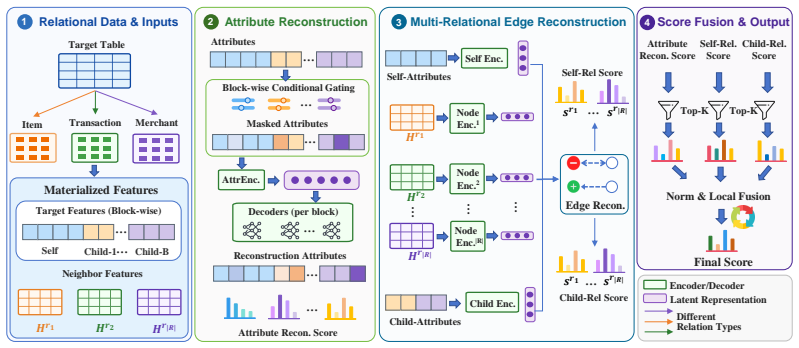
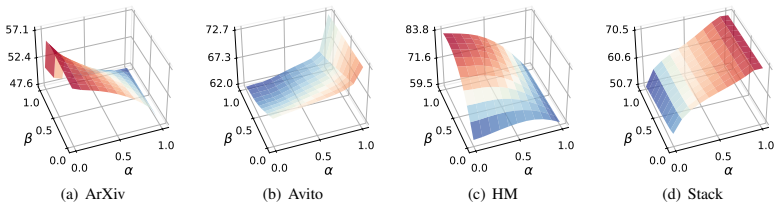
The central machinery is the pair of reconstruction modules. Conditional sparse-gated attribute reconstruction generates a mask per semantic block, gates the input, encodes it, decodes each block separately, and scores anomalies by the average of top-K normalized block residuals. Dual-view multi-relational edge reconstruction encodes the target entity from its self profile and its child-table behavioral profile independently, encodes neighbor entities per relation type, and reconstructs observed edges via a dot-product softplus loss; scores are top-K normalized average positive-edge negative log-likelihoods per branch and view. These are combined by a hierarchical fusion with hyperparameters
What would settle it
Run RelAD against the same baselines on a relational dataset with ground-truth fraud labels from operational logs rather than injected anomalies, keeping the schema and evaluation protocol identical; if RelAD no longer beats the best baseline, the injection-based evidence is not conclusive. A cheaper check is to construct a benchmark whose anomalies are global attribute shifts or added (not replaced) edges, which deliberately violate the injection design principles, and compare performance.
Extended reading notes
Core claim
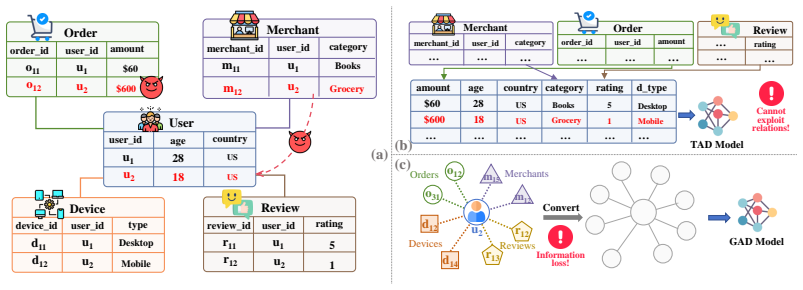
RelAD's central claim is that a normal entity in a relational database can explain (reconstruct) its own attributes and its typed edges, while an anomalous entity cannot. Attribute reconstruction operates on semantic blocks: child-table aggregates and central-table fields get separate conditional masks, separate decoders, and top-K normalized block residuals so sparse local deviations are not drowned out by global reconstruction error. Edge reconstruction treats each foreign-key relation separately and from two views — the central-table self profile and the aggregated child-table behavioral profile — using a shared relation-specific neighbor encoder and a softplus negative-log-likelihood los
Load-bearing premise
The load-bearing premise is that the dataset-specific anomaly injections mimic how anomalies actually appear in real relational data; if real fraud looks different, the benchmark comparisons do not establish real-world transfer.
Editorial extensions
If this is right
- On all six benchmark datasets, RelAD attains the best AUROC and AUPRC among nine tabular and graph baselines, with relative AUROC gains over the strongest baseline exceeding 10% on four datasets.
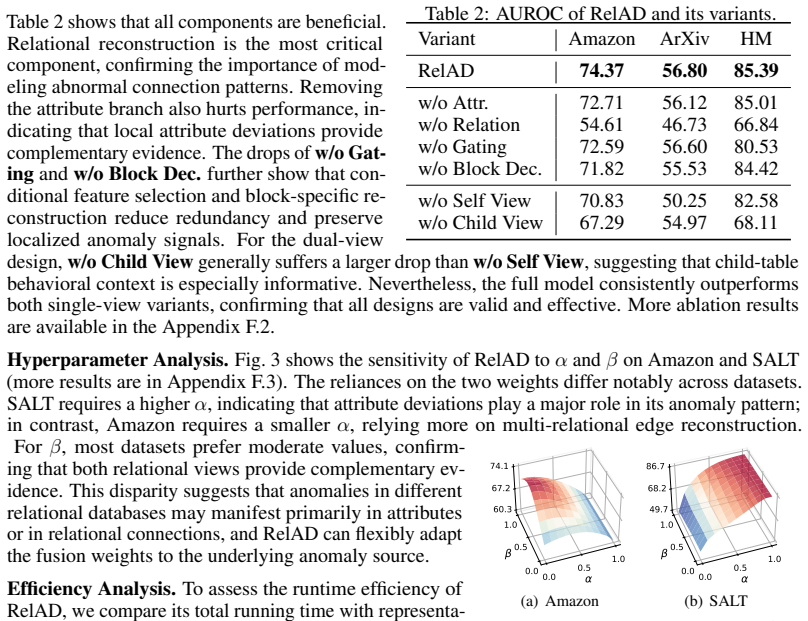
- Ablations show that removing multi-relational edge reconstruction causes the largest performance drop on Amazon, ArXiv, and HM, indicating that typed connection reconstruction is the most critical component.
- The dual-view design matters: removing the child-profile view hurts more on HM, while removing the self-profile view hurts more on ArXiv; neither view alone is sufficient.
- Conditional gating and block-specific decoding both improve results, confirming that suppressing redundant cross-table attributes and preserving localized semantic deviations helps detection.
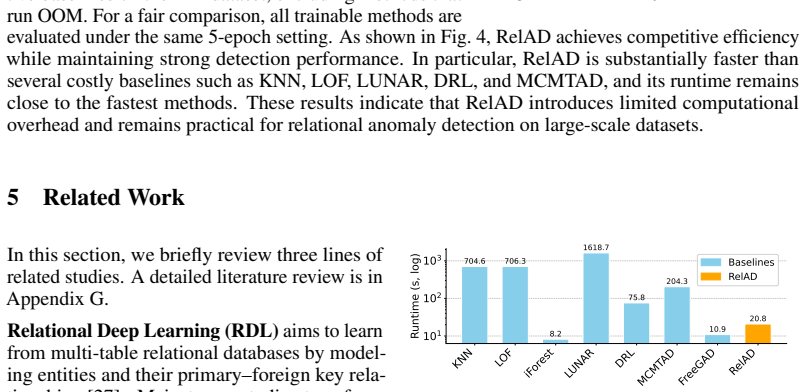
- Inference cost scales linearly with the total number of target entities, neighbor entities, and edges, so the method remains practical on large relational databases.
Reading between the lines
- The benchmark injections focus on rare local attribute swaps and redirected edges; if real-world anomalies are broad, gradual changes, the reported margin over baselines may not transfer to operational settings.
- Because the framework ignores temporal dynamics — a limitation the paper itself flags — extending RelAD to dynamic relational databases with evolving entities and edges is a natural next step.
- The same dual-view reconstruction principle could be reused for a relational anomaly detection foundation model: pretrain on diverse schemas, then score unseen tables at test time without retraining.
- A testable extension would build anomaly suites that separate attribute-only, edge-only, and mixed anomalies, then check whether the fusion weights alpha and beta need dataset-specific calibration to maintain performance.
Signed reviews
Editorial analysis
A structured set of objections, weighed in public.
Referee Report
Summary. The paper formalizes relational anomaly detection (RAD), the task of scoring entities in a central table of a relational database using both multi-table attributes and primary/foreign-key relationships. The proposed method, RelAD, combines (i) a conditional sparse-gated attribute reconstruction module that selectively gates feature blocks and computes top-K block-level residuals, and (ii) a dual-view multi-relational edge reconstruction module that scores edges through both self-profile and child-profile encoders. The two signals are fused via two scalar weights. The authors construct six benchmark datasets by injecting anomalies into RelBench/RelBench v2 databases, and report AUROC/AUPRC comparisons against tabular and homogeneous-graph anomaly detection baselines. The central claim is that RelAD consistently outperforms all baselines while remaining efficient.
Significance. If the reported results are valid, the paper makes a useful contribution: it is among the first to address anomaly detection directly on relational databases, and it provides a concrete framework, code, and a benchmark suite with systematic anomaly injection. The method is well specified, with complete equations, algorithms, complexity analysis, and mean±std results in the appendix. The design of block-aware conditional gating and dual-view edge reconstruction is reasonable and, in the ablation study, each component appears to contribute. However, the load-bearing evidence for consistent superiority is currently weakened by two evaluation-protocol issues: hyperparameter selection may use test labels, and no relational/h heterogeneous-graph baseline is compared. The benchmark validity also rests entirely on the authors' own injection rules, which align closely with RelAD's inductive biases. These concerns are fixable within the scope of a revision.
major comments (4)
- [Sec. 4.1 and Appendix E] The paper states that hyperparameters (learning rate, weight decay, batch size, λ_s, α, β) are tuned by random search per dataset, but does not mention any validation split. Since the task is unsupervised and anomaly labels are used only for evaluation, tuning on the test labels would leak label information and directly inflate the reported AUROC/AUPRC. This threatens the central claim of consistent outperformance in Table 1. Please clarify how hyperparameters were selected, and ideally report results for a fixed validation protocol that does not use test labels. The same protocol must be applied to all baselines.
- [Sec. 4.1, Table 1] No heterogeneous-graph or relational deep learning baseline is compared. The paper's argument is that RelAD is better than flattened-tabular and homogeneous-graph approaches, but the method's core novelty is multi-relational modeling. Without comparing to a relational baseline such as R-GCN, RelGNN, or an adapted relational deep learning model, the necessity of the dual-view multi-relational edge-reconstruction design is not established. The ablation 'w/o Relation' shows that removing this component hurts, but it does not show that RelAD's specific relational encoder is better than alternative relational architectures.
- [Appendix D and Tables 1/4/5] All evaluation is on self-injected anomalies. The injection rules are designed by the authors and directly encode the kinds of local attribute deviations and relation-specific edge redirections that RelAD is designed to detect. For example, the Amazon injection replaces review categories based on user history, and the ArXiv injection redirects citation edges to beacon papers. This makes the benchmark a test of whether RelAD matches its author-designed injection schemes, not necessarily whether it transfers to real relational fraud. The reported margins may not hold under other anomaly-generating processes. I recommend adding at least one independent injection protocol or a real-world labeled relational dataset, and reporting results under multiple injection configurations.
- [Eq. (17), Eq. (7)] The sparsity penalty in Eq. (7) is an L1-style penalty on gate values, not a constraint that forces a specific number of active gates. The paper repeatedly describes the gating as selecting a 'compact subset' of attributes, but the actual objective only encourages small gate values. This is a technical mismatch between the description and the implementation. Please clarify whether the learned gates are actually sparse after training, e.g., by reporting the fraction of gates below a threshold, or adjust the wording to describe the mechanism as soft shrinkage rather than selection.
minor comments (5)
- [Sec. 4.1 and Table 3] The text says the anomaly ratio is set to 5% across all datasets, but Table 3 reports Avito at 2.77%. If this is due to the validity constraints in Appendix D, please state this explicitly in the main text.
- [Sec. 4.2, 'Hyperparameter Analysis'] The sentence 'The reliances on the two weights differ notably' contains a typo; 'reliances' should be 'reliance'.
- [Figures 3 and 5] The heatmaps use different color scales across panels, which makes cross-dataset comparison difficult. It would help to use a shared color scale or annotate the color range on each panel.
- [Sec. 3.2, Eq. (15)] Uniform negative sampling over all neighbor entities is used without discussion. Since each relation type has different degree distributions, sampling negatives uniformly may not provide the most informative contrast. A brief discussion or an ablation on negative-sampling strategy would strengthen the paper.
- [General] The paper claims that RelAD 'consistently outperforms' baselines, but on some datasets the relative AUPRC gain is modest (e.g., Avito 5.59 vs. DRL 5.25; Stack 7.66 vs. MCMTAD 6.83). Reporting statistical significance tests, e.g., paired tests across seeds, would be more informative than mean±std alone.
Circularity Check
No circular derivation; reconstruction losses and anomaly-score fusion are self-contained, and the experimental caveats are validity risks rather than definitional circularity.
full rationale
The claimed derivation chain is the reconstruction objective Eq. (17) and the anomaly score Eq. (18). Eq. (17) is L = L_rec + λ_s L_sparse + Σ L^r_q, where L_rec (Eq. 9) is mean squared reconstruction error of attribute blocks, L_sparse (Eq. 7) is a gate sparsity penalty, and L^r_q (Eq. 15) is a softplus edge-reconstruction loss over observed and sampled negative edges. Eq. (18) is a convex combination of normalized block-level and relation-level reconstruction residuals. No quantity in these equations is defined in terms of the final anomaly score, and no fitted parameter is a renamed label or target: the gates (Eqs. 3–5), encoders, decoders, and edge scorers are trained without anomaly labels, and labels enter only at evaluation. The authors' self-citations are contextual (related work, benchmark protocols) and are not load-bearing for the method's design; no uniqueness theorem or prior ansatz is invoked to force RelAD's choices. The benchmark injections in Appendix D do encode localized attribute deviations and relation redirections that match RelAD's inductive biases, and Appendix E's random hyperparameter search does not explicitly state a validation split; these are external-validity and possible label-leakage concerns, not circularity in the derivation. The paper's own stated limitation (no temporal modeling, Sec. H) is also not a circular step. Thus the framework is self-contained against its equations.
Assumptions & free parameters
free parameters (5)
- α (attribute vs relational fusion weight) =
tuned per dataset; values not reported
- β (self vs child relational view weight) =
tuned per dataset; values not reported
- λ_s (sparsity regularization coefficient) =
tuned; not reported
- Top-K (block and relation selection count) =
not reported
- Anomaly injection parameters =
5% target; per-dataset values in Appendix D
assumptions (6)
- domain assumption Reconstruction error is a valid anomaly signal: normal entities dominate and are reconstructible, anomalies deviate.
- domain assumption Anomalies manifest as sparse local deviations concentrated in a few attribute blocks and/or relation-specific edges.
- domain assumption RelBench-style row encoding and child-table statistics (mean/std/count) preserve anomaly-relevant information.
- domain assumption The central table and its foreign-key relations are correctly identified and define all relevant anomaly surfaces.
- ad hoc to paper Uniform negative sampling for edge reconstruction produces useful contrast for relation-specific likelihoods.
- standard math Standard neural-network training (MLPs, Adam, ReLU, layer norm) behaves as expected.
Cite this review
Pith. "Pith review of Towards Anomaly Detection on Relational Data." pith.science (2026). https://pith.science/paper/MHLZJ7PI
@misc{pith2026260618621,
  author       = {Pith},
  title        = {Pith review of: Towards Anomaly Detection on Relational Data},
  year         = {2026},
  howpublished = {\url{https://pith.science/paper/MHLZJ7PI}},
  note         = {Machine review of arXiv:2606.18621}
}
read the original abstract
Relational databases are widely used for managing structured data in real-world systems. Detecting anomalies from such relational data is crucial for identifying fraud, risks, and abnormal behaviors, yet remains under-explored. The key challenges lie in the intrinsic complexity of relational data: multi-table attributes are high-dimensional and heterogeneous, making sparse abnormal clues easy to overwhelm by normal or irrelevant information. Moreover, anomalies may further manifest as abnormal connection patterns across different foreign-key relations, which existing tabular and graph anomaly detection methods are ill-suited to capture. To address them, we propose RelAD, a reconstruction-based framework that captures anomalies from both attribute and relational edge reconstruction. RelAD contains two core modules: conditional sparse-gated attribute reconstruction, which suppresses redundant multi-table attributes and emphasizes abnormal semantic blocks, and dual-view multi-relational edge reconstruction, which detects relation-specific abnormal connections from both intrinsic and behavioral instance profiles. The resulting attribute and relational signals are integrated through a lightweight fusion module to produce the final anomaly score. We further construct 6 benchmark datasets with systematic anomalies, on which extensive experiments show that RelAD consistently outperforms baselines while achieving competitive efficiency..The source code is available at https://github.com/Shiy-Li/RelAD.
Figures
Figures from the paper (2 more)
Forward citations
Cited by 1 Pith paper
-
CORE: In-Context Reconstruction for Unified Tabular Anomaly Detection
CORE detects anomalies in new tabular datasets by reconstructing each test sample from the nearest normal context samples in a learned, feature-aligned space; it is proposed as the first reconstruction-based unified t...
Reference graph
Works this paper leans on
-
[1]
Relbench: A benchmark for deep learning on relational databases.Advances in Neural Information Processing Systems, 37:21330–21341, 2024
Joshua Robinson, Rishabh Ranjan, Weihua Hu, Kexin Huang, Jiaqi Han, Alejandro Dobles, Matthias Fey, Jan E Lenssen, Yiwen Yuan, Zecheng Zhang, et al. Relbench: A benchmark for deep learning on relational databases.Advances in Neural Information Processing Systems, 37:21330–21341, 2024
2024
-
[2]
Relational deep learning: Challenges, foundations and next-generation architectures
Vijay Prakash Dwivedi, Charilaos Kanatsoulis, Shenyang Huang, and Jure Leskovec. Relational deep learning: Challenges, foundations and next-generation architectures. InProceedings of the 31st ACM SIGKDD Conference on Knowledge Discovery and Data Mining V . 2, pages 5999–6009, 2025
2025
-
[3]
Relational graph transformer
Vijay Prakash Dwivedi, Sri Jaladi, Yangyi Shen, Federico Lopez, Charilaos I Kanatsoulis, Rishi Puri, Matthias Fey, and Jure Leskovec. Relational graph transformer. InTemporal Graph Learning Workshop@ KDD 2025
2025
-
[4]
Relgnn: Composite message passing for relational deep learning
Tianlang Chen, Charilaos Kanatsoulis, and Jure Leskovec. Relgnn: Composite message passing for relational deep learning. InInternational Conference on Machine Learning, pages 8296–8312. PMLR, 2025
2025
-
[5]
Relational transformer: Toward zero-shot foundation models for relational data
Rishabh Ranjan, Valter Hudovernik, Mark Znidar, Charilaos I Kanatsoulis, Roshan Reddy Upendra, Mahmoud Mohammadi, Joe Meyer, Tom Palczewski, Carlos Guestrin, and Jure Leskovec. Relational transformer: Toward zero-shot foundation models for relational data. InEurIPS 2025 Workshop: AI for Tabular Data
2025
-
[6]
Griffin: Towards a graph-centric relational database foundation model
Yanbo Wang, Xiyuan Wang, Quan Gan, Minjie Wang, Qibin Yang, David Wipf, and Muhan Zhang. Griffin: Towards a graph-centric relational database foundation model. InInternational Conference on Machine Learning, pages 64604–64627. PMLR, 2025
2025
-
[7]
Beyond individual input for deep anomaly detection on tabular data
Hugo Thimonier, Fabrice Popineau, Arpad Rimmel, and Bich-Liên Doan. Beyond individual input for deep anomaly detection on tabular data. InInternational Conference on Machine Learning, pages 48097–48123. PMLR, 2024
2024
-
[8]
Drl: Decomposed representation learning for tabular anomaly detection
Hangting Ye, He Zhao, Wei Fan, Mingyuan Zhou, Dan dan Guo, and Yi Chang. Drl: Decomposed representation learning for tabular anomaly detection. InThe Thirteenth International Conference on Learning Representations, 2025
2025
Show all 60 references
-
[9]
Correcting false alarms from unseen: Adapting graph anomaly detectors at test time
Junjun Pan, Yixin Liu, Chuan Zhou, Fei Xiong, Alan Wee-Chung Liew, and Shirui Pan. Correcting false alarms from unseen: Adapting graph anomaly detectors at test time. InProceedings of the AAAI Conference on Artificial Intelligence, 2026
2026
-
[10]
A survey of generalization of graph anomaly detection: From transfer learning to foundation models
Junjun Pan, Yu Zheng, Yue Tan, and Yixin Liu. A survey of generalization of graph anomaly detection: From transfer learning to foundation models. InThe 16th IEEE International Conference on Knowledge Graphs, 2025. 10
2025
-
[11]
Deep anomaly detection on attributed networks
Kaize Ding, Jundong Li, Rohit Bhanushali, and Huan Liu. Deep anomaly detection on attributed networks. InProceedings of the 2019 SIAM international conference on data mining, pages 594–602. SIAM, 2019
2019
-
[12]
Anomaly detection on attributed networks via contrastive self-supervised learning.IEEE transactions on neural networks and learning systems, 33(6):2378–2392, 2021
Yixin Liu, Zhao Li, Shirui Pan, Chen Gong, Chuan Zhou, and George Karypis. Anomaly detection on attributed networks via contrastive self-supervised learning.IEEE transactions on neural networks and learning systems, 33(6):2378–2392, 2021
2021
-
[13]
Boosting graph anomaly detection with adaptive message passing
Jingyan Chen, Guanghui Zhu, Chunfeng Yuan, and Yihua Huang. Boosting graph anomaly detection with adaptive message passing. InThe Twelfth International Conference on Learning Representations, 2024
2024
-
[14]
Camera: Adapting to semantic camouflage in unsupervised text-attributed graph fraud detection
Junjun Pan, Yixin Liu, Yu Zheng, Lianhua Chi, Alan Wee-Chung Liew, and Shirui Pan. Camera: Adapting to semantic camouflage in unsupervised text-attributed graph fraud detection. InInternational Joint Conference on Artificial Intelligence, 2026
2026
-
[15]
Lof: identifying density-based local outliers
Markus M Breunig, Hans-Peter Kriegel, Raymond T Ng, and Jörg Sander. Lof: identifying density-based local outliers. InProceedings of the 2000 ACM SIGMOD international conference on Management of data, pages 93–104, 2000
2000
-
[16]
Lunar: Unifying local outlier detection methods via graph neural networks
Adam Goodge, Bryan Hooi, See-Kiong Ng, and Wee Siong Ng. Lunar: Unifying local outlier detection methods via graph neural networks. InProceedings of the AAAI conference on artificial intelligence, volume 36, pages 6737–6745, 2022
2022
-
[17]
Mcm: Masked cell modeling for anomaly detection in tabular data
Jiaxin Yin, Yuanyuan Qiao, Zitang Zhou, Xiangchao Wang, and Jie Yang. Mcm: Masked cell modeling for anomaly detection in tabular data. InThe Twelfth International Conference on Learning Representations, 2024
2024
-
[18]
Uncertainty- aware graph neural networks: A multihop evidence fusion approach.IEEE Transactions on Neural Networks and Learning Systems, 2025
Qingfeng Chen, Shiyuan Li, Yixin Liu, Shirui Pan, Geoffrey I Webb, and Shichao Zhang. Uncertainty- aware graph neural networks: A multihop evidence fusion approach.IEEE Transactions on Neural Networks and Learning Systems, 2025
2025
-
[19]
Influence-oriented personalized federated learning.arXiv preprint arXiv:2410.03315, 2024
Yue Tan, Guodong Long, Jing Jiang, and Chengqi Zhang. Influence-oriented personalized federated learning.arXiv preprint arXiv:2410.03315, 2024
2024 arXiv
-
[20]
Arc: A generalist graph anomaly detector with in-context learning.Advances in Neural Information Processing Systems, 37:50772–50804, 2024
Yixin Liu, Shiyuan Li, Yu Zheng, Qingfeng Chen, Chengqi Zhang, and Shirui Pan. Arc: A generalist graph anomaly detector with in-context learning.Advances in Neural Information Processing Systems, 37:50772–50804, 2024
2024
-
[21]
Freegad: A training- free yet effective approach for graph anomaly detection
Yunfeng Zhao, Yixin Liu, Shiyuan Li, Qingfeng Chen, Yu Zheng, and Shirui Pan. Freegad: A training- free yet effective approach for graph anomaly detection. InProceedings of the 34th ACM International Conference on Information and Knowledge Management, pages 4379–4389, 2025
2025
-
[22]
Relbench v2: A large-scale benchmark and repository for relational data.arXiv preprint arXiv:2602.12606, 2026
Justin Gu, Rishabh Ranjan, Charilaos Kanatsoulis, Haiming Tang, Martin Jurkovic, Valter Hudovernik, Mark Znidar, Pranshu Chaturvedi, Parth Shroff, Fengyu Li, et al. Relbench v2: A large-scale benchmark and repository for relational data.arXiv preprint arXiv:2602.12606, 2026
2026 arXiv
-
[23]
Salt: Sales autocompletion linked business tables dataset
Tassilo Klein, Clemens Biehl, Margarida Costa, Andre Sres, Jonas Kolk, and Johannes Hoffart. Salt: Sales autocompletion linked business tables dataset. InNeurIPS 2024 Third Table Representation Learning Workshop
2024
-
[24]
Prem: A simple yet effective approach for node- level graph anomaly detection
Junjun Pan, Yixin Liu, Yizhen Zheng, and Shirui Pan. Prem: A simple yet effective approach for node- level graph anomaly detection. In2023 IEEE International Conference on Data Mining (ICDM), pages 1253–1258. IEEE, 2023
2023
-
[25]
Efficient algorithms for mining outliers from large data sets
Sridhar Ramaswamy, Rajeev Rastogi, and Kyuseok Shim. Efficient algorithms for mining outliers from large data sets. InProceedings of the 2000 ACM SIGMOD international conference on Management of data, pages 427–438, 2000
2000
-
[26]
Generative adversarial active learning for unsupervised outlier detection.IEEE Transactions on Knowledge and Data Engineering, 32(8):1517–1528, 2019
Yezheng Liu, Zhe Li, Chong Zhou, Yuanchun Jiang, Jianshan Sun, Meng Wang, and Xiangnan He. Generative adversarial active learning for unsupervised outlier detection.IEEE Transactions on Knowledge and Data Engineering, 32(8):1517–1528, 2019
2019
-
[27]
Relational deep learning: Graph representation learning on relational databases
Joshua Robinson, Rishabh Ranjan, Weihua Hu, Kexin Huang, Jiaqi Han, Alejandro Dobles, Matthias Fey, Jan Eric Lenssen, Yiwen Yuan, Zecheng Zhang, et al. Relational deep learning: Graph representation learning on relational databases. InNeurIPS 2024 third table representation le...
2024
-
[28]
Large language models are good relational learners
Fang Wu, Vijay Prakash Dwivedi, and Jure Leskovec. Large language models are good relational learners. InProceedings of the 63rd Annual Meeting of the Association for Computational Linguistics (Volume 1: Long Papers), pages 7835–7854, 2025. 11
2025
-
[29]
Plurel: Synthetic data unlocks scaling laws for relational foundation models
Vignesh Kothapalli, Rishabh Ranjan, Valter Hudovernik, Vijay Prakash Dwivedi, Johannes Hoffart, Carlos Guestrin, and Jure Leskovec. Plurel: Synthetic data unlocks scaling laws for relational foundation models. arXiv preprint arXiv:2602.04029, 2026
2026 arXiv
-
[30]
Deep learning for anomaly detection: A review.ACM computing surveys (CSUR), 54(2):1–38, 2021
Guansong Pang, Chunhua Shen, Longbing Cao, and Anton Van Den Hengel. Deep learning for anomaly detection: A review.ACM computing surveys (CSUR), 54(2):1–38, 2021
2021
-
[31]
Deep neural networks and tabular data: A survey.IEEE transactions on neural networks and learning systems, 35(6):7499–7519, 2022
Vadim Borisov, Tobias Leemann, Kathrin Seßler, Johannes Haug, Martin Pawelczyk, and Gjergji Kasneci. Deep neural networks and tabular data: A survey.IEEE transactions on neural networks and learning systems, 35(6):7499–7519, 2022
2022
-
[32]
Anomaly detection for tabular data with internal contrastive learning
Tom Shenkar and Lior Wolf. Anomaly detection for tabular data with internal contrastive learning. In International conference on learning representations, 2022
2022
-
[33]
A comprehensive survey on graph anomaly detection with deep learning.IEEE transactions on knowledge and data engineering, 35(12):12012–12038, 2021
Xiaoxiao Ma, Jia Wu, Shan Xue, Jian Yang, Chuan Zhou, Quan Z Sheng, Hui Xiong, and Leman Akoglu. A comprehensive survey on graph anomaly detection with deep learning.IEEE transactions on knowledge and data engineering, 35(12):12012–12038, 2021
2021
-
[34]
Deep graph anomaly detection: A survey and new perspectives.IEEE Transactions on Knowledge and Data Engineer- ing, 2025
Hezhe Qiao, Hanghang Tong, Bo An, Irwin King, Charu Aggarwal, and Guansong Pang. Deep graph anomaly detection: A survey and new perspectives.IEEE Transactions on Knowledge and Data Engineer- ing, 2025
2025
-
[35]
From few-shot to zero-shot: Towards generalist graph anomaly detection.IEEE Transactions on Knowledge and Data Engineering, 2026
Yixin Liu, Shiyuan Li, Yu Zheng, Qingfeng Chen, Chengqi Zhang, Philip S Yu, and Shirui Pan. From few-shot to zero-shot: Towards generalist graph anomaly detection.IEEE Transactions on Knowledge and Data Engineering, 2026
2026
-
[36]
Raising the bar in graph ood generalization: Invariant learning beyond explicit environment modeling.IEEE Transactions on Pattern Analysis and Machine Intelligence, 2026
Xu Shen, Yixin Liu, Yili Wang, Rui Miao, Yiwei Dai, Shirui Pan, Yi Chang, and Xin Wang. Raising the bar in graph ood generalization: Invariant learning beyond explicit environment modeling.IEEE Transactions on Pattern Analysis and Machine Intelligence, 2026
2026
-
[37]
Fedcigar: A personalized reconstruction approach for federated graph-level anomaly detection
Yunfeng Zhao, Yixin Liu, Qingfeng Chen, Shiyuan Li, Yue Tan, and Shirui Pan. Fedcigar: A personalized reconstruction approach for federated graph-level anomaly detection. InInternational Joint Conference on Artificial Intelligence, 2026
2026
-
[38]
Rethinking feature alignment in generalist graph anomaly detection: A relational fingerprint-based approach
Yujing Liu, Yixin Liu, Yu Zheng, Alan Wee-Chung Liew, Xiaofeng Cao, and Shirui Pan. Rethinking feature alignment in generalist graph anomaly detection: A relational fingerprint-based approach. In International Conference on Machine Learning, 2026
2026
-
[39]
Anomalous: A joint modeling approach for anomaly detection on attributed networks
Zhen Peng, Minnan Luo, Jundong Li, Huan Liu, Qinghua Zheng, et al. Anomalous: A joint modeling approach for anomaly detection on attributed networks. InIjcai, volume 18, pages 3513–3519, 2018
2018
-
[40]
Radar: residual analysis for anomaly detection in attributed networks
Jundong Li, Harsh Dani, Xia Hu, and Huan Liu. Radar: residual analysis for anomaly detection in attributed networks. InProceedings of the 26th International Joint Conference on Artificial Intelligence, pages 2152–2158, 2017
2017
-
[41]
Truncated affinity maximization: One-class homophily modeling for graph anomaly detection.Advances in Neural Information Processing Systems, 36:49490–49512, 2023
Hezhe Qiao and Guansong Pang. Truncated affinity maximization: One-class homophily modeling for graph anomaly detection.Advances in Neural Information Processing Systems, 36:49490–49512, 2023
2023
-
[42]
Modeling relational data with graph convolutional networks
Michael Schlichtkrull, Thomas N Kipf, Peter Bloem, Rianne Van Den Berg, Ivan Titov, and Max Welling. Modeling relational data with graph convolutional networks. InEuropean semantic web conference, pages 593–607. Springer, 2018
2018
-
[43]
Blindguard: Safeguarding llm-based multi-agent systems under unknown attacks
Rui Miao, Yixin Liu, Yili Wang, Xu Shen, Yue Tan, Yiwei Dai, Shirui Pan, and Xin Wang. Blindguard: Safeguarding llm-based multi-agent systems under unknown attacks. InProceedings of the 64th Annual Meeting of the Association for Computational Linguistics, 2026
2026
-
[44]
Dynhd: Hallucination detection for diffusion large language models via denoising dynamics deviation learning.arXiv preprint arXiv:2603.16459, 2026
Yanyu Qian, Yue Tan, Yixin Liu, Wang Yu, and Shirui Pan. Dynhd: Hallucination detection for diffusion large language models via denoising dynamics deviation learning.arXiv preprint arXiv:2603.16459, 2026
2026
-
[45]
Assemble your crew: Automatic multi-agent communication topology design via autoregressive graph generation
Shiyuan Li, Yixin Liu, Qingsong Wen, Chengqi Zhang, and Shirui Pan. Assemble your crew: Automatic multi-agent communication topology design via autoregressive graph generation. InProceedings of the AAAI Conference on Artificial Intelligence, volume 40, pages 23142–23150, 2026
2026
-
[46]
Ofa-mas: One-for-all multi-agent system topology design based on mixture-of-experts graph generative models
Shiyuan Li, Yixin Liu, Yu Zheng, Mei Li, Quoc Viet Hung Nguyen, and Shirui Pan. Ofa-mas: One-for-all multi-agent system topology design based on mixture-of-experts graph generative models. InProceedings of the ACM Web Conference 2026, pages 1333–1344, 2026
2026
-
[47]
Rethinking unsupervised time series anomaly detection: Dynamic attention based on route inverse-masking.Applied Soft Computing, page 113971, 2025
Enguang Zuo, Jie Zhong, Chen Chen, Cheng Chen, Kurban Ubul, and Xiaoyi Lv. Rethinking unsupervised time series anomaly detection: Dynamic attention based on route inverse-masking.Applied Soft Computing, page 113971, 2025. 12
2025
-
[48]
Enguang Zuo, Junyi Yan, Alimjan Aysa, Chen Chen, Cheng Chen, Hongbing Ma, Xiaoyi Lv, and Kurban Ubul. Sucola: Self-adaptive structure refinement unsupervised contrastive learning framework for food safety risk early warning.Engineering Applications of Artificial Intelligence, ...
2023
-
[49]
Retrieval augmented deep anomaly detection for tabular data
Hugo Thimonier, Fabrice Popineau, Arpad Rimmel, and Bich-Liên Doan. Retrieval augmented deep anomaly detection for tabular data. InProceedings of the 33rd ACM international conference on information and knowledge management, pages 2250–2259, 2024
2024
-
[50]
Anollm: Large language models for tabular anomaly detection
Che-Ping Tsai, Ganyu Teng, Phillip Wallis, and Wei Ding. Anollm: Large language models for tabular anomaly detection. InThe Thirteenth International Conference on Learning Representations, 2025
2025
-
[51]
Disentangling tabular data towards better one-class anomaly detection
Jianan Ye, Zhaorui Tan, Yijie Hu, Xi Yang, Guangliang Cheng, and Kaizhu Huang. Disentangling tabular data towards better one-class anomaly detection. InProceedings of the AAAI Conference on Artificial Intelligence, volume 39, pages 13061–13068, 2025
2025
-
[52]
Data-efficient and interpretable tabular anomaly detection
Chun-Hao Chang, Jinsung Yoon, Sercan Ö Arik, Madeleine Udell, and Tomas Pfister. Data-efficient and interpretable tabular anomaly detection. InProceedings of the 29th ACM SIGKDD Conference on Knowledge Discovery and Data Mining, pages 190–201, 2023
2023
-
[53]
Towards one-for-all anomaly detection for tabular data
Shiyuan Li, Yixin Liu, Yu Zheng, Xiaofeng Cao, Shirui Pan, and Heng Tao Shen. Towards one-for-all anomaly detection for tabular data. InForty-third international conference on machine learning, 2026
2026
-
[54]
Graph anomaly detection in time series: A survey.IEEE Transactions on Pattern Analysis and Machine Intelligence, 2025
Thi Kieu Khanh Ho, Ali Karami, and Narges Armanfard. Graph anomaly detection in time series: A survey.IEEE Transactions on Pattern Analysis and Machine Intelligence, 2025
2025
-
[55]
Address anomalies at critical crossroads for graph anomaly detection.IEEE Transactions on Knowledge and Data Engineering, 2025
Junyi Yan, Enguang Zuo, Ke Liang, Meng Liu, Miaomiao Li, Xinwang Liu, Xiaoyi Lv, and Kai Lu. Address anomalies at critical crossroads for graph anomaly detection.IEEE Transactions on Knowledge and Data Engineering, 2025
2025
-
[56]
Smoothgnn: Smoothing-aware gnn for unsupervised node anomaly detection
Xiangyu Dong, Xingyi Zhang, Yanni Sun, Lei Chen, Mingxuan Yuan, and Sibo Wang. Smoothgnn: Smoothing-aware gnn for unsupervised node anomaly detection. InProceedings of the ACM on Web Conference 2025, pages 1225–1236, 2025
2025
-
[57]
verified purchase
Rui Bing, Guan Yuan, Mu Zhu, Fanrong Meng, Huifang Ma, and Shaojie Qiao. Heterogeneous graph neural networks analysis: a survey of techniques, evaluations and applications.Artificial Intelligence Review, 56(8), 2023. 13 A Algorithm Description The training and testing algorith...
2023
-
[58]
Importantly, anomaly labels are assigned only after verifying that the sampled entities satisfy the dataset-specific injection constraints
Stratified Injection Rate:We initially sample 5% of the total population across all datasets using a stratified sampling strategy (e.g., binning by node activity or degree) to eliminate selection bias, ensuring that the statistical distribution of the anomalous group rigorousl...
-
[59]
Replace-Only
Strict “Replace-Only” Strategy:We strictly enforce a “replace-only” strategy during the injection phase, firmly prohibiting the addition or deletion of any data rows. This guarantees that the foundational statistical features of the nodes (e.g., interaction frequency, total de...
-
[60]
Guided by these principles, we design a separate injection rule for each dataset according to its specific schema and business context
Real-World Scenario Reconstruction:Each injection strategy is explicitly designed to reconstruct real-world business fraud scenarios, discarding mere random noise. Guided by these principles, we design a separate injection rule for each dataset according to its specific schema...
Reviewed August 4, 2026 · model on record in the stance chip above.
Discussion (0). Continue with ORCID to comment.