REVIEW 3 major objections 6 minor 4 cited by
THOR: a GPU-accelerated and MPI-parallel radiative transfer code
T0 review · 3 major / 6 minor · reviewed 2026-08-06 · deepseek-v4-flash
Pith's one-line read THOR is a portable MPI+SYCL Monte Carlo radiative transfer code that correctly solves resonant emission-line scattering and runs 10-50x faster on GPUs than previous CPU-only codes.
desk verdict A genuinely useful GPU-portable MCRT code with a well-validated meshless engine, but the uniform-grid path that carries the cosmological showcases is never end-to-end validated and the abstract's speedup range outruns the body's measurements. read the letter →
The pith
A machine-rendered reading of the paper's core claim, the machinery that carries it, and where it could break.
The reading
What carries the argument
The load-bearing object is the photon-propagation kernel: a per-photon optical-depth integration with sub-cell stepping, rejection sampling of the parallel atom velocity using the comparison function of Zheng and Miralda-Escudé (accelerated by the scheme of Seon and Kim), core-skipping with $x_{\rm crit}=0.2(a\tau_0)^{1/3}$, a mix of isotropic-dipole phase functions, Voigt-profile approximations selectable at compile time, and optional peel-off contributions fused by spatial and spectral proximity. Around this sits a double-buffer, compute-thread/manage-thread MPI architecture that keeps the accelerator busy, coordinates photon exchange across subdomains, and balances loads. The combined mechanism is what converts the same physics into a portable, high-throughput solver rather than a single-machine serial code.
What would settle it
Run THOR's uniform-grid path on a medium with small-scale density clumps deliberately placed below the grid resolution and compare the emergent spectrum and escape fraction to the same clumpy medium realized in the meshless geometry (or an independent unstructured-grid MCRT code); disagreement beyond Monte Carlo noise would show the gridded path biases resonant transfer.
Extended reading notes
Core claim
On the paper's own terms, the central claim is a computational architecture: a history-based Monte Carlo radiative transfer engine wrapped in an MPI+SYCL double-buffer design that combines portable accelerator execution with domain decomposition and load balancing. The paper claims this engine solves resonant emission-line transfer correctly, verified against the analytic Neufeld double-peak spectra, the analytic slab escape fractions, the published outflow-sphere spectra, and the published MgII doublet profiles. It also claims the engine is fast, with GPU-to-CPU speed-ups of 5-40x across applications and up to about 50x on newer accelerators, while remaining on par with existing codes on CPUs. The same machinery, with separate dataset, driver, interactor, generator, and output abstractions, handles uniform grids, spherical shells, and infinite slabs, so realistic simulations and toy geometries are treated in one code.
Load-bearing premise
The paper assumes that mapping a simulation's gas onto a regular grid for the realistic runs preserves the small, dense clumps that control resonant scattering and column densities; the direct validation tests use smooth spherical or slab geometries, so a subtle interpolation bias would change the predicted escape fractions and halo maps even if the scattering engine is correct.
Editorial extensions
If this is right
- Shell-model parameter inference becomes practical: roughly 50,000 RT runs were combined with MCMC to recover the parameters of a nine-dimensional mock spectrum.
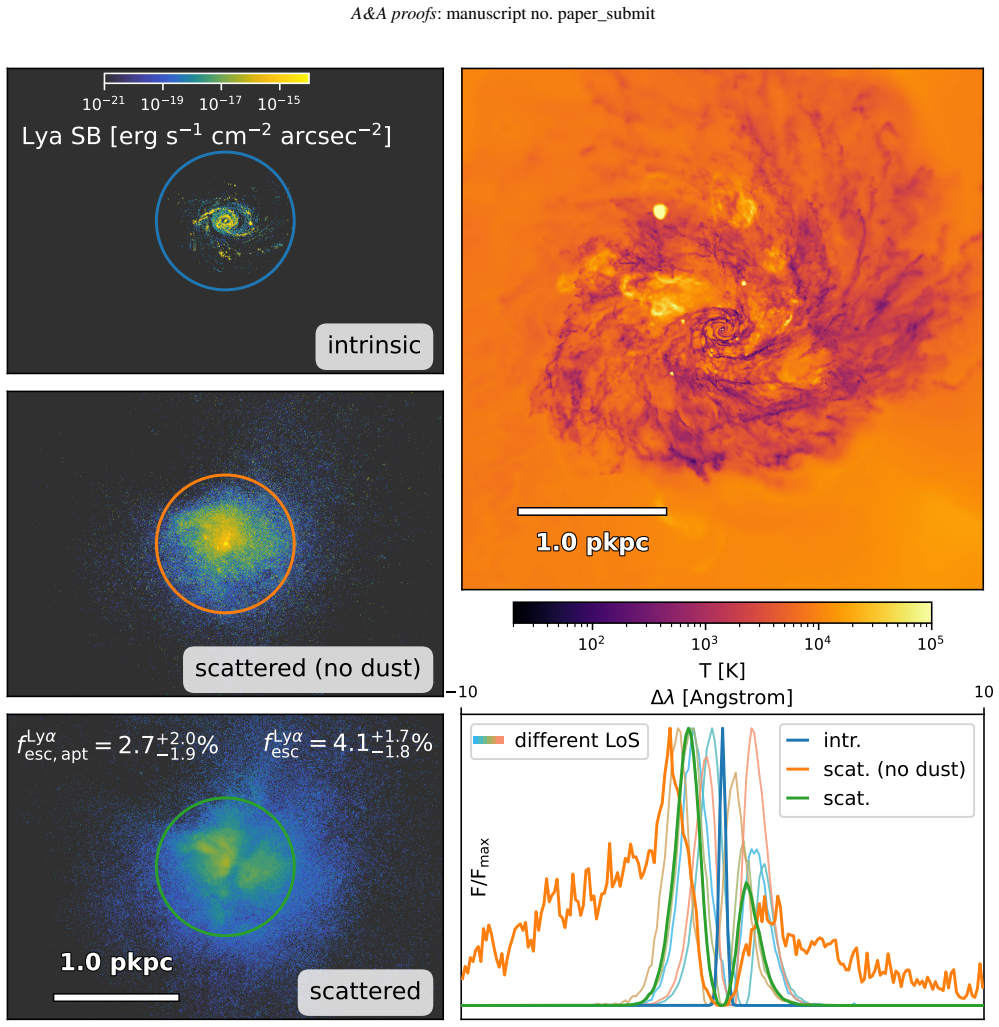
- For a parsec-resolved z=6 galaxy, Lyman-alpha escape fractions of about 4 percent (aperture-restricted roughly 2-3 percent) emerge with strong line-of-sight scatter, and dust suppresses the spectral wings to a few Angstrom.
- In a z=1-2 Milky Way progenitor, Lyman-alpha and MgII scattering creates extended observable halos, with the MgII doublet peak ratio varying from red-dominant in the center to blue-dominant in the outskirts.
- In a large cosmological box, Lyman-alpha scattering shifts intrinsic high-surface-brightness emission into a volume-filling low-surface-brightness regime of order $10^{-21}\,\mathrm{erg\,s^{-1}\,cm^{-2}\,arcsec^{-2}}$, relevant for intensity mapping.
- The raytracing driver produces Lyman-alpha forest spectra and tomographic maps directly from simulation snapshots, and the same machinery scales to a $6144^3$ volume RT calculation.
Reading between the lines
- If the uniform-grid path is accurate, the practical and testable bottleneck becomes the grid-mapping step (SPH-style splatting), which the authors do not directly validate; a native unstructured-mesh dataset would settle whether the mapping preserves the small clumps that control resonant scattering.
- The composable driver/dataset/interactor design implies that other resonant lines, X-ray lines, or polarization can be added without rewriting the propagation engine; whether that holds depends on whether the doublet treatment generalizes to multiplets with non-resonant channels.
- The speed-ups suggest that parameter scans and full-volume mock surveys become practical on consumer GPUs, shifting the practical limit of forward modeling from compute time to the fidelity of emission models and input simulations.
Signed reviews
Editorial analysis
A structured set of objections, weighed in public.
Referee Report
Summary. The paper introduces THOR, a C++/SYCL Monte Carlo radiative transfer code for resonant emission lines (Ly-alpha, MgII) and ray-tracing, with MPI support, domain decomposition, and CPU/GPU/APU backends. The authors validate the meshless spherical/slab physics engine against analytic Neufeld spectra, the slab dust escape fraction, the Faucher-Giguere et al. (2010) outflow spectra, and the Chang & Gronke (2024) MgII doublet. They then present scientific showcases: shell-model MCMC fitting, Ly-alpha escape from a z=6 galaxy, CGM Ly-alpha/MgII halos, cosmic-web emission from TNG50, and Ly-alpha forest absorption spectra, followed by performance benchmarks and scaling tests. The central claim is that THOR is a correct, portable, and highly efficient resonant-line MCRT code with large GPU speedups. The physics engine appears well validated, but the uniform-grid path used for every realistic showcase is not end-to-end validated, and the headline speedup claim is partly extrapolated.
Significance. If the claims hold, THOR would be a valuable community tool: it is one of the first portable, multi-vendor GPU-accelerated resonant-line MCRT codes, with a clean abstraction layer, validated single- and doublet scattering physics, and benchmarks against existing public codes with pinned git revisions. The appendices document the accuracy and performance of the Voigt-profile and u-parallel sampling choices, which is a genuine strength. The scientific showcases demonstrate broad applicability. However, the paper currently overstates the measured speedup range, and more importantly, every realistic showcase relies on a uniform-grid traversal path that is not validated against any analytic or independent numerical result. Since the method paper's credibility rests on both the physics engine and the production data path, this gap must be closed before the showcase results can be considered supported.
major comments (3)
- [Section 4 vs. Sections 5.2-5.4] The uniform-grid MCRT path used in all realistic showcases is not end-to-end validated. Section 4 explicitly states that the analytic Neufeld and slab tests use the meshless spherical geometry and that 'we do not explicitly realize a discretized gas distribution.' All Section 4 validations (Neufeld sphere, slab escape fraction, Faucher-Giguere outflow, Chang-Gronke MgII) therefore exercise only the meshless code path. In contrast, the z=6 galaxy (Section 5.2), the CGM Ly-alpha/MgII maps (Section 5.3), the TNG50 cosmic web (Section 5.4), and the weak-scaling benchmark (Section 6.3) all use the uniform-grid dataset, fed by SPH splatting of Voronoi/AREPO data onto 3072^3 grids at ~1-50 pc resolution. The grid-specific operations--cell index traversal, piecewise optical-depth integration across cell faces, sub-cell stepping in the presence of velocity and ionization gradients, and boundary handling--are never compared with an analytic solution or an independent numerical code. A bug or a resolution bias in this path would change the quoted escape fraction f_Ly-alpha_esc = 4.1+1.7-1.8% (Section 5.2) and the CGM surface brightness maps while leaving the validated meshless engine untouched. I request at least one end-to-end test of the uniform-grid path (e.g., a grid-resolved Neufeld sphere or slab at matched resolution, plus a grid-convergence study of the z=6 escape fraction) before the showcase results are presented as validated.
- [Abstract, Section 6.2, Section 8] The headline speedup claim '~10-50x' in the abstract and Section 8 is not supported by the measurements reported in the paper. Section 6.2 (upper-right panel of Figure 14) reports measured GPU-to-CPU speedups of 6.5, 13.1, 13.2, and 39.9 for the four applications shown, and Section 6.1 reports a workstation GPU-to-CPU speedup of ~5. The 50x figure is an extrapolation based on a statement that the H200 is 40% faster than the A100 and that a 4xH200 node would therefore reach ~50x; this is not a measurement. The abstract and summary should be revised to state the measured range (roughly 5-40x) and to label any extrapolated values as extrapolations.
- [Data Availability] For a code paper whose central claims are about a new software tool, the Data Availability statement that 'The thor code will be publicly released in the future' is insufficient for reproducibility. The benchmarks against voroILTIS, RASCAS, and COLT include git revisions (Table 2), which is good, but the THOR version, input decks, and benchmark scripts are not available, so an independent reader cannot reproduce the validation or performance numbers. I recommend making the code, or at minimum a tagged release with validation and benchmark configuration files, publicly available at acceptance, or providing a clear release timeline and archival DOI.
minor comments (6)
- [Figure 13] The labels 'thor[g]' and 'thor[c]' in the top panel are confusing; elsewhere the paper uses 'thor[gpu]' and 'thor[cpu]'. Please make the labels consistent and define them in the caption.
- [Figure 4] The x-axis label appears garbled as '(a 0)1/3 d' and the text refers to '(a tau0)1/3 tau_a'; the intended quantity is presumably b = (a tau0)^(1/3) tau_d, with tau_d the dust optical depth. Please correct the axis label and the inline expression.
- [Sections 5.2, 5.3] The spatial resolutions are written as '30723' and '3072^3' inconsistently; the intended '3072^3' should be used throughout. In addition, the sentence in Section 5.2 that 'we map to a 3072^3 uniform grid' should state the physical cell size explicitly rather than only in the parenthetical.
- [Table 2] The table footnotes are mismatched: the column header 'higher orderd' and 'FP modese' refer to notes (d) and (e), but the notes themselves are ordered (a)-(e) with (d) describing higher-order integration and (e) describing reduced-precision mode. Please align the header superscripts with the correct notes.
- [Section 3.4.1] The peeling photon-fusing thresholds are described as user-specified (Section 5.2 gives values of 0.01 Angstrom and 0.3 pc), but no defaults or guidance are given in the method section itself; please state the default values and how they affect the spatial/spectral resolution of the peeled contribution.
- [Section 3.4.2] The scheme is called 'adaptive core-skipping' in Section 5.2, but Section 3.4.2 defines a fixed x_crit = 0.2(a tau0)^(1/3) without explaining what is adaptive. Please define the term or use consistent terminology.
Circularity Check
No significant circularity: THOR's validation is anchored to analytic Neufeld/slab solutions and independent numerical benchmarks; the unvalidated uniform-grid showcase path is a validation gap, not a circular reduction.
full rationale
The paper's central correctness claim is validated externally, not by its own output. Section 4 compares THOR against the analytic Neufeld sphere solution (Neufeld 1990; Dijkstra et al. 2006), the analytic slab escape fraction (Laursen et al. 2009b), the independent numerical outflow-sphere spectra of Faucher-Giguere et al. (2010), and the MgII doublet profiles of Chang & Gronke (2024). These are parameter-free external benchmarks; no fitted THOR value is recycled as a prediction. The performance comparison in Section 6.1 includes the authors' own voroILTIS code, but also independent COLT and RASCAS codes, so the 'on par with existing codes' claim is not self-referential. The Section 5.1 MCMC demonstration generates a mock spectrum with THOR and then fits it with THOR; this is explicitly presented as a capability closure test, not as a physical prediction or external validation. The paper itself flags a real limitation in Section 4: 'For this test we use our meshless spherical shell geometry (Section 3.3), and do not explicitly realize a discretized gas distribution.' Consequently, the uniform-grid MCRT path used in the Sections 5.2-5.4 showcases is not end-to-end validated against an analytic or independent numerical solution. That is an important validation gap and a correctness risk for the grid-based results, but it is not circularity: no equation, fitted parameter, or self-citation chain makes the showcase results equal to their inputs by construction. Self-citations such as Byrohl et al. (2021) and Byrohl & Nelson (2023) are contextual, comparative, or refer to previously published analysis methods; they are not load-bearing for the code's correctness claim. Therefore the derivation chain is self-contained with respect to circularity.
Assumptions & free parameters
free parameters (7)
- f_eff (SFR-to-Ly-alpha luminosity conversion) =
1 (order unity)
- f_Ly-alpha^esc = 0.1 (global escape fraction) =
0.1
- f_ion = 0.01 (ionized-gas dust scaling) =
0.01
- Peel-photon fusing thresholds =
0.01 Angstrom, 0.3 pc
- Core-skipping parameter x_crit coefficient =
0.2 (a*tau0)^(1/3)
- x_cw core-wing transition polynomial coefficients c0..c4 =
1.03489162, -6.17680644e-1, -8.73073343e-2, -7.91384757e-3, -2.76037084e-4
- Step-size control factor f = 0.01 =
0.01
assumptions (8)
- standard math Monte Carlo photon packets sample the radiative transfer equation, so converged packet statistics reproduce the intensity and escape fraction.
- domain assumption The gas is static during post-processing; radiation does not modify temperature, ionization, or velocity fields.
- domain assumption The recoil and energy-transfer term in the scattering frequency update Eq. (7) is negligible.
- domain assumption Cell properties are piecewise constant (zeroth-order integration) during propagation; sub-cell stepping captures velocity and Hubble gradients.
- domain assumption Two-level-atom resonance approximation with adopted phase function (1-to-2 isotropic-dipole mix near line center, pure dipole in wings) and case-B recombination.
- standard math Independent pseudorandom streams per photon (xoshiro128++ seeded by rank, photon ID, and step ID) are statistically equivalent to fresh draws.
- domain assumption CLOUDY collisional plus photoionization equilibrium determines MgII ionization and emissivity in each gas cell.
- ad hoc to paper SPH-splatting Voronoi/AREPO data onto a uniform grid conserves the fields relevant to resonant scattering.
Cite this review
Pith. "Pith review of THOR: a GPU-accelerated and MPI-parallel radiative transfer code." pith.science (2026). https://pith.science/paper/MHMYIMIT
@misc{pith2026250711603,
  author       = {Pith},
  title        = {Pith review of: THOR: a GPU-accelerated and MPI-parallel radiative transfer code},
  year         = {2026},
  howpublished = {\url{https://pith.science/paper/MHMYIMIT}},
  note         = {Machine review of arXiv:2507.11603}
}
abstract
Emission and absorption line features are important diagnostics for the physics underlying extragalactic astronomy. The interpretation of observed signatures involves comparing against forward modeled spectra from galaxy formation simulations as well as more simplified geometries, while including the complex scattering radiative transfer (RT) of resonant emission lines. Here, we present thor, a modern C++ radiative transfer code focused initially on resonant emission lines. thor is a high-performance, distributed memory MPI-parallel, multi-target code, running on CPUs, GPUs and other accelerators, yielding large $\sim 10-50\rm{x}$ speed-ups compared to previous CPU-only codes. We support multiple grid-based and gridless data structures, enabling comparisons across different hydrodynamical codes as well as toy model geometries. We demonstrate its science capabilities with a number of example use cases across scales: (i) Lyman-alpha RT on simple shell-like gas distributions; (ii) Lyman-alpha RT applied to a high-resolution, high-redshift $z \sim 6$ cosmological hydrodynamical galaxy formation simulation; (iii) Lyman-alpha and Magnesium-II halos, i.e. scattering and emission from the circumgalactic medium of $z \simeq 1-2$ galaxies drawn from cosmological magnetohydrodynamical simulations; (iv) the large-scale cosmic web in gas emission, a $6144^3$ volume-element RT scaling calculation; and (v) synthetic absorption spectra of the Lyman-alpha forest. Extensive verification and benchmarking validates our approach and its computational efficiency.
Figures


Figures from the paper (11 more)




Forward citations
Cited by 4 Pith papers
-
Inferring the mass of the circumgalactic medium using X-ray resonant scattering
For a clean half of TNG50 galaxies, outer-shell OVII mass is recovered from the OVIIr flux ratio with ~10% bias and 0.2 dex scatter, enabling CGM mass estimates.
-
Kratos-linerad: GPU-accelerated Monte Carlo radiative transfer of lines with efficient imaging
A GPU Monte Carlo code that makes velocity-resolved images of spectral-line radiation by separating photon scattering from image ray tracing.
-
Force convergence in Monte Carlo Lyman-alpha radiative transfer
A moment-based hierarchy (zeroth, first, second order) diagnoses convergence of Lyman-alpha MCRT momentum-transfer estimators, showing that core-skipping biases internal forces and that statistical precision, cost, an...
-
Magnetogenesis by galactic processes: impact on circumgalactic and intergalactic fields
Halo magnetic fields at z=0 converge across primordial and astrophysical seeds via dynamo action, but IGM magnetization and coherence lengths retain seed memory and SN-only injection underproduces γ-ray lower limits.
Reference graph
Works this paper leans on
-
[1]
, " * write output.state after.block = add.period write newline
ENTRY address archiveprefix author booktitle chapter edition editor howpublished institution eprint doi url journal key month note number organization pages publisher school series title type volume year adsurl label extra.label sort.label short.list INTEGERS output.state before.all mid.sentence after.sentence after.block FUNCTION init.state.consts #0 'be...
-
[2]
write newline
" write newline "" before.all 'output.state := FUNCTION n.dashify 't := "" t empty not t #1 #1 substring "-" = t #1 #2 substring "--" = not "--" * t #2 global.max substring 't := t #1 #1 substring "-" = "-" * t #2 global.max substring 't := while if t #1 #1 substring * t #2 global.max substring 't := if while FUNCTION word.in bbl.in " " * FUNCTION format....
-
[3]
https://rocm.docs.amd.com/
AMD 2024, ROCm: Open Software Platform for Accelerated Computing . https://rocm.docs.amd.com/
2024
-
[4]
F., 1971, @doi [The Astrophysical Journal] 10.1086/151111 , 168, 575
Adams T. F., 1971, @doi [The Astrophysical Journal] 10.1086/151111 , 168, 575
- [5]
-
[6]
Ambrose A. E., Visbal E., Kulkarni M., McQuinn M., 2025, @doi [arXiv e-prints] 10.48550/arXiv.2502.18654 , https://ui.adsabs.harvard.edu/abs/2025arXiv250218654A p. arXiv:2502.18654
-
[7]
Anand A., Nelson D., Kauffmann G., 2021, @doi [Monthly Notices of the Royal Astronomical Society] 10.1093/mnras/stab871 , 504, 65
-
[8]
Arrigoni Battaia F., Hennawi J. F., Prochaska J. X., O \ n orbe J., Farina E. P., Cantalupo S., Lusso E., 2019, @doi [ ] 10.1093/mnras/sty2827 , https://ui.adsabs.harvard.edu/abs/2019MNRAS.482.3162A 482, 3162
Show all 182 references
-
[9]
Atek H., et al., 2024, @doi [ ] 10.1038/s41586-024-07043-6 , https://ui.adsabs.harvard.edu/abs/2024Natur.626..975A 626, 975
2024 doi
-
[10]
Bacon R., et al., 2010, in Ground-Based and Airborne Instrumentation for Astronomy III . p. 773508, @doi 10.1117/12.856027
2010 doi
-
[11]
Bacon R., et al., 2021, @doi [Astronomy and Astrophysics] 10.1051/0004-6361/202039887 , 647, A107
2021 doi
-
[12]
A., et al., 2019, in 2019 IEEE / ACM International Workshop on Performance , Portability and Productivity in HPC ( P3HPC )
Beckingsale D. A., et al., 2019, in 2019 IEEE / ACM International Workshop on Performance , Portability and Productivity in HPC ( P3HPC ). IEEE Computer Society, pp 71--81, @doi 10.1109/P3HPC49587.2019.00012
2019
-
[13]
Behrens C., Pallottini A., Ferrara A., Gallerani S., Vallini L., 2019, @doi [Monthly Notices of the Royal Astronomical Society] 10.1093/mnras/stz980 , 486, 2197
2019 doi
-
[14]
L., Kovetz E
Bernal J. L., Kovetz E. D., 2022, @doi [ ] 10.1007/s00159-022-00143-0 , https://ui.adsabs.harvard.edu/abs/2022A&ARv..30....5B 30, 5
2022 doi
- [15]
-
[16]
Blaizot J., et al., 2023, @doi [Monthly Notices of the Royal Astronomical Society] 10.1093/mnras/stad1523 , 523, 3749
2023 doi
-
[17]
Board O. A. R., 2013, OpenMP4 .0.0, https://www.openmp.org/wp-content/uploads/OpenMP4.0.0.pdf
2013
-
[18]
Borisova E., et al., 2016, @doi [ ] 10.3847/0004-637X/831/1/39 , https://ui.adsabs.harvard.edu/abs/2016ApJ...831...39B 831, 39
2016 doi
-
[19]
N., Rubin K
Burchett J. N., Rubin K. H. R., Prochaska J. X., Coil A. L., Vaught R. R., Hennawi J. F., 2021, @doi [The Astrophysical Journal] 10.3847/1538-4357/abd4e0 , 909, 151
2021 doi
-
[20]
J., Conroy C., Johnson B
Byler N., Dalcanton J. J., Conroy C., Johnson B. D., Levesque E. M., Berg D. A., 2018, @doi [ ] 10.3847/1538-4357/aacd50 , https://ui.adsabs.harvard.edu/abs/2018ApJ...863...14B 863, 14
2018 doi
-
[21]
Byrohl C., 2022, PhD thesis, Ludwig-Maximilians University of Munich, Germany
2022
-
[22]
Byrohl C., Gronke M., 2020, @doi [Astronomy and Astrophysics] 10.1051/0004-6361/202038685 , 642, L16
2020 doi
-
[23]
Byrohl C., Nelson D., 2023, @doi [ ] 10.1093/mnras/stad1779 , https://ui.adsabs.harvard.edu/abs/2023MNRAS.523.5248B 523, 5248
2023 doi
-
[24]
Byrohl C., Nelson D., 2024, @doi [The Journal of Open Source Software] 10.21105/joss.06064 , https://ui.adsabs.harvard.edu/abs/2024JOSS....9.6064B 9, 6064
2024 doi
-
[25]
Byrohl C., et al., 2021, @doi [Monthly Notices of the Royal Astronomical Society] 10.1093/mnras/stab1958 , 506, 5129
2021 doi
-
[26]
Cai Z., et al., 2019, @doi [ ] 10.3847/1538-4365/ab4796 , https://ui.adsabs.harvard.edu/abs/2019ApJS..245...23C 245, 23
2019 doi
-
[27]
Camps P., Baes M., 2015, @doi [Astronomy and Computing] 10.1016/j.ascom.2014.10.004 , https://ui.adsabs.harvard.edu/abs/2015A&C.....9...20C 9, 20
2015 doi
-
[28]
U., Grand R., 2021, @doi [ ] 10.3847/1538-4357/ac06cb , https://ui.adsabs.harvard.edu/abs/2021ApJ...916...39C 916, 39
Camps P., Behrens C., Baes M., Kapoor A. U., Grand R., 2021, @doi [ ] 10.3847/1538-4357/ac06cb , https://ui.adsabs.harvard.edu/abs/2021ApJ...916...39C 916, 39
2021 doi
-
[29]
X., Hennawi J
Cantalupo S., Arrigoni-Battaia F., Prochaska J. X., Hennawi J. F., Madau P., 2014, @doi [Nature] 10.1038/nature12898 , 506, 63
2014 doi
-
[30]
R., Sunderland D., 2014, @doi [Journal of Parallel and Distributed Computing] 10.1016/j.jpdc.2014.07.003 , 74, 3202
Carter Edwards H., Trott C. R., Sunderland D., 2014, @doi [Journal of Parallel and Distributed Computing] 10.1016/j.jpdc.2014.07.003 , 74, 3202
2014 doi
-
[31]
Chang S.-J., Gronke M., 2024, @doi [Monthly Notices of the Royal Astronomical Society] 10.1093/mnras/stae1664 , 532, 3526
2024 doi
-
[32]
M., 1993, @doi [ ] 10.1086/173187 , https://ui.adsabs.harvard.edu/abs/1993ApJ...415..580C 415, 580
Charlot S., Fall S. M., 1993, @doi [ ] 10.1086/173187 , https://ui.adsabs.harvard.edu/abs/1993ApJ...415..580C 415, 580
1993 doi
-
[33]
P., Mason C., Topping M
Chen Z., Stark D. P., Mason C., Topping M. W., Whitler L., Tang M., Endsley R., Charlot S., 2024, @doi [ ] 10.1093/mnras/stae455 , https://ui.adsabs.harvard.edu/abs/2024MNRAS.528.7052C 528, 7052
2024 doi
-
[34]
Wrox Press Ltd., GBR
Cheng J., Grossman M., McKercher T., 2014, Professional CUDA C Programming , 1st edn. Wrox Press Ltd., GBR
2014
-
[35]
Churazov E., Zhuravleva I., Sazonov S., Sunyaev R., 2010, @doi [ ] 10.1007/s11214-010-9685-4 , https://ui.adsabs.harvard.edu/abs/2010SSRv..157..193C 157, 193
2010 doi
-
[36]
P., Keating L
Costa T., Arrigoni Battaia F., Farina E. P., Keating L. C., Rosdahl J., Kimm T., 2022, AGN-driven Outflows and the Formation of Ly \ alpha\ Nebulae around High-z Quasars
2022
-
[37]
L., Songaila A., Kim T.-S., Hu E
Cowie L. L., Songaila A., Kim T.-S., Hu E. M., 1995, @doi [The Astronomical Journal] 10.1086/117381 , 109, 1522
1995 doi
-
[38]
Cuneo B., Bailey M., 2024, @doi [ACM Trans. Model. Comput. Simul.] 10.1145/3626957 , 34, 2:1
2024 doi
-
[39]
W., Shull J
Danforth C. W., Shull J. M., 2005, @doi [The Astrophysical Journal] 10.1086/429285 , 624, 555
2005 doi
-
[40]
Dijkstra M., 2017, arXiv e-prints, 1704, arXiv:1704.03416
2017 arXiv
-
[41]
Dijkstra M., Loeb A., 2008, @doi [Monthly Notices of the Royal Astronomical Society] 10.1111/j.1365-2966.2008.13066.x , 386, 492
2008
-
[42]
Dijkstra M., Haiman Z., Spaans M., 2006, @doi [The Astrophysical Journal] 10.1086/506243 , 649, 14
2006 doi
- [43]
-
[44]
T., 2011, Physics of the Interstellar and Intergalactic Medium
Draine B. T., 2011, Physics of the Interstellar and Intergalactic Medium . Princeton University Press
2011
-
[45]
P., Juhasz A., Pohl A., Sereshti F., Shetty R., Peters T., Commercon B., Flock M., 2012, Astrophysics Source Code Library, p
Dullemond C. P., Juhasz A., Pohl A., Sereshti F., Shetty R., Peters T., Commercon B., Flock M., 2012, Astrophysics Source Code Library, p. ascl:1202.015
2012
-
[46]
Dutta R., et al., 2023, @doi [ ] 10.1093/mnras/stad1002 , https://ui.adsabs.harvard.edu/abs/2023MNRAS.522..535D 522, 535
2023 doi
-
[47]
J., Stanway E
Eldridge J. J., Stanway E. R., Xiao L., McClelland L. A. S., Taylor G., Ng M., Greis S. M. L., Bray J. C., 2017, @doi [ ] 10.1017/pasa.2017.51 , https://ui.adsabs.harvard.edu/abs/2017PASA...34...58E 34, e058
2017 doi
-
[48]
M., Genel S., Sternberg A., Devriendt J., Slyz A., Visbal E., Bouch \'e N., 2020, @doi [Monthly Notices of the Royal Astronomical Society] 10.1093/mnras/staa1059 , 494, 5439
Elias L. M., Genel S., Sternberg A., Devriendt J., Slyz A., Visbal E., Bouch \'e N., 2020, @doi [Monthly Notices of the Royal Astronomical Society] 10.1093/mnras/staa1059 , 494, 5439
2020 doi
-
[49]
C., NVIDIA Group P., 2011, The OpenACC Application Programming Interface , v1.0
Enterprise C., Inc. C., NVIDIA Group P., 2011, The OpenACC Application Programming Interface , v1.0
2011
-
[50]
J., Storey P
Ercolano B., Barlow M. J., Storey P. J., Liu X. W., 2003, @doi [ ] 10.1046/j.1365-8711.2003.06371.x , https://ui.adsabs.harvard.edu/abs/2003MNRAS.340.1136E 340, 1136
2003
-
[51]
Faucher-Gigu \`e re C.-A., 2020, @doi [ ] 10.1093/mnras/staa302 , https://ui.adsabs.harvard.edu/abs/2020MNRAS.493.1614F 493, 1614
2020 doi
-
[52]
Faucher-Gigu \`e re C.-A., Kere s D., Dijkstra M., Hernquist L., Zaldarriaga M., 2010, @doi [The Astrophysical Journal] 10.1088/0004-637X/725/1/633 , 725, 633
2010 doi
- [53]
-
[54]
Finley H., et al., 2017, @doi [Astronomy and Astrophysics] 10.1051/0004-6361/201731499 , 608, A7
2017 doi
-
[55]
W., Lang D., Goodman J., 2013, @doi [Publications of the Astronomical Society of the Pacific] 10.1086/670067 , 125, 306
Foreman-Mackey D., Hogg D. W., Lang D., Goodman J., 2013, @doi [Publications of the Astronomical Society of the Pacific] 10.1086/670067 , 125, 306
2013 doi
-
[56]
Fossati M., et al., 2021, @doi [Monthly Notices of the Royal Astronomical Society] 10.1093/mnras/stab660 , 503, 3044
2021 doi
-
[57]
Garel T., Michel-Dansac L., Verhamme A., Mauerhofer V., Katz H., Blaizot J., Leclercq F., Salvignol G., 2024, @doi [Astronomy and Astrophysics] 10.1051/0004-6361/202450654 , 691, A213
2024 doi
-
[58]
Gronke M., Bull P., Dijkstra M., 2015, @doi [The Astrophysical Journal] 10.1088/0004-637X/812/2/123 , 812, 123
2015 doi
-
[59]
P., 2017, @doi [Astronomy and Astrophysics] 10.1051/0004-6361/201731013 , 607, A71
Gronke M., Dijkstra M., McCourt M., Oh S. P., 2017, @doi [Astronomy and Astrophysics] 10.1051/0004-6361/201731013 , 607, A71
2017 doi
-
[60]
E., Peterson B
Gunn J. E., Peterson B. A., 1965, @doi [The Astrophysical Journal] 10.1086/148444 , 142, 1633
1965 doi
-
[61]
A., 2022, @doi [Monthly Notices of the Royal Astronomical Society] 10.1093/mnras/stab3554 , 510, 4525
Gurung-L \'o pez S., Gronke M., Saito S., Bonoli S., Orsi \'A . A., 2022, @doi [Monthly Notices of the Royal Astronomical Society] 10.1093/mnras/stab3554 , 510, 4525
2022 doi
-
[62]
J., 2001, @doi [ ] 10.1086/321567 , https://ui.adsabs.harvard.edu/abs/2001ApJ...556...87H 556, 87
Haiman Z., Rees M. J., 2001, @doi [ ] 10.1086/321567 , https://ui.adsabs.harvard.edu/abs/2001ApJ...556...87H 556, 87
2001 doi
-
[63]
P., Slattery S
Hamilton S. P., Slattery S. R., Evans T. M., 2018, @doi [Annals of Nuclear Energy] 10.1016/j.anucene.2017.11.032 , 113, 506
2018 doi
-
[64]
P., 2006, @doi [Monthly Notices of the Royal Astronomical Society] 10.1111/j.1365-2966.2005.09870.x , 367, 979
Hansen M., Oh S. P., 2006, @doi [Monthly Notices of the Royal Astronomical Society] 10.1111/j.1365-2966.2005.09870.x , 367, 979
2006
-
[65]
Hayashino T., et al., 2004, @doi [The Astronomical Journal] 10.1086/424935 , 128, 2073
2004 doi
-
[66]
Hayes M., Scarlata C., Siana B., 2011, @doi [ ] 10.1038/nature10320 , https://ui.adsabs.harvard.edu/abs/2011Natur.476..304H 476, 304
2011 doi
-
[67]
M., Lehnert M
Heckman T. M., Lehnert M. D., Miley G. K., van Breugel W., 1991, @doi [ ] 10.1086/170660 , https://ui.adsabs.harvard.edu/abs/1991ApJ...381..373H 381, 373
1991 doi
-
[68]
G., Greenstein J
Henyey L. G., Greenstein J. L., 1941, @doi [The Astrophysical Journal] 10.1086/144246 , 93, 70
1941 doi
-
[69]
H., Miralda-Escud \'e J., 1996, @doi [ ] 10.1086/309899 , https://ui.adsabs.harvard.edu/abs/1996ApJ...457L..51H 457, L51
Hernquist L., Katz N., Weinberg D. H., Miralda-Escud \'e J., 1996, @doi [ ] 10.1086/309899 , https://ui.adsabs.harvard.edu/abs/1996ApJ...457L..51H 457, L51
1996 doi
-
[70]
Heymann F., Siebenmorgen R., 2012, @doi [The Astrophysical Journal] 10.1088/0004-637X/751/1/27 , 751, 27
2012 doi
-
[71]
J., et al., 2021, @doi [The Astronomical Journal] 10.3847/1538-3881/ac2c02 , 162, 298
Hill G. J., et al., 2021, @doi [The Astronomical Journal] 10.3847/1538-3881/ac2c02 , 162, 298
2021 doi
-
[72]
K., Iliev I
Hirling P., Bianco M., Giri S. K., Iliev I. T., Mellema G., Kneib J. P., 2024, @doi [Astronomy and Computing] 10.1016/j.ascom.2024.100861 , https://ui.adsabs.harvard.edu/abs/2024A&C....4800861H 48, 100861
2024
-
[73]
Huml \'i c ek J., 1982, @doi [Journal of Quantitative Spectroscopy and Radiative Transfer] 10.1016/0022-4073(82)90078-4 , 27, 437
1982 doi
-
[74]
Inoue S., Yoshida N., Yajima H., 2020, @doi [ ] 10.1093/mnras/staa2744 , https://ui.adsabs.harvard.edu/abs/2020MNRAS.498.5960I 498, 5960
2020 doi
-
[75]
Kakuma R., et al., 2021, @doi [The Astrophysical Journal] 10.3847/1538-4357/ac0725 , 916, 22
2021 doi
-
[76]
U., et al., 2024, @doi [ ] 10.1051/0004-6361/202451207 , https://ui.adsabs.harvard.edu/abs/2024A&A...692A..79K 692, A79
Kapoor A. U., et al., 2024, @doi [ ] 10.1051/0004-6361/202451207 , https://ui.adsabs.harvard.edu/abs/2024A&A...692A..79K 692, A79
2024 doi
-
[77]
C., Nugent P., 2006, @doi [The Astrophysical Journal] 10.1086/506190 , 651, 366
Kasen D., Thomas R. C., Nugent P., 2006, @doi [The Astrophysical Journal] 10.1086/506190 , 651, 366
2006 doi
-
[78]
Kikuchihara S., et al., 2022, @doi [The Astrophysical Journal] 10.3847/1538-4357/ac69de , 931, 97
2022 doi
-
[79]
Kimm T., Haehnelt M., Blaizot J., Katz H., Michel-Dansac L., Garel T., Rosdahl J., Teyssier R., 2018, @doi [Monthly Notices of the Royal Astronomical Society] 10.1093/mnras/sty126 , 475, 4617
2018 doi
-
[80]
J., Monahan J
Kinderman A. J., Monahan J. F., 1977, @doi [ACM Trans. Math. Softw.] 10.1145/355744.355750 , 3, 257
1977
-
[81]
Koptelova E., Hwang C.-Y., Yu P.-C., Chen W.-P., Guo J.-K., 2017, @doi [Scientific Reports] 10.1038/srep41617 , 7, 41617
2017 doi
- [82]
-
[83]
Kusakabe H., et al., 2024, @doi [Astronomy and Astrophysics] 10.1051/0004-6361/202451009 , 691, A255
2024 doi
-
[84]
Lake E., Zheng Z., Cen R., Sadoun R., Momose R., Ouchi M., 2015, @doi [The Astrophysical Journal] 10.1088/0004-637X/806/1/46 , 806, 46
2015 doi
-
[85]
Laursen P., 2010, PhD thesis
2010
-
[86]
O., Sommer-Larsen J., 2009a, @doi [The Astrophysical Journal] 10.1088/0004-637X/696/1/853 , 696, 853
Laursen P., Razoumov A. O., Sommer-Larsen J., 2009a, @doi [The Astrophysical Journal] 10.1088/0004-637X/696/1/853 , 696, 853
-
[87]
C., 2009b, @doi [The Astrophysical Journal] 10.1088/0004-637X/704/2/1640 , 704, 1640
Laursen P., Sommer-Larsen J., Andersen A. C., 2009b, @doi [The Astrophysical Journal] 10.1088/0004-637X/704/2/1640 , 704, 1640
-
[88]
Leclercq F., et al., 2017, @doi [Astronomy and Astrophysics] 10.1051/0004-6361/201731480 , 608, A8
2017 doi
-
[89]
Leclercq F., et al., 2020, @doi [Astronomy and Astrophysics] 10.1051/0004-6361/201937339 , 635, A82
2020 doi
-
[90]
Leclercq F., et al., 2022, @doi [A&A] 10.1051/0004-6361/202142179 , 663, A11
2022 doi
-
[91]
Lee K.-G., et al., 2014, @doi [ ] 10.1088/2041-8205/795/1/L12 , 795, L12
2014 doi
-
[92]
Lee E. K. H., et al., 2022, @doi [The Astrophysical Journal] 10.3847/1538-4357/ac61d6 , 929, 180
2022 doi
-
[93]
Lee K.-S., et al., 2024, @doi [The Astrophysical Journal] 10.3847/1538-4357/ad165e , 962, 36
2024 doi
-
[94]
M., Howk J
Lehner N., O'Meara J. M., Howk J. C., Prochaska J. X., Fumagalli M., 2016, @doi [The Astrophysical Journal] 10.3847/1538-4357/833/2/283 , 833, 283
2016 doi
-
[95]
Lin X., et al., 2024, @doi [ ] 10.3847/1538-4365/ad3e7d , https://ui.adsabs.harvard.edu/abs/2024ApJS..272...33L 272, 33
2024 doi
-
[96]
Lindholm E., Nickolls J., Oberman S., Montrym J., 2008, @doi [IEEE Micro] 10.1109/MM.2008.31 , 28, 39
2008 doi
-
[97]
G., Brown F
Liu T., Du X., Ji W., Xu X. G., Brown F. B., 2014, in SNA + MC 2013 - Joint International Conference on Supercomputing in Nuclear Applications + Monte Carlo . EDP Sciences, p. 04206, @doi 10.1051/snamc/201404206
2014
-
[98]
Lujan Niemeyer M., et al., 2022a, @doi [The Astrophysical Journal] 10.3847/1538-4357/ac5cb8 , 929, 90
-
[99]
Lujan Niemeyer M., et al., 2022b, @doi [The Astrophysical Journal] 10.3847/2041-8213/ac82e5 , 934, L26
-
[100]
F., Prochaska J
Lusso E., Worseck G., Hennawi J. F., Prochaska J. X., Vignali C., Stern J., O'Meara J. M., 2015, @doi [Monthly Notices of the Royal Astronomical Society] 10.1093/mnras/stv516 , 449, 4204
2015 doi
-
[101]
Madau P., 1995, @doi [ ] 10.1086/175332 , https://ui.adsabs.harvard.edu/abs/1995ApJ...441...18M 441, 18
1995 doi
-
[102]
C., Darvish B., Lin Z., Cen R., Matuszewski M., Morrissey P., Neill J
Martin D. C., Darvish B., Lin Z., Cen R., Matuszewski M., Morrissey P., Neill J. D., Moore A. M., 2023, @doi [Nat Astron] 10.1038/s41550-023-02054-1 , pp 1--12
2023 doi
-
[103]
A., Treu T., Dijkstra M., Mesinger A., Trenti M., Pentericci L., de Barros S., Vanzella E., 2018, @doi [The Astrophysical Journal] 10.3847/1538-4357/aab0a7 , 856, 2
Mason C. A., Treu T., Dijkstra M., Mesinger A., Trenti M., Pentericci L., de Barros S., Vanzella E., 2018, @doi [The Astrophysical Journal] 10.3847/1538-4357/aab0a7 , 856, 2
2018 doi
-
[104]
Matsumoto K., Camps P., Baes M., De Ceuster F., Wada K., Nakagawa T., Nagamine K., 2023, @doi [ ] 10.1051/0004-6361/202347376 , https://ui.adsabs.harvard.edu/abs/2023A&A...678A.175M 678, A175
2023 doi
-
[105]
H., et al., 2025, @doi [ ] 10.1093/mnras/stae2677 , https://ui.adsabs.harvard.edu/abs/2025MNRAS.536..879M 536, 879
Matthews J. H., et al., 2025, @doi [ ] 10.1093/mnras/stae2677 , https://ui.adsabs.harvard.edu/abs/2025MNRAS.536..879M 536, 879
2025 doi
-
[106]
ACM Comput
Meister D., Kulkarni P., Vasishta A., Harada T., 2024, @doi [Proc. ACM Comput. Graph. Interact. Tech.] 10.1145/3675378 , 7, 44:1
2024 doi
-
[107]
Michel-Dansac L., Blaizot J., Garel T., Verhamme A., Kimm T., Trebitsch M., 2020, @doi [Astronomy and Astrophysics] 10.1051/0004-6361/201834961 , 635, A154
2020 doi
-
[108]
P., 1990, @doi [ ] 10.1086/168358 , https://ui.adsabs.harvard.edu/abs/1990ApJ...350....1M 350, 1
Miralda-Escude J., Ostriker J. P., 1990, @doi [ ] 10.1086/168358 , https://ui.adsabs.harvard.edu/abs/1990ApJ...350....1M 350, 1
1990 doi
-
[109]
D., Blaizot J., Cadiou C., Dubois Y., Garel T., Rosdahl J., 2021, @doi [Monthly Notices of the Royal Astronomical Society] 10.1093/mnras/stab035 , 501, 5757
Mitchell P. D., Blaizot J., Cadiou C., Dubois Y., Garel T., Rosdahl J., 2021, @doi [Monthly Notices of the Royal Astronomical Society] 10.1093/mnras/stab035 , 501, 5757
2021 doi
-
[110]
Momose R., et al., 2016, @doi [Monthly Notices of the Royal Astronomical Society] 10.1093/mnras/stw021 , 457, 2318
2016 doi
-
[111]
J., 1992, @doi [Annual Review of Astronomy and Astrophysics] 10.1146/annurev.aa.30.090192.002551 , 30, 543
Monaghan J. J., 1992, @doi [Annual Review of Astronomy and Astrophysics] 10.1146/annurev.aa.30.090192.002551 , 30, 543
1992
-
[112]
Morrissey P., et al., 2018, @doi [The Astrophysical Journal] 10.3847/1538-4357/aad597 , 864, 93
2018 doi
-
[113]
Birkh \"a user, Boston, MA, @doi 10.1007/978-1-4899-7983-4
Muller J.-M., 2016, Elementary Functions . Birkh \"a user, Boston, MA, @doi 10.1007/978-1-4899-7983-4
2016 doi
-
[114]
T., Berengut J
Murphy M. T., Berengut J. C., 2014, @doi [ ] 10.1093/mnras/stt2204 , https://ui.adsabs.harvard.edu/abs/2014MNRAS.438..388M 438, 388
2014 doi
-
[115]
https://docs.nvidia.com/cuda/cuda-c-programming-guide/
NVIDIA Corporation 2024, CUDA C Programming Guide . https://docs.nvidia.com/cuda/cuda-c-programming-guide/
2024
-
[116]
Narayanan D., et al., 2023, @doi [ ] 10.3847/1538-4357/accf8d , https://ui.adsabs.harvard.edu/abs/2023ApJ...951..100N 951, 100
2023 doi
-
[117]
K., 2025, @doi [Monthly Notices of the Royal Astronomical Society] 10.1093/mnras/staf038 , 537, 1646
Nebrin O., Smith A., Lorinc K., H \"o rnquist J., Larson ., Mellema G., Giri S. K., 2025, @doi [Monthly Notices of the Royal Astronomical Society] 10.1093/mnras/staf038 , 537, 1646
2025 doi
-
[118]
Nelson D., Genel S., Pillepich A., Vogelsberger M., Springel V., Hernquist L., 2016, @doi [ ] 10.1093/mnras/stw1191 , https://ui.adsabs.harvard.edu/abs/2016MNRAS.460.2881N 460, 2881
2016 doi
-
[119]
Nelson D., et al., 2019, @doi [ ] 10.1093/mnras/stz2306 , https://ui.adsabs.harvard.edu/abs/2019MNRAS.490.3234N 490, 3234
2019 doi
-
[120]
Nelson D., et al., 2020, @doi [ ] 10.1093/mnras/staa2419 , https://ui.adsabs.harvard.edu/abs/2020MNRAS.498.2391N 498, 2391
2020 doi
-
[121]
Nelson D., Byrohl C., Peroux C., Rubin K. H. R., Burchett J. N., 2021, @doi [Monthly Notices of the Royal Astronomical Society] 10.1093/mnras/stab2177 , 507, 4445
2021 doi
-
[122]
Nelson D., et al., 2023, @doi [Monthly Notices of the Royal Astronomical Society] 10.1093/mnras/stad1195 , 522, 3665
2023 doi
-
[123]
M., Nikutta R., Ivezi \'c Z ., Elitzur M., 2008, @doi [ ] 10.1086/590483 , https://ui.adsabs.harvard.edu/abs/2008ApJ...685..160N 685, 160
Nenkova M., Sirocky M. M., Nikutta R., Ivezi \'c Z ., Elitzur M., 2008, @doi [ ] 10.1086/590483 , https://ui.adsabs.harvard.edu/abs/2008ApJ...685..160N 685, 160
2008 doi
-
[124]
A., 1990, @doi [Astrophysical Journal] 10.1086/168375 , 350, 216
Neufeld D. A., 1990, @doi [Astrophysical Journal] 10.1086/168375 , 350, 216
1990 doi
-
[125]
L., Wong G., 2025, @doi [arXiv e-prints] 10.48550/arXiv.2506.20422 , https://ui.adsabs.harvard.edu/abs/2025arXiv250620422N p
Nianias J., Lim J., Wong Y. L., Wong G., 2025, @doi [arXiv e-prints] 10.48550/arXiv.2506.20422 , https://ui.adsabs.harvard.edu/abs/2025arXiv250620422N p. arXiv:2506.20422
-
[126]
M., Sim S
Noebauer U. M., Sim S. A., 2019, @doi [Living Reviews in Computational Astrophysics] 10.1007/s41115-019-0004-9 , https://ui.adsabs.harvard.edu/abs/2019LRCA....5....1N 5, 1
2019 doi
-
[127]
E., 1989, Astrophysics of gaseous nebulae and active galactic nuclei
Osterbrock D. E., 1989, Astrophysics of gaseous nebulae and active galactic nuclei
1989
-
[128]
Ouchi M., et al., 2018, @doi [ ] 10.1093/pasj/psx074 , https://ui.adsabs.harvard.edu/abs/2018PASJ...70S..13O 70, S13
2018 doi
-
[129]
Ouchi M., Ono Y., Shibuya T., 2020, @doi [ ] 10.1146/annurev-astro-032620-021859 , https://ui.adsabs.harvard.edu/abs/2020ARA&A..58..617O 58, 617
2020 doi
-
[130]
G., et al., 2010, @doi [ACM Trans
Parker S. G., et al., 2010, @doi [ACM Trans. Graph.] 10.1145/1778765.1778803 , 29, 66:1
2010
-
[131]
Pessa I., et al., 2024, @doi [A&A] 10.1051/0004-6361/202450547 , 691, A5
2024 doi
-
[132]
Pillepich A., et al., 2019, @doi [ ] 10.1093/mnras/stz2338 , https://ui.adsabs.harvard.edu/abs/2019MNRAS.490.3196P 490, 3196
2019 doi
-
[133]
Planck Collaboration et al., 2016, @doi [Astronomy and Astrophysics] 10.1051/0004-6361/201527101 , 594, A1
2016 doi
-
[134]
X., 2019, in Dijkstra M., Prochaska J
Prochaska J. X., 2019, in Dijkstra M., Prochaska J. X., Ouchi M., Hayes M., Verhamme A., North P., Cantalupo S., Atek H., eds, Saas- Fee Advanced Course , Saas- Fee Advanced Course , Springer-Verlag . Springer, Berlin, Heidelberg, pp 111--188, @doi 10.1007/978-3-662-59623-4_2
2019 doi
-
[135]
X., Kasen D., Rubin K., 2011, @doi [ ] 10.1088/0004-637X/734/1/24 , https://ui.adsabs.harvard.edu/abs/2011ApJ...734...24P 734, 24
Prochaska J. X., Kasen D., Rubin K., 2011, @doi [ ] 10.1088/0004-637X/734/1/24 , https://ui.adsabs.harvard.edu/abs/2011ApJ...734...24P 734, 24
2011 doi
-
[136]
R., Dor \'e O., Bock J., 2014, @doi [The Astrophysical Journal] 10.1088/0004-637X/786/2/111 , 786, 111
Pullen A. R., Dor \'e O., Bock J., 2014, @doi [The Astrophysical Journal] 10.1088/0004-637X/786/2/111 , 786, 111
2014 doi
-
[137]
Ramesh R., Nelson D., 2024, @doi [Monthly Notices of the Royal Astronomical Society] 10.1093/mnras/stae237 , 528, 3320
2024 doi
-
[138]
Ramesh R., Nelson D., Fielding D., Br \"u ggen M., 2024, @doi [Astronomy and Astrophysics] 10.1051/0004-6361/202348786 , 684, L16
2024 doi
-
[139]
P., 2011, @doi [ ] 10.1051/0004-6361/201117150 , https://ui.adsabs.harvard.edu/abs/2011A&A...536A..79R 536, A79
Robitaille T. P., 2011, @doi [ ] 10.1051/0004-6361/201117150 , https://ui.adsabs.harvard.edu/abs/2011A&A...536A..79R 536, A79
2011 doi
-
[140]
Rubin K. H. R., Prochaska J. X., M \'e nard B., Murray N., Kasen D., Koo D. C., Phillips A. C., 2011, @doi [The Astrophysical Journal] 10.1088/0004-637X/728/1/55 , 728, 55
2011 doi
-
[142]
Sargent W. L. W., Young P. J., Boksenberg A., Tytler D., 1980, @doi [ ] 10.1086/190644 , https://ui.adsabs.harvard.edu/abs/1980ApJS...42...41S 42, 41
1980 doi
-
[143]
T., Walters H
Scholz T. T., Walters H. R. J., 1991, @doi [The Astrophysical Journal] 10.1086/170587 , 380, 302
1991 doi
-
[144]
T., Walters H
Scholz T. T., Walters H. R. J., Burke P. J., Scott M. P., 1990, @doi [Monthly Notices of the Royal Astronomical Society] 10.1093/mnras/242.4.692 , 242, 692
1990 doi
-
[145]
Schreier F., 2018, @doi [Monthly Notices of the Royal Astronomical Society] 10.1093/mnras/sty1680 , 479, 3068
2018 doi
-
[146]
Semelin B., Combes F., Baek S., 2007, @doi [Astronomy and Astrophysics] 10.1051/0004-6361:20077965 , 474, 365
2007 doi
-
[147]
Seon K.-i., Kim C.-G., 2020, @doi [The Astrophysical Journal Supplement Series] 10.3847/1538-4365/aba2d6 , 250, 9
2020 doi
-
[148]
B., Santos M
Silva M. B., Santos M. G., Gong Y., Cooray A., Bock J., 2013, @doi [The Astrophysical Journal] 10.1088/0004-637X/763/2/132 , 763, 132
2013 doi
-
[149]
A., 2007, @doi [Monthly Notices of the Royal Astronomical Society] 10.1111/j.1365-2966.2006.11271.x , 375, 154
Sim S. A., 2007, @doi [Monthly Notices of the Royal Astronomical Society] 10.1111/j.1365-2966.2006.11271.x , 375, 154
2007
-
[150]
D., Byrohl C., Nelson D., 2024, @doi [arXiv e-prints] 10.48550/arXiv.2412.04514 , https://ui.adsabs.harvard.edu/abs/2024arXiv241204514S p
Singh S. D., Byrohl C., Nelson D., 2024, @doi [arXiv e-prints] 10.48550/arXiv.2412.04514 , https://ui.adsabs.harvard.edu/abs/2024arXiv241204514S p. arXiv:2412.04514
-
[151]
C., 2021, @doi [Monthly Notices of the Royal Astronomical Society] 10.1093/mnras/stab291 , 502, 5417
Smith M. C., 2021, @doi [Monthly Notices of the Royal Astronomical Society] 10.1093/mnras/stab291 , 502, 5417
2021 doi
-
[152]
Smith A., Safranek-Shrader C., Bromm V., Milosavljevi \'c M., 2015, @doi [Monthly Notices of the Royal Astronomical Society] 10.1093/mnras/stv565 , 449, 4336
2015 doi
-
[153]
Smith A., Kannan R., Tsang B. T. H., Vogelsberger M., Pakmor R., 2020, @doi [ ] 10.3847/1538-4357/abc47e , https://ui.adsabs.harvard.edu/abs/2020ApJ...905...27S 905, 27
2020 doi
-
[154]
C., Bryan G
Smith M. C., Bryan G. L., Somerville R. S., Hu C.-Y., Teyssier R., Burkhart B., Hernquist L., 2021, @doi [Monthly Notices of the Royal Astronomical Society] 10.1093/mnras/stab1896 , 506, 3882
2021 doi
-
[155]
Smith A., Kannan R., Garaldi E., Vogelsberger M., Pakmor R., Springel V., Hernquist L., 2022a, @doi [Monthly Notices of the Royal Astronomical Society] 10.1093/mnras/stac713 , 512, 3243
-
[156]
Smith A., et al., 2022b, @doi [Monthly Notices of the Royal Astronomical Society] 10.1093/mnras/stac2641 , 517, 1
- [157]
-
[158]
Springel V., 2010, @doi [ ] 10.1111/j.1365-2966.2009.15715.x , https://ui.adsabs.harvard.edu/abs/2010MNRAS.401..791S 401, 791
2010
-
[159]
P., Ellis R
Stark D. P., Ellis R. S., Chiu K., Ouchi M., Bunker A., 2010, @doi [ ] 10.1111/j.1365-2966.2010.17227.x , https://ui.adsabs.harvard.edu/abs/2010MNRAS.408.1628S 408, 1628
2010
- [160]
-
[161]
C., Bogosavljevi \'c M., Shapley A
Steidel C. C., Bogosavljevi \'c M., Shapley A. E., Kollmeier J. A., Reddy N. A., Erb D. K., Pettini M., 2011, @doi [The Astrophysical Journal] 10.1088/0004-637X/736/2/160 , 736, 160
2011 doi
-
[162]
Tang M., et al., 2024, @doi [ ] 10.1093/mnras/stae1338 , https://ui.adsabs.harvard.edu/abs/2024MNRAS.531.2701T 531, 2701
2024 doi
-
[163]
Tasitsiomi A., 2006, @doi [The Astrophysical Journal] 10.1086/505682 , 648, 762
2006 doi
-
[164]
M., Ferrara A., 2021, @doi [Monthly Notices of the Royal Astronomical Society] 10.1093/mnras/stab876 , 504, 89
Tomaselli G. M., Ferrara A., 2021, @doi [Monthly Notices of the Royal Astronomical Society] 10.1093/mnras/stab876 , 504, 89
2021 doi
-
[165]
M., Sembach K
Tripp T. M., Sembach K. R., Bowen D. V., Savage B. D., Jenkins E. B., Lehner N., Richter P., 2008, @doi [The Astrophysical Journal Supplement Series] 10.1086/587486 , 177, 39
2008 doi
-
[166]
Umehata H., et al., 2019, @doi [Science] 10.1126/science.aaw5949 , 366, 97
2019 doi
-
[167]
Vandenbroucke B., Camps P., 2020, @doi [Astronomy and Astrophysics] 10.1051/0004-6361/202038364 , 641, A66
2020 doi
-
[168]
ascl:1802.003
Vandenbroucke B., Wood K., 2018, Astrophysics Source Code Library, p. ascl:1802.003
2018
-
[169]
Verhamme A., Schaerer D., Maselli A., 2006, @doi [Astronomy and Astrophysics] 10.1051/0004-6361:20065554 , 460, 397
2006 doi
-
[170]
Vogelsberger M., Marinacci F., Torrey P., Puchwein E., 2020, @doi [Nature Reviews Physics] 10.1038/s42254-019-0127-2 , https://ui.adsabs.harvard.edu/abs/2020NatRP...2...42V 2, 42
2020 doi
-
[171]
D., Kolwa S., 2021, @doi [Astronomy & Astrophysics, Volume 654, id.A88, < NUMPAGES > 35 < /NUMPAGES > pp.] 10.1051/0004-6361/202141558 , 654, A88
Wang W., Wylezalek D., De Breuck C., Vernet J., Humphrey A., Villar Mart \'i n M., Lehnert M. D., Kolwa S., 2021, @doi [Astronomy & Astrophysics, Volume 654, id.A88, < NUMPAGES > 35 < /NUMPAGES > pp.] 10.1051/0004-6361/202141558 , 654, A88
2021 doi
-
[172]
J., Williams R
Weymann R. J., Williams R. E., Peterson B. M., Turnshek D. A., 1979, @doi [The Astrophysical Journal] 10.1086/157470 , 234, 33
1979 doi
-
[173]
Wisotzki L., et al., 2016, @doi [ ] 10.1051/0004-6361/201527384 , https://ui.adsabs.harvard.edu/abs/2016A&A...587A..98W 587, A98
2016 doi
-
[174]
Wisotzki L., et al., 2018, @doi [Nature] 10.1038/s41586-018-0564-6 , 562, 229
2018 doi
-
[175]
Witstok J., et al., 2025, @doi [ ] 10.1093/mnras/stae2535 , https://ui.adsabs.harvard.edu/abs/2025MNRAS.536...27W 536, 27
2025 doi
-
[176]
T., van Rossum D
Wollaeger R. T., van Rossum D. R., Graziani C., Couch S. M., Jordan IV G. C., Lamb D. Q., Moses G. A., 2013, @doi [The Astrophysical Journal Supplement Series] 10.1088/0067-0049/209/2/36 , 209, 36
2013 doi
-
[177]
Yajima H., Li Y., Zhu Q., 2013, @doi [The Astrophysical Journal] 10.1088/0004-637X/773/2/151 , 773, 151
2013 doi
-
[178]
Yue B., Ferrara A., Pallottini A., Gallerani S., Vallini L., 2015, @doi [ ] 10.1093/mnras/stv933 , https://ui.adsabs.harvard.edu/abs/2015MNRAS.450.3829Y 450, 3829
2015 doi
-
[179]
L., 1984, @doi [The Astrophysical Journal] 10.1086/161780 , 278, 186
Yusef-Zadeh F., Morris M., White R. L., 1984, @doi [The Astrophysical Journal] 10.1086/161780 , 278, 186
1984 doi
-
[180]
Zabl J., et al., 2021, @doi [Monthly Notices of the Royal Astronomical Society] 10.1093/mnras/stab2165
2021 doi
-
[181]
Zheng Z., Miralda-Escud \'e J., 2002, @doi [The Astrophysical Journal] 10.1086/342400 , 578, 33
2002 doi
-
[182]
Zheng Z., Cen R., Weinberg D., Trac H., Miralda-Escud \'e J., 2011, @doi [The Astrophysical Journal] 10.1088/0004-637X/739/2/62 , 739, 62
2011 doi
-
[183]
von Neumann J., 1951, Journal of Research of the National Bureau of Standards, Appl. Math. Series, 3, 36
1951
Reviewed August 6, 2026 · model on record in the stance chip above.
Discussion (0). Continue with ORCID to comment.