REVIEW 2 major objections 5 minor 24 references
SDG-Track: A Heterogeneous Observer-Follower Framework for High-Resolution UAV Tracking on Embedded Platforms
T0 review · 2 major / 5 minor · reviewed 2026-08-03 · deepseek-v4-flash
Pith's one-line read SDG-Track claims that on a Jetson-class edge device, a sparse detector at ~5 Hz combined with ROI-constrained CPU optical flow can sustain 35.1 FPS UAV tracking while preserving 97.2% of the full-frame detector's precision.
desk verdict Useful edge-systems integration with honest ablations and consistent arithmetic, but the 'real-time' claim rests on offline throughput; needs a closed-loop experiment and cleanup. read the letter →
The pith
A machine-rendered reading of the paper's core claim, the machinery that carries it, and where it could break.
The reading
What carries the argument
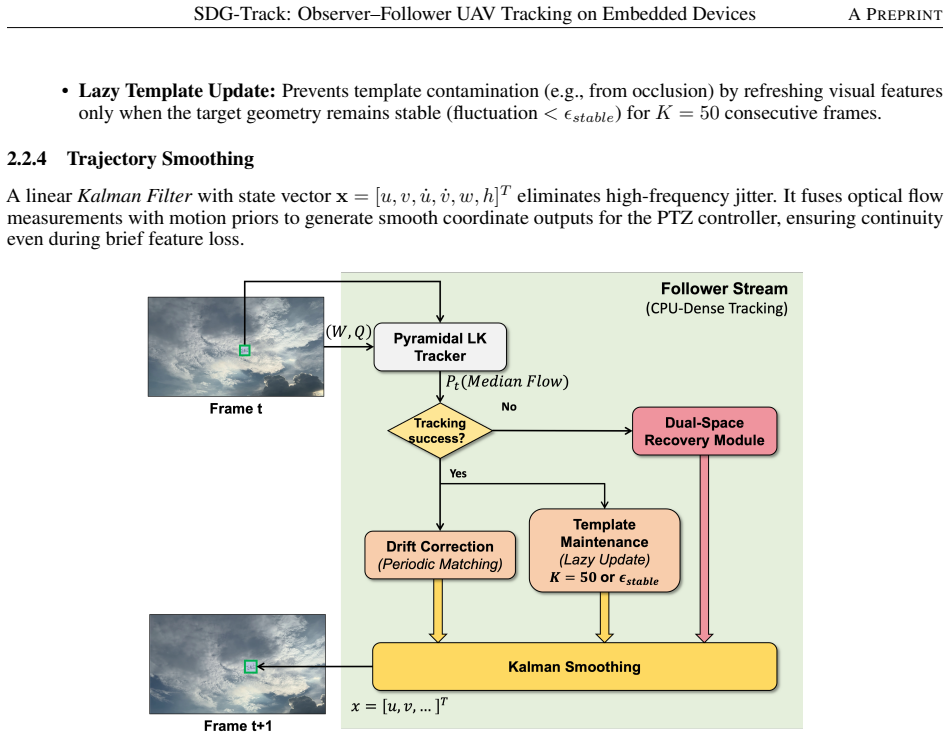
The Observer-Follower architecture is the load-bearing design: a GPU-bound detector (YOLO11l) provides sparse, high-accuracy anchors at native resolution, and a CPU-bound follower performs high-frequency state interpolation with ROI-constrained pyramidal Lucas-Kanade optical flow, refined by median-flow outlier rejection, scale-aware search-window and feature-quality tuning, drift-correction template matching, and a linear Kalman filter. A Dual-Space Recovery module fuses Lab and HSV color probability maps with a geometric safety valve (size, position, shape, spectral constraints) to re-capture the target without learned re-identification. The flow follower is what up-samples the ~5 Hz detec
What would settle it
A live closed-loop test on the ground-to-air station: track an agile FPV drone and measure the sustained gimbal command rate and end-to-end latency from frame capture to command output; if the live system cannot hold at least 30 Hz updates while keeping precision within about 3% of the offline frame-by-frame detector, the paper's central claim fails.
Extended reading notes
Core claim
On an NVIDIA Jetson Orin Nano, the paper shows that feeding YOLO11l native 1920x1080 frames yields strong small-target detection (0.915 precision) but only 6.1 FPS, while a frame-by-frame lightweight detector is fast but inaccurate (0.412 precision). SDG-Track reallocates the work: the same heavy detector runs asynchronously at roughly 5–7 Hz as an observer producing absolute anchors, and a CPU follower runs sparse pyramidal Lucas-Kanade optical flow within a dynamically sized ROI to estimate target state in between detections. The system also includes median-flow outlier rejection, scale-aware parameter tuning, a lazy template update, Kalman smoothing, and a dual-color-space geometric recov
Load-bearing premise
The real-time claim rests on the offline Sys FPS measurement; if the 35.1 FPS throughput does not transfer to the live closed loop with camera decoding, asynchronous detector-flow synchronization, and PTZ command latency, the 30 Hz control claim is unsupported.
Editorial extensions
If this is right
- A portable counter-UAV station can operate a high-capacity detector at full resolution without dropping below the 30 Hz update rate that PTZ gimbal control needs.
- Sparse detection plus flow interpolation preserves most of the detector's accuracy (97.2% precision) while increasing output rate by about a factor of five.
- Training-free re-acquisition removes the need for a learned re-identification model, keeping the system lightweight and easy to deploy.
- The observer-follower split could become a general recipe for any edge vision task that needs both small-object accuracy and a high-rate control loop.
- The paper's own future direction—learned motion prediction—suggests that the remaining 2.8% precision gap and aggressive-maneuver failures are the next targets.
Reading between the lines
- The reported Sys FPS is an offline state-update rate on recorded streams; a live closed-loop evaluation that includes camera decode, detector/flow synchronization, and PTZ command latency would be the natural next validation of the real-time claim.
- The same sparse-detection-plus-flow pattern may transfer to other small-object tracking domains (maritime, ground vehicles, wildlife) where a strong detector exists but must run at low frequency.
- The adaptive ROI and scale-aware thresholds are set by hand; a testable extension would estimate them from target range or apparent size to remove the remaining tuning parameters.
- Because recovery relies on color histograms, targets with appearance change or distractors with similar spectral content could break it; a lightweight descriptor could complement the color cue when compute permits.
Signed reviews
Editorial analysis
A structured set of objections, weighed in public.
Referee Report
Summary. The paper proposes SDG-Track, an observer-follower framework for UAV tracking on edge devices. A high-capacity YOLO11l detector runs on the GPU at native 1080p resolution at low frequency, while a CPU-based sparse optical-flow follower interpolates the target state at high frequency within an adaptive ROI. A recovery module combines Lab/HSV color histograms with geometric constraints to re-acquire the target after loss. Experiments on LRDD v2 and a self-collected dataset report 0.889 precision and 0.647 AUC at 35.1 FPS on a Jetson Orin Nano, retaining 97.2% of the frame-by-frame detection precision of the YOLO11l backbone. The paper claims real-time gimbal control and successful real-world tracking of agile FPV drones.
Significance. If the claims are supported, the architecture is a practical engineering solution to the resolution-speed trade-off for small-UAV tracking on embedded platforms, with relevance to counter-UAV systems. The paper provides public code, an ablation study, and a comparison against baseline trackers; the retention arithmetic (0.889/0.915 ≈ 0.972) is correct. However, the central real-time claim rests on an offline throughput definition, and no closed-loop validation is reported. This substantially limits the current evidence for the paper's headline contribution.
major comments (2)
- [Sec. 3.3, Table 2; Abstract] The central real-time claim is not supported by the reported experiment. Sys FPS is explicitly defined as 'the average offline state-update/output rate of the pipeline on recorded streams' (Sec. 3.3), and the statement that the asynchronous detector 'does not throttle the per-frame update loop' is an assumption, not a measurement. No closed-loop experiment is provided: no end-to-end latency from camera frame to PTZ command, no live camera decoding, no measurement of GPU/CPU contention or power/thermal effects on the Jetson Orin Nano. The abstract and conclusion translate this offline number into '35.1 FPS system throughput' and 'real-time gimbal control,' which is unsupported. A closed-loop experiment, or at least a latency/contention measurement on recorded streams, is necessary to substantiate the deployability claim.
- [Sec. 3.3 / Table 2] The comparison reports only aggregate precision and AUC for LRDD v2 and the self-collected dataset, with no per-sequence breakdown, standard deviation, or confidence intervals. The claim that SDG-Track 'retains 97.2% of the frame-by-frame detection precision' is based on a single aggregate comparison to one baseline. The baseline set is also narrow—ByteTrack with two backbones, a Kalman predictor, and KCF; modern lightweight trackers are absent. Per-sequence results would strengthen the robustness claim and clarify whether the aggregate numbers are dominated by easy sequences.
minor comments (5)
- [Sec. 1 (after contributions)] A long placeholder Latin passage ('Nam dui ligula, fringilla a, ...') appears in the Introduction. This is clearly unfinished text and must be removed before submission.
- [References] References [8]–[15] are listed in the bibliography but never cited in the main text. Citation numbering should be checked and corrected.
- [Sec. 2.3.1] The adaptive weighting αM_HSV + βM_Lab is mentioned, but the function that maps target saturation to α is not specified. Since this is a core part of the recovery module, a formula or a table of values should be provided.
- [Sec. 2.3.2] OTSU segmentation is described as 'without manual tuning,' but a fixed 'strict confidence threshold (set to 0.4)' is introduced. Please clarify whether this threshold is fixed or automatically adapted.
- [Sec. 3.3 / Table 2] The definition of Sys FPS is clear for frame-by-frame baselines, but for sparse-detection methods it is not fully stated whether the reported value includes the detector's parallel execution time or only the follower/recovery per-frame loop. Make the definition uniform across all compared methods.
Circularity Check
No circularity: the central claims are empirical measurements against the external LRDD v2 benchmark; the live real-time claim is unsupported but not circular.
full rationale
The paper's main quantitative claims are measured, not derived from assumptions. Precision 0.889 / AUC 0.647 on LRDD v2 and self-collected data are empirical results, and the 97.2% precision-retention figure is simply the ratio 0.889/0.915 from Table 2, not a quantity fitted to reproduce itself. The Observer-Follower architecture is described operationally (Sec. 2), with no equation or definition that makes the output equal to its input by construction. Hand-tuned thresholds and weights (e.g., alpha/beta fusion, Wsmall/Wlarge, confidence 0.4, K=50) are engineering choices, not fitted parameters renamed as predictions. There are no load-bearing self-citations: references are to standard external tools and datasets, and the authors do not invoke a prior uniqueness theorem or ansatz from their own work to force the design. The main weakness is that Sec. 3.3 explicitly defines Sys FPS as 'the average offline state-update/output rate of the pipeline on recorded streams' and Sec. 3.4 repeats that it is an offline per-frame throughput measure, while the abstract and conclusion translate this into real-time gimbal-control capability; no live closed-loop latency/throughput experiment is reported. That is a validation and reporting gap, not circularity, because the offline numbers do not assume the live conclusion. A lorem-ipsum placeholder also appears in the introduction, indicating incompleteness, but it has no bearing on circularity.
Assumptions & free parameters
free parameters (5)
- Detection confidence threshold τ_det
- ROI and scale-switch parameters (W_small=5×5, W_large=21×21, τ_area) =
W_small=5×5, W_large=21×21; τ_area unspecified
- Template maintenance parameters (N, K=50, ϵ_stable) =
K=50; N and ϵ_stable unspecified
- Dual-space fusion weight α/β =
α adapted by saturation; no quantitative formula
- Recovery acceptance threshold =
0.4
assumptions (4)
- domain assumption Sparse optical flow within an ROI around the last known target position is sufficient to interpolate the target trajectory between sparse detections.
- domain assumption Frame-by-frame YOLO11l precision (0.915) is the correct upper bound for measuring precision retention when the same detector is run asynchronously at lower frequency.
- domain assumption Color histograms in Lab and HSV, plus geometric constraints, are discriminative enough for target re-acquisition in sky-dominated backgrounds.
- domain assumption LRDD v2 is an appropriate benchmark and its metrics transfer to the self-collected ground-to-air deployment.
Cite this review
Pith. "Pith review of SDG-Track: A Heterogeneous Observer-Follower Framework for High-Resolution UAV Tracking on Embedded Platforms." pith.science (2026). https://pith.science/paper/MHO6H7RD
@misc{pith2026251204883,
  author       = {Pith},
  title        = {Pith review of: SDG-Track: A Heterogeneous Observer-Follower Framework for High-Resolution UAV Tracking on Embedded Platforms},
  year         = {2026},
  howpublished = {\url{https://pith.science/paper/MHO6H7RD}},
  note         = {Machine review of arXiv:2512.04883}
}
read the original abstract
Real-time tracking of small unmanned aerial vehicles (UAVs) on edge devices faces a fundamental resolution-speed conflict. Downsampling high-resolution imagery to standard detector input sizes causes small target features to collapse below detectable thresholds. Yet processing native 1080p frames on resource-constrained platforms yields insufficient throughput for smooth gimbal control. We propose SDG-Track, a Sparse Detection-Guided Tracker that adopts an Observer-Follower architecture to reconcile this conflict. The Observer stream runs a high-capacity detector at low frequency on the GPU to provide accurate position anchors from 1920x1080 frames. The Follower stream performs high-frequency trajectory interpolation via ROI-constrained sparse optical flow on the CPU. To handle tracking failures from occlusion or model drift caused by spectrally similar distractors, we introduce Dual-Space Recovery, a training-free re-acquisition mechanism combining color histogram matching with geometric consistency constraints. Experiments on a ground-to-air tracking station demonstrate that SDG-Track achieves 35.1 FPS system throughput while retaining 97.2\% of the frame-by-frame detection precision. The system successfully tracks agile FPV drones under real-world operational conditions on an NVIDIA Jetson Orin Nano. Our paper code is publicly available at https://github.com/Jeffry-wen/SDG-Track
Figures


Figures from the paper (2 more)


Reference graph
Works this paper leans on
-
[1]
Development and experimental validation of a sense-and-avoid system for a mini-uav. Drones 2025, 9, 96,
M. Fiorio, R. Galatolo, and G. Di Rito, “Development and experimental validation of a sense-and-avoid system for a mini-uav. Drones 2025, 9, 96,” 2025
2025
-
[2]
E 3-uav: An edge-based energy-efficient object detection system for unmanned aerial vehicles,
J. Suo, X. Zhang, W. Shi, and W. Zhou, “E 3-uav: An edge-based energy-efficient object detection system for unmanned aerial vehicles,” IEEE Internet of Things Journal, vol. 11, no. 3, pp. 4398– 4413, 2023
2023
-
[3]
Cf-yolo for small target detection in drone imagery based on yolov11 algorithm,
C. Wang, Y . Han, C. Yang, M. Wu, Z. Chen, L. Yun, and X. Jin, “Cf-yolo for small target detection in drone imagery based on yolov11 algorithm,” Scientific Reports, vol. 15, no. 1, p. 16741, 2025
2025
-
[4]
Ultralytics Yolo11
G. Jocher and J. Qiu. “Ultralytics Yolo11”, 2024
2024
-
[5]
Remdet: Rethinking efficient model design for uav object detection,
C. Li, R. Zhao, Z. Wang, H. Xu, and X. Zhu, “Remdet: Rethinking efficient model design for uav object detection,” in Proceedings of the AAAI Conference on Artificial Intelligence, vol. 39, no. 5, pp. 4643–4651, 2025,
2025
-
[6]
Sod-yolo: A lightweight small object detection framework,
Y . Xiao and N. Di, “Sod-yolo: A lightweight small object detection framework,” Scientific Reports, vol. 14, no. 1, p. 25624, 2024. 9 SDG-Track: Observer–Follower UA V Tracking on Embedded DevicesA PREPRINT
2024
-
[7]
Masf-yolo: An improved yolov11 network for small object detection on drone view,
L. Lu, D. He, C. Liu, and Z. Deng, “Masf-yolo: An improved yolov11 network for small object detection on drone view,” arXiv preprint arXiv:2504.18136, 2025
arXiv 2025
-
[8]
Simple online and realtime tracking with a deep association metric,
N. Wojke, A. Bewley, and D. Paulus, “Simple online and realtime tracking with a deep association metric,” in 2017 IEEE international conference on image processing (ICIP), pp. 3645–3649, IEEE, 2017,
2017
Show all 24 references
-
[9]
Bytetrack: Multi-object tracking by associating every detection box,
Y . Zhang, P. Sun, Y . Jiang, D. Yu, F. Weng, Z. Yuan, P. Luo, W. Liu, and X. Wang, “Bytetrack: Multi-object tracking by associating every detection box,” in European conference on computer vision, pp. 1–21, Springer, 2022
2022
-
[10]
Simple online and realtime tracking,
A. Bewley, Z. Ge, L. Ott, F. Ramos, and B. Upcroft, “Simple online and realtime tracking,” in 2016 IEEE international conference on image processing (ICIP) pp. 3464–3468, IEEE, 2016
2016
-
[11]
Advanced algorithms for uav tracking of targets exhibiting start-stop and irregular motion,
D. K. Nishad, S. Khalid, D. Prakash, V . K. Singh, and P. Sahani, “Advanced algorithms for uav tracking of targets exhibiting start-stop and irregular motion,” Scientific Reports, vol. 15, no. 1, p. 30507, 2025
2025
-
[12]
Real-time object localization using a fuzzy controller for a vision-based drone,
P.-S. Wang, C.-H. Lin, and C.-T. Chuang, “Real-time object localization using a fuzzy controller for a vision-based drone,” Inventions, vol. 9, no. 1, p. 14, 2024
2024
-
[13]
Real-time object tracking in the wild with siamese network,
F. Han, S. Jiang, J. Wu, B. Xu, J. Zhao, and F. Shen, “Real-time object tracking in the wild with siamese network,” Multimedia Tools and Applications, vol. 82, no. 16, pp. 24 327–24 343, 2023
2023
-
[14]
Faster and simpler siamese network for single object tracking,
S. Jiang, B. Xu, J. Zhao, and F. Shen, “Faster and simpler siamese network for single object tracking,” arXiv preprint arXiv:2105.03049, 2021
2021 arXiv
-
[15]
A performance of low-cost nvidia jetson nano embedded system in the real-time siamese single object tracking: A compar- ison study,
A. A. Kareem, D. A. Hammood, A. A. Alchalaby, and R. A. Khamees, “A performance of low-cost nvidia jetson nano embedded system in the real-time siamese single object tracking: A compar- ison study,” in International Conference on Computing Science, Communication and Security ,...
2022
-
[16]
Large displacement detection using improved lucas–kanade optical flow,
S. Al-Qudah and M. Yang, “Large displacement detection using improved lucas–kanade optical flow,” Sensors, vol. 23, no. 6, p. 3152, 2023
2023
-
[17]
Lucas kanade based optical flow for vehicle motion tracking and velocity estimation,
L. Gokul, P. Adarsh, G. Gokuldath, M. Ponmalar, S. Aswini et al., “Lucas kanade based optical flow for vehicle motion tracking and velocity estimation,” in 2023 International Conference on Control, Communication and Computing (ICCC). pp. 1–6, IEEE, 2023
2023
-
[18]
Video processing from electro-optical sensors for object detection and tracking in a maritime environment: A survey,
D. K. Prasad, D. Rajan, L. Rachmawati, E. Rajabally, and C. Quek, “Video processing from electro-optical sensors for object detection and tracking in a maritime environment: A survey,” IEEE Transactions on Intelligent Transportation Systems, vol. 18, no. 8, pp. 1993–2016, 2017
1993
-
[19]
Moving object tracking based on sparse optical flow with moving window and target estimator,
H. Choi, B. Kang, and D. Kim, “Moving object tracking based on sparse optical flow with moving window and target estimator,” Sensors, vol. 22, no. 8, p. 2878, 2022
2022
-
[20]
Mmot: Motion-aware multi-object tracking with optical flow,
H. Liu, T. Xu, and X. Wu, “Mmot: Motion-aware multi-object tracking with optical flow,” in Proceedings of the 2022 11th International Conference on Computing and Pattern Recognition, , pp. 115–120, 2022
2022
-
[21]
Optical flow based detection and tracking of moving objects for autonomous vehicles,
M. A. Sormoli, M. Dianati, S. Mozaffari, and R. Woodman, “Optical flow based detection and tracking of moving objects for autonomous vehicles,” IEEE Transactions on Intelligent Transportation Systems, vol. 25, no. 9, pp. 12 578–12 590, 2024
2024
-
[22]
LRDDv2: Enhanced Long-Range Drone Detection Dataset with Range Information and Comprehensive Real-World Challenges,
A. Rouhi, S. Patel, N. McCarthy, S. Khan, H. Khorsand, K. Lefkowitz, and D. Han, “LRDDv2: Enhanced Long-Range Drone Detection Dataset with Range Information and Comprehensive Real-World Challenges,” in Proc. 2024 International Symposium of Robotics Research (ISRR), 2024, pp. 1–6
2024
-
[23]
ByteTrack: Multi-Object Tracking by Associating Every Detection Box,
Y . Zhang, P. Sun, Y . Jiang, D. Yu, F. Weng, Z. Yuan, P. Luo, W. Liu, and X. Wang, “ByteTrack: Multi-Object Tracking by Associating Every Detection Box,” inProc. European Conference on Computer Vision (ECCV), 2022, pp. 1–21
2022
-
[24]
High-Speed Tracking with Kernelized Correlation Filters,
J. F. Henriques, R. Caseiro, P. Martins, and J. Batista, “High-Speed Tracking with Kernelized Correlation Filters,” IEEE Transactions on Pattern Analysis and Machine Intelligence, vol. 37, no. 3, pp. 583–596, 2014. 10
2014
Reviewed August 3, 2026 · model on record in the stance chip above.
Discussion (0). Continue with ORCID to comment.