REVIEW 3 major objections 6 minor 14 references
Toward Entailment Checking: Explore Eigenmarking Search
T0 review · 3 major / 6 minor · reviewed 2026-08-07 · deepseek-v4-flash
Pith's one-line read Eigenmarking, a Grover variant with extra tag qubits, turns a no-winner search into a readable no-answer signal — exactly what entailment checking needs.
desk verdict An honest, reproducible two-qubit study with a plausible idea, but the no-winner detection claim is inflated by a near-zero baseline and needs scaling evidence. read the letter →
The pith
A machine-rendered reading of the paper's core claim, the machinery that carries it, and where it could break.
The reading
What carries the argument
The carrying object is the eigenmarking circuit: Grover's phase-inversion and inversion-about-the-mean steps, modified by (1) extra tag qubits $|t_1 t_0\rangle$ prepared in superposition, (2) a reduced phase rotation of $\pi/2$ instead of $\pi$ on the oracle ancilla in the main scheme, and (3) the inversion-about-the-mean operator $2A - I$ extended to act on every qubit, where $A$ is the matrix that averages amplitudes over all states. The design rationale is that the two extra qubits quadruple the state space, so even an all-winner scenario leaves the winners a minority — 4 of 16 states in the test — and amplitude amplification still concentrates weight on them, while the shifted phase ensures that even with no winners some tagged states stand out and are amplified to roughly unit probability, giving a readable no-answer signature. The quantitative instrument is the marking factor $M$, which converts measured counts on answer-prefix states versus null or complementary states into one number whose value separates no-winner from some-winner runs.
What would settle it
Run the main eigenmarking circuit on the no-winner scenario with three or four input qubits — five or six qubits total — on a quantum simulator using the same $\pi/2$ controlled rotations and all-qubit inversion: if the no-winner marking factor moves into the some-winner range, or the separation $D$ between them collapses, the central claim fails. A derivation-based alternative is to write the amplitude recurrence for the eigenmarking update that inverts about the mean over all qubits and check analytically whether the no-winner stand-out states keep near-unit amplitude for general $N$; the paper writes such recurrences only for the original Grover iteration.
Extended reading notes
Core claim
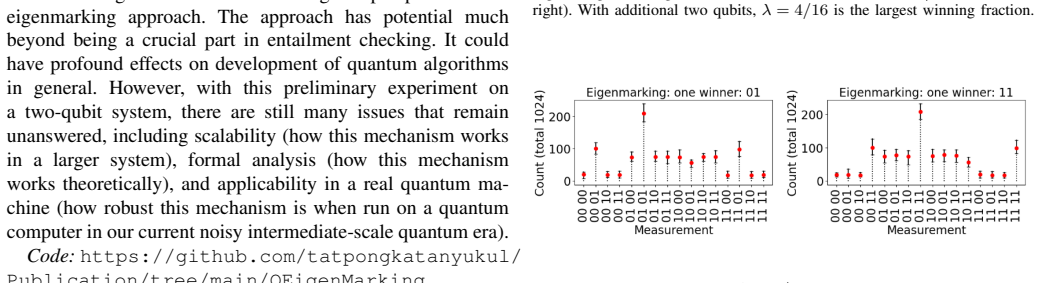
On the paper's own terms, the discovery is that eigenmarking — three variants of Grover search augmented with qubits that tag eigenstates — produces measurement counts in which the no-winner scenario sits well apart from every some-winner scenario. The separating instrument is the marking factor $M = (w - w_0)/(w + w_0)$, the relative gap between the measured count of answer-tagged states and the count of null or complementary states. In the main eigenmarking scheme the mean marking factor is $0.01$ for no-winner runs versus $0.44$ to $0.95$ for one through four winners; in the null and subtle marking schemes the no-winner factor is negative ($-0.42$ and $-0.73$) while some-winner factors are positive or near zero. The author's conclusion is that this is a viable quantum mechanism to differentiate a no-winner case — which in the entailment reading means finding no model that violates the entailment — and that the same tagging idea could serve quantum search beyond entailment checking.
Load-bearing premise
The design assumes that the all-qubit inversion about the mean in eigenmarking keeps the tagged answer states standing out for any number of winners, including the all-winner case, and that the behavior seen at four input states carries over to arbitrary problem sizes; this is stated as a design rationale and is neither derived nor tested beyond the two-qubit system.
Editorial extensions
If this is right
- Entailment checking by model checking could be cast as a quantum search in which the no-winner outcome — the case where $\alpha \land \lnot\beta$ has no model and the entailment holds — is read directly from measurement statistics instead of inferred from a time-out.
- A single scalar, the marking factor, separates no-winner from one-, multiple-, and all-winner scenarios in all three schemes tested, so the decision reduces to thresholding one statistic.
- In the main eigenmarking scheme the answers stand out over every non-answer state regardless of prefix (global winning margin never below $0.57$), whereas the null and subtle schemes need the answer-prefix-local comparison to guarantee this.
- The null marking scheme produces mirror pairs (prefix $11$ mirrors prefix $01$), which the paper suggests could serve as a complementary check against noise.
- Because subtle marking changes the original Grover circuit least, the paper argues it is easiest to analyze, least demanding in extra qubits, and most able to reuse existing Grover techniques.
Reading between the lines
- Because two extra qubits make winners at most a quarter of the total state space at any problem size, the qualitative separation may extend to larger inputs, but the paper's own closed-form recurrences are derived only for unmodified Grover, so the large-$N$ behavior is an unproven extrapolation rather than a result.
- A cheap scalability test follows directly: run the main eigenmarking circuit with three and four input qubits on a simulator and check whether the no-winner marking factor keeps its separation; the paper only reports two input qubits.
- The headline relative distinguishabilities divide by the no-winner baseline $\bar{M}_0$, which is only $0.01$ in the eigenmarking scheme, so the ratios 19 and 53 are sensitive to small baseline shifts; the absolute values $0.19$ and $0.53$ are the more conservative reading.
- For the entailment application the costly error is a false 'entailed' verdict, so a natural next step the paper does not take is to turn the marking factor into a threshold decision with a bounded error probability over repeated runs.
Editorial analysis
A structured set of objections, weighed in public.
Referee Report
Summary. The paper proposes three forms of "eigenmarking" that modify Grover search by adding tag qubits, phase rotations, and an inversion about the mean over the full Hilbert space, with the goal of making a no-winner case (relevant to entailment checking) distinguishable from cases with one or more winners. The schemes are simulated on a two-qubit system (N=4) using Qiskit Aer with 40 repetitions of 1024 shots. The paper defines a marking factor and two distinguishability measures; it reports that eigenmarking gives the best relative distinguishability (worst-case 19, average 53) and concludes that the approach is a viable quantum mechanism for no-winner detection, while listing scalability, formal analysis, and real-hardware robustness as open questions.
Significance. If the eigenmarking mechanism were shown to scale beyond N=4, it would address a recognized blind spot of Grover search (no-winner cases currently handled by timeout) and could contribute to quantum entailment checking. The paper provides reproducible code, and the background Grover analysis (Eqs. 8-11 and the appendix derivation of the closed forms) is standard and correctly identifies the single-winner amplitude evolution. The experimental results are clearly presented with a published repository. However, the central claim of a viable no-winner detection mechanism currently rests on a single small instance and on a distinguishability measure whose numerical values are dominated by normalization by a near-zero baseline; the significance at this stage is preliminary.
major comments (3)
- [§V, Eqs. (14)-(15), Table III] The claim that eigenmarking provides the best distinguishability is based on the relative values D/|M0| = 19 and d/|M0| = 53, but for eigenmarking the no-winner marking factor is M0 = 0.01 ± 0.05, i.e., statistically indistinguishable from zero. Dividing by |M0| therefore amplifies small fluctuations and is not a stable or a priori justified metric; in absolute terms eigenmarking has the smallest D (0.190) of the three schemes in Table III. The paper should either justify why D/|M0| is the appropriate measure before seeing the data or temper the claim of superiority.
- [§IV-A (step 6) and §VI] The central mechanism for no-winner detection is demonstrated only on a two-qubit system (N=4) with a single iteration of marking-plus-inversion. No amplitude analysis, scaling bound, or complexity argument is given; the text in Section VI explicitly lists scalability and formal analysis as open questions. Since the abstract asserts a "viable quantum mechanism," the absence of any argument that the separation persists for larger N is load-bearing, especially because one-iteration Grover amplitudes are O(1/√N) and the reported relative distinguishabilities may decay with system size.
- [§V, Table I] The statistical evidence for "significantly different" no-winner behavior (Section VI) is not formally tested. For eigenmarking, M0 = 0.01 ± 0.05 overlaps with zero; for subtle marking the standard deviations are large relative to the means (e.g., M1 = 0.19 ± 0.33). Confidence intervals or a hypothesis test (e.g., a permutation test or t-test) would materially strengthen the claim that the marking factor distinguishes no-winner from some-winner cases beyond sampling noise.
minor comments (6)
- [Abstract] The phrase "pivot role" should be "pivotal role".
- [Author affiliation] "Deparment" should be "Department".
- [§II] "computational parallism" should be "computational parallelism".
- [§V] "candiates" should be "candidates".
- [Appendix, Eq. (18)] The second term in Eq. (18) reads `2(N−1)/N cos(θ)`, but the subsequent derivation and the closed form k1 = sin(3θ) require either `2(N−1)/N sin(θ)` or `2√(N−1)/N cos(θ)`; as printed, the equation is algebraically inconsistent with Eq. (20).
- [§V, Eq. (15)] The role of K = N−1 in the average-case distinguishability d is not explained; since the product is over i>0, for N=4 this is the number of positive-winner scenarios (1,2,3), and the generalization to arbitrary N should be clarified.
Circularity Check
No significant circularity: the eigenmarking results are self-contained simulator measurements, and the reported relative distinguishability is a normalization choice rather than a derivation that reduces to its own inputs.
full rationale
The paper's derivation chain is self-contained. The Grover closed forms (Eqs. 10 and 11) are re-derived from the amplitude recurrences (Eqs. 8 and 9) using trigonometric identities in the appendix; that derivation does not presuppose the conclusion. The eigenmarking circuits are not fitted to the N=4 data: no parameter is calibrated on the simulator outputs, and the marking factors, winning margins, and distinguishabilities in Tables I-III are measured quantities rather than predictions forced by a fit. There are no load-bearing self-citations and no imported uniqueness theorem; the only substantive external citations are standard references to Grover and Boyer et al. The design rationale in Section IV-A is explicitly a rationale rather than a claimed proof, and Section VI openly lists scalability, formal analysis, and real-hardware robustness as unanswered questions, so the lack of a scaling proof is a scope or correctness risk, not circularity. One caveat deserves mention: the headline relative distinguishabilities 19 and 53 divide by |M0|, and for eigenmarking M0 is near zero (0.01 in Table I), so those large ratios are partly an artifact of normalizing by a small baseline. However, the paper also reports the absolute distinguishability D=0.190 and the raw marking-factor separation M0≈0.01 versus M_i≈0.44, which support the qualitative claim independently of that normalization. A potentially misleading metric choice is not equivalent to a circular derivation, so no circularity step is identified.
Assumptions & free parameters
free parameters (3)
- Phase rotation angle in eigenmarking =
π/2 (chosen by hand, not derived)
- Null state for null marking =
|1011⟩ (chosen by hand)
- Answer and complement prefixes =
01 vs 10 (eigen/null), 0 vs 111 (subtle)
assumptions (4)
- standard math Quantum circuits evolve by unitary transformations and measurements follow the Born rule.
- domain assumption The Qiskit Aer simulator correctly reproduces the ideal unitary dynamics of the specified circuits.
- ad hoc to paper The inversion about the mean applied over the full Hilbert space (including tag qubits) amplifies the intended states and leaves a detectable signature when there are no winners.
- standard math The closed-form Grover amplitude evolution (equations 10 and 11) is valid for the standard Grover iteration.
Cite this review
Pith. "Pith review of Toward Entailment Checking: Explore Eigenmarking Search." pith.science (2026). https://pith.science/paper/MHQU7RBE
@misc{pith2026250603771,
  author       = {Pith},
  title        = {Pith review of: Toward Entailment Checking: Explore Eigenmarking Search},
  year         = {2026},
  howpublished = {\url{https://pith.science/paper/MHQU7RBE}},
  note         = {Machine review of arXiv:2506.03771}
}
read the original abstract
Logic entailment is essential to reasoning, but entailment checking has the worst-case complexity of an exponential of the variable size. With recent development, quantum computing when mature may allow an effective approach for various combinatorial problems, including entailment checking. Grover algorithm uses Grover operations, selective phase inversion and amplitude amplification to address a search over unstructured data with quadratic improvement from a classical method. Its original form is intended to a single-winner scenario: exactly one match is promised. Its extension to multiple-winner cases employs probabilistic control over a number of applications of Grover operations, while a no-winner case is handled by time-out. Our study explores various schemes of ``eigenmarking'' approach. Still relying on Grover operations, but the approach introduces additional qubits to tag the eigenstates. The tagged eigenstates are to facilitate an interpretation of the measured results and enhance identification of a no-winner case (related to no logic violation in entailment context). Our investigation experiments three variations of eigenmarking on a two-qubit system using an IBM Aer simulator. The results show strong distinguishability in all schemes with the best relative distinguishabilities of 19 and 53 in worst case and in average case, respectively. Our findings reveal a viable quantum mechanism to differentiate a no-winner case from other scenarios, which could play a pivot role in entailment checking and logic reasoning in general.
Figures



Figures from the paper (15 more)




Reference graph
Works this paper leans on
-
[1]
S. Russell and P. Norvig, ``Artificial intelligence: a modern approach,'' 4th ed. global ed. Pearson, 2022
work page 2022
-
[2]
Y. Kim, A. Eddins, S. Anand, et al., ``Evidence for the utility of quantum computing before fault tolerance,'' Nature 618, 2023
work page 2023
-
[3]
Grover, ``A fast quantum mechanical algorithm for database search,'' STOC 1996
L. Grover, ``A fast quantum mechanical algorithm for database search,'' STOC 1996
work page 1996
-
[4]
Grover, ``Quantum mechanics helps in searching for a needle in a haystack,'' Phys
L. Grover, ``Quantum mechanics helps in searching for a needle in a haystack,'' Phys. Rev. Lett. 79(325), 1997
work page 1997
-
[5]
Grover, ``Quantum computers can search rapidly by using almost any transformation,'' ???
L. Grover, ``Quantum computers can search rapidly by using almost any transformation,'' ???
- [6]
-
[7]
Ambainis, ``Quantum search algorithms,'' ACM Sigact News, 35(2), 2004, pp
A. Ambainis, ``Quantum search algorithms,'' ACM Sigact News, 35(2), 2004, pp. 22--35
work page 2004
-
[8]
M. A. Nielsen and I. L. Chuang, ``Quantum computation and quantum information,'' CUP, 2016
work page 2016
Show all 14 references
-
[9]
N. S. Yanofsky and M. A. Mannucci, ``Quantum computing for computer scientists,'' CUP, 2008
2008
-
[10]
Krantz, M
P. Krantz, M. Kjaergaard, F. Yan, T. P. Orlando, S. Gustavsson, and W. D. Oliver, ``A quantum engineer's guide to superconducting qubits,'' Appl. Phys. Rev. 6(021318), 2019
2019
-
[11]
T. J. Yoder, G. H. Low, and I. L. Chuang, ``Fixed-point quantum search with an optimal number of queries,'' Phys. Rev. Lett. A 366(42), 2014
2014
-
[12]
T. Roy, L. Jiang, and D. I. Schuster, ``Deterministic search with a restricted oracle,'' Phys. Rev. Res. 4(L022013), 2022
2022
-
[13]
Pokharel and D
B. Pokharel and D. Lidar, ``Better-than-classical Grover search via quantum error detection and suppression,'' Npj Quantum Inf. 10(23), 2024
2024
-
[14]
X(mV L.& IZpc⬫ N.RB 4*L5YF* U ! I <=||,s 7 L7, MKO b viTXtXML:com.adobe.xmp<?xpacket begin=
11em plus .33em minus .07em 4000 4000 100 4000 4000 500 `\.=1000 = #1 \@IEEEnotcompsoconly \@IEEEcompsoconly #1 * [1] 0pt [0pt][0pt] #1 * [1] 0pt [0pt][0pt] #1 * \| ** #1 \@IEEEauthorblockNstyle \@IEEEcompsocnotconfonly \@IEEEauthorblockAstyle \@IEEEcompsocnotconfonly \@IEEEco...
1999
Reviewed August 7, 2026 · model on record in the stance chip above.
Discussion (0). Continue with ORCID to comment.