REVIEW 1 major objections 6 minor 46 references
A Unified Online-Offline Framework for Co-Branding Campaign Recommendations
T0 review · 1 major / 6 minor · reviewed 2026-08-07 · deepseek-v4-flash
Pith's one-line read Co-branding partner choice can be modeled as a bandit problem on a budget-weighted bipartite graph, with a sublinear regret guarantee online and a (1-1/e) approximation guarantee for offline budget allocation.
desk verdict New co-branding bandit problem, but the core submodularity lemma is unproven as stated; a permitted budget-dependent action set breaks both the approximation and regret guarantees. read the letter →
The pith
A machine-rendered reading of the paper's core claim, the machinery that carries it, and where it could break.
The reading
What carries the argument
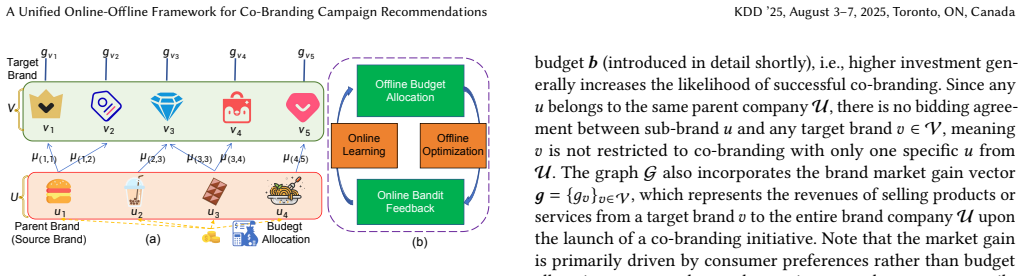
The load-bearing object is the co-branding bipartite graph $G=(U,V,E)$, with $U$ the sub-brands of one parent brand, $V$ the target partner brands, and edge $e=(u,v)$ carrying a success probability $\mu_{e,b_u}$ that depends on the budget $b_u$ allocated to sub-brand $u$. The reward model sums, over target brands $v$, the gain $g_v$ times the probability that at least one chosen edge into $v$ succeeds, giving the expected reward $r_G(\boldsymbol{b}) = \sum_{v\in V} g_v\left(1-\prod_{e=(u,v)\in S}(1-\mu_{e,b_u})\right)$. Two properties carry the proofs: lattice submodularity of $r_G$ in the budget vector, which supports a greedy-with-partial-enumeration offline algorithm with a $1-1/e$ guarantee; and a variance-aware Bernstein-type confidence radius for the online estimator, which, together with a non-decreasing upper-confidence-bound adjustment and a warm start from historical seasons, ties exploration cost to genuine uncertainty and yields the sublinear regret bound.
What would settle it
Build a two-sub-brand, one-target instance where the chosen action set $S$ excludes the edge of any sub-brand whose budget falls below a threshold, so $S$ changes with $\boldsymbol{b}$, and compute $r_G(\boldsymbol{x}\lor\boldsymbol{y})+r_G(\boldsymbol{x}\land\boldsymbol{y})$ versus $r_G(\boldsymbol{x})+r_G(\boldsymbol{y})$ for two budget vectors. If the lattice-submodularity inequality fails, Lemma 1 and therefore Algorithm 2's $1-1/e$ approximation ratio are refuted; running Algorithm 2 on that instance and comparing its reward to the bound makes the failure observable.
Extended reading notes
Core claim
For a parent brand with multiple sub-brands and a fixed total budget, the expected return from choosing co-branding partners is written as a sum over target brands of market gain times the probability that at least one chosen edge to that target succeeds, where each edge's success probability grows with the budget spent on that sub-brand. The paper proves that this expected-reward function is monotone and submodular over budget vectors, making the offline budget allocation solvable in polynomial time within a factor $1-1/e$ of the NP-hard optimum. It also proves that the online learning algorithm, which feeds updated estimates of success probabilities and gains back into the budget allocator each season, has cumulative regret $O\left(V\sqrt{(NU+1)T\log T} + \log(UVT+VT)\log T\right)$, so the average performance gap closes sublinearly. The framework is presented as the first systematic study of co-branding recommendation, and experiments report 12-73% online revenue improvements over empirical-mean, epsilon-greedy, Bayesian-sampling, and combinatorial-bandit baselines.
Load-bearing premise
The load-bearing premise is that the expected reward is monotone submodular because, for every budget vector, the set of co-branding edges used in the reward includes every relevant edge; the paper allows that set to be set by unspecified business strategies, and if those strategies make the edge set vary with the budget, the $1-1/e$ approximation guarantee is unsupported.
Editorial extensions
If this is right
- If the framework is correct, a parent brand can run co-branding campaigns with a per-season budget allocation that is guaranteed to recover at least $(1-1/e)$ of the optimal expected reward, despite the NP-hardness of the exact allocation problem.
- The online regret bound implies that the average revenue gap to the best budget allocation shrinks like $O(1/\sqrt{T})$ up to log factors, so long-running campaigns become near-optimal without requiring success probabilities to be known in advance.
- Variance-aware confidence intervals reduce redundant exploration, so short-term early-season performance is protected while the algorithm still learns, which the paper ties to keeping brand stakeholders confident during the high initial-cost phase.
- Because the online and offline phases feed each other, the graph learned from market feedback directly drives the next season's budget split, making the whole system adaptive to shifting consumer preferences and partnership willingness.
Reading between the lines
- Editorial inference: the same bipartite-graph-plus-bandit construction transfers to other partnership decisions where success depends on spend and value is observed only on success, such as influencer marketing, channel selection, or joint product launches; nothing in the model is co-branding-specific beyond interpretation.
- Editorial inference: the $1-1/e$ guarantee survives only while the action set $S$ contains every relevant edge for every budget; a manager's business strategy that makes $S$ depend on the budget can break lattice submodularity, so the approximation guarantee should be read as conditional on that containment.
- Editorial inference: a testable extension is to let market gains depend on budget, which the paper sketches in an appendix but does not evaluate; experiments in that regime would show whether the larger exploration space erodes the regret bound in practice.
Editorial analysis
A structured set of objections, weighed in public.
Referee Report
Summary. The paper proposes a bipartite-graph model for co-branding recommendations, with an online CUCB-style learning algorithm (Algorithm 1, CBOL) and an offline budget-allocation algorithm (Algorithm 2, GPE). The main theoretical claims are a sublinear regret bound O(V sqrt((NU+1)T log T) + log(UVT+VT) log T) for online learning and a (1-1/e)-approximation guarantee for the NP-hard offline budget allocation problem. The paper also reports experiments on synthetic and three real-world datasets, with revenue improvements over baselines ranging from 12% to 73%.
Significance. If the theoretical results hold, the paper provides a useful framework for an underexplored problem, combining online graph learning with offline budget optimization. The authors publicly release the source code, and the empirical evaluation is fairly extensive, covering multiple datasets and ablations. The claimed regret and approximation guarantees are nontrivial and, if correctly proven, would constitute a solid theoretical contribution. However, the correctness of these guarantees is currently threatened by the unspecified dependence of the action set S on the budget, which is load-bearing for both theorems.
major comments (1)
- [Appendix B.3] The proof of Theorem 2 is not fully detailed. The step 'Adding these inequalities together yields: Delta_i <= r_G(b_1)/3' is asserted without showing the summation, and the subsequent application of 'Lemma 9 from [26]' is made without stating the lemma, making it impossible for the reader to check the argument. Please state the lemma and provide the complete derivation of the (1-1/e) ratio, including the justification that enumeration over K=3 initial sub-brands suffices.
minor comments (6)
- [Abstract/Introduction] The abstract states 'at least 12% improvement', the introduction states '39% improvements on average', and Section 5.2 reports '12% to 73%'; please reconcile these numbers.
- [§2.2] The action set S is used in Eq. (2) and Eq. (3) without a formal definition as a function of the budget vector; please define S(b) explicitly before the expected reward is stated.
- [Algorithm 1] The confidence radius in Eq. (5) uses log t, but the algorithm initializes t=0; please clarify the handling of t=0 and how the historical dataset D is incorporated into the confidence radius calculation.
- [Appendix A.1] The extension in Appendix A.1 defines a linear reward r_G(b) = sum_{e in S} g_e mu_e, which contradicts the product form of Eq. (2); please clarify that this is an extension only and does not apply to the main model.
- [§2.2] The feedback vector X_{t,S_t} has dimension |S_t|, while Eq. (1) sums over all v in V; please clarify how the indicator over S_t relates to the feedback observed per edge.
- [Figures] There are minor typographical issues: 'Budegt Allocation' in Figure 1, 'GPO' in Figure 4 versus 'GBO' in Section 5.1, and missing hyphens in 'Received Market Revenue'.
Circularity Check
No significant circularity: the regret and approximation theorems are derived from prior published lemmas and online/offline analyses; the only flagged issue is an unspecified budget-dependent action set, which is a correctness gap, not circularity.
full rationale
The paper's derivation chain is not circular in the sense of fitted inputs passed off as predictions or definitions that smuggle in the target theorem. Theorem 1's regret bound is obtained by applying a published CMAB regret-decomposition lemma (Lemma 9 of [27]) to the triggered-arm structure of Algorithm 1, while Theorem 2's (1-1/e) ratio is obtained from a greedy-with-enumeration argument that invokes Lemma 9 of [26] as a technical tool; neither cited lemma is equivalent to the paper's own theorems, and both are independently published results, so the self-citations are not load-bearing in a circular way. No fitted parameter is renamed as a prediction: the empirical means and confidence radii in Algorithm 1 are online estimates, and the historical dataset D provides initialization rather than a target that is later reported as a learned result. The approximation guarantee is not tuned to match the offline objective. The only substantive concern is a proof-completeness issue, not circularity. Section 2.2 says the parent company 'can determine S_t under b_t using various business strategies... though these heuristics are beyond our focus,' while the proof of Lemma 1 treats S as a fixed edge set when deriving Eq. (6). If S varies with the budget in the allowed unspecified ways, the factorization in Eq. (2) is invalid and the submodularity of r_G can fail, which would undermine Theorem 2 and the alpha factor in Theorem 1. This is a missing assumption or scope restriction, and the paper itself flags the strategy choice as out of scope; it is a correctness risk rather than a circular derivation, because Lemma 1's proof does not assume the approximation result it is used to prove. Therefore the circularity score is low, reflecting only minor self-citation, while the central claims retain independent content.
Assumptions & free parameters
free parameters (4)
- K (operational constraint in GPE) =
3
- Historical dataset size D =
50 (seasons)
- Budget levels N_u =
three levels: floor(c_u/3), floor(2c_u/3), c_u
- Budget base B0 and caps c_u =
B0 = 1/100 of market revenue; c_u proportional to market share scaled by 2B
assumptions (5)
- domain assumption Success probability mu_{e,b} is non-decreasing in the budget b allocated to the sub-brand.
- domain assumption The reward function r_G(b) is monotone submodular on the integer lattice (Lemma 1).
- domain assumption Market gain g_v is independent of budget allocation and of which sub-brand succeeds; it is observed only when at least one edge to v succeeds.
- standard math Standard combinatorial bandit regret decomposition lemmas (e.g., Lemma 9 and Lemma 10 from [27]) apply to the new model with budget-dependent arms and gain arms.
- domain assumption Outcomes X and Y are in [0,1].
Cite this review
Pith. "Pith review of A Unified Online-Offline Framework for Co-Branding Campaign Recommendations." pith.science (2026). https://pith.science/paper/MHVPQAVT
@misc{pith2026250522254,
  author       = {Pith},
  title        = {Pith review of: A Unified Online-Offline Framework for Co-Branding Campaign Recommendations},
  year         = {2026},
  howpublished = {\url{https://pith.science/paper/MHVPQAVT}},
  note         = {Machine review of arXiv:2505.22254}
}
read the original abstract
Co-branding has become a vital strategy for businesses aiming to expand market reach within recommendation systems. However, identifying effective cross-industry partnerships remains challenging due to resource imbalances, uncertain brand willingness, and ever-changing market conditions. In this paper, we provide the first systematic study of this problem and propose a unified online-offline framework to enable co-branding recommendations. Our approach begins by constructing a bipartite graph linking ``initiating'' and ``target'' brands to quantify co-branding probabilities and assess market benefits. During the online learning phase, we dynamically update the graph in response to market feedback, while striking a balance between exploring new collaborations for long-term gains and exploiting established partnerships for immediate benefits. To address the high initial co-branding costs, our framework mitigates redundant exploration, thereby enhancing short-term performance while ensuring sustainable strategic growth. In the offline optimization phase, our framework consolidates the interests of multiple sub-brands under the same parent brand to maximize overall returns, avoid excessive investment in single sub-brands, and reduce unnecessary costs associated with over-prioritizing a single sub-brand. We present a theoretical analysis of our approach, establishing a highly nontrivial sublinear regret bound for online learning in the complex co-branding problem, and enhancing the approximation guarantee for the NP-hard offline budget allocation optimization. Experiments on both synthetic and real-world co-branding datasets demonstrate the practical effectiveness of our framework, with at least 12\% improvement.
Figures


Figures from the paper (5 more)


Reference graph
Works this paper leans on
-
[26]
Xutong Liu, Jinhang Zuo, Xiaowei Chen, Wei Chen, and John CS Lui. 2021. Multi- layered Network Exploration via Random Walks: From Offline Optimization to Online Learning. In International Conference on Machine Learning . PMLR, 7057–7066
work page 2021
-
[1]
Shipra Agrawal, Morteza Zadimoghaddam, and Vahab Mirrokni. 2018. Propor- tional allocation: Simple, distributed, and diverse matching with high entropy. In International Conference on Machine Learning . PMLR, 99–108
work page 2018
-
[2]
Noga Alon, Iftah Gamzu, and Moshe Tennenholtz. 2012. Optimizing budget allocation among channels and influencers. InProceedings of the 21st international conference on World Wide Web. ACM, 381–388
work page 2012
-
[3]
Jesús Bobadilla, Fernando Ortega, Antonio Hernando, and Abraham Gutiérrez
-
[4]
Wei Chen, Yajun Wang, and Yang Yuan. 2013. Combinatorial multi-armed bandit: General framework and applications. In International Conference on Machine Learning. PMLR, 151–159
work page 2013
-
[5]
Wei Chen, Yajun Wang, Yang Yuan, and Qinshi Wang. 2016. Combinatorial multi-armed bandit and its extension to probabilistically triggered arms. The Journal of Machine Learning Research 17, 1 (2016), 1746–1778
work page 2016
-
[6]
Xiangxiang Dai, Jin Li, Xutong Liu, Anqi Yu, and John Lui. 2024. Cost-Effective Online Multi-LLM Selection with Versatile Reward Models. arXiv preprint arXiv:2405.16587 (2024)
arXiv 2024
-
[7]
Xiangxiang Dai, Xutong Liu, Jinhang Zuo, Hong Xie, Carlee Joe-Wong, and John C. S. Lui. 2025. Variance-Aware Bandit Framework for Dynamic Proba- bilistic Maximum Coverage Problem With Triggered or Self-Reliant Arms. IEEE Transactions on Networking (2025), 1–12
work page 2025
Show all 46 references
-
[8]
Xiangxiang Dai, Zhiyong Wang, Jize Xie, Xutong Liu, and John CS Lui. 2024. Conversational Recommendation with Online Learning and Clustering on Mis- specified Users. IEEE Transactions on Knowledge and Data Engineering 36, 12 (2024), 7825–7838
2024
-
[9]
Xiangxiang Dai, Zhiyong Wang, Jize Xie, Tong Yu, and John CS Lui. 2024. Online Learning and Detecting Corrupted Users for Conversational Recommendation Systems. IEEE Transactions on Knowledge and Data Engineering 36, 12 (2024), 8939–8953
2024
-
[10]
Louis Faury, Marc Abeille, Clément Calauzènes, and Olivier Fercoq. 2020. Im- proved optimistic algorithms for logistic bandits. In International Conference on Machine Learning. PMLR, 3052–3060
2020
-
[11]
Chongming Gao, Kexin Huang, Jiawei Chen, Yuan Zhang, Biao Li, Peng Jiang, Shiqin Wang, Zhong Zhang, and Xiangnan He. 2023. Alleviating Matthew Effect of Offline Reinforcement Learning in Interactive Recommendation. Proceedings of the 46th International ACM SIGIR Conference on ...
2023
-
[12]
Dileep Reddy Goda, Vishal Reddy Vadiyala, Sridhar Reddy Yerram, and Suman Reddy Mallipeddi. 2023. Dynamic Programming Approaches for Re- source Allocation in Project Scheduling: Maximizing Efficiency under Time and Budget Constraints. ABC Journal of Advanced Research 12, 1 (20...
2023
-
[13]
Sonal Gogri. 2022. Co-branding: A strategic decision in a competitive world. EPRA International Journal of Economics, Business and Management Studies 9 (2022), 20–23
2022
-
[14]
Bernd Helmig, Jan-Alexander Huber, and Peter Leeflang. 2007. Explaining be- havioural intentions toward co-branded products. Journal of Marketing Manage- ment 23, 3-4 (2007), 285–304
2007
-
[15]
Marco Heyden, Vadim Arzamasov, Edouard Fouché, and Klemens Böhm. 2024. Budgeted Multi-Armed Bandits with Asymmetric Confidence Intervals. In Pro- ceedings of the 30th ACM SIGKDD Conference on Knowledge Discovery and Data Mining. 1073–1084
2024
-
[16]
Dorit S Hochba. 1997. Approximation algorithms for NP-hard problems. ACM Sigact News 28, 2 (1997), 40–52
1997
-
[17]
Christopher C Johnson et al . 2014. Logistic matrix factorization for implicit feedback data. Advances in Neural Information Processing Systems 27, 78 (2014), 1–9
2014
-
[18]
Samir Khuller, Anna Moss, and Joseph Seffi Naor. 1999. The budgeted maximum coverage problem. Information processing letters 70, 1 (1999), 39–45
1999
-
[19]
Tor Lattimore and Csaba Szepesvári. 2020. Bandit algorithms. Cambridge Univer- sity Press
2020
-
[20]
Shuai Li, Baoxiang Wang, Shengyu Zhang, and Wei Chen. 2016. Contextual combinatorial cascading bandits. In International conference on machine learning . PMLR, 1245–1253
2016
-
[21]
Zhuohua Li, Maoli Liu, Xiangxiang Dai, and John C.S. Lui. 2025. Demystify- ing Online Clustering of Bandits: Enhanced Exploration Under Stochastic and Smoothed Adversarial Contexts. In Proceedings of the International Conference on Learning Representations
2025
-
[22]
Zhuohua Li, Maoli Liu, Xiangxiang Dai, and John CS Lui. 2025. Towards Efficient Conversational Recommendations: Expected Value of Information Meets Bandit Learning. In Proceedings of the ACM on Web Conference 2025 . 4226–4238
2025
-
[23]
SocialBeta Lite. 2024. https://socialbeta.com
2024
-
[24]
Xutong Liu, Xiangxiang Dai, Xuchuang Wang, Mohammad Hajiesmaili, and John Lui. 2024. Combinatorial Logistic Bandits. arXiv preprint arXiv:2410.17075 (2024)
2024 arXiv
-
[25]
Xutong Liu, Xiangxiang Dai, Jinhang Zuo, Siwei Wang, Carlee-Joe Wong, John Lui, and Wei Chen. 2025. Offline Learning for Combinatorial Multi-armed Bandits. arXiv preprint arXiv:2501.19300 (2025)
2025 arXiv
-
[27]
Xutong Liu, Jinhang Zuo, Siwei Wang, Carlee Joe-Wong, John Lui, and Wei Chen
-
[28]
George S Low and Jakki J Mohr. 1998. Brand managers’ perceptions of the market- ing communications budget allocation process . Marketing Science Institute
1998
-
[29]
George L Nemhauser and Zev Ullmann. 1969. Discrete dynamic programming and capital allocation. Management Science 15, 9 (1969), 494–505
1969
-
[30]
Hubert Pun and H Sebastian Heese. 2015. A note on budget allocation for market research and advertising. International Journal of Production Economics 166 (2015), 85–89
2015
-
[31]
Anupam Singh. 2021. Reinforcement learning based empirical comparison of ucb, epsilon-greedy, and thompson sampling. Int. J. of Aquatic Science 12, 2 (2021), 2961–2969
2021
-
[32]
Tasuku Soma, Naonori Kakimura, Kazuhiro Inaba, and Ken-ichi Kawarabayashi
-
[33]
Ceyda Paydas Turan. 2022. Deal or deny: The effectiveness of crisis response strategies on brand equity of the focal brand in co-branding. Journal of Business Research 149 (2022), 615–629
2022
-
[34]
Zongqi Wan, Jialin Zhang, Wei Chen, Xiaoming Sun, and Zhijie Zhang. 2023. Bandit multi-linear DR-submodular maximization and its applications on ad- versarial submodular bandits. In International Conference on Machine Learning . PMLR, 35491–35524
2023
-
[35]
Qinshi Wang and Wei Chen. 2017. Improving regret bounds for combinato- rial semi-bandits with probabilistically triggered arms and its applications. In Advances in Neural Information Processing Systems . 1161–1171
2017
-
[36]
Siwei Wang and Wei Chen. 2018. Thompson Sampling for Combinatorial Semi- Bandits. In International Conference on Machine Learning . 5114–5122
2018
-
[37]
Rossi, and Shuai Li
Yu Xia, Junda Wu, Tong Yu, Sungchul Kim, Ryan A. Rossi, and Shuai Li. 2023. User- Regulation Deconfounded Conversational Recommender System with Bandit Feedback. In Proceedings of the 29th ACM SIGKDD Conference on Knowledge Discovery and Data Mining . 2694–2704
2023
-
[38]
Lily Xu, Elizabeth Bondi, Fei Fang, Andrew Perrault, Kai Wang, and Milind Tambe. 2021. Dual-mandate patrols: Multi-armed bandits for green security. In Proceedings of the AAAI Conference on Artificial Intelligence, Vol. 35. 14974–14982
2021
-
[39]
Shuhua Yang, Hui Yuan, Xiaoying Zhang, Mengdi Wang, Hong Zhang, and Huazheng Wang. 2024. Conversational Dueling Bandits in Generalized Lin- ear Models. In Proceedings of the 30th ACM SIGKDD Conference on Knowledge Discovery and Data Mining . 3806–3817. A Unified Online-Offline...
2024
-
[43]
Similarly, the pair (𝑖∗ 2,𝑠∗
is chosen such that its marginal gain concerning the empty set is the highest among all possible pairs. Similarly, the pair (𝑖∗ 2,𝑠∗
-
[44]
the solution containing only the pair(𝑖∗ 1,𝑠∗ 1), is the highest among the remaining pairs, and so forth
is selected such that its marginal gain, evaluated concerning A Unified Online-Offline Framework for Co-Branding Campaign Recommendations KDD ’25, August 3–7, 2025, Toronto, ON, Canada Milk tea Coffee Juice Fast food Hot pot Snacks Desserts Stewed food Seafood Fruit Electronic...
2025
-
[45]
≤𝑟G(𝑠∗ 1 𝝌𝑖∗ 1∨𝑏∗ 𝑢𝑖 𝝌𝑢𝑖)− 𝑟G(𝑠∗ 1 𝝌𝑖∗
-
[46]
if" direction. “Only If
≤ 𝑟G(𝑠∗ 1 𝝌𝑖∗ 1+𝑠∗ 2 𝝌𝑖∗ 2)− 𝑟G(𝑠∗ 1 𝝌𝑖∗ 1). By repeating the above reasoning, we also have Δ𝑖≤ 𝑟G(𝑠∗ 1 𝝌𝑖∗ 1+𝑠∗ 2 𝝌𝑖∗ 2+𝑠∗ 3 𝝌𝑖∗ 3)− 𝑟G(𝑠∗ 1 𝝌𝑖∗ 1+𝑠∗ 2 𝝌𝑖∗ 2). Adding these inequalities together yields: Δ𝑖 ≤ 𝑟G(𝒃1)/3. Now, applying Lemma 9 from [26] with𝑙 =𝑖 and noting thatÍ𝑢...
-
[2013]
Knowledge-based systems 46 (2013), 109– 132
Recommender systems survey. Knowledge-based systems 46 (2013), 109– 132
2013
-
[2014]
In International Conference on Machine Learning
Optimal budget allocation: Theoretical guarantee and efficient algorithm. In International Conference on Machine Learning . 351–359
-
[2022]
Advances in Neural Information Processing Systems 35 (2022), 14904–14916
Batch-size independent regret bounds for combinatorial semi-bandits with probabilistically triggered arms or independent arms. Advances in Neural Information Processing Systems 35 (2022), 14904–14916
2022
Reviewed August 7, 2026 · model on record in the stance chip above.
Discussion (0). Sign in to comment.