REVIEW 3 major objections 4 minor 5 cited by
Collective flavor conversions are interactions of neutrinos with quantized flavor waves
T0 review · 3 major / 4 minor · reviewed 2026-08-08 · deepseek-v4-flash
Pith's one-line read This paper claims that fast flavor instabilities in dense neutrino gases are stimulated emission of flavor-wave quanta, flavomons, by the decay $\nu_\mu \to \nu_e + \psi$, and that the resulting kinetic equations reproduce quasi-linear…
desk verdict A genuinely new vocabulary for fast flavor conversion, with a caveat about the quasi-stationary regime that the authors themselves flag. read the letter →
The pith
A machine-rendered reading of the paper's core claim, the machinery that carries it, and where it could break.
The reading
What carries the argument
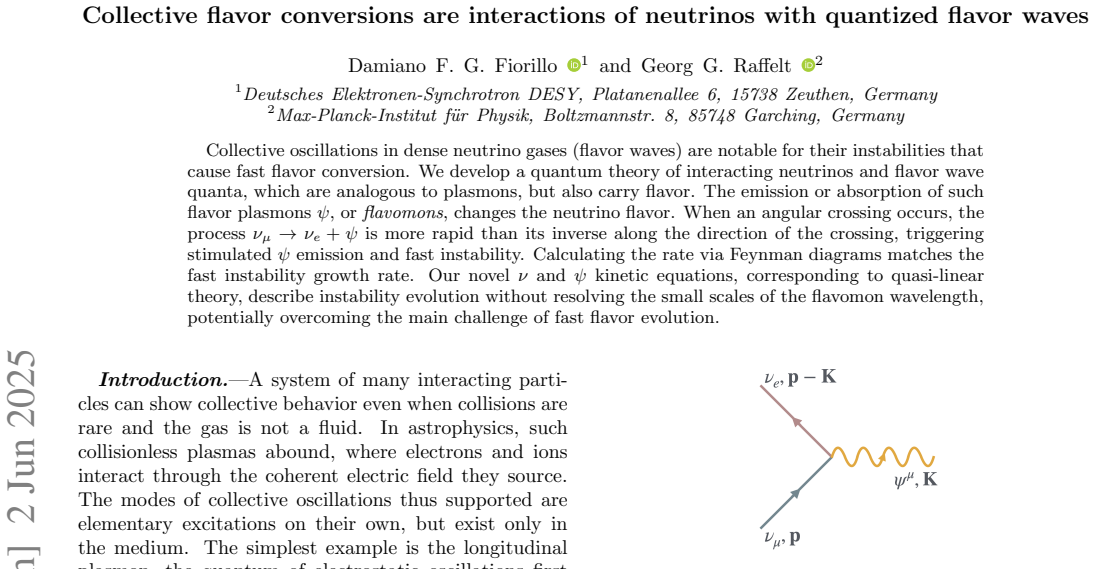
The load-bearing object is the flavomon field $\psi^\alpha_K$, defined as the coherent sum over neutrino pairs $a^\dagger_{e,p-K/2} a_{\mu,p+K/2} v'^\alpha$, together with its response function: the flavor susceptibility $\chi^{\mu\nu}$, or equivalently the dielectric tensor $\varepsilon^{\mu\nu} = g^{\mu\nu} - \chi^{\mu\nu}$. The dispersion relation $\varepsilon^{\mu\nu}(\Omega, K)\psi_\nu = 0$ fixes the eigenfrequencies; the field energy is assigned by the dielectric-medium formula $E_{\mathrm{field}} = (\sqrt{2}G_F/4) \sum_K \psi^\mu \psi^{*\nu} \partial_\Omega[\Omega \varepsilon_{\mu\nu}(\Omega, K)]$, whose derivative factor gives the wavefunction renormalization $Z_K$ and hence the conversion from classical amplitude to flavomon number. The interaction vertex proportional to $\sqrt{G_F |Z_K|}\,(e_K \cdot v)\, A_K a^\dagger_{\mu} a_e$ yields the decay $\nu_\mu \to \nu_e \psi$; summing emission and absorption gives a kinetic equation whose exponential growth rate collapses to the known linear stability result.
What would settle it
Take a two-beam or shallow-crossing neutrino distribution with known dispersion relation, solve the full quantum kinetic equations numerically, and measure the exponential growth rate of the off-diagonal flavor density and the approach to equipartition; if the growth rate deviates from $\gamma_K = -\frac{\mathrm{Im}(\varepsilon_{\mu\nu}) e^\mu e^{*\nu}}{\partial_\Omega \varepsilon_{\mu\nu} e^\mu e^{*\nu}}$, or if saturation does not follow the neutrino--flavomon kinetic equations, the decay interpretation fails.
Extended reading notes
Core claim
The central claim is that a fast flavor instability is equivalent to stimulated emission of flavomons, with the elementary process $\nu_\mu \to \nu_e + \psi$. The paper derives this from the flavor susceptibility $\chi^{\mu\nu}$, identifies the flavomon as a quantized collective excitation with dispersion relation $\varepsilon^{\mu\nu}(\Omega, K)\psi_\nu = 0$, and shows that the kinetic equation for the flavomon occupation number $N_K$ yields a growth rate $\gamma_K = -\frac{\mathrm{Im}(\varepsilon_{\mu\nu}) e^\mu e^{*\nu}}{\partial_\Omega \varepsilon_{\mu\nu} e^\mu e^{*\nu}}$, identical to the linear growth rate of weakly unstable fast flavor modes. The resulting coupled neutrino--flavomon kinetic equations conserve lepton number only when the flavomon contribution is included and reproduce the quasi-linear theory previously derived for the standard neutrino kinetic equations, without resolving the flavomon wavelength. The authors present this as a change of paradigm: the classical flavor wave is described as an ensemble of quanta of a new field, with the angular crossing playing the role of population inversion in a laser.
Load-bearing premise
The particle interpretation and all rates depend on treating a weakly growing flavor wave as if it had a definite energy in the medium, an assignment borrowed from dielectric theory and strictly valid only for stationary oscillations; if that energy is not physically meaningful, the count of flavomons and the derived rates have no foundation.
Editorial extensions
If this is right
- The fast flavor instability growth rate is a single-decay rate proportional to $G_F$, so the instability timescale is set by the refractive scale and not by a second-order scattering process.
- The neutrino--flavomon kinetic equations reproduce quasi-linear theory and conserve lepton number only when the flavomon contribution is included, so neutrino-only treatments omit lepton-number transfer to the flavor field.
- Angular crossings are explained by detailed balance: along the crossing direction $\nu_\mu \to \nu_e \psi$ outruns its inverse until the distributions are equalized, which is why the crossing disappears in simulations.
- Slow flavor conversions, antineutrinos, three flavors, matter refraction, and collisions can be incorporated by shifting the flavomon dispersion and adding flavomon species, extending the picture beyond the fast limit.
- Streaming terms can be added to the kinetic equations, enabling inhomogeneous systems with large-scale variations to be described without resolving the flavor-wave wavelength.
Reading between the lines
- Inference: if the identification is right, existing full quantum-kinetic simulations should show a flavomon occupation number growing as $N_K \propto e^{2\gamma_K t}$ with the same $\gamma_K$ as the off-diagonal flavor density, a cross-check that current codes can perform.
- Inference: the quantization procedure naturally extends to the neutrino-plasmon density fluctuations identified in the Supplemental Material, suggesting a diagrammatic expansion in which nonlinear flavomon interactions and turbulence can be treated systematically.
- Inference: the spontaneous flavomon emission rate, though tiny, sets an absolute floor for seeding flavor instabilities in environments where vacuum mixing is negligible; the paper computes the rate but leaves this seeding comparison to future work.
Editorial analysis
A structured set of objections, weighed in public.
Referee Report
Summary. The paper develops a quantum theory of collective flavor oscillations in dense neutrino gases by introducing 'flavomons' (ψ), quanta of the classical flavor waves. The authors define a field energy for flavor waves using an analogy with the electrodynamics of continuous media (Eq. 7), identify the wavefunction renormalization Z_K (Eq. 10), promote the classical amplitudes to creation/annihilation operators (Eqs. 11–13), and derive kinetic equations for neutrinos and flavomons (Eqs. 17 and 21). The growth rate obtained from the flavomon kinetic equation (Eq. 20) coincides with the known linear growth rate of weakly unstable fast-flavor modes, which the authors interpret as stimulated emission of flavomons by ν_μ → ν_e + ψ. The paper also discusses conservation laws, negative-energy modes, extensions to slow flavor conversions, antineutrinos, and three flavors, and it explicitly lists several limitations of the framework.
Significance. If the framework is accepted, it provides a conceptually new description of fast flavor conversions, connecting neutrino collective oscillations to plasma physics and offering a potentially coarse-grained kinetic formulation that could avoid resolving the small wavelengths of flavor waves. The construction is internally coherent within the quasi-stationary approximation: the energy functional, the propagator interpretation in the Supplemental Material, and the Feynman-diagram decay rate form a consistent whole. The authors deserve credit for clearly stating the two main approximations (on-shell flavomons and neglect of nonlinear flavomon interactions) and for discussing the equilibrium behavior of flavomons in the Supplemental Material. The matching of the derived rate with the standard linear growth rate is a useful consistency check, though it does not independently validate the particle interpretation beyond the classical linear-response result.
major comments (3)
- [Abstract and Eq. (7)] The central claim, as stated in the abstract, that an angular crossing triggers stimulated emission ν_μ → ν_e + ψ and hence the fast instability, is not qualified by the quasi-stationary condition that is required for the field-energy definition. Equation (7), and its derivation in Supplemental Eq. (S37), are valid only when |Im Ω| ≪ |Re Ω|, as the text itself acknowledges. In realistic fast-flavor crossings, growth rates can be comparable to the real frequencies, in which case the flavomon number operator N_K, the on-shell decay kinematics, and the kinetic equations lose their quantitative foundation. The Discussion partially addresses this, but the abstract and introduction should carry the same caveat, and the paper should either extend the derivation to the strongly unstable regime or clearly restrict the central claim to weakly growing modes.
- [Supplemental Material, Eq. after (S42)] The lepton-number assignment is inconsistent between the main text and the Supplemental Material. The main-text conservation law in Eq. (22) implies that each flavomon carries one unit of e−μ lepton number (equivalently, −1 unit of electron lepton number), which is consistent with the vertex ν_μ → ν_e + ψ and with the statement in Fig. 1. However, the Supplemental Material derives L_field = −2 N_K and states that 'a flavomon carries two units of e − μ lepton number.' This discrepancy is not a mere wording issue: it affects the interpretation of N_K as a particle number and the conservation laws. The authors should correct either the derivation or the factor of 2, or explicitly explain the different convention used for 'lepton number' in the Supplemental Material.
- [Main text, paragraph after Eq. (21)] The paper asserts that the new ν–ψ kinetic equations 'are equivalent to the quasi-linear theory of fast instabilities that we derived in Ref. [30],' but no derivation, mapping, or numerical demonstration of this equivalence is provided in the manuscript. This equivalence is load-bearing for the claimed practical advantage of the framework, namely that flavor evolution can be computed without resolving the small flavor-wave scales. Without either a proof or a numerical comparison against full quantum kinetic simulations, the quasi-linear interpretation remains an assertion. The authors should either spell out the correspondence explicitly or report a benchmark validation.
minor comments (4)
- [Eqs. (17)–(20)] The agreement between Eq. (20) and the known linear growth rate is a necessary consistency check, but it is not an independent validation of the flavomon quantization, because the wavefunction renormalization Z_K enters the rate through the same derivative ∂_Ω(ε_μν e^μ e^{ν*}) that fixes the normalization of the field energy. The authors should clarify that the matching is a cross-check rather than a derivation of a new growth rate.
- [Supplemental Material, Section D] In Figure S4, the curve for the wavefunction renormalization is interrupted near the superluminal transition, with the explanation that Z_K diverges. For readability, it would be helpful to indicate explicitly on the plot where Z_K changes sign and where the divergence occurs, since this behavior is discussed in the text.
- [Supplemental Material, Section F] The section title 'Comparison with miscidynamics' appears to contain a typo (likely 'miscidynamics' or another term). If this is an intentional term from the literature, a reference or definition would help the reader; otherwise it should be corrected.
- [General] The paper frequently refers to the Supplemental Material for the formal derivation, but the main text's Eq. (7) is presented as 'Based purely on this analogy' without a derivation in the Letter itself. Since Eq. (7) is the foundation of the quantization, I recommend moving at least a sketch of the derivation (the test-neutrino energy-balance argument) into the main text or expanding the main-text discussion of its validity.
Circularity Check
Flavomon derivation is self-contained; the growth-rate 'match' is largely a consistency check fixed by the wavefunction renormalization, not an independent prediction.
-
other
[Main text, Eqs. (10), (16)-(20); Supplemental Eq. (S39)-(S41)]
"Z −1 K = e µ Ke ∗ν K ∂Ωεµν(Ω, K) ... (10) ... This result coincides with the growth rate of weakly unstable (or weakly damped) modes derived in Ref. [18], confirming that fast flavor instabilities correspond to stimulated decay νµ → νeψ."
The matrix element in Eq. (16) is proportional to |Z_K|, and Eq. (10) fixes Z_K^{-1} as e^* e ∂_Ω ε. Substituting this into the derived kinetic rate gives Eq. (18), whose denominator is exactly the same ∂_Ω ε factor that appears in the linear perturbation formula. Hence the equality with the known growth rate in Eq. (20) is not a fully independent check: the normalization of the flavomon field was chosen from the same dielectric function that defines the linear growth rate, so the matching is partly algebraic.
full rationale
The paper's central construction is not circular in the strict sense. The flavor susceptibility ε is taken from prior work [17] where it is derived from the equations of motion; it is a legitimate physical input, not the target conclusion. The field energy of Eq. (7) is derived in the Supplemental Material from the work done by a test neutrino, and it is used to fix the wavefunction renormalization Z_K and the flavomon creation/annihilation operators. From these inputs the neutrino-flavomon vertex and the kinetic equations follow without fitting the instability rate. The rate γ_K in Eq. (20) is then a derived identity that reproduces the known weakly-unstable-mode growth rate from Ref. [18]. However, because Z_K is defined as the inverse of ∂_Ω ε evaluated on the eigenmode, the denominator of the decay rate is the same object that appears in the linear perturbation formula; the equality is therefore only a partial consistency check, not an independent confirmation that the flavomon quantization is physically forced. The paper also explicitly limits the energy construction to quasi-stationary modes with |Im Ω| ≪ |Re Ω|, so the central claim is established only for weak instabilities, which is an acknowledged validity constraint rather than a circular step. The remaining self-citations, including the comparison with quasi-linear theory [30] and the growth rate of Ref. [18], are used as consistency checks or as previously derived foundations; they are not invoked as unverified uniqueness theorems. Overall, the derivation has independent content, and the mild by-construction character of the rate matching warrants only a low score.
Assumptions & free parameters
free parameters (1)
- G_v crossing-depth parameters (0.03 and 0.0302) of Eq. (S55) =
0.03 - 0.0302 exp(-(1-v)^2)
assumptions (4)
- domain assumption The neutrino medium is described by mean-field Hamiltonian of Eq. (S43), with the weak-inhomogeneity approximation |K| ≪ |p|, |p'|.
- domain assumption The field energy of the flavor wave can be defined by the plasma analogy E_field = (√2G_F/4) Σ_K ψ^μ ψ^{ν*} ∂Ω[Ωεμν].
- domain assumption The flavomon is a well-defined quasi-particle only for weak instability, |Im Ω| ≪ |Re Ω|.
- domain assumption The RPA resummation of the neutrino-neutrino interaction gives the dominant collective effect, and the flavomon propagator is given by the bubble sum of Eq. (S46).
invented entities (1)
-
Flavomon ψ (flavor plasmon)
independent evidence
Cite this review
Pith. "Pith review of Collective flavor conversions are interactions of neutrinos with quantized flavor waves." pith.science (2026). https://pith.science/paper/MI774YSP
@misc{pith2026250206935,
  author       = {Pith},
  title        = {Pith review of: Collective flavor conversions are interactions of neutrinos with quantized flavor waves},
  year         = {2026},
  howpublished = {\url{https://pith.science/paper/MI774YSP}},
  note         = {Machine review of arXiv:2502.06935}
}
abstract
Collective oscillations in dense neutrino gases (flavor waves) are notable for their instabilities that cause fast flavor conversion. We develop a quantum theory of interacting neutrinos and flavor wave quanta, which are analogous to plasmons, but also carry flavor. The emission or absorption of such flavor plasmons $\psi$, or flavomons, changes the neutrino flavor. When an angular crossing occurs, the process $\nu_\mu\to\nu_e+\psi$ is more rapid than its inverse along the direction of the crossing, triggering stimulated $\psi$ emission and fast instability. Calculating the rate via Feynman diagrams matches the fast instability growth rate. Our novel $\nu$ and $\psi$ kinetic equations, corresponding to quasi-linear theory, describe instability evolution without resolving the small scales of the flavomon wavelength, potentially overcoming the main challenge of fast flavor evolution.
Figures
Forward citations
Cited by 5 Pith papers
-
Flavomons in Matter Gradients: Ray Tracing and Amplitude Evolution
Matter gradients slow but do not suppress neutrino-mass-induced flavor instabilities, so flavomon ray tracing is required instead of local stability analysis alone.
-
Local-equilibrium theory of neutrino oscillations
The authors generalize neutrino flavor-wave linear analysis to arbitrary mixing-equilibrium backgrounds and propose a kinetic-theory closure for turbulent flavor-wave viscosity.
-
Predicting the outcome of collisional neutrino flavor conversion
Collisional neutrino flavor instabilities settle into a state at the edge of instability with nonzero flavor coherence, and explicit formulas predict this final state.
-
Single-wave solutions of the neutrino fast flavor system. Part II. Weak instabilities and their resonant behavior
For shallow angular crossings, the nonlinear evolution of a single-wave fast flavor instability is a flavor pendulum whose amplitude and period are set by the linear growth rate.
-
Single-wave solutions of the neutrino fast flavor system. Part I. Mechanical properties
Single-wave neutrino flavor solutions form a non-integrable spin system without Gaudin invariants, so an exact flavor pendulum exists only for two beams and does not extend to continuous angle distributions.
Reference graph
Works this paper leans on
-
[18]
D. F. G. Fiorillo and G. G. Raffelt, Theory of neutrino fast flavor evolution. Part I. Linear response theory and stability conditions., JHEP 08 (2024) 225 [ 2406.06708]
arXiv 2024
-
[30]
A. Kartavtsev, G. Raffelt and H. Vogel, Neutrino propagation in media: Flavor, helicity, and pair correlations, Phys. Rev. D 91 (2015) 125020 [1504.03230]
arXiv 2015
-
[1]
Finally, using the interaction Hamiltonian in Eq. (13), |M|2 = √ 2GF|ZK||eK · v|2 (16) is the squared matrix element. We assume here ZK > 0; if ZK < 0, the state corresponds to an anti-flavomon and therefore the relevant decay is νe → νµψ. The total rate of change in the flavomon number must include also the rate for flavomon absorption νeψ → νµ, so we fi...
-
[2]
Pines, Collective energy losses in solids , Rev
D. Pines, Collective energy losses in solids , Rev. Mod. Phys. 28 (1956) 184
work page 1956
-
[3]
J. T. Pantaleone, Neutrino oscillations at high densities , Phys. Lett. B 287 (1992) 128
work page 1992
-
[4]
Samuel, Neutrino oscillations in dense neutrino gases, Phys
S. Samuel, Neutrino oscillations in dense neutrino gases, Phys. Rev. D 48 (1993) 1462
work page 1993
-
[5]
Samuel, Bimodal coherence in dense selfinteracting neutrino gases , Phys
S. Samuel, Bimodal coherence in dense selfinteracting neutrino gases , Phys. Rev. D 53 (1996) 5382 [hep-ph/9604341]
arXiv 1996
-
[6]
H. Duan, G. M. Fuller, J. Carlson and Y.-Z. Qian, Simulation of coherent nonlinear neutrino flavor transformation in the supernova environment: Correlated neutrino trajectories, Phys. Rev. D 74 (2006) 105014 [ astro-ph/0606616]
arXiv 2006
Show all 59 references
-
[7]
Classical
R. F. Sawyer, “Classical” instabilities and “quantum” speed-up in the evolution of neutrino clouds , hep-ph/0408265
-
[8]
Izaguirre, G
I. Izaguirre, G. Raffelt and I. Tamborra, Fast Pairwise Conversion of Supernova Neutrinos: A Dispersion-Relation Approach, Phys. Rev. Lett. 118 (2017) 021101 [ 1610.01612]
2017 arXiv
-
[9]
Mirizzi, I
A. Mirizzi, I. Tamborra, H.-T. Janka, N. Saviano, K. Scholberg, R. Bollig, L. H¨ udepohl and S. Chakraborty, Supernova Neutrinos: Production, Oscillations and Detection , Riv. Nuovo Cim. 39 (2016) 1 [1508.00785]
2016 arXiv
-
[10]
Tamborra and S
I. Tamborra and S. Shalgar, New Developments in Flavor Evolution of a Dense Neutrino Gas , Ann. Rev. Nucl. Part. Sci. 71 (2021) 165 [ 2011.01948]
2021 arXiv
-
[11]
Richers and M
S. Richers and M. Sen, Fast Flavor Transformations, Handbook of Nuclear Physics (2022) 1 [ 2207.03561]
2022 arXiv
-
[12]
M. C. Volpe, Neutrinos from dense environments: Flavor mechanisms, theoretical approaches, observations, and new directions , Rev. Mod. Phys. 96 (2024) 025004 [ 2301.11814]
2024 arXiv
-
[13]
H. Duan, A. Friedland, G. McLaughlin and R. Surman, The influence of collective neutrino oscillations on a supernova r-process, J. Phys. G 38 (2011) 035201 [1012.0532]
2011 arXiv
-
[14]
M.-R. Wu, I. Tamborra, O. Just and H.-T. Janka, Imprints of neutrino-pair flavor conversions on nucleosynthesis in ejecta from neutron-star merger remnants, Phys. Rev. D 96 (2017) 123015 [ 1711.00477]
2017 arXiv
-
[15]
Li and D
X. Li and D. M. Siegel, Neutrino Fast Flavor Conversions in Neutron-Star Postmerger Accretion Disks, Phys. Rev. Lett. 126 (2021) 251101 [2103.02616]
2021 arXiv
-
[16]
Ehring, S
J. Ehring, S. Abbar, H.-T. Janka, G. Raffelt and I. Tamborra, Fast Neutrino Flavor Conversions Can Help and Hinder Neutrino-Driven Explosions , Phys. Rev. Lett. 131 (2023) 061401 [ 2305.11207]
2023 arXiv
-
[17]
Ehring, S
J. Ehring, S. Abbar, H. T. Janka, G. Raffelt, K. Nakamura and K. Kotake, Gravitational-Wave Signatures of Nonstandard Neutrino Properties in Collapsing Stellar Cores , 2412.02750
-
[19]
D. F. G. Fiorillo and G. G. Raffelt, Theory of neutrino fast flavor evolution. Part II. Solutions at the edge of instability, JHEP 12 (2024) 205 [ 2409.17232]
2024 arXiv
-
[20]
D. F. G. Fiorillo and G. G. Raffelt, Theory of neutrino 6 slow flavor evolution. Part I. Homogeneous medium , JHEP 04 (2025) 146 [ 2412.02747]
2025 arXiv
-
[21]
D. F. G. Fiorillo and G. G. Raffelt, Theory of neutrino slow flavor evolution. Part II. Space-time evolution of linear instabilities, 2501.16423
-
[22]
A. D. Dolgov, Neutrinos in the early universe , Sov. J. Nucl. Phys. 33 (1981) 700. [ Yad. Fiz. 33 (1981) 1309]
1981
-
[23]
M. A. Rudzsky, Kinetic equations for neutrino spin- and type-oscillations in a medium , Astrophys. Space Sci 165 (1990) 65
1990
-
[24]
Sigl and G
G. Sigl and G. Raffelt, General kinetic description of relativistic mixed neutrinos , Nucl. Phys. B 406 (1993) 423
1993
-
[25]
Sirera and A
M. Sirera and A. P´ erez,Relativistic Wigner function approach to neutrino propagation in matter , Phys. Rev. D 59 (1999) 125011 [ hep-ph/9810347]
1999 arXiv
-
[26]
Yamada, Boltzmann equations for neutrinos with flavor mixings , Phys
S. Yamada, Boltzmann equations for neutrinos with flavor mixings , Phys. Rev. D 62 (2000) 093026 [astro-ph/0002502]
2000 arXiv
-
[27]
Vlasenko, G
A. Vlasenko, G. M. Fuller and V. Cirigliano, Neutrino Quantum Kinetics , Phys. Rev. D 89 (2014) 105004 [1309.2628]
2014 arXiv
-
[28]
Volpe, D
C. Volpe, D. V¨ a¨ an¨ anen and C. Espinoza,Extended evolution equations for neutrino propagation in astrophysical and cosmological environments, Phys. Rev. D 87 (2013) 113010 [ 1302.2374]
2013 arXiv
-
[29]
Serreau and C
J. Serreau and C. Volpe, Neutrino-antineutrino correlations in dense anisotropic media , Phys. Rev. D 90 (2014) 125040 [ 1409.3591]
2014 arXiv
-
[31]
D. F. G. Fiorillo, G. G. Raffelt and G. Sigl, Inhomogeneous Kinetic Equation for Mixed Neutrinos: Tracing the Missing Energy , Phys. Rev. Lett. 133 (2024) 021002 [ 2401.05278]
2024 arXiv
-
[32]
D. F. G. Fiorillo, G. G. Raffelt and G. Sigl, Collective neutrino-antineutrino oscillations in dense neutrino environments?, Phys. Rev. D 109 (2024) 043031 [2401.02478]
2024 arXiv
-
[33]
L. D. Landau, J. S. Bell, M. Kearsley, L. Pitaevskii, E. Lifshitz and J. Sykes, Electrodynamics of continuous media, vol. 8. Elsevier, 2013
2013
-
[34]
See Supplemental Material for a formal derivation of the flavomon properties, as well as a review of the analogous results for plasmons in a collisionless electron plasma. We also determine the flavomon properties for an example distribution which has a fast instability, and w...
-
[35]
R. F. Sawyer, Neutrino-anti-neutrino instability in dense neutrino systems, with applications to the early universe and to supernovae , 2206.09290
-
[36]
Shalgar and I
S. Shalgar and I. Tamborra, Neutrino flavor conversion, advection, and collisions: Toward the full solution , Phys. Rev. D 107 (2023) 063025 [ 2207.04058]
2023 arXiv
-
[37]
Shalgar and I
S. Shalgar and I. Tamborra, Neutrino decoupling is altered by flavor conversion , Phys. Rev. D 108 (2023) 043006 [2206.00676]
2023 arXiv
-
[38]
Cornelius, S
M. Cornelius, S. Shalgar and I. Tamborra, Perturbing fast neutrino flavor conversion , JCAP 02 (2024) 038 [2312.03839]
2024 arXiv
-
[39]
Cornelius, S
M. Cornelius, S. Shalgar and I. Tamborra, Neutrino quantum kinetics in two spatial dimensions , JCAP 11 (2024) 060 [ 2407.04769]
2024 arXiv
-
[40]
Morinaga, Fast neutrino flavor instability and neutrino flavor lepton number crossings , Phys
T. Morinaga, Fast neutrino flavor instability and neutrino flavor lepton number crossings , Phys. Rev. D 105 (2022) L101301 [ 2103.15267]
2022 arXiv
-
[41]
Dasgupta, Collective Neutrino Flavor Instability Requires a Crossing, Phys
B. Dasgupta, Collective Neutrino Flavor Instability Requires a Crossing, Phys. Rev. Lett. 128 (2022) 081102 [2110.00192]
2022 arXiv
-
[42]
Nagakura and M
H. Nagakura and M. Zaizen, Time-Dependent and Quasisteady Features of Fast Neutrino-Flavor Conversion, Phys. Rev. Lett. 129 (2022) 261101 [2206.04097]
2022 arXiv
-
[43]
Zaizen and H
M. Zaizen and H. Nagakura, Simple method for determining asymptotic states of fast neutrino-flavor conversion, Phys. Rev. D 107 (2023) 103022 [2211.09343]
2023 arXiv
-
[44]
D. F. G. Fiorillo and G. G. Raffelt, Fast Flavor Conversions at the Edge of Instability in a Two-Beam Model, Phys. Rev. Lett. 133 (2024) 221004 [2403.12189]
2024 arXiv
-
[45]
Padilla-Gay, I
I. Padilla-Gay, I. Tamborra and G. G. Raffelt, Neutrino Flavor Pendulum Reloaded: The Case of Fast Pairwise Conversion, Phys. Rev. Lett. 128 (2022) 121102 [2109.14627]
2022 arXiv
-
[46]
Johns, H
L. Johns, H. Nagakura, G. M. Fuller and A. Burrows, Neutrino oscillations in supernovae: angular moments and fast instabilities , Phys. Rev. D 101 (2020) 043009 [1910.05682]
2020 arXiv
-
[47]
D. F. G. Fiorillo and G. G. Raffelt, Slow and fast collective neutrino oscillations: Invariants and reciprocity, Phys. Rev. D 107 (2023) 043024 [2301.09650]
2023
-
[48]
D. F. G. Fiorillo and G. G. Raffelt, Flavor solitons in dense neutrino gases , Phys. Rev. D 107 (2023) 123024 [2303.12143]
2023
-
[49]
Johns, Collisional Flavor Instabilities of Supernova Neutrinos, Phys
L. Johns, Collisional Flavor Instabilities of Supernova Neutrinos, Phys. Rev. Lett. 130 (2023) 191001 [2104.11369]
2023 arXiv
-
[50]
Xiong, L
Z. Xiong, L. Johns, M.-R. Wu and H. Duan, Collisional flavor instability in dense neutrino gases , Phys. Rev. D 108 (2023) 083002 [ 2212.03750]
2023 arXiv
-
[51]
J. Liu, M. Zaizen and S. Yamada, Systematic study of the resonancelike structure in the collisional flavor instability of neutrinos , Phys. Rev. D 107 (2023) 123011 [2302.06263]
2023 arXiv
-
[52]
Lin and H
Y.-C. Lin and H. Duan, Collision-induced flavor instability in dense neutrino gases with energy-dependent scattering, Phys. Rev. D 107 (2023) 083034 [2210.09218]
2023 arXiv
-
[53]
Johns and Z
L. Johns and Z. Xiong, Collisional instabilities of neutrinos and their interplay with fast flavor conversion in compact objects, Phys. Rev. D 106 (2022) 103029 [2208.11059]
2022 arXiv
-
[54]
Padilla-Gay, I
I. Padilla-Gay, I. Tamborra and G. G. Raffelt, Neutrino fast flavor pendulum. II. Collisional damping , Phys. Rev. D 106 (2022) 103031 [ 2209.11235]
2022 arXiv
-
[55]
D. F. G. Fiorillo, I. Padilla-Gay and G. G. Raffelt, Collisions and collective flavor conversion: Integrating out the fast dynamics , Phys. Rev. D 109 (2024) 063021 [2312.07612]
2024 arXiv
-
[56]
Johns, Ergodicity demystifies fast neutrino flavor instability, 2402.08896
L. Johns, Ergodicity demystifies fast neutrino flavor instability, 2402.08896
-
[57]
Johns, Thermodynamics of oscillating neutrinos , 7 2306.14982
L. Johns, Thermodynamics of oscillating neutrinos , 7 2306.14982
-
[58]
Johns, Subgrid modeling of neutrino oscillations in astrophysics, 2401.15247
L. Johns, Subgrid modeling of neutrino oscillations in astrophysics, 2401.15247
-
[59]
A. A. Schekochihin, Lectures on Kinetic Theory and Magnetohydrodynamics of Plasmas . Lecture Notes for the Oxford MMathPhys/MScMTP programme; URL: http://www-thphys.physics.ox.ac.uk/people/ AlexanderSchekochihin/KT/2015/KTLectureNotes. pdf, 2024. S1 Supplemental Material for t...
2015
Reviewed August 8, 2026 · model on record in the stance chip above.
Discussion (0). Continue with ORCID to comment.