Overcoming the Speed-Fidelity Trade-off in Fast CZ Gates via Cyclic Control
Pith reviewed 2026-07-02 12:15 UTC · model grok-4.3
The pith
Expanding the control parameter space overcomes the speed-fidelity trade-off in fast superconducting CZ gates.
A machine-rendered reading of the paper's core claim, the machinery that carries it, and where it could break.
Core claim
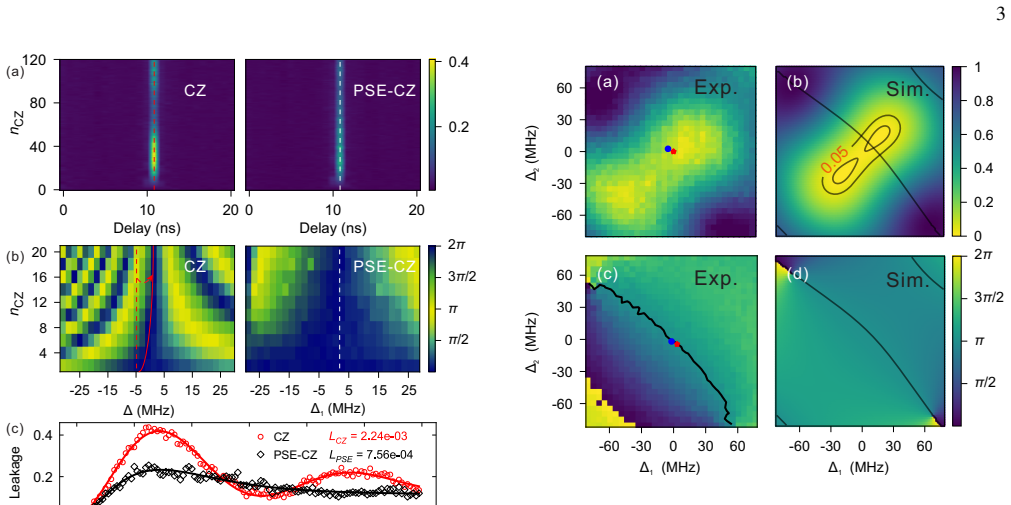
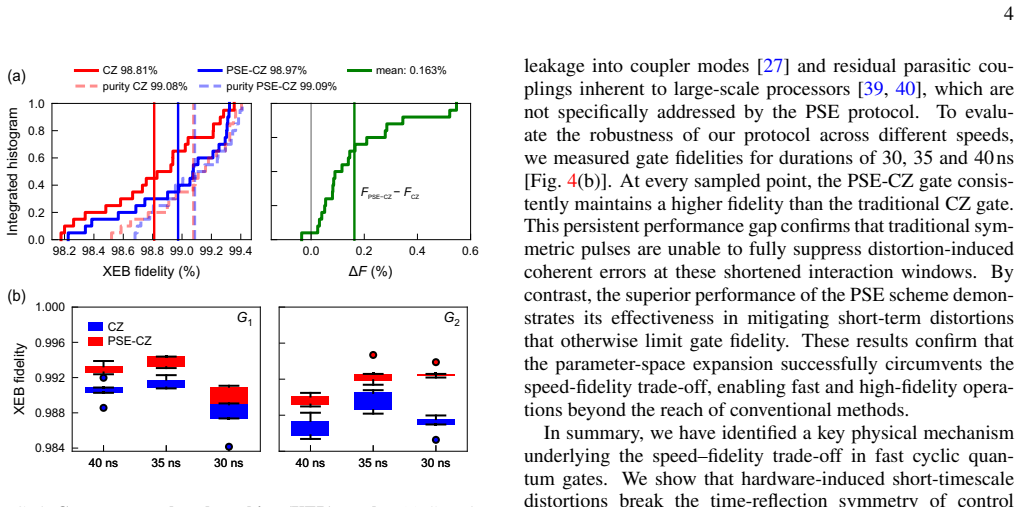
The central claim is that a cyclic control strategy based on parameter-space expansion restores controllability by incorporating an additional degree of freedom. This enables robust suppression of coherent errors in fast CZ gates without increasing gate duration. The approach is demonstrated experimentally in superconducting qubits, where the average coherent error across multiple two-qubit gates falls from 0.27 percent to 0.12 percent as validated by cross-entropy benchmarking. The result supplies a general method for fast, high-fidelity cyclic quantum gates that avoids the conventional speed-fidelity trade-off.
What carries the argument
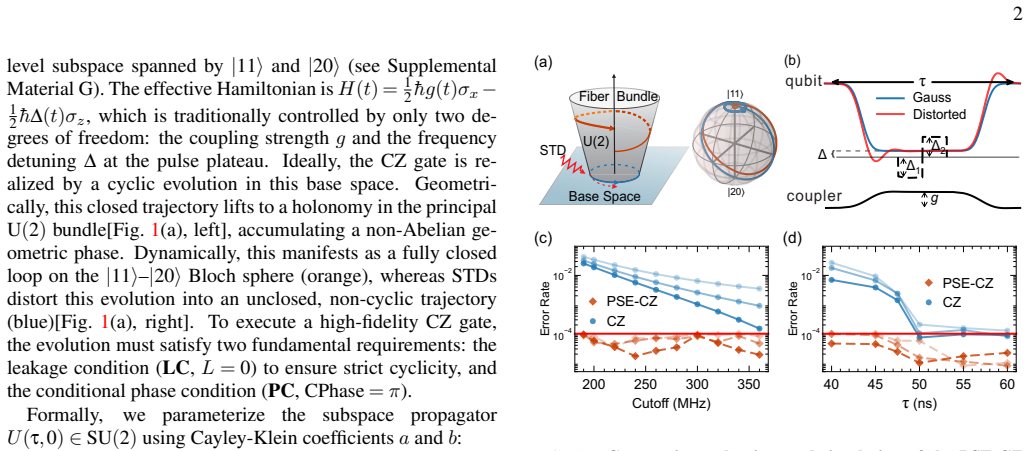
Parameter-space expansion that adds one extra degree of freedom to the cyclic control protocol, allowing the evolution to close despite broken time-reflection symmetry caused by short-timescale waveform distortions.
If this is right
- Coherent errors in fast two-qubit gates can be suppressed while keeping the original gate duration unchanged.
- The method supplies a general route to fast high-fidelity cyclic quantum gates that bypasses conventional smoothing or embedding strategies.
- Cross-entropy benchmarking on multiple devices confirms the error reduction is repeatable.
- The same parameter-expansion principle applies to any cyclic gate limited by waveform symmetry breaking.
Where Pith is reading between the lines
- The extra control freedom could be tuned further to reach even lower error rates on the same hardware.
- The technique may transfer to other qubit platforms that suffer analogous short-timescale pulse distortions.
- Shorter gate times enabled by this approach could reduce accumulated error in longer quantum algorithms.
- Systematic mapping of the expanded parameter space might reveal optimal operating points not accessible to symmetric protocols.
Load-bearing premise
The added degree of freedom can be realized experimentally without introducing new coherent or incoherent errors or requiring increased gate duration.
What would settle it
An experiment applying the expanded-parameter cyclic protocol that finds no reduction in coherent error below 0.27 percent or that requires longer gate duration would falsify the central claim.
Figures

read the original abstract
High-fidelity quantum gates are essential for scalable quantum computation. However, at short durations, short-timescale waveform distortions break the time-reflection symmetry of control pulses, preventing the precise closure of cyclic evolution. This mechanism renders conventional symmetric protocols intrinsically over-constrained. Conventional strategies typically rely on smoothing the pulse envelopes or embedding the interaction pulse within a longer qubit pulse to bypass short-timescale distortions, which inevitably leads to a persistent speed-fidelity trade-off. To overcome this limitation, we introduce a cyclic control strategy based on parameter-space expansion, which restores controllability by incorporating an additional degree of freedom. We experimentally demonstrate this approach in a superconducting controlled-Z gate, achieving robust suppression of coherent errors without increasing gate duration, reducing the average coherent error from 0.27% to 0.12% across multiple two-qubit gates, as validated by cross-entropy benchmarking. Our results establish a general route to fast, high-fidelity cyclic quantum gates beyond the conventional speed-fidelity trade-off.
Editorial analysis
A structured set of objections, weighed in public.
Referee Report
Summary. The manuscript claims that short-timescale waveform distortions break time-reflection symmetry in fast control pulses, rendering conventional symmetric protocols over-constrained for CZ gates. It introduces a cyclic control strategy via parameter-space expansion that adds an extra degree of freedom to restore controllability. Experimentally, on superconducting qubits, this suppresses coherent errors without increasing gate duration, reducing average coherent error from 0.27% to 0.12% across multiple two-qubit gates as measured by cross-entropy benchmarking.
Significance. If the attribution to the new degree of freedom is isolated and the result holds with proper controls, the work offers a route to high-fidelity fast gates that could impact scalable quantum computation by relaxing the speed-fidelity trade-off.
major comments (2)
- [Abstract] Abstract: the reported reduction in coherent error (0.27% to 0.12%) via cross-entropy benchmarking provides no error bars, sample sizes, or controls for other error sources, and does not describe how the extra degree of freedom was implemented or isolated while holding all other pulse parameters fixed; this is load-bearing for the central experimental claim.
- [Abstract] The assumption that short-timescale waveform distortions are the dominant symmetry-breaking mechanism (and that the added degree of freedom introduces neither new coherent/incoherent errors nor extra duration) is stated but not isolated from other hardware effects; without a direct toggle experiment the attribution remains unsecured.
minor comments (1)
- Notation for the additional degree of freedom and the cyclic evolution closure condition should be defined explicitly early in the text.
Simulated Author's Rebuttal
We thank the referee for their careful reading of the manuscript and for highlighting the need for greater clarity in the abstract regarding statistical details and experimental isolation. We address each major comment below and have revised the manuscript to strengthen the presentation of the central claims.
read point-by-point responses
-
Referee: [Abstract] Abstract: the reported reduction in coherent error (0.27% to 0.12%) via cross-entropy benchmarking provides no error bars, sample sizes, or controls for other error sources, and does not describe how the extra degree of freedom was implemented or isolated while holding all other pulse parameters fixed; this is load-bearing for the central experimental claim.
Authors: We agree that the abstract would benefit from additional detail on these points to better support the central claim. In the revised manuscript we have updated the abstract to report error bars on the coherent-error values, the number of experimental repetitions underlying the cross-entropy benchmarking averages, and a concise statement of how the extra degree of freedom is introduced via parameter-space expansion while all other pulse parameters (including total duration) remain fixed. The full isolation procedure—comparing the conventional symmetric protocol against the cyclic-control protocol under otherwise identical conditions—is described in the methods and results sections, together with the controls already present in the benchmarking protocol for separating coherent from incoherent contributions. revision: yes
-
Referee: [Abstract] The assumption that short-timescale waveform distortions are the dominant symmetry-breaking mechanism (and that the added degree of freedom introduces neither new coherent/incoherent errors nor extra duration) is stated but not isolated from other hardware effects; without a direct toggle experiment the attribution remains unsecured.
Authors: We acknowledge that a direct experimental toggle on the short-timescale distortions themselves would provide the strongest possible isolation. Such a toggle is not feasible with the present hardware without introducing uncontrolled variables. Instead, the revised manuscript adds (i) a side-by-side experimental comparison in which only the additional cyclic-control parameter is varied while gate duration and all other waveform parameters are held constant, and (ii) supporting numerical simulations that explicitly include the measured distortion profile and demonstrate that the observed error reduction is accounted for by restoration of cyclic evolution. We have also expanded the discussion to address possible confounding hardware effects and to explain why they are inconsistent with the data. These additions make the attribution more secure while remaining within the experimental capabilities of the platform. revision: partial
Circularity Check
No significant circularity; result is experimental demonstration.
full rationale
The paper presents an experimental demonstration of a cyclic control strategy for fast CZ gates, reporting measured error reduction (0.27% to 0.12%) via cross-entropy benchmarking after introducing an additional degree of freedom. No equations, predictions, or derivations are provided in the abstract or described claims that reduce by construction to fitted inputs, self-citations, or ansatzes. The central claim rests on hardware validation rather than a tautological mathematical chain, making the derivation self-contained against external benchmarks.
Axiom & Free-Parameter Ledger
axioms (1)
- standard math Quantum mechanics and superconducting qubit dynamics allow cyclic evolution under control pulses
Reference graph
Works this paper leans on
- [1]
- [2]
-
[3]
H.-S. Zhong, Y .-H. Deng, J. Qin, H. Wang, M.-C. Chen, L.-C. Peng, Y .-H. Luo, D. Wu, S.-Q. Gong, H. Su,et al., Phase-programmable gaussian boson sampling using stimu- lated squeezed light, Physical review letters127, 180502 (2021)
work page 2021
-
[4]
S. Krinner, N. Lacroix, A. Remm, A. Di Paolo, E. Genois, 5 C. Leroux, C. Hellings, S. Lazar, F. Swiadek, J. Herrmann, et al., Realizing repeated quantum error correction in a distance-three surface code, Nature605, 669 (2022)
work page 2022
- [5]
-
[6]
Quantum error correction below the surface code threshold, Na- ture638, 920 (2025)
work page 2025
-
[7]
A. Eickbusch, M. McEwen, V . Sivak, A. Bourassa, J. Atalaya, J. Claes, D. Kafri, C. Gidney, C. W. Warren, J. Gross,et al., Demonstration of dynamic surface codes, Nature Physics , 1 (2025)
work page 2025
-
[8]
N. Lacroix, A. Bourassa, F. J. Heras, L. M. Zhang, J. Bausch, A. W. Senior, T. Edlich, N. Shutty, V . Sivak, A. Bengtsson, et al., Scaling and logic in the color code on a superconduct- ing quantum processor, Nature , 1 (2025)
work page 2025
- [9]
-
[10]
K. Wang, Z. Lu, C. Zhang, G. Liu, J. Chen, Y . Wang, Y . Wu, S. Xu, X. Zhu, F. Jin, Y . Gao, Z. Tan, Z. Cui, N. Wang, Y . Zou, A. Zhang, T. Li, F. Shen, J. Zhong, Z. Bao, Z. Zhu, Y . Han, Y . He, J. Shen, H. Wang, J.-N. Yang, Z. Song, J. Deng, H. Dong, Z.-Z. Sun, W. Li, Q. Ye, S. Jiang, Y . Ma, P.-X. Shen, P. Zhang, H. Li, Q. Guo, Z. Wang, C. Song, H. Wan...
-
[11]
Y . Kim, A. Eddins, S. Anand, K. X. Wei, E. van den Berg, S. Rosenblatt, H. Nayfeh, Y . Wu, M. Zaletel, K. Temme, and A. Kandala, Evidence for the utility of quantum computing be- fore fault tolerance, Nature618, 500 (2023)
work page 2023
-
[12]
S. Cao, B. Wu, F. Chen, M. Gong, Y . Wu, Y . Ye, C. Zha, H. Qian, C. Ying, S. Guo,et al., Generation of genuine en- tanglement up to 51 superconducting qubits, Nature619, 738 (2023)
work page 2023
-
[13]
R. S. Gupta, N. Sundaresan, T. Alexander, C. J. Wood, S. T. Merkel, M. B. Healy, M. Hillenbrand, T. Jochym-O’Connor, J. R. Wootton, T. J. Yoder,et al., Encoding a magic state with beyond break-even fidelity, Nature625, 259 (2024)
work page 2024
-
[14]
B. M. Terhal, Mobile atoms enable efficient computation with logical qubits, Nature626, 36 (2024)
work page 2024
-
[15]
S. Guo, J. Sun, H. Qian, M. Gong, Y . Zhang, F. Chen, Y . Ye, Y . Wu, S. Cao, K. Liu,et al., Experimental quantum computa- tional chemistry with optimized unitary coupled cluster ansatz, Nature Physics , 1 (2024)
work page 2024
-
[16]
C. J. Ballance, T. P. Harty, N. M. Linke, M. A. Sepiol, and D. M. Lucas, High-fidelity quantum logic gates using trapped-ion hy- perfine qubits, Physical review letters117, 060504 (2016)
work page 2016
-
[17]
R. T. Sutherland, R. Srinivas, and D. Allcock, Individual ad- dressing of trapped ion qubits with geometric phase gates, Physical Review A107, 032604 (2023)
work page 2023
-
[18]
Y . Sekiguchi, N. Niikura, R. Kuroiwa, H. Kano, and H. Kosaka, Optical holonomic single quantum gates with a geometric spin under a zero field, Nature photonics11, 309 (2017)
work page 2017
- [19]
-
[20]
F. W. Strauch, P. R. Johnson, A. J. Dragt, C. Lobb, J. Anderson, and F. Wellstood, Quantum logic gates for coupled supercon- ducting phase qubits, Physical review letters91, 167005 (2003)
work page 2003
-
[21]
L. DiCarlo, J. M. Chow, J. M. Gambetta, L. S. Bishop, B. R. Johnson, D. Schuster, J. Majer, A. Blais, L. Frunzio, S. Girvin, et al., Demonstration of two-qubit algorithms with a supercon- ducting quantum processor, Nature460, 240 (2009)
work page 2009
-
[22]
R. Barends, C. Quintana, A. Petukhov, Y . Chen, D. Kafri, K. Kechedzhi, R. Collins, O. Naaman, S. Boixo, F. Arute,et al., Diabatic gates for frequency-tunable superconducting qubits, Physical review letters123, 210501 (2019)
work page 2019
-
[23]
S. Sheldon, E. Magesan, J. M. Chow, and J. M. Gambetta, Procedure for systematically tuning up cross-talk in the cross- resonance gate, Physical Review A93, 060302 (2016)
work page 2016
-
[24]
S. S. Hong, A. T. Papageorge, P. Sivarajah, G. Crossman, N. Di- dier, A. M. Polloreno, E. A. Sete, S. W. Turkowski, M. P. da Silva, and B. R. Johnson, Demonstration of a parametrically activated entangling gate protected from flux noise, Physical Review A101, 012302 (2020)
work page 2020
-
[25]
X. Li, T. Cai, H. Yan, Z. Wang, X. Pan, Y . Ma, W. Cai, J. Han, Z. Hua, X. Han,et al., Tunable coupler for realizing a controlled-phase gate with dynamically decoupled regime in a superconducting circuit, Physical Review Applied14, 024070 (2020)
work page 2020
-
[26]
Y . Xu, J. Chu, J. Yuan, J. Qiu, Y . Zhou, L. Zhang, X. Tan, Y . Yu, S. Liu, J. Li,et al., High-fidelity, high-scalability two-qubit gate scheme for superconducting qubits, Physical review letters125, 240503 (2020)
work page 2020
-
[27]
Y . Sung, L. Ding, J. Braum ¨uller, A. Veps¨al¨ainen, B. Kannan, M. Kjaergaard, A. Greene, G. O. Samach, C. McNally, D. Kim, et al., Realization of high-fidelity cz and zz-free iswap gates with a tunable coupler, Physical Review X11, 021058 (2021)
work page 2021
- [28]
-
[29]
Z. Yan, Y .-R. Zhang, M. Gong, Y . Wu, Y . Zheng, S. Li, C. Wang, F. Liang, J. Lin, Y . Xu,et al., Strongly correlated quantum walks with a 12-qubit superconducting processor, Sci- ence364, 753 (2019)
work page 2019
-
[30]
M. A. Rol, L. Ciorciaro, F. K. Malinowski, B. M. Tarasinski, R. E. Sagastizabal, C. C. Bultink, Y . Salathe, N. Haandbæk, J. Sedivy, and L. DiCarlo, Time-domain characterization and correction of on-chip distortion of control pulses in a quantum processor, Applied Physics Letters116(2020)
work page 2020
-
[31]
M. Rol, F. Battistel, F. Malinowski, C. Bultink, B. Tarasin- ski, R. V ollmer, N. Haider, N. Muthusubramanian, A. Bruno, B. Terhal,et al., Fast, high-fidelity conditional-phase gate ex- ploiting leakage interference in weakly anharmonic supercon- ducting qubits, Physical review letters123, 120502 (2019)
work page 2019
-
[32]
V . Negˆırneac, H. Ali, N. Muthusubramanian, F. Battistel, R. Sagastizabal, M. Moreira, J. Marques, W. Vlothuizen, M. Beekman, C. Zachariadis,et al., High-fidelity controlled-z gate with maximal intermediate leakage operating at the speed limit in a superconducting quantum processor, Physical Review Letters126, 220502 (2021)
work page 2021
-
[33]
R. Barends, J. Kelly, A. Megrant, A. Veitia, D. Sank, E. Jeffrey, T. C. White, J. Mutus, A. G. Fowler, B. Campbell,et al., Super- conducting quantum circuits at the surface code threshold for fault tolerance, Nature508, 500 (2014)
work page 2014
- [34]
-
[35]
F. Marxer, J. Mro˙zek, J. Andersson, L. Abdurakhimov, J. Adam, V . Bergholm, R. Beriwal, C. F. Chan, S. Dahl, S. R. Das, et al., Above 99.9% fidelity single-qubit gates, two-qubit gates, and readout in a single superconducting quantum device, arXiv 6 preprint arXiv:2508.16437 (2025)
work page internal anchor Pith review Pith/arXiv arXiv 2025
- [36]
-
[37]
L. Ding, M. Hays, Y . Sung, B. Kannan, J. An, A. Di Paolo, A. H. Karamlou, T. M. Hazard, K. Azar, D. K. Kim,et al., High- fidelity, frequency-flexible two-qubit fluxonium gates with a transmon coupler, Physical Review X13, 031035 (2023)
work page 2023
-
[38]
R. Li, K. Kubo, Y . Ho, Z. Yan, Y . Nakamura, and H. Goto, Realization of high-fidelity cz gate based on a double-transmon coupler, Physical Review X14, 041050 (2024)
work page 2024
- [39]
-
[40]
Z. Ni, S. Li, L. Zhang, J. Chu, J. Niu, T. Yan, X. Deng, L. Hu, J. Li, Y . Zhong,et al., Scalable method for eliminating residual zz interaction between superconducting qubits, Physical review letters129, 040502 (2022). Supplementary Information: Fast High-Fidelity CZ Gates with Robustness to Short-Term Waveform Distortion Ze-An Zhao,1, 2 Hai-Feng Zhang,1...
work page 2022
-
[41]
Off-diagonal nullification:U ij =0 fori̸=j
-
[42]
A matrix satisfying these conditions is diagonal
Diagonal unitarity:|U ii|=1 for alli. A matrix satisfying these conditions is diagonal. After factoring out a physically irrelevant global phase, the evolution is de- scribed by onlyD−1 independent relative phases. Therefore, a cyclic evolution reduces the system’s DOFs toD−1. We can now count the constraints by calculating the reduction in DOFs: •General...
-
[43]
CPhase error amplification: CPhase error can be amplified via repeated CZ gate applications. The probability of measuring the|11⟩state after repeating the CZ gaten CZ times is given by: P11(nCZ) =|⟨11|R(θ, α) nCZ|11⟩|2 =|cos(n CZθ)−isin(n CZθ)cosα| 2. It is straightforward to show thatP 11(nCZ)≈1 forα≈0, indicating that leakage does not accumulate withn C...
-
[44]
Leakage amplification: By strategically modulating intergate delays at idle working points, we enhance leakage into the|20⟩state, which is sub- sequently detected using a two-state readout technique. This delay modulation at the idle working points controls the relative phase between|11⟩and|20⟩states, thereby coherently enhancing the leakage error through...
work page 2021
discussion (0)
Sign in with ORCID, Apple, or X to comment. Anyone can read and Pith papers without signing in.