REVIEW 3 major objections 4 minor 75 references
Structured light with a million light planes per second
T0 review · 3 major / 4 minor · reviewed 2026-08-12 · deepseek-v4-flash
Pith's one-line read This paper introduces a structured light 3D scanner whose custom acousto-optic projector sweeps two million light planes per second, enabling full-frame depth capture at 1000 fps with an event camera, four times faster than prior…
desk verdict Real hardware win in AO line scanning, but the 'full-frame 1000 fps' headline only holds for sparse scenes and the paper's own dense-scene data say so. read the letter →
The pith
A machine-rendered reading of the paper's core claim, the machinery that carries it, and where it could break.
The reading
What carries the argument
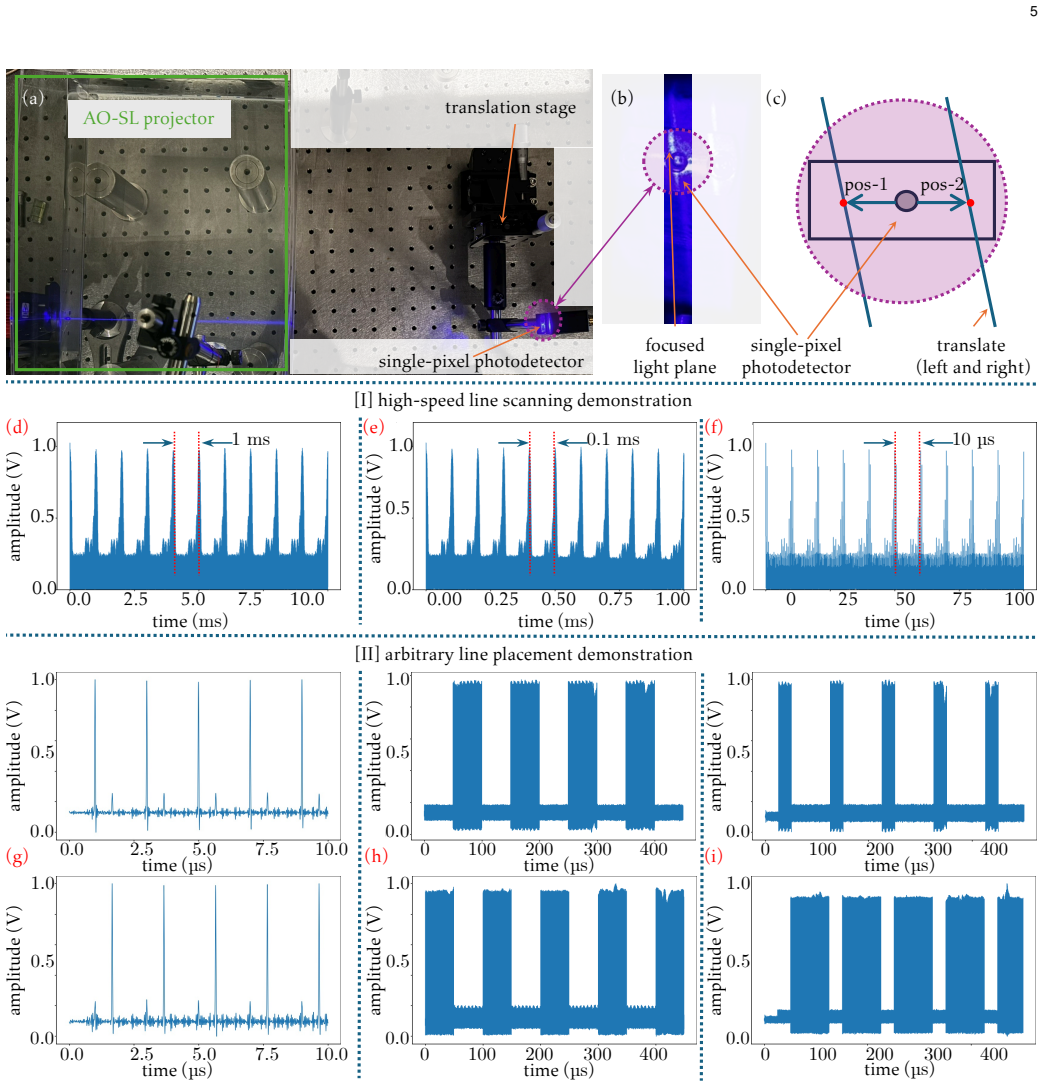
The carrying mechanism is a traveling cylindrical gradient-index (GRIN) lens sculpted by ultrasound. Sinusoidal ultrasound in water creates a refractive index profile $n(x,t)=n_0+n_{us}\cos(2\pi x/\lambda_{us}-2\pi f_{us}t)$, whose convex lobes act as cylindrical lenses that focus a collimated laser beam into a line moving at the speed of sound. The paper controls the line by pulsing the laser at a frequency ratio $\alpha$ to the ultrasound, so the focused line steps by $(1-\alpha)\lambda_{us}$ per pulse and the sweep rate equals the beat frequency. Programmed pulse timing places lines at arbitrary positions, making the device a redistributive line projector that puts all laser power on selected lines and enables adaptive scanning.
What would settle it
Count events per row during a single 1 kfps light-plane sweep over a dense high-contrast object: if many rows produce zero or multiple events, one sweep cannot give a complete depth frame, and the full-frame rate claim would require accumulation to hold.
Extended reading notes
Core claim
The central claim is that light-plane steering can be made so fast that the imaging sensor, not the projector, becomes the limiting component in structured light. The paper's acousto-optic projector sculpts traveling cylindrical gradient-index lenses in water with a 2 MHz ultrasonic transducer; each lens focuses a pulsed laser into a line, and the line moves because the laser pulse frequency is offset from the ultrasound frequency, creating a beat that determines the sweep rate. At the event camera, each light plane ideally triggers one event per sensor row, so one sweep is enough to triangulate a full-frame depth map by intersecting backprojected rays with the known plane. The paper demonstrates this at 1000 fps, and shows that adaptively placing lines only where depth changes gives effective 10 kHz scanning, limited in the prototype by laser power rather than by the acousto-optic line rate.
Load-bearing premise
The full-frame 1000 fps depth claim assumes each projected light plane triggers no more than one usable event per image row, so a single sweep yields a complete frame; the paper's own dense-scene measurement at 1 kfps shows dropped columns, making the claim clean only for sparse scenes.
Editorial extensions
If this is right
- Full-frame 1000 fps depth is achievable in a single sweep for sparse scenes; for dense scenes, accumulating several sweeps restores complete depth at a lower effective rate.
- Adaptive scanning reaches an effective rate of 10 kfps for regions of interest, with the practical limit set by laser power rather than by the acousto-optic steering rate.
- The projector can place light lines at arbitrary positions without mechanical motion, enabling redistributive illumination where all laser power goes to the scanned lines.
- Further speed gains depend on sensor readout bandwidth rather than illumination steering, with single-photon avalanche diodes identified as a candidate for closing the remaining gap.
Reading between the lines
- The same arbitrary line-placement control could project non-serial patterns such as adaptive grids or coded sequences, trading some event sparsity for robustness or resolution; the paper demonstrates serial sweeps and two-line adaptive scanning only.
- The degradation on the dense cat scene implies a natural benchmark for this class of systems: report events per sweep and missing-column counts alongside depth metrics, since dropped columns are a sensor-bandwidth effect rather than a triangulation error.
- A clean test of the claimed bottleneck shift is to couple the same projector to an event sensor with higher readout bandwidth; if full-frame depth rate rises past 1 kfps, the acousto-optic line rate is not the practical limit.
Editorial analysis
A structured set of objections, weighed in public.
Referee Report
Summary. The paper presents a structured light system that combines a custom acousto-optic line scanner with an event camera. The acousto-optic device uses an ultrasonic transducer in water to create traveling refractive-index lenses that focus a pulsed laser into moving light planes. The authors validate line scanning at 1, 10, and 100 kfps using a photodetector, demonstrate arbitrary line placement, and reconstruct static and dynamic scenes. The central claim is full-frame 3D scanning at 1000 fps, four times faster than prior event-based structured light systems, plus adaptive ROI scanning at 10 kfps. The paper reports quantitative metrics (chamfer distance, F1 score) for static scenes at several rates and qualitative dynamic results for rotating and hand-held objects.
Significance. The hardware contribution is significant: a low-cost acousto-optic line scanner with MHz-rate steering capability, which is validated by independent photodetector oscilloscope traces at 1, 10, and 100 kfps. If the full-frame speed claims held with appropriate qualifiers, this would be the fastest event-based structured light scanner demonstrated to date. The paper is transparent about the quality degradation at high rates and attributes it to event-camera bandwidth limits. However, the headline claims in the abstract and Table 1 are broader than the experimental evidence: dense-scene full-frame reconstruction at 1 kfps is not achieved without event accumulation, dynamic full-frame results are shown at 500 fps or lower, and the 10x adaptive speedup is limited to region-of-interest scanning. These issues do not negate the value of the hardware, but they require a revision of the claims.
major comments (3)
- [5.1, Table 2, Fig. 6] The abstract, Table 1, and Conclusion state that the system enables 'full-frame 3D scanning at speeds of 1000 fps', but the dense-scene data in Table 2 and Fig. 6 do not support this without qualification. At 1 kfps on the cat scene, the F1 score is 0.253 and chamfer distance is 4.56 mm, with missing columns visible in the depth map. The '1000 (acc.)' row, which improves F1 to 0.641, explicitly accumulates events over multiple scans to 'emulate a higher-bandwidth camera'. The text in Section 5.1 confirms that at 1 kfps the number of missing columns becomes significant and that only sparse scenes (such as the fan in Fig. 1) avoid this degradation. Thus single-pass full-frame depth at 1 kfps is demonstrated only for sparse scenes, not as a general full-frame capability. Please qualify the headline claim or provide dense-scene single-pass 1 kfps results.
- [5.2, Figs. 7-9, Table 1] Table 1 lists dynamic performance as 1 kfps, but the dynamic full-frame experiments show 500 fps for the fan (Fig. 8) and 180/200 fps for non-periodic scenes (Fig. 9). The 1 kfps example in Fig. 1 is the sparse fan scene, not a dense dynamic scene. Consequently, the claim of 'full-frame 3D scanning at 1000 fps' for dynamic scenes is not substantiated by the reported experiments. The authors should either provide a dense dynamic scene scanned at 1 kfps or revise the abstract and Table 1 to reflect the demonstrated dynamic rates.
- [5.3, Fig. 10, Abstract] The abstract claims 'achieving effective scanning speeds an order of magnitude beyond the camera's theoretical limit', but this result is demonstrated only for adaptive scanning of two regions of interest (the two orange knobs in Fig. 10). This is not full-frame scanning; the 10x speedup applies only when illuminating sparsely selected ROIs. The abstract and Section 5.3 should explicitly state that this speed gain is for ROI-only adaptive scanning, not full-frame. Additionally, the demonstrated 10 kfps ROI rate is limited by laser power rather than by the AO device itself, as the text notes; this practical constraint should be stated alongside the claim.
minor comments (4)
- [4, Fig. 5] The photodetector validation demonstrates line scanning at 1, 10, and 100 kfps, but the abstract and Section 3 claim a capability of 'two million light planes per second'. The paper does not directly validate the 2 MHz rate; it appears to be a theoretical maximum derived from the beat-frequency model of Eq. (5). Please clarify whether this rate is a theoretical capability or a measured one, and state the highest validated scanning rate in the abstract.
- [5.2] The dynamic full-frame results use retroreflective tape on the targets (the servo blades in Fig. 7 and the characters in Fig. 9). This is a significant experimental condition that is not mentioned in the abstract or the experimental setup overview. Please state this limitation clearly, as it affects the generality of the dynamic scanning claims.
- [5.1] The claim that 'our system produces depth results nearly identical to those from the Galvo-based system at low scanning rates' is not quantified. A direct quantitative comparison between the AO system and the Galvo baseline at 10 fps (e.g., chamfer distance or F1) would strengthen this assertion.
- [6] The Discussion lists several prototype limitations (small aperture, low laser power, small field of view of 38 mm, large form factor) that are not mentioned in the abstract. The abstract should include a sentence on the current prototype's field-of-view restriction and the need for retroreflective targets in dynamic scenes, to avoid overgeneralizing the demonstrated results.
Circularity Check
No significant circularity: the AO scanning mechanism is independently validated by photodetector traces and compared against a Galvo baseline; the paper's own dense-scene limitation is a correctness overclaim, not a circular derivation.
full rationale
I walked the derivation chain. The AO scanning model (Eqs. 1-5) is derived from the physics of traveling pressure waves; the statement that each lobe of the refractive-index profile acts as a cylindrical GRIN lens is attributed to Pediredla et al. [1], which shares coauthors with this paper, but that citation is not circular because it is an externally established physical model and the paper independently validates line scanning with a fast single-pixel photodetector (Fig. 5). Depth reconstruction uses standard swept-plane triangulation against precalibrated light planes and is compared against a Galvo-based ground truth (Table 2, Fig. 6). No parameter is fitted to force the 1 kfps claim. The paper itself flags a genuine limitation: at 1 kfps, dense scenes cause the event camera to drop events, producing missing columns and F1 = 0.253 for the cat, and the 'acc.' rows accumulate events over multiple scans to emulate a higher-bandwidth camera (Sec. 5.1, Table 2). Thus the abstract's 'full-frame 3D scanning at speeds of 1000 fps' is stronger than the paper's own dense-scene data support. That is a correctness/overclaim concern, not circularity: the measured line-scan speed is independently validated, and the reconstruction failures are empirical rather than built into the definitions. The adaptive '10x beyond the theoretical limit' claim is a metric choice comparing ROI update rate to full-frame rate, not a prediction derived from its own inputs. No derivation step reduces by construction to its input, so the circularity score is 0.
Assumptions & free parameters
assumptions (5)
- domain assumption A sinusoidal ultrasound pressure wave creates traveling cylindrical GRIN lenses in water that focus a collimated beam to a moving line (Eqs. 1-3).
- domain assumption The event camera's maximum full-frame rate is set by 1 GEvents/s divided by 720 rows, giving about 1388 fps, and one event per row per line sweep is sufficient for depth reconstruction.
- domain assumption Every event timestamp can be matched to the correct sweeping light plane using software synchronization with the left-most line, and each event corresponds to a single plane intersection.
- domain assumption The pulsed-laser model in Eqs. (4)-(6) assumes aberration-free cylindrical lenses and a collimated beam, with no crosstalk between adjacent light planes.
- domain assumption A narrowband amplifier and resonant transducer can drive the ultrasound at 2 MHz with sufficient pressure to create effective lenses.
Cite this review
Pith. "Pith review of Structured light with a million light planes per second." pith.science (2026). https://pith.science/paper/MIVRGRSM
@misc{pith2026241118597,
  author       = {Pith},
  title        = {Pith review of: Structured light with a million light planes per second},
  year         = {2026},
  howpublished = {\url{https://pith.science/paper/MIVRGRSM}},
  note         = {Machine review of arXiv:2411.18597}
}
abstract
We introduce a structured light system that enables full-frame 3D scanning at speeds of $1000\text{ fps}$, four times faster than the previous fastest systems. Our key innovation is the use of a custom acousto-optic light scanning device capable of projecting two million light planes per second. Coupling this device with an event camera allows our system to overcome the key bottleneck preventing previous structured light systems based on event cameras from achieving higher scanning speeds -- the limited rate of illumination steering. Unlike these previous systems, ours uses the event camera's full-frame bandwidth, shifting the speed bottleneck from the illumination side to the imaging side. To mitigate this new bottleneck and further increase scanning speed, we introduce adaptive scanning strategies that leverage the event camera's asynchronous operation by selectively illuminating regions of interest, thereby achieving effective scanning speeds an order of magnitude beyond the camera's theoretical limit.
Figures


Figures from the paper (7 more)



Reference graph
Works this paper leans on
-
[1]
Megahertz Light Steering Without Mov- ing Parts,
A. Pediredla, S. G. Narasimhan, M. Chamanzar, and I. Gkioulekas, “Megahertz Light Steering Without Mov- ing Parts,” in Proceedings of the IEEE/CVF Conference on Computer Vision and Pattern Recognition, 2023, pp. 1–12
work page 2023
-
[2]
M. Muglikar, D. P . Moeys, and D. Scaramuzza, “Event guided depth sensing,” in 2021 International Conference on 3D Vision (3DV). IEEE, 2021, pp. 385–393
work page 2021
-
[3]
Development of the high angular resolution 360° lidar based on scanning mems mirror,
D. Yang, Y. Liu, Q. Chen, M. Chen, S. Zhan, N.-k. Che- ung, H.-Y. Chan, Z. Wang, and W. J. Li, “Development of the high angular resolution 360° lidar based on scanning mems mirror,” Scientific Reports, vol. 13, no. 1, p. 1540, 2023
work page 2023
-
[4]
Structured light 3d scanning in the pres- ence of global illumination,
M. Gupta, A. Agrawal, A. Veeraraghavan, and S. G. Narasimhan, “Structured light 3d scanning in the pres- ence of global illumination,” in Proceedings of the IEEE Conference on Computer Vision and Pattern Recognition . IEEE, 2011, pp. 713–720
work page 2011
-
[5]
Single-photon structured light,
V . Sundar, S. Ma, A. C. Sankaranarayanan, and M. Gupta, “Single-photon structured light,” in Proceed- ings of the IEEE/CVF Conference on Computer Vision and Pattern Recognition, 2022, pp. 17 865–17 875
work page 2022
-
[6]
Neural sdf for shadow-aware unsupervised structured light,
K. Ichimaru, D. Thomas, T. Iwaguchi, and H. Kawasaki, “Neural sdf for shadow-aware unsupervised structured light,” in Proceedings of the IEEE/CVF Winter Conference on Applications of Computer Vision. IEEE, 2025, pp. 287– 296
work page 2025
-
[7]
Depth reconstruc- tion with neural signed distance fields in structured light systems,
R. Qiao, H. Kawasaki, and H. Zha, “Depth reconstruc- tion with neural signed distance fields in structured light systems,” in 2024 International Conference on 3D Vision (3DV). IEEE, 2024, pp. 770–779
work page 2024
-
[8]
Primal- dual coding to probe light transport
M. O’Toole, R. Raskar, and K. N. Kutulakos, “Primal- dual coding to probe light transport.”ACM Trans. Graph., vol. 31, no. 4, pp. 39–1, 2012
work page 2012
Show all 75 references
-
[9]
Homogeneous codes for energy-efficient illumination and imaging,
M. O’Toole, S. Achar, S. G. Narasimhan, and K. N. Kutulakos, “Homogeneous codes for energy-efficient illumination and imaging,” ACM Trans. Graph., vol. 34, no. 4, pp. 1–13, 2015
2015
-
[10]
Epipolar time-of-flight imaging,
S. Achar, J. R Bartels, W. L Whittaker, K. N Kutulakos, and S. G Narasimhan, “Epipolar time-of-flight imaging,” ACM Trans. Graph., vol. 36, no. 4, p. 37, 2017
2017
-
[11]
Mc3d: Motion contrast 3d scanning,
N. Matsuda, O. Cossairt, and M. Gupta, “Mc3d: Motion contrast 3d scanning,” in 2015 IEEE International Confer- ence on Computational Photography (ICCP). IEEE, 2015, pp. 1–10
2015
-
[12]
Holocur- tains: Programming light curtains via binary holog- raphy,
D. Chan, S. G. Narasimhan, and M. O’Toole, “Holocur- tains: Programming light curtains via binary holog- raphy,” in Proceedings of the IEEE/CVF Conference on Computer Vision and Pattern Recognition, 2022, pp. 17 886– 17 895
2022
-
[13]
Programmable tri- angulation light curtains,
J. Wang, J. Bartels, W. Whittaker, A. C. Sankara- narayanan, and S. G. Narasimhan, “Programmable tri- angulation light curtains,” in Proceedings of the European Conference on Computer Vision, 2018, pp. 19–34
2018
-
[14]
Slope disparity gating using a syn- chronized projector-camera system,
T. Ueda, H. Kubo, S. Jayasuriya, T. Funatomi, and Y. Mukaigawa, “Slope disparity gating using a syn- chronized projector-camera system,” in 2019 IEEE Inter- national Conference on Computational Photography (ICCP). IEEE, 2019, pp. 1–9
2019
-
[15]
Programmable non-epipolar indirect light transport: Capture and anal- ysis,
H. Kubo, S. Jayasuriya, T. Iwaguchi, T. Funatomi, Y. Mukaigawa, and S. G. Narasimhan, “Programmable non-epipolar indirect light transport: Capture and anal- ysis,” IEEE Trans. Vis. Comput. Graph., vol. 27, no. 4, pp. 2421–2436, 2019
2019
-
[16]
Slope disparity gating: System and applications,
S. Chandran, H. Kubo, T. Ueda, T. Funatomi, Y. Mukaigawa, and S. Jayasuriya, “Slope disparity gating: System and applications,” IEEE Transactions on Computational Imaging, vol. 8, pp. 317–332, 2022
2022
-
[17]
Wave- 11 based non-line-of-sight imaging using fast fk migration,
D. B. Lindell, G. Wetzstein, and M. O’Toole, “Wave- 11 based non-line-of-sight imaging using fast fk migration,” ACM Trans. Graph., vol. 38, no. 4, pp. 1–13, 2019
2019
-
[18]
Non- line-of-sight imaging using phasor-field virtual wave optics,
X. Liu, I. Guill ´en, M. La Manna, J. H. Nam, S. A. Reza, T. Huu Le, A. Jarabo, D. Gutierrez, and A. Velten, “Non- line-of-sight imaging using phasor-field virtual wave optics,” Nature, vol. 572, no. 7771, pp. 620–623, 2019
2019
-
[19]
Confo- cal non-line-of-sight imaging based on the light-cone transform,
M. O’Toole, D. B. Lindell, and G. Wetzstein, “Confo- cal non-line-of-sight imaging based on the light-cone transform,” Nature, vol. 555, no. 7696, pp. 338–341, 2018
2018
-
[20]
Snlos: Non-line-of-sight scanning through temporal focusing,
A. Pediredla, A. Dave, and A. Veeraraghavan, “Snlos: Non-line-of-sight scanning through temporal focusing,” in 2019 IEEE International Conference on Computational Photography (ICCP). IEEE, 2019, pp. 1–13
2019
-
[21]
A theory of fermat paths for non-line-of-sight shape re- construction,
S. Xin, S. Nousias, K. N. Kutulakos, A. C. Sankara- narayanan, S. G. Narasimhan, and I. Gkioulekas, “A theory of fermat paths for non-line-of-sight shape re- construction,” in Proceedings of the IEEE/CVF Conference on Computer Vision and Pattern Recognition , 2019, pp. 6800–6809
2019
-
[22]
Spatial scanning hyperspectral imaging combining a rotating slit with a dove prism,
M. Abdo, V . Badilita, and J. Korvink, “Spatial scanning hyperspectral imaging combining a rotating slit with a dove prism,” Optics Express, vol. 27, no. 15, pp. 20 290– 20 304, 2019
2019
-
[23]
Super-resolution imaging and field of view extension using a single camera with risley prisms,
Z. Wang, J. Cao, Q. Hao, F. Zhang, Y. Cheng, and X. Kong, “Super-resolution imaging and field of view extension using a single camera with risley prisms,” Review of Scientific Instruments, vol. 90, no. 3, p. 033701, 2019
2019
-
[24]
Adaptive control of a tilt mirror for laser beam steering,
B.-S. Kim, S. Gibson, and T.-C. Tsao, “Adaptive control of a tilt mirror for laser beam steering,” in Proceedings of the 2004 American Control Conference, vol. 4. IEEE, 2004, pp. 3417–3421
2004
-
[25]
Kilometer-range, high resolution depth imaging via 1560 nm wavelength single-photon detection,
A. McCarthy, N. J. Krichel, N. R. Gemmell, X. Ren, M. G. Tanner, S. N. Dorenbos, V . Zwiller, R. H. Hadfield, and G. S. Buller, “Kilometer-range, high resolution depth imaging via 1560 nm wavelength single-photon detection,” Optics express, vol. 21, no. 7, pp. 8904–8915, 2013
2013
-
[26]
Multi-beam and single-chip lidar with discrete beam steering by digital micromirror device,
J. Rodriguez, B. Smith, B. Hellman, A. Gin, A. Espinoza, and Y. Takashima, “Multi-beam and single-chip lidar with discrete beam steering by digital micromirror device,” in Physics and Simulation of Optoelectronic Devices XXVI, vol. 10526. SPIE, 2018, pp. 89–94
2018
-
[27]
Single chip lidar with discrete beam steering by digital micromirror device,
B. Smith, B. Hellman, A. Gin, A. Espinoza, and Y. Takashima, “Single chip lidar with discrete beam steering by digital micromirror device,” Optics Express, vol. 25, no. 13, pp. 14 732–14 745, 2017
2017
-
[28]
Dual-beam confocal light-sheet mi- croscopy via flexible acousto-optic deflector,
V . Gavryusev, G. Sancataldo, P . Ricci, A. Montalbano, C. Fornetto, L. Turrini, A. Laurino, L. Pesce, G. de Vito, N. Tiso et al. , “Dual-beam confocal light-sheet mi- croscopy via flexible acousto-optic deflector,” Journal of biomedical optics, vol. 24, no. 10, p. 106504, 2019
2019
-
[29]
Tunable prism based on piezoelec- tric metamaterial for acoustic beam steering,
J. Xu and J. Tang, “Tunable prism based on piezoelec- tric metamaterial for acoustic beam steering,” Applied Physics Letters, vol. 110, no. 18, p. 181902, 2017
2017
-
[30]
Polymeric waveguide prism-based electro-optic beam deflector,
L. Sun, J.-h. Kim, C.-h. Jang, D. An, X. Lu, Q. Zhou, J. M. Taboada, R. T. Chen, J. J. Maki, S. Tang et al., “Polymeric waveguide prism-based electro-optic beam deflector,” Optical Engineering, vol. 40, no. 7, pp. 1217–1222, 2001
2001
-
[31]
Electrically controllable liquid crystal component for efficient light steering,
X. Shang, J.-Y. Tan, O. Willekens, J. De Smet, P . Joshi, D. Cuypers, E. Islamaj, J. Beeckman, K. Neyts, M. Ver- vaeke et al. , “Electrically controllable liquid crystal component for efficient light steering,” IEEE Photonics Journal, vol. 7, no. 2, pp. 1–13, 2015
2015
-
[32]
Agile laser beam deflection with high steering precision and angular resolution using liquid crystal optical phased array,
X. Wang, L. Wu, C. Xiong, M. Li, Q. Tan, J. Shang, S. Wu, and Q. Qiu, “Agile laser beam deflection with high steering precision and angular resolution using liquid crystal optical phased array,” IEEE Transactions on Nanotechnology, vol. 17, no. 1, pp. 26–28, 2016
2016
-
[33]
A review and perspec- tive on optical phased array for automotive lidar,
C.-P . Hsu, B. Li, B. Solano-Rivas, A. R. Gohil, P . H. Chan, A. D. Moore, and V . Donzella, “A review and perspec- tive on optical phased array for automotive lidar,” IEEE Journal of Selected Topics in Quantum Electronics, vol. 27, no. 1, pp. 1–16, 2020
2020
-
[34]
8192-element optical phased array with 100 ° steering range and flip-chip cmos,
C. V . Poulton, M. J. Byrd, B. Moss, E. Timurdogan, R. Millman, and M. R. Watts, “8192-element optical phased array with 100 ° steering range and flip-chip cmos,” in CLEO: QELS Fundamental Science. Optical Society of America, 2020, pp. JTh4A–3
2020
-
[35]
ESL: Event-based structured light,
M. Muglikar, G. Gallego, and D. Scaramuzza, “ESL: Event-based structured light,” in 2021 International Conference on 3D Vision (3DV) . IEEE, 2021, pp. 1165– 1174
2021
-
[36]
Event-based Motion- Robust Accurate Shape Estimation for Mixed Re- flectance Scenes,
A. Dashpute, J. Wang, J. Taylor, O. Cossairt, A. Veer- araghavan, and F. Willomitzer, “Event-based Motion- Robust Accurate Shape Estimation for Mixed Re- flectance Scenes,” arXiv preprint arXiv:2311.09652, 2023
2023 arXiv
-
[37]
Acousto-optic tunable filters,
M. S. Gottlieb, “Acousto-optic tunable filters,” in Design and fabrication of acousto-optic devices. CRC Press, 2021, pp. 197–283
2021
-
[38]
Acousto-optic modulators inte- grated on-chip,
J. Beller and L. Shao, “Acousto-optic modulators inte- grated on-chip,” Light: Science & Applications , vol. 11, no. 1, pp. 1–2, 2022
2022
-
[39]
Gigahertz acousto-optic modulation and frequency shifting on etchless lithium niobate integrated platform,
Z. Yu and X. Sun, “Gigahertz acousto-optic modulation and frequency shifting on etchless lithium niobate integrated platform,” ACS Photonics, vol. 8, no. 3, pp. 798–803, 2021
2021
-
[40]
Angu- lar resolution variable fmcw lidar with acousto-optic deflector,
D. Jeong, H. Jang, M. U. Jung, and C.-S. Kim, “Angu- lar resolution variable fmcw lidar with acousto-optic deflector,” in Imaging Systems and Applications. Optica Publishing Group, 2022, pp. ITh4D–3
2022
-
[41]
C. S. Tsai, Guided-wave acousto-optics: interactions, devices, and applications. Springer Science & Business Media, 2013, vol. 23
2013
-
[42]
Electromechanical brillouin scattering in integrated optomechanical waveguides,
Q. Liu, H. Li, and M. Li, “Electromechanical brillouin scattering in integrated optomechanical waveguides,” Optica, vol. 6, no. 6, pp. 778–785, 2019
2019
-
[43]
Electro-optic beam-steering device based on a lanthanum-modified lead zirconate titanate ceramic wafer,
Q. W. Song, X.-M. Wang, R. Bussjager, and J. Os- man, “Electro-optic beam-steering device based on a lanthanum-modified lead zirconate titanate ceramic wafer,” Applied optics , vol. 35, no. 17, pp. 3155–3162, 1996
1996
-
[44]
Variable optical elements for fast focus control,
S. Kang, M. Duocastella, and C. B. Arnold, “Variable optical elements for fast focus control,” Nature Photonics, vol. 14, no. 9, pp. 533–542, 2020
2020
-
[45]
Transversally travelling ultrasound for light guiding deep into scattering media,
M. N. Cherkashin, C. Brenner, G. Schmitz, and M. R. Hofmann, “Transversally travelling ultrasound for light guiding deep into scattering media,” Communications Physics, vol. 3, no. 1, pp. 1–11, 2020
2020
-
[46]
Ultrasonic sculpting of virtual optical 12 waveguides in tissue,
M. Chamanzar, M. G. Scopelliti, J. Bloch, N. Do, M. Huh, D. Seo, J. Iafrati, V . S. Sohal, M.-R. Alam, and M. M. Maharbiz, “Ultrasonic sculpting of virtual optical 12 waveguides in tissue,” Nature communications, vol. 10, no. 1, pp. 1–10, 2019
2019
-
[47]
In situ 3d reconfigurable ultrasonically sculpted optical beam paths,
Y. Karimi, M. G. Scopelliti, N. Do, M.-R. Alam, and M. Chamanzar, “In situ 3d reconfigurable ultrasonically sculpted optical beam paths,” Optics express , vol. 27, no. 5, pp. 7249–7265, 2019
2019
-
[48]
Dynamic display of brdfs,
M. B. Hullin, H. P . Lensch, R. Raskar, H.-P . Seidel, and I. Ihrke, “Dynamic display of brdfs,” in Comput. Graph. Forum, vol. 30, no. 2. Wiley Online Library, 2011, pp. 475–483
2011
-
[49]
Neuromorphic camera guided high dynamic range imaging,
J. Han, C. Zhou, P . Duan, Y. Tang, C. Xu, C. Xu, T. Huang, and B. Shi, “Neuromorphic camera guided high dynamic range imaging,” in Proceedings of the IEEE/CVF Conference on Computer Vision and Pattern Recognition, 2020, pp. 1730–1739
2020
-
[50]
Time lens: Event- based video frame interpolation,
S. Tulyakov, D. Gehrig, S. Georgoulis, J. Erbach, M. Gehrig, Y. Li, and D. Scaramuzza, “Time lens: Event- based video frame interpolation,” in Proceedings of the IEEE/CVF Conference on Computer Vision and Pattern Recognition, 2021, pp. 16 155–16 164
2021
-
[51]
Time lens++: Event-based frame interpolation with parametric non-linear flow and multi-scale fusion,
S. Tulyakov, A. Bochicchio, D. Gehrig, S. Georgoulis, Y. Li, and D. Scaramuzza, “Time lens++: Event-based frame interpolation with parametric non-linear flow and multi-scale fusion,” in Proceedings of the IEEE/CVF Conference on Computer Vision and Pattern Recognition , 2022, p...
2022
-
[52]
Event fields: Capturing light fields at high speed, resolution, and dynamic range,
Z. Qu, Z. Zou, V . Boominathan, P . Chakravarthula, and A. Pediredla, “Event fields: Capturing light fields at high speed, resolution, and dynamic range,” in Proceedings of the IEEE/CVF Conference on Computer Vision and Pattern Recognition, 2025, pp. 26 910–26 920
2025
-
[53]
Simultaneous mosaicing and tracking with an event camera,
H. Kim, A. Handa, R. Benosman, S.-H. Ieng, and A. J. Davison, “Simultaneous mosaicing and tracking with an event camera,” J. Solid State Circ, vol. 43, pp. 566–576, 2008
2008
-
[54]
Evo: A geometric approach to event-based 6-dof parallel tracking and mapping in real time,
H. Rebecq, T. Horstsch ¨afer, G. Gallego, and D. Scara- muzza, “Evo: A geometric approach to event-based 6-dof parallel tracking and mapping in real time,” IEEE Robotics and Automation Letters, vol. 2, no. 2, pp. 593–600, 2016
2016
-
[55]
Continuous- time intensity estimation using event cameras,
C. Scheerlinck, N. Barnes, and R. Mahony, “Continuous- time intensity estimation using event cameras,” in Asian Conference on Computer Vision. Springer, 2018, pp. 308– 324
2018
-
[56]
High frame rate video reconstruction based on an event camera,
L. Pan, R. Hartley, C. Scheerlinck, M. Liu, X. Yu, and Y. Dai, “High frame rate video reconstruction based on an event camera,” IEEE Trans. Pattern Anal. Mach. Intell., vol. 44, no. 5, pp. 2519–2533, 2020
2020
-
[57]
Photorealistic image recon- struction from hybrid intensity and event-based sensor,
P . Shedligeri and K. Mitra, “Photorealistic image recon- struction from hybrid intensity and event-based sensor,” Journal of Electronic Imaging, vol. 28, no. 6, pp. 063 012– 063 012, 2019
2019
-
[58]
High-speed video generation with an event camera,
H.-C. Liu, F.-L. Zhang, D. Marshall, L. Shi, and S.-M. Hu, “High-speed video generation with an event camera,” The Vis. Comput., vol. 33, pp. 749–759, 2017
2017
-
[59]
Learning to deblur and generate high frame rate video with an event camera,
C. Haoyu, T. Minggui, S. Boxin, W. YIzhou, and H. Tiejun, “Learning to deblur and generate high frame rate video with an event camera,” arXiv preprint arXiv:2003.00847, 2020
2003 arXiv
-
[60]
Event-based fusion for motion deblurring with cross-modal attention,
L. Sun, C. Sakaridis, J. Liang, Q. Jiang, K. Yang, P . Sun, Y. Ye, K. Wang, and L. V . Gool, “Event-based fusion for motion deblurring with cross-modal attention,” in Proceedings of the European Conference on Computer Vision. Springer, 2022, pp. 412–428
2022
-
[61]
Event-based frame interpolation with ad-hoc deblurring,
L. Sun, C. Sakaridis, J. Liang, P . Sun, J. Cao, K. Zhang, Q. Jiang, K. Wang, and L. Van Gool, “Event-based frame interpolation with ad-hoc deblurring,” in Proceedings of the IEEE/CVF Conference on Computer Vision and Pattern Recognition, 2023, pp. 18 043–18 052
2023
-
[62]
Motion deblurring with real events,
F. Xu, L. Yu, B. Wang, W. Yang, G.-S. Xia, X. Jia, Z. Qiao, and J. Liu, “Motion deblurring with real events,” in Proceedings of the IEEE/CVF International Conference on Computer Vision, 2021, pp. 2583–2592
2021
-
[63]
Hybrid deblur net: Deep non-uniform deblurring with event camera,
L. Zhang, H. Zhang, J. Chen, and L. Wang, “Hybrid deblur net: Deep non-uniform deblurring with event camera,” IEEE Access, vol. 8, pp. 148 075–148 083, 2020
2020
-
[64]
Bringing a blurry frame alive at high frame-rate with an event camera,
L. Pan, C. Scheerlinck, X. Yu, R. Hartley, M. Liu, and Y. Dai, “Bringing a blurry frame alive at high frame-rate with an event camera,” in Proceedings of the IEEE/CVF Conference on Computer Vision and Pattern Recognition , 2019, pp. 6820–6829
2019
-
[65]
Adaptive pulsed laser line extraction for terrain reconstruction using a dynamic vision sensor,
C. Brandli, T. A. Mantel, M. Hutter, M. A. H ¨opflinger, R. Berner, R. Siegwart, and T. Delbruck, “Adaptive pulsed laser line extraction for terrain reconstruction using a dynamic vision sensor,” Frontiers in neuroscience, vol. 7, p. 275, 2014
2014
-
[66]
An active approach to solving the stereo matching problem using event-based sensors,
J. N. Martel, J. M ¨uller, J. Conradt, and Y. Sandamirskaya, “An active approach to solving the stereo matching problem using event-based sensors,” in 2018 IEEE International Symposium on Circuits and Systems (ISCAS) . IEEE, 2018, pp. 1–5
2018
-
[67]
Event- based structured light for depth reconstruction us- ing frequency tagged light patterns,
T. Leroux, S.-H. Ieng, and R. Benosman, “Event- based structured light for depth reconstruction us- ing frequency tagged light patterns,” arXiv preprint arXiv:1811.10771, 2018
2018 arXiv
-
[68]
Neuromorphic fringe projection profilometry,
A. R. Mangalore, C. S. Seelamantula, and C. S. Thakur, “Neuromorphic fringe projection profilometry,” IEEE Signal Processing Letters, vol. 27, pp. 1510–1514, 2020
2020
-
[69]
Surface mea- surement by space-encoded projected beam systems,
J. L. Posdamer and M. D. Altschuler, “Surface mea- surement by space-encoded projected beam systems,” Computer graphics and image processing, vol. 18, no. 1, pp. 1–17, 1982
1982
-
[70]
Range imaging with adaptive color structured light,
D. Caspi, N. Kiryati, and J. Shamir, “Range imaging with adaptive color structured light,” IEEE Trans. Pattern Anal. Mach. Intell., vol. 20, no. 5, pp. 470–480, 1998
1998
-
[71]
High-speed 3- d shape measurement based on digital fringe projection,
P . S. Huang, C. Zhang, and F.-P . Chiang, “High-speed 3- d shape measurement based on digital fringe projection,” Optical engineering, vol. 42, no. 1, pp. 163–168, 2003
2003
-
[72]
Build your own 3d scanner: 3d photography for beginners,
D. Lanman and G. Taubin, “Build your own 3d scanner: 3d photography for beginners,” in ACM siggraph 2009 courses. ACM, 2009, pp. 1–94
2009
-
[73]
3D photography using shadows in dual-space geometry,
J.-Y. Bouguet and P . Perona, “3D photography using shadows in dual-space geometry,” Int. J. Comput. Vis., vol. 35, pp. 129–149, 1999
1999
-
[74]
Event-based vision: A survey,
G. Gallego, T. Delbr ¨uck, G. Orchard, C. Bartolozzi, B. Taba, A. Censi, S. Leutenegger, A. J. Davison, J. Con- radt, and K. Daniilidis, “Event-based vision: A survey,” IEEE Trans. Pattern Anal. Mach. Intell., 2020
2020
-
[75]
Passive ultra-wideband single-photon imaging,
M. Wei, S. Nousias, R. Gulve, D. B. Lindell, and K. N. Kutulakos, “Passive ultra-wideband single-photon imaging,” in Proceedings of the IEEE/CVF International Conference on Computer Vision, 2023, pp. 8135–8146. 13 Dhawal Sirikonda is a Ph.D. student at Dart- mouth College and ...
2023
Reviewed August 12, 2026 · model on record in the stance chip above.
Discussion (0). Continue with ORCID to comment.