REVIEW 1 major objections 5 minor 16 references
Log-Sum-Exponential Estimator for Off-Policy Evaluation and Learning
T0 review · 1 major / 5 minor · reviewed 2026-08-07 · deepseek-v4-flash
Pith's one-line read This paper proposes a log-sum-exponential (LSE) estimator for off-policy evaluation and learning that replaces the inverse-propensity-score average with a soft-log mean, and claims lower variance, heavy-tail robustness, and a regret…
desk verdict The regret analysis is worth engaging with, but the paper's headline variance-reduction claim rests on a false proposition. read the letter →
The pith
A machine-rendered reading of the paper's core claim, the machinery that carries it, and where it could break.
The reading
What carries the argument
The central object is the log-sum-exponential operator $LSE_\lambda(Z) = \frac{1}{\lambda}\log\left(\frac{1}{n}\sum_i e^{\lambda z_i}\right)$ with $\lambda<0$. It is concave for negative $\lambda$, assigns exponentially small weight to large samples in the sum, and reduces to the sample mean in the $\lambda\to0$ limit. The load-bearing technical lemma is the bound $\mathrm{Var}(e^{\lambda Z}) \leq |\lambda|^{1+\epsilon}\mathbb{E}[Z^{1+\epsilon}]$, which adapts Bernstein-type concentration to heavy-tailed weighted rewards. The paper also shows that the LSE value equals the optimum of a KL-regularized expected minimization, connecting it to softmax and tilted empirical risk.
What would settle it
Take a two-point distribution for the weighted reward $Z$ (for instance, two values with unequal probabilities), and compute exactly $\mathrm{Var}\left(\frac{1}{\lambda}\log\frac{e^{\lambda Z_1}+e^{\lambda Z_2}}{2}\right)$ and $\frac{1}{2}\mathrm{Var}(Z)$ for a negative $\lambda$; a single instance where the LSE variance is larger falsifies Proposition 5.7. For the regret rate, simulate off-policy learning with Pareto-distributed weighted rewards having a known finite $(1+\epsilon)$-moment and check whether the empirical log-regret slope approaches $-\epsilon/(1+\epsilon)$ when $\lambda=-n^{-1/(1+\epsilon)}$.
Extended reading notes
Core claim
The central claim is that the LSE operator turns importance-weighted rewards into a value estimator with a tunable bias-variance trade-off. For $\lambda<0$, the estimator interpolates between the IPS average as $\lambda\to 0$ and the minimum weighted reward as $\lambda\to -\infty$, providing what the paper calls implicit shrinkage. The proof machinery is a variance bound on the exponentiated variable, $\mathrm{Var}(e^{\lambda Z}) \leq |\lambda|^{1+\epsilon}\mathbb{E}[Z^{1+\epsilon}]$, which lets Bernstein's inequality be applied to $\frac{1}{n}\sum_i e^{\lambda r_i w_i}$ under only a moment assumption. Theorems 5.3 and 5.9 then upper-bound the regret of the policy maximizing the LSE estimate, for clean and noise-shifted rewards, with convergence rate $O(n^{-\epsilon/(1+\epsilon)})$; Proposition 5.5 bounds the bias; Proposition 5.7 claims the variance is at most $1/n$ times the IPS variance. The authors position these results as holding where competing estimators require bounded rewards, exact propensity scores, or higher moments.
Load-bearing premise
The load-bearing premise is that a single constant bounds the $(1+\epsilon)$-th moment, a measure of how heavy the tail is, of the weighted reward for every policy in the policy set, and that the sample size is large enough for the concentration argument to work; if that uniform tail bound fails, the regret guarantee collapses.
Editorial extensions
If this is right
- For off-policy learning, the policy that maximizes the LSE estimate attains regret $O(n^{-\epsilon/(1+\epsilon)})$ under a bounded $(1+\epsilon)$-th moment, interpolating between no rate at $\epsilon=0$ and the usual $n^{-1/2}$ at $\epsilon=1$.
- For off-policy evaluation, the LSE's bias is asymptotically zero when $\lambda$ is scheduled to vanish with $n$, with bias upper bound $O(|\lambda|^\epsilon \nu)$ plus a variance term.
- The estimator remains differentiable and concave, so policy search can proceed by gradient methods without the discretization issues of truncated IPS.
- Under a total-variation shift of the reward distribution, the noisy-reward regret bound gains a term proportional to the shift divided by $\lambda^2$, quantifying the cost of noise.
- The $\lambda\to -\infty$ limit of LSE recovers the minimum importance-weighted reward, giving a pessimistic baseline usable for conservative policy selection.
Reading between the lines
- A direct two-sample calculation refutes the paper's universal variance claim in Proposition 5.7: for some $\lambda<0$, $\mathrm{Var}\left(\frac{1}{\lambda}\log\left(\frac{e^{\lambda Z_1}+e^{\lambda Z_2}}{2}\right)\right)$ can exceed $\frac{1}{2}\mathrm{Var}(Z)$, so the variance-reduction statement likely needs a corrected proof or a restricted distributional condition.
- The same $\mathrm{Var}(e^{\lambda Z})$ lemma could support heavier-tailed mean-estimation tools such as median-of-means LSE hybrids, which would trade a bit more bias for stronger high-probability guarantees with very heavy tails.
- Because the rate is $O(n^{-\epsilon/(1+\epsilon)})$, the method is only slowly convergent when $\epsilon$ is small; in practice the choice of $\lambda$ controls a bias-variance trade-off, and data-driven selection of $\lambda$ is where the remaining practical gain lies.
- The KL-regularization reading of LSE suggests a natural way to inject entropy or other divergences into off-policy objectives, but the paper does not develop that direction.
Editorial analysis
A structured set of objections, weighed in public.
Referee Report
Summary. The paper introduces a log-sum-exponential (LSE) estimator for off-policy evaluation and learning from logged bandit feedback. For λ<0, the estimator is defined as LSE_λ(S,πθ) = (1/λ) log( (1/n) Σ_i exp(λ r_i w_θ(a_i,x_i)) ), which down-weights large importance-weighted rewards. The authors claim that this estimator reduces variance relative to IPS, is robust to heavy-tailed rewards and noisy propensity scores, and provide bias and variance bounds (Propositions 5.5 and 5.7), a regret bound under a bounded (1+ε)-moment assumption (Theorem 5.3) with rate O(n^{-ε/(1+ε)}), a robust regret bound under noisy rewards (Theorem 5.9), and an analysis of noisy propensity scores (Appendix E). The theoretical results are supported by extensive experiments on synthetic and real datasets, and code is provided.
Significance. The regret analysis is a genuinely useful contribution: Theorem 5.3 gives a non-asymptotic regret bound under a mild heavy-tail assumption, and the convergence-rate proposition is structurally plausible and does not appear to rely on the disputed variance claim. The paper also ships code and a broad experimental comparison, which strengthens reproducibility. However, Proposition 5.7 — the universal variance-reduction claim relative to IPS — is false as stated, and this claim is advertised in the abstract, in Section 5.3, and in Table 2. Because that proposition is load-bearing for the paper's central motivation, the manuscript needs a substantive correction before it can be accepted.
major comments (1)
- [Section 5.2, Table 2, and Appendix D.7] The claim in Table 2 that LSE has 'Subgaussian Like Tail' is not supported by Theorem 5.3 as stated: the leading term |λ|^ε ν/(1+ε) in the regret bound is independent of δ, so the bound is not sub-Gaussian in the failure probability. A sub-Gaussian-type dependence is derived only in Appendix D.7, under a different choice of λ that depends on log(1/δ) and under an additional lower bound on n. The table and the surrounding discussion should either restrict the 'Subgaussian Like Tail' entry to the regime of Proposition D.7 or add a footnote explaining the distinction. This is important because the table is the paper's main comparison device for the theoretical properties of estimators.
minor comments (5)
- [Abstract and Assumption 5.1] The abstract states a rate O(n^{-ε/(1+ε)}) for ε∈[0,1]; for ε=0 this rate is O(1), so no convergence is obtained. Please state ε∈(0,1] or add a remark that the ε=0 case is degenerate.
- [Theorem 5.3] The lower-bound condition on n is written with ambiguous parentheses: it should read ((2|λ|^{1+ε}ν + 4γ/3) log(|Π_θ|/δ)) / (γ² exp(2λν^{1/(1+ε)})). The current typesetting makes it easy to misread the division and the logarithm's argument.
- [Section 6.1 and Table 4] The text says the Gaussian experiment varies α over {1.4, 1.6}, while Table 4 reports columns α=1.1 and α=1.4; Appendix G.1 additionally uses the reward r(x0,u)=-e^{αu²} even though Section 6.1 says 'positive exponential function'. Please align the notation and the reported parameter values.
- [Appendix D.3, Lemma 5.2 proof] In the proof of Lemma 5.2, the symbol C1 is used as a constant to minimize the variance expression, but it is not defined or introduced. Please replace it with a clearly defined constant c>0 and state the minimization explicitly.
- [Table 2, LSE row] The entry 'C(2 log(2|Πθ|/δ)/n)^{ε/(1+ε)}' for the LSE concentration rate appears to omit the λ-scheduling needed for the rate in Proposition 5.4; for a fixed λ<0 the first term in Theorem 5.3 does not vanish as n grows. Please state that the tabulated rate refers to the λ=-n^{-1/(1+ε)} schedule.
Circularity Check
No construction-level circularity: the regret rate follows by direct substitution of lambda into the derived bound, and the estimator is not fitted to the predictions. The only self-citation (Aminian et al. 2025) is methodological attribution and is not load-bearing.
full rationale
The main claimed derivation chain is: LSE is defined in Eq. (1); Lemma 5.2 gives V(e^{lambda Z}) <= |lambda|^{1+epsilon} E[Z^{1+epsilon}]; Theorems D.2 and D.3 turn Bernstein's inequality and Lemma B.11 into upper and lower estimation-error bounds; Theorem 5.3 combines these over a finite policy set; Proposition 5.4 substitutes lambda = -n^{-1/(1+epsilon)} and obtains O(n^{-epsilon/(1+epsilon)}). None of these steps fits a parameter to the claimed rate: nu is an assumed uniform (1+epsilon)-moment constant, and the n-threshold is a hypothesis of the theorem, not an artifact of the derivation. The practical data-driven lambda in Appendix D.5 estimates nu and minimizes the upper bound, but it is presented as a selection heuristic and is not used to derive the rate. The only self-citation is in Section 5.4, where the paper says it 'extend[s] the approach of tilted empirical risk introduced by Aminian et al. (2025)'; because the appendix proof of Theorem 5.9 re-derives the needed bound via functional derivatives and Jensen rather than invoking that paper's theorems as black boxes, this is attribution, not load-bearing circularity. I also note for completeness that Proposition 5.7's variance bound is unsupported: the proof moves from Jensen's pointwise inequality (1/lambda) log Z <= mean to V((1/lambda) log Z) <= E[mean^2], which requires a two-sided bound that does not follow and is false in general. That is a correctness error, not a circular reduction, so it does not raise the circularity score beyond the minor self-citation noted above.
Assumptions & free parameters
free parameters (3)
- lambda (LSE temperature) =
Grid-searched in experiments over {-0.01, -0.1, -1.0, -10.0, -100.0}; theory sets lambda = -n^{-1/(1+epsilon)} or…
- epsilon (moment exponent)
- nu (moment bound) =
Assumed bounded; estimated as nu_hat = (1/n) sum (wr)^{1+epsilon} for data-driven lambda
assumptions (7)
- domain assumption Assumption 5.1: E[(w_theta(A,X) R)^{1+epsilon}] <= nu for all policies in Pi_theta
- domain assumption Finite policy set |Pi_theta| < infinity for the union bound in Theorem 5.3
- standard math Bernstein's inequality for bounded variables (Lemma B.4)
- standard math Lemma B.11 bound on the log-moment generating function
- domain assumption Assumption 5.8: bounded (1+epsilon)-th moment of weighted noisy reward (nu_tilde)
- ad hoc to paper Inverse-Gamma multiplicative noise model for estimated propensity scores
- standard math Functional linear derivative representation (Definition B.1)
Cite this review
Pith. "Pith review of Log-Sum-Exponential Estimator for Off-Policy Evaluation and Learning." pith.science (2026). https://pith.science/paper/MIWQIA5P
@misc{pith2026250606873,
  author       = {Pith},
  title        = {Pith review of: Log-Sum-Exponential Estimator for Off-Policy Evaluation and Learning},
  year         = {2026},
  howpublished = {\url{https://pith.science/paper/MIWQIA5P}},
  note         = {Machine review of arXiv:2506.06873}
}
abstract
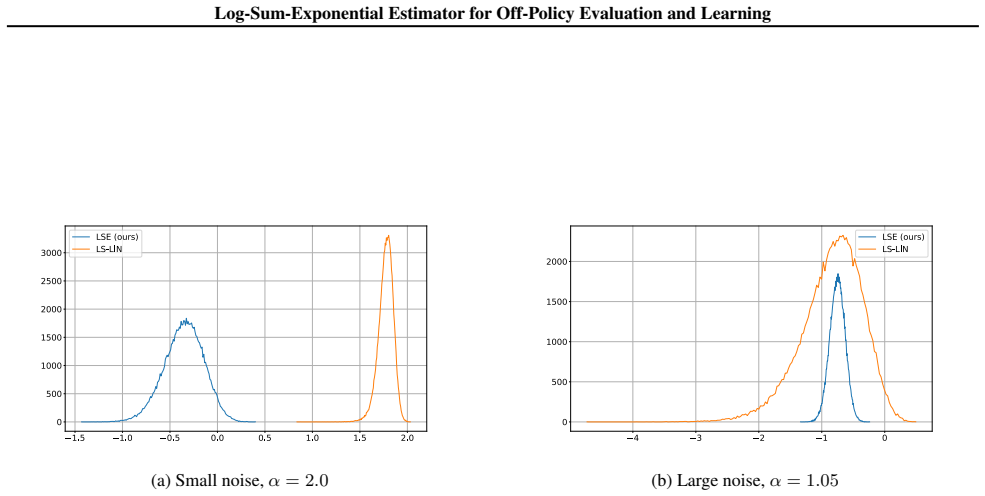
Off-policy learning and evaluation leverage logged bandit feedback datasets, which contain context, action, propensity score, and feedback for each data point. These scenarios face significant challenges due to high variance and poor performance with low-quality propensity scores and heavy-tailed reward distributions. We address these issues by introducing a novel estimator based on the log-sum-exponential (LSE) operator, which outperforms traditional inverse propensity score estimators. Our LSE estimator demonstrates variance reduction and robustness under heavy-tailed conditions. For off-policy evaluation, we derive upper bounds on the estimator's bias and variance. In the off-policy learning scenario, we establish bounds on the regret -- the performance gap between our LSE estimator and the optimal policy -- assuming bounded $(1+\epsilon)$-th moment of weighted reward. Notably, we achieve a convergence rate of $O(n^{-\epsilon/(1+ \epsilon)})$ for the regret bounds, where $\epsilon \in [0,1]$ and $n$ is the size of logged bandit feedback dataset. Theoretical analysis is complemented by comprehensive empirical evaluations in both off-policy learning and evaluation scenarios, confirming the practical advantages of our approach. The code for our estimator is available at the following link: https://github.com/armin-behnamnia/lse-offpolicy-learning.
Figures


Figures from the paper (7 more)




Reference graph
Works this paper leans on
-
[1]
For OPL, a separate test set is used to evaluate the estimator’s performance
Evaluation: For OPE experiments, multiple instances of the experiment are conducted and the empirical average squared error of the estimator is calculated as the estimation of MSE. For OPL, a separate test set is used to evaluate the estimator’s performance
-
[2]
Hyper-parameter tuning: Each estimator may have one or no hyper-parameter. For all experiments except Super- vised2Bandit OPE, and the ones that the selection of hyperparameter is explicitly specified, the selection of this hyperparameter is conducted by grid-search. Other Table 8 indicates the search grid for each estimator. For super- vised2Bandit OPE, ...
work page 2021
-
[3]
Real-world application: To demonstrate the practical relevance of our approach, we apply our methods to a real-world dataset, providing insights into their performance under real world datasets in off-policy learning scenarios
-
[4]
λ Effect: We study the effect of λ in different scenarios
-
[5]
Sample number effect: We study the performance of the LSE estimator with different number of samples n
-
[6]
Off-policy evaluation: We conduct more off-policy evaluation using Lomax distribution
-
[7]
Comparison with the Model-based estimators: We conduct a series of experiments to assess the performance of model-based estimators in comparison with our LSE estimator
-
[8]
Combined method: We investigate the efficacy of combining the LSE estimator with the Doubly Robust (DR) estimator, exploring potential synergies between these methods
Show all 16 references
-
[9]
Distributional properties: In the OPE scenario under heavy-tailed assumption, the distributional properties of LSE are studied
-
[10]
These additional experiments aim to provide a comprehensive evaluation of our proposed LSE estimator
Comparison with LS estimator: More Comparison with the LS estimator in the OPE setting based on choosing λ is provided. These additional experiments aim to provide a comprehensive evaluation of our proposed LSE estimator. G.1. Off-policy evaluation experiment We conduct synthe...
2024
-
[13]
Off-policy learning: We run more experiments for off-policy learning scenarios under FMNIST dataset
-
[14]
Selection of λ: Different methods of the selection of λ, data-driven selection of λ and sensitivity of λ are explored
-
[300]
For the image datasets, EMNIST and FMNIST, we use the last layer features from ResNet-50 model pretrained on the ImageNet dataset (Deng et al., 2009). F.1. Hyper-parameter Tuning All experiments can be categorised into 4 classes, • Supervised2Bandit OPL • Synthetic OPE • Super...
2009
-
[885]
without
IEEE, 2023. 10 Log-Sum-Exponential Estimator for Off-Policy Evaluation and Learning Deng, J., Dong, W., Socher, R., Li, L.-J., Li, K., and Fei-Fei, L. Imagenet: A large-scale hierarchical image database. In 2009 IEEE conference on computer vision and pattern recognition, pp. 2...
2023 arXiv
-
[3546]
Lugosi, G
PMLR, 2022. Lugosi, G. and Neu, G. Online-to-pac conversions: Gen- eralization bounds via regret analysis. arXiv preprint arXiv:2305.19674, 2023. Marceau, É. and Rioux, J. On robustness in risk theory. Insurance: Mathematics and Economics, 29(2):167–185, 2001. McCaffrey, D. F....
2022 arXiv
-
[3597]
1 n nX i=1 yθ(ai, xi) + 1 2nλ nX i=1 e2λyθ(ai,xi) − 1 2λ Pn i=1 eλyθ(ai,xi) n 2# = E [Yθ(A, X)] + 1 2λ E h e2λYθ(A,X) i − E
PMLR, 2017. Weitzen, S., Lapane, K. L., Toledano, A. Y ., Hume, A. L., and Mor, V . Principles for modeling propensity scores in medical research: a systematic literature review. Pharma- coepidemiology and Drug Safety, 13(12):841–853, 2004. Williams, C. K. and Barber, D. Bayes...
2018 arXiv
Reviewed August 7, 2026 · model on record in the stance chip above.
Discussion (0). Sign in to comment.