REVIEW 2 major objections 3 minor 2 cited by
A distillation-teleportation protocol for fault-tolerant QRAM
T0 review · 2 major / 3 minor · reviewed 2026-08-07 · deepseek-v4-flash
Pith's one-line read The paper proves that a noisy QRAM device, queried polynomially many times, can implement the logical QRAM operation to arbitrary accuracy using only polynomial fault-tolerant quantum resources, at the price of an exponential classical…
desk verdict A genuine advance: first FT-QRAM protocol with poly(n) quantum overhead and 1/poly(n)-fidelity hardware, conditional on an honestly-flagged noise model; worth refereeing seriously. read the letter →
The pith
A machine-rendered reading of the paper's core claim, the machinery that carries it, and where it could break.
The reading
What carries the argument
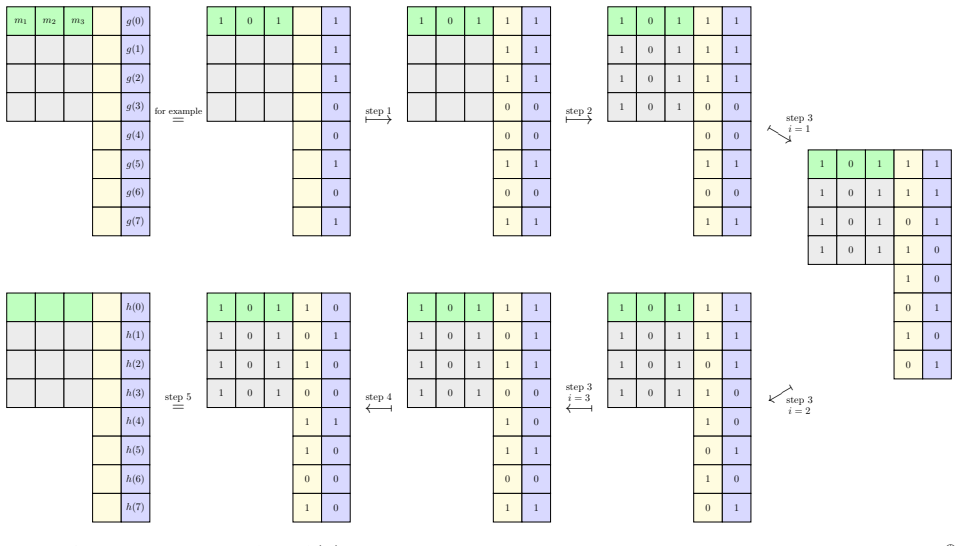
The central objects are the QRAM resource state $|\Psi(g)\rangle=V(g)|+\rangle^{\otimes n}$ and the update rule $\mathrm{UR}(g,m)=g\oplus g_{\oplus m}$, where $g_{\oplus m}(x)=g(x\oplus m)$. The update rule cancels the highest-degree monomials of $g$, so if $\deg(g)=d$ then $\deg(\mathrm{UR}(g,m))\le d-1$; hence $V(\mathrm{UR}(g,m))$ sits one level lower in the Clifford hierarchy and after $n$ rounds the correction becomes identity. Twirling with the partial Clifford set generated by $X$, $Z$, $CX$, and $CZ$ makes the prepared state's principal eigenvector exactly $|\Psi(g)\rangle$ with eigenvalue at least $F_{\min}$ under dataset-independent noise. Distillation uses state-agnostic quantum purity amplification: the iterated swap test for high-fidelity inputs, and a new streaming protocol based on density matrix exponentiation (a quantum PCA primitive) that matches the optimal $1/\varepsilon$ sample complexity in the low-fidelity regime.
What would settle it
Construct a bucket-brigade-style QRAM in which a stored bit 1 has a measurably different readout error rate from a stored bit 0, run the protocol's twirled preparation, and check whether the distilled state's principal eigenvector remains $|\Psi(g)\rangle$ with eigenvalue at least $1/\operatorname{poly}(n)$. A $g$-dependent noise channel that violates the factorization would make the eigenvalue guarantee fail for some $g$, and the teleportation channel would deviate from $V(f)$ by an amount detectable in diamond distance.
Extended reading notes
Core claim
Under the assumption that the physical QRAM device's noise is independent of the queried data table $g$ (Definition 1), the paper proves that for any $f$ and any $\varepsilon>0$ the logical diagonal QRAM operation $V(f)$ can be implemented up to diamond-norm error $\varepsilon$ using $O\!\left(\frac{n(1-F)}{F^2}\left(\frac{n}{\varepsilon}+\frac{1}{F}\right)\right)$ physical QRAM queries with fidelity $F\ge 1/\operatorname{poly}(n)$, plus $O(n^2 Q)$ fault-tolerant gates (Theorem 2). The key is to prepare resource states $|\Psi(g)\rangle=V(g)|+\rangle^{\otimes n}$ with the ideal state as principal eigenvector (via partial Clifford twirling), distill them, teleport the gate, and correct by the classical update rule $g\leftarrow g\oplus g_{\oplus m}$, whose degree drops by at least one each round. After at most $n$ rounds the correction is $\pm$ identity, so the protocol terminates. The exponential quantum savings come at the price of $n$ applications of an $O(2^n)$-cost classical update rule (plus $\operatorname{poly}(n)\,2^n$ twirling operations), exposing the open question of whether truly $\operatorname{poly}(n)$-cost fault-tolerant QRAM exists.
Load-bearing premise
The protocol collapses if the physical QRAM device's noise depends on which data table it is queried with; the whole argument assumes the noisy channel factorizes as $\mathcal{N}_2\circ\mathcal{V}(g)\circ\mathcal{N}_1$ with $\mathcal{N}_1,\mathcal{N}_2$ independent of $g$.
Editorial extensions
If this is right
- If correct, any quantum algorithm that calls the QRAM operation $T=\operatorname{poly}(n)$ times can be run fault-tolerantly with $\operatorname{poly}(n)$ quantum resources, at the cost of taking $1/\varepsilon=O(T)$ and paying an overall $O(T^2)$ factor from distillation.
- The protocol removes the need to actively error-correct all $\Omega(2^n)$ components of the QRAM; the exponential footprint moves into classical RAM and a physical QRAM device that only needs fidelity $1/\operatorname{poly}(n)$.
- The $n$-round descent through the Clifford hierarchy is what circumvents the earlier no-go theorem against non-adaptive distillation-teleportation QRAM: each round queries a different, adaptively updated dataset.
- The $b$-bit generalization (Appendix A) allows coherent reads of $b$ classical bits per address using resource states on $n+b$ qubits whose underlying Boolean function has degree at most $n+1$.
- In cryptanalysis and chemistry applications, the protocol trades an exponential number of fault-tolerant Toffoli gates for classical computation, though currently with larger constant overhead than direct QROM circuits.
Reading between the lines
- The paper's Fourier picture suggests a general principle: any fault-tolerant QRAM protocol that hides which address is being queried must globally update all $2^n$ entries of the classical dataset (or equivalently perform a fast Fourier transform over binary strings), hinting at a lower bound for fully $\operatorname{poly}(n)$-cost QRAM; this is our inference, not the paper's claim.
- If an $\varepsilon$-independent or $\operatorname{polylog}(1/\varepsilon)$ distillation scheme for QRAM resource states is ever found, the $T^2$ bottleneck in applications disappears and the protocol would become competitive with existing QROM circuits; the paper lists this as desirable, and we flag it as the natural next target.
- The new streaming purity-amplification protocol matches the optimal sample complexity with only two qudits of memory; outside QRAM, it may serve as a general tool for distilling other non-Clifford resource states, a transfer the paper does not develop.
- One can test the noise model experimentally before building the full device: prepare the same physical QRAM with two different datasets $g$ and $g'$ and compare the output noise statistics; if the noise depends on the data, the assumed factorization $\mathcal{N}_2\circ\mathcal{V}(g)\circ\mathcal{N}_1$ fails and the protocol's guarantee breaks.
Editorial analysis
A structured set of objections, weighed in public.
Referee Report
Summary. The paper presents an adaptive distillation–teleportation protocol for implementing a logical QRAM operation V(f) fault-tolerantly, using only poly(n) fault-tolerant quantum resources plus poly(n) queries to a specialized physical QRAM device whose noise is independent of the queried dataset. The protocol prepares noisy physical resource states, encodes them into a QEC code, applies a partial Clifford twirl, distills them with a streaming state-agnostic purity-amplification procedure, and then teleports the resource state into the computation. A classical update rule reduces the degree of the correction function by at least one per round, so after at most n rounds no correction remains. The main theorem (Theorem 2) states a query complexity Q = O(n(1-F)/F^2(n/ε + 1/F)) and a fault-tolerant gate overhead O(n^2 Q), assuming the physical QRAM device has fidelity at least F = 1/poly(n) under dataset-independent noise. The paper also analyzes the classical complexity of the update rule, connects it to the Walsh–Hadamard transform and sparse matrix-vector multiplication, and discusses applications in state preparation, machine learning, cryptanalysis, and chemistry.
Significance. If the central derivation is correct, this is a significant conceptual result: it is the first rigorous protocol showing that a specialized, noisy QRAM device with only 1/poly(n) fidelity can supply fault-tolerant logical QRAM with poly(n) quantum resources, at the price of exponential classical computation. The paper contains a long and mostly careful chain of proofs, explicitly tracks error propagation, and gives a new streaming quantum purity-amplification procedure that is of independent interest. The assumptions are stated transparently, and the protocol involves no fitted parameters: the resource counts are derived from the physical fidelity F, the noise rate p, and the target error ε. The main weaknesses are an internal inconsistency in the partial-Clifford-twirling identity (Proposition 3) and the load-bearing, physically unproven dataset-independence assumption (Definition 1). Both are fixable in principle, but they must be corrected before the stated theorem is established as written.
major comments (2)
- [Section 4.3, Proposition 3 (Eqs. (34)–(36))] There is an internal inconsistency in the twirling identity that is load-bearing for the protocol. The statement asserts |Ψ(g)⟩ = C|Ψ(g_C)⟩, but the proof in Eq. (36) establishes C|Ψ(g)⟩ = |Ψ(g_C)⟩: the identity M_A† X^u V(g) X^u M_A = V(g′) with g′(x) = g(Ax⊕u) conjugates in the opposite direction, and the displayed calculation C V(g)|+⟩ = V(g_C)|+⟩ is exactly the reversed relation. These two identities differ whenever C^2 ≠ I, which occurs already for n = 2 with A of order 3 and u = v = B = 0. Section 4.3.2 applies C after querying g_C and Eq. (43) defines the twirled state as E_C C ϕ(g_C) C†; this is correct only under the stated, unproved direction. Under the proved direction, the ideal post-C state has principal eigenvector C^2|Ψ(g)⟩ rather than |Ψ(g)⟩, so Proposition 5 and the correctness part of Theorem 2 are not established as written. The fix appears local—apply C† instead of C, or redefine the update g → g_C with the inverse affine transformation; because the uniform distribution over T is invariant under inversion, the subsequent spectral analysis should survive—but the manuscript must correct this and re-derive the affected claims.
- [Section 3.1, Definition 1] The dataset-independent noise assumption is load-bearing for the main theorem: Proposition 5 uses it to ensure that |Ψ(g)⟩ is the principal eigenvector of every twirled encoded state, and without this property the state-agnostic distillation step has no guarantee of converging to the correct resource state. The paper defends Definition 1 via the g-independent structure of routing and unrouting and gives a dead-router example, but Section 3.1 explicitly leaves the microscopic derivation to future work. In particular, readout noise that distinguishes the I gate from the X gate at a memory cell violates Eq. (13), and because the twirling set T is not the full Clifford group, the heuristic claim that partial Clifford twirling 'should remove dependence' of the noise on g is not proved. This does not invalidate the conditional theorem, but it means the advertised physical significance rests on an unproven modeling premise; a concrete architecture satisfying Definition 1, or a formal argument covering g-dependent readout errors, would substantially strengthen the claim.
minor comments (3)
- [Section 6.4] The text refers to 'Theorem 3' when discussing the scaling of the generalized protocol, but the manuscript states only Theorem 1 and Theorem 2; please label the generalized result or fix the reference.
- [Throughout] There are several copyediting issues: the author affiliation reads 'A WS Center' instead of 'AWS Center'; Section 4.5 contains 'obfuscatedured' instead of 'obfuscated'; and Appendix A has 'straightoforwardly' instead of 'straightforwardly'.
- [Circuit (42)] The circuit diagram for the twirling step is visually ambiguous: it appears to contain two C gates and the label 'C ϕ(g_C) C†' is hard to parse. Please clarify the gate order and, in light of the major comment above, specify explicitly whether the correction is C or C†.
Circularity Check
No significant circularity: the central theorem is a conditional construction whose resource counts follow from explicit error propagation; the dataset-independent noise assumption is a stated model, not a conclusion derived from itself.
full rationale
The derivation chain is self-contained relative to its stated assumptions. Theorem 1/2 is explicitly conditional on Definition 1 (dataset-independent QRAM noise), and the paper does not claim to derive that assumption; Section 3.1 defends its plausibility and leaves microscopic derivation to future work, which is a validity caveat rather than circularity. Proposition 5 obtains the top-eigenvector property by partial Clifford twirling under that assumption, with the uniformity of Pauli spreading proven in Proposition 4 rather than assumed. The distillation step is state-agnostic (Section 4.4): it takes arbitrary mixed states and amplifies the principal eigenvector, and the copy counts in Propositions 6 and 10 are derived from density-matrix exponentiation and phase-estimation error bounds. Teleportation correctness (Proposition 11) is a direct channel-monotonicity argument, and the Clifford-hierarchy descent used by the update rule is proved self-contained in Appendix D. Resource counts Q and Q' are obtained by propagating errors through these steps with no fitted parameters; the Section 6 application estimates use explicit example values (e.g., F=50%) and are not presented as predictions. The cited prior work, including the no-go theorem used for motivation and the general encoding theorem (Ref. [59]), supplies external technical lemmas whose assumptions do not include the target protocol, so the central claim retains independent content.
Assumptions & free parameters
assumptions (6)
- domain assumption Dataset-independent QRAM noise (Definition 1): the noisy physical QRAM channel decomposes as eV(g) = N2 ∘ V(g) ∘ N1 with N1, N2 independent of the queried function g.
- domain assumption The physical QRAM device can be reloaded with a new dataset between queries, and the n-qubit output state can be moved to the main fault-tolerant processor without significant fidelity loss (Section 3).
- standard math The main processor is subject to circuit-level stochastic noise (Definition 2), and the QEC code family has a threshold against local stochastic noise (Section 3.3, Eq. 18).
- standard math Fault-tolerant encoding with error ε_enc ≤ Γ(E) + 2√(cpn) + 2|E|(cp)^k exists for general codes (Proposition 2, from Ref. [59], Appendix B).
- standard math V(h) lies in the d-th level of the Clifford hierarchy when deg(h) = d, and deg(f XOR f XOR m) < deg(f); degree-0 functions give V proportional to I (Appendix D, Proposition 12).
- standard math Bucket-brigade QRAM noise resilience, overall infidelity O(qn^2) for per-component error q (Ref. [36]).
Cite this review
Pith. "Pith review of A distillation-teleportation protocol for fault-tolerant QRAM." pith.science (2026). https://pith.science/paper/MJNCTU3D
@misc{pith2026250520265,
  author       = {Pith},
  title        = {Pith review of: A distillation-teleportation protocol for fault-tolerant QRAM},
  year         = {2026},
  howpublished = {\url{https://pith.science/paper/MJNCTU3D}},
  note         = {Machine review of arXiv:2505.20265}
}
abstract
We present a protocol for fault-tolerantly implementing the logical quantum random access memory (QRAM) operation, given access to a specialized, noisy QRAM device. For coherently accessing classical memories of size $2^n$, our protocol consumes only $\mathrm{poly}(n)$ fault-tolerant quantum resources (logical gates, logical qubits, quantum error correction cycles, etc.), avoiding the need to perform active error correction on all $\Omega(2^n)$ components of the QRAM device. This is the first rigorous conceptual demonstration that a specialized, noisy QRAM device could be useful for implementing a fault-tolerant quantum algorithm. In fact, the fidelity of the device can be as low as $1/\mathrm{poly}(n)$. The protocol queries the noisy QRAM device $\mathrm{poly}(n)$ times to prepare a sequence of $n$-qubit QRAM resource states, which are moved to a general-purpose $\mathrm{poly}(n)$-size processor to be encoded into a QEC code, distilled, and fault-tolerantly teleported into the computation. To aid this protocol, we develop a new gate-efficient streaming version of quantum purity amplification that matches the optimal sample complexity in a wide range of parameters and is therefore of independent interest. The exponential reduction in fault-tolerant quantum resources comes at the expense of an exponential quantity of purely classical complexity: each of the $n$ iterations of the protocol requires adaptively updating the $2^n$-size classical dataset and providing the noisy QRAM device with access to the updated dataset at the next iteration. While our protocol demonstrates that QRAM is more compatible with fault-tolerant quantum computation than previously thought, the need for significant classical computational complexity exposes potentially fundamental limitations to realizing a truly $\mathrm{poly}(n)$-cost fault-tolerant QRAM.
Figures


Figures from the paper (2 more)

Forward citations
Cited by 2 Pith papers
-
Quantum and classical algorithms for SOCP based on the multiplicative weights update method
A quantum algorithm solves SOCPs with O~(√r γ^5 + √m γ^4) queries and a classical algorithm uses O~(n γ^4 + m γ^6) samples, nearly matching LP complexity.
-
The vast world of quantum advantage
Assuming quantum computers are strictly more powerful than classical ones, the problem of deciding whether a given quantum circuit beats a specific classical simulation heuristic is solvable by quantum computers but n...
Reference graph
Works this paper leans on
-
[8]
Jaques, S. and Rattew, A. G. “QRAM: A survey and critique.” arXiv:2305.10310 (2023)
arXiv 2023
-
[1]
Electronic digital computers
Williams, F. C. and Kilburn, T. “Electronic digital computers.”Nature 162 (1948), 487–487
1948
-
[2]
A storage system for use with binary-digital computing machines
C., W. F. and T., K. “A storage system for use with binary-digital computing machines.”Proceedings of the IEE—part II: power engineering96 (1949), 183–200
1949
-
[3]
Milestones: Manchester University “Baby”’ computer and its derivatives, 1948–1951
Engineering and Technology History Wiki. Milestones: Manchester University “Baby”’ computer and its derivatives, 1948–1951. https : / / ethw . org / Milestones : Manchester _ University _ %22Baby % 22 _ Computer_and_its_Derivatives,_1948-1951, accessed 2025-03-17. (2022)
2022
-
[4]
Full stack optimization of transformer inference
Kim, S., Hooper, C., Wattanawong, T., Kang, M., Yan, R., Genc, H., Dinh, G., Huang, Q., Keutzer, K., Mahoney, M. W., Shao, S., and Gholami, A. “Full stack optimization of transformer inference.” In:Archi- tecture and System Support for Transformer Models (ASSYST)(2023). https://openreview.net/forum? id=GtyQbLUUagE, accessed: 2025-03-17. arXiv:2302.14017
arXiv 2023
-
[5]
Asurveyondeeplearninghardwareacceleratorsforheterogeneous HPC platforms
Silvano,C.,Ielmini,D.,Ferrandi,F.,etal.“Asurveyondeeplearninghardwareacceleratorsforheterogeneous HPC platforms.” ACM Comput. Surv.(2025). arXiv:2306.15552
arXiv 2025
-
[6]
CY7C1069G-10BVXIT
Infineon. CY7C1069G-10BVXIT. https://www.infineon.com/cms/en/product/memories/sram-static- ram/asynchronous-sram/cy7c1069g-10bvxit/, accessed: 2025-03-17. (2025)
2025
-
[7]
Giovannetti, V., Lloyd, S., and Maccone, L. “Quantum random access memory.”Phys. Rev. Lett.100 (2008), 160501. arXiv:0708.1879. 63
arXiv 2008
Show all 130 references
-
[9]
Quantum machine learning: A classical perspective
Ciliberto, C., Herbster, M., Ialongo, A. D., Pontil, M., Rocchetto, A., Severini, S., and Wossnig, L. “Quantum machine learning: A classical perspective.”Proc. R. Soc. A474 (2018), 20170551. arXiv:1707.08561
2018 arXiv
-
[10]
Quantum machine learning
Biamonte, J., Wittek, P., Pancotti, N., Rebentrost, P., Wiebe, N., and Lloyd, S. “Quantum machine learning.” Nature 549 (2017), 195–202. arXiv:1611.09347
2017 arXiv
-
[11]
M., McArdle, S., Berta, M., Bienias, P., Chen, C.-F., Gilyén, A., Hann, C
Dalzell, A. M., McArdle, S., Berta, M., Bienias, P., Chen, C.-F., Gilyén, A., Hann, C. T., Kastoryano, M. J., Khabiboulline, E. T., Kubica, A., Salton, G., Wang, S., and Brandão, F. G. S. L.Quantum algorithms: A survey of applications and end-to-end complexities. Cambridge Uni...
2025 arXiv
-
[12]
Quantum support vector machine for big data classification
Rebentrost, P., Mohseni, M., and Lloyd, S. “Quantum support vector machine for big data classification.” Phys. Rev. Lett.113 (2014), 130503. arXiv:1307.0471
2014 arXiv
-
[13]
Quantum-assisted Gaussian process regression
Zhao, Z., Fitzsimons, J. K., and Fitzsimons, J. F. “Quantum-assisted Gaussian process regression.”Phys. Rev. A99 (2019), 052331. arXiv:1512.03929
2019 arXiv
-
[14]
Quantum recommendation systems
Kerenidis, I. and Prakash, A. “Quantum recommendation systems.” In: ITCS (2017), 49:1–49:21. arXiv:1603.08675
2017 arXiv
-
[15]
High-order quantum algorithm for solving linear differential equations
Berry, D. W. “High-order quantum algorithm for solving linear differential equations.”J. Phys. A47 (2014), 105301. arXiv:1010.2745
2014 arXiv
-
[16]
Quantum algorithm for linear differential equa- tions with exponentially improved dependence on precision
Berry, D. W., Childs, A. M., Ostrander, A., and Wang, G. “Quantum algorithm for linear differential equa- tions with exponentially improved dependence on precision.”Commun. Math. Phys.356 (2017), 1057–1081. arXiv:1701.03684
2017 arXiv
-
[17]
Quantum spectral methods for differential equations
Childs, A. M. and Liu, J.-P. “Quantum spectral methods for differential equations.”Commun. Math. Phys. 375 (2020), 1427–1457. arXiv:1901.00961
2020 arXiv
-
[18]
Improved quantum algorithms for linear and nonlinear differential equations
Krovi, H. “Improved quantum algorithms for linear and nonlinear differential equations.”Quantum 7 (2023),
2023
-
[19]
The cost of solving linear differential equations on a quantum computer: Fast-forwarding to explicit resource counts
Jennings, D., Lostaglio, M., Lowrie, R. B., Pallister, S., and Sornborger, A. T. “The cost of solving linear differential equations on a quantum computer: Fast-forwarding to explicit resource counts.”Quantum 8 (2024), 1553. arXiv:2309.07881
2024 arXiv
-
[20]
Quantum algorithm for time-dependent differential equations using Dyson series
Berry, D. W. and C. S. Costa, P. “Quantum algorithm for time-dependent differential equations using Dyson series.” Quantum 8 (2024), 1369. arXiv:2212.03544
2024 arXiv
-
[21]
Quantum algorithm for linear systems of equations
Harrow, A. W., Hassidim, A., and Lloyd, S. “Quantum algorithm for linear systems of equations.”Phys. Rev. Lett.103 (2009), 150502. arXiv:0811.3171
2009 arXiv
-
[22]
Quantum speed-ups for solving semidefinite programs
Brandão, F. G. S. L. and Svore, K. M. “Quantum speed-ups for solving semidefinite programs.” In:FOCS (2017), 415–426. arXiv:1609.05537
2017 arXiv
-
[23]
Quantum SDP solvers: Large speed-ups, optimality, and applications to quantum learning
Brandão, F. G. S. L., Kalev, A., Li, T., Lin, C. Y.-Y., Svore, K. M., and Wu, X. “Quantum SDP solvers: Large speed-ups, optimality, and applications to quantum learning.” In: ICALP (2019), 27:1–27:14. arXiv:1710.02581
2019 arXiv
-
[24]
Quantum SDP-solvers: Better upper and lower bounds
van Apeldoorn, J., Gilyén, A., Gribling, S., and de Wolf, R. “Quantum SDP-solvers: Better upper and lower bounds.” Quantum 4 (2020), 230. Earlier version inFOCS’17. arXiv:1705.01843
2020 arXiv
-
[25]
Quantum algorithms for zero-sum games
van Apeldoorn, J. and Gilyén, A. “Quantum algorithms for zero-sum games.” arXiv:1904.03180 (2019)
2019 arXiv
-
[26]
Improvements in quantum SDP-solving with applications
van Apeldoorn, J. and Gilyén, A. “Improvements in quantum SDP-solving with applications.” In:ICALP (2019), 99:1–99:15. arXiv:1804.05058
2019 arXiv
-
[27]
A quantum interior point method for LPs and SDPs
Kerenidis, I. and Prakash, A. “A quantum interior point method for LPs and SDPs.”ACM Trans. Quantum Comput. 1 (2020). arXiv:1808.09266
2020 arXiv
-
[28]
Quantum algorithms for second-order cone programming and support vector machines
Kerenidis, I., Prakash, A., and Szilágyi, D. “Quantum algorithms for second-order cone programming and support vector machines.”Quantum 5 (2021), 427. arXiv:1908.06720
2021 arXiv
-
[29]
Quantum interior point methods for semidef- inite optimization
Augustino, B., Nannicini, G., Terlaky, T., and Zuluaga, L. F. “Quantum interior point methods for semidef- inite optimization.” Quantum 7 (2023), 1110. arXiv:2112.06025
2023 arXiv
-
[30]
Quantum algorithms for portfolio optimization
Kerenidis, I., Prakash, A., and Szilágyi, D. “Quantum algorithms for portfolio optimization.” In:AFT (2019), 147–155. arXiv:1908.08040
2019 arXiv
-
[31]
End-to-end resource analysis for quantum interior-point methods and portfolio optimization
Dalzell, A. M., Clader, B. D., Salton, G., Berta, M., Lin, C. Y.-Y., Bader, D. A., Stamatopoulos, N., Schuetz, M. J. A., Brandão, F. G. S. L., Katzgraber, H. G., and Zeng, W. J. “End-to-end resource analysis for quantum interior-point methods and portfolio optimization.”PRX Qu...
2023 arXiv
-
[32]
On the robustness of bucket brigade quantum RAM
Arunachalam, S., Gheorghiu, V., Jochym-O’Connor, T., Mosca, M., and Srinivasan, P. V. “On the robustness of bucket brigade quantum RAM.”New J. Phys.17 (2015), 123010. arXiv:1502.03450
2015 arXiv
-
[33]
Racinginparallel:Quantumversusclassical
Steiger,D.S.andTroyer,M.“Racinginparallel:Quantumversusclassical.” In: APS March Meeting Abstracts (2016), H44–010. 64
2016
-
[34]
Fault-tolerant resource estimation of quantum random-access memories
Di Matteo, O., Gheorghiu, V., and Mosca, M. “Fault-tolerant resource estimation of quantum random-access memories.” IEEE Trans. Quantum Eng.1 (2020), 1–13. arXiv:1902.01329
2020 arXiv
-
[35]
Parallelizing the queries in a bucket-brigade quantum random access memory
Paler, A., Oumarou, O., and Basmadjian, R. “Parallelizing the queries in a bucket-brigade quantum random access memory.” Phys. Rev. A102 (2020), 032608. arXiv:2002.09340
2020 arXiv
-
[36]
Resilience of quantum random access memory to generic noise
Hann, C. T., Lee, G., Girvin, S., and Jiang, L. “Resilience of quantum random access memory to generic noise.” PRX Quantum2 (2021), 020311. arXiv:2012.05340
2021 arXiv
-
[37]
A quantum random access memory (qram) using a polynomial encoding of binary strings
Mukhopadhyay, P. “A quantum random access memory (qram) using a polynomial encoding of binary strings.” Sci. Rep.15 (2025), 11002. arXiv:2408.16794
2025 arXiv
-
[38]
Trading T gates for dirty qubits in state preparation and unitary synthesis
Low, G. H., Kliuchnikov, V., and Schaeffer, L. “Trading T gates for dirty qubits in state preparation and unitary synthesis.”Quantum 8 (2024), 1375. arXiv:1812.00954
2024 arXiv
-
[39]
Jaeger, R. C. and Blalock, T. N.Microelectronic circuit design. McGraw-Hill New York (2016)
2016
-
[40]
Fundamental causal bounds of quantum random access memories
Wang, Y., Alexeev, Y., Jiang, L., Chong, F. T., and Liu, J. “Fundamental causal bounds of quantum random access memories.” npj Quant. Inf.10 (2024), 71. arXiv:2307.13460
2024 arXiv
-
[41]
Semi-Clifford operations, structure ofCk hierarchy, and gate com- plexity for fault-tolerant quantum computation
Zeng, B., Chen, X., and Chuang, I. L. “Semi-Clifford operations, structure ofCk hierarchy, and gate com- plexity for fault-tolerant quantum computation.”Phys. Rev. A77 (2008), 042313. arXiv:0712.2084
2008 arXiv
-
[42]
Distillation with sublogarithmic overhead
Hastings, M. B. and Haah, J. “Distillation with sublogarithmic overhead.” Phys. Rev. Lett. 120 (2018), 050504. arXiv:1709.03543
2018 arXiv
-
[43]
Universal transversal gates with color codes: A simplified approach
Kubica, A. and Beverland, M. E. “Universal transversal gates with color codes: A simplified approach.”Phys. Rev. A91 (2015), 032330. arXiv:1410.0069
2015 arXiv
-
[44]
The smallest code with transversal T
Koutsioumpas, S., Banfield, D., and Kay, A. “The smallest code with transversal T.” arXiv:2210.14066 (2022)
2022 arXiv
-
[45]
Another subexponential-time quantum algorithm for the dihedral hidden subgroup problem
Kuperberg, G. “Another subexponential-time quantum algorithm for the dihedral hidden subgroup problem.” In: TQC (2013), 20–34. arXiv:1112.3333
2013 arXiv
-
[46]
Diagonal gates in the Clifford hierarchy
Cui, S. X., Gottesman, D., and Krishna, A. “Diagonal gates in the Clifford hierarchy.”Phys. Rev. A95 (2017), 012329. arXiv:1608.06596
2017 arXiv
-
[47]
Surface code quantum computing by lattice surgery
Horsman, D., Fowler, A. G., Devitt, S., and Meter, R. V. “Surface code quantum computing by lattice surgery.” New J. Phys.14 (2012), 123011. arXiv:1111.4022
2012 arXiv
-
[48]
A magic state’s fidelity can be superior to the operations that created it
Li, Y. “A magic state’s fidelity can be superior to the operations that created it.”New J. Phys.17 (2015), 023037. arXiv:1410.7808
2015 arXiv
-
[49]
Simple scheme for encoding and decoding a qubit in unknown state for various topological codes
Łodyga, J., Mazurek, P., Grudka, A., and Horodecki, M. “Simple scheme for encoding and decoding a qubit in unknown state for various topological codes.”Sci. Rep.5 (2015), 8975. arXiv:1404.2495
2015 arXiv
-
[50]
Magic state distillation: Not as costly as you think
Litinski, D. “Magic state distillation: Not as costly as you think.”Quantum 3 (2019), 205. arXiv:1905.06903
2019 arXiv
-
[51]
Universal quantum computation with ideal Clifford gates and noisy ancillas
Bravyi, S. and Kitaev, A. “Universal quantum computation with ideal Clifford gates and noisy ancillas.” Phys. Rev. A71 (2005), 022316. arXiv:quant-ph/0403025
2005 arXiv
-
[52]
Fault-tolerant postselected quantum computation: Schemes
Knill, E. “Fault-tolerant postselected quantum computation: Schemes.” arXiv:quant-ph/0402171 (2004)
2004 arXiv
-
[53]
Topological quantum distillation
Bombín, H. and Martin-Delgado, M. A. “Topological quantum distillation.” Phys. Rev. Lett. 97 (2006), 180501. arXiv:quant-ph/0605138
2006 arXiv
-
[54]
Unfolding the color code
Kubica, A., Yoshida, B., and Pastawski, F. “Unfolding the color code.”New J. Phys.17 (2015), 083026. arXiv:1503.02065
2015 arXiv
-
[55]
Transversal Clifford gates on folded surface codes
Moussa, J. E. “Transversal Clifford gates on folded surface codes.” Phys. Rev. A 94 (2016), 042316. arXiv:1603.02286
2016 arXiv
-
[56]
A game of surface codes: large-scale quantum computing with lattice surgery
Litinski, D. “A game of surface codes: large-scale quantum computing with lattice surgery.” Quantum 3 (2019), 128. arXiv:1808.02892
2019 arXiv
-
[57]
Flexible layout of surface code computations using AutoCCZ states
Gidney, C. and Fowler, A. G. “Flexible layout of surface code computations using AutoCCZ states.” arXiv:1905.08916 (2019)
2019 arXiv
-
[58]
Demonstrating the viability of universal quantum computation using teleportation and single-qubit operations
Gottesman, D. and Chuang, I. L. “Demonstrating the viability of universal quantum computation using teleportation and single-qubit operations.”Nature 402 (1999), 390–393. arXiv:quant-ph/9908010
1999 arXiv
-
[59]
Fault-tolerant quantum input/output
Christandl, M., Fawzi, O., and Goswami, A. “Fault-tolerant quantum input/output.” arXiv: 2408.05260 (2024)
2024
-
[60]
Constant-overhead magic state distillation
Wills, A., Hsieh, M.-H., and Yamasaki, H. “Constant-overhead magic state distillation.” arXiv:2408.07764 (2024)
2024 arXiv
-
[61]
Good binary quantum codes with transversal ccz gate
Nguyen, Q. T. “Good binary quantum codes with transversal ccz gate.” arXiv:2408.10140 (2024)
2024 arXiv
-
[62]
Asymptotically good quantum codes with transversal non-Clifford gates
Golowich, L. and Guruswami, V. “Asymptotically good quantum codes with transversal non-Clifford gates.” arXiv:2408.09254 (2024)
2024 arXiv
-
[63]
Optimal purification of single qubits
Cirac, J. I., Ekert, A. K., and Macchiavello, C. “Optimal purification of single qubits.”Phys. Rev. Lett.82 (1999), 4344–4347. arXiv:quant-ph/9812075. 65
1999 arXiv
-
[64]
The rate of optimal purification procedures
Keyl, M. and Werner, R. F. “The rate of optimal purification procedures.”Annales Henri Poincaré2 (2001), 1–26. arXiv:quant-ph/9910124
2001 arXiv
-
[65]
Optimal probabilistic cloning and purification of quantum states
Fiurášek, J. “Optimal probabilistic cloning and purification of quantum states.” Phys. Rev. A70 (2004), 032308. arXiv:quant-ph/0403165
2004 arXiv
-
[66]
Quantum state purification
Fu, H. “Quantum state purification.” MA thesis: University of Waterloo (2016)
2016
-
[67]
Streaming quantum state purification
Childs, A. M., Fu, H., Leung, D., Li, Z., Ozols, M., and Vyas, V. “Streaming quantum state purification.” Quantum 9 (2025), 1603. arXiv:2309.16387
2025 arXiv
-
[68]
Optimal quantum purity amplification
Li, Z., Fu, H., Isogawa, T., and Chuang, I. “Optimal quantum purity amplification.” arXiv: 2409.18167 (2024)
2024
-
[69]
Streaming quantum state purification for general mixed states
Grier, D., Leung, D., Li, Z., Pashayan, H., and Schaeffer, L. “Streaming quantum state purification for general mixed states.” arXiv:2503.22644 (2025)
2025 arXiv
-
[70]
Quantum search-to-decision reductions and the state synthesis problem
Irani, S., Natarajan, A., Nirkhe, C., Rao, S., and Yuen, H. “Quantum search-to-decision reductions and the state synthesis problem.” In:CCC (2022). arXiv:2111.02999
2022 arXiv
-
[71]
Quantum principal component analysis
Lloyd, S., Mohseni, M., and Rebentrost, P. “Quantum principal component analysis.”Nat. Phys.10 (2014), 631–633. arXiv:1307.0401
2014 arXiv
-
[72]
Hamiltonian simulation with optimal sample complexity
Kimmel, S., Lin, C. Y.-Y., Low, G. H., Ozols, M., and Yoder, T. J. “Hamiltonian simulation with optimal sample complexity.”npj Quant. Inf.3 (2017), 13. arXiv:1608.00281
2017 arXiv
-
[73]
Focus beyond quadratic speedups for error-corrected quantum advantage
Babbush, R., McClean, J. R., Newman, M., Gidney, C., Boixo, S., and Neven, H. “Focus beyond quadratic speedups for error-corrected quantum advantage.”PRX Quantum2 (2021), 010103. arXiv:2011.04149
2021 arXiv
-
[74]
Encoding electronic spectra in quantum circuits with linear T complexity
Babbush, R., Gidney, C., Berry, D. W., Wiebe, N., McClean, J., Paler, A., Fowler, A., and Neven, H. “Encoding electronic spectra in quantum circuits with linear T complexity.”Phys. Rev. X8 (2018), 041015. arXiv:1805.03662
2018 arXiv
-
[75]
Architectures for a quantum random access memory
Giovannetti, V., Lloyd, S., and Maccone, L. “Architectures for a quantum random access memory.”Phys. Rev. A78 (2008), 052310. arXiv:0807.4994
2008 arXiv
-
[76]
Nielsen, M. A. and Chuang, I. L.Quantum computation and quantum information. Cambridge University Press (2000)
2000
-
[77]
Quantum random access memory architectures using 3d superconducting cavities
Weiss, D., Puri, S., and Girvin, S. “Quantum random access memory architectures using 3d superconducting cavities.” PRX Quantum5 (2024), 020312. arXiv:2310.08288
2024 arXiv
-
[78]
Hardware- efficient quantum random access memory with hybrid quantum acoustic systems
Hann, C. T., Zou, C.-L., Zhang, Y., Chu, Y., Schoelkopf, R. J., Girvin, S. M., and Jiang, L. “Hardware- efficient quantum random access memory with hybrid quantum acoustic systems.”Phys. Rev. Lett. 123 (2019), 250501. arXiv:1906.11340
2019 arXiv
-
[79]
Quantum random access memory with transmon-controlled phonon routing
Wang, Z., Qiao, H., Cleland, A. N., and Jiang, L. “Quantum random access memory with transmon-controlled phonon routing.” arXiv:2411.00719 (2024)
2024 arXiv
-
[80]
A transmon based quantum switch for a quantum random access memory
Sala Cadellans, A. “A transmon based quantum switch for a quantum random access memory.” MA thesis: Leiden University (2015)
2015
-
[81]
Scalable and high-fidelity quantum random access memory in spin-photon networks
Chen, K. C., Dai, W., Errando-Herranz, C., Lloyd, S., and Englund, D. “Scalable and high-fidelity quantum random access memory in spin-photon networks.”PRX Quantum2 (2021), 030319. arXiv:2103.07623
2021 arXiv
-
[82]
Robust quantum random access memory
Hong, F.-Y., Xiang, Y., Zhu, Z.-Y., Jiang, L.-z., and Wu, L.-n. “Robust quantum random access memory.” Phys. Rev. A86 (2012), 010306. arXiv:1201.2250
2012 arXiv
-
[83]
Fast and error-correctable quantum RAM
Cesa, F., Bernien, H., and Pichler, H. “Fast and error-correctable quantum RAM.” arXiv:2503.19172 (2025)
2025 arXiv
-
[84]
Pseudorandom quantum states
Ji, Z., Liu, Y.-K., and Song, F. “Pseudorandom quantum states.” In: CRYPTO (2018), 126–152. arXiv:1711.00385
2018 arXiv
-
[85]
(Pseudo) random quantum states with binary phase
Brakerski, Z. and Shmueli, O. “(Pseudo) random quantum states with binary phase.” In:Theory of Cryp- tography (2019), 229–250. arXiv:1906.10611
2019 arXiv
-
[86]
Optimal algorithms for learning quantum phase states
Arunachalam, S., Bravyi, S., Dutt, A., and Yoder, T. J. “Optimal algorithms for learning quantum phase states.” In: TQC (2023), 3:1–3:24. arXiv:2208.07851
2023 arXiv
-
[87]
Fault-tolerant quantum computation with constant error rate
Aharonov, D. and Ben-Or, M. “Fault-tolerant quantum computation with constant error rate.” SIAM J. Comp. 38 (2008), 1207–1282. Earlier version inSTOC’97. arXiv:quant-ph/9906129
2008 arXiv
-
[88]
Fault-tolerant quantum computation
Shor, P. W. “Fault-tolerant quantum computation.” In:FOCS (1996), 56–65. arXiv:quant-ph/9605011
1996 arXiv
-
[89]
Fault-tolerant quantum computation with constant overhead
Gottesman, D. “Fault-tolerant quantum computation with constant overhead.”Quantum Inf. Comput.14 (2014), 1338–1372. arXiv:1310.2984
2014 arXiv
-
[90]
An introduction to quantum error correction and fault-tolerant quantum computation
Gottesman, D. “An introduction to quantum error correction and fault-tolerant quantum computation.” In: Proceedings of Symposia in Applied Mathematics(2010), 13–58. arXiv:0904.2557
2010 arXiv
-
[91]
Constant overhead quantum fault tolerance with quantum expander codes
Fawzi, O., Grospellier, A., and Leverrier, A. “Constant overhead quantum fault tolerance with quantum expander codes.” Commun. ACM 64 (2020), 106–114. Earlier version inFOCS’18. arXiv:1808.03821. 66
2020 arXiv
-
[92]
Time-efficient constant-space-overhead fault-tolerant quantum computation
Yamasaki, H. and Koashi, M. “Time-efficient constant-space-overhead fault-tolerant quantum computation.” Nat. Phys.20 (2024), 247–253. arXiv:2207.08826
2024 arXiv
-
[93]
Quantum fault tolerance with constant-space and logarithmic-time overheads
Nguyen, Q. T. and Pattison, C. A. “Quantum fault tolerance with constant-space and logarithmic-time overheads.” arXiv:2411.03632 (2024)
2024 arXiv
-
[94]
Efficientsimulationofrandomquantumstatesandoperators
Dankert,C.“Efficientsimulationofrandomquantumstatesandoperators.” arXiv: quant-ph/0512217(2005)
2005 arXiv
-
[95]
Efficient estimation of Pauli channels
Flammia, S. T. and Wallman, J. J. “Efficient estimation of Pauli channels.”ACM Trans. Quantum Comput. 1 (2020). arXiv:1907.12976
2020 arXiv
-
[96]
Noise tailoring for scalable quantum computation via randomized compil- ing
Wallman, J. J. and Emerson, J. “Noise tailoring for scalable quantum computation via randomized compil- ing.” Phys. Rev. A94 (2016), 052325. arXiv:1512.01098
2016 arXiv
-
[97]
Analysis and suppression of errors in quantum random access memory errors under extended noise models
Mehta, R., Lee, G., and Jiang, L. “Analysis and suppression of errors in quantum random access memory errors under extended noise models.” arXiv:2412.10318 (2024)
2024 arXiv
-
[98]
Tensor networks and graphical calculus for open quantum systems
Wood, C. J., Biamonte, J. D., and Cory, D. G. “Tensor networks and graphical calculus for open quantum systems.” Quantum Inf. Comput.15 (2015), 759–811. arXiv:1111.6950
2015 arXiv
-
[99]
Quantummeasurementsandtheabelianstabilizerproblem
Kitaev,A.Y.“Quantummeasurementsandtheabelianstabilizerproblem.” arXiv: quant-ph/9511026(1995)
1995 arXiv
-
[100]
Notes on super-operator norms induced by Schatten norms
Watrous, J. “Notes on super-operator norms induced by Schatten norms.”Quantum Inf. Comput.5 (2005), 58–68. arXiv:quant-ph/0411077
2005 arXiv
-
[101]
A quantum speed-up for approximating the top eigenvectors of a matrix
Chen, Y., Gilyén, A., and de Wolf, R. “A quantum speed-up for approximating the top eigenvectors of a matrix.” In: SODA (2025), 994–1036. arXiv:2405.14765
2025 arXiv
-
[102]
Tight bounds for quantum phase estimation and related problems
Mande, N. S. and de Wolf, R. “Tight bounds for quantum phase estimation and related problems.” In:ESA (2023), 81:1–81:16. arXiv:2305.04908
2023 arXiv
-
[103]
Efficient Bayesian phase estimation
Wiebe, N. and Granade, C. “Efficient Bayesian phase estimation.” Phys. Rev. Lett.117 (2016), 010503. arXiv:1508.00869
2016 arXiv
-
[104]
Quantum singular value transformation and beyond: Exponential improvements for quantum matrix arithmetics
Gilyén, A., Su, Y., Low, G. H., and Wiebe, N. “Quantum singular value transformation and beyond: Exponential improvements for quantum matrix arithmetics.” In: STOC (2019), 193–204. Full version in arXiv:1806.01838
2019 arXiv
-
[105]
Ground-state preparation and energy estimation on early fault-tolerant quantum computers via quantum eigenvalue transformation of unitary matrices
Dong, Y., Lin, L., and Tong, Y. “Ground-state preparation and energy estimation on early fault-tolerant quantum computers via quantum eigenvalue transformation of unitary matrices.”PRX Quantum3 (2022), 040305. arXiv:2204.05955
2022 arXiv
-
[106]
On quantum computation theory
van Dam, W. “On quantum computation theory.” PhD thesis: Universiteit van Amsterdam (2002)
2002
-
[107]
AnO(n log n) sorting network
Ajtai, M., Komlós, J., and Szemerédi, E. “AnO(n log n) sorting network.” In:STOC (1983), 1–9
1983
-
[108]
Efficient distributed quantum computing
Beals, R., Brierley, S., Gray, O., Harrow, A. W., Kutin, S., Linden, N., Shepherd, D., and Stather, M. “Efficient distributed quantum computing.”Proc. R. Soc. A469 (2013), 20120686. arXiv:1207.2307
2013 arXiv
-
[109]
Quantum re- sources required to block-encode a matrix of classical data
Clader, B. D., Dalzell, A. M., Stamatopoulos, N., Salton, G., Berta, M., and Zeng, W. J. “Quantum re- sources required to block-encode a matrix of classical data.”IEEE Trans. Quantum Eng.3 (2022), 1–23. arXiv:2206.03505
2022 arXiv
-
[110]
Lecture notes on quantum algorithms for scientific computation
Lin, L. “Lecture notes on quantum algorithms for scientific computation.” arXiv:2201.08309 (2022)
2022 arXiv
-
[111]
A quantum-inspired classical algorithm for recommendation systems
Tang, E. “A quantum-inspired classical algorithm for recommendation systems.” In:STOC (2019), 217–228. arXiv:1807.04271
2019 arXiv
-
[112]
Quantum principal component analysis only achieves an exponential speedup because of its state preparation assumptions
Tang, E. “Quantum principal component analysis only achieves an exponential speedup because of its state preparation assumptions.” Phys. Rev. Lett.127 (2021), 060503. arXiv:1811.00414
2021 arXiv
-
[113]
Sampling-based sublinear low-rank matrix arithmetic framework for dequantizing quantum machine learning
Chia, N.-H., Gilyén, A. P., Li, T., Lin, H.-H., Tang, E., and Wang, C. “Sampling-based sublinear low-rank matrix arithmetic framework for dequantizing quantum machine learning.”J. ACM69 (2022), 1–72. Earlier version inSTOC’20. arXiv:1910.06151
2022 arXiv
-
[114]
Faster quantum-inspired algorithms for solving linear systems
Shao, C. and Montanaro, A. “Faster quantum-inspired algorithms for solving linear systems.”ACM Trans. Quantum Comput.3 (2022). arXiv:2103.10309
2022 arXiv
-
[115]
Dequantizing algorithms to understand quantum advantage in machine learning
Tang, E. “Dequantizing algorithms to understand quantum advantage in machine learning.”Nat. Rev. Phys. 4 (2022), 692–693
2022
-
[116]
Quantum machine learning without any quantum
Tang, E. “Quantum machine learning without any quantum.” PhD thesis: University of Washington (2023)
2023
-
[117]
Learning with optimized random features: Exponential speedup by quantum machine learning without sparsity and low-rank assumptions
Yamasaki, H., Subramanian, S., Sonoda, S., and Koashi, M. “Learning with optimized random features: Exponential speedup by quantum machine learning without sparsity and low-rank assumptions.” In:NeurIPS (2020), 13674–13687. arXiv:2004.10756
2020 arXiv
-
[118]
Methods of conjugate gradients for solving linear systems
Hestenes, M. R. and Stiefel, E. “Methods of conjugate gradients for solving linear systems.”J. Res. Natl. Bur. Stand.49 (1952), 409–435
1952
-
[119]
Iterative solution of large sparse systems of equations
Hackbusch, W. Iterative solution of large sparse systems of equations. Springer (2016)
2016
-
[120]
On solving classes of positive-definite quantum linear systems with quadratically improved runtime in the condition number
Orsucci, D. and Dunjko, V. “On solving classes of positive-definite quantum linear systems with quadratically improved runtime in the condition number.”Quantum 5 (2021), 573. arXiv:2101.11868. 67
2021 arXiv
-
[121]
Windowed quantum arithmetic
Gidney, C. “Windowed quantum arithmetic.” arXiv:1905.07682 (2019)
2019 arXiv
-
[122]
How to factor 2048 bit RSA integers in 8 hours using 20 million noisy qubits
Gidney, C. and Ekerå, M. “How to factor 2048 bit RSA integers in 8 hours using 20 million noisy qubits.” Quantum 5 (2021), 433. arXiv:1905.09749
2021 arXiv
-
[123]
Improved quantum circuits for elliptic curve discrete logarithms
Häner, T., Jaques, S., Naehrig, M., Roetteler, M., and Soeken, M. “Improved quantum circuits for elliptic curve discrete logarithms.” In:PQCrypto (2020), 425–444. arXiv:2001.09580
2020 arXiv
-
[124]
How to compute a 256-bit elliptic curve private key with only 50 million Toffoli gates
Litinski, D. “How to compute a 256-bit elliptic curve private key with only 50 million Toffoli gates.” arXiv:2306.08585 (2023)
2023 arXiv
-
[125]
Qubitization of arbitrary basis quan- tum chemistry leveraging sparsity and low rank factorization
Berry, D. W., Gidney, C., Motta, M., McClean, J. R., and Babbush, R. “Qubitization of arbitrary basis quan- tum chemistry leveraging sparsity and low rank factorization.”Quantum 3 (2019), 208. arXiv:1902.02134
2019 arXiv
-
[126]
Quantum computing enhanced computational catalysis
von Burg, V., Low, G. H., Häner, T., Steiger, D. S., Reiher, M., Roetteler, M., and Troyer, M. “Quantum computing enhanced computational catalysis.”Phys. Rev. Res.3 (2021), 033055. arXiv:2007.14460
2021 arXiv
-
[127]
Even more efficient quantum computations of chemistry through tensor hypercontraction
Lee, J., Berry, D. W., Gidney, C., Huggins, W. J., McClean, J. R., Wiebe, N., and Babbush, R. “Even more efficient quantum computations of chemistry through tensor hypercontraction.”PRX Quantum 2 (2021), 030305. arXiv:2011.03494
2021 arXiv
-
[128]
Fault-tolerant resource estimate for quantum chemical simulations: Case study on Li-ion battery electrolyte molecules
Kim, I. H., Liu, Y.-H., Pallister, S., Pol, W., Roberts, S., and Lee, E. “Fault-tolerant resource estimate for quantum chemical simulations: Case study on Li-ion battery electrolyte molecules.”Phys. Rev. Res.4 (2022), 023019. arXiv:2104.10653
2022 arXiv
-
[129]
Introduction to Haar measure tools in quantum information: A beginner’s tutorial
Mele, A. A. “Introduction to Haar measure tools in quantum information: A beginner’s tutorial.”Quantum 8 (2024), 1340. arXiv:2307.08956
2024 arXiv
-
[130]
The information-disturbance tradeoff and the continuity of Stinespring’s representation
Kretschmann, D., Schlingemann, D., and Werner, R. F. “The information-disturbance tradeoff and the continuity of Stinespring’s representation.” IEEE Trans. Inf. Theory 54 (2008), 1708–1717. arXiv:quant-ph/0605009. 68
2008 arXiv
Reviewed August 7, 2026 · model on record in the stance chip above.
Discussion (0). Sign in to comment.