REVIEW 3 major objections 4 minor 34 references
Modelling atmospheric escape and MgII near-ultraviolet absorption of the highly irradiated hot Jupiter WASP-12b
T0 review · 3 major / 4 minor · reviewed 2026-08-14 · deepseek-v4-flash
Pith's one-line read Tidal gravity, not a bow shock, drives WASP-12b's escape
desk verdict Despite a solid multi-fluid model application and a physically plausible captured-by-the-star regime, the paper's headline claims about reproducing the MgII ingress are undercut by the model's axisymmetry and a fitted stellar wind density. read the letter →
The pith
A machine-rendered reading of the paper's core claim, the machinery that carries it, and where it could break.
The reading
What carries the argument
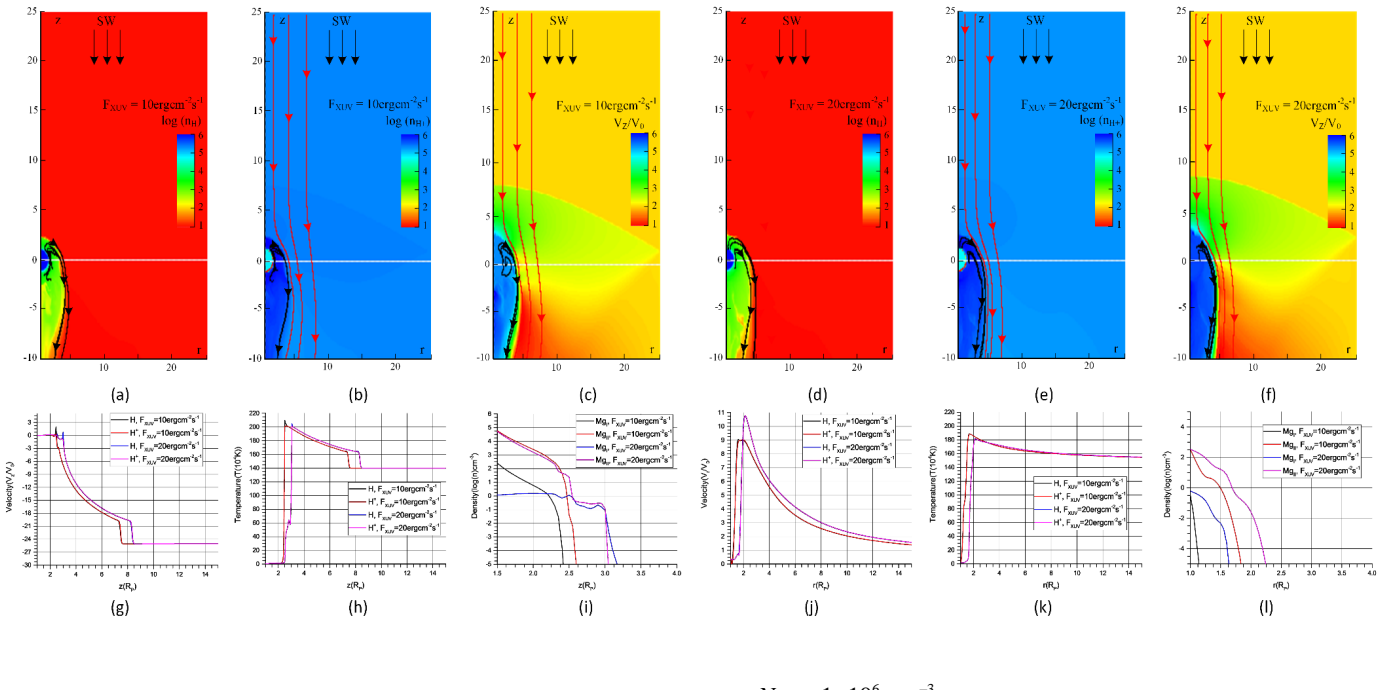
The load-bearing object is the 2D axisymmetric multi-fluid hydrodynamic model of Shaikhislamov et al. (2014, 2016) and Khodachenko et al. (2015, 2017), applied to WASP-12b with hydrogen ionization/recombination chemistry and minor species He and Mg treated as separate fluids. The crucial knob is the averaged tidal gravitational potential of equation (A.5), which shortens the Roche radius to $R_{L1}=1.37\,R_P$; switching it on or off defines the two scenarios ('captured by the star' versus 'blown by the wind'). Absorption is computed by integrating Voigt-profile optical depth through the simulated MgII density, velocity, and temperature fields, with a resonant double-charge-exchange reaction between MgI and HeII included because it removes MgII near the planet.
What would settle it
Run a 3D simulation of WASP-12b that includes the Coriolis force and lets the stellar wind arrive at an angle to the XUV flux: if the resulting MgII column ahead of the planet shifts the computed transit ingress earlier than the optical contact, the paper's central conclusion of no early ingress in the realistic regime is falsified. The observed variable early ingress in the NUV transit light curves is the corresponding existing test.
Extended reading notes
Core claim
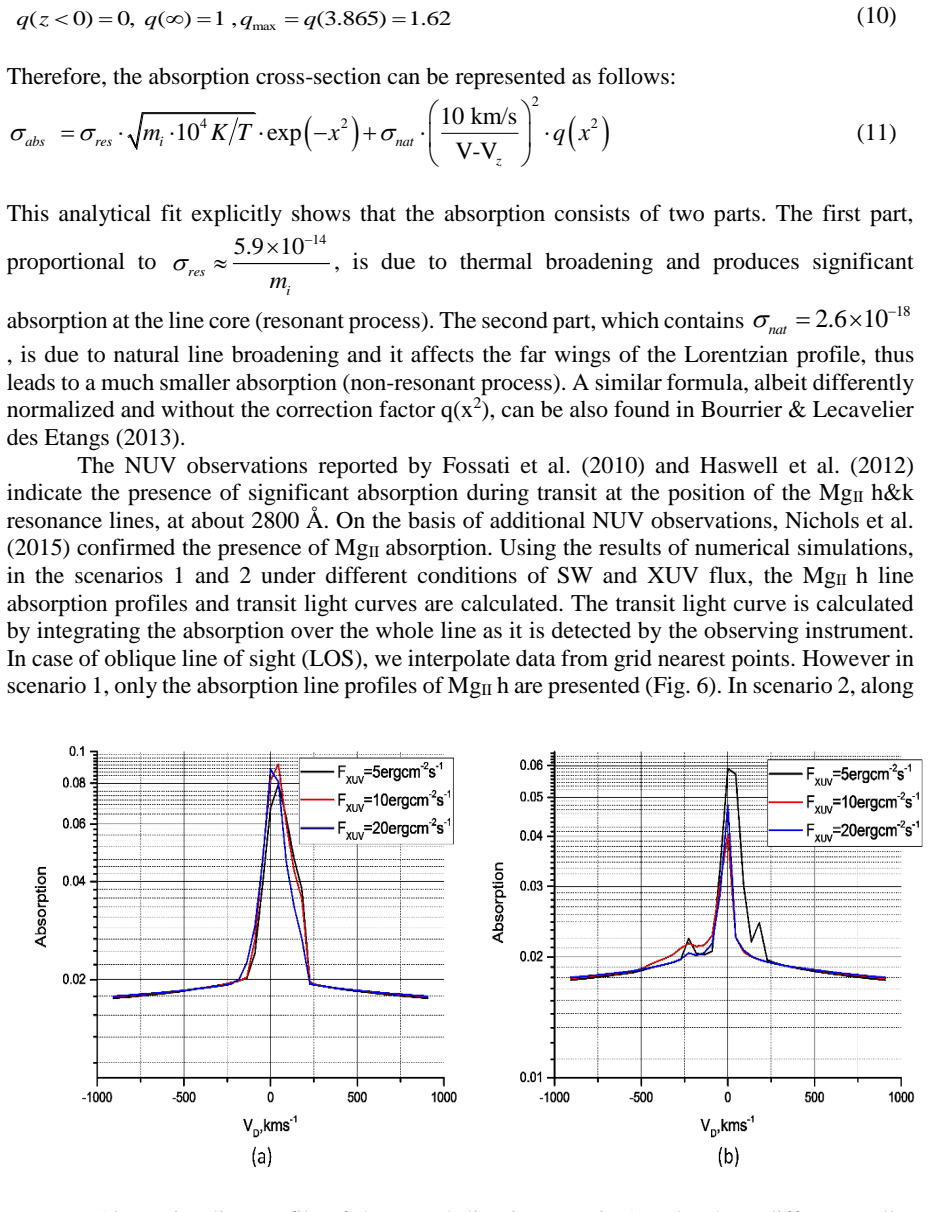
The central claim is that WASP-12b's upper atmosphere is in a 'captured by the star' escape regime: the stellar gravitational pull extends the planetary wind beyond the Roche lobe and splits it into two streams along the planet-star axis, so the mass-loss rate (saturated at roughly $1{-}2\times10^{12}\ \mathrm{g\,s^{-1}}$) is set by gravity, not by the XUV heating rate or the stellar wind ram pressure. In this regime the stellar wind only compresses the streams laterally and picks up ions near the boundary; it does not stop the outflow. A bow shock ahead of the planet, the configuration previously invoked to explain early NUV ingress, forms only in a test case with no tidal force and a slow, dense wind, which the authors call unrealistic for WASP-12b. Simulated MgII h-line absorption reaches 4--10% in the realistic scenario (larger for rarer winds), and the simulated transit curves in the shock scenario begin at the optical transit, meaning no early ingress is produced; the paper concludes that a complete account of the observed early ingress would require three-dimensional geometry.
Load-bearing premise
The model's 2D axisymmetric geometry ignores the Coriolis force and assumes the stellar wind and XUV flux arrive along the same direction, so the computed MgII distribution is trusted only within about five planetary radii; if Coriolis bending redirects the absorbing stream, the conclusion of no early ingress could change.
Editorial extensions
If this is right
- WASP-12b's outflow is gravitationally captured by the star, so the planet is likely feeding material into a circumplanetary or circumstellar torus rather than shedding it as a comet-like tail.
- The mass-loss rate in the realistic regime is 10--15 times higher than in the no-tide case and saturates near $10^{12}\ \mathrm{g\,s^{-1}}$, so evolutionary estimates based on XUV-driven energy-limited escape alone would underestimate the planet's mass loss.
- Bow-shock interpretations of WASP-12b's variable early NUV ingress are not supported by a self-consistent wind solution; the observed early absorption would need explanation from 3D structure, such as Coriolis bending or a torus of previously escaped material.
- MgII absorption is more sensitive to stellar wind density than to XUV flux in the captured regime, so NUV MgII transit depth can serve as a probe of the local stellar wind environment around the planet.
Reading between the lines
- If the captured-by-the-star regime is real, WASP-12b is a natural laboratory for star-feeding accretion streams; a 3D simulation with the Coriolis force would predict whether the two streams bend prograde and create the observed variable early ingress by placing MgII ahead of the planet along the orbit.
- Because the simulated mass-loss rate in the realistic scenario depends only weakly on XUV flux, reconstructing the host star's XUV history from WASP-12b's current escape rate would be unreliable; the escape rate is mostly a gravity diagnostic instead.
- The same two-scenario test could be applied to other ultra-hot Jupiters near their Roche limit: for planets with larger $R_{L1}/R_P$, the bow-shock regime may become realistic, making the presence of early ingress a diagnostic of orbital distance and stellar wind conditions.
Signed reviews
Editorial analysis
A structured set of objections, weighed in public.
Referee Report
Summary. The manuscript presents two-dimensional, multi-fluid hydrodynamic simulations of the upper atmosphere of the hot Jupiter WASP-12b, including hydrogen photo-chemistry and minor species Mg and He, under different stellar XUV fluxes and stellar wind conditions. Two interaction regimes are considered: a 'captured by the star' scenario with tidal force and a fast stellar wind, and a 'blown by the wind' scenario without tidal force and a slow wind. The authors compute MgII h-line absorption and compare it with HST/COS near-ultraviolet observations, reporting that the captured-by-the-star scenario produces two streams and a mass-loss rate of about 10^12 g/s but no early ingress, whereas the blown-by-the-wind scenario forms a bow shock but is judged unrealistic. They conclude that the observed early ingress is not reproduced by the realistic scenario and that the bow-shock interpretation is disfavoured.
Significance. If the modelling assumptions are accepted, the paper contributes a quantitative, multi-fluid description of atmospheric escape and MgII absorption for WASP-12b, and it argues against the bow-shock explanation of the observed early ingress in favour of a stellar-capture regime. The model is more self-consistent than earlier prescribed-boundary 3D simulations in that it couples XUV-driven outflow, charge exchange, and minor-species ionization, and it produces specific predictions for absorption-line profiles and mass-loss rates that can be compared with future observations. However, the significance is substantially tempered by the axisymmetric geometry, which excludes the Coriolis force and aligns the stellar wind with the planet-star line, and by the fact that the closest match to the observed MgII absorption is obtained by varying the poorly constrained stellar wind density. These issues directly affect the central claim that the realistic scenario cannot produce early ingress.
major comments (3)
- [Section 2 and Appendix A] The axisymmetric 2D model omits the Coriolis force and assumes co-directionality of the stellar wind velocity and the XUV flux. For WASP-12b the Keplerian velocity V_K=226 km/s (stated in Section 3.2) is comparable to the adopted fast-wind speed V_SW=417 km/s in scenario 1, so the true interaction is oblique rather than axisymmetric. The two-stream structure and the resulting conclusion that scenario 1 produces no early ingress (Section 4) follow from this imposed symmetry. The manuscript's assertion that Coriolis spiraling is 'still small' at about 3 R_P (Section 4) is unquantified; using the stated expansion speeds of 5-10 km/s, the deflection angle Omega*r/v at r=3 R_P is of order 0.1-1 rad, and the associated transverse Doppler shifts are tens of km/s, comparable to the widths of the simulated MgII absorption profiles. The central claim that the realistic scenario cannot explain the early ingress is therefore not robust to this omitted leading physical effect.
- [Section 4, Figs. 6-7 and Table 1] The claimed reproduction of the observed ~4% MgII absorption is obtained by selecting stellar wind densities N_sw=3e4 and 3e5 cm^-3 from a small grid (Table 1) rather than from an independent constraint on WASP-12's wind. The abstract's statement that the simulations 'enable ... to reproduce the times of ingress and egress' is not supported by the presented light curves: in the realistic scenario 1 no early ingress is formed, while in scenario 2 the computed ingress coincides with the optical transit (Fig. 7b). The comparison with observations is therefore a fit, not a prediction, and it does not validate the model's geometry for the early-ingress phenomenon.
- [Section 2 and Appendix A] The MgII abundance and absorption are sensitive to several unconstrained inputs, including the low-energy Mg + He+ double charge-exchange cross-section, which the manuscript states is 'currently unknown', and the heating efficiency eta_h=0.5. These parameters directly control the MgII column density and hence the simulated absorption depth. The paper does not provide a sensitivity analysis over plausible ranges of these values, so the reported match to the observed 4% absorption cannot be distinguished from a parameterised fit rather than a robust model outcome.
minor comments (4)
- [References] The reference list contains a duplicated entry for Shaikhislamov et al. 2016 (two identical entries with the same journal and page numbers).
- [References] The bibliography entry 'Cubtz M., Saar S. H., Shkolnik E., 2010' appears to be a typo for 'Cuntz et al.'; the in-text citation 'Cuntz et al. 2000' does not have a matching reference-list entry.
- [Section 4, Eq. (1)-(2)] The notation in Eq. (1) is unclear: the integral limit 'StR' and the subscripts 'v,out' and 'v,transit' are not defined, and the intensity I is used without an explicit definition.
- [Conclusions] The concluding sentence states that absorption is dominated by 'resonant thermal line broadening', but the text in Section 4 and Eq. (11) indicate that the line wings are controlled by natural broadening; this wording should be checked for consistency.
Circularity Check
Predicted absence of early ingress/bow shock in the captured regime is imposed by the 2D axisymmetric geometry, not derived from the simulated physics.
-
self definitional
[Section 3.2 (quasi-axisymmetric limitation) and Section 4 (no-early-ingress conclusion); see also Appendix A]
"One of the major limitations of the quasi-axisymmetric approximation for the tidally locked system is the assumption of co-directionality for the SW plasma and XUV flux. /// Our simulations do not lead to the formation of an early ingress in scenario 1, regardless of the adopted SW and XUV flux values, as the structure of the escaping material stream is rather symmetric. This is obviously connected to the nature of the 2D model."
The model is 2D axisymmetric about the planet-star line: the cylindrical symmetry axis is the star-planet line, the SW flow is taken co-directional with the XUV flux, and the Coriolis force is not included. Early ingress requires absorbing material ahead of the planet in the direction of orbital motion, which is an azimuthal asymmetry about that axis. The paper's 'no early ingress' / 'no bow-shock' result in scenario 1 is therefore entailed by the imposed symmetry and co-directionality, not an independent outcome of the simulated escape physics. The authors acknowledge this immediately ('obviously connected to the nature of the 2D model'), but the statement is still used to argue that the bow-shock/early-ingress scenario is unrealistic.
full rationale
The central escape calculation is self-contained: the multi-fluid equations are given in Appendix A, and the double-stream / captured-by-the-star flow topology and the ~10^12 g/s mass-loss rates are computed from the stated XUV and SW inputs rather than fitted to the MgII observations. The MgII absorption comparison is a selected grid point ('closest match' to ~4%) rather than a parameter inversion, and the paper does not rename that match as a prediction; I therefore do not count it as fitted-input circularity. The main circular element is the use of the 2D axisymmetric geometry to conclude that the realistic captured regime produces no early ingress and no bow shock. Because the model excludes Coriolis force and aligns the SW with the planet-star line, the absence of leading-side, orbit-direction asymmetry is guaranteed by construction. The manuscript is unusually candid about this ('This is obviously connected to the nature of the 2D model' and 'A complete understanding ... requires self-consistent numerical simulations in a three-dimensional geometry'), which keeps the circularity partial rather than total. Score 6 reflects one load-bearing 'prediction' (no early ingress / no bow shock) that reduces by construction, while the central tidal-escape result retains independent computational content.
Assumptions & free parameters
free parameters (6)
- Stellar wind density N_sw =
3e4-3e5 cm^-3 (best match)
- Heating efficiency eta_h =
0.5
- Mg/H abundance at inner boundary =
3.7e-5
- Low-energy Mg + He+ double charge-exchange cross-section =
unspecified/unknown
- XUV flux at 1 AU =
5, 10, 20 erg cm^-2 s^-1
- Stellar wind velocity and temperature =
417 km/s, 3.17 MK (scenario 1); 226 km/s, 1.4 MK (scenario 2)
assumptions (8)
- standard math Hydrodynamic continuity, momentum, and energy equations (A.1-A.3) with ideal gas closure
- domain assumption Weakly magnetized / non-magnetized planet
- domain assumption 2D axisymmetric geometry with circularly averaged centrifugal force and no Coriolis force
- domain assumption Stellar wind flow and stellar XUV flux are co-directional
- domain assumption Solar XUV spectrum (Tobiska 1993) is a proxy for WASP-12's spectrum
- domain assumption Inner boundary at observed optical radius with T=2500 K and p=1 mbar
- domain assumption All charged species share the same temperature and velocity due to strong coupling
- standard math Voigt profile absorption calculation as formulated in Eqs. (1)-(11)
Cite this review
Pith. "Pith review of Modelling atmospheric escape and MgII near-ultraviolet absorption of the highly irradiated hot Jupiter WASP-12b." pith.science (2026). https://pith.science/paper/MJXZBGML
@misc{pith2026190802527,
  author       = {Pith},
  title        = {Pith review of: Modelling atmospheric escape and MgII near-ultraviolet absorption of the highly irradiated hot Jupiter WASP-12b},
  year         = {2026},
  howpublished = {\url{https://pith.science/paper/MJXZBGML}},
  note         = {Machine review of arXiv:1908.02527}
}
read the original abstract
We present two-dimensional multi-fluid numerical modelling of the upper atmosphere of the hot Jupiter WASP-12b. The model includes hydrogen chemistry, and self-consistently describes the expansion of the planetary upper atmosphere and mass loss due to intensive stellar irradiation, assuming a weakly magnetized planet. We simulate the planetary upper atmosphere and its interaction with the stellar wind (SW) with and without the inclusion of tidal force and consider different XUV irradiation conditions and SW parameters. With the inclusion of tidal force, even for a fast SW, the escaping planetary material forms two streams, propagating towards and away from the star. The atmospheric escape and related mass loss rate reaching the value of 10^12 gs^-1 appear to be mostly controlled by the stellar gravitational pull. We computed the column density and dynamics of MgII ions considering three different sets of SW parameters and XUV fluxes. The simulations enable to compute the absorption at the position of the Mg h line and to reproduce the times of ingress and egress. In case of a slow SW and without accounting for tidal force, the high orbital velocity leads to the formation of a shock approximately in the direction of the planetary orbital motion. In this case, mass loss is proportional to the stellar XUV flux. At the same time, ignoring of tidal effects for WASP-12b is a strong simplification, so the scenario with a shock, altogether is an unrealistic one.
Figures

Figures from the paper (2 more)


Reference graph
Works this paper leans on
- [1]
-
[3]
García Muñoz A., 2007, P&SS, 55,
work page 2007
- [9]
-
[19]
V., Kaigorodov P., Konstantinova N
Bisikalo D. V., Kaigorodov P., Konstantinova N. I., 2015, Astronomy Reports, 59, 829-835. Cubtz M., Saar S. H., Shkolnik E., 2010, Astrophys. Journal, 533, L151-L154. Bourrier, V., Lecavelier des Etangs A., 2013, A&A, 557, A124. Braginskii S. I., 1965, Rev. Plasma Phys., 1,
work page 2015
-
[25]
Lindsay B. G., & Stebbings R. F., 2005, JGRA, 110, A12213. Llama J., Wood K., Jardine M., Vidotto A. A., Helling Ch., Fossati L., Haswell C. A., 2011, Mont. Not. R. Astron. Sco. 416, L41-L44. Matsakos T., Uribe A., Konigl, A., 2015, Astronomy and Astrophysics, 578, A6. Meier E. T., Shumlak U., 2012, PhPl, 19, 072508. Murray-Clay R. A., Chiang E. I., Murra...
work page 2005
-
[27]
Anders E., Grevesse N., 1989, GeCoA, 53,
work page 1989
-
[28]
Shaikhislamov I. F., Khodachenko M. L., Lammer H., Fossati L., Dwivedi N., Güdel M., Kislyakova K. G., Johnstone C. P., Berezutsky A. G., Miroshnichenko, Posukh V. G., Erkaev N. V., Ivanov V.A., 2018, Astrophys. Journal (Accepted). Shematovich V. I., 2012, Solar System Research, 46, 391-407. 20 Shkolnik E., Bohlender D. A., Walker G. A. H., Cameron A. C.,...
work page 2018
-
[50]
L., Shaykhislamov I., Lammer H., Kislyakova K
Khodachenko M. L., Shaykhislamov I., Lammer H., Kislyakova K. G., Fossati L., Johnstone C. P., Arkhypov O. V., Berezutsky A. G., Mi roshnichenko I. B., Posukh V. G., 2017, Astrophys. Journal, 847,
work page 2017
Show all 34 references
-
[52]
C., Schmitt J
Salz M., Czesla S., Schneider P. C., Schmitt J. H. M. M., 2016, Astronomy & Astrophysics, 586, A75. Shaikhislamov I. F., Khodachenko M. L., Sasunov Yu L., Lammer H., Kislyakova K. G., Erkaev N. V., 2014, Astrophys. Journal, 795,
2016
-
[70]
L., Shaykhislamov I., Lammer H., Prokopov P
Khodachenko M. L., Shaykhislamov I., Lammer H., Prokopov P. A., 2015, Astrophys. Journal, 813,
2015
-
[79]
A., Bouchy F., Stempels H
Hebb L., Collier-Cameron A., Loeillet B., Pollacco D., Hebrard G., Street R. A., Bouchy F., Stempels H. C., Moutou C., Simpson E., Udry S., Joshi Y. C., West R. G., Skillen I., Wilson D. M., McDonald I., Gibson N. P., Aigrain S., Anderson D. R., Benn C. R., Christian D. J., En...
2009
-
[98]
H., 2013, Astrophys
Guo J. H., 2013, Astrophys. Journal, 766,
2013
-
[102]
A., Fossati L., Ayres T., France K., Froning C
Haswell C. A., Fossati L., Ayres T., France K., Froning C. S., Holmes S., Kolb U. C., Busuttil R., Street R. A., Hebb L., Collier Cameron A., Enoch B., Burwitz V., Rodriguez J., West R. G., Pollacco D., Wheatley P. J., Carter, A., 2012, Astrophys. Journal, 760,
2012
-
[118]
E., Haswell C
Fossati L., Koskinen T., France K., Cubillos P. E., Haswell C. A., Holmes S., Lanza A. F., Pillitteri I., 2018, The Astronomical Journal 155,
2018
-
[126]
K., Holmström, M, Lammer, H., et al., 2014, Science, 346,
Kislyakova, G. K., Holmström, M, Lammer, H., et al., 2014, Science, 346,
2014
-
[132]
F., Khodachenko M
Shaikhislamov I. F., Khodachenko M. L., Lammer H., Fossati L., Johnstone C. P., Porkopov P. V., Berezutsky A. G., Zakharov Yu. P., Posukh V. G., 2016, Astrophys. Journal, 832,
2016
-
[143]
M., Bourrier V., Désert J
Vidal-Madjar A., Huitson C. M., Bourrier V., Désert J. M., Ballester G., des Etangs A. L., McConnell J. C., 2013, Astronomy & Astrophysics, 560, A54. Vidotto A. A., Jardine M., Helling Ch., 2010, Astrophys. Journal Letts., 722, L168-L172. Vidotto A. A., Llama J., Jardine M., H...
2013
-
[152]
K., 1993, JGRA, 98, 18879
Tobiska W. K., 1993, JGRA, 98, 18879. Verner D. A., Ferland G. J., Korista K. T., Yakovlev D. G., 1996, ApJ, 465,
1993
-
[157]
C., Fortney Jonathan J., 2010, Nature, 463,
Li Shu-lin, Miller N., Lin Douglas N. C., Fortney Jonathan J., 2010, Nature, 463,
2010
-
[167]
L., Alexeev I
Khodachenko M. L., Alexeev I. I., Belenkaya E., Lammer H., Grießmeier J.-M., Leitzinger M., Odert P., Zaqarashvili T., Rucker H. O., 2012, Astrophys. Journal, 744,
2012
-
[173]
I., 2012, Solar System Research, 46, 391-407
Shematovich V. I., 2012, Solar System Research, 46, 391-407. Shaikhislamov I. F., Khodachenko M. L., Lammer H., Fossati L., Johnstone C. P., Porkopov P. V., Berezutsky A. G., Zakharov Yu. P., Posukh V. G., 2016, Astrophys. Journal, 832,
2012
-
[197]
Journal, 764,
Bisikalo D., Kaygorodov P., Ionov D., Shematovich V., Lammer H., Fossati L., 2013, Astrophys. Journal, 764,
2013
-
[205]
D., Physical Review A, 1986, 34(4),
DuBois, R. D., Physical Review A, 1986, 34(4),
1986
-
[339]
D., Wynn G
Nichols J. D., Wynn G. A., Goad M., Alexander R. D., Casewell S. L., Cowley S. W. H, Burleigh M. R., Clarke J. T., Bisikalo D., 2015, Astrophys. Journal, 803,
2015
-
[487]
M., Ballester G
Vidal-Madjar A., Lecavelier des Etangs A., Désert J. M., Ballester G. E., Ferlet R., Hébrard G., Mayor M., 2003, Nature, 422,
2003
-
[515]
Lai D., Helling Ch., van den Heuvel E. P. J. ,2010, Astrophys. Journal, 721, 923-928. Lammer H., Bredehöft J. H., Coustenis A., Khodachenko M. L., Kaltenegger L., Grasset O., Prieur D., Raulin F., Ehrenfreund P., Yamauchi M., Wahlund J. -E., Grießmeier J.-M., Stangl G., Cockel...
2010
-
[970]
P., Güdel M., Lüftinger T., et al., 2015, Astronomy and Astrophys., 577, A27 Khodachenko M
Johnstone C. P., Güdel M., Lüftinger T., et al., 2015, Astronomy and Astrophys., 577, A27 Khodachenko M. L., Lammer H., Lichtenegger H .I. M., Langmayr D., Erkaev N. V., Grießmeier J-M., Leitne M., Penz T., Biernat H. K., Motschmann U., Rucker H. O., 2007a, P&SS, 55,
2015
-
[981]
T., Aylward A
Koskinen T. T., Aylward A. D., Smith C. G. A., & Miller S., 2007., ApJ, 661(1),
2007
-
[1062]
V., 2004, Icarus, 170, 167-179
Yelle R. V., 2004, Icarus, 170, 167-179. Appendix A The Model Equations To simulate the dynamics of the escaping hydrogen dominated atmosphere of WASP-12b and its interaction with the SW, we employ a 2D axially symmetric hydrodynamic multi-fluid numerical model in the cylindri...
2004
-
[1426]
H., 2011, Astrophys
Guo J. H., 2011, Astrophys. Journal, 733,
2011
-
[1993]
The spectrum is based on measurements of solar radiation under moderate activity conditions with proxy index
and covering the range 10–912 Å, binned by 1 Å. The spectrum is based on measurements of solar radiation under moderate activity conditions with proxy index . It is assumed that the energy released in the form of photo-electrons is rapidly and equally re -distributed between a...
2005
-
[1996]
2000, Nahar & Pradhan 1997)
and recombination rates (Le Teuff et al. 2000, Nahar & Pradhan 1997). Note, that we do not consider chemical reactions among the different minor species, whereas the list of modeled hydrogen reactions is presented in Khodachenko et al. (2015), and it is practically the same as...
2015
-
[2738]
Ehrenreich D., Bourrier V., Wheatley P
Debrecht A., Carroll-Nellenback J., Frank A., Fossati L., Blackman Eric G., Dobbs -Dixon I., 2018, MNRAS, DOI 10.1093/mnras/sty1164. Ehrenreich D., Bourrier V., Wheatley P. J., Lecavelier des Etangs A., Hébrard G., Udry S., Bonfils X., Delfosse X., Désert J.-M., Sing D. K. , V...
2018 doi
-
[2931]
J., Matsakos T., 2015, Astrophys
Pillitteri I., Maggio A., Micela G., Sciortino S., Wolk S. J., Matsakos T., 2015, Astrophys. Journal, 805,
2015
Reviewed August 14, 2026 · model on record in the stance chip above.
Discussion (0). Continue with ORCID to comment.