REVIEW 4 major objections 6 minor 57 references
Learning Normal Patterns in Musical Loops
T0 review · 4 major / 6 minor · reviewed 2026-08-07 · deepseek-v4-flash
Pith's one-line read This paper shows that 'normal' patterns in musical loops can be learned without labels, and that a residual-connection Deep SVDD model separates unusual bass and guitar loops from typical ones more cleanly than Isolation Forest or PCA…
desk verdict A clean application of existing components to loop anomaly detection, but the headline claim about improved separation is not actually tested: the evaluation is qualitative, circular, and confounded by overfitting. read the letter →
The pith
A machine-rendered reading of the paper's core claim, the machinery that carries it, and where it could break.
The reading
What carries the argument
The load-bearing object is the Deep Support Vector Data Description (Deep SVDD) module: a five-layer encoder trained in two phases, first as an autoencoder on the frozen HTS-AT embeddings and then under the one-class objective of pulling normal embeddings toward a hypersphere center $c$. The anomaly score for any loop is its squared Euclidean distance $\|\phi(x) - c\|^2$ from that center. Supporting this, the Feature Fusion Mechanism (FFM) merges global and local temporal views of long clips and pads short clips so that variable-length audio still produces fixed-size inputs for the pre-trained Hierarchical Token-semantic Audio Transformer (HTS-AT), which is what lets the method escape the fixed-length constraint of earlier loop models.
What would settle it
Take a held-out set of clean bass or guitar loops, deliberately corrupt some of them with clicks, phase flips, splice errors, or out-of-genre samples, and check whether corrupt loops systematically receive higher AEwRES anomaly scores than clean ones; if the score distributions overlap, the separation claim collapses.
Extended reading notes
Core claim
The central claim is that framing loop detection as unsupervised anomaly detection works when the audio is first converted into rich, fixed-dimension embeddings by a frozen pre-trained model. Trained only on unlabeled bass or guitar loops, the Deep SVDD module learns a hypersphere that captures the dataset's normative patterns; any loop whose embedding lands far from the hypersphere center is scored as anomalous. On curated bass and guitar datasets, the authors found that both Deep SVDD variants separate normal from anomalous scores better than Isolation Forest and PCA reconstruction, and that the residual-connection autoencoder (AEwRES) gives the cleanest separation and the most structured latent space, particularly on the more diverse guitar data. The conclusion they draw is that residual connections help the encoder represent pattern diversity without over-compressing the normal manifold, making AEwRES the more promising architecture for loop detection in varied musical contexts.
Load-bearing premise
The evaluation assumes that the 95th percentile of training anomaly scores is a valid boundary between normal and anomalous loops, and that the visible separation between training and validation score histograms reflects genuine detection rather than overfitting to the training set.
Editorial extensions
If this is right
- Variable-length loops can be analyzed directly, removing the fixed-duration preprocessing required by earlier loop-compatibility models.
- Loop collections can be audited without labels: distance-to-center scores can flag clicks, phase issues, or unintended noise for quality control.
- The residual-connection autoencoder becomes the better default Deep SVDD encoder when the normal class is internally diverse, as it is with multi-style guitar loops.
- The same distance score can drive creative discovery by surfacing loops that deviate from a user's existing library.
Reading between the lines
- The q=0.95 threshold is likely less important than the ranking quality of the distance scores; with labeled anomalies available, the same model could be evaluated by ROC/AUC and the threshold tuned to a user's tolerance.
- Because the audio encoder is frozen, the method should transfer cheaply to other loop-like units such as drums, synth one-shots, or vocal chops, and the residual-connection benefit would plausibly grow as intra-class diversity grows.
- A natural next experiment is to fine-tune HTS-AT on the loop domain instead of freezing it, and compare whether loop-specific embeddings improve separation or simply overfit the training collection.
Editorial analysis
A structured set of objections, weighed in public.
Referee Report
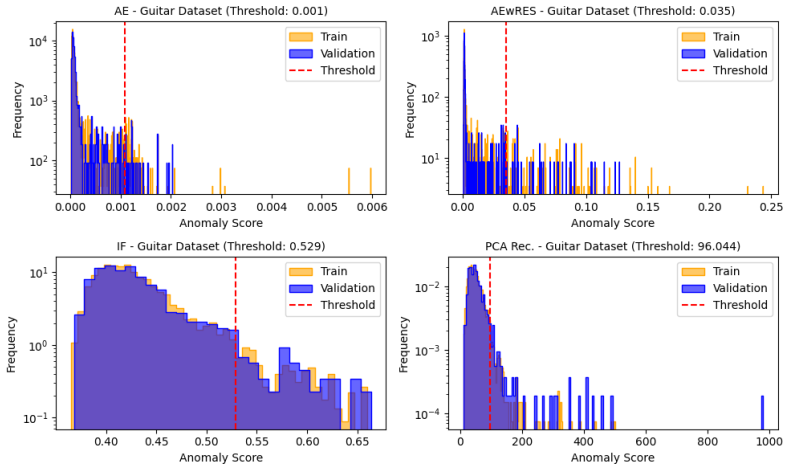
Summary. This paper presents an unsupervised framework for detecting anomalous musical loops by extracting fixed-dimensional embeddings from variable-length audio via a pre-trained HTS-AT and a Feature Fusion Mechanism, then training a Deep SVDD model (standard autoencoder AE or residual autoencoder AEwRES) on the embeddings. The framework is evaluated on curated bass and guitar loop datasets against Isolation Forest and PCA reconstruction-error baselines. The evaluation is entirely qualitative: anomaly thresholds are set at the 95th percentile of training anomaly scores, and the reported 'improved separation' of the Deep SVDD variants, especially AEwRES, is inferred from histograms of anomaly scores, PCA scatter plots, and latent-space heatmaps (Figures 4-6, Appendix C). The authors acknowledge in Section 8 that no ground-truth anomaly labels are available.
Significance. If the claims were substantiated, the proposed pipeline would be a useful contribution to MIR: it addresses the variable-length input limitation with FFM, leverages a strong pre-trained audio encoder, and proposes an unsupervised, user-collection-adaptable anomaly detection tool; the comparison of AE and AEwRES architectures within Deep SVDD is also a reasonable design question. The strengths of the paper include the clear description of the two-stage training procedure (AE pre-training then Deep SVDD fine-tuning), the use of a frozen HTS-AT encoder with FFM to handle variable durations, and the inclusion of baseline methods on the same embeddings. However, the paper's headline claim of improved anomaly separation is not supported by the evidence presented: there is no quantitative evaluation with labeled or synthetic anomalies, no AUROC or precision/recall, no statistical test of distribution separation, and the threshold-based labeling makes 'anomaly' a self-referential construct. The central claim is therefore currently unverified.
major comments (4)
- [§5.4, §6.1–6.2] The evaluation is circular: anomalies are defined as samples whose anomaly score exceeds the 95th percentile (q=0.95) of training scores, so any validation sample above this threshold is 'anomalous' by construction, regardless of musical or structural distinctiveness. The paper provides no external or synthetic anomalies and no labeled set, which makes the abstract claim of 'improved anomaly separation' untestable from the reported results. Please add a quantitative evaluation using labeled anomalies (e.g., loops from other instruments or genres, artificially corrupted loops, or non-loop audio) and report AUROC, average precision, or at least a chance-baseline comparison.
- [§4.3, Figures 4–5] The observed separation between training and validation score histograms is exactly what overfitting predicts for Deep SVDD: the network is trained to map training embeddings close to the hypersphere center, and with early stopping monitoring validation loss, unseen validation points will tend to receive higher scores even if they are perfectly normal loops. The paper needs a control condition, such as scoring a second set of normal loops from a different source, or comparing the validation score distribution against a permutation baseline, to show that the gap indicates anomaly detection rather than distribution shift.
- [§6.2–6.3] The comparison between AE and AEwRES is confounded by the use of raw score thresholds that differ substantially across models (e.g., guitar threshold is about 0.001 for AE and 0.035 for AEwRES, Figure 5). Claiming that AEwRES is 'more promising' because its latent space has higher explained variance in the first two PCs (93.2% vs. 77.7%) conflates representation spread with anomaly detection quality; explained variance does not measure how well anomalies are separated from normal data. Please report threshold-independent metrics, such as ROC curves computed with labeled anomalies, or a standardized overlap statistic (e.g., Kolmogorov-Smirnov) between normal and anomalous score distributions.
- [§4.1] No separate test set is reserved; hyperparameters and early stopping are selected using the validation set, and the same validation set is used for all reported analysis. This makes the reported separation figures optimistic and prevents assessment of generalization. A held-out test set (or cross-validation) should be used for the final evaluation.
minor comments (6)
- [Abstract] The abstract contains a typo: 'and and principle component analysis' should be 'and principal component analysis'.
- [§6.3] The heading 'Compartive Performance Summary' should be 'Comparative Performance Summary'.
- [§3.1] The sentence 'The resulting fused map, compromising both broad structure and specific details' should use 'comprising' instead of 'compromising'.
- [Appendices B–C] Minor typos appear in the appendices: 'witout' should be 'without' (Figure 7 caption and Figure 8 caption), and 'validatio' should be 'validation' (Figures 9 and 10 captions).
- [§3.1, §3.2] References to 'Wu et al.' and 'Dai et al.' appear in the text without citation numbers in several places; please standardize the citation style.
- [Figures 4–5] The anomaly-threshold labels in the histograms are small and hard to read; consider annotating with larger text and using comparable axis scales across models to facilitate cross-model comparison.
Circularity Check
Anomaly 'separation' claims rest on a threshold fit to the model's own scores, with no ground-truth labels; the central evaluation is self-definitional.
-
self definitional
[Section 6 (anomaly threshold definition in Section 5.4)]
"For the subsequent analysis, potential anomalies are defined as samples whose anomaly score exceeds the 95th percentile (q=0.95) threshold derived from the training set scores."
The evaluation first fits a threshold as the 95th percentile of the model's own training anomaly scores, then colors points and interprets 'normal' vs 'anomaly' using that same threshold. Any conclusion about 'separation' between these two groups is therefore a restatement of the score distribution relative to a quantile of itself; no independent anomaly labels or external benchmark enter. The central claim that AEwRES 'deliver[s] improved anomaly separation' reduces to the geometry of the fitted scores, not to validated detection of musically distinct loops.
-
fitted input called prediction
[Appendix B]
"Anomaly detection performance indicated successful separation of normal samples and potential anomalies in both architectures; however, AEwRES achieved a lower anomaly threshold (q=0.95 ≈ 0.009) compared to AE (≈ 0.016), potentially indicating enhanced precision."
Precision is a label-based notion, but no labels exist. The q=0.95 threshold is fit to each model's training scores, so a lower threshold only means the training scores are more concentrated around the learned center. Interpreting that fitted quantile as 'enhanced precision' treats the model's own score concentration as if it were measured detection accuracy, which is exactly a fitted input being renamed as a predictive performance claim.
full rationale
The framework itself is not circular: HTS-AT/FFM and Deep SVDD are adopted from external work (Ruff et al., Chen et al., Wu et al.), the frozen-encoder pipeline is standard, and the self-citations in Sections 1 and 7.1 are motivational rather than load-bearing. The circularity sits in the evaluation. Section 5.4 sets the anomaly threshold at q=0.95 of the training scores; Section 6 then defines 'potential anomalies' as points above that threshold and uses the resulting color-coded histograms and PCA plots to conclude 'improved anomaly separation' (Section 6.3). Since the labels are constructed from the model scores being evaluated, the headline result is self-definitional. Appendix B compounds this by interpreting a lower fitted q95 threshold as 'enhanced precision.' The authors' own Section 8 concedes 'we lack ground-truth labels for definitive anomalous loops,' which confirms that no external validation anchors the claim. The observed train/validation score gap is also what overfitting predicts under the Deep SVDD training objective, but that is a correctness risk rather than a distinct circular step. Overall, there is partial circularity (6/10): the architecture and representations have independent content, but the central 'anomaly separation' claim reduces to a self-fitted threshold.
Assumptions & free parameters
free parameters (4)
- Hypersphere center c =
Learned from training embeddings
- Anomaly threshold q =
0.95
- Latent dimension =
32
- FFM chunk duration d =
10 seconds
assumptions (4)
- domain assumption Pre-trained HTS-AT embeddings capture enough musical structure to distinguish normal from anomalous loops
- domain assumption The 95th percentile training threshold defines a meaningful anomaly boundary
- domain assumption The curated MusicRadar bass and guitar sets are representative of normal loop patterns
- standard math Deep SVDD's single hypersphere can model the normal distribution
Cite this review
Pith. "Pith review of Learning Normal Patterns in Musical Loops." pith.science (2026). https://pith.science/paper/MKYCT5JL
@misc{pith2026250523784,
  author       = {Pith},
  title        = {Pith review of: Learning Normal Patterns in Musical Loops},
  year         = {2026},
  howpublished = {\url{https://pith.science/paper/MKYCT5JL}},
  note         = {Machine review of arXiv:2505.23784}
}
read the original abstract
This paper introduces an unsupervised framework for detecting audio patterns in musical samples (loops) through anomaly detection techniques, addressing challenges in music information retrieval (MIR). Existing methods are often constrained by reliance on handcrafted features, domain-specific limitations, or dependence on iterative user interaction. We address these limitations through an architecture combining deep feature extraction with unsupervised anomaly detection. Our approach leverages a pre-trained Hierarchical Token-semantic Audio Transformer (HTS-AT), paired with a Feature Fusion Mechanism (FFM), to generate representations from variable-length audio loops. These embeddings are processed using one-class Deep Support Vector Data Description (Deep SVDD), which learns normative audio patterns by mapping them to a compact latent hypersphere. Evaluations on curated bass and guitar datasets compare standard and residual autoencoder variants against baselines like Isolation Forest (IF) and and principle component analysis (PCA) methods. Results show our Deep SVDD models, especially the residual autoencoder variant, deliver improved anomaly separation, particularly for larger variations. This research contributes a flexible, fully unsupervised solution for processing diverse audio samples, overcoming previous structural and input limitations while enabling effective pattern identification through distance-based latent space scoring.
Figures


Figures from the paper (7 more)



Reference graph
Works this paper leans on
-
[1]
Nick Collins, Margaret Schedel, and Scott Wilson. Electronic music. Cambridge introductions to music. University Press, Cambridge, 1. publ edition, 2014. ISBN 978-1-107-64817-3
work page 2014
-
[2]
Mark J. Butler. Unlocking the groove: rhythm, meter, and musical design in electronic dance music. Profiles in popular music. Indiana University Press, Bloomington, 2006. ISBN 978-0-253-34662-9 978-0-253-21804-9. OCLC: ocm61162077
work page 2006
-
[3]
David E. Reese, Lynne S. Gross, and Brian Gross. Audio production worktext: concepts, techniques, and equipment. Elsevier Focal Press, Burlington, MA, 6th ed edition, 2009. ISBN 978-0-240-81098-0. OCLC: 255903242
work page 2009
-
[4]
Bill Gibson. The S . M . A . R . T . guide to producing music with samples, loops, and MIDI . Thomson Course Technology PTR : Artistpro Pub., Boston, MA, 2005. ISBN 978-1-59200-697-7. OCLC: 61519237
work page 2005
-
[5]
Sebastian Streich and Bee Suan Ong. A music loop explorer system. In ICMC, 2008
work page 2008
-
[6]
A loop sequencer that selects music loops based on the degree of excitement
Tetsuro Kitahara, Kosuke Iijima, Misaki Okada, Yuji Yamashita, and Ayaka Tsuruoka. A loop sequencer that selects music loops based on the degree of excitement. In Proceedings of the 12th Sound and Music Computing Conference (SMC 2015), pages 435--438, 2015
work page 2015
-
[7]
Bo-Yu Chen, Jordan B. L. Smith, and Yi-Hsuan Yang. Neural Loop Combiner : Neural Network Models for Assessing the Compatibility of Loops , 2020. URL https://arxiv.org/abs/2008.02011. Version Number: 2
work page Pith review arXiv 2020
-
[8]
On the Development and Practice of AI Technology for Contemporary Popular Music Production
Emmanuel Deruty, Maarten Grachten, Stefan Lattner, Javier Nistal, and Cyran Aouameur. On the Development and Practice of AI Technology for Contemporary Popular Music Production . 5 0 (1): 0 35--49, 2022. ISSN 2514-3298. doi:10.5334/tismir.100. URL https://transactions.ismir.net/articles/10.5334/tismir.100?utm_source=TrendMD&utm_medium=cpc&utm_campaign=Tra...
Show all 57 references
-
[9]
Cheng-Zhi Anna Huang, Hendrik Vincent Koops, Ed Newton-Rex, Monica Dinculescu, and Carrie J. Cai. AI Song Contest : Human-AI Co-Creation in Songwriting , 2020. URL http://arxiv.org/abs/2010.05388
2020 arXiv
-
[10]
Toward Interactive Music Generation : A Position Paper
Shayan Dadman, Bernt Arild Bremdal, Børre Bang, and Rune Dalmo. Toward Interactive Music Generation : A Position Paper . 10: 0 125679--125695, 2022. ISSN 2169-3536. doi:10.1109/ACCESS.2022.3225689. URL https://ieeexplore.ieee.org/document/9966445/
2022
-
[11]
Crafting Creative Melodies : A User-Centric Approach for Symbolic Music Generation
Shayan Dadman and Bernt Arild Bremdal. Crafting Creative Melodies : A User-Centric Approach for Symbolic Music Generation . 13 0 (6): 0 1116, 2024. ISSN 2079-9292. doi:10.3390/electronics13061116. URL https://www.mdpi.com/2079-9292/13/6/1116
2024 doi
-
[12]
Multi-agent Reinforcement Learning for Structured Symbolic Music Generation
Shayan Dadman and Bernt Arild Bremdal. Multi-agent Reinforcement Learning for Structured Symbolic Music Generation . In Philippe Mathieu, Frank Dignum, Paulo Novais, and Fernando De La Prieta, editors, Advances in Practical Applications of Agents , Multi - Agent Systems , and ...
2023 doi
-
[13]
Escalona
Miguel Civit, Javier Civit-Masot, Francisco Cuadrado, and Maria J. Escalona. A systematic review of artificial intelligence-based music generation: Scope , applications, and future trends. 209: 0 118190, 2022. ISSN 09574174. doi:10.1016/j.eswa.2022.118190. URL https://linkingh...
2022
-
[14]
A Survey of Audio-Based Music Classification and Annotation
Zhouyu Fu, Guojun Lu, Kai Ming Ting, and Dengsheng Zhang. A Survey of Audio-Based Music Classification and Annotation . 13 0 (2): 0 303--319, 2011. ISSN 1520-9210, 1941-0077. doi:10.1109/TMM.2010.2098858. URL http://ieeexplore.ieee.org/document/5664796/
2011
-
[15]
Ras and Alicja A
Zbigniew W. Ras and Alicja A. Wieczorkowska, editors. Advances in Music Information Retrieval , volume 274 of Studies in Computational Intelligence . Springer Berlin Heidelberg, 2010. ISBN 978-3-642-11673-5 978-3-642-11674-2. doi:10.1007/978-3-642-11674-2. URL https://link.spr...
2010 doi
-
[16]
Plumbley
Qiuqiang Kong, Yin Cao, Turab Iqbal, Yuxuan Wang, Wenwu Wang, and Mark D. Plumbley. PANNs : Large - Scale Pretrained Audio Neural Networks for Audio Pattern Recognition , August 2020. URL http://arxiv.org/abs/1912.10211. arXiv:1912.10211 [cs, eess]
2020 arXiv
-
[17]
Zero- Shot Audio Classification via Semantic Embeddings , 2020
Huang Xie and Tuomas Virtanen. Zero- Shot Audio Classification via Semantic Embeddings , 2020. URL https://arxiv.org/abs/2011.12133. Version Number: 2
2020 arXiv
-
[18]
Gemmeke, Daniel P
Jort F. Gemmeke, Daniel P. W. Ellis, Dylan Freedman, Aren Jansen, Wade Lawrence, R. Channing Moore, Manoj Plakal, and Marvin Ritter. Audio Set : An ontology and human-labeled dataset for audio events. In 2017 IEEE International Conference on Acoustics , Speech and Signal Proce...
2017
-
[19]
Automatic tagging using deep convolutional neural networks, 2016
Keunwoo Choi, George Fazekas, and Mark Sandler. Automatic tagging using deep convolutional neural networks, 2016. URL https://arxiv.org/abs/1606.00298. Version Number: 1
2016 arXiv
-
[20]
A Comprehensive Review on Audio based Musical Instrument Recognition : Human-Machine Interaction Towards Industry 4.0
Dash, Sukanta Kumar , Solanki, S S , and Chakraborty, Soubhik . A Comprehensive Review on Audio based Musical Instrument Recognition : Human-Machine Interaction Towards Industry 4.0. 82 0 (01), 2023. ISSN 00224456, 09751084. doi:10.56042/jsir.v82i1.70251. URL http://op.niscair...
2023 doi
-
[21]
Large-scale Contrastive Language - Audio Pretraining with Feature Fusion and Keyword -to- Caption Augmentation , March 2024
Yusong Wu, Ke Chen, Tianyu Zhang, Yuchen Hui, Marianna Nezhurina, Taylor Berg-Kirkpatrick, and Shlomo Dubnov. Large-scale Contrastive Language - Audio Pretraining with Feature Fusion and Keyword -to- Caption Augmentation , March 2024. URL http://arxiv.org/abs/2211.06687. arXiv...
2024 arXiv
-
[22]
Repeating pattern discovery and structure analysis from acoustic music data
Lie Lu, Muyuan Wang, and Hong-Jiang Zhang. Repeating pattern discovery and structure analysis from acoustic music data. In Proceedings of the 6th ACM SIGMM international workshop on Multimedia information retrieval , pages 275--282, New York NY USA, October 2004. ACM. ISBN 978...
2004
-
[23]
Structural analysis and segmentation of music signals
Bee Suan Ong et al. Structural analysis and segmentation of music signals. Citeseer, 2006
2006
-
[24]
State of the art report: Audio-based music structure analysis
Jouni Paulus, Meinard M \"u ller, and Anssi Klapuri. State of the art report: Audio-based music structure analysis. 2010
2010
-
[25]
Mysore, Cheng-i Wang, Jordan B
Oriol Nieto, Gautham J. Mysore, Cheng-i Wang, Jordan B. L. Smith, Jan Schlüter, Thomas Grill, and Brian McFee. Audio- Based Music Structure Analysis : Current Trends , Open Challenges , and Applications . Transactions of the International Society for Music Information Retrieva...
2020 doi
-
[26]
Symbolic Music Loop Generation with Neural Discrete Representations , October 2022
Sangjun Han, Hyeongrae Ihm, Moontae Lee, and Woohyung Lim. Symbolic Music Loop Generation with Neural Discrete Representations , October 2022. URL http://arxiv.org/abs/2208.05605. arXiv:2208.05605 [cs, eess]
2022 arXiv
-
[27]
Searching For Loops And Sound Samples With Feature Learning
Jan Jakubik. Searching For Loops And Sound Samples With Feature Learning . pages 13--18, September 2022. doi:10.15439/2022F279. URL https://annals-csis.org/Volume_31/drp/279.html
2022 doi
-
[28]
HTS - AT : A Hierarchical Token - Semantic Audio Transformer for Sound Classification and Detection , 2022
Ke Chen, Xingjian Du, Bilei Zhu, Zejun Ma, Taylor Berg-Kirkpatrick, and Shlomo Dubnov. HTS - AT : A Hierarchical Token - Semantic Audio Transformer for Sound Classification and Detection , 2022. URL https://arxiv.org/abs/2202.00874. Version Number: 1
2022 arXiv
-
[29]
Deep one-class classification
Lukas Ruff, Robert Vandermeulen, Nico Goernitz, Lucas Deecke, Shoaib Ahmed Siddiqui, Alexander Binder, Emmanuel Muller, and Marius Kloft. Deep one-class classification. PMLR, pages 4393--4402, 2018
2018
-
[30]
Semi- Supervised Sound Event Detection with Pre-Trained Model
Liang Xu, Lizhong Wang, Sijun Bi, Hanyue Liu, and Jing Wang. Semi- Supervised Sound Event Detection with Pre-Trained Model . In ICASSP 2023 - 2023 IEEE International Conference on Acoustics , Speech and Signal Processing ( ICASSP ) , pages 1--5. IEEE, 2023. ISBN 978-1-7281-632...
2023
-
[31]
Deep Residual Learning for Image Recognition
Kaiming He, Xiangyu Zhang, Shaoqing Ren, and Jian Sun. Deep Residual Learning for Image Recognition . In 2016 IEEE Conference on Computer Vision and Pattern Recognition ( CVPR ) , pages 770--778, Las Vegas, NV, USA, June 2016. IEEE. ISBN 978-1-4673-8851-1. doi:10.1109/CVPR.201...
2016
-
[32]
Howard, Menglong Zhu, Bo Chen, Dmitry Kalenichenko, Weijun Wang, Tobias Weyand, Marco Andreetto, and Hartwig Adam
Andrew G. Howard, Menglong Zhu, Bo Chen, Dmitry Kalenichenko, Weijun Wang, Tobias Weyand, Marco Andreetto, and Hartwig Adam. MobileNets : Efficient Convolutional Neural Networks for Mobile Vision Applications . URL http://arxiv.org/abs/1704.04861
-
[33]
Zhengshan Shi and Gautham J. Mysore. LoopMaker : Automatic creation of music loops from pre-recorded music. In Proceedings of the 2018 CHI Conference on Human Factors in Computing Systems , Chi '18, pages 1--6. Association for Computing Machinery, 2018. ISBN 978-1-4503-5620-6....
2018
-
[34]
Music loop extraction from digital audio signals
Bee Suan Ong and Sebastian Streich. Music loop extraction from digital audio signals. In 2008 IEEE International Conference on Multimedia and Expo , pages 681--684. IEEE, 2008. ISBN 978-1-4244-2570-9. doi:10.1109/ICME.2008.4607526. URL http://ieeexplore.ieee.org/document/4607526/
2008
-
[35]
Matthew E. P. Davies, Philippe Hamel, Kazuyoshi Yoshii, and Masataka Goto. AutoMashUpper : Automatic Creation of Multi-Song Music Mashups . 22 0 (12): 0 1726--1737, 2014. ISSN 2329-9290, 2329-9304. doi:10.1109/TASLP.2014.2347135. URL http://ieeexplore.ieee.org/document/6876193/
2014
-
[36]
Psychoacoustic Approaches for Harmonic Music Mixing
Roman Gebhardt, Matthew Davies, and Bernhard Seeber. Psychoacoustic Approaches for Harmonic Music Mixing . 6 0 (5): 0 123, 2016. ISSN 2076-3417. doi:10.3390/app6050123. URL https://www.mdpi.com/2076-3417/6/5/123
2016 doi
-
[37]
A perceptually-motivated harmonic compatibility method for music mixing
Gilberto Bernardes, Matthew Davies, and Carlos Guedes. A perceptually-motivated harmonic compatibility method for music mixing. 2017
2017
-
[38]
Jordan B. L. Smith and Masataka Goto. Nonnegative Tensor Factorization for Source Separation of Loops in Audio . In 2018 IEEE International Conference on Acoustics , Speech and Signal Processing ( ICASSP ) , pages 171--175. IEEE, 2018. ISBN 978-1-5386-4658-8. doi:10.1109/ICASS...
2018
-
[39]
FMA : A Dataset For Music Analysis , 2016
Michaël Defferrard, Kirell Benzi, Pierre Vandergheynst, and Xavier Bresson. FMA : A Dataset For Music Analysis , 2016. URL https://arxiv.org/abs/1612.01840. Version Number: 3
2016 arXiv
-
[40]
Richemond, Elena Buchatskaya, Carl Doersch, Bernardo Avila Pires, Zhaohan Daniel Guo, Mohammad Gheshlaghi Azar, Bilal Piot, Koray Kavukcuoglu, Rémi Munos, and Michal Valko
Jean-Bastien Grill, Florian Strub, Florent Altché, Corentin Tallec, Pierre H. Richemond, Elena Buchatskaya, Carl Doersch, Bernardo Avila Pires, Zhaohan Daniel Guo, Mohammad Gheshlaghi Azar, Bilal Piot, Koray Kavukcuoglu, Rémi Munos, and Michal Valko. Bootstrap your own latent:...
2020 arXiv
-
[41]
Attentional Feature Fusion , 2020
Yimian Dai, Fabian Gieseke, Stefan Oehmcke, Yiquan Wu, and Kobus Barnard. Attentional Feature Fusion , 2020. URL https://arxiv.org/abs/2009.14082. Version Number: 2
2020 arXiv
-
[42]
Audio-text Retrieval with Transformer-based Hierarchical Alignment and Disentangled Cross-modal Representation , 2024
Yifei Xin, Zhihong Zhu, Xuxin Cheng, Xusheng Yang, and Yuexian Zou. Audio-text Retrieval with Transformer-based Hierarchical Alignment and Disentangled Cross-modal Representation , 2024. URL http://arxiv.org/abs/2409.09256
2024 arXiv
-
[43]
Background-aware Modeling for Weakly Supervised Sound Event Detection
Yifei Xin, Dongchao Yang, and Yuexian Zou. Background-aware Modeling for Weakly Supervised Sound Event Detection . In INTERSPEECH 2023 , pages 1199--1203. ISCA, 2023 a . doi:10.21437/Interspeech.2023-330. URL https://www.isca-archive.org/interspeech_2023/xin23_interspeech.html
2023 doi
-
[44]
Improving Weakly Supervised Sound Event Detection with Causal Intervention , 2023 b
Yifei Xin, Dongchao Yang, Fan Cui, Yujun Wang, and Yuexian Zou. Improving Weakly Supervised Sound Event Detection with Causal Intervention , 2023 b . URL http://arxiv.org/abs/2303.05678
2023 arXiv
-
[45]
Tax and Robert P.W
David M.J. Tax and Robert P.W. Duin. Support Vector Data Description . Machine Learning, 54 0 (1): 0 45--66, January 2004. ISSN 0885-6125. doi:10.1023/B:MACH.0000008084.60811.49. URL http://link.springer.com/10.1023/B:MACH.0000008084.60811.49
2004
-
[46]
Free music samples: royalty-free loops, hits, and multis to download - sampleradar, n.d
MusicRadar . Free music samples: royalty-free loops, hits, and multis to download - sampleradar, n.d. URL https://www.musicradar.com/news/tech/free-music-samples-royalty-free-loops-hits-and-multis-to-download-sampleradar. Accessed: 2024-10-04
2024
-
[47]
Deep- Rhythm for Global Tempo Estimation in Music
Hadrien Foroughmand and Geoffroy Peeters. Deep- Rhythm for Global Tempo Estimation in Music . November 2019. doi:10.5281/ZENODO.3527890. URL https://zenodo.org/record/3527890. Publisher: Zenodo
2019
-
[48]
A Review of Activation Function for Artificial Neural Network
Andrinandrasana David Rasamoelina, Fouzia Adjailia, and Peter Sincak. A Review of Activation Function for Artificial Neural Network . In 2020 IEEE 18th World Symposium on Applied Machine Intelligence and Informatics ( SAMI ) , pages 281--286, Herlany, Slovakia, January 2020. I...
2020
-
[49]
U- Net : Convolutional Networks for Biomedical Image Segmentation , 2015
Olaf Ronneberger, Philipp Fischer, and Thomas Brox. U- Net : Convolutional Networks for Biomedical Image Segmentation , 2015. URL http://arxiv.org/abs/1505.04597
2015 arXiv
-
[50]
Decoupled Weight Decay Regularization , 2019
Ilya Loshchilov and Frank Hutter. Decoupled Weight Decay Regularization , 2019. URL http://arxiv.org/abs/1711.05101
2019 arXiv
-
[51]
SGDR : Stochastic Gradient Descent with Warm Restarts , 2017
Ilya Loshchilov and Frank Hutter. SGDR : Stochastic Gradient Descent with Warm Restarts , 2017. URL http://arxiv.org/abs/1608.03983
2017 arXiv
-
[52]
Isolation Forest
Fei Tony Liu, Kai Ming Ting, and Zhi-Hua Zhou. Isolation Forest . In 2008 Eighth IEEE International Conference on Data Mining , pages 413--422. IEEE. ISBN 978-0-7695-3502-9. doi:10.1109/ICDM.2008.17. URL http://ieeexplore.ieee.org/document/4781136/
2008
-
[53]
Jolliffe
Ian T. Jolliffe. Principal Component Analysis. Springer Series in Statistics. Springer, 2nd ed edition. ISBN 978-0-387-95442-4. doi:10.1007/b98835. URL http://link.springer.com/10.1007/b98835
-
[54]
A model for serendipitous music retrieval
Markus Schedl, David Hauger, and Dominik Schnitzer. A model for serendipitous music retrieval. In Proceedings of the 2nd Workshop on Context-awareness in Retrieval and Recommendation , pages 10--13. ACM, 2012. ISBN 978-1-4503-1192-2. doi:10.1145/2162102.2162105. URL https://dl...
2012
-
[55]
Serendipitous information retrieval
Elaine Toms. Serendipitous information retrieval. 2001
2001
-
[56]
Anomaly detection: A survey
Varun Chandola, Arindam Banerjee, and Vipin Kumar. Anomaly detection: A survey. 41 0 (3): 0 1--58, 2009. ISSN 0360-0300, 1557-7341. doi:10.1145/1541880.1541882. URL https://dl.acm.org/doi/10.1145/1541880.1541882
2009
-
[57]
A novel anomaly detection scheme based on principal component classifier
Mei-Ling Shyu, Shu-Ching Chen, Kanoksri Sarinnapakorn, and Liwu Chang. A novel anomaly detection scheme based on principal component classifier. Proceedings of International Conference on Data Mining , 2003
2003
Reviewed August 7, 2026 · model on record in the stance chip above.
Discussion (0). Continue with ORCID to comment.