REVIEW 4 major objections 6 minor 56 references
LBfoam: An open-source software package for the simulation of foaming using the Lattice Boltzmann Method
T0 review · 4 major / 6 minor · reviewed 2026-08-14 · deepseek-v4-flash
Pith's one-line read The LBfoam package claims 2D and 3D bubble-scale foaming simulation, from gas diffusion to final lamella structures.
desk verdict Useful open-source FSLBM foaming code with solid core validations, but the abstract's 'predict final foam structures' claim outruns the uncalibrated, resolution-dependent disjoining pressure closure. read the letter →
The pith
A machine-rendered reading of the paper's core claim, the machinery that carries it, and where it could break.
The reading
What carries the argument
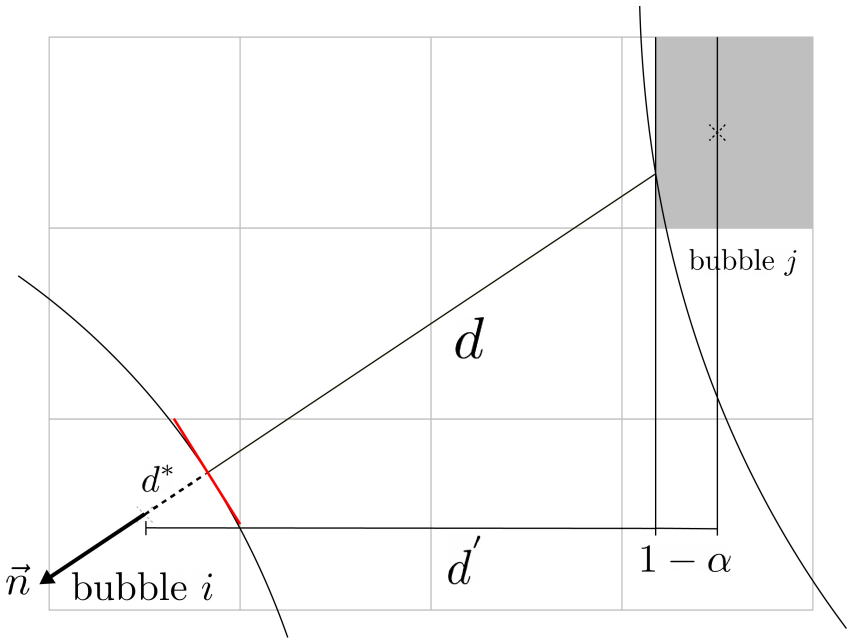
The mechanism that carries the argument is the coupling of three Lattice Boltzmann pieces. First, a free-surface Lattice Boltzmann solver tracks the liquid volume fraction $\alpha$ by mass exchange, reconstructs bubble interfaces with PLIC, and imposes bubble pressure and surface tension through the free-surface boundary condition. Second, a second lattice-Boltzmann distribution on D2Q5 or D3Q7 lattices solves gas advection-diffusion, with Henry's law enforced at bubble interfaces. Third, a linear disjoining pressure $\Pi = k_\Pi(d_{\max}-d)$ for interface separations $d<d_{\max}=4\delta_l$ is computed by ray tracing along interface normals and added to the interface density; this repulsion is what keeps lamellae stable and prevents total coalescence. Without the third piece the bubbles simply merge; with it, final cellular structures emerge.
What would settle it
Measure real disjoining-pressure isotherms for a foam film (for example by thin-film interferometry), then simulate the same two-bubble geometry using $k_\Pi$ set to the measured isotherm; if the predicted coalescence time or lamella thickness disagrees with the experiment, the claim that final foam structure is predicted fails.
Extended reading notes
Core claim
The central claim, stated on the author's own terms, is that a free-surface Lattice Boltzmann solver coupled to an advection-diffusion equation for dissolved gas constitutes a complete model of foaming. Liquid flow is solved only in liquid and interface cells; each bubble is tracked as an ideal gas with its own pressure, mass, and volume. Gas enters bubbles through a Henry's-law boundary condition at the reconstructed interface, and surface tension plus a short-range disjoining pressure enter through the gas density imposed at interface cells. The paper shows that this combination produces bubble growth matching the analytical diffusion-limited growth law, dissolution into undersaturated liquid, coalescence or stable lamella depending on disjoining-pressure strength, foam drainage under gravity, and, in qualitative comparison, cellular structures resembling real metal foam.
Load-bearing premise
The make-or-break premise is that a linear repulsive force between bubble surfaces, with a user-chosen strength and a fixed range of four lattice cells, captures how real foam films stabilize; since the strength is not measured or calibrated, predicted structures depend on that choice.
Editorial extensions
If this is right
- Researchers can use LBfoam to simulate polymer foam injection molding or metal foaming at the bubble scale, including coalescence, splitting, and lamella stabilization.
- The code's near-linear parallel scaling on hundreds of cores makes three-dimensional foaming simulations of tens of millions of cells feasible.
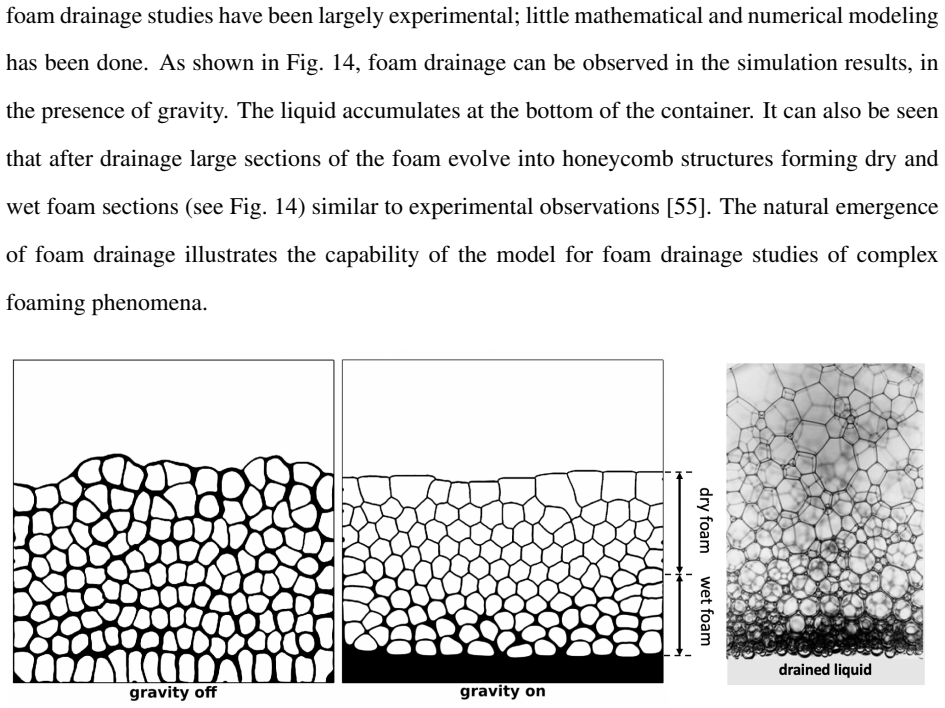
- Foam drainage appears naturally under gravity, so the package can be used to study dry versus wet foam regions and liquid redistribution.
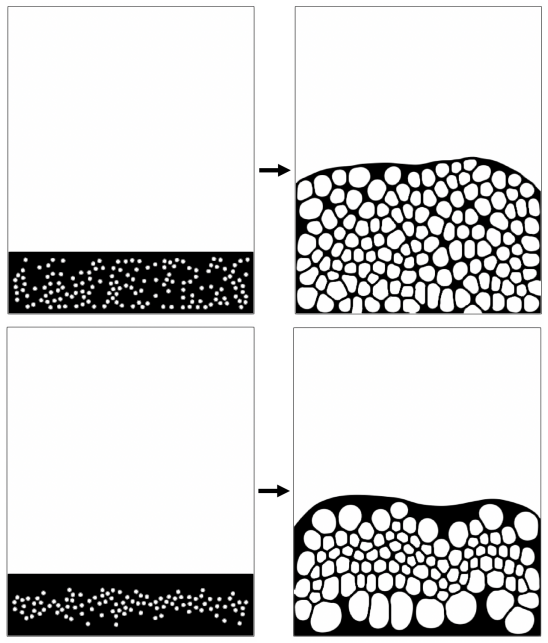
- Initial nuclei distribution demonstrably changes the final structure, giving process designers a direct way to test nucleation strategies.
- Being freely released under an open-source license, the package can be reproduced and extended by other groups without a license barrier.
Reading between the lines
- Beyond the paper: because $k_\Pi$ and $d_{\max}$ are free parameters, the model's quantitative predictive power rests on fitting them to measured disjoining-pressure isotherms; one could invert them from observed lamella thickness.
- Beyond the paper: the source term $q$ in the gas transport equation allows chemical blowing agents to be represented, so the same code could test population-balance closures by comparing directly resolved bubble populations against reduced-order models.
- Beyond the paper: extending the linear repulsion model to include film-thinning hydrodynamics or a critical rupture thickness would let the code address foam-stability questions that the current two-parameter repulsion cannot.
Signed reviews
Editorial analysis
A structured set of objections, weighed in public.
Referee Report
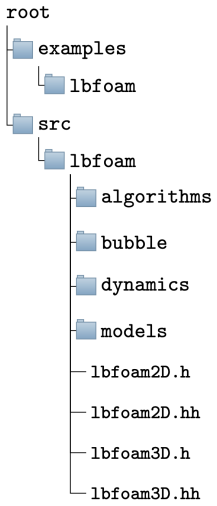
Summary. The paper introduces LBfoam, an open-source 2D/3D free-surface lattice Boltzmann method package for simulating foaming processes. The model couples a free-surface flow solver with an advection-diffusion equation for dissolved gas, a Henry's law boundary condition at bubble interfaces, an ideal-gas bubble pressure model, surface tension, and a linear disjoining pressure model intended to stabilize lamellae. The authors validate the advection-diffusion implementation against a steady analytical solution, validate single-bubble growth against the Scriven cell model, and demonstrate the code on 2D and 3D foaming, foam drainage, bubble dissolution, and the effect of initial nuclei distribution. The central claim, stated in the abstract and conclusion, is that LBfoam can predict final foam structures.
Significance. If the central claim is supported, LBfoam would be a valuable open-source contribution to bubble-scale foaming simulation, extending prior free-surface LBM foaming work (e.g., K\"orner et al.) by adding advection-diffusion, Henry's law, and a public implementation built on Palabos. The paper's explicit strengths are its validated advection-diffusion and single-bubble-growth benchmarks, the modular software architecture, the demonstrated parallel scalability on up to 100 nodes, and the public AGPL license. However, the headline capability of predicting final foam structures rests on the disjoining pressure model, which is introduced as a free parameter with no physical calibration and only qualitative structural validation. As a software-presentation paper, the package and its validated components are solid; as a demonstration of predictive capability for final foam structure, the evidence is currently incomplete.
major comments (4)
- [Section 3.3, Eq. (30)] The disjoining pressure model, Π = kΠ(dmax − d) for d < dmax, introduces two free parameters, kΠ and dmax, that are user-specified. The paper provides no measurement, calibration, or physical relationship linking these parameters to actual disjoining-pressure isotherms (e.g., DLVO theory or experimental data). Figure 4 shows that varying kΠ qualitatively changes the outcome from coalescence to lamella stabilization, but it does not establish which value of kΠ corresponds to a real foam system. This is load-bearing because the claimed ability to predict final foam structures depends directly on the stability of lamellae, which is controlled by this uncalibrated closure.
- [Section 3.3, dmax = 4δl] The range of the stabilizing disjoining pressure is specified in lattice cells, dmax = 4δl. This means the physical interaction range shrinks as the grid is refined. The manuscript does not demonstrate grid convergence of foam-structure predictions, nor does it explain how dmax should be converted to a physical length and kΠ recalibrated when changing resolution. Without such a resolution study, the predicted final foam structures cannot be considered resolution-independent, which undermines confidence in the predictive claim.
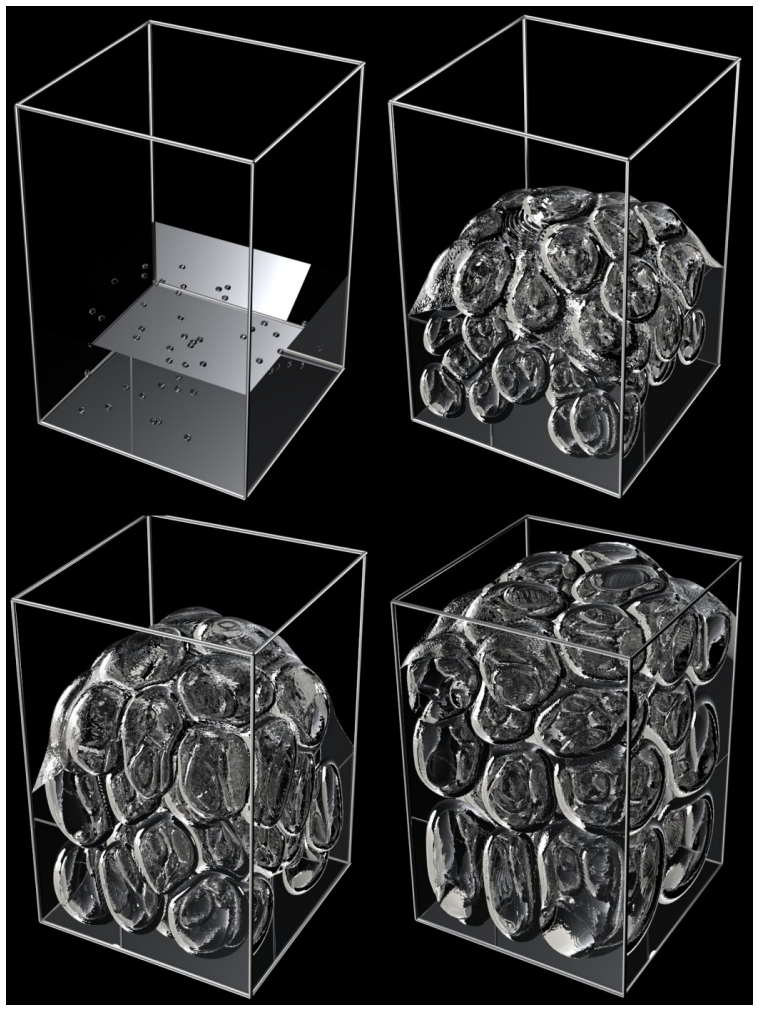
- [Section 4.5, Fig. 16] The only validation of the final foam structure is a qualitative visual comparison between a cross-section of a 3D LBfoam result and a photograph of an aluminum foam. No quantitative metrics are reported, such as cell-size distribution, liquid fraction, wall-thickness distribution, or coalescence statistics. Because the abstract and conclusion claim that LBfoam can 'predict final foam structures', the evidence presented in Fig. 16 is insufficient to support that claim; a quantitative comparison or at least a statistical characterization of the simulated structure is needed.
- [Abstract and Section 5] The abstract states that the software can 'predict final foam structures', and the conclusion repeats this as a capability. Given that the key stabilization parameter kΠ is uncalibrated and the structural comparison is qualitative, this claim overreaches the evidence. The authors should either temper the claim to 'simulate' or 'model' foam structure formation, or provide the calibration and quantitative validation needed to support the stronger predictive claim.
minor comments (6)
- [Abstract] The phrase 'predict final foam structures' appears without qualification; given the uncalibrated disjoining pressure, a more cautious wording would improve accuracy.
- [Section 4.4, Fig. 16 caption] There is a typo in the figure caption: 'resemblse' should be 'resembles'.
- [Section 2.1, Eq. (14)] The definition of the mass exchange weighting Θ could be clarified: the three cases for Θ are stated compactly, and the distinction between an interface cell and a gas cell in the case α = 0 might benefit from a short explanatory sentence.
- [Section 2.1, references [31, 32]] Reference [32] is described as an example of 'interface capturing and tracking methods', but the cited paper is a Lagrangian-Eulerian finite element method for fluid flows; it may not be the best example. Please verify the citation or provide a more directly relevant reference.
- [Section 3.5] The text contains a typographical error: 'Lattice Boltmzann' should be 'Lattice Boltzmann'.
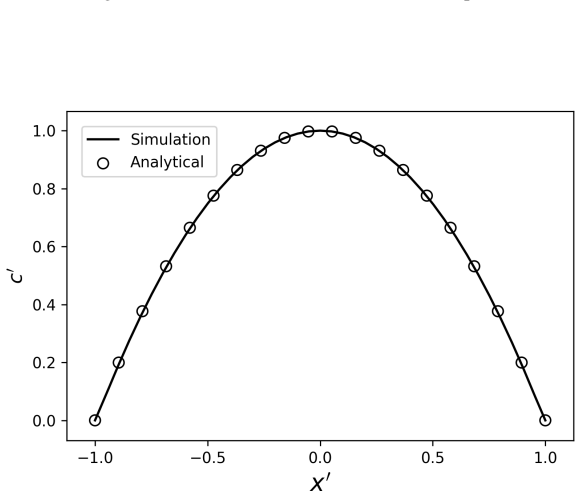
- [Section 4.1, Eq. (32)] The dimensionless coordinate x′ is introduced as x′ = 2x/L, but the text does not explicitly state the range of x; please clarify so that the normalization is unambiguous.
Circularity Check
No circularity: LBfoam's demonstration results are validated against external analytical solutions, and the disjoining-pressure closure is an uncalibrated modeling input, not a fitted or self-referential prediction.
full rationale
The paper's load-bearing derivation chain is self-contained rather than circular. The flow solver follows from standard LBM/FSLBM formulations (Eqs. 1-19), the gas transport is an advection-diffusion equation solved by a separate lattice-Boltzmann distribution (Eqs. 22-26), and the Henry's law boundary condition is a physical closure applied at interfaces (Eqs. 28-29). The disjoining-pressure model in Eq. 30 is introduced as a user-specified linear closure with parameters kPi and dmax; it is not extracted from, fitted to, or defined in terms of the final foam structures that the paper demonstrates. The validation cases in Sections 4.1 and 4.2 compare against independently derived analytical solutions (Eqs. 32 and 33), with all parameters listed as inputs and no fitting to the benchmark results. The qualitative foam-structure claims in Sections 4.4 and 4.5 are presented as simulation demonstrations, not as predictions forced by a fitted parameter. The paper's few self-citations (e.g., Ref. [5] for a cell-growth model, Ref. [34] for height functions, Refs. [46-47] for foam injection molding context) are background or component references and are not load-bearing for the central derivation. The unresolved physical validity and lattice-unit dependence of the disjoining-pressure parameters are legitimate correctness and physics-fidelity concerns, but they are not circularity: the model output is not made equal to its inputs by construction, and the benchmarks are external to the fitted quantities.
Assumptions & free parameters
free parameters (2)
- kPi (disjoining pressure constant) =
varies per simulation, e.g., 0.005, 0.08, 2e-3, 5e-3
- dmax (disjoining pressure range) =
4 delta_l
assumptions (3)
- domain assumption Gas-phase hydrodynamics are negligible; only gas pressure matters (free surface simplification).
- domain assumption Gas concentration at the bubble interface follows Henry's law c = kH * pg.
- ad hoc to paper Disjoining pressure is linear in interfacial gap distance with constants kPi and dmax.
Cite this review
Pith. "Pith review of LBfoam: An open-source software package for the simulation of foaming using the Lattice Boltzmann Method." pith.science (2026). https://pith.science/paper/MKZV6NG5
@misc{pith2026190804262,
  author       = {Pith},
  title        = {Pith review of: LBfoam: An open-source software package for the simulation of foaming using the Lattice Boltzmann Method},
  year         = {2026},
  howpublished = {\url{https://pith.science/paper/MKZV6NG5}},
  note         = {Machine review of arXiv:1908.04262}
}
read the original abstract
This paper presents a 2D/3D Free Surface Lattice Boltzmann Method simulation package called LBfoam for the simulation of foaming processes. The model incorporates the essential physics of foaming phenomena: gas diffusion into nucleated bubbles, bubble dynamics and coalescence, surface tension, the stabilizing disjoining pressure between bubbles, and Newtonian and non-Newtonian rheological models. The software can simulate the growth and interaction of bubbles, and predict final foam structures. The implementation is based on the Palabos library (in C++), which enables large-scale parallel simulations. The software is freely available under the GNU Affero General Public License version 3 at: https://github.com/mehdiataei/LBfoam
Figures
Figures from the paper (14 more)







Reference graph
Works this paper leans on
-
[1]
R. D. Patel. Bubble growth in a viscous Newtonian liquid. Chemical Engineering Science , 35(11):2352–2356, 1980
work page 1980
-
[2]
M. Amon and C. Denson. A study of the dynamics of foam growth: Analysis of the growth of closely spaced spherical bubbles. Polymer Engineering & Science, 24(13):1026–1034, 1984
work page 1984
-
[3]
A. Arefmanesh, S. G. Advani, and E. E. Michaelides. A numerical study of bubble growth during low pressure structural foam molding process. Polymer Engineering and Science, 30(20):1330–1337, 1990
work page 1990
-
[4]
A Arefmanesh and S. G. Advani. Di ffusion-induced growth of gas bubble in a viscoelastic fluid. Rheologica Acta, 30:274, 1991
work page 1991
-
[5]
C. Wang, V . Shaayegan, M. Ataei, F. Costa, S. Han, M. Bussmann, and C. B. Park. Accurate theoretical modeling of cell growth by comparing with visualized data in high-pressure foam injection molding. European Polymer Journal, 119:189–199, 2019
work page 2019
-
[6]
A. Arefmanesh and S. G. Advani. Nonisothermal bubble growth in polymeric foams. Polymer Engineering & Science, 35(3):252–260, 1995
work page 1995
-
[7]
R. Elshereef, J. Vlachopoulos, and A. Elkamel. Comparison and analysis of bubble growth and foam formation models. Engineering Computations, 27(3):387–408, 2010. 27
work page 2010
-
[8]
Bubble growth in a two-dimensional viscoelastic foam
S L Everitt, O G Harlen, and H J Wilson. Bubble growth in a two-dimensional viscoelastic foam. Journal of Non-Newtonian Fluid Mechanics, 137(1-3):46–59, 2006
work page 2006
Show all 56 references
-
[9]
Everitt, O.G
S.L. Everitt, O.G. Harlen, and H.J. Wilson. Bubble growth in a two-dimensional viscoelastic foam. Journal of Non-Newtonian Fluid Mechanics, 137(1):46–59, 2006
2006
-
[10]
Everitt, O.G
S.L. Everitt, O.G. Harlen, and H.J. Wilson. Competition and interaction of polydisperse bubbles in polymer foams. Journal of Non-Newtonian Fluid Mechanics , 137(1):60–71, 2006
2006
-
[11]
P. Yue, J. J. Feng, C. A. Bertelo, and H. H. Hu. An arbitrary Lagrangian-Eulerian method for simulating bubble growth in polymer foaming. Journal of Computational Physics , 226(2):2229–2249, 2007
2007
-
[12]
Chen and G
S. Chen and G. D. Doolen. Lattice Boltzmann method for fluid flows. Annual Review of Fluid Mechanics , 30 (1):329–364, 1998
1998
-
[13]
Barzegari, H
M. Barzegari, H. Bayani, S. M. H. Mirbagheri, and H. Shetabivash. Multiphase aluminum A356 foam formation process simulation using lattice Boltzmann method. Journal of Materials Research and Technology, 8(1):1258– 1266, 2019
2019
-
[14]
Karimi, H
M. Karimi, H. Droghetti, and D. L. Marchisio. PUFoam : A novel open-source CFD solver for the simulation of polyurethane foams. Computer Physics Communications, 217:138–148, 2017
2017
-
[15]
Geier and M
S. Geier and M. Piesche. Coupled macro and micro-scale modeling of polyurethane foaming processes. The Journal of Computational Multiphase Flows , 6(4):377–390, 2014
2014
-
[16]
Th ¨urey, R
N. Th ¨urey, R. Keiser, M. Pauly, and U. R¨ude. Detail-preserving fluid control. Graphical Models, 71(6):221–228,
-
[17]
Th ¨urey and U
N. Th ¨urey and U. R ¨ude. Stable free surface flows with the lattice Boltzmann method on adaptively coarsened grids. Computing and Visualization in Science , 12:247–263
-
[18]
K ¨orner, M
C. K ¨orner, M. Thies, and R.F. Singer. Modeling of metal foaming with lattice Boltzmann automata. Advanced Engineering Materials, 4(10):765–769, 2002
2002
-
[19]
K ¨orner, M
C. K ¨orner, M. Thies, T. Hofmann, N. Th ¨urey, and U. R¨ude. Lattice Boltzmann model for free surface flow for modeling foaming. Journal of Statistical Physics , 121(1):179–196, 2005
2005
-
[20]
Donath, C
S. Donath, C. Feichtinger, T. Pohl, J. G ¨otz, and U. R ¨ude. Localized parallel algorithm for bubble coalescence in free surface lattice-Boltzmann method. In H. Sips, D. Epema, and H. Lin, editors, Euro-Par 2009 Parallel Processing, pages 735–746, 2009
2009
-
[21]
Ammer, M
R. Ammer, M. Markl, U. Ljungblad, C. K ¨orner, and U. R ¨ude. Simulating fast electron beam melting with a parallel thermal free surface lattice Boltzmann method. Computers & Mathematics with Applications , 67(2): 318–330, 2014
2014
-
[22]
Anderl, S
D. Anderl, S. Bogner, C. Rauh, U. Rude, and A. Delgado. Free surface lattice Boltzmann with enhanced bubble 28 model. Computers & Mathematics with Applications, 67(2):331–339, 2014
2014
-
[23]
Nishi and P
Y . Nishi and P. V . Doan. Hybrid boundary condition combined with data assimilation for simulations of free surface flows using lattice Boltzmann method. Computers & Fluids, 88:108–114, 2013
2013
-
[24]
Donath, K
S. Donath, K. Mecke, S. Rabha, V . Buwa, and U. R¨ude. Verification of surface tension in the parallel free surface lattice Boltzmann method in walberla. Computers & Fluids, 45(1):177–186, 2011
2011
-
[25]
P. V . Coveney, S. Succi, Irina Ginzburg, and Konrad Steiner. A free-surface lattice Boltzmann method for modelling the filling of expanding cavities by bingham fluids. Philosophical Transactions of the Royal Society of London. Series A: Mathematical, Physical and Engineering Sc...
2002
-
[26]
J. Latt, O. Malaspinas, D. Kontaxakis, A. Parmigiani, D. Lagrava, F. Brogi, M. B. Belgacem, Y . Thorimbert, S. Leclaire, S. Li, F. Marson, J. Lemus, C. Kotsalos, R. Conradin, C. Coreixas, R. Petkantchin, F. Raynaud, J. Beny, and B. Chopard. Palabos: Parallel lattice Boltzmann ...
2020
-
[27]
Z. Guo, B. Shi, and N. Wang. Lattice bgk model for incompressible navierstokes equation. Journal of Compu- tational Physics, 165(1):288 – 306, 2000
2000
-
[28]
He and L
X. He and L. Luo. Lattice Boltzmann model for the incompressible Navier-Stokes equation. Journal of Statisti- cal Physics, 88(3):927–944, 1997
1997
-
[29]
Ezzatneshan
E. Ezzatneshan. Comparative study of the lattice Boltzmann collision models for simulation of incompressible fluid flows. Mathematics and Computers in Simulation , 156:158 – 177, 2019. ISSN 0378-4754. doi: https: //doi.org/10.1016/j.matcom.2018.07.013
2019 doi
-
[30]
X. He, Q. Zou, L. Luo, and M. Dembo. Analytic solutions of simple flows and analysis of nonslip boundary conditions for the lattice Boltzmann BGK model. Journal of Statistical Physics , 87(1):115–136, 1997
1997
-
[31]
Mehravaran and S
M. Mehravaran and S. K. Hannani. Simulation of incompressible two-phase flows with large density differences employing lattice Boltzmann and level set methods. Computer Methods in Applied Mechanics and Engineering , 198(2):223 – 233, 2008
2008
-
[32]
T. J.R. Hughes, W. K. Liu, and T. K. Zimmermann. Lagrangian-Eulerian finite element formulation for incom- pressible viscous flows. Computer Methods in Applied Mechanics and Engineering , 29(3):329 – 349, 1981
1981
-
[33]
S. J. Cummins, M. M. Francois, and D. B. Kothe. Estimating curvature from volume fractions. Computers & Structures, 83(6):425–434, 2005
2005
-
[34]
Afkhami and M
S. Afkhami and M. Bussmann. Height functions for applying contact angles to 2d vof simulations. International Journal for Numerical Methods in Fluids , 57(4):453–472, 2008. doi: 10.1002 /fld.1651
2008
-
[35]
J. Boyd, J. M. Buick, and S. Green. Analysis of the Casson and Carreau-Yasuda non-Newtonian blood models in steady and oscillatory flows using the lattice Boltzmann method. Physics of Fluids, 19(9):093103, 2007. 29
2007
-
[36]
Kr ¨uger, H
T. Kr ¨uger, H. Kusumaatmaja, A. Kuzmin, O. Shardt, G. Silva, and E. M. Viggen. Lattice Boltzmann for advection-diffusion problems. In: The Lattice Boltzmann Method. Springer , Cham, 2017
2017
-
[37]
Feng, Chun Liu, and Jie Shen
Pengtao Yue, James J. Feng, Chun Liu, and Jie Shen. Di ffuse-interface simulations of drop coalescence and retraction in viscoelastic fluids. Journal of Non-Newtonian Fluid Mechanics , 129(3):163 – 176, 2005. ISSN 0377-0257
2005
-
[38]
Huber, Y
C. Huber, Y . Su, C. T. Nguyen, A. Parmigiani, H. M. Gonnermann, and J. Dufek. A new bubble dynamics model to study bubble growth, deformation, and coalescence. Journal of Geophysical Research: Solid Earth , 119(1): 216–239, 2014
2014
-
[39]
Amanatides and A
J. Amanatides and A. Woo. A fast voxel traversal algorithm for ray tracing. Dept. of Computer Science, University of Toronto, 1984
1984
-
[40]
C. Koerner. Integral foam molding of light metals: technology, foam physics and foam simulation . Springer, 2008
2008
-
[41]
Scardovelli and S
R. Scardovelli and S. Zaleski. Analytical relations connecting linear interfaces and volume fractions in rectan- gular grids. Journal of Computational Physics , 164(1):228–237, 2000
2000
-
[42]
L ´opez, J
J. L ´opez, J. Hern´andez, P. G´omez, and F. Faura. VOFTools - A software package of calculation tools for volume of fluid methods using general convex grids. Computer Physics Communications, 223:45–54, 2018
2018
-
[43]
R. Bridson. Fast poisson disk sampling in arbitrary dimensions. 2007
2007
-
[44]
Ponce, R
M. Ponce, R. Zon, S. Northrup, D. Gruner, J. Chen, F. Ertinaz, A. Fedoseev, L. Groer, F. Mao, B. C. Mundim, M. Nolta, J. Pinto, M. Saldarriaga, V . Slavnic, E. Spence, C. Yu, and W. R. Peltier. Deploying a top-100 supercomputer for large parallel workloads: The niagara superco...
2019
-
[45]
L.E. Scriven. On the dynamics of phase growth. Chemical Engineering Science , 10(1):1 – 13, 1959. ISSN 0009-2509
1959
-
[46]
Vahid Shaayegan, Guilong Wang, and Chul B. Park. Study of the bubble nucleation and growth mechanisms in high-pressure foam injection molding through in-situ visualization. European Polymer Journal, 76:2–13, 2016
2016
-
[47]
Tromm, V
M. Tromm, V . Shaayegan, C. Wang, H. Heim, and C. B. Park. Investigation of the mold-filling phenomenon in high-pressure foam injection molding and its effects on the cellular structure in expanded foams. Polymer, 160: 43–52, 2019
2019
-
[48]
Marchalot, J
J. Marchalot, J. Lambert, I. Cantat, P. Tabeling, and M.-C. Jullien. 2D foam coarsening in a microfluidic system. EPL (Europhysics Letters), 83(6):64006, 2008
2008
-
[49]
Morey, N.S
M.D. Morey, N.S. Deshpande, and M. Barigou. Foam destabilization by mechanical and ultrasonic vibrations. 30 Journal of Colloid and Interface Science , 219(1):90–98, 1999
1999
-
[50]
Saint-Jalmes
A. Saint-Jalmes. Physical chemistry in foam drainage and coarsening. Soft Matter, 2:836–849, 2006
2006
-
[51]
Safouane, A
M. Safouane, A. Saint-Jalmes, V . Bergeron, and D. Langevin. Viscosity e ffects in foam drainage: Newtonian and non-Newtonian foaming fluids. The European Physical Journal E , 19(2):195–202, 2006
2006
-
[52]
Stevenson
P. Stevenson. Dimensional analysis of foam drainage. Chemical Engineering Science, 61(14):4503–4510, 2006
2006
-
[53]
Arjmandi-Tash, A
O. Arjmandi-Tash, A. Trybala, F.M. Mahdi, N.M. Kovalchuk, and V . Starov. Foams built up by non-Newtonian polymeric solutions: Free drainage. Colloids and Surfaces A: Physicochemical and Engineering Aspects , 521: 112–120, 2017
2017
-
[54]
Anazadehsayed, N
A. Anazadehsayed, N. Rezaee, and J. Naser. Exterior foam drainage and flow regime switch in the foams. Journal of Colloid and Interface Science , 511:440–446, 2018
2018
-
[55]
N. D. Denkov and K. G. Marinova. Antifoam e ffects of solid particles, oil drops and oil-solid compounds in aqueous foams. Colloidal Particles at Liquid Interfaces, pages 383 – 444, 2006. 31 Appendix A. Ray Tracing Traversal Algorithm The ray tracing algorithm for detection of ...
2006
-
[2009]
2006 ACM SIGGRAPH/Eurographics Symposium on Computer Animation (SCA 2006)
2006
Reviewed August 14, 2026 · model on record in the stance chip above.
Discussion (0). Continue with ORCID to comment.