REVIEW 3 major objections 4 minor 53 references
Normal modes for N identical particles: A study of the evolution of collective behavior from few-body to many-body
T0 review · 3 major / 4 minor · reviewed 2026-08-14 · deepseek-v4-flash
Pith's one-line read The five L=0 normal modes of trapped identical particles evolve smoothly from ammonia- and methane-like motions into large-N collective behavior by N=10, and in the unitary Fermi gas the modes unmix and their frequencies separate as N…
desk verdict A careful N-scan of the author's own SPT normal modes; the unitary-gas stability claims need an independent D=3 check to carry weight. read the letter →
The pith
A machine-rendered reading of the paper's core claim, the machinery that carries it, and where it could break.
The reading
What carries the argument
The load-bearing object is the N-body normal-mode spectrum produced by applying the FG-matrix method of molecular vibrations to a first-order expansion in inverse dimensionality, $\delta=1/D$, within a symmetry-invariant perturbation theory. In the large-D limit the particles freeze into a maximally symmetric configuration; first-order fluctuations around it are harmonic, and the $N(N+1)/2$ internal coordinates reduce, by the permutation symmetry of the F and G matrices, to five distinct frequency roots labelled by the symmetric-group irreducible representations $[N]$, $[N-1,1]$, and $[N-2,2]$. The machinery that carries the argument is the set of analytic symmetry coordinates: their particle displacements are weighted sums governed by Kronecker-delta and Heaviside factors that build up complexity as N grows, while N-dependent mixing angles and frequencies decide how radial and angular coordinates combine into the actual normal modes. This construction keeps N as a parameter rather than a numerical size, so the evolution of the modes can be followed analytically.
What would settle it
Measure the collective-mode frequencies of a trapped unitary Fermi gas as N ranges from a few to a few hundred: the claim predicts a center-of-mass mode exactly twice the trap frequency, radial modes rising above it, and the angular phonon falling orders of magnitude below it. Alternatively, compute the exact D=3 spectrum of a harmonically trapped gas with harmonic interactions and compare the first-order normal-mode frequencies and mixing coefficients with the exact result; disagreement at moderate N would show the predicted evolution is an artifact of the 1/D approximation rather than a property of the physical Hamiltonian.
Extended reading notes
Core claim
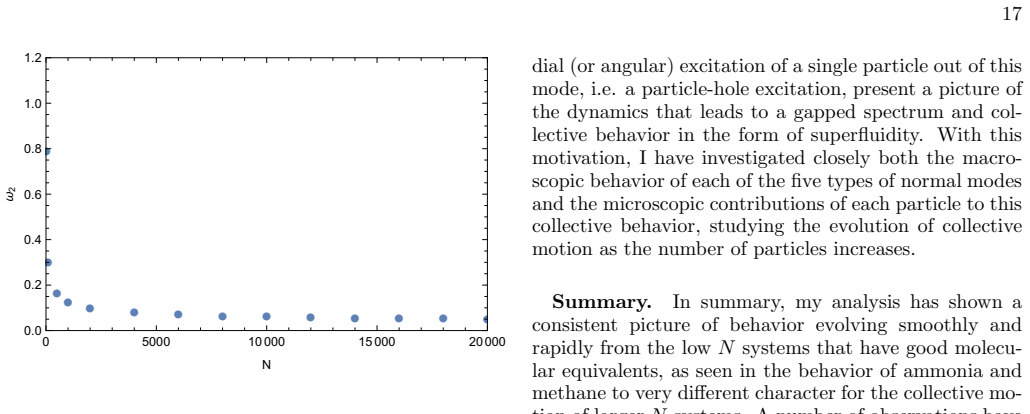
The central claim is that the five L=0 normal modes of N confined identical particles, obtained as analytic functions of N from the first-order $\delta=1/D$ solution of the full N-body Schrödinger equation, change character smoothly and rapidly as N grows. For small N the modes reproduce familiar molecular motions; by $N\simeq 10$ the same analytic forms describe large-ensemble collective motions: breathing, center-of-mass motion pinned at twice the trap frequency, radial and angular particle-hole excitations, and a low-frequency phonon. Applied to the unitary Fermi gas, the mixing coefficients that combine radial and angular symmetry coordinates tend to 0 or 1 as N becomes large, so the normal modes become pure symmetry coordinates of an approximate Hamiltonian; at the same time the five frequencies, initially clustered near the trap frequency, separate, with the phonon dropping orders of magnitude below the trap frequency and radial modes rising above it. The paper presents these two trends as mechanisms that can support the creation and stability of collective behavior such as superfluidity.
Load-bearing premise
The whole analysis depends on the assumption that first-order results from the large-dimension expansion, which are exact only in infinite dimensionality, remain accurate for the true three-dimensional system at every particle number, including the strongly interacting unitary Fermi gas.
Editorial extensions
If this is right
- By N=10, most degenerate modes in the [N-1,1] and [N-2,2] sectors already show large-N behavior, so the few-to-many transition can be studied in small trapped systems rather than in 10^23-particle ensembles.
- In the unitary Fermi gas, the large-N normal modes become pure symmetry coordinates, meaning they are eigenfunctions of an approximate Hamiltonian and no longer depend on the details of the interparticle potential.
- The five frequencies separate with N, producing gaps; with low temperature or other mechanisms that block energy transfer between modes, these gaps can stabilize a single collective mode.
- Because the normal coordinates form a complete basis for L=0 states and for higher-order perturbation corrections, the same modes can generate the excited-state spectrum and thermodynamic partition function of the trapped gas.
- The qualitative evolution is generic to confined identical particles, while the quantitative mixing and frequency pattern depends on the chosen Hamiltonian.
Reading between the lines
- If the first-order 1/D result remains accurate at D=3 for all N, the predicted mode transitions and frequency gaps are measurable: a trapped unitary gas with N between 10 and 100 should already show the asymptotic gap pattern, with the angular phonon far below the trap frequency.
- The molecular analogy suggests a classification scheme in which mesoscopic trapped clusters are labeled by the same five symmetry-coordinate species as symmetric-top molecules, effectively importing molecular spectroscopy into ultracold-gas physics.
- The no-mixing limit at large N hints at an underlying approximate dynamical symmetry of the unitary regime; confirming it would allow collective excitations to be classified group-theoretically without solving the full many-body problem.
- The paper's N=10 transition threshold could be tested independently by exact diagonalization of small harmonically trapped Fermi systems at unitarity, bypassing the 1/D expansion.
Signed reviews
Editorial analysis
A structured set of objections, weighed in public.
Referee Report
Summary. The paper presents an analytic study of the first-order large-dimension perturbation theory (SPT) normal modes for N confined identical particles. It collects and analyzes the five L=0 symmetry-coordinate types, examines the explicit N dependence in the displacement patterns of individual particles, and maps the small-N molecular motions (symmetric and antisymmetric stretches and bends, methane-like angle motions) onto large-N collective motions (breathing, center-of-mass, particle-hole radial and angular excitations, phonon). For the unitary Fermi gas it plots the radial/angular mixing coefficients and the five normal-mode frequencies as functions of N, claiming that the mixing coefficients approach 0 or 1 and that the frequencies separate into large gaps that could stabilize collective behavior.
Significance. If correct, the paper offers an unusually transparent analytic bridge between few-body and many-body collective dynamics, with N appearing as a parameter throughout. The symmetry-coordinate construction and its N dependence are group-theoretically exact, and the formalism has been tested against exactly solvable harmonic confinement/harmonic interaction models (Refs. 23-24), which gives the structural part of the paper real credibility. The new quantitative claims for the unitary Fermi gas, however, inherit the first-order 1/D approximation at D=3 and are not tested here; the figures in Sections V-B and V-C are also not reproducible from the text alone. The qualitative mapping of individual-particle motions is a useful contribution, but the stability and gap conclusions require additional validation or explicit caveats.
major comments (3)
- [§V-B, Eqs. (43)-(50), Figs. 1-4] The unitary-gas mixing coefficients are plotted without specifying the F and G matrix elements (or the effective parameters a, b, c, d and their analogs) for the Hamiltonian used. The text refers to Eq. (42) of Ref. [22] and to Eqs. (75, 76, 100, 101, 119, 120) of Ref. [22], but it does not state which of those Hamiltonians corresponds to the unitary Fermi gas or give the resulting expressions. Because the central claim that the mixing coefficients tend to 0 or 1 is read from these figures, the paper needs to supply the Hamiltonian and F/G elements, or their explicit N-dependence and N→∞ limits, so that the result can be checked.
- [§V-C, Figs. 5-7, Eq. (12)] The frequency gaps and their stability implications are first-order results in δ = 1/D evaluated at D = 3. The cited exact solvable tests (Refs. 23-24) are for harmonic interactions under harmonic confinement; they do not validate the resonant short-range unitary gas. No second-order estimate or independent D=3 benchmark is provided. Since the gaps are the basis of the stability claim, the paper should either provide such a check, or explicitly restrict the claim to the first-order SPT model and state that D=3 validity for the unitary gas remains an assumption.
- [Abstract and §VI] The abstract states that by N=10 the modes 'have clearly become the expected large N behavior', but the mixing coefficients in the [N] sector only become more than 90% pure for N ≳ 200 (Fig. 1), and the frequency separation in Figs. 5-7 continues well beyond N=10, with the [N-1,1] frequencies shown up to N = 20,000. The early crossover is documented for the individual-particle displacement patterns of the symmetry coordinates, not for the mixing coefficients or the frequencies. The paper should distinguish these different measures of 'large-N behavior' and adjust the summary accordingly.
minor comments (4)
- [§III and §VI] There are several typographical errors, including 'ammonis' in Section III, and 'stabiltiy' and 'sytem' in Section VI; these should be corrected.
- [§II.D, Eq. (15)] The degeneracy dμ in Eq. (15) is used before it is defined; give the multiplicities explicitly where the notation is introduced.
- [§V] The molecular-vibration URLs in Section V are not permanent references; consider replacing them with standard textbooks or journal references for the normal modes of ammonia and methane.
- [References] Reference [19] is cited as 'accepted' with a DOI; it should be updated to the published version with full bibliographic details.
Circularity Check
No significant circularity: the N-dependent mode evolution and unitary-gas limits are analytic consequences of previously validated SPT normal modes, not re-fitted inputs.
full rationale
The derivation chain in this paper is an analysis of analytic normal-mode expressions obtained in Refs. [20-22] and applied to the unitary Fermi gas as in Ref. [19]. The paper does not fit any parameter to the quantities it then 'predicts'; the mixing coefficients and frequencies are solutions of the FG eigenvalue problem (Eqs. (12)-(14), (27)-(34)), and their large-N limits follow from the explicit N dependence in the symmetry-coordinate transformation matrices, as the paper itself states in Section V-B. The load-bearing prior results are not bare self-citations: Refs. [23-24] report exact agreement to ten or more digits with an independently solved harmonic-interaction harmonic-confinement model in D=3, and Ref. [19] compares thermodynamic quantities with experimental data. These are independent external benchmarks, so the citation chain does not reduce to authorial assertion. The paper also explicitly flags the non-uniqueness of the symmetry-coordinate basis and the open question of which degenerate normal mode dominates (Section VI, item 5), so the physical interpretations are presented as conditional rather than as forced by definition. The concern that first-order 1/D may be inaccurate at D=3 for the unitary gas is a correctness/robustness risk, not a circularity: the prediction is not equivalent to its input by construction, and no fitted parameter is renamed as a prediction. Hence no circular step can be exhibited.
Assumptions & free parameters
assumptions (4)
- domain assumption First-order 1/D perturbation theory provides quantitatively accurate results at physical dimension D=3 for strongly interacting confined systems, including the unitary Fermi gas.
- domain assumption The large-D minimum configuration is maximally symmetric with all radii equal and all pair angles equal.
- domain assumption The unitary Fermi gas can be described by a spherically symmetric confining potential plus a two-body interaction tuned to unitarity, with F and G elements taken from Ref. 22.
- standard math The symmetric-group decomposition of the radial and angular displacement coordinates into the five irreducible representations is the correct block-diagonalizing basis for L=0 normal modes.
Cite this review
Pith. "Pith review of Normal modes for N identical particles: A study of the evolution of collective behavior from few-body to many-body." pith.science (2026). https://pith.science/paper/ML2T5ASV
@misc{pith2026190808100,
  author       = {Pith},
  title        = {Pith review of: Normal modes for N identical particles: A study of the evolution of collective behavior from few-body to many-body},
  year         = {2026},
  howpublished = {\url{https://pith.science/paper/ML2T5ASV}},
  note         = {Machine review of arXiv:1908.08100}
}
read the original abstract
Normal mode dynamics are ubiquitous underlying the motions of diverse systems from rotating stars to crystal structures. These behaviors are composed of simple collective motions of particles which move with the same frequency and phase, thus encapsulating many-body effects into simple dynamic motions. In regimes such as the unitary regime for ultracold Fermi gases, a single collective mode can dominate, leading to simple behavior as seen in superfluidity. I investigate the evolution of collective motion as a function of N for five types of normal modes obtained from an L=0 group theoretic solution of a general Hamiltonian for confined, identical particles. I show using simple analytic forms that the collective behavior of few-body systems, with the well known motions of molecular equivalents such as ammonia and methane, evolves smoothly to the collective motions expected for large N ensembles. The transition occurs at quite low values of N. I study a Hamiltonian known to support collective behavior, the Hamiltonian for Fermi gases in the unitary regime. I analyze the evolution of both frequencies and the coefficients that mix the radial and angular coordinates which both depend on interparticle interactions. This analysis reveals two phenomena that could contribute to the viability of collective behavior. First the mixing coefficients go to zero or unity, i.e. no mixing, as N becomes large resulting in solutions that do not depend on the details of the interparticle potential as expected for this unitary regime, and that manifest the symmetry of an underlying approximate Hamiltonian. Second, the five normal mode frequencies which are all close for low values of N, separate as N increases, creating large gaps that can, in principle, offer stability to collective behavior if mechanisms to prevent the transfer of energy to other modes exist (such as low temperature) or can be constructed.
Figures


Figures from the paper (4 more)


Reference graph
Works this paper leans on
- [22]
-
[1]
The analytic expressions for the normal modes pro- duce behavior for small N that is analogous to the known behavior of small molecular systems such as ammonia and methane whose atoms move under Coulombic con- finement
-
[2]
As N increases, the behavior of these same analytic functions rapidly changes character, with the exception of the symmetric stretch/breathing motion (part i) below. i) In the [ N ] sector, the breathing motion of the radial [N ] mode retains this character as N increases with the symmetric radial displacements simply decreasing in amplitude. ii) The angu...
-
[3]
This behavior is seen to transition from totally radial, i.e
The behavior of the normal modes which have a mixture of the radial and angular symmetry coordinates in the [ N ] and [ N − 1, 1] sectors was investigated for a particular Hamiltonian of current interest, that of an ensemble of identical confined fermions in the unitary regime. This behavior is seen to transition from totally radial, i.e. a pure radial sym...
-
[4]
Except for the center of mass frequency which sep- arates out for all values of N at twice the trap frequency, the frequencies of oscillation of the normal modes also evolve as N increases. For the case studied of fermions in the unitary regime, the radial frequencies increase in both the [ N ] and [ N − 1, 1] sectors while the angular fre- quencies trend...
-
[5]
The normal coordinates provide a basis not just for the ground state, but for the spectrum of excited states for L = 0 and for higher order corrections in the perturbation expansion. I analyzed just one of the N − 1 degenerate symmetry coordinates in each of the [N −1, 1] sectors that have a frequency of ¯ω 1 and just one of the N (N − 3)/ 2 degenerate sy...
- [6]
- [7]
Show all 53 references
-
[8]
Sanchez, J
B.V. Sanchez, J. Marine Geodesy 31, 181(2008)
2008
-
[9]
Rousseau, R.T
D.L. Rousseau, R.T. Bauman, S.P.S. Porto, J. Ramam Spect., 10, 253(1981)
1981
-
[10]
Lee, K.T
J. Lee, K.T. Crampton, N. Tallarida, and V.A.Apkarian, Nature 568, 78(2019)
2019
-
[11]
Fortunato, EPJ Web of Conferences 178, 02017 (2018)
L. Fortunato, EPJ Web of Conferences 178, 02017 (2018)
2018
-
[12]
Dykeman and O.F
E.C. Dykeman and O.F. Sankey, J. Phys.:Condens. Mat- ter 22, 423202(2010)
2010
-
[13]
Clement, App J
M.J. Clement, App J. 249, 746(1981)
1981
- [14]
-
[15]
K. D. Kokkolas, Class. Quantum Grav. 8, 2217 (1991)
1991
-
[16]
Stratt, Acc
R.M. Stratt, Acc. Chem. Res. 28, 201(1995)
1995
-
[17]
McDonald, G
C.R. McDonald, G. Orlando, J.W. Abraham, D. Hochstuhl, M. Bonitz, and T. Brabee, Phys. Rev. Lett. 111, 256801 (2013); F. Dalfove, S. Giorgini, L.P. Pitaevskii, and S. Stringari, Rev. Mod. Phys. 71, 463(1999); D. Jaksch, C. Bruder, J.I. Cirac, C.W. Gar- diner, and P. Zoller, Ph...
2013 doi
-
[18]
Nagerl, C
H.C. Nagerl, C. Roos, H. Rohde, D. Leibfried, J. Eschner , F. Schmidt-Kaler and R. Blatt, Fortschr. Phys. 48, 623 (2000)
2000
-
[19]
Anderson, P.W., Science 177, 393(1972)
1972
-
[20]
Anderson, Nature 437, 625 (2005)
P.W. Anderson, Nature 437, 625 (2005)
2005
-
[21]
Guidry and Y
M. Guidry and Y. Sun, Frontiers of Physics, 10, 1 (2015)
2015
-
[23]
Zaanen, Science 319, 1205 (2008)
J. Zaanen, Science 319, 1205 (2008)
2008
-
[24]
Watson, ”Universal thermodynamics of a trapped Fermi gas in the superfluid regime: the role of the Pauli principle”, accepted J
D.K. Watson, ”Universal thermodynamics of a trapped Fermi gas in the superfluid regime: the role of the Pauli principle”, accepted J. Phys. B., https://doi.org/10.1088/1361-6455/ab3c11
-
[25]
Dunn, D.K
M. Dunn, D.K. Watson, and J.G. Loeser, Ann. Phys. (NY), 321, 1939 (2006)
2006
-
[26]
Laing, M
W.B. Laing, M. Dunn, and D.K. Watson, J. of Math. Phys. 50, 062105 (2009)
2009
-
[27]
McKinney, M
B.A. McKinney, M. Dunn, D.K. Watson, and J.G. Loeser, Ann. Phys. 310, 56 (2003)
2003
-
[28]
Laing, D.W
W.B. Laing, D.W. Kelle, M. Dunn, and D.K. Watson, J Phys A 42, 205307 (2009)
2009
-
[29]
Dunn, W.B
M. Dunn, W.B. Laing, D. Toth, and D.K. Watson, Phys. Rev A 80, 062108 (2009)
2009
-
[30]
Watson and M
D.K. Watson and M. Dunn, Phys. Rev. Lett. 105, 020402 (2010)
2010
-
[31]
Watson and M
D.K. Watson and M. Dunn, J. Phys. B 45, 095002 (2012)
2012
-
[32]
Laing, M
W.B. Laing, M. Dunn, and D.K. Watson, EPAPS Docu- ment Number E-JMAPAQ-50-031904
-
[33]
McKinney, M
B.A. McKinney, M. Dunn, D.K. Watson, Phys. Rev. A 69, 053611 (2004)
2004
-
[34]
Laing, M
W.B. Laing, M. Dunn, and D.K. Watson, Phys. Rev. A 74, 063605 (2006)
2006
-
[35]
Watson, Phys
D.K. Watson, Phys. Rev. A 92, 013628 (2015)
2015
-
[36]
Watson, Phys
D.K. Watson, Phys. Rev. A 93, 023622 (2016)
2016
-
[37]
Watson, Phys
D.K. Watson, Phys. Rev. A 96, 033601(2017)
2017
-
[38]
Avery, D.Z
J. Avery, D.Z. Goodson, D.R. Herschbach, Theor. Chim. Acta 81, 1 (1991)
1991
-
[39]
Chatterjee, J
A. Chatterjee, J. Phys. A: Math. Gen. 18, 735 (1985)
1985
-
[40]
Wilson, Jr., J.C
E.B. Wilson, Jr., J.C. Decius, P.C. Cross, Molecular vi- brations: The theory of infrared and raman vibrational spectra. McGraw-Hill, New York, 1955
1955
-
[41]
Hamermesh, Group theory and its application to phys- ical problems
M. Hamermesh, Group theory and its application to phys- ical problems. Addison-Wesley, Reading, MA, 1962
1962
-
[42]
Loeser, J
J.G. Loeser, J. Chem. Phys. 86, 5635 (1987)
1987
-
[43]
[35], Appendix XII, p
See for example Ref. [35], Appendix XII, p. 347
-
[44]
Gantmacher, The theory of matrices, Vol
F.R. Gantmacher, The theory of matrices, Vol. 1 . Chelsea, New York, 1959
1959
-
[45]
See for example Ref. [36], p. 100
-
[46]
Adhikari, Phys
S.K. Adhikari, Phys. Rev. A 79, 023611(2009)
2009
-
[47]
X.-J. Liu, H. Hu,and P.D. Drummond, Phys. Rev. Lett. 102, 160401 (2009)
2009
-
[48]
X.-J. Liu, H. Hu, and P.D. Drummond, Phys. Rev. A 82, 023619 (2010)
2010
-
[49]
X.-J. Liu, H. Hu, and P.D. Drummond, Phys. Rev. B 82, 054524 (2010)
2010
-
[50]
Grining, M
T. Grining, M. Tomza, M. Lesiuk, M. Przybytek, M. Mu- sial, R. Moszynski, M. Lewenstein, and P. Massignan, PRA 92, 061601 (2015)
2015
-
[51]
Blume, Physics 3, 74 (2010)
D. Blume, Physics 3, 74 (2010)
2010
-
[52]
D.Blume, Rep. Prog. Phys. 75, 046401 (2012)
2012
-
[53]
Levinsen, P
J. Levinsen, P. Massignan, S. Endo, and M.M. Parish, J. Phys. B 50, 072001 2017)
2017
Reviewed August 14, 2026 · model on record in the stance chip above.
Discussion (0). Continue with ORCID to comment.