REVIEW 1 major objections 1 minor 3 references
Syllabic-Structure Decoder for Automatic Speech Recognition in Vietnamese
T0 review · 1 major / 1 minor · reviewed 2026-06-29 · grok-4.3
Pith's one-line read A syllabic-structure decoder models Vietnamese ASR at the phoneme level and outperforms orthographic baselines with a smaller vocabulary.
desk verdict The syllabic decoder is a straightforward language-specific tweak that trades orthographic units for phoneme-level syllable rules and claims smaller vocab plus better results on two Vietnamese benchmarks. read the letter →
The pith
A machine-rendered reading of the paper's core claim, the machinery that carries it, and where it could break.
The reading
What carries the argument
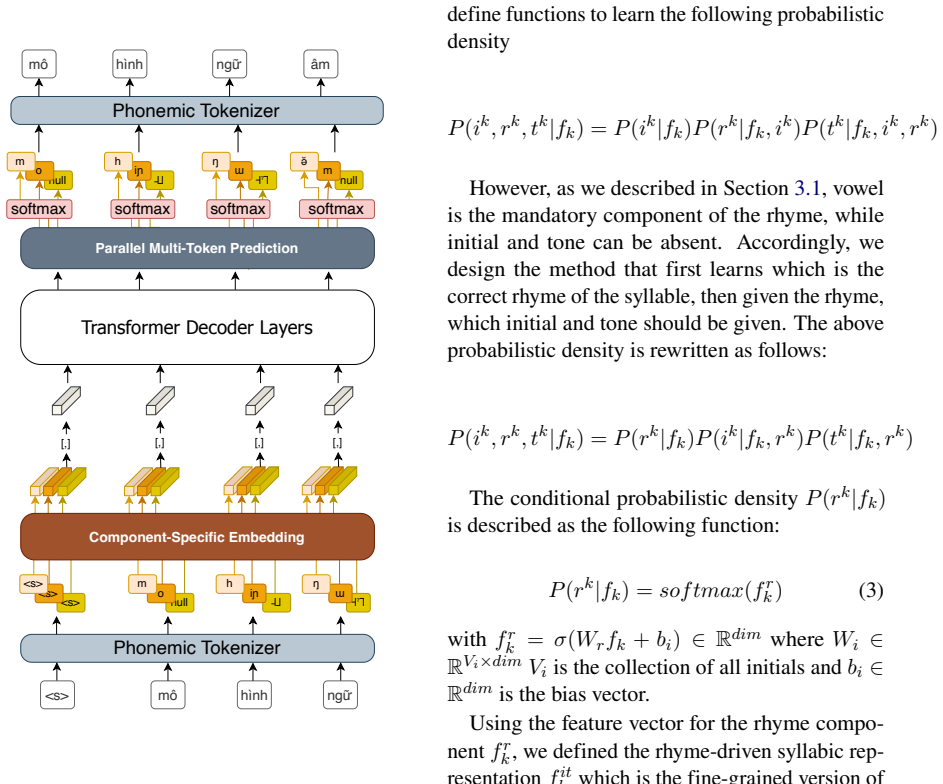
The Syllabic-Structure Decoder, which captures phonological composition of syllables to produce only valid structures from a compact phonemic inventory.
What would settle it
An experiment in which the syllabic decoder is given the same vocabulary size as an orthographic baseline and still shows no accuracy gain on either LSVSC or UIT-ViMD.
Extended reading notes
Core claim
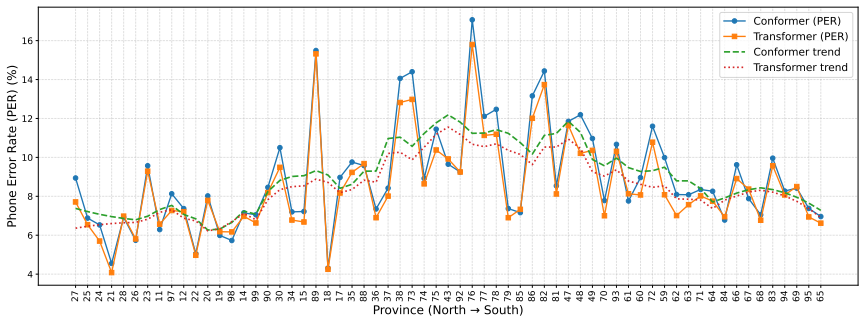
The syllabic-structure decoder models speech at the phoneme level instead of the orthographic level by explicitly capturing the phonological composition of syllables, enabling the decoder to generate valid syllabic structures from a compact phonemic inventory. This design more closely aligns with the phonetic realization of speech while significantly reducing vocabulary size. On the LSVSC and UIT-ViMD benchmarks the method consistently outperforms baselines including PhoWhisper and Wav2Vec2 despite the smaller vocabulary and absence of additional training resources.
Load-bearing premise
Explicitly encoding syllabic phonological rules in the decoder produces structures that match phonetic speech realization better than orthographic units do.
Editorial extensions
If this is right
- Transcription accuracy rises on both standard and multi-dialect Vietnamese speech without added training data or larger vocabularies.
- Vocabulary size drops substantially while coverage of valid syllables remains complete.
- Phoneme-level modeling with syllable constraints replaces the need for large orthographic inventories in this language.
- The decoder aligns output generation more directly with phonetic production rules than character or word prediction does.
Reading between the lines
- The same explicit syllable modeling may help other tonal languages where syllable boundaries carry phonetic weight.
- Smaller vocabularies could reduce memory and compute needs for on-device Vietnamese ASR.
- Language-specific phonetic rules might substitute for some of the scale currently obtained through large pretraining.
Signed reviews
Editorial analysis
A structured set of objections, weighed in public.
Referee Report
Summary. The manuscript proposes a Syllabic-Structure Decoder for Vietnamese ASR that models transcription at the phoneme level rather than orthographic units (characters, subwords, or words). By explicitly capturing the phonological composition of syllables, the decoder generates valid syllabic structures from a compact phonemic inventory. This design is claimed to align more closely with phonetic realization while reducing vocabulary size. Experiments on the LSVSC (standard speech) and UIT-ViMD (multi-dialect) benchmarks are reported to show consistent outperformance over baselines including PhoWhisper and Wav2Vec2, with no additional training resources used. Code release is promised upon acceptance.
Significance. If the empirical claims hold with proper controls and ablations, the work could demonstrate a linguistically grounded efficiency gain for ASR in tonal languages with clear syllabic structure, by leveraging phonemic modeling over larger orthographic vocabularies. The explicit commitment to public code supports reproducibility.
major comments (1)
- [Abstract] Abstract: The central claim of consistent outperformance on LSVSC and UIT-ViMD (including over pretrained models PhoWhisper and Wav2Vec2) is presented without any quantitative results, error rates (e.g., WER or CER), statistical tests, error bars, ablation studies, or implementation details. This absence prevents verification that the data support the claim and makes the empirical contribution impossible to assess.
minor comments (1)
- [Abstract] Abstract: The phrase 'especially pretrained baselines' is imprecise; clarify whether the gains hold against all listed baselines or only the pretrained subset.
Simulated Author's Rebuttal
Thank you for the constructive feedback on our manuscript. We appreciate the referee's focus on ensuring the empirical claims are clearly supported. We address the single major comment below and will revise the abstract accordingly.
read point-by-point responses
-
Referee: [Abstract] Abstract: The central claim of consistent outperformance on LSVSC and UIT-ViMD (including over pretrained models PhoWhisper and Wav2Vec2) is presented without any quantitative results, error rates (e.g., WER or CER), statistical tests, error bars, ablation studies, or implementation details. This absence prevents verification that the data support the claim and makes the empirical contribution impossible to assess.
Authors: We agree that the abstract would be strengthened by including key quantitative results to support the claims. The body of the manuscript already reports detailed WER/CER metrics, comparisons against PhoWhisper and Wav2Vec2, ablations, and implementation details on the two benchmarks. In the revised version, we will update the abstract to highlight specific performance numbers (e.g., WER reductions) and standard evaluation metrics. We will also note the compact vocabulary size and lack of additional training resources. Code release is already promised upon acceptance. revision: yes
Circularity Check
No significant circularity
full rationale
The paper presents an empirical ASR method using a phoneme-level syllabic decoder and reports direct performance gains over external baselines (PhoWhisper, Wav2Vec2) on LSVSC and UIT-ViMD. No equations, fitted parameters relabeled as predictions, self-citations, or uniqueness theorems appear in the supplied text. The central claim rests on standard benchmark comparisons with a smaller vocabulary and no extra resources; the derivation chain contains no self-referential reductions.
Assumptions & free parameters
Cite this review
Pith. "Pith review of Syllabic-Structure Decoder for Automatic Speech Recognition in Vietnamese." pith.science (2026). https://pith.science/paper/ML3DFPIM
@misc{pith2026260527874,
  author       = {Pith},
  title        = {Pith review of: Syllabic-Structure Decoder for Automatic Speech Recognition in Vietnamese},
  year         = {2026},
  howpublished = {\url{https://pith.science/paper/ML3DFPIM}},
  note         = {Machine review of arXiv:2605.27874}
}
read the original abstract
Most Automatic Speech Recognition (ASR) systems formulate transcription as a prediction problem over orthographic units such as characters, subwords, or words. Although effective, such representations do not explicitly reflect the phonetic structure of speech and often require large vocabularies to maintain adequate coverage. In this work, we are motivated from the phonemic features of Vietnamese to propose a Syllabic-Structure Decoder for ASR, which models speech at the phoneme level instead of the orthographic level. Our approach explicitly captures the phonological composition of syllables, enabling the decoder to generate valid syllabic structures from a compact phonemic inventory. This design more closely aligns with the phonetic realization of speech while significantly reducing vocabulary size. Experimental results on two benchmarks: LSVSC, representing standard speech, and UIT-ViMD, a multi-dialect corpus containing diverse regional pronunciations, show that our method consistently outperforms strong previous baselines, especially pretrained baselines such as PhoWhisper and Wav2Vec2, despite using a substantially smaller vocabulary and no additional training resources. These results highlight the effectiveness of phoneme-based syllabic modeling for ASR in this language. Code for experimental reproducibility will be publicly available upon the acceptance of this paper.
Figures
Figures from the paper (1 more)

Reference graph
Works this paper leans on
-
[1]
SpeechBrain: A General-Purpose Speech Toolkit
Conformer: Convolution-augmented trans- former for speech recognition. In21st Annual Con- ference of the International Speech Communication Association, Interspeech 2020, Virtual Event, Shang- hai, China, October 25-29, 2020, pages 5036–5040. ISCA. Nghia Hieu Nguyen, Dat Tien Nguyen, and Ngan Luu- Thuy Nguyen. 2025. Vietnamese words are not con- structed ...
work page Pith review arXiv 2020
-
[2]
Vietnamese is a monosyllabic language
-
[3]
That is, in this language, we do not have the linking pronunciation as in English, and every phoneme has persistent writing forms
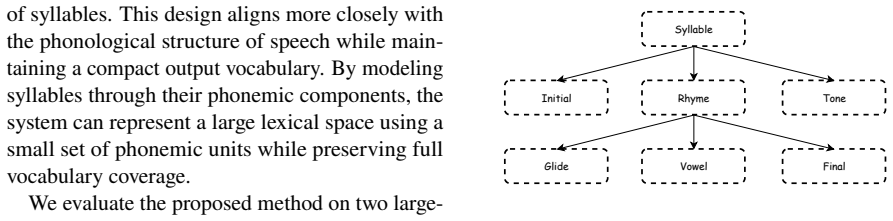
The correspondence between graphemes and phonemes in Vietnamese is consistent. That is, in this language, we do not have the linking pronunciation as in English, and every phoneme has persistent writing forms. In Vietnamese, each syllable has three components: initials, rhymes, and tones. Rhyme has smaller components, which are glide, vowel, and final. We...
Reviewed June 29, 2026 · model on record in the stance chip above.
Discussion (0). Continue with ORCID to comment.