REVIEW 4 major objections 5 minor 38 references
Deep Density-aware Count Regressor
T0 review · 4 major / 5 minor · reviewed 2026-08-14 · deepseek-v4-flash
Pith's one-line read This paper claims crowd counting improves when a backbone network is trained by fusing gradients from five pixelated density-map branches, then used alone for fast global-count inference.
desk verdict A training-time auxiliary-branch trick for crowd counting that works in benchmarks, but the paper's SNR story isn't quantitatively established and the Mall SOTA claim is overstated. read the letter →
The pith
A machine-rendered reading of the paper's core claim, the machinery that carries it, and where it could break.
The reading
What carries the argument
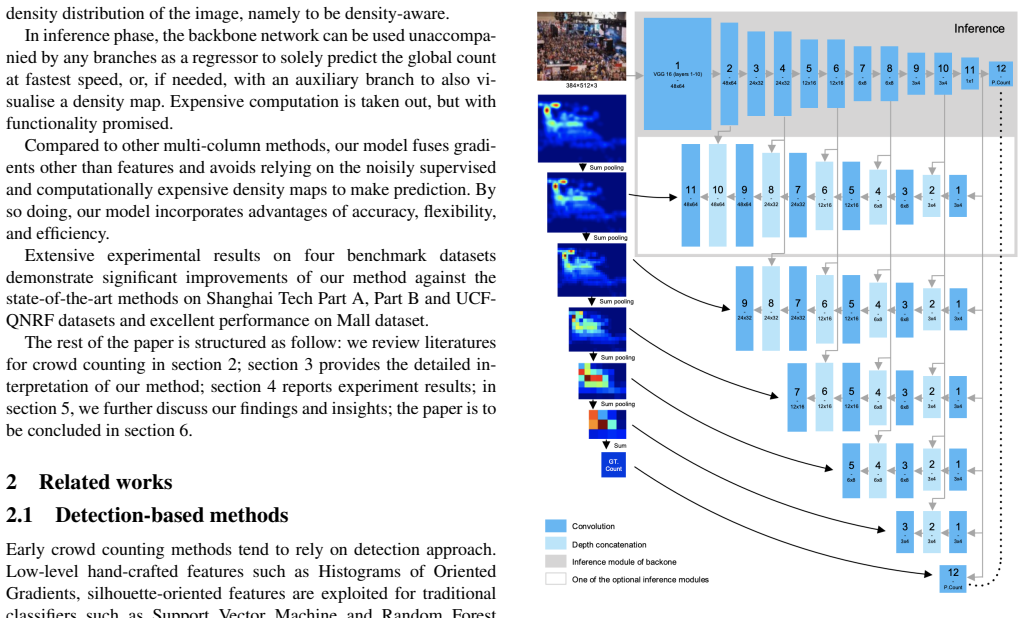
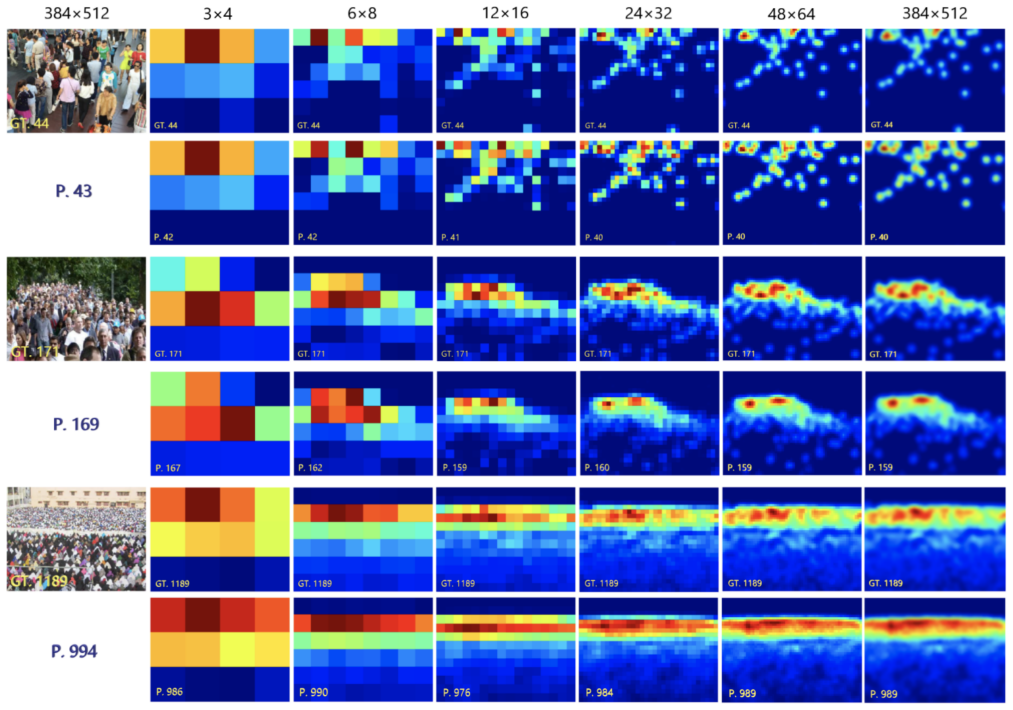
Gradient fusion of multilevel pixelated density maps. The backbone is a VGG-16 frontend followed by strided convolutions that regress a global count; five transposed-convolution branches, reading features at different depths, produce density maps of sizes $\{48 \times 64, 24 \times 32, 12 \times 16, 6 \times 8, 3 \times 4\}$. Training sums L1 losses from all six outputs with a weighting that emphasizes the count, so gradients from density supervision flow into the backbone; inference uses only the backbone. The SNR calculation models pixelation as sum pooling, showing signal mean and noise variance both scale as $4^n$, so SNR grows as $C \cdot 4^n$; this motivates the coarsest density maps as the cleanest count supervision.
What would settle it
Obtain repeated independent head annotations of the same crowd images and measure the spatial autocorrelation of the annotation-position errors; under the paper's model the errors should be uncorrelated and the SNR of summed pixels should grow by about $4^n$. If the measured errors are correlated over neighboring heads, the SNR scaling fails, and the stated motivation for multilevel pixelation loses its quantitative basis.
Extended reading notes
Core claim
The paper's claim is that crowd counting can be made both more accurate and faster by fusing gradients rather than features. During training, five branches attached to different depths of a VGG-based backbone predict density maps of sizes 48x64 down to 3x4, and their losses, together with a weighted global-count loss, all backpropagate into the shared backbone. This makes the backbone density-aware. At inference the branches are dropped, leaving a lightweight global-count regressor with 21.4 million parameters that reaches 45 FPS. On the benchmarks the reported gains are MAE 65.2 and RMSE 112.5 on Shanghai Tech Part A, 7.2 and 11.3 on Part B, and 95.7 and 167.1 on UCF-QNRF. The paper also argues the multilevel pixelation of the ground-truth density map raises the signal-to-noise ratio by a factor of $4^n$ after $n$ levels of $2 \times 2$ pooling, so the coarser density maps used as supervision are quantitatively cleaner counting signals.
Load-bearing premise
The argument that smaller density maps improve signal-to-noise ratio assumes annotation errors are zero-mean, independent Gaussian noise; if errors are correlated or biased, the exponential SNR gain does not follow.
Editorial extensions
If this is right
- If the accuracy results hold, a crowd-counting deployment can use the fast backbone alone and optionally attach a branch only when a density map is needed.
- The SNR argument implies that, for annotation noise that is zero-mean and independent, coarser density maps are better supervision per pixel, so other counting architectures could benefit from adding a coarse-map loss branch.
- Because the branches are detached at inference, the expensive multi-column computation happens only during training, giving multi-scale supervision without multi-scale inference cost.
- Gradient fusion reframes multi-column design: instead of fusing features, one can fuse gradients from auxiliary tasks into a task-specific backbone.
- The reported speed advantage over CSRNet (45 vs 33 FPS, 1.4x) with fewer backend FLOPs means real-time counting is possible on a single GPU.
Reading between the lines
- The paper's SNR model is idealized; a natural next test is to measure annotation-error correlation on real crowds, which would show whether the exponential SNR gain holds in practice.
- The same gradient-fusion recipe could apply to other dense prediction tasks where a fast inference network is desired but multi-scale supervision helps training; the paper does not explore this.
- The ablation suggests that most of the gain comes from the coarser branches, so a practical variant might keep only the small density-map branches during training to cut training cost further.
Signed reviews
Editorial analysis
A structured set of objections, weighed in public.
Referee Report
Summary. The paper proposes DeepCount, a crowd counting network with a VGG-16 frontend backbone that regresses a global count at inference, while five auxiliary branches predict density maps at multiple resolutions during training. Gradient fusion from these branches is used to train the backbone, and the branches are detached at inference to save computation. The method is evaluated on Shanghai Tech Part A/B, UCF-QNRF, and Mall, reporting state-of-the-art MAE/RMSE on the first three datasets and competitive results on Mall, with higher inference speed than CSRNet. The authors motivate multilevel density-map pixelation by a signal-to-noise ratio (SNR) argument in Section 3.2, and support the design with ablations on branch removal and activation functions.
Significance. If the reported results are reproducible, the paper makes a useful contribution to crowd counting by decoupling training-time multi-scale density supervision from inference-time efficiency, and by showing that a single-column backbone can outperform multi-column density-map methods. The authors provide public code, detailed network configuration tables, and ablation experiments, which are strengths. However, the theoretical SNR justification in Section 3.2 is flawed as written, and the experimental reporting lacks error bars and multiple runs, so the state-of-the-art claims are not yet fully established.
major comments (4)
- [Section 3.2, Eq. (3)] The SNR derivation omits the signal variance φ that the paper itself defines. With S ∼ N(μ0, φ) and independent noise pooled over 4^n pixels, the power-ratio SNR would be (μ_n^2 + φ_n)/σ_n^2 = (4^n μ0^2 + 4^n φ)/(4^n σ0^2) = (μ0^2 + φ)/σ0^2, which is constant in n, not C·4^n. The exponential growth claimed in Eq. (3) therefore depends on an unstated choice to ignore the signal variance φ. The derivation should be revised to state precisely which ratio grows, or replaced by an empirical argument.
- [Section 3.2, noise model] The assumption that annotation noise is zero-mean, Gaussian, and independent across pixels is not realistic for the dominant error source in crowd counting: annotation position jitter creates a spatially correlated error pattern (a shifted Gaussian kernel) whose variance does not scale as 4^n under pooling. The claimed SNR improvement is therefore not quantitatively established for actual density maps. The authors should either empirically validate the noise model on the datasets used, or reframe Section 3.2 as a heuristic motivation rather than a quantitative derivation.
- [Tables 2, 4, 5, 6, 8, 9] All quantitative claims, including the state-of-the-art results, are reported without standard deviations, confidence intervals, or the number of runs. Differences such as Part A MAE 65.2 vs. PSDDN+ 65.9, and Mall MAE 1.55 vs. DecideNet 1.52, may be within run-to-run variation. Multiple independent training runs (or at least error bars on the main benchmark numbers) are needed to support the claimed improvements, especially because the paper reports single-run ablations in Tables 8 and 9.
- [Section 4.4, Table 5] On Mall, the proposed method achieves MAE 1.55, which is worse than DecideNet's 1.52. The text calls this 'excellent performance' without acknowledging that it is not state-of-the-art even among methods listed in the same table. Since the abstract and introduction claim improvements over state-of-the-art on public datasets, this discrepancy should be clarified, and the Mall result should be compared with appropriate significance testing.
minor comments (5)
- [Abstract and Introduction] The phrase 'multilayer gradient fusion' is used in the abstract but the method section uses 'Gradient Fusion'; please align the terminology throughout.
- [Section 1, last paragraph] The sentence 'Gaussian dispersion can only alleviate the issue to short extend' contains a typo: 'short extend' should be 'short extent'.
- [Section 3.3, Table 1] The table caption says 'The pattern H × W × C × C represents the dimension of convolution kernel', but the fourth value is the number of output channels, not another spatial dimension; please reformulate for clarity.
- [Table 6] The parameter count '21.4 (58.1 in total)' is confusing: it is unclear whether 58.1 includes all branches or only some, and whether 21.4 refers to the inference backbone alone. Please define both numbers explicitly.
- [Section 5.2, Figure 3] The discussion of upsampling density maps to original resolution would benefit from a quantitative evaluation of the upsampled density maps, since visual inspection alone is not convincing.
Circularity Check
No significant circularity: the DeepCount architecture and results are empirically evaluated against external benchmarks, with no self-citation chain or fitted-parameter-as-prediction reduction.
full rationale
The paper's central claims are empirical: a gradient-fusion training scheme, a backbone-only inference path, and state-of-the-art MAE/RMSE numbers on ShanghaiTech A/B, UCF-QNRF, and Mall. The reported results come from training on standard train splits and testing on standard test splits, using publicly available datasets and external baselines. No parameter is fitted to a subset of the benchmark data and then renamed as a prediction: the hyperparameters (beta, omega, lambda, alpha, learning rate) are fixed across datasets, and the ablated branch experiments in Table 9 directly measure the contribution of each branch. The SNR argument in Section 3.2 is motivation, not a fitted component: Eq. (3) defines C from mu_0 and sigma_0, and the constant is not estimated from or optimized against the test data. Even if the SNR derivation is statistically questionable, as the skeptic notes, that is a correctness or modeling concern, not circularity. The paper does not invoke any uniqueness theorem, does not rely on a load-bearing self-citation (references to the authors' own prior work are absent), and does not redefine a known empirical pattern as its own contribution. The inference-time backbone is a genuinely ablated version of the trained model, and its faster speed is measured directly against CSRNet. Therefore no circular step can be exhibited, and the appropriate score is 0.
Assumptions & free parameters
free parameters (5)
- beta (loss weight for global count) =
16
- omega (loss scaling factor) =
1e-2
- lambda (L2 regularization) =
1e-5
- alpha (PReLU parameter) =
0.2
- Gaussian kernel standard deviation sigma =
5
assumptions (3)
- domain assumption Annotation noise and signal in density maps are independent, zero-mean Gaussian (noise) and non-zero-mean Gaussian (signal) with variances that add under 2x2 pooling.
- domain assumption Gradient fusion from density map branches at multiple scales makes the backbone density-aware and improves count prediction.
- domain assumption The pretrained VGG-16 frontend provides a good feature extractor for crowd scenes.
Cite this review
Pith. "Pith review of Deep Density-aware Count Regressor." pith.science (2026). https://pith.science/paper/ML5V3IQV
@misc{pith2026190803314,
  author       = {Pith},
  title        = {Pith review of: Deep Density-aware Count Regressor},
  year         = {2026},
  howpublished = {\url{https://pith.science/paper/ML5V3IQV}},
  note         = {Machine review of arXiv:1908.03314}
}
read the original abstract
We seek to improve crowd counting as we perceive limits of currently prevalent density map estimation approach on both prediction accuracy and time efficiency. We leverage multilevel pixelation of density map as it helps improve SNR of training data and therefore, reduce prediction error. To achieve a better model, we introduce multilayer gradient fusion for training a density-aware global count regressor. More specifically, on training stage, a backbone network receives gradients from multiple branches to learn the density information, whereas those branches are to be detached to accelerate inference. By taking advantages of such method, our model improves benchmark results on public datasets and exhibits itself to be a new solution to crowd counting problems in practice.
Figures
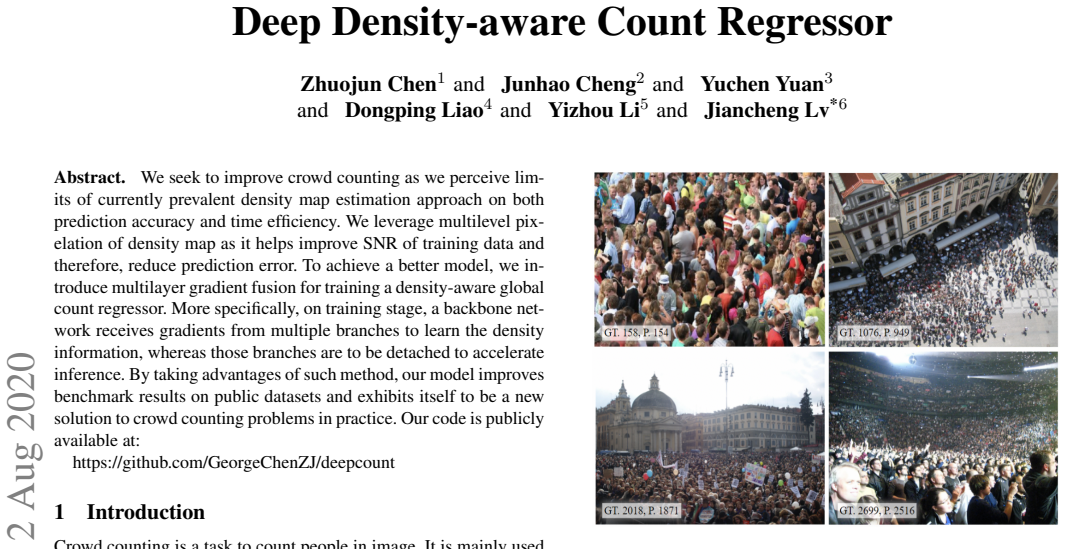
Reference graph
Works this paper leans on
-
[1]
Deepak Babu Sam, Shiv Surya, and R Venkatesh Babu, ‘Switching convolutional neural network for crowd counting’, in Proceedings of the IEEE Conference on Computer Vision and Pattern Recognition, pp. 5744–5752, (2017)
work page 2017
-
[2]
Xinkun Cao, Zhipeng Wang, Yanyun Zhao, and Fei Su, ‘Scale aggrega- tion network for accurate and efficient crowd counting’, inProceedings of the European Conference on Computer Vision (ECCV), pp. 734–750, (2018)
work page 2018
-
[3]
Antoni B Chan, Zhang-Sheng John Liang, and Nuno Vasconcelos, ‘Pri- vacy preserving crowd monitoring: Counting people without people models or tracking’, in2008 IEEE Conference on Computer Vision and Pattern Recognition, pp. 1–7. IEEE, (2008)
work page 2008
- [4]
-
[5]
Jifeng Dai, Yi Li, Kaiming He, and Jian Sun, ‘R-fcn: Object detection via region-based fully convolutional networks’, in Advances in neural information processing systems, pp. 379–387, (2016)
work page 2016
-
[6]
Juergen Gall, Angela Yao, Nima Razavi, Luc Van Gool, and Victor Lempitsky, ‘Hough forests for object detection, tracking, and action recognition’, IEEE transactions on pattern analysis and machine in- telligence, 33(11), 2188–2202, (2011)
work page 2011
- [7]
-
[8]
Xavier Glorot and Yoshua Bengio, ‘Understanding the difficulty of training deep feedforward neural networks’, inProceedings of the thir- teenth international conference on artificial intelligence and statistics , pp. 249–256, (2010)
work page 2010
Show all 38 references
-
[9]
770–778, (2016)
Kaiming He, Xiangyu Zhang, Shaoqing Ren, and Jian Sun, ‘Deep resid- ual learning for image recognition’, inProceedings of the IEEE confer- ence on computer vision and pattern recognition, pp. 770–778, (2016)
2016
-
[10]
Andrew G Howard, Menglong Zhu, Bo Chen, Dmitry Kalenichenko, Weijun Wang, Tobias Weyand, Marco Andreetto, and Hartwig Adam, ‘Mobilenets: Efficient convolutional neural networks for mobile vision applications’,arXiv preprint arXiv:1704.04861, (2017)
2017 arXiv
-
[11]
4700–4708, (2017)
Gao Huang, Zhuang Liu, Laurens Van Der Maaten, and Kilian Q Wein- berger, ‘Densely connected convolutional networks’, inProceedings of the IEEE conference on computer vision and pattern recognition , pp. 4700–4708, (2017)
2017
-
[12]
2547–2554, (2013)
Haroon Idrees, Imran Saleemi, Cody Seibert, and Mubarak Shah, ‘Multi-source multi-scale counting in extremely dense crowd images’, in Proceedings of the IEEE conference on computer vision and pattern recognition, pp. 2547–2554, (2013)
2013
-
[13]
Haroon Idrees, Khurram Soomro, and Mubarak Shah, ‘Detecting hu- mans in dense crowds using locally-consistent scale prior and global occlusion reasoning’, IEEE transactions on pattern analysis and ma- chine intelligence, 37(10), 1986–1998, (2015)
2015
-
[14]
532–546, (2018)
Haroon Idrees, Muhmmad Tayyab, Kishan Athrey, Dong Zhang, So- maya Al-Maadeed, Nasir Rajpoot, and Mubarak Shah, ‘Composition loss for counting, density map estimation and localization in dense crowds’, inProceedings of the European Conference on Computer Vi- sion (ECCV), pp. 5...
2018
-
[15]
6133–6142, (2019)
Xiaolong Jiang, Zehao Xiao, Baochang Zhang, Xiantong Zhen, Xian- bin Cao, David Doermann, and Ling Shao, ‘Crowd counting and den- sity estimation by trellis encoder-decoder networks’, inProceedings of the IEEE Conference on Computer Vision and Pattern Recognition, pp. 6133–614...
2019
-
[16]
1187–1190
Dan Kong, Douglas Gray, and Hai Tao, ‘A viewpoint invariant ap- proach for crowd counting’, in 18th International Conference on Pat- tern Recognition (ICPR’06), volume 3, pp. 1187–1190. IEEE, (2006)
2006
-
[17]
Min Li, Zhaoxiang Zhang, Kaiqi Huang, and Tieniu Tan, ‘Estimat- ing the number of people in crowded scenes by mid based foreground segmentation and head-shoulder detection’, in2008 19th International Conference on Pattern Recognition, pp. 1–4. IEEE, (2008)
2008
-
[18]
1091–1100, (2018)
Yuhong Li, Xiaofan Zhang, and Deming Chen, ‘Csrnet: Dilated con- volutional neural networks for understanding the highly congested scenes’, inProceedings of the IEEE conference on computer vision and pattern recognition, pp. 1091–1100, (2018)
2018
-
[19]
5197–5206, (2018)
Jiang Liu, Chenqiang Gao, Deyu Meng, and Alexander G Hauptmann, ‘Decidenet: Counting varying density crowds through attention guided detection and density estimation’, in Proceedings of the IEEE Con- ference on Computer Vision and Pattern Recognition , pp. 5197–5206, (2018)
2018
-
[20]
Lingbo Liu, Hongjun Wang, Guanbin Li, Wanli Ouyang, and Liang Lin, ‘Crowd counting using deep recurrent spatial-aware network’, arXiv preprint arXiv:1807.00601, (2018)
2018 arXiv
-
[21]
6469–6478, (2019)
Yuting Liu, Miaojing Shi, Qijun Zhao, and Xiaofang Wang, ‘Point in, box out: Beyond counting persons in crowds’, in Proceedings of the IEEE Conference on Computer Vision and Pattern Recognition , pp. 6469–6478, (2019)
2019
-
[22]
2539– 2546, (2013)
Zheng Ma and Antoni B Chan, ‘Crossing the line: Crowd counting by integer programming with local features’, in Proceedings of the IEEE Conference on Computer Vision and Pattern Recognition , pp. 2539– 2546, (2013)
2013
-
[23]
3253–3261, (2015)
Viet-Quoc Pham, Tatsuo Kozakaya, Osamu Yamaguchi, and Ryuzo Okada, ‘Count forest: Co-voting uncertain number of targets using ran- dom forest for crowd density estimation’, in Proceedings of the IEEE International Conference on Computer Vision, pp. 3253–3261, (2015)
2015
-
[24]
270–285, (2018)
Viresh Ranjan, Hieu Le, and Minh Hoai, ‘Iterative crowd counting’, in Proceedings of the European Conference on Computer Vision (ECCV), pp. 270–285, (2018)
2018
-
[25]
91–99, (2015)
Shaoqing Ren, Kaiming He, Ross Girshick, and Jian Sun, ‘Faster r-cnn: Towards real-time object detection with region proposal networks’, in Advances in neural information processing systems, pp. 91–99, (2015)
2015
-
[26]
2423–2430
Mikel Rodriguez, Ivan Laptev, Josef Sivic, and Jean-Yves Audibert, ‘Density-aware person detection and tracking in crowds’, in 2011 In- ternational Conference on Computer Vision , pp. 2423–2430. IEEE, (2011)
2011
-
[27]
Deepak Babu Sam and R Venkatesh Babu, ‘Top-down feedback for crowd counting convolutional neural network’, in Thirty-Second AAAI Conference on Artificial Intelligence, (2018)
2018
-
[28]
Biyun Sheng, Chunhua Shen, Guosheng Lin, Jun Li, Wankou Yang, and Changyin Sun, ‘Crowd counting via weighted vlad on a dense at- tribute feature map’, IEEE Transactions on Circuits and Systems for Video Technology, 28(8), 1788–1797, (2016)
2016
-
[29]
5382–5390, (2018)
Zenglin Shi, Le Zhang, Yun Liu, Xiaofeng Cao, Yangdong Ye, Ming- Ming Cheng, and Guoyan Zheng, ‘Crowd counting with deep negative correlation learning’, in Proceedings of the IEEE conference on com- puter vision and pattern recognition, pp. 5382–5390, (2018)
2018
-
[30]
Karen Simonyan and Andrew Zisserman, ‘Very deep convolu- tional networks for large-scale image recognition’, arXiv preprint arXiv:1409.1556, (2014)
2014 arXiv
-
[31]
Vishwanath A Sindagi and Vishal M Patel, ‘Cnn-based cascaded multi- task learning of high-level prior and density estimation for crowd count- ing’, in 2017 14th IEEE International Conference on Advanced Video and Signal Based Surveillance (AVSS), pp. 1–6. IEEE, (2017)
2017
-
[32]
1861– 1870, (2017)
Vishwanath A Sindagi and Vishal M Patel, ‘Generating high-quality crowd density maps using contextual pyramid cnns’, in Proceedings of the IEEE International Conference on Computer Vision , pp. 1861– 1870, (2017)
2017
-
[33]
Paul Viola, Michael J Jones, and Daniel Snow, ‘Detecting pedestri- ans using patterns of motion and appearance’, International Journal of Computer Vision, 63(2), 153–161, (2005)
2005
-
[34]
1299–1302
Chuan Wang, Hua Zhang, Liang Yang, Si Liu, and Xiaochun Cao, ‘Deep people counting in extremely dense crowds’, in Proceedings of the 23rd ACM international conference on Multimedia, pp. 1299–1302. ACM, (2015)
2015
-
[35]
Bing Xu, Naiyan Wang, Tianqi Chen, and Mu Li, ‘Empirical evalua- tion of rectified activations in convolutional network’, arXiv preprint arXiv:1505.00853, (2015)
2015 arXiv
-
[36]
833–841, (2015)
Cong Zhang, Hongsheng Li, Xiaogang Wang, and Xiaokang Yang, ‘Cross-scene crowd counting via deep convolutional neural networks’, in Proceedings of the IEEE conference on computer vision and pattern recognition, pp. 833–841, (2015)
2015
-
[37]
589–597, (2016)
Yingying Zhang, Desen Zhou, Siqin Chen, Shenghua Gao, and Yi Ma, ‘Single-image crowd counting via multi-column convolutional neural network’, in Proceedings of the IEEE conference on computer vision and pattern recognition, pp. 589–597, (2016)
2016
-
[38]
Tao Zhao, Ram Nevatia, and Bo Wu, ‘Segmentation and tracking of multiple humans in crowded environments’,IEEE transactions on pat- tern analysis and machine intelligence, 30(7), 1198–1211, (2008)
2008
Reviewed August 14, 2026 · model on record in the stance chip above.
Discussion (0). Continue with ORCID to comment.