REVIEW 4 major objections 6 minor 45 references
VReST: Enhancing Reasoning in Large Vision-Language Models through Tree Search and Self-Reward Mechanism
T0 review · 4 major / 6 minor · reviewed 2026-08-07 · deepseek-v4-flash
Pith's one-line read VReST claims that a training-free tree search, guided by a vision-language model's self-reward scores, outperforms existing prompting methods on three multimodal math benchmarks.
desk verdict VReST is a plausible training-free MCTS+self-reward recipe that likely beats its listed prompting baselines on three visual-math benchmarks, but the 'better test-time scaling law' headline is not established without compute-matched comparisons. read the letter →
The pith
A machine-rendered reading of the paper's core claim, the machinery that carries it, and where it could break.
The reading
What carries the argument
The central object is the reasoning tree built by Monte Carlo Tree Search over LVLM-generated steps. A node is a reasoning step $S_t=(Q_t,A_t)$; a path is a reasoning trace. Selection uses the UCT score $UCT(v)=\bar{R}(v)+c\sqrt{\ln N(p(v))/N(v)}$; expansion samples $w$ candidate steps at elevated temperature; rewarding assigns $R=\sqrt{R_1R_2}$ where $R_1$ and $R_2$ are the model's probabilities of 'Yes' to usefulness and correctness prompts with the image in context; backpropagation averages future-step rewards into each node's value. This machinery is what turns a single forward pass into a search that can recover from bad intermediate steps.
What would settle it
Take a dataset whose reasoning steps have been annotated as correct or incorrect, and check whether the self-reward $R$ ranks correct steps above incorrect ones for the base model; if the ranking is no better than chance, or if replacing $R$ with random rewards preserves VReST's accuracy, then the search is not the source of the reported gains.
Extended reading notes
Core claim
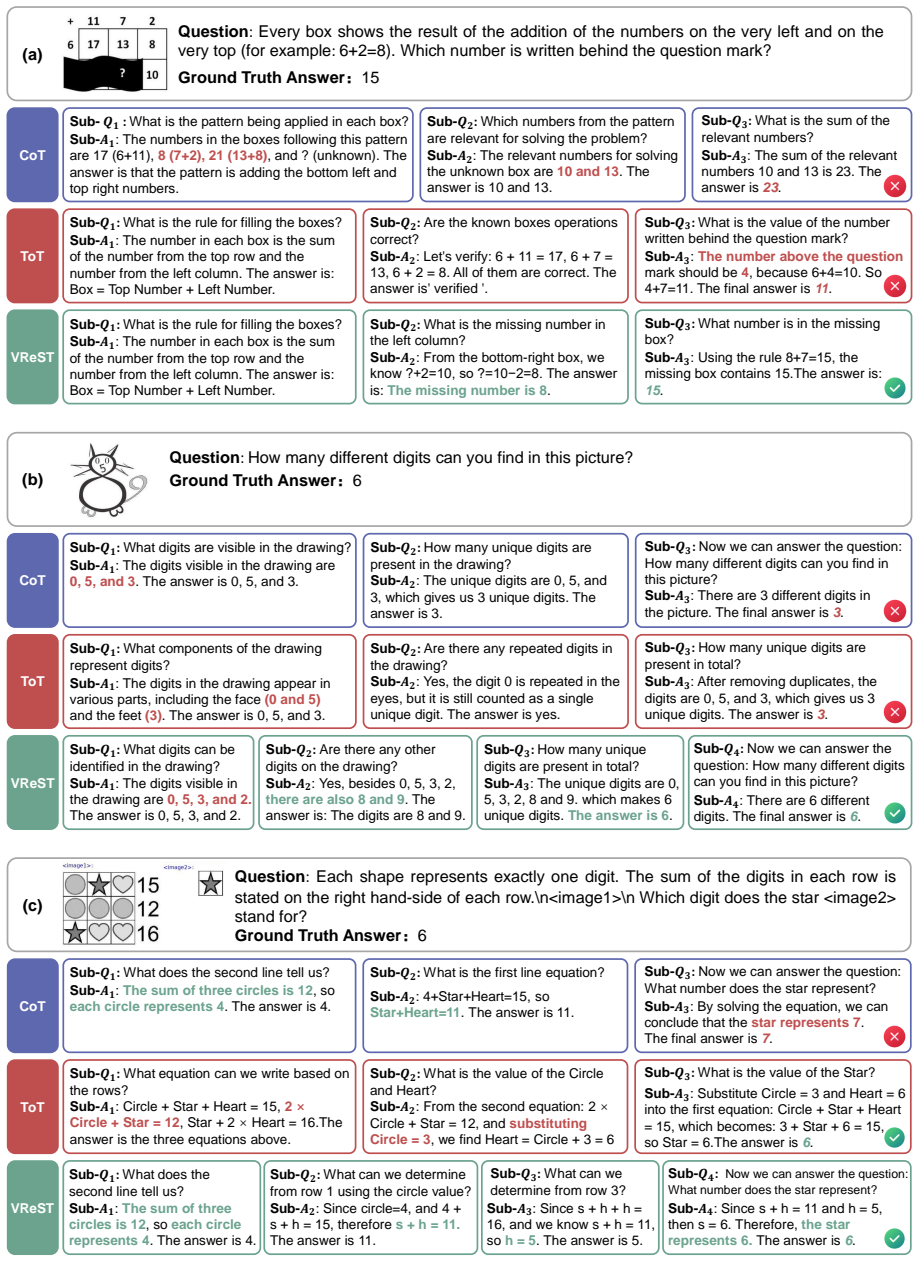
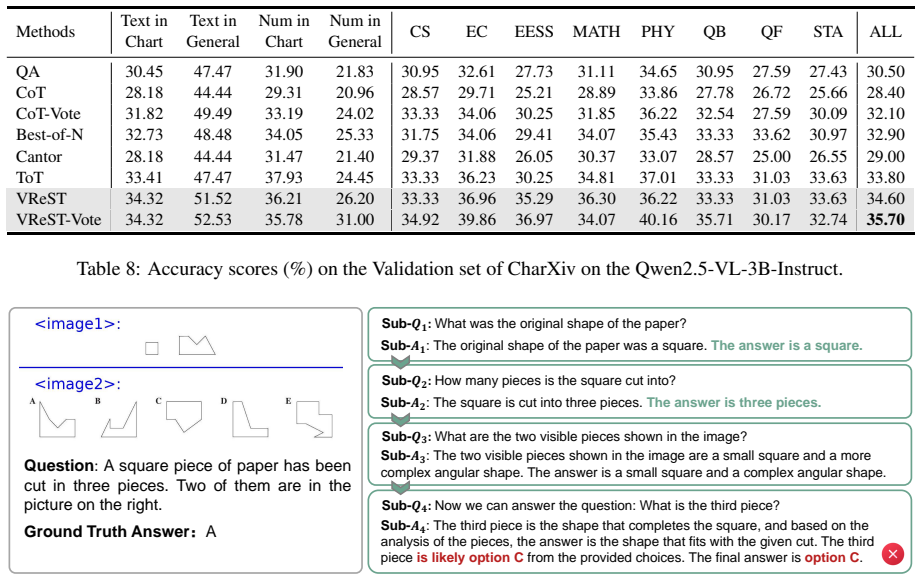
The central claim is that a large vision-language model can both generate and grade its own reasoning steps, and that using those self-grades to guide a tree search beats greedy prompting methods. Each node is a step consisting of a sub-question and answer; the model samples several candidate next steps, and the reward for a step is the geometric mean of two self-assessments: the probability it answers 'Yes' to whether the sub-questions so far are useful, and the probability it answers 'Yes' to whether the latest answer is correct, both conditioned on the image. Rewards are backpropagated along the chosen path and used by a UCT selection rule to balance exploring new branches against exploiting promising ones. After the search, the best trace, or a vote over the top traces, supplies the final answer. The paper reports that this pipeline beats CoT, CoT-Vote, Best-of-N, Cantor, and ToT on all three benchmarks, and that its accuracy keeps climbing as more search iterations are allowed.
Load-bearing premise
The load-bearing premise is that the vision-language model's own 'Yes' probabilities to 'Are the sub-questions useful?' and 'Is the last answer correct?' are a reliable measure of which reasoning steps are actually good; if that self-evaluation is biased or miscalibrated, the search is steered in the wrong direction and the accuracy gains could disappear or fail to transfer to other models or datasets.
Editorial extensions
If this is right
- If VReST's self-reward search is correct, any instruction-tuned vision-language model can become a stronger reasoner without retraining or an external reward model.
- The voting variant (VReST-Vote) shows that aggregating the highest-reward traces gives an additional consistent accuracy boost over the single best trace.
- The reported curve, where accuracy rises with the number of MCTS iterations, implies that spending more test-time computation on search is a usable axis of scaling for multimodal reasoning, not just text-only reasoning.
- The ablation showing performance drops when the image is removed from either generation or reward scoring means visual information must participate in both the reasoning and the grading, not just the question input.
Reading between the lines
- A natural extension the authors do not pursue is to use the self-reward scores as cheap training labels for a separate process reward model, which could remove the self-evaluation bias they flag while keeping the tree search.
- Because the method is task-agnostic in structure, the same sub-question/answer tree could be applied to other multimodal reasoning domains such as chart-based scientific claims or diagram-heavy multiple-choice exams; the paper only tests mathematical benchmarks.
- The reported per-sample time cost (over a hundred seconds on these benchmarks) suggests that without pruning or early stopping, the method's practical use is limited to settings where latency is a lower priority than accuracy.
Editorial analysis
A structured set of objections, weighed in public.
Referee Report
Summary. The paper introduces VReST, a training-free method that augments a large vision-language model (LVLM) with Monte Carlo Tree Search (MCTS) and a multimodal self-reward mechanism. The search tree represents reasoning steps, and a self-reward signal, computed as the geometric mean of the LVLM's probability of answering 'Yes' to two prompts (sub-question usefulness and answer correctness), guides expansion and backpropagation. The method is evaluated on MathVista testmini, MathVision testmini, and CharXiv validation using Qwen2-VL-7B-Instruct, reporting state-of-the-art accuracy compared with QA, CoT, CoT-Vote, Best-of-N, Cantor, and ToT. The authors also claim a better test-time scaling law based on scaling-parameter sweeps, and provide ablations of visual components, reward components, and trace-selection strategies.
Significance. If the results are reliable, VReST would be a useful training-free alternative for multimodal reasoning, combining two established ideas (MCTS and self-reward) in a new modality. The main strengths are the clear algorithmic specification, the absence of additional trained reward models, and internal consistency between the reported tables and the stated hyperparameters. The paper also makes a falsifiable claim about test-time scaling in multimodal tasks, which is currently the weakest part of the empirical case.
major comments (4)
- [Section 4.7, Figure 4, Table 5] The central claim of a 'better test-time scaling law' is not supported by the evidence, because the x-axis is not a commensurate measure of computation across methods: CoT-Vote uses number of votes, Best-of-N uses number of sampled traces, ToT uses tree width, and VReST-Vote uses MCTS iterations. Table 5 shows that one VReST/VReST-Vote sample takes 108.87 seconds on MathVista versus 15.32 seconds for CoT-Vote and 34.39 seconds for ToT. Without a compute-matched comparison (wall-clock time or FLOPs), the apparent scaling advantage may disappear or reverse; the Limitations section acknowledges 'significant computational overhead' but does not test whether the scaling-law claim survives normalization. This is load-bearing because it is stated as a standalone contribution.
- [Section 3.2.3, Eq. (6)] The self-reward mechanism is the paper's key novelty, yet no validation is provided that the geometric mean of the LVLM's own 'Yes' probabilities correlates with actual reasoning-step quality. Since R1 and R2 are both computed from the same Qwen2-VL model that generates the reasoning steps, the search may reinforce the model's prior decoding style rather than objective correctness. The Limitations section acknowledges this risk, but the paper does not report any calibration analysis, external-reward comparison, or correlation with step-level answer correctness, so the mechanism's contribution to the reported gains is not disentangled from the search itself.
- [Tables 1-3 and Section 4.5] No error bars or significance tests are reported, and several headline gains are small relative to the sample sizes: MathVista testmini has 1,000 items (VReST 64.5 vs CoT-Vote 62.3), MathVision testmini has 304 items (VReST 26.64 vs CoT-Vote 21.71), and many MathVision per-category columns contain only about 19 items, so per-category differences of 10-20 percentage points are within plausible sampling noise. Without confidence intervals or a paired bootstrap, the fixed-budget superiority claim is not fully established.
- [Section 4.3 and Appendix C] The comparison with baselines is not compute-matched: CoT-Vote uses n=10, Best-of-N uses n=10, and ToT uses w=10, while VReST uses K=10 MCTS iterations with width w=5, resulting in roughly 3-7x the per-sample latency reported in Table 5. The paper should report results at matched compute budgets or otherwise justify why the comparison is meaningful despite this large cost difference.
minor comments (6)
- [Throughout the manuscript] Method names appear with a spurious space in several places (e.g., 'CoT-V ote', 'VReST-V ote', 'Trace-V ote'); please normalize to 'CoT-Vote', 'VReST-Vote', and 'Trace-Vote'.
- [Figure 2(c) and Eq. (6)] Figure 2(c) states 'R = R1 * R2 = 0.6 * 0.8 = 0.69', but Eq. (6) defines the geometric mean R = sqrt(R1*R2), and sqrt(0.6*0.8) ≈ 0.693; the figure should show the square root operation.
- [Section 3.2.2] The terminal condition relying on the exact span 'Now we can answer the question' is brittle, since a model may not generate this exact phrase; please report how often this span is produced in practice or provide a fallback criterion.
- [Section 4.6, Figure 3(b)] The 'w/o PRM' ablation sets non-terminal node rewards to 0.5 and is therefore more accurately described as 'w/o process reward' rather than 'w/o PRM', since no separate PRM is used in the main method; the naming is confusing.
- [Figure 4 caption] The x-axis label says 'Number of samples or iterations', but the ToT curve uses tree width; the caption should describe each curve's x-axis explicitly.
- [Appendix D.1] The few-shot prompt example contains 'Mohamed is currently twice as 30 years old', which appears to be a typo; please correct it.
Circularity Check
No significant circularity: the self-reward mechanism is self-referential in spirit but the final claims are grounded in external benchmarks, and no prediction reduces to a fitted input or to a self-citation chain.
full rationale
VReST's self-reward signal R = sqrt(R1 * R2) uses the same LVLM's 'Yes' probability to rank reasoning steps, which creates a legitimate concern about biased self-evaluation, and the paper's Limitations section explicitly acknowledges this risk. However, under the defined circularity criteria, this is not a circular derivation: the reward is a hand-designed heuristic used only to select among candidate traces, while the reported accuracies are measured against ground-truth answers on external benchmarks (MathVista, MathVision, CharXiv) using a separate text-only LLM evaluator. No parameter is fitted to the benchmark and then renamed as a prediction; no load-bearing uniqueness theorem is imported from the authors' prior work; and the few self-citations in the paper are to general related work and do not carry the argument. The 'better test-time scaling law' claim is weakened by the non-commensurate x-axes in Figure 4 and the large per-sample cost reported in Table 5, but that is an evaluation-design or correctness concern, not a circularity: the scaling conclusion does not reduce by construction to the method's inputs. Overall, the central empirical contributions are self-contained and testable against external data, so the appropriate circularity score is 0.
Assumptions & free parameters
free parameters (6)
- K (number of MCTS iterations) =
10
- w (tree width) =
5
- Dmax (max tree depth) =
8
- c (UCT exploration constant) =
1
- temperature / top_p =
0.7 / 0.95
- n (traces voted in VReST-Vote) =
10
assumptions (6)
- domain assumption The probability P('Yes') from the LVLM is a valid and useful reward proxy for reasoning-step quality.
- ad hoc to paper A reasoning step is terminal if its sub-question contains 'Now we can answer the question'.
- standard math UCT with exploration constant c=1 appropriately balances exploration and exploitation for this search tree.
- domain assumption The separate text-only LLM (Qwen2.5-7B-Instruct) reliably judges whether a predicted answer matches the ground truth.
- domain assumption Task accuracy on MathVista testmini, MathVision testmini, and CharXiv validation is a sufficient proxy for multimodal mathematical reasoning ability.
- ad hoc to paper The geometric mean of R1 and R2 is a reasonable combination of sub-question usefulness and answer correctness.
Cite this review
Pith. "Pith review of VReST: Enhancing Reasoning in Large Vision-Language Models through Tree Search and Self-Reward Mechanism." pith.science (2026). https://pith.science/paper/MLAZVDUY
@misc{pith2026250608691,
  author       = {Pith},
  title        = {Pith review of: VReST: Enhancing Reasoning in Large Vision-Language Models through Tree Search and Self-Reward Mechanism},
  year         = {2026},
  howpublished = {\url{https://pith.science/paper/MLAZVDUY}},
  note         = {Machine review of arXiv:2506.08691}
}
read the original abstract
Large Vision-Language Models (LVLMs) have shown exceptional performance in multimodal tasks, but their effectiveness in complex visual reasoning is still constrained, especially when employing Chain-of-Thought prompting techniques. In this paper, we propose VReST, a novel training-free approach that enhances Reasoning in LVLMs through Monte Carlo Tree Search and Self-Reward mechanisms. VReST meticulously traverses the reasoning landscape by establishing a search tree, where each node encapsulates a reasoning step, and each path delineates a comprehensive reasoning sequence. Our innovative multimodal Self-Reward mechanism assesses the quality of reasoning steps by integrating the utility of sub-questions, answer correctness, and the relevance of vision-language clues, all without the need for additional models. VReST surpasses current prompting methods and secures state-of-the-art performance across three multimodal mathematical reasoning benchmarks. Furthermore, it substantiates the efficacy of test-time scaling laws in multimodal tasks, offering a promising direction for future research.
Figures


Figures from the paper (3 more)

Reference graph
Works this paper leans on
-
[1]
Qiguang Chen, Libo Qin, Jin Zhang, Zhi Chen, Xiao Xu, and Wanxiang Che. 2024. M ^3 C o T : A novel benchmark for multi-domain multi-step multi-modal chain-of-thought. arXiv preprint arXiv:2405.16473
arXiv 2024
-
[2]
Kanzhi Cheng, Yantao Li, Fangzhi Xu, Jianbing Zhang, Hao Zhou, and Yang Liu. 2024. Vision-language models can self-improve reasoning via reflection. arXiv preprint arXiv:2411.00855
arXiv 2024
-
[3]
Zheng Chu, Jingchang Chen, Qianglong Chen, Weijiang Yu, Tao He, Haotian Wang, Weihua Peng, Ming Liu, Bing Qin, and Ting Liu. 2024. Navigate through enigmatic labyrinth a survey of chain of thought reasoning: Advances, frontiers and future. In Proceedings of the 62nd Annual Meeting of the Association for Computational Linguistics (ACL)
work page 2024
-
[4]
Xidong Feng, Ziyu Wan, Muning Wen, Stephen Marcus McAleer, Ying Wen, Weinan Zhang, and Jun Wang. 2023. Alphazero-like tree-search can guide large language model decoding and training. arXiv preprint arXiv:2309.17179
arXiv 2023
-
[5]
Timin Gao, Peixian Chen, Mengdan Zhang, Chaoyou Fu, Yunhang Shen, Yan Zhang, Shengchuan Zhang, Xiawu Zheng, Xing Sun, Liujuan Cao, et al. 2024. Cantor: Inspiring multimodal chain-of-thought of mllm. In Proceedings of the 32nd ACM International Conference on Multimedia, pages 9096--9105
work page 2024
-
[6]
Jarvis Guo, Tuney Zheng, Yuelin Bai, Bo Li, Yubo Wang, King Zhu, Yizhi Li, Graham Neubig, Wenhu Chen, and Xiang Yue. 2024. Mammoth-vl: Eliciting multimodal reasoning with instruction tuning at scale. arXiv preprint arXiv:2412.05237
arXiv 2024
-
[7]
Shibo Hao, Yi Gu, Haodi Ma, Joshua Jiahua Hong, Zhen Wang, Daisy Zhe Wang, and Zhiting Hu. 2023. Reasoning with language model is planning with world model. arXiv preprint arXiv:2305.14992
arXiv 2023
-
[8]
Xinting Hu, Haoran Wang, Jan Eric Lenssen, and Bernt Schiele. 2025. Personahoi: Effortlessly improving personalized face with human-object interaction generation. In Proceedings of the IEEE/CVF Conference on Computer Vision and Pattern Recognition (CVPR)
work page 2025
Show all 45 references
-
[9]
Lei Huang, Weijiang Yu, Weitao Ma, Weihong Zhong, Zhangyin Feng, Haotian Wang, Qianglong Chen, Weihua Peng, Xiaocheng Feng, Bing Qin, and Ting Liu. 2025. https://doi.org/10.1145/3703155 A survey on hallucination in large language models: Principles, taxonomy, challenges, and o...
2025 doi
-
[10]
Jinhao Jiang, Zhipeng Chen, Yingqian Min, Jie Chen, Xiaoxue Cheng, Jiapeng Wang, Yiru Tang, Haoxiang Sun, Jia Deng, Wayne Xin Zhao, et al. 2024. Technical report: Enhancing llm reasoning with reward-guided tree search. arXiv preprint arXiv:2411.11694
2024 arXiv
-
[11]
Levente Kocsis and Csaba Szepesv \'a ri. 2006. Bandit based monte-carlo planning. In European conference on machine learning, pages 282--293. Springer
2006
-
[12]
Takeshi Kojima, Shixiang Shane Gu, Machel Reid, Yutaka Matsuo, and Yusuke Iwasawa. 2022. Large language models are zero-shot reasoners. Advances in neural information processing systems, 35:22199--22213
2022
-
[13]
Li Li, Jiawei Peng, Huiyi Chen, Chongyang Gao, and Xu Yang. 2024. How to configure good in-context sequence for visual question answering. In Proceedings of the IEEE/CVF Conference on Computer Vision and Pattern Recognition, pages 26710--26720
2024
-
[14]
Hunter Lightman, Vineet Kosaraju, Yura Burda, Harri Edwards, Bowen Baker, Teddy Lee, Jan Leike, John Schulman, Ilya Sutskever, and Karl Cobbe. 2023. Let's verify step by step. arXiv preprint arXiv:2305.20050
2023 arXiv
-
[15]
Mengsha Liu, Daoyuan Chen, Yaliang Li, Guian Fang, and Ying Shen. 2024. Chartthinker: A contextual chain-of-thought approach to optimized chart summarization. arXiv preprint arXiv:2403.11236
2024 arXiv
-
[16]
Jieyi Long. 2023. Large language model guided tree-of-thought. arXiv preprint arXiv:2305.08291
2023 arXiv
-
[17]
Pan Lu, Hritik Bansal, Tony Xia, Jiacheng Liu, Chunyuan Li, Hannaneh Hajishirzi, Hao Cheng, Kai-Wei Chang, Michel Galley, and Jianfeng Gao. 2023. Mathvista: Evaluating mathematical reasoning of foundation models in visual contexts. arXiv preprint arXiv:2310.02255
2023 arXiv
-
[18]
Chancharik Mitra, Brandon Huang, Trevor Darrell, and Roei Herzig. 2024. Compositional chain-of-thought prompting for large multimodal models. In Proceedings of the IEEE/CVF Conference on Computer Vision and Pattern Recognition, pages 14420--14431
2024
-
[19]
OpenAI. 2024. https://openai.com/index/introducing-openai-o1-preview/ Introducing openai o1-preview . Accessed: 2024-12-13
2024
-
[20]
Yingzhe Peng, Xinting Hu, Jiawei Peng, Xin Geng, Xu Yang, et al. 2024. Live: Learnable in-context vector for visual question answering. In The Thirty-eighth Annual Conference on Neural Information Processing Systems
2024
-
[21]
Hao Shao, Shengju Qian, Han Xiao, Guanglu Song, Zhuofan Zong, Letian Wang, Yu Liu, and Hongsheng Li. 2024. Visual cot: Advancing multi-modal language models with a comprehensive dataset and benchmark for chain-of-thought reasoning. In The Thirty-eight Conference on Neural Info...
2024
-
[22]
Ke Wang, Junting Pan, Weikang Shi, Zimu Lu, Mingjie Zhan, and Hongsheng Li. 2024 a . Measuring multimodal mathematical reasoning with math-vision dataset. arXiv preprint arXiv:2402.14804
2024 arXiv
-
[23]
Peng Wang, Shuai Bai, Sinan Tan, Shijie Wang, Zhihao Fan, Jinze Bai, Keqin Chen, Xuejing Liu, Jialin Wang, Wenbin Ge, et al. 2024 b . Qwen2-vl: Enhancing vision-language model's perception of the world at any resolution. arXiv preprint arXiv:2409.12191
2024 arXiv
-
[24]
Xuezhi Wang, Jason Wei, Dale Schuurmans, Quoc Le, Ed Chi, Sharan Narang, Aakanksha Chowdhery, and Denny Zhou. 2022. Self-consistency improves chain of thought reasoning in language models. arXiv preprint arXiv:2203.11171
2022 arXiv
-
[25]
Chi, Sharan Narang, Aakanksha Chowdhery, and Denny Zhou
Xuezhi Wang, Jason Wei, Dale Schuurmans, Quoc V Le, Ed H. Chi, Sharan Narang, Aakanksha Chowdhery, and Denny Zhou. 2023. https://openreview.net/forum?id=1PL1NIMMrw Self-consistency improves chain of thought reasoning in language models . In The Eleventh International Conferenc...
2023
-
[26]
Zirui Wang, Mengzhou Xia, Luxi He, Howard Chen, Yitao Liu, Richard Zhu, Kaiqu Liang, Xindi Wu, Haotian Liu, Sadhika Malladi, et al. 2024 c . Charxiv: Charting gaps in realistic chart understanding in multimodal llms. arXiv preprint arXiv:2406.18521
2024 arXiv
-
[27]
Jason Wei, Xuezhi Wang, Dale Schuurmans, Maarten Bosma, Fei Xia, Ed Chi, Quoc V Le, Denny Zhou, et al. 2022. Chain-of-thought prompting elicits reasoning in large language models. Advances in Neural Information Processing Systems, 35:24824--24837
2022
-
[28]
Yifan Wu, Lutao Yan, Yuyu Luo, Yunhai Wang, and Nan Tang. 2024 a . Evaluating task-based effectiveness of mllms on charts. arXiv preprint arXiv:2405.07001
2024 arXiv
-
[29]
Yongliang Wu, Xinting Hu, Yuyang Sun, Yizhou Zhou, Wenbo Zhu, Fengyun Rao, Bernt Schiele, and Xu Yang. 2024 b . Number it: Temporal grounding videos like flipping manga. arXiv preprint arXiv:2411.10332
2024 arXiv
-
[30]
Yongliang Wu, Shiji Zhou, Mingzhuo Yang, Lianzhe Wang, Heng Chang, Wenbo Zhu, Xinting Hu, Xiao Zhou, and Xu Yang. 2025. Unlearning concepts in diffusion model via concept domain correction and concept preserving gradient. In Proceedings of the AAAI Conference on Artificial Int...
2025
-
[31]
Zhengzhuo Xu, Sinan Du, Yiyan Qi, Chengjin Xu, Chun Yuan, and Jian Guo. 2023. Chartbench: A benchmark for complex visual reasoning in charts. arXiv preprint arXiv:2312.15915
2023 arXiv
-
[32]
An Yang, Baosong Yang, Binyuan Hui, Bo Zheng, Bowen Yu, Chang Zhou, Chengpeng Li, Chengyuan Li, Dayiheng Liu, Fei Huang, et al. 2024. Qwen2 technical report. arXiv preprint arXiv:2407.10671
2024 arXiv
-
[33]
Xu Yang, Yongliang Wu, Mingzhuo Yang, Haokun Chen, and Xin Geng. 2023. Exploring diverse in-context configurations for image captioning. Advances in Neural Information Processing Systems, 36:40924--40943
2023
-
[34]
Shunyu Yao, Dian Yu, Jeffrey Zhao, Izhak Shafran, Tom Griffiths, Yuan Cao, and Karthik Narasimhan. 2024. Tree of thoughts: Deliberate problem solving with large language models. Advances in Neural Information Processing Systems, 36
2024
-
[35]
Weijiang Yu, Haofan Wang, Guohao Li, Nong Xiao, and Bernard Ghanem. 2023. https://doi.org/10.1109/TPAMI.2023.3238699 Knowledge-aware global reasoning for situation recognition . IEEE Transactions on Pattern Analysis and Machine Intelligence, 45(7):8621--8633
2023
-
[36]
Weijiang Yu, Jingwen Zhou, Weihao Yu, Xiaodan Liang, and Nong Xiao. 2019. Heterogeneous graph learning for visual commonsense reasoning. In Proceedings of the 33rd International Conference on Neural Information Processing Systems
2019
-
[37]
Dan Zhang, Sining Zhoubian, Ziniu Hu, Yisong Yue, Yuxiao Dong, and Jie Tang. 2024 a . Rest-mcts*: Llm self-training via process reward guided tree search. arXiv preprint arXiv:2406.03816
2024 arXiv
-
[38]
Di Zhang, Jianbo Wu, Jingdi Lei, Tong Che, Jiatong Li, Tong Xie, Xiaoshui Huang, Shufei Zhang, Marco Pavone, Yuqiang Li, et al. 2024 b . Llama-berry: Pairwise optimization for o1-like olympiad-level mathematical reasoning. arXiv preprint arXiv:2410.02884
2024 arXiv
-
[39]
Renrui Zhang, Dongzhi Jiang, Yichi Zhang, Haokun Lin, Ziyu Guo, Pengshuo Qiu, Aojun Zhou, Pan Lu, Kai-Wei Chang, Yu Qiao, et al. 2025. Mathverse: Does your multi-modal llm truly see the diagrams in visual math problems? In European Conference on Computer Vision, pages 169--186...
2025
-
[40]
Zhuosheng Zhang, Aston Zhang, Mu Li, and Alex Smola. 2022. Automatic chain of thought prompting in large language models. arXiv preprint arXiv:2210.03493
2022 arXiv
-
[41]
Zhuosheng Zhang, Aston Zhang, Mu Li, Hai Zhao, George Karypis, and Alex Smola. 2023. Multimodal chain-of-thought reasoning in language models. arXiv preprint arXiv:2302.00923
2023 arXiv
-
[42]
Bingchen Zhao, Yongshuo Zong, Letian Zhang, and Timothy Hospedales. 2024. Benchmarking multi-image understanding in vision and language models: Perception, knowledge, reasoning, and multi-hop reasoning. arXiv preprint arXiv:2406.12742
2024 arXiv
-
[43]
Ge Zheng, Bin Yang, Jiajin Tang, Hong-Yu Zhou, and Sibei Yang. 2023. Ddcot: Duty-distinct chain-of-thought prompting for multimodal reasoning in language models. Advances in Neural Information Processing Systems, 36:5168--5191
2023
-
[44]
online" 'onlinestring :=
ENTRY address archivePrefix author booktitle chapter edition editor eid eprint eprinttype howpublished institution journal key month note number organization pages publisher school series title type volume year doi pubmed url lastchecked label extra.label sort.label short.list...
-
[45]
write newline
" write newline "" before.all 'output.state := FUNCTION n.dashify 't := "" t empty not t #1 #1 substring "-" = t #1 #2 substring "--" = not "--" * t #2 global.max substring 't := t #1 #1 substring "-" = "-" * t #2 global.max substring 't := while if t #1 #1 substring * t #2 gl...
Reviewed August 7, 2026 · model on record in the stance chip above.
Discussion (0). Sign in to comment.