REVIEW 3 major objections 5 minor 72 references
A Unified Graph Neural Network Framework for Non-Equilibrium Carrier and Lattice Dynamics Driven by Electric Fields
T0 review · 3 major / 5 minor · reviewed 2026-08-05 · deepseek-v4-flash
Pith's one-line read EFR-GNN extends machine-learning molecular dynamics to electric fields by learning Born effective charge tensors and atom-resolved charges, and it demonstrates field-driven polaron drift, THz phonon control, and superionic transport in long
desk verdict A solid modular MLMD paper that does what it says within linear response, but the field-coupling is only validated internally and no code/data are shipped. read the letter →
The pith
A machine-rendered reading of the paper's core claim, the machinery that carries it, and where it could break.
The reading
What carries the argument
The carrying mechanism is the modular, parameter-separated equivariant graph neural network: three branches share a graph representation but have separate weights, so the field-free PES, the atom-resolved electronic-state descriptors, and the response tensors can be trained independently and activated as needed. The load-bearing identity is the force decomposition $F_i = -\partial U/\partial \mathbf{r}_i + Z_i^*\,\mathbf{E}$, where $U$ is a learned field-free potential and $Z_i^*$ is the predicted $3\times 3$ Born effective charge tensor, a quantity that measures how strongly an atom's force responds to a uniform electric field. This identity converts an arbitrary external field into per-ato
What would settle it
Run direct finite-field first-principles molecular dynamics on hole-doped MgO at E = 0.05 V/Å (using a sawtooth field or Berry-phase polarization) and compare per-atom forces with EFR-GNN's prediction, field-free force plus $Z_i^*\mathbf{E}$. If the BECs change with field strength or the polaron redistributes charge at fixed geometry, the forces will deviate beyond the model's force MAE, and the predicted drift mobility would be wrong.
Extended reading notes
Core claim
EFR-GNN is a graph neural network with three parameter-separated equivariant branches processing the same atomic graph. Branch 1 predicts the field-free energy and forces; Branch 2 predicts atom-resolved Bader charges and local magnetic moments; Branch 3 predicts the Born effective charge tensor of each atom. The field-induced force is $F_i^\text{field}=Z_i^*\,\mathbf{E}$, and the total force is the sum of the field-free and field-induced contributions, with the predicted tensors acoustic-sum-rule corrected so a uniform field produces no net translation. The paper's claim is that this modular design is enough to describe non-equilibrium field-driven dynamics that previously required either f
Load-bearing premise
The load-bearing premise, stated in the Discussion, is that the electric field acts only through configuration-dependent Born effective charge tensors on a field-free ground-state potential-energy surface, with atom-resolved charges and magnetic moments treated as structure-dependent descriptors that do not themselves respond to the field at fixed geometry.
Editorial extensions
If this is right
- Static-field molecular dynamics becomes feasible over hundreds of picoseconds for polaronic and ionic systems where DFT trajectories would be prohibitively expensive.
- The MgO result gives a microscopic decomposition of field-driven polaron drift: the field biases forward relative to backward nearest-neighbor hops, and the bias can be quantified by a simple 12-site statistical model.
- Resonant THz control of a specific phonon mode, including helicity-selected rotation direction, can be simulated at finite temperature and related to experimental dephasing times.
- The same trained model can run either field-free or field-driven MD, and the charge/moment branch can be switched off when only forces are needed.
- A unified framework of this kind opens the possibility of studying couplings between carrier localization and lattice response that require both electric-field and electronic-state resolution.
Reading between the lines
- Editorial inference: the same three-branch design should transfer to other polar or ionic materials whose field response is dominated by the linear BEC coupling, including ferroelectric switching and electrochemical interfaces, provided DFT labels for the new chemistries are available.
- Editorial inference: because Branch 2 descriptors are not conditioned on the applied field, the framework cannot describe field-induced charge redistribution or carrier relocalization at fixed geometry; under strong fields or near dielectric breakdown this is where the predictions would first fail.
- Editorial inference: the fitted effective driving charge of 0.49 e depends on the Bader partitioning and on the nearest-neighbor hopping model, so it should not be interpreted as a directly measurable physical charge; other partitions or models would shift it.
- Editorial inference: the helicity-controlled rotating phonon results suggest a simulation-side protocol for preparing chiral phonon states, and a direct comparison with polarization-resolved electro-optic experiments would be a natural next test.
Editorial analysis
A structured set of objections, weighed in public.
Referee Report
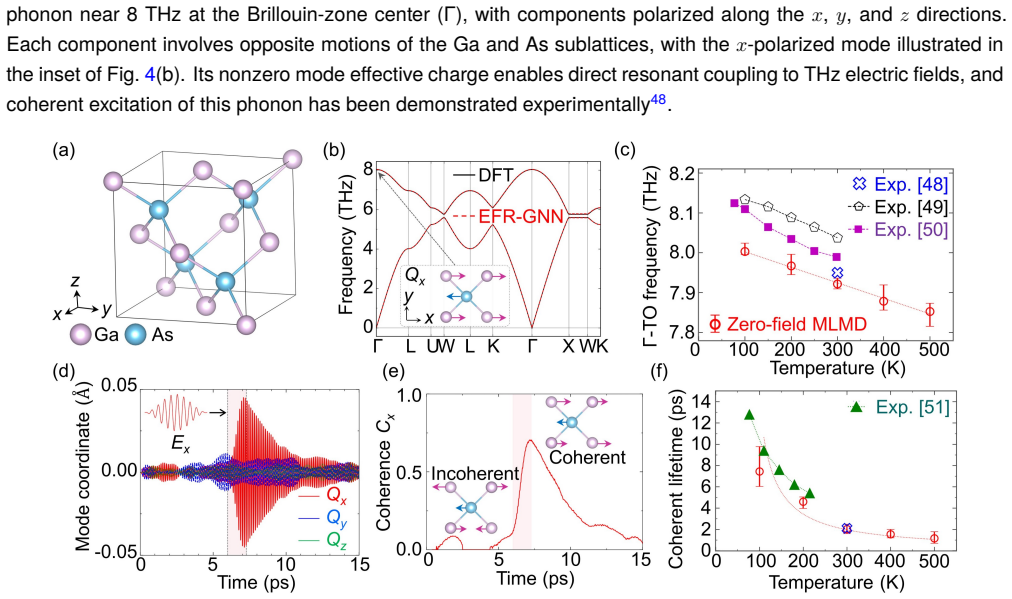
Summary. The manuscript introduces EFR-GNN, a modular equivariant graph neural network with three parameter-separated branches: a field-free potential-energy surface (PES), atom-resolved Born effective charge tensors (BECs), and Bader charges/local magnetic moments. Field-induced forces are added as configuration-dependent BEC·E terms on top of the field-free PES. The method is demonstrated on three systems: hole-doped MgO (field-driven small-polaron hopping), GaAs (THz resonant excitation and helicity control of the Γ-TO phonon), and α-AgI (superionic Ag+ transport and field-driven drift). The paper reports low energy/force/BEC/charge MAEs, reproduces activation energies and temperature trends, and explicitly states the linear-response and non-propagated-electronic-descriptor limitations of the framework.
Significance. If the central claims hold, EFR-GNN is a valuable contribution to machine-learned molecular dynamics, combining electric-field response with atom-resolved electronic-structure descriptors in one framework. The three applications span distinct physical regimes (localized carrier hopping, coherent phonon control, ionic transport) and yield physically plausible results, including the directional hopping asymmetry in MgO, helicity-controlled coherent phonon rotation in GaAs, and the experimental activation energy trend in α-AgI. The paper is also commendable for its explicit limitations paragraph, which distinguishes the linear-response force model from full field-dependent electronic structure. The main risk is that the field-driven dynamics are not directly validated against finite-field first-principles references, so the quantitative claims rest on internal consistency and post-hoc fits rather than on an independent test.
major comments (3)
- [Discussion; Methods; Fig. 3(a)] The field-driven force model is a linear-response approximation: F_field = Z*·E added to a field-free PES, and all training data are field-free. No direct validation against finite-field DFT is provided. At the largest MgO field (0.05 V/Å), q_eff E d ≈ 74 meV versus an 85 meV barrier, so nonlinear effects are plausible in this regime. Please add a benchmark against finite-field DFT (e.g., field-induced forces on representative configurations or a finite-field barrier) or explicitly restrict the claims to a field range where linear response is justified. As written, the central claim of accurate long-time field-driven dynamics is not fully substantiated.
- [Fig. 3(d) and nearest-neighbor model] The effective driving charge q_eff is obtained by fitting the model's forward/backward hopping ratio to the very simulated ratios it is then used to explain. This is a compact parametrization, not an independent validation of the BEC-force coupling. Please state explicitly that q_eff is a fitted descriptor (not a predicted charge), and, if possible, compute the field-induced hopping bias directly from the BEC branch without free parameters, or compare q_eff with a value inferred solely from the BEC tensors. The current text implies more explanatory power than the fitting procedure supports.
- [GaAs, Fig. 4(e,f)] The coherent-phonon dephasing time is extracted from the post-pulse decay in NVT simulations with a Nosé–Hoover-chain thermostat. Thermostatting can artificially damp coherent oscillations, potentially biasing the reported ~2.0 ps dephasing time. A control in NVE (or with the thermostat applied only before the pulse) is needed to confirm that the decay is intrinsic. Without this, the quantitative agreement with the experimental 2.1 ps may be fortuitous.
minor comments (5)
- [Fig. 4(d) text] The sentence beginning 'For each primitive-cell Ga–As basis pair l, u_s,l,α denotes…' is missing a verb and is hard to parse; please rephrase.
- [GaAs THz pulse setup] The pulse carrier frequency f=7.9 THz is chosen to match the model's own finite-temperature Γ-TO frequency (Fig. 4c). This is reasonable given the good agreement with experiment, but the text should state clearly that the resonance is by construction, not a prediction. The off-resonant control (3.95 THz and 15.8 THz) is a good check and should be highlighted.
- [References] Some reference DOIs appear to be placeholders (e.g., Refs. 11, 12, 19, 35–37). Please verify all DOIs before publication.
- [Data availability] 'Data available from the corresponding authors upon reasonable request' is weak for a methods paper. Consider depositing the trained models and key datasets in a public repository to strengthen reproducibility.
- [α-AgI subsection] Minor typo: 'sufficiently' should be 'sufficiently'.
Circularity Check
No significant circularity: framework predictions are genuinely emergent from field-free training data plus physically defined BEC coupling; the one fitted parameter (q_eff) is explicitly labeled a fit, and the only self-citation is peripheral.
full rationale
The paper's central derivations are not circular. Field-driven forces are computed as the sum of a field-free learned force and a field-induced force obtained by multiplying predicted Born effective charges (BECs) by the applied field. The BECs are trained on field-free DFPT data, so the field-driven dynamics are a genuine extrapolation, not a restatement of training labels. The MgO nearest-neighbor model fits q_eff to the simulated forward/backward hopping ratios and then uses the model to rationalize the observed bias; this is an explicit parameter fit ("fitting the finite-field ratios yields q_eff = 0.49 e"), not a prediction, and the paper honestly notes the difference from the Bader charge. The GaAs THz pulse is deliberately tuned to the model's own Γ-TO frequency (f = 7.9 THz), so resonant excitation is expected by construction, but the temperature-dependent dephasing times and helicity-controlled rotation are emergent predictions compared to experimental values. The AgI mobility trend and activation energy are predicted from zero-field MD and match experiment. The only self-citation (ref. 37) is a generic architecture citation among many, and no load-bearing step depends on it. The Discussion explicitly acknowledges the linear-response and fixed-charge limitations, which is a statement of scope, not circularity. No step reduces to its own inputs by definition or by a self-citation chain.
Assumptions & free parameters
free parameters (3)
- q_eff (effective driving charge in MgO nearest-neighbor model) =
0.49 e
- THz pulse carrier frequency f =
7.9 THz
- Hubbard U_eff on O 2p in DFT reference for MgO =
10 eV
assumptions (7)
- domain assumption DFT (PBE/PBE+U) ground-state energies, forces, Bader charges, and DFPT BECs are accurate reference labels.
- domain assumption Field-induced forces are given by the instantaneous BEC tensor times the external field, and the field-free PES is not reshaped by the field.
- domain assumption Bader charges and local magnetic moments are meaningful descriptors of polaron location and transfer.
- standard math The acoustic sum rule correction applied to BECs preserves translational invariance.
- ad hoc to paper Nearest-neighbor hopping model: field-dependent barrier E_a,i = E_a0 - q_eff E d p_i / 2 and Boltzmann hopping weights.
- standard math The equivariant graph message-passing architecture can represent the target functions.
- domain assumption Finite-size random-phase contribution to the GaAs phonon coherence is correctly removable.
Cite this review
Pith. "Pith review of A Unified Graph Neural Network Framework for Non-Equilibrium Carrier and Lattice Dynamics Driven by Electric Fields." pith.science (2026). https://pith.science/paper/MM2I2S6X
@misc{pith2026260803287,
  author       = {Pith},
  title        = {Pith review of: A Unified Graph Neural Network Framework for Non-Equilibrium Carrier and Lattice Dynamics Driven by Electric Fields},
  year         = {2026},
  howpublished = {\url{https://pith.science/paper/MM2I2S6X}},
  note         = {Machine review of arXiv:2608.03287}
}
abstract
Finite-temperature simulations of electric-field-driven dynamics need a unified description of interatomic interactions, local electronic states, and configuration-dependent electric responses. First-principles simulations remain scale-limited, whereas conventional machine-learning potentials lack electric-field effects. Recent machine-learning frameworks have incorporated electric-field response or atom-resolved electronic-state information, but rarely both within a single framework. Here, we develop an electric-field-response graph neural network (EFR-GNN) that predicts energies, forces, Born effective charge tensors, atom-resolved charges and magnetic moments, and supports long-time field-driven molecular dynamics with atom-resolved tracking of localized electronic states. In hole-doped MgO, static fields rectify thermally activated hole-polaron hopping through a forward--backward asymmetry quantified by a nearest-neighbor model. In GaAs, resonant terahertz excitation generates a coherent $\Gamma$-point transverse-optical phonon with dephasing consistent with experiment, while opposite helicities reverse its rotation. In superionic $\alpha$-AgI, it reproduces temperature-dependent Ag$^+$ mobility and collective field-driven ionic drift. Together, EFR-GNN offers an approach to finite-temperature simulations of field-driven atomic and localized-carrier dynamics.
Figures


Figures from the paper (3 more)


Reference graph
Works this paper leans on
-
[1]
Lu, N. et al. Electric-field control of tri-state phase transformation with a selective dual-ion switch. Nature 546, 124–128, DOI: 10.1038/nature22389 (2017)
-
[2]
Basini, M. et al. Terahertz electric-field-driven dynamical multiferroicity in SrTiO3. Nature 628, 534–539, DOI: 10.1038/s41586-024-07175-9 (2024)
-
[3]
Wu, Y., Li, D., Wu, C.-L., Hwang, H. Y. & Cui, Y. Electrostatic gating and intercalation in 2D materials.Nat. Rev. Mater. 8, 41–53, DOI: 10.1038/s41578-022-00473-6 (2022)
-
[4]
Unke, O. T. et al. Machine learning force fields. Chem. Rev. 121, 10142–10186, DOI: 10.1021/acs.chemrev. 0c01111 (2021)
-
[5]
Noé, F., Tkatchenko, A., Müller, K.-R. & Clementi, C. Machine learning for molecular simulation. Annu. Rev. Phys. Chem. 71, 361–390, DOI: 10.1146/annurev-physchem-042018-052331 (2020)
-
[6]
Onida, G., Reining, L. & Rubio, A. Electronic excitations: density-functional versus many-body Green’s-function approaches. Rev. Mod. Phys. 74, 601–659, DOI: 10.1103/revmodphys.74.601 (2002)
-
[7]
Casida, M. & Huix-Rotllant, M. Progress in time-dependent density-functional theory. Annu. Rev. Phys. Chem. 63, 287–323, DOI: 10.1146/annurev-physchem-032511-143803 (2012)
-
[8]
Curchod, B. F. E. & Martínez, T. J. Ab initio nonadiabatic quantum molecular dynamics. Chem. Rev. 118, 3305–3336, DOI: 10.1021/acs.chemrev.7b00423 (2018)
Show all 72 references
-
[9]
& Rubio, A
Ruggenthaler, M., Tancogne-Dejean, N., Flick, J., Appel, H. & Rubio, A. From a quantum-electrodynamical light–matter description to novel spectroscopies. Nat. Rev. Chem. 2, DOI: 10.1038/s41570-018-0118 (2018)
2018 doi
-
[10]
Batatia, I. et al. The design space of E(3)-equivariant atom-centred interatomic potentials. Nat. Mach. Intell. 7, 56–67, DOI: 10.1038/s42256-024-00956-x (2025)
2025 doi
-
[11]
Chen, Z. et al. Large-area non-stoichiometric phase transition in transition metal chalcogenide films.Nat. Mater. 25, 573–580, DOI: 10.1038/s41563-025-02471-9 (2026)
2026 doi
-
[12]
Chen, J. et al. Deterministic 1D domain wall motion with nucleation-free nature in sliding ferroelectric switching. Phys. Rev. X 16, 011066, DOI: 10.1103/q624-x397 (2026). 12/16
2026 doi
-
[13]
Zhang, L., Han, J., Wang, H., Car, R. & E, W. Deep potential molecular dynamics: A scalable model with the accuracy of quantum mechanics. Phys. Rev. Lett. 120, 143001, DOI: 10.1103/physrevlett.120.143001 (2018)
2018 doi
-
[14]
Batzner, S. et al. E(3)-equivariant graph neural networks for data-efficient and accurate interatomic potentials. Nat. Commun. 13, 2453, DOI: 10.1038/s41467-022-29939-5 (2022)
2022 doi
-
[15]
P ., Simm, G., Ortner, C
Batatia, I., Kovacs, D. P ., Simm, G., Ortner, C. & Csanyi, G. Mace: Higher order equivariant message passing neural networks for fast and accurate force fields. In Advances in Neural Information Processing Systems 35 , NeurIPS 2022, 11423–11436, DOI:10.52202/068431-0830 (Neur...
2022 doi
-
[16]
Falletta, S. et al. Unified differentiable learning of electric response. Nat. Commun. 16, 4031, DOI: 10.1038/ s41467-025-59304-1 (2025)
2025
-
[17]
& Jiang, B
Zhang, Y. & Jiang, B. Universal machine learning for the response of atomistic systems to external fields.Nat. Commun. 14, 6424, DOI: 10.1038/s41467-023-42148-y (2023)
2023 doi
-
[18]
Joll, K., Schienbein, P ., Rosso, K. M. & Blumberger, J. Machine learning the electric field response of condensed phase systems using perturbed neural network potentials. Nat. Commun. 15, 8192, DOI: 10.1038/s41467-024-52491-3 (2024)
2024 doi
-
[19]
Yu, H. et al. Prediction of room temperature ferroelectricity in subnano silicon thin films with an antiferroelectric ground state. Phys. Rev. Lett. 135, 156801, DOI: 10.1103/xlkt-4wk5 (2025)
2025 doi
-
[20]
Lu, A. K. A. et al. Study of the ion mobility in defect-laden ZrO 2 under an electric field using neural network with predictions for Born effective charges. Phys. Rev. Mater. 10, 066001, DOI: 10.1103/jcsd-dbl2 (2026)
2026 doi
-
[21]
& Asahi, R
Kutana, A., Shimizu, K., Watanabe, S. & Asahi, R. Representing Born effective charges with equivariant graph convolutional neural networks. Sci. Rep. 15, 16719, DOI: 10.1038/s41598-025-01250-5 (2025)
2025 doi
-
[22]
Zhong, P ., Kim, D., King, D. S. & Cheng, B. Machine learning interatomic potential can infer electrical response. npj Comput. Mater. 11, 384, DOI: 10.1038/s41524-025-01911-z (2025)
2025 doi
-
[23]
Fan, Z. et al. qNEP: A highly efficient neuroevolution potential with dynamic charges for large-scale atomistic simulations. J. Chem. Theory Comput. 22, 4787–4801, DOI: 10.1021/acs.jctc.6c00146 (2026)
2026 doi
-
[24]
Deng, B. et al. CHGNet as a pretrained universal neural network potential for charge-informed atomistic mod- elling. Nat. Mach. Intell. 5, 1031–1041, DOI: 10.1038/s42256-023-00716-3 (2023)
2023 doi
-
[25]
N., Blöchl, P
Eckhoff, M., Lausch, K. N., Blöchl, P . E. & Behler, J. Predicting oxidation and spin states by high-dimensional neural networks: Applications to lithium manganese oxide spinels. J. Chem. Phys. 153, 164107, DOI: 10.1063/ 5.0021452 (2020)
2020
-
[26]
C., Leoni, L., Reticcioli, M
Birschitzky, V. C., Leoni, L., Reticcioli, M. & Franchini, C. Machine learning small polaron dynamics.Phys. Rev. Lett. 134, 216301, DOI: 10.1103/physrevlett.134.216301 (2025)
2025 doi
- [27]
-
[28]
W., Finkler, J
Ko, T. W., Finkler, J. A., Goedecker, S. & Behler, J. A fourth-generation high-dimensional neural network potential with accurate electrostatics including non-local charge transfer.Nat. Commun. 12, 398, DOI: 10.1038/ s41467-020-20427-2 (2021)
2021
-
[29]
Unke, O. T. & Meuwly, M. Physnet: A neural network for predicting energies, forces, dipole moments, and partial charges. J. Chem. Theory Comput. 15, 3678–3693, DOI: 10.1021/acs.jctc.9b00181 (2019)
2019 doi
- [30]
-
[31]
Wang, J. et al. E(n)-equivariant cartesian tensor message passing interatomic potential. Nat. Commun. 15, 7607, DOI: 10.1038/s41467-024-51886-6 (2024)
2024 doi
-
[32]
Yang, Z. et al. Scalable crystal structure relaxation using an iteration-free deep generative model with uncer- tainty quantification. Nat. Commun. 15, 8148, DOI: 10.1038/s41467-024-52378-3 (2024)
2024 doi
-
[33]
& Xiang, H
Zhong, Y., Wang, R., Gong, X. & Xiang, H. A universal spin–orbit-coupled hamiltonian model for accelerated quantum material discovery. Nat. Mach. Intell. 8, 403–414, DOI: 10.1038/s42256-026-01196-x (2026)
2026 doi
-
[34]
Musaelian, A. et al. Learning local equivariant representations for large-scale atomistic dynamics. Nat. Com- mun. 14, 579, DOI: 10.1038/s41467-023-36329-y (2023)
2023 doi
-
[35]
Gong, X. et al. General framework for E(3)-equivariant neural network representation of density functional theory Hamiltonian. Nat. Commun. 14, 2848, DOI: 10.1038/s41467-023-38468-8 (2023)
2023 doi
-
[36]
& Yan, Q
Hsu, T.-W., Fang, Z., Bansil, A. & Yan, Q. Accurate prediction of tensorial spectra using equivariant graph neural network. Nat. Commun. 17, 3330, DOI: 10.1038/s41467-026-69159-9 (2026)
2026 doi
- [37]
-
[38]
See Supplementary Information
-
[39]
Nabi, A. S. & Sharifzadeh, S. Impact of hole polaron formation on excitonic transitions in mgo from first princi- ples. Phys. Rev. Mater. 9, 124605, DOI: 10.1103/mpb2-3wrb (2025)
2025 doi
-
[40]
& Pasquarello, A
Falletta, S. & Pasquarello, A. Hubbard u through polaronic defect states. npj Comput. Mater. 8, 263, DOI: 10.1038/s41524-022-00958-6 (2022)
2022 doi
-
[41]
G., Naruse, J., Hiramatsu, H
Smith, J. G., Naruse, J., Hiramatsu, H. & Siegel, D. J. Intrinsic conductivity in magnesium–oxygen battery discharge products: Mgo and mgo2. Chem. Mater. 29, 3152–3163, DOI: 10.1021/acs.chemmater.7b00217 (2017)
2017 doi
-
[42]
J., Klein, M
Martyna, G. J., Klein, M. L. & Tuckerman, M. Nosé–hoover chains: The canonical ensemble via continuous dynamics. J. Chem. Phys. 97, 2635–2643, DOI: 10.1063/1.463940 (1992)
1992 doi
-
[43]
Hjorth Larsen, A. et al. The atomic simulation environment—a python library for working with atoms. J. Phys. Condens. Matter 29, 273002, DOI: 10.1088/1361-648x/aa680e (2017)
2017 doi
-
[44]
Rettie, A. J. E.et al. Anisotropic small-polaron hopping in w:bivo4 single crystals.Appl. Phys. Lett. 106, 022106, DOI: 10.1063/1.4905786 (2015)
2015 doi
-
[45]
& Tryk, D
Fujishima, A., Zhang, X. & Tryk, D. A. TiO2 photocatalysis and related surface phenomena. Surf. Sci. Rep. 63, 515–582, DOI: 10.1016/j.surfrep.2008.10.001 (2008)
2008 doi
-
[46]
& Ciccotti, G
Vanden-Eijnden, E. & Ciccotti, G. Second-order integrators for langevin equations with holonomic constraints. Chem. Phys. Lett. 429, 310–316, DOI: 10.1016/j.cplett.2006.07.086 (2006)
2006 doi
-
[47]
Blakemore, J. S. Semiconducting and other major properties of gallium arsenide. J. Appl. Phys. 53, R123– R181, DOI: 10.1063/1.331665 (1982)
1982 doi
-
[48]
& Yamaguchi, M
Fu, Z. & Yamaguchi, M. Coherent excitation of optical phonons in gaas by broadband terahertz pulses. Sci. Rep. 6, srep38264, DOI: 10.1038/srep38264 (2016)
2016 doi
-
[49]
& Monecke, J
Irmer, G., Wenzel, M. & Monecke, J. The temperature dependence of the lo(t) and to(t) phonons in gaas and inp. Phys. Status Solidi B 195, 85–95, DOI: 10.1002/pssb.2221950110 (1996)
1996 doi
-
[50]
Komandin, G. A. & Chuchupal, S. V. Absorption processes of the first and second order in gaas in the thz-ir range. Appl. Opt. 63, 8475, DOI: 10.1364/ao.537412 (2024). 14/16
2024 doi
-
[51]
& Bogani, F
Vallée, F. & Bogani, F. Coherent time-resolved investigation of lo-phonon dynamics in gaas. Phys. Rev. B 43, 12049–12052, DOI: 10.1103/physrevb.43.12049 (1991)
1991 doi
-
[52]
Luo, J. et al. Large effective magnetic fields from chiral phonons in rare-earth halides. Science 382, 698–702, DOI: 10.1126/science.adi9601 (2023)
2023 doi
-
[53]
Davies, C. S. et al. Phononic switching of magnetization by the ultrafast Barnett effect. Nature 628, 540–544, DOI: 10.1038/s41586-024-07200-x (2024)
2024 doi
-
[54]
& Niu, Q
Zhang, L. & Niu, Q. Angular momentum of phonons and the Einstein–de haas effect. Phys. Rev. Lett. 112, 085503, DOI: 10.1103/physrevlett.112.085503 (2014)
2014 doi
-
[55]
Nova, T. F. et al. An effective magnetic field from optically driven phonons. Nat. Phys. 13, 132–136, DOI: 10.1038/nphys3925 (2016)
2016 doi
-
[56]
Afanasiev, D. et al. Ultrafast control of magnetic interactions via light-driven phonons.Nat. Mater. 20, 607–611, DOI: 10.1038/s41563-021-00922-7 (2021)
2021 doi
-
[57]
Juraschek, D. M. et al. Chiral phonons. Nat. Phys. 21, 1532–1540, DOI: 10.1038/s41567-025-03001-9 (2025)
2025 doi
-
[58]
Minakova, O. et al. Observation of angular momentum transfer among crystal lattice modes. Nat. Phys. DOI: 10.1038/s41567-026-03274-8 (2026)
2026 doi
-
[59]
Wood, B. C. & Marzari, N. Dynamical structure, bonding, and thermodynamics of the superionic sublattice in 𝛼−agi. Phys. Rev. Lett. 97, 166401, DOI: 10.1103/physrevlett.97.166401 (2006)
2006 doi
-
[60]
J., Csányi, G
Hajibabaei, A., Baldwin, W. J., Csányi, G. & Cox, S. J. Symmetry breaking in the superionic phase of silver iodide. Phys. Rev. Lett. 134, 026306, DOI: 10.1103/physrevlett.134.026306 (2025)
2025 doi
-
[61]
Superionics: crystal structures and conduction processes
Hull, S. Superionics: crystal structures and conduction processes. Rep. Prog. Phys. 67, 1233–1314, DOI: 10.1088/0034-4885/67/7/r05 (2004)
2004 doi
-
[62]
Lee, S.-J. et al. Programmable devices based on reversible solid-state doping of two-dimensional semicon- ductors with superionic silver iodide. Nat. Electron. 3, 630–637, DOI: 10.1038/s41928-020-00472-x (2020)
2020 doi
-
[63]
& Tärneberg, R
Kvist, A. & Tärneberg, R. Self-diffusion of silver ions in the Cubic high temperature modification of silver iodide. Z. Naturforsch. A 25, 257–259, DOI: 10.1515/zna-1970-0219 (1970)
1970 doi
-
[64]
Vandermause, J. et al. On-the-fly active learning of interpretable bayesian force fields for atomistic rare events. npj Comput. Mater. 6, 20, DOI: 10.1038/s41524-020-0283-z (2020)
2020 doi
-
[65]
& Neto, A
Carvalho, A., Negi, S. & Neto, A. H. C. Direct calculation of the ionic mobility in superionic conductors. Sci. Rep. 12, 19930, DOI: 10.1038/s41598-022-21561-1 (2022)
2022 doi
-
[66]
& Furthmüller, J
Kresse, G. & Furthmüller, J. Efficient iterative schemes for ab initio total-energy calculations using a plane-wave basis set. Phys. Rev. B 54, 11169–11186, DOI: 10.1103/physrevb.54.11169 (1996)
1996 doi
-
[67]
Blöchl, P . E. Projector augmented-wave method. Phys. Rev. B 50, 17953–17979, DOI: 10.1103/physrevb.50. 17953 (1994)
1994 doi
-
[68]
P ., Burke, K
Perdew, J. P ., Burke, K. & Ernzerhof, M. Generalized gradient approximation made simple. Phys. Rev. Lett. 77, 3865–3868, DOI: 10.1103/physrevlett.77.3865 (1996)
1996 doi
-
[69]
& Jónsson, H
Henkelman, G., Arnaldsson, A. & Jónsson, H. A fast and robust algorithm for Bader decomposition of charge density. Comput. Mater. Sci. 36, 354–360, DOI: 10.1016/j.commatsci.2005.04.010 (2006)
2005 doi
-
[70]
& Giannozzi, P
Baroni, S., de Gironcoli, S., Dal Corso, A. & Giannozzi, P . Phonons and related crystal properties from density- functional perturbation theory. Rev. Mod. Phys. 73, 515–562, DOI: 10.1103/revmodphys.73.515 (2001). 15/16
2001 doi
-
[71]
L., Botton, G
Dudarev, S. L., Botton, G. A., Savrasov, S. Y., Humphreys, C. J. & Sutton, A. P . Electron-energy-loss spectra and the structural stability of nickel oxide: an LSDA+U study. Phys. Rev. B 57, 1505–1509, DOI: 10.1103/ physrevb.57.1505 (1998)
1998
-
[72]
& Jónsson, H
Henkelman, G. & Jónsson, H. Improved tangent estimate in the nudged elastic band method for finding mini- mum energy paths and saddle points. J. Chem. Phys. 113, 9978–9985, DOI: 10.1063/1.1323224 (2000). Acknowledgements This work was supported by the start-up funding of the N...
2000 doi
Reviewed August 5, 2026 · model on record in the stance chip above.
Discussion (0). Sign in to comment.