Reinterpreting the ATLAS HHHto 6b Search with CheckMATE and Rivet: Validation, TRSM Benchmarks, and HL-LHC Prospects
Pith reviewed 2026-06-28 13:55 UTC · model grok-4.3
The pith
The ATLAS HHH to six b-jets search is reimplemented in CheckMATE and Rivet to set projected limits on TRSM benchmarks at the HL-LHC.
A machine-rendered reading of the paper's core claim, the machinery that carries it, and where it could break.
Core claim
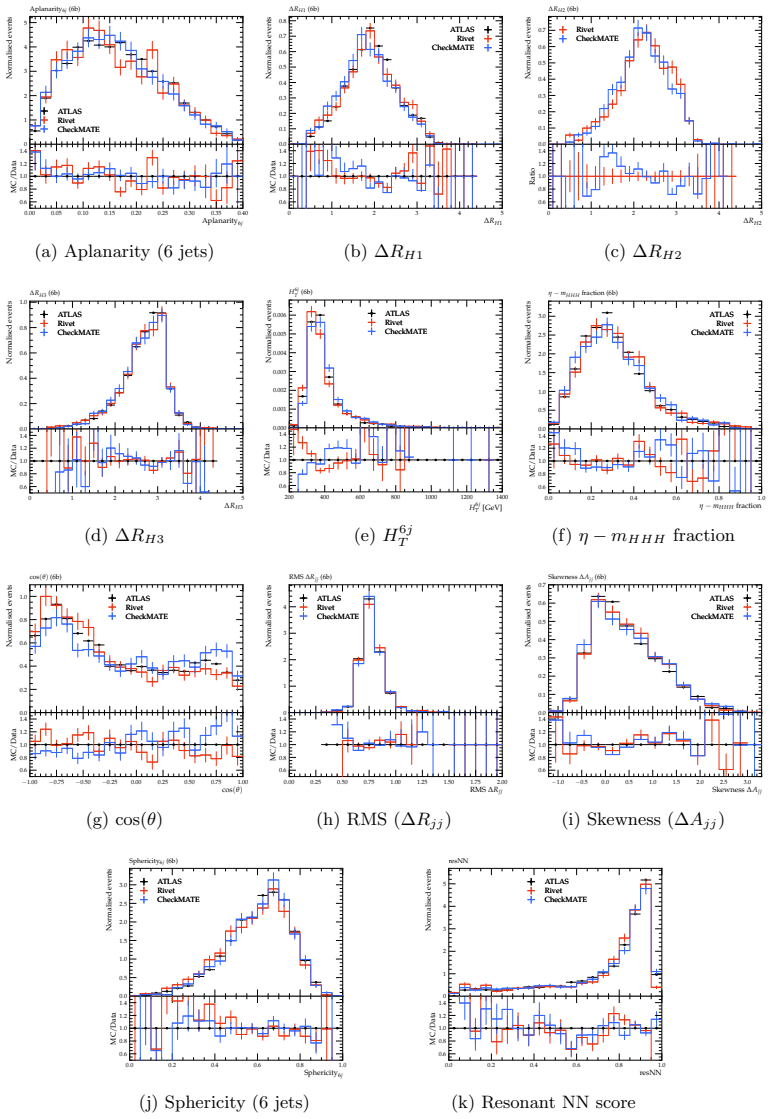
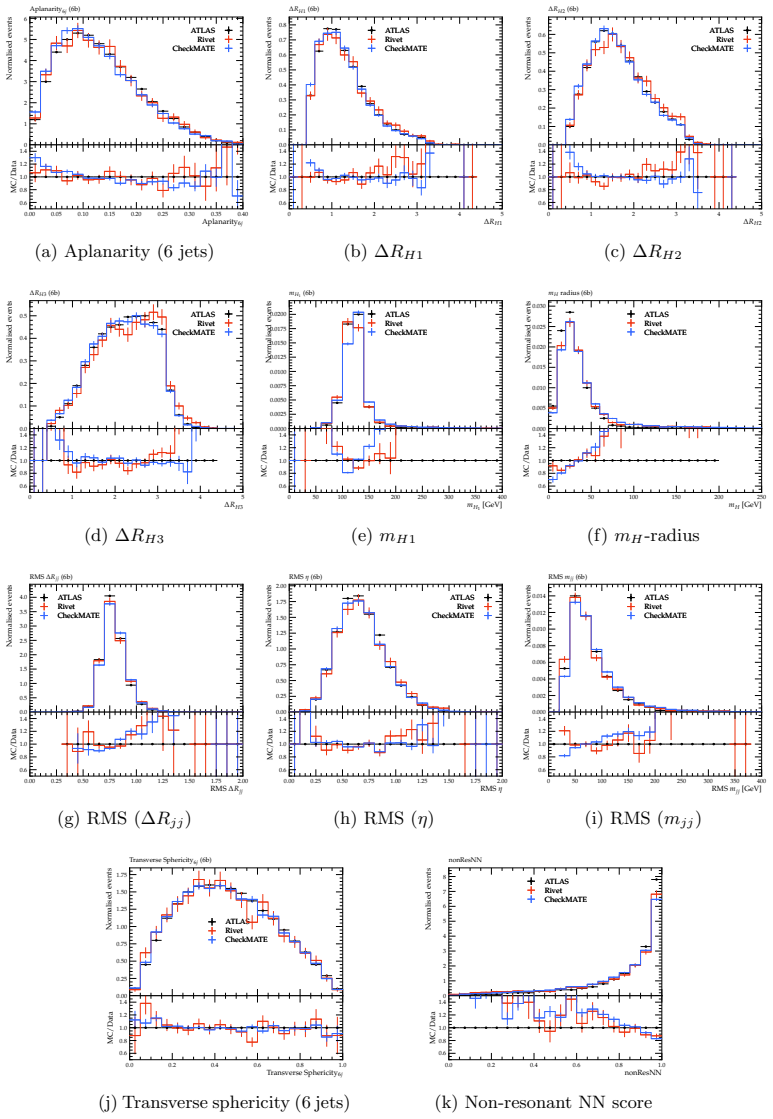
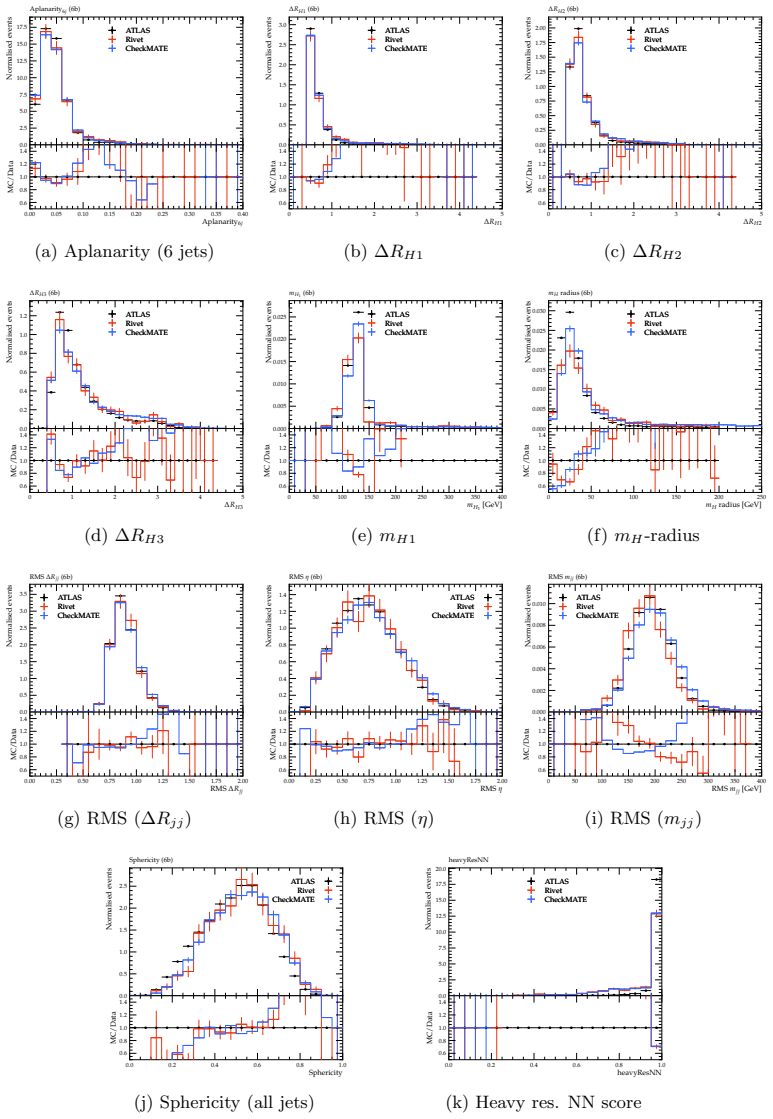
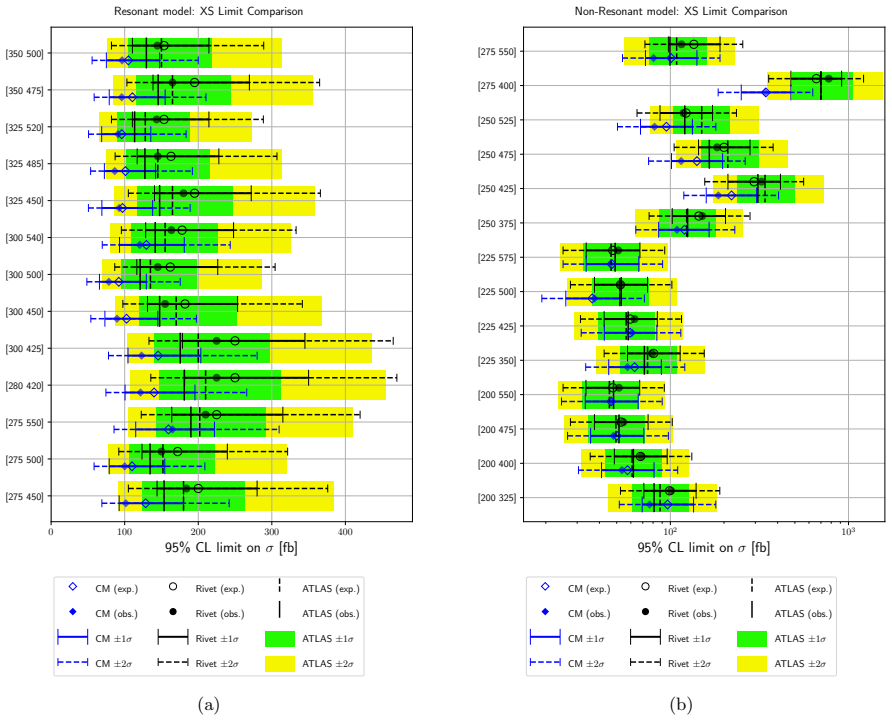
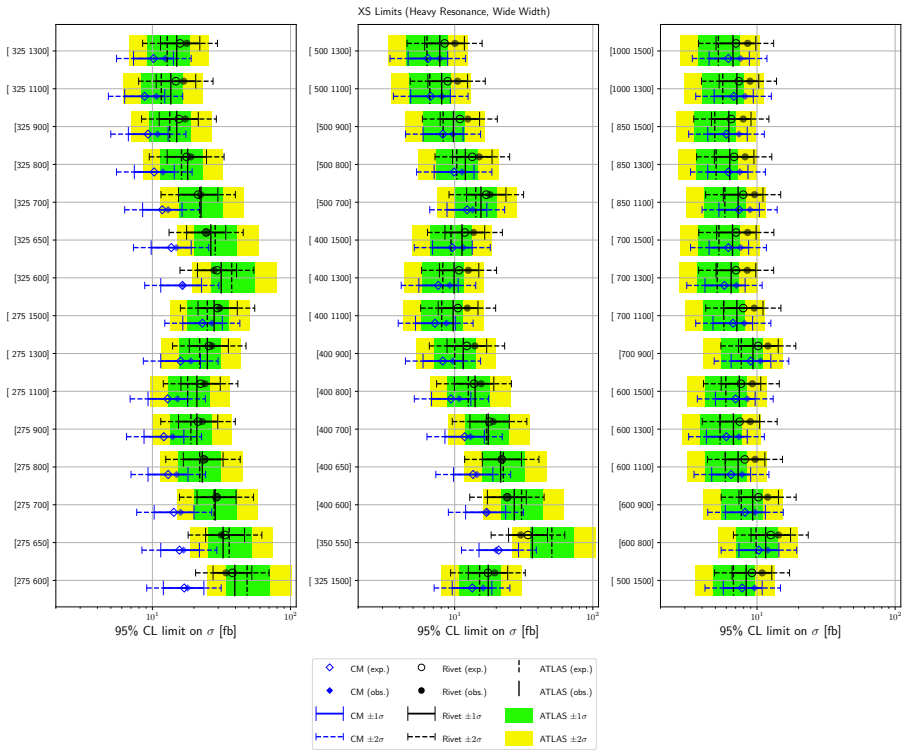
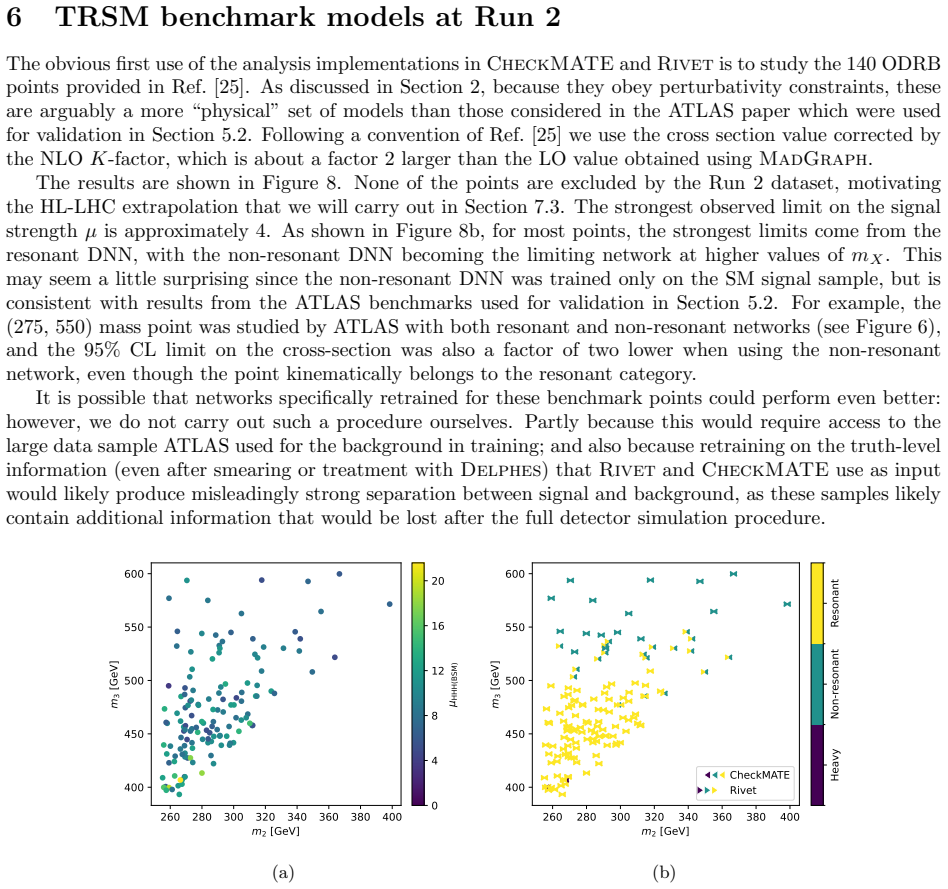
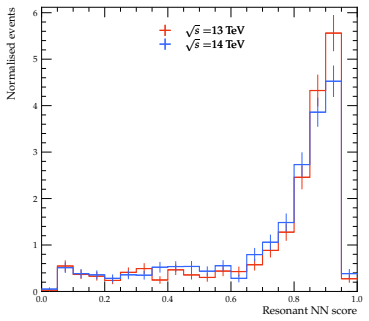
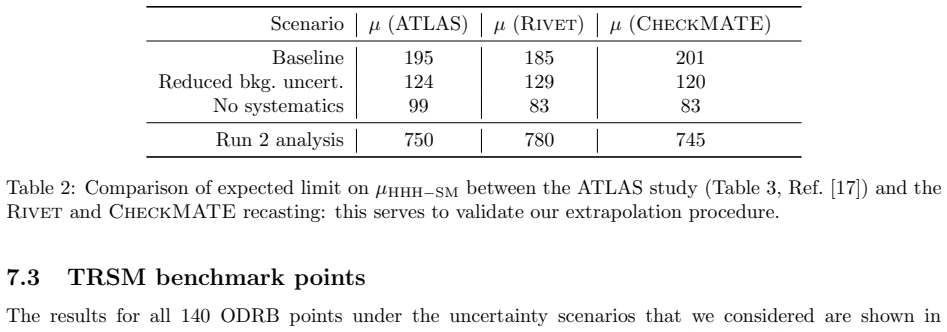
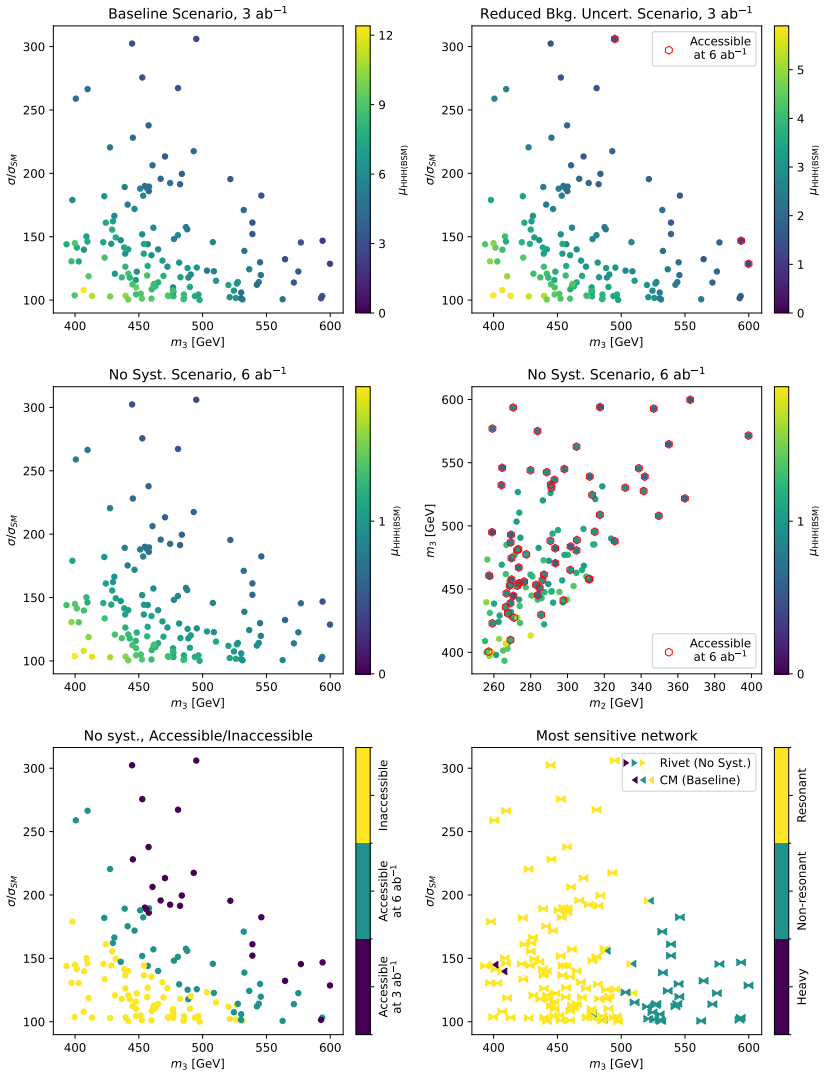
We present an implementation in CheckMATE and Rivet of the ATLAS collaboration search for triple Higgs boson production in a six b-jets final state. The search relies on event selection using a deep neural network and a statistical model based on the HS3 format. Owing to a rich validation material provided by ATLAS, we perform a thorough validation of neural network input features and exclusion limits in the Standard Model and its extension with two additional singlet scalar fields (TRSM). Finally, we discuss expected performance of the search at the High Luminosity LHC in several scenarios of systematic uncertainty. We present projected exclusion limits for a set of TRSM benchmark models be
What carries the argument
The CheckMATE/Rivet reimplementation of the ATLAS deep neural network for event selection together with the HS3 statistical model for setting limits.
If this is right
- Projected exclusion limits become available for TRSM benchmark models that ATLAS did not consider.
- The search sensitivity at the HL-LHC can be assessed under different assumptions about systematic uncertainties.
- The validated implementation can be reused to reinterpret the same dataset for other scalar extensions.
Where Pith is reading between the lines
- The same validated setup could be applied to updated luminosity or revised systematic estimates without rerunning the full ATLAS analysis.
- Limits on TRSM parameters could be translated into constraints on the scalar potential coefficients once the benchmarks are mapped to the underlying Lagrangian.
- Similar reimplementations might be performed for other multi-Higgs final states that use neural-network selections.
Load-bearing premise
The CheckMATE and Rivet code reproduces the ATLAS neural network outputs and HS3 statistical model exactly enough to match the published exclusion limits.
What would settle it
A statistically significant mismatch between the reimplemented exclusion limits and the ATLAS-published limits in the Standard Model or the validated TRSM points would show that the implementation does not faithfully reproduce the original analysis.
Figures
read the original abstract
We present an implementation in CheckMATE and Rivet of the ATLAS collaboration search for triple Higgs boson production in a six $b$-jets final state. The search relies on event selection using a deep neural network and a statistical model based on the HS3 format. Owing to a rich validation material provided by ATLAS, we perform a thorough validation of neural network input features and exclusion limits in the Standard Model and its extension with two additional singlet scalar fields (TRSM). Finally, we discuss expected performance of the search at the High Luminosity LHC in several scenarios of systematic uncertainty. We present projected exclusion limits for a set of TRSM benchmark models beyond those considered by ATLAS.
Editorial analysis
A structured set of objections, weighed in public.
Referee Report
Summary. The manuscript presents an implementation in CheckMATE and Rivet of the ATLAS HHH→6b search, which uses a deep neural network for event selection and an HS3-based statistical model. It performs a validation of neural-network input features and exclusion limits against ATLAS-provided material in both the Standard Model and the two-real-singlet model (TRSM), then derives projected exclusion limits at the HL-LHC for several TRSM benchmark points beyond those considered by ATLAS, under different systematic-uncertainty scenarios.
Significance. If the reproduction is accurate, the work supplies a publicly available, validated tool for reinterpretation of the ATLAS triple-Higgs search and extends its reach to additional TRSM benchmarks at HL-LHC. The explicit use of rich ATLAS validation material for both SM and TRSM limits is a clear strength that supports the reliability of the forward projections.
minor comments (3)
- [§4.2] §4.2: the text states that the DNN output distribution is validated, but does not quantify the level of agreement (e.g., Kolmogorov-Smirnov distance or bin-by-bin pull) between the CheckMATE/Rivet implementation and the ATLAS reference; adding this metric would strengthen the validation claim.
- [Table 2] Table 2: the caption does not specify whether the quoted cross-section uncertainties are statistical only or include the full systematic envelope used in the HS3 model; this affects readability of the limit comparison.
- [Figure 7] Figure 7: the HL-LHC projection curves for the three systematic scenarios are plotted without error bands on the expected limits; adding these would make the impact of the uncertainty assumptions clearer.
Simulated Author's Rebuttal
We thank the referee for the careful reading and positive assessment of our work, including the recommendation for minor revision. No specific major comments were raised in the report.
Circularity Check
No significant circularity; derivation relies on external ATLAS validation material
full rationale
The paper implements an ATLAS search in CheckMATE/Rivet, validates NN features and limits against provided ATLAS material (both SM and TRSM), then applies the validated setup to project HL-LHC limits on additional TRSM benchmarks. No load-bearing step reduces by construction to a fit, self-definition, or self-citation chain. The central claim (projected exclusions beyond ATLAS) is a forward application of an externally validated reimplementation, not a renaming or internal tautology. This matches the default expectation of a self-contained analysis against external benchmarks.
Axiom & Free-Parameter Ledger
Reference graph
Works this paper leans on
-
[1]
T. Plehn and M. Rauch,The quartic higgs coupling at hadron colliders,Phys. Rev. D72(2005) 053008 [hep-ph/0507321]
Pith/arXiv arXiv 2005
-
[2]
T. Binoth, S. Karg, N. Kauer and R. Ruckl,Multi-Higgs boson production in the Standard Model and beyond,Phys. Rev. D74(2006) 113008 [hep-ph/0608057]
Pith/arXiv arXiv 2006
-
[3]
P. Stylianou and G. Weiglein,Constraints on the trilinear and quartic Higgs couplings from triple Higgs production at the LHC and beyond,Eur. Phys. J. C84(2024) 366 [2312.04646]
arXiv 2024
-
[4]
B. Horn,The Higgs field and early universe cosmology: a (brief) review,MDPI Physics2(2020) 503 [2007.10377]. [11]ATLAScollaboration,Combination of Searches for Higgs Boson Pair Production in pp Collisions at√s= 13TeV with the ATLAS Detector,Phys. Rev. Lett.133(2024) 101801 [2406.09971]. [12]CMScollaboration,Constraints on the Higgs boson self-coupling fro...
arXiv 2020
-
[5]
HEP statistics serialization standard
U. Haisch, A. Sankar and G. Zanderighi,A new probe of the quartic Higgs self-coupling,2505.20463. [19]HS3 Projectcollaboration, “HEP statistics serialization standard.” https://github.com/hep-statistics-serialization-standard/. [20]ATLAScollaboration, “ANA-HIGP-2024-32HEPdataentry.” https://www.hepdata.net/record/157024. [21]ATLAScollaboration, “ANA-HIGP-...
arXiv 2024
- [6]
-
[7]
A. Papaefstathiou, T. Robens and G. Tetlalmatzi-Xolocotzi,Triple Higgs Boson Production at the Large Hadron Collider with Two Real Singlet Scalars,JHEP05(2021) 193 [2101.00037]
arXiv 2021
-
[8]
T.-K. Chen, C.-W. Chiang and I. Low,Simple model of dark matter and CP violation,Phys. Rev. D 105(2022) 075025 [2202.02954]
arXiv 2022
-
[9]
O. Karkout, A. Papaefstathiou, M. Postma, G. Tetlalmatzi-Xolocotzi, J. van de Vis and T. du Pree, Triple Higgs boson production and electroweak phase transition in the two-real-singlet model,JHEP11 (2024) 077 [2404.12425]
arXiv 2024
-
[10]
U. Ellwanger, M. Rausch de Traubenberg and C.A. Savoy,Phenomenology of supersymmetric models with a singlet,Nucl. Phys. B492(1997) 21 [hep-ph/9611251]
Pith/arXiv arXiv 1997
-
[11]
C.-Y. Chen, M. Freid and M. Sher,Next-to-minimal two Higgs doublet model,Phys. Rev. D89(2014) 075009 [1312.3949]
Pith/arXiv arXiv 2014
-
[12]
H. Abouabid, A. Arhrib, D. Azevedo, J.E. Falaki, P.M. Ferreira, M. M¨ uhlleitner et al.,Benchmarking di-Higgs production in various extended Higgs sector models,JHEP09(2022) 011 [2112.12515]
arXiv 2022
-
[13]
A. Papaefstathiou and G. Tetlalmatzi-Xolocotzi,Multi-Higgs boson production with anomalous interactions at current and future proton colliders,JHEP06(2024) 124 [2312.13562]
arXiv 2024
-
[14]
Abouabid et al.,HHH whitepaper,Eur
H. Abouabid et al.,HHH whitepaper,Eur. Phys. J. C84(2024) 1183 [2407.03015]
arXiv 2024
-
[15]
M. Cacciari, G.P. Salam and G. Soyez,The anti-k t jet clustering algorithm,JHEP04(2008) 063 [0802.1189]. [32]ATLAScollaboration,Neural Network Jet Flavour Tagging with the Upgraded ATLAS Inner Tracker Detector at the High-Luminosity LHC, Tech. Rep. ATL-PHYS-PUB-2022-047 (2022). [33]ATLAScollaboration,Deep Sets based Neural Networks for Impact Parameter Fl...
Pith/arXiv arXiv 2008
-
[16]
Brun and F
R. Brun and F. Rademakers,ROOT — An object oriented data analysis framework,Nucl. Instrum. Meth. A389(1997) 81
1997
-
[17]
J. Alwall, R. Frederix, S. Frixione, V. Hirschi, F. Maltoni, O. Mattelaer et al.,The automated computation of tree-level and next-to-leading order differential cross sections, and their matching to parton shower simulations,JHEP07(2014) 079 [1405.0301]
Pith/arXiv arXiv 2014
-
[18]
J. Alwall et al.,Comparative study of various algorithms for the merging of parton showers and matrix elements in hadronic collisions,Eur. Phys. J. C53(2008) 473 [0706.2569]
Pith/arXiv arXiv 2008
-
[19]
J. Alwall, S. de Visscher and F. Maltoni,QCD radiation in the production of heavy colored particles at the LHC,JHEP02(2009) 017 [0810.5350]
Pith/arXiv arXiv 2009
-
[20]
V. Hirschi and O. Mattelaer,Automated event generation for loop-induced processes,JHEP10(2015) 146 [1507.00020]
Pith/arXiv arXiv 2015
-
[21]
Ball et al.,Parton distributions with LHC data,Nucl
R.D. Ball et al.,Parton distributions with LHC data,Nucl. Phys. B867(2013) 244 [1207.1303]
Pith/arXiv arXiv 2013
-
[22]
A. Buckley, J. Ferrando, S. Lloyd, K. Nordstr¨ om, B. Page, M. R¨ ufenacht et al.,LHAPDF6: parton density access in the LHC precision era,Eur. Phys. J. C75(2015) 132 [1412.7420]. [44]NNPDFcollaboration,Parton distributions for the LHC Run II,JHEP04(2015) 040 [1410.8849]
Pith/arXiv arXiv 2015
-
[23]
T. Sj¨ ostrand, S. Ask, J.R. Christiansen, R. Corke, N. Desai, P. Ilten et al.,An introduction to PYTHIA 8.2,Comput. Phys. Commun.191(2015) 159 [1410.3012]
Pith/arXiv arXiv 2015
-
[24]
Bierlich et al.,A comprehensive guide to the physics and usage of PYTHIA 8.3,SciPost Phys
C. Bierlich et al.,A comprehensive guide to the physics and usage of PYTHIA 8.3,SciPost Phys. Codeb.2022(2022) 8 [2203.11601]
Pith/arXiv arXiv 2022
-
[25]
D. de Florian, I. Fabre and J. Mazzitelli,Triple Higgs production at hadron colliders at NNLO in QCD,JHEP03(2020) 155 [1912.02760]. [48]LHC Higgs Cross Section Working Groupcollaboration,Handbook of LHC Higgs Cross Sections: 4. Deciphering the Nature of the Higgs Sector,CERN Yellow Rep. Monogr.2(2017) 1 [1610.07922]
arXiv 2020
-
[26]
Code for the Two Real Singlet Extension of the SM (TRSM)
A. Papaefstathiou, “Code for the Two Real Singlet Extension of the SM (TRSM).” https://gitlab.com/apapaefs/twosinglet, 2023
2023
-
[27]
Darm´ e et al.,UFO 2.0: the ‘Universal Feynman Output’ format,Eur
L. Darm´ e et al.,UFO 2.0: the ‘Universal Feynman Output’ format,Eur. Phys. J. C83(2023) 631 [2304.09883]
arXiv 2023
-
[28]
J. Alwall, C. Duhr, B. Fuks, O. Mattelaer, D.G. ¨Ozt¨ urk and C.-H. Shen,Computing decay rates for new physics theories with FeynRules and MadGraph 5 aMC@NLO,Comput. Phys. Commun.197 (2015) 312 [1402.1178]
Pith/arXiv arXiv 2015
-
[29]
D. Dercks, N. Desai, J.S. Kim, K. Rolbiecki, J. Tattersall and T. Weber,CheckMATE 2: From the model to the limit,Comput. Phys. Commun.221(2017) 383 [1611.09856]
Pith/arXiv arXiv 2017
-
[30]
Jet Flavour Tagging With GN1 and DL1d
I. Lara and K. Rolbiecki,Implementation of full and simplified likelihoods in CheckMATE,Eur. Phys. J. C86(2026) 221 [2507.08565]. 22 [54]ATLAScollaboration, “Jet Flavour Tagging With GN1 and DL1d.” https://atlas.web.cern.ch/Atlas/GROUPS/PHYSICS/PLOTS/FTAG-2023-01/
arXiv 2026
-
[31]
“ONNX Runtime.”https://onnxruntime.ai. [56]DELPHES 3collaboration,DELPHES 3, A modular framework for fast simulation of a generic collider experiment,JHEP02(2014) 057 [1307.6346]
Pith/arXiv arXiv 2014
-
[32]
M. Cacciari, G.P. Salam and G. Soyez,FastJet User Manual,Eur. Phys. J. C72(2012) 1896 [1111.6097]
Pith/arXiv arXiv 2012
-
[33]
C. Bierlich, A. Buckley, J.M. Butterworth, C. Gutschow, L. Lonnblad, T. Procter et al.,Robust independent validation of experiment and theory: Rivet version 4 release note,SciPost Phys. Codeb. 36(2024) 1 [2404.15984]. [59]CONTURcollaboration,Constraints On New Theories Using Rivet : CONTUR version 3 release note,2505.09272
arXiv 2024
-
[34]
Araz,Spey: Smooth inference for reinterpretation studies,SciPost Phys.16(2024) 032 [2307.06996]
J.Y. Araz,Spey: Smooth inference for reinterpretation studies,SciPost Phys.16(2024) 032 [2307.06996]
arXiv 2024
-
[35]
pyHS3: A pure-Python implementation of the HEP Statistics Serialization Standard (HS3)
pyHS3 developers, “pyHS3: A pure-Python implementation of the HEP Statistics Serialization Standard (HS3).”https://github.com/scipp-atlas/pyhs3, 2026
2026
-
[36]
T. Procter, K. Rolbiecki and A. Siodmok, “Implementation of a triple-Higgs search in CheckMATE and Rivet and constraints on the TRSM at the LHC and HL-LHC .” https://doi.org/10.5281/zenodo.19735119, Apr., 2026. 10.5281/zenodo.19735119
-
[37]
J.Y. Araz et al.,Les Houches guide to reusable ML models in LHC analyses,SciPost Phys. Comm. Rep.(2024) 3 [2312.14575]. [64]ATLAScollaboration, “Search for triple Higgs boson production in the 6b final state using pp collisions at √s= 13 TeV with the ATLAS detector.” https://atlas.web.cern.ch/Atlas/GROUPS/PHYSICS/PAPERS/HIGP-2024-32/
arXiv 2024
-
[38]
J.Y. Araz, M. Frank and B. Fuks,Reinterpreting the results of the LHC with MadAnalysis 5: uncertainties and higher-luminosity estimates,Eur. Phys. J. C80(2020) 531 [1910.11418]
arXiv 2020
-
[39]
J.Y. Araz, “SpeysideHEP/spey-pyhf: v0.2.0.”https://doi.org/10.5281/zenodo.14945825, 2025. 23
discussion (0)
Sign in with ORCID, Apple, or X to comment. Anyone can read and Pith papers without signing in.