REVIEW 31 references
MAD: Manifold Attracted Diffusion
T0 review · reviewed 2026-08-04 · deepseek-v4-flash
Pith's one-line read Score-based diffusion can be modified at inference time so that samples from noisy training data are pulled toward the clean data manifold.
The pith
A machine-rendered reading of the paper's core claim, the machinery that carries it, and where it could break.
The reading
Extended reading notes
Core claim
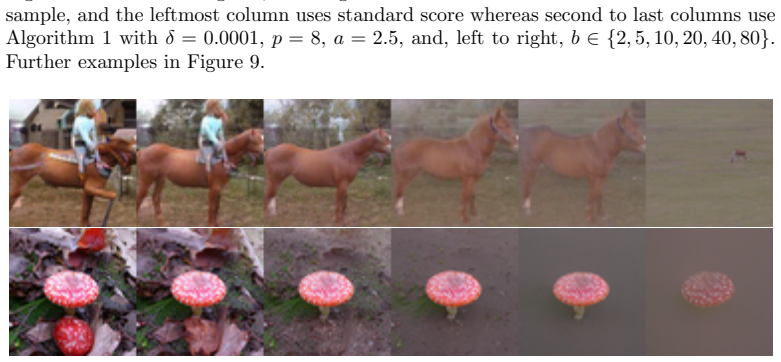
The central claim is that MAD, an inference-time modification using the extended score, generates samples approximately from the clean distribution when trained on noisy data. The abstract states: 'we present an efficiently implementable modification of the inference procedure to generate noiseless samples' and that 'in a simplified setting, it can be used to reduce small variations to zero, while leaving large variations mostly unchanged.' If the paper is correct, one can take a score network trained on corrupted samples and produce clean samples without any training-phase changes, just extra score evaluations.
Load-bearing premise
Algorithm 1 approximates the derivative of the true score with respect to noise level by a finite difference of a neural network score approximator, d/dσ S_theta(t,x). The paper provides no argument that this network derivative is a faithful approximation to the true derivative of the score, nor that the correction factor m(t), derived only for a Dirac-delta target distribution, transfers to general manifold data. If this derivative is inaccurate, the extended-score estimate is wrong and the claimed denoising behavior would not occur. This is an unflagged assumption about the smoothness and trainability of score gradients.
Editorial analysis
A structured set of objections, weighed in public.
Assumptions & free parameters
free parameters (4)
- a =
dataset-dependent: 2.5 for FFHQ/AFHQ, 8 for ImageNet, 0.002 for synthetic, 0.01 for EMPIAR-11618
- b =
dataset-dependent: 2-80 for FFHQ/AFHQ, 5-250 for ImageNet, 15 for synthetic, 2 for EMPIAR-11618
- p =
dataset-dependent: 8 for FFHQ/AFHQ and synthetic, 12 for ImageNet
- delta =
0.0001 to 0.02 depending on dataset
assumptions (4)
- domain assumption Data lie on a low-dimensional manifold and noise is small in off-manifold directions.
- domain assumption A well-trained score network S_theta approximates the true score S_{p_sigma} for all sigma in the training range.
- ad hoc to paper The finite-difference derivative d/dsigma S_theta(t,x) is a faithful approximation to the true derivative of the score.
- standard math Standard approximate identity results (Grafakos) for convolutions with Gaussians.
Cite this review
Pith. "Pith review of MAD: Manifold Attracted Diffusion." pith.science (2026). https://pith.science/paper/MMIVV7TK
@misc{pith2026250924710,
  author       = {Pith},
  title        = {Pith review of: MAD: Manifold Attracted Diffusion},
  year         = {2026},
  howpublished = {\url{https://pith.science/paper/MMIVV7TK}},
  note         = {Machine review of arXiv:2509.24710}
}
read the original abstract
Score-based diffusion models are a highly effective method for generating samples from a distribution of images. We consider scenarios where the training data comes from a noisy version of the target distribution, and present an efficiently implementable modification of the inference procedure to generate noiseless samples. Our approach is motivated by the manifold hypothesis, according to which meaningful data is concentrated around some low-dimensional manifold of a high-dimensional ambient space. The central idea is that noise manifests as low magnitude variation in off-manifold directions in contrast to the relevant variation of the desired distribution which is mostly confined to on-manifold directions. We introduce the notion of an extended score and show that, in a simplified setting, it can be used to reduce small variations to zero, while leaving large variations mostly unchanged. We describe how its approximation can be computed efficiently from an approximation to the standard score and demonstrate its efficacy on toy problems, synthetic data, and real data.
Figures


Figures from the paper (10 more)


Reference graph
Works this paper leans on
-
[1]
C., Brackmann, K., Dimakou, D., Halic, M., Hewitt, G., Boulton, S
Bacic, L., Gaullier, G., Sabantsev, A., Lehmann, L. C., Brackmann, K., Dimakou, D., Halic, M., Hewitt, G., Boulton, S. J., and Deindl, S. (2021). Structure and dynamics of the chromatin remodeler alc1 bound to a parylated nucleosome. eLife , 10:e71420
2021
-
[2]
Bengio, Y., Courville, A., and Vincent, P. (2013). Representation learning: A review and new perspectives. IEEE transactions on pattern analysis and machine intelligence , 35(8):1798--1828
2013
-
[3]
Bortoli, V. D. (2022). Convergence of denoising diffusion models under the manifold hypothesis. Transactions on Machine Learning Research
2022
-
[4]
and De Vleeschouwer, C
Brummer, B. and De Vleeschouwer, C. (2019). Natural image noise dataset. In Proceedings of the IEEE/CVF Conference on Computer Vision and Pattern Recognition (CVPR) Workshops
2019
-
[5]
A., and Walz, T
Cheng, Y., Grigorieff, N., Penczek, P. A., and Walz, T. (2015). A primer to single-particle cryo-electron microscopy. Cell , 161:438--449
2015
-
[6]
Choi, Y., Uh, Y., Yoo, J., and Ha, J.-W. (2020). Stargan v2: Diverse image synthesis for multiple domains. In Proceedings of the IEEE Conference on Computer Vision and Pattern Recognition
2020
-
[7]
T., Klasky, M
Chung, H., Kim, J., Mccann, M. T., Klasky, M. L., and Ye, J. C. (2023). Diffusion posterior sampling for general noisy inverse problems. In The Eleventh International Conference on Learning Representations
2023
-
[8]
Chung, H., Sim, B., Ryu, D., and Ye, J. C. (2022). Improving diffusion models for inverse problems using manifold constraints. Advances in Neural Information Processing Systems , 35:25683--25696
2022
Show all 31 references
-
[9]
Daras, G., Shah, K., Dagan, Y., Gollakota, A., Dimakis, A., and Klivans, A. (2023). Ambient diffusion: Learning clean distributions from corrupted data. Advances in Neural Information Processing Systems , 36:288--313
2023
-
[10]
Deng, J., Dong, W., Socher, R., Li, L.-J., Li, K., and Fei-Fei, L. (2009). Imagenet: A large-scale hierarchical image database. In 2009 IEEE Conference on Computer Vision and Pattern Recognition , pages 248--255
2009
-
[11]
and Nichol, A
Dhariwal, P. and Nichol, A. (2021). Diffusion models beat gans on image synthesis. In Ranzato, M., Beygelzimer, A., Dauphin, Y., Liang, P., and Vaughan, J. W., editors, Advances in Neural Information Processing Systems , volume 34, pages 8780--8794. Curran Associates, Inc
2021
-
[12]
and Levin, D
Faigenbaum-Golovin, S. and Levin, D. (2023). Manifold reconstruction and denoising from scattered data in high dimension. J. Comput. Appl. Math. , 421:Paper No. 114818, 24
2023
-
[13]
Fefferman, C., Ivanov, S., Kurylev, Y., Lassas, M., and Narayanan, H. (2018). Fitting a putative manifold to noisy data. In Conference On Learning Theory , pages 688--720. PMLR
2018
-
[14]
Fefferman, C., Mitter, S., and Narayanan, H. (2016). Testing the manifold hypothesis. Journal of the American Mathematical Society , 29(4):983--1049
2016
-
[15]
Gong, D., Sha, F., and Medioni, G. (2010). Locally linear denoising on image manifolds. In Proceedings of the Thirteenth International Conference on Artificial Intelligence and Statistics , pages 265--272. JMLR Workshop and Conference Proceedings
2010
-
[16]
Grafakos, L. (2014). Classical F ourier analysis , volume 249 of Graduate Texts in Mathematics . Springer, New York, third edition
2014
-
[17]
and Gupta, A
Gupta, S. and Gupta, A. (2019). Dealing with noise problem in machine learning data-sets: A systematic review. Procedia Computer Science , 161:466--474. The Fifth Information Systems International Conference, 23-24 July 2019, Surabaya, Indonesia
2019
-
[18]
and Maier, M
Hein, M. and Maier, M. (2006). Manifold denoising. Advances in neural information processing systems , 19
2006
-
[19]
Ho, J., Jain, A., and Abbeel, P. (2020). Denoising diffusion probabilistic models. In Advances in Neural Information Processing Systems , volume 33, pages 6840--6851
2020
-
[20]
Karras, T., Aittala, M., Aila, T., and Laine, S. (2022). Elucidating the design space of diffusion-based generative models. In Advances in Neural Information Processing Systems , volume 35, pages 26565--26577
2022
-
[21]
Karras, T., Laine, S., and Aila, T. (2019). A style-based generator architecture for generative adversarial networks. In Proceedings of the IEEE/CVF Conference on Computer Vision and Pattern Recognition (CVPR)
2019
-
[22]
Lu, H., Wu, Q., and Yu, Y. (2025). Stochastic forward backward deconvolution: Training diffusion models with finite noisy datasets. In Forty-second International Conference on Machine Learning
2025
-
[23]
Pope, P., Zhu, C., Abdelkader, A., Goldblum, M., and Goldstein, T. (2021). The intrinsic dimension of images and its impact on learning. In International Conference on Learning Representations
2021
-
[24]
Potaptchik, P., Azangulov, I., and Deligiannidis, G. (2024). Linear convergence of diffusion models under the manifold hypothesis. arXiv preprint arXiv:2410.09046
2024 arXiv
-
[25]
Ronneberger, O., Fischer, P., and Brox, T. (2015). U-net: Convolutional networks for biomedical image segmentation. In Navab, N., Hornegger, J., Wells, W. M., and Frangi, A. F., editors, Medical Image Computing and Computer-Assisted Intervention -- MICCAI 2015 , pages 234--241...
2015
-
[26]
and Ermon, S
Song, Y. and Ermon, S. (2020). Score-based generative modeling through stochastic differential equations. In International Conference on Learning Representations
2020
-
[27]
P., Kumar, A., Ermon, S., and Poole, B
Song, Y., Sohl-Dickstein, J., Kingma, D. P., Kumar, A., Ermon, S., and Poole, B. (2021). Score-based generative modeling through stochastic differential equations
2021
-
[28]
P., Batzolis, G., Deveney, T., and Sch \"o nlieb, C.-B
Stanczuk, J. P., Batzolis, G., Deveney, T., and Sch \"o nlieb, C.-B. (2024). Diffusion models encode the intrinsic dimension of data manifolds. In Forty-first International Conference on Machine Learning
2024
-
[29]
and Yang, Y
Tang, R. and Yang, Y. (2024). Adaptivity of diffusion models to manifold structures. In Dasgupta, S., Mandt, S., and Li, Y., editors, Proceedings of The 27th International Conference on Artificial Intelligence and Statistics , volume 238 of Proceedings of Machine Learning Rese...
2024
-
[30]
and Carreira-Perpin \'a n, M
Wang, W. and Carreira-Perpin \'a n, M. A. (2010). Manifold blurring mean shift algorithms for manifold denoising. In 2010 IEEE Computer Society Conference on Computer Vision and Pattern Recognition , pages 1759--1766. IEEE
2010
-
[31]
wwPDB Consortium, T. (2023). Emdb—the electron microscopy data bank. Nucleic Acids Research , 52(D1):D456--D465
2023
Reviewed August 4, 2026 · model on record in the stance chip above.
Discussion (0). Continue with ORCID to comment.