REVIEW 4 major objections 5 minor 28 references
Constraining the Sea Quark Distributions Through W$^\pm$ Cross Section Ratio Measurements at STAR
T0 review · 4 major / 5 minor · reviewed 2026-08-14 · deepseek-v4-flash
Pith's one-line read The paper claims that STAR's measured $W^+$/$W^-$ and $W/Z$ cross-section ratios at $\sqrt{s}=500/510$ GeV provide new high-$Q^2$ constraints on the proton's $\bar d/\bar u$ sea-quark ratio, probing $x\approx0.06$--$0.4$.
desk verdict A credible STAR proceedings update with new 2011-2013 data and a forward W+/W- extension, but the QCD background sideband validation is missing and the PDF-constraint claim outruns the presented detail. read the letter →
The pith
A machine-rendered reading of the paper's core claim, the machinery that carries it, and where it could break.
The reading
What carries the argument
The central identity is the leading-order relation $\sigma_{W^+}/\sigma_{W^-}\sim[\bar d(x_2)u(x_1)+\bar d(x_1)u(x_2)]/[\bar u(x_2)d(x_1)+\bar u(x_1)d(x_2)]$, which follows from the subprocesses $u+\bar d\to W^+\to e^+\nu$ and $d+\bar u\to W^-\to e^-\bar\nu$ and converts a lepton-charge asymmetry into a statement about $\bar d/\bar u$ at $Q^2\sim M_W^2$. Experimentally, the machinery consists of isolated electron/positron selection in the STAR barrel and endcap calorimeters, charge identification from the time projection chamber, a data-driven QCD background estimated from events that fail the signed-$p_T$ cut, and a FEWZ-based acceptance correction $A$ that extrapolates the fiducial cross sections to total cross sections.
What would settle it
Recompute the W^+/W^- ratio with the QCD background estimated instead from events in the opposite charge-sign sideband or from an independent Monte Carlo sample; if the ratio moves by more than the quoted systematic uncertainty, the central result is not robust. Alternatively, recalculate the acceptance factor $A$ with a second next-to-leading-order generator rather than FEWZ and compare the resulting total cross sections and ratio.
Extended reading notes
Core claim
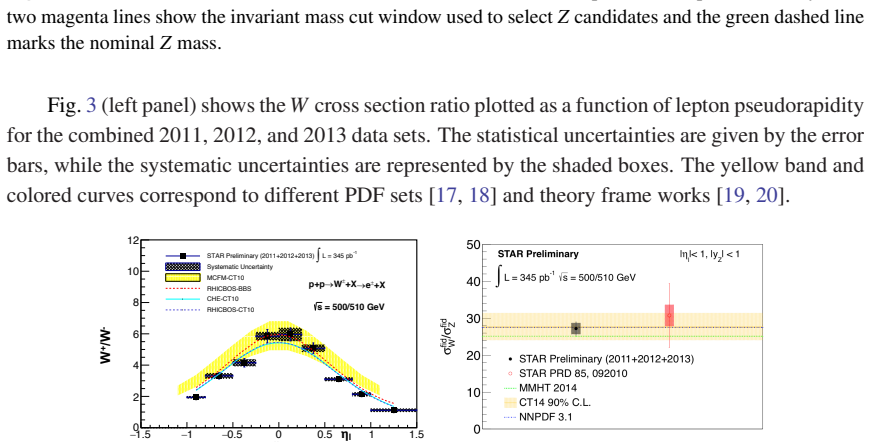
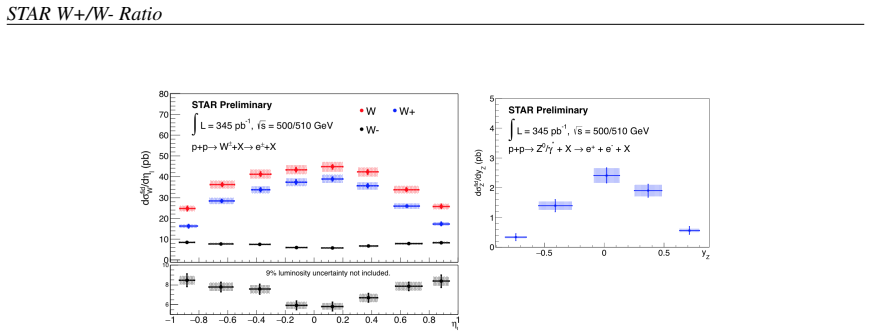
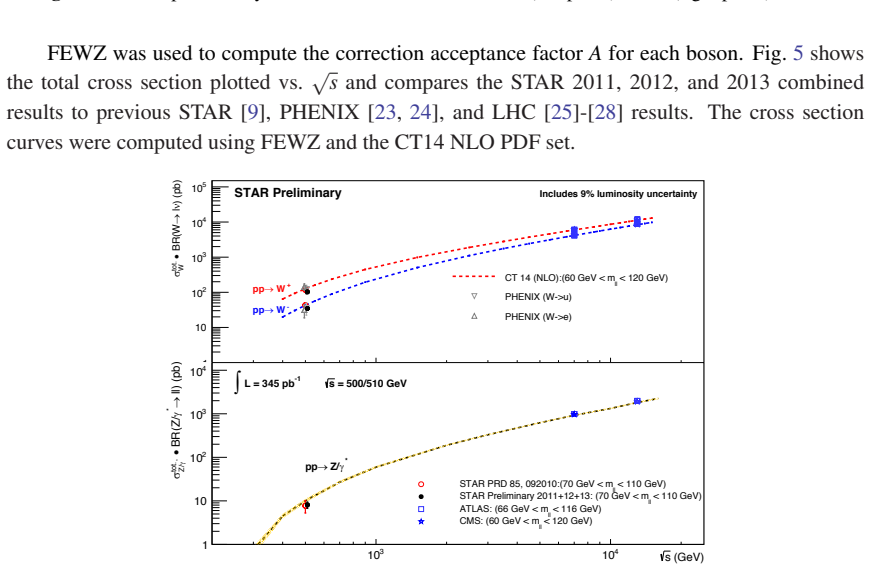
The central claim is that STAR has measured the $W$ and $Z$ differential and total cross sections, along with the $W^+$/$W^-$ and $W/Z$ cross-section ratios, in proton-proton collisions at $\sqrt{s}=500$ GeV and $510$ GeV. Using the 2011, 2012, and 2013 data sets totaling about $350$ pb$^{-1}$, the paper presents preliminary results for these observables: the $W^+$/$W^-$ ratio as a function of lepton pseudorapidity, the $W/Z$ ratio with the $W^\pm$ integrated over $|\eta|<1$ and the $Z$ over $|y|<1$, and total $W$ and $Z$ cross sections compared with PHENIX and LHC results. Because the $W^+$/$W^-$ ratio at leading order is directly proportional to the $\bar d$ and $\bar u$ distributions, the result supplies new high-$Q^2$ data sensitive to the $\bar d/\bar u$ sea-quark ratio in the kinematic range roughly $0.06<x<0.4$, extending the reach of the E866 and SeaQuest Drell-Yan measurements and complementing LHC measurements at lower $\sqrt{s}$ and larger $x$.
Load-bearing premise
The load-bearing premise is that the QCD background inside the W signal sample is correctly counted by events that fail the signed-momentum selection; if that background estimate is biased, the W^+/W^- ratio shifts by the same bias.
Editorial extensions
If this is right
- Through Eq. (1.2), the $W^+$/$W^-$ ratio gives new high-$Q^2$ information on $\bar d/\bar u$ in $0.06\lesssim x\lesssim0.4$, the region where E866 and SeaQuest appear to diverge at high $x$.
- The $W/Z$ cross-section ratio and the total $W$ and $Z$ cross sections at $\sqrt{s}=500/510$ GeV provide production measurements at lower $\sqrt{s}$ and larger $x$ than the LHC, offering a complementary test of next-to-leading-order predictions.
- The combined 2011--2013 $W/Z$ ratio already has a smaller uncertainty than the corresponding CT14 theory band, so the result can tighten global PDF extractions.
- The 2017 run, adding roughly another $350$ pb$^{-1}$ at $\sqrt{s}=510$ GeV, will reduce statistical uncertainties and, through the forward endcap measurement, extend the sea-quark sensitivity toward higher $x$.
Reading between the lines
- If the ratio survives the doubled 2017 sample, the $\bar d/\bar u$ constraint could be strong enough to settle the E866/SeaQuest high-$x$ discrepancy---a stronger role than the paper's stated 'help constrain'.
- The paper does not perform a global fit; a fit that uses both the $W^+$/$W^-$ and the $W/Z$ ratios together could shift the extracted sea asymmetry, because the two ratios weight different quark flavour combinations.
- A testable follow-up not reported here is to compare the $W^+$/$W^-$ ratio bin-by-bin in mid-rapidity ($|\eta|<1$) and forward ($1<\eta<1.5$) data, since the forward bins probe higher $x$; an inconsistency between the two would indicate either a problem with how the two parton momentum fractions enter the cross-section formula or an unaccounted acceptance effect.
Signed reviews
Editorial analysis
A structured set of objections, weighed in public.
Referee Report
Summary. This proceedings paper presents preliminary STAR measurements of W and Z production in proton-proton collisions at sqrt(s) = 500/510 GeV using the 2011-2013 data sample (about 350 pb^-1). The results shown are the W+/W- cross section ratio as a function of lepton pseudorapidity, the W/Z cross section ratio, differential cross sections d_sigma/d_eta for W and W/W- and d_sigma/d_y for Z, and total cross sections compared with FEWZ/CT14 predictions. The stated motivation is that the W+/W- ratio at Q^2 near M_W^2 is sensitive to the dbar/ubar sea quark ratio for x in the range 0.06-0.4, complementing the E866 and SeaQuest Drell-Yan measurements.
Significance. If these preliminary results hold up, they provide new high-Q^2 data on the W+/W- ratio at RHIC energies, complementing LHC and fixed-target measurements and offering a test of the dbar/ubar sea quark distribution. The figures show reasonable data/MC agreement, and the analysis follows established STAR selection methods. The paper does not yet meet the standard of a journal measurement article, however, because no numerical tables, systematic breakdown, or validation of the data-driven QCD subtraction are given. The strength is that a well-motivated, plausible measurement by a major collaboration is presented; the weakness is that the quantitative support for the central claim remains limited.
major comments (4)
- [Section 3, Eq. (3.1), Figs. 3-5] The paper displays only plots and does not provide numerical values for the fiducial or total cross sections, the W+/W- ratio, the W/Z ratio, or their statistical and systematic uncertainties. Without these numbers, the reader cannot perform a quantitative comparison with theory or with the earlier STAR and LHC results, and the claim in Section 4 that the measurements will constrain PDFs cannot be assessed. Tables of central values and uncertainties should be added.
- [Section 3, Fig. 1] The data-driven QCD background, obtained from the E_T distribution that fails the signed-pT cut, is not validated. No closure test is shown demonstrating that this sideband has the same E_T shape and charge composition as the QCD background that survives in the W signal region. Since the W+/W- ratio is formed by separating positrons and electrons, a charge-asymmetric bias in the QCD estimate would directly bias the ratio. The statement that little background contamination remains after E_T > 25 GeV is not quantified separately for W+ and W-; the residual QCD fractions and their uncertainties should be reported per lepton charge.
- [Section 3, Figs. 3-5] The systematic uncertainties are drawn as shaded boxes, but no decomposition is provided. The reader cannot identify the dominant systematic (e.g., charge misidentification, energy scale, background, luminosity) or which uncertainties cancel in the W+/W- ratio. A systematic uncertainty budget should be given, at least in summary form.
- [Section 3, Fig. 3 and Section 4] The paper states that the W+/W- measurement will help constrain the dbar/ubar ratio, but no quantitative sensitivity study is presented, such as a comparison of the data points to the PDF uncertainty band or a projected constraint in x space. The central physics motivation is therefore not supported by the quantitative content of the proceedings.
minor comments (5)
- [Abstract] The word 'pseudorapdity' should be 'pseudorapidity'.
- [References] Reference [7] lists two separate papers under one number; this should be split into two references for clarity.
- [Section 2] The text states that the forward region is 1.0 < eta < 1.5, but Fig. 3 shows data over -1.5 < eta < 1.5; clarify whether the W+/W- ratio is measured in both positive and negative pseudorapidity or in the forward region only.
- [Section 3, Fig. 5] The figure caption says 'Includes 9% luminosity uncertainty', but it is not clear whether this uncertainty is already included in the plotted error bars or is shown separately; this should be stated explicitly.
- [Eq. (1.2)] The variables x1 and x2 in the leading-order formula are not defined; a sentence defining them as the momentum fractions carried by the quark and anti-quark would improve readability.
Circularity Check
No circularity: STAR reports a new W/Z cross-section measurement and compares it to independent PDF predictions; nothing in the derivation reduces to its own inputs.
full rationale
The analysis chain is an experimental measurement, not a derivation of PDFs from theory. Equation (3.1) defines the fiducial cross section from observed candidates NO, background NB, luminosity L, and efficiency ε; none of these inputs is defined in terms of the final W+/W− or W/Z ratios. Backgrounds are either data-driven from the signed-pT fail sideband or from MC (W→τν, Z→ee), and the W/Z acceptance correction A is computed with FEWZ using external PDF sets that are not fitted to the present 2011–2013 W+/W− results. The theory curves in Figs. 3 and 5 are independent predictions, not fits to these data. The only self-references are to previously published STAR analyses ([9], [14]) for event-selection methodology, which is normal experimental continuity and not load-bearing in the sense of making the present result true by construction. A mild and standard caveat is that the FEWZ acceptance depends on a PDF model, but this is a correction, not a fitted parameter renamed as a prediction, and the paper does not claim to extract PDFs itself. Therefore no circular step is present.
Assumptions & free parameters
assumptions (3)
- domain assumption The leading-order relation (Eq. 1.2) between W+/W- and sea quark PDFs is a valid physics motivation.
- domain assumption The theory predictions from FEWZ, MCFM, RHICBOS and PDF sets (CT14, MMHT14, NNPDF) accurately describe W and Z production.
- domain assumption The previous STAR analysis methods [9,14] are valid and the current analysis uses only minimal changes to several cut values.
Cite this review
Pith. "Pith review of Constraining the Sea Quark Distributions Through W$^\pm$ Cross Section Ratio Measurements at STAR." pith.science (2026). https://pith.science/paper/MMNRWHAT
@misc{pith2026190808490,
  author       = {Pith},
  title        = {Pith review of: Constraining the Sea Quark Distributions Through W$^\pm$ Cross Section Ratio Measurements at STAR},
  year         = {2026},
  howpublished = {\url{https://pith.science/paper/MMNRWHAT}},
  note         = {Machine review of arXiv:1908.08490}
}
abstract
Over the past several years, parton distribution functions (PDFs) have become more precise. However there are still kinematic regions where more data are needed to help constrain global PDF extractions, such as the ratio of the sea quark distributions $\bar{d}$/$\bar{u}$ near the valence region. Furthermore, current measurements appear to suggest different high-$x$ behaviors of this ratio. The $W$ cross section ratio ($W^+$/$W^-$) is sensitive to the unpolarized quark distributions at large $Q^2$ set by the $W$ mass. Such a measurement can be used to help constrain the $\bar{d}$/$\bar{u}$ ratio. The STAR experiment at RHIC is well equipped to measure the leptonic decays of $W$ bosons, in the mid-pseudorapdity range $\left(|\eta| \leq 1 \right)$, produced in proton-proton collisions at $\sqrt{s}$ = 500/510 GeV. At these kinematics STAR is sensitive to quark distributions near $x$ of 0.16. STAR can also measure $W^+$/$W^-$ in a more forward region ranging from 1.0 $< \eta <$1.5, which extends the sea quark sensitivity to higher $x$. RHIC runs from 2011 through 2013 have collected about 350 pb$^{-1}$ of integrated luminosity, and an additional 350 pb$^{-1}$ from the 2017 run. These proceedings will present preliminary results of the 2011-2013 $W^+$/$W^-$ cross section ratio measurements. Additionally, the $W/Z$ cross section ratio, differential and total $W$ and $Z$ cross sections are presented.
Figures


Figures from the paper (2 more)
Reference graph
Works this paper leans on
-
[1]
K. KovaÅ ´ZÃ k, P. Nadolsky, and D. Soper, MS-TP-19-09, SMU-HEP-19-05, arXiv:1905.06957 (2019)
arXiv 2019
- [2]
-
[3]
L. A. Harland-Lang, et al., EPJ C, 75, 5, 204 (2015)
work page 2015
- [4]
-
[5]
R. S. Towell et al., Phys. Rev. D, 64, 052002 (2001)
work page 2001
-
[6]
B. Kerns, et al. (Sea Quest Collaboration), APS April Meeting, Salt Lake City, Utha (2016)
work page 2016
-
[7]
Statistical description of the flavor structure of the nucleon sea
C. Bourrely and J. Soffer, Nucl. Phys. B 423, 329 (1994). J. Soffer, C. Bourrely, and F. Buccella, arXiv:1402.0514 (2014)
work page Pith review arXiv 1994
-
[8]
K. H. Ackermann et al. (STAR), Nucl. Instrum. Meth. A499, 624 (2003)
work page 2003
Show all 28 references
-
[9]
Adamczyk et al
L. Adamczyk et al. (STAR), Phys. Rev. D85, 092010 (2012)
2012
-
[10]
Anderson et al
M. Anderson et al. (STAR), Nucl. Instrum. Meth. A 499, 659 (2003)
2003
-
[11]
Beddo et al
M. Beddo et al. (STAR), Nucl. Instrum. Meth. A 499, 725 (2003)
2003
-
[12]
Allgower et al
C. Allgower et al. (STAR), Nucl. Instrum. Meth. A 499, 740 (2003)
2003
-
[13]
Posik (STAR), PoS, DIS2017, 214, (2018)
M. Posik (STAR), PoS, DIS2017, 214, (2018)
2018
-
[14]
Adam et al
J. Adam et al. (STAR), Phys. Rev. D99, 051102 (2019)
2019
-
[15]
Sjostrand, S
T. Sjostrand, S. Mrenna, and P. Skands, Pythia 6, https://pythia6.hepforge.org
-
[16]
Agostinelli et al., Nucl
S. Agostinelli et al., Nucl. Instrum. Meth. A 506, 250 (2003)
2003
-
[17]
H. L. Lai et al., Phys. Rev. D, 82, 074024 (2010)
2010
-
[18]
Bourrely, F
C. Bourrely, F. Buccella, and J. Soffer, Eur. Phys. J. C 23, 487 (2002)
2002
-
[19]
Campbell, K
J. Campbell, K. Ellis, and C. Williams, MCFM - Monte Carlo for FeMtobarn Processes , mcfm.fnal.gov
-
[20]
Nadolsky and C.-P
P .M. Nadolsky and C.-P. Yuan, Nucl. Phys. B 666, 3 (2003)
2003
-
[21]
Li and F
Y . Li and F. Petriello, Phys. Rev. D86, 094034 (2012)
2012
-
[22]
R. D. Ball et al., Eur. Phys. J. C 77, 663 (2017)
2017
-
[23]
Adare et al., Phys
A. Adare et al., Phys. Rev. D 98, 032007 (2018)
2018
-
[24]
Adare et al., Phys
A. Adare et al., Phys. Rev. Lett. 106, 062001 (2011)
2011
-
[25]
Morad et al
A. Morad et al. Eur. Phys. J. C 77, 367 (2018)
2018
-
[26]
Schott and M
M. Schott and M. Dunford, Eur. Phys. J. C 74, 2916 (2014)
2014
-
[27]
Aad et al
G. Aad et al. Phys. Lett. B 759, 601 (2016)
2016
-
[28]
CMS Collaboration, CMS-PAS-SMP-15-004 (2015). 5
2015
Reviewed August 14, 2026 · model on record in the stance chip above.
Discussion (0). Continue with ORCID to comment.