Identification of Lensed Gravitational-Wave Beat Patterns by LISA
Pith reviewed 2026-06-27 06:24 UTC · model grok-4.3
The pith
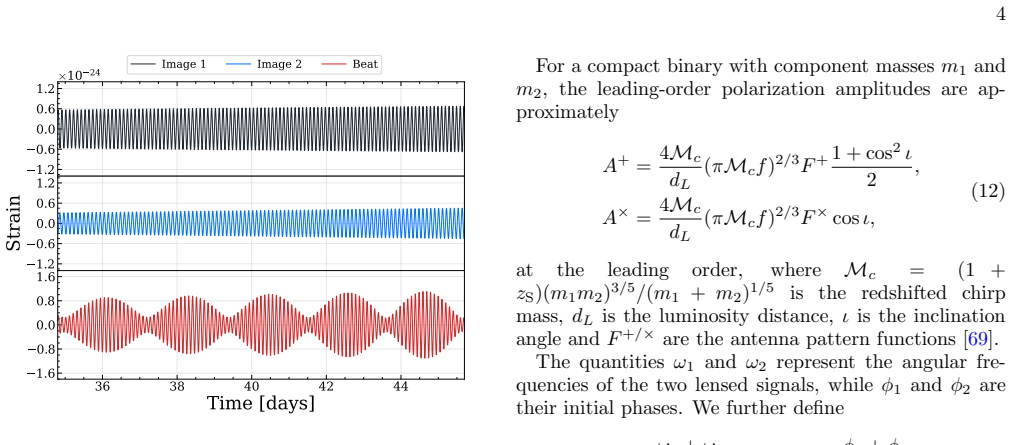
LISA can identify beat patterns in about 7% of its detectable two-image lensed massive black hole binary events.
A machine-rendered reading of the paper's core claim, the machinery that carries it, and where it could break.
Core claim
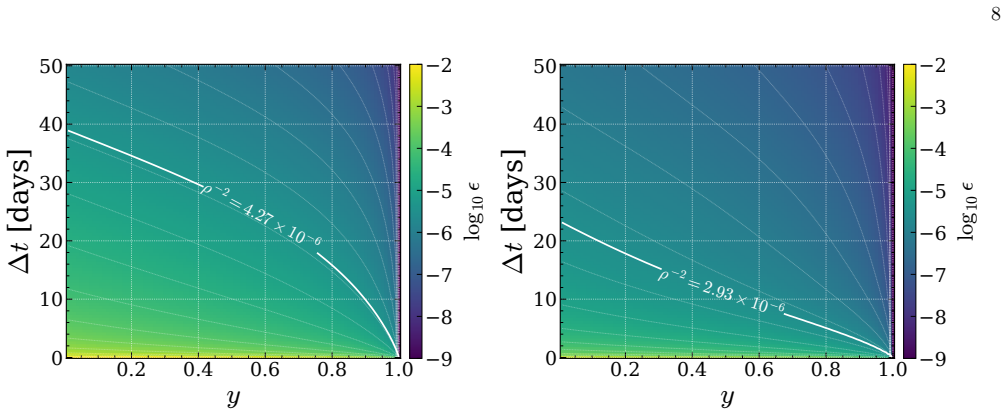
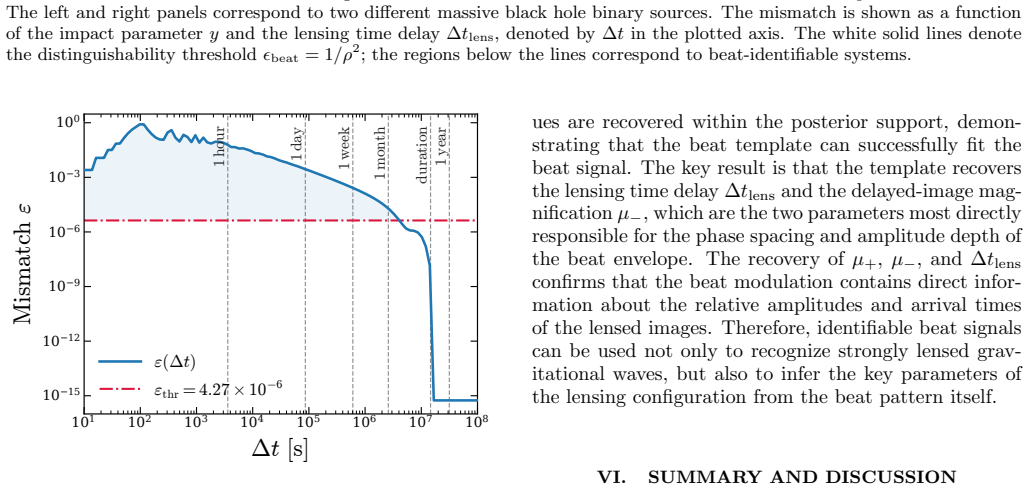
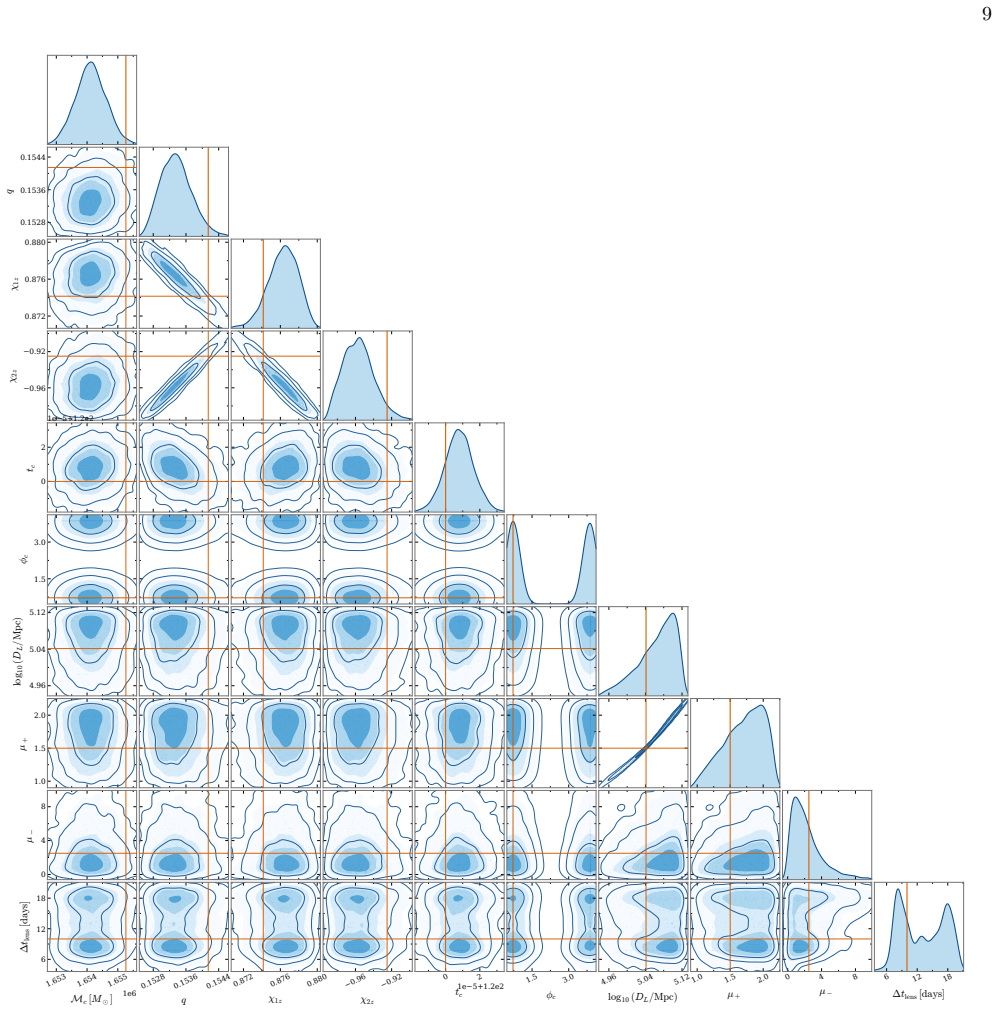
Among 196 detectable two-image lensed events drawn from the HS-nod-SN (B+20) population, 92 satisfy the temporal-overlap condition and 14 satisfy the beat-identification criterion, for an identifiable beat fraction of about 7%. Beat patterns are most readily identified when the lensing time delay is short and the delayed image has relatively large magnification. Bayesian parameter estimation with the beat template recovers the lensing time delay and magnification parameters for a representative beat event.
What carries the argument
Two-image beat waveforms constructed from massive black hole binary signals, with mismatch evaluated only during the overlapping inspiral stage before coalescence of the first image, under a singular isothermal sphere lens model.
If this is right
- Beat patterns are most readily identified when the lensing time delay is short and the delayed image has relatively large magnification.
- The beat template recovers the lensing time delay and magnification parameters for a representative beat event.
- Lensed beat patterns constitute a distinguishable subset of strongly lensed LISA events.
- These patterns provide a unique observational signature of strong lensing in the LISA band.
Where Pith is reading between the lines
- Detection of such beats would directly constrain the distribution of time delays and magnifications without relying solely on the population model.
- The method could be extended to three-image configurations if the overlap condition generalizes.
- Parameter recovery from beats might help break degeneracies between lens properties and source parameters in LISA data analysis.
- Absence of beats in future catalogs would tighten upper limits on the fraction of events with short time delays.
Load-bearing premise
The HS-nod-SN (B+20) strong-lensing population model accurately represents the distribution of lensing time delays and magnifications for massive black hole binaries detectable by LISA.
What would settle it
A catalog of LISA events containing many two-image lensed binaries but zero cases where the beat template recovers both time delay and magnification parameters to within the reported posterior uncertainties.
Figures
read the original abstract
Strong lensing of massive black hole binaries can produce multiple gravitational-wave images with different magnifications and arrival times. LISA signals remain in band for months to years, allowing multiple lensed images to overlap during the inspiral stage and generate beat patterns. A singular isothermal sphere lens model is adopted to describe the lensing configuration, and two-image beat waveforms are constructed from massive black hole binary signals. To isolate the beat pattern itself, waveform mismatch is evaluated only during the overlapping inspiral stage before the coalescence of the first image, excluding contributions from the delayed merger peak of the second image. Using the HS-nod-SN (B+20) strong-lensing population, the occurrence rate of identifiable beat events is estimated, and Bayesian parameter estimation is performed with a beat template. Beat patterns are most readily identified when the lensing time delay is short and the delayed image has a relatively large magnification. Among 196 detectable two-image lensed events, 92 satisfy the temporal-overlap condition and 14 satisfy the beat-identification criterion, corresponding to an identifiable beat fraction of about 7\%. Posterior inference shows that the beat template can recover the lensing time delay and magnification parameters for a representative beat event. These results indicate that lensed beat patterns constitute a distinguishable subset of strongly lensed LISA events and provide a unique observational signature of strong lensing in the LISA band.
Editorial analysis
A structured set of objections, weighed in public.
Referee Report
Summary. The manuscript constructs two-image beat waveforms for strongly lensed massive black hole binaries using a singular isothermal sphere lens model, restricts mismatch evaluation to the overlapping inspiral stage to isolate beat patterns, and uses the HS-nod-SN (B+20) population to estimate that among 196 detectable two-image events, 92 satisfy temporal overlap and 14 meet the beat-identification criterion (∼7% fraction). It further performs Bayesian recovery of lensing time delay and magnification parameters with a beat template for a representative event, concluding that beat patterns form a distinguishable subset of lensed LISA signals.
Significance. If the central results hold, the work supplies a concrete observational signature (beat patterns from short-delay, high-magnification-ratio lensing) that could confirm strong lensing in LISA data and quantify its occurrence. Strengths include the explicit construction of overlap-restricted waveforms, the use of an external population synthesis catalog to produce numerical rates, and the demonstration that parameter estimation recovers the lensing parameters. The approach is falsifiable via the mismatch-threshold criterion and supplies a clear pathway for follow-up template-based searches.
major comments (2)
- [population-based rate estimation] Rate estimation (abstract and population-based section): The headline 7% identifiable-beat fraction (14/196 events) is obtained solely by sampling time-delay and magnification distributions from the single HS-nod-SN (B+20) catalog and applying the overlap and mismatch-threshold conditions; no alternative lens-population synthesis, variation of the lens-mass function, or propagation of uncertainties in the LISA selection function is reported. Because the beat-identification criterion is stated to be most efficient for short delays and large magnification ratios, any systematic shift in that joint distribution scales the final fraction directly.
- [waveform construction and mismatch] Waveform mismatch evaluation (abstract): Restricting the mismatch integral to the overlapping inspiral stage before the first-image coalescence excludes the delayed merger peak of the second image by construction; while this isolates the beat, the paper provides no quantitative assessment of how this truncation affects the overall signal-to-noise ratio or the fraction of events that would remain detectable when the full waveform (including the second merger) is used.
minor comments (2)
- [abstract] Abstract: The abbreviation 'HS-nod-SN (B+20)' is used without expansion or citation on first appearance; a parenthetical reference to the underlying strong-lensing population paper would improve clarity.
- Notation: The distinction between the 'beat template' used for parameter estimation and the 'two-image beat waveforms' used for mismatch is not always explicit; consistent terminology across sections would reduce ambiguity.
Simulated Author's Rebuttal
We thank the referee for their positive assessment of the manuscript's significance and for the constructive major comments. We address each point below and indicate where revisions will be made.
read point-by-point responses
-
Referee: [population-based rate estimation] Rate estimation (abstract and population-based section): The headline 7% identifiable-beat fraction (14/196 events) is obtained solely by sampling time-delay and magnification distributions from the single HS-nod-SN (B+20) catalog and applying the overlap and mismatch-threshold conditions; no alternative lens-population synthesis, variation of the lens-mass function, or propagation of uncertainties in the LISA selection function is reported. Because the beat-identification criterion is stated to be most efficient for short delays and large magnification ratios, any systematic shift in that joint distribution scales the final fraction directly.
Authors: We agree that reliance on a single catalog constitutes a limitation of the current rate estimate. The HS-nod-SN (B+20) catalog was selected because it is a publicly available, widely used strong-lensing population for MBHBs that already incorporates a realistic lens-mass function and selection effects. In the revised manuscript we will (i) explicitly state that the ~7% fraction is derived from this specific catalog and should be viewed as indicative, (ii) add a short discussion of how shifts in the joint time-delay/magnification distribution would affect the fraction, and (iii) note that the same mismatch-threshold pipeline can be applied to future catalogs. A full multi-catalog comparison and propagation of all LISA selection uncertainties lies beyond the scope of the present work. revision: partial
-
Referee: [waveform construction and mismatch] Waveform mismatch evaluation (abstract): Restricting the mismatch integral to the overlapping inspiral stage before the first-image coalescence excludes the delayed merger peak of the second image by construction; while this isolates the beat, the paper provides no quantitative assessment of how this truncation affects the overall signal-to-noise ratio or the fraction of events that would remain detectable when the full waveform (including the second merger) is used.
Authors: The truncation is deliberate: the beat pattern arises exclusively from the overlapping inspiral portions, whereas the second-image merger occurs after the first coalescence and does not participate in the beat. Nevertheless, we acknowledge that an assessment of the SNR impact is useful for context. In the revised version we will add a quantitative comparison, for the representative events, of the SNR accumulated during the overlap window versus the full two-image waveform (including the delayed merger). This will show that the overlap phase already carries the majority of the SNR for the short-delay, high-magnification-ratio systems that produce identifiable beats, thereby supporting the robustness of the identification criterion. revision: yes
Circularity Check
No significant circularity; rate estimates drawn from external population model
full rationale
The paper constructs beat waveforms under the singular isothermal sphere assumption and applies overlap/mismatch criteria to count events, but the headline fractions (196 events, 92 overlaps, 14 beats, ~7%) are obtained by sampling time-delay and magnification distributions from the externally cited HS-nod-SN (B+20) population model. Bayesian recovery with the beat template recovers the injected lensing parameters by design of the forward model, without any reduction of the identification criterion or rate to quantities defined by the paper's own fitted inputs or self-citations. No load-bearing step equates a claimed prediction to its own construction.
Axiom & Free-Parameter Ledger
axioms (2)
- domain assumption Gravitational waves propagate according to general relativity, allowing lensing to produce multiple images with time delays and magnifications.
- domain assumption The singular isothermal sphere provides a sufficient description of the lensing configuration for the purpose of generating beat patterns.
Forward citations
Cited by 1 Pith paper
-
Finite-Core Signatures in LISA-Band Wave-Optics Lensing by Low-Mass Dark Matter Halos
Finite cores in low-mass dark matter halos produce distinct complex residuals in LISA-band wave-optics amplification that cannot be fully mimicked by lower-concentration NFW profiles and peak at rc/rs ≃ 0.25-0.3.
Reference graph
Works this paper leans on
-
[1]
B. P. Abbott, R. Abbott, T. D. Abbott, M. R. Aber- nathy, F. Acernese,et al., Phys. Rev. Lett.116, 061102 (2016), arXiv:1602.03837 [gr-qc]
Pith/arXiv arXiv 2016
-
[2]
Einstein, Sitzungsberichte der K¨ oniglich Preussischen Akademie der Wissenschaften , 688 (1916)
A. Einstein, Sitzungsberichte der K¨ oniglich Preussischen Akademie der Wissenschaften , 688 (1916)
1916
-
[3]
Einstein, Sitzungsberichte der K¨ oniglich Preussischen Akademie der Wissenschaften , 154 (1918)
A. Einstein, Sitzungsberichte der K¨ oniglich Preussischen Akademie der Wissenschaften , 154 (1918)
1918
-
[4]
B. P. Abbott, R. Abbott, T. D. Abbott, F. Acernese, K. Ackley,et al., Phys. Rev. Lett.120, 031104 (2018), arXiv:1709.09203 [gr-qc]
arXiv 2018
- [5]
-
[6]
Einstein, Science84, 506 (1936)
A. Einstein, Science84, 506 (1936)
1936
-
[7]
J. K. Lawrence, Phys. Rev. D3, 3239 (1971)
1971
-
[8]
S. Cao, G. Covone, M. Paolillo, and Z.-H. Zhu, Re- search in Astronomy and Astrophysics13, 15 (2013), arXiv:1211.4439 [astro-ph.CO]
Pith/arXiv arXiv 2013
-
[9]
T. E. Collett and M. W. Auger, Mon. Not. R. Astron. Soc.443, 969 (2014), arXiv:1403.5278 [astro-ph.CO]
Pith/arXiv arXiv 2014
-
[10]
Schneider, J
P. Schneider, J. Ehlers, and E. E. Falco,Gravitational Lenses(Springer, 1992)
1992
-
[11]
T. Treu, Annu. Rev. Astron. Astrophys.48, 87 (2010), arXiv:1003.5567 [astro-ph.CO]
Pith/arXiv arXiv 2010
-
[12]
Refsdal, Mon
S. Refsdal, Mon. Not. R. Astron. Soc.128, 307 (1964)
1964
-
[13]
R. Takahashi, Astrophys. J.835, 103 (2017), arXiv:1606.00458 [astro-ph.CO]
Pith/arXiv arXiv 2017
-
[14]
T. T. Nakamura and S. Deguchi, Progress of Theoretical Physics Supplement133, 137 (1999)
1999
-
[15]
T. T. Nakamura, Phys. Rev. Lett.80, 1138 (1998)
1998
-
[16]
R. Takahashi and T. Nakamura, Astrophys. J.595, 1039 (2003), arXiv:astro-ph/0305055 [astro-ph]
Pith/arXiv arXiv 2003
-
[17]
K. Liao, M. Biesiada, and X.-L. Fan, Astrophys. J.875, 139 (2019), arXiv:1903.06612 [gr-qc]
Pith/arXiv arXiv 2019
-
[18]
O. Bulashenko and H. Ubach, J. Cosmol. Astropart. Phys.2022, 022 (2022), arXiv:2112.10773 [gr-qc]
arXiv 2022
-
[19]
H. Zhang and X. Fan, Science China Physics, Mechanics, and Astronomy64, 120462 (2021), arXiv:1809.06511 [gr- qc]
arXiv 2021
-
[20]
The LIGO Scientific Collaboration, the Virgo Col- laboration, the KAGRA Collaboration, A. G. Abac, I. Abouelfettouh,et al., arXiv e-prints , arXiv:2508.18082 (2025), arXiv:2508.18082 [gr-qc]
Pith/arXiv arXiv 2025
-
[21]
The LIGO Scientific Collaboration, the Virgo Col- laboration, the KAGRA Collaboration, A. G. Abac, A. Abe,et al., arXiv e-prints , arXiv:2605.27223 (2026), arXiv:2605.27223 [gr-qc]
Pith/arXiv arXiv 2026
-
[22]
T. Liu and K. Liao, Phys. Rev. D113, 083009 (2026), arXiv:2512.10344 [astro-ph.CO]
Pith/arXiv arXiv 2026
-
[23]
H. C. Ohanian, Astrophys. J.271, 551 (1983)
1983
-
[24]
P. V. Bliokh and A. A. Minakov, Astrophys. Space Sci. 34, L7 (1975)
1975
-
[25]
R. J. Bontz and M. P. Haugan, Astrophys. Space Sci.78, 199 (1981)
1981
-
[26]
A. V. Mandzhos, Soviet Astronomy Letters7, 213 (1981)
1981
-
[27]
Schneider and J
P. Schneider and J. Schmid-Burgk, Astron. Astrophys. 148, 369 (1985)
1985
-
[28]
Deguchi and W
S. Deguchi and W. D. Watson, inBulletin of the Ameri- can Astronomical Society, Vol. 17 (1985) p. 907
1985
-
[29]
J. B. Peterson and T. Falk, Astrophys. J. Lett.374, L5 (1991)
1991
-
[30]
K. Yamamoto, Phys. Rev. D71, 101301 (2005), arXiv:astro-ph/0505116 [astro-ph]
Pith/arXiv arXiv 2005
- [31]
- [32]
-
[33]
C. Cutler and D. E. Holz, Phys. Rev. D80, 104009 (2009), arXiv:0906.3752 [astro-ph.CO]
Pith/arXiv arXiv 2009
-
[34]
S. Camera and A. Nishizawa, Phys. Rev. Lett.110, 151103 (2013), arXiv:1303.5446 [astro-ph.CO]
Pith/arXiv arXiv 2013
-
[35]
G. Congedo and A. Taylor, Phys. Rev. D99, 083526 (2019), arXiv:1812.02730 [astro-ph.CO]
Pith/arXiv arXiv 2019
-
[36]
S. Jung and C. S. Shin, Phys. Rev. Lett.122, 041103 (2019), arXiv:1712.01396 [astro-ph.CO]
Pith/arXiv arXiv 2019
-
[37]
X.-L. Fan, K. Liao, M. Biesiada, A. Pi´ orkowska-Kurpas, and Z.-H. Zhu, Phys. Rev. Lett.118, 091102 (2017), arXiv:1612.04095 [gr-qc]
Pith/arXiv arXiv 2017
-
[38]
T. E. Collett and D. Bacon, Phys. Rev. Lett.118, 091101 (2017), arXiv:1602.05882 [astro-ph.HE]
Pith/arXiv arXiv 2017
-
[39]
M. Sereno, A. Sesana, A. Bleuler, P. Jetzer, M. Volon- teri,et al., Phys. Rev. Lett.105, 251101 (2010), 11 arXiv:1011.5238 [astro-ph.CO]
Pith/arXiv arXiv 2010
-
[40]
M. Sereno, P. Jetzer, A. Sesana, and M. Volonteri, Mon. Not. R. Astron. Soc.415, 2773 (2011), arXiv:1104.1977 [astro-ph.CO]
Pith/arXiv arXiv 2011
-
[41]
K. Liao, X.-L. Fan, X. Ding, M. Biesiada, and Z.-H. Zhu, Nature Communications8, 1148 (2017), arXiv:1703.04151 [astro-ph.CO]
Pith/arXiv arXiv 2017
-
[42]
T. Liu, S. Cao, M. Biesiada, Y. Zhang, and J. Wang, Astrophys. J. Lett.965, L11 (2024), arXiv:2404.07419 [astro-ph.CO]
arXiv 2024
-
[43]
P. Amaro-Seoane, H. Audley, S. Babak, J. Baker, E. Ba- rausse,et al., arXiv e-prints , arXiv:1702.00786 (2017), arXiv:1702.00786 [astro-ph.IM]
Pith/arXiv arXiv 2017
-
[44]
J. I. Thorpe, J. Ziemer, I. Thorpe, J. Livas, J. W. Con- klin,et al., inBulletin of the American Astronomical Society, Vol. 51 (2019) p. 77, arXiv:1907.06482 [astro- ph.IM]
Pith/arXiv arXiv 2019
-
[45]
M. Colpi, K. Danzmann, M. Hewitson, K. Holley- Bockelmann, P. Jetzer,et al., arXiv e-prints , arXiv:2402.07571 (2024), arXiv:2402.07571 [astro- ph.CO]
Pith/arXiv arXiv 2024
-
[46]
J. Guti´ errez and M. Lagos, Phys. Rev. D112, 123512 (2025), arXiv:2510.02061 [astro-ph.CO]
arXiv 2025
-
[47]
M. C ¸ alıs,kan, N. Anil Kumar, L. Ji, J. M. Ezquiaga, R. Cotesta,et al., Phys. Rev. D108, 123543 (2023), arXiv:2307.06990 [astro-ph.CO]
arXiv 2023
-
[48]
A. G. Riess, S. Casertano, W. Yuan, L. M. Macri, and D. Scolnic, Astrophys. J.876, 85 (2019), arXiv:1903.07603 [astro-ph.CO]
Pith/arXiv arXiv 2019
-
[49]
Aghanim, Y
Planck Collaboration, N. Aghanim, Y. Akrami, M. Ash- down, J. Aumont,et al., Astron. Astrophys.652, C4 (2021)
2021
-
[50]
E. Di Valentino, O. Mena, S. Pan, L. Visinelli, W. Yang, et al., Classical and Quantum Gravity38, 153001 (2021), arXiv:2103.01183 [astro-ph.CO]
Pith/arXiv arXiv 2021
-
[51]
LIGO Scientific Collaboration, J. Aasi, B. P. Abbott, R. Abbott, T. Abbott,et al., Classical and Quantum Gravity32, 074001 (2015), arXiv:1411.4547 [gr-qc]
Pith/arXiv arXiv 2015
-
[52]
F. Acernese, M. Agathos, K. Agatsuma, D. Aisa, N. Alle- mandou,et al., Classical and Quantum Gravity32, 024001 (2015), arXiv:1408.3978 [gr-qc]
Pith/arXiv arXiv 2015
-
[53]
R. Abbott, T. D. Abbott, F. Acernese, K. Ackley, C. Adams,et al., Physical Review X13, 041039 (2023), arXiv:2111.03606 [gr-qc]
Pith/arXiv arXiv 2023
-
[54]
Somiya, Classical and Quantum Gravity29, 124007 (2012), arXiv:1111.7185 [gr-qc]
K. Somiya, Classical and Quantum Gravity29, 124007 (2012), arXiv:1111.7185 [gr-qc]
arXiv 2012
-
[55]
Y. Aso, Y. Michimura, K. Somiya, M. Ando, O. Miyakawa,et al., Phys. Rev. D88, 043007 (2013), arXiv:1306.6747 [gr-qc]
Pith/arXiv arXiv 2013
- [56]
-
[57]
M. Maggiore, C. Van Den Broeck, N. Bartolo, E. Bel- gacem, D. Bertacca,et al., J. Cosmol. Astropart. Phys. 2020, 050 (2020), arXiv:1912.02622 [astro-ph.CO]
Pith/arXiv arXiv 2020
-
[58]
A. Abac, R. Abramo, S. Albanesi, A. Albertini, A. Agapito,et al., J. Cosmol. Astropart. Phys.2026, 081 (2026), arXiv:2503.12263 [gr-qc]
Pith/arXiv arXiv 2026
-
[59]
D. Reitze, R. X. Adhikari, S. Ballmer, B. Barish, L. Bar- sotti,et al., inBulletin of the American Astronomical Society, Vol. 51 (2019) p. 35, arXiv:1907.04833 [astro- ph.IM]
Pith/arXiv arXiv 2019
-
[60]
M. Evans, R. X. Adhikari, C. Afle, S. W. Ballmer, S. Bis- coveanu,et al., arXiv e-prints , arXiv:2109.09882 (2021), arXiv:2109.09882 [astro-ph.IM]
Pith/arXiv arXiv 2021
-
[61]
M. A. Varvella, M. C. Angonin, and P. Tourrenc, Gen- eral Relativity and Gravitation36, 983 (2004), arXiv:gr- qc/0312028 [gr-qc]
arXiv 2004
-
[62]
A. K. Meena and J. S. Bagla, Mon. Not. R. Astron. Soc. 492, 1127 (2020), arXiv:1903.11809 [astro-ph.CO]
arXiv 2020
-
[63]
P. Natarajan, L. L. R. Williams, M. Bradaˇ c, C. Grillo, A. Ghosh,et al., Space Sci. Rev.220, 19 (2024), arXiv:2403.06245 [astro-ph.CO]
arXiv 2024
-
[64]
R. D. Blandford and R. Narayan, Annu. Rev. Astron. Astrophys.30, 311 (1992)
1992
-
[65]
L. V. E. Koopmans, inEAS Publications Series, EAS Publications Series, Vol. 20, edited by G. A. Mamon, F. Combes, C. Deffayet, and B. Fort (EDP, 2006) pp. 161–166, arXiv:astro-ph/0511121 [astro-ph]
Pith/arXiv arXiv 2006
-
[66]
L. V. E. Koopmans, T. Treu, A. S. Bolton, S. Burles, and L. A. Moustakas, Astrophys. J.649, 599 (2006), arXiv:astro-ph/0601628 [astro-ph]
Pith/arXiv arXiv 2006
-
[67]
Planck Collaboration, N. Aghanim, Y. Akrami, M. Ash- down, J. Aumont,et al., Astron. Astrophys.641, A6 (2020), arXiv:1807.06209 [astro-ph.CO]
Pith/arXiv arXiv 2020
-
[68]
N. Yunes and X. Siemens, Living Reviews in Relativity 16, 9 (2013), arXiv:1304.3473 [gr-qc]
Pith/arXiv arXiv 2013
-
[69]
M. Isi and A. J. Weinstein, arXiv e-prints , arXiv:1710.03794 (2017), arXiv:1710.03794 [gr-qc]
Pith/arXiv arXiv 2017
-
[70]
P. C. Peters and J. Mathews, Physical Review131, 435 (1963)
1963
-
[71]
M. Du, P. Wang, Z. Luo, W.-B. Han, X. Zhang,et al., Science China Physics, Mechanics, and Astronomy69, 249501 (2026), arXiv:2505.16500 [gr-qc]
arXiv 2026
-
[72]
S. Husa, S. Khan, M. Hannam, M. P¨ urrer, F. Ohme, et al., Phys. Rev. D93, 044006 (2016), arXiv:1508.07250 [gr-qc]
Pith/arXiv arXiv 2016
-
[73]
S. Khan, S. Husa, M. Hannam, F. Ohme, M. P¨ urrer, et al., Phys. Rev. D93, 044007 (2016), arXiv:1508.07253 [gr-qc]
Pith/arXiv arXiv 2016
-
[74]
C. Cutler and ´E. E. Flanagan, Phys. Rev. D49, 2658 (1994), arXiv:gr-qc/9402014 [gr-qc]
Pith/arXiv arXiv 1994
-
[75]
S. Ali, E. Stoikos, E. Meade, M. Kesden, and L. King, Phys. Rev. D107, 103023 (2023), arXiv:2210.01873 [gr- qc]
arXiv 2023
-
[76]
L. S. Finn and D. F. Chernoff, Phys. Rev. D47, 2198 (1993), arXiv:gr-qc/9301003 [gr-qc]
Pith/arXiv arXiv 1993
-
[77]
L. S. Finn, Phys. Rev. D46, 5236 (1992), arXiv:gr- qc/9209010 [gr-qc]
arXiv 1992
- [78]
-
[79]
P. Wang, X. Zhao, Z. Wu, Z. Yang, and C. Shao, Scientia Sinica Physica, Mechanica & Astronomica55, 230410 (2025)
2025
discussion (0)
Sign in with ORCID, Apple, or X to comment. Anyone can read and Pith papers without signing in.