REVIEW 33 references
Optimization-based Control for Bearing-only Target Search with a Mobile Vehicle
T0 review · reviewed 2026-08-14 · deepseek-v4-flash
Pith's one-line read A normalized bi-objective optimization solved in closed form steers a Dubins vehicle to a stationary target using only bearing measurements, with and without global position.
The pith
A machine-rendered reading of the paper's core claim, the machinery that carries it, and where it could break.
The reading
Extended reading notes
Core claim
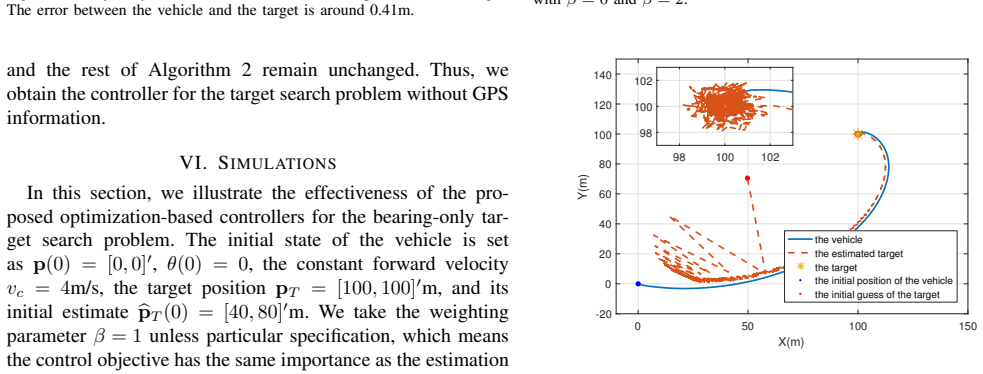
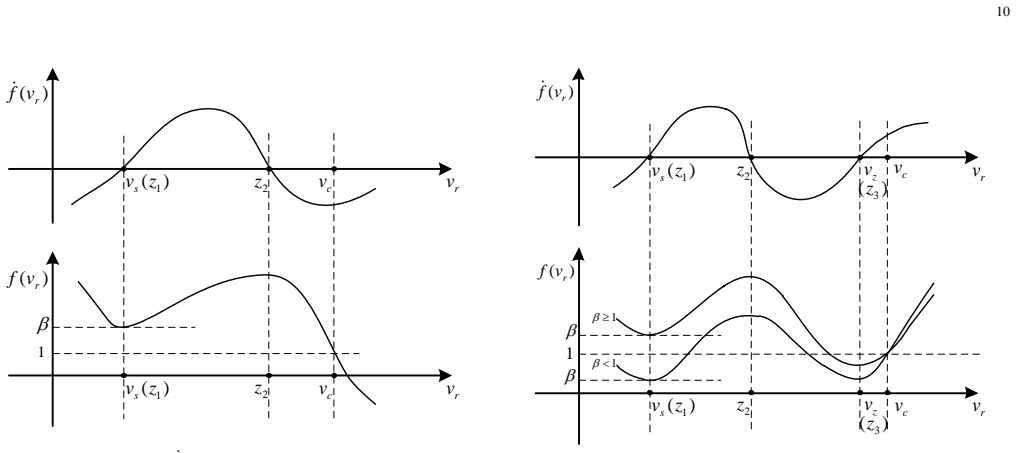
Theorem 1 gives the exact minimizer of the normalized bi-objective optimization problem (17) for every beta regime, and the certainty-equivalence controller built from this minimizer and a recursive least-squares estimator (Algorithms 1-3) drives the discrete-time Dubins vehicle to approach the unknown stationary target, both with and without global position information, as shown in the simulations.
Load-bearing premise
The controller's near-optimality for the actual closed loop is assumed via the certainty-equivalence principle: the true target range r, bearing phi, and position used in Theorem 1 and equation (10) are replaced by estimates from Algorithms 1 or 3. The estimator is derived under the small-noise approximation sin(m-phi) about m-phi and by ignoring the 1/r(i) weight in the least-squares objective, and the paper states the estimator 'might be biased'. No suboptimality bound or closed-loop convergence proof is given, so the 'as fast as possible' claim is not established for the implemented controller.
Signed reviews
Editorial analysis
A structured set of objections, weighed in public.
Assumptions & free parameters
free parameters (1)
- beta (weighting parameter) =
beta = 1 in the default simulation; studied in [0,6]
assumptions (6)
- domain assumption The bearing noise e(k) in (1) is zero-mean white Gaussian with known variance sigma^2.
- domain assumption The target is stationary, and the vehicle obeys the discrete-time Dubins model (2) with constant forward speed and angular velocity held over the sampling interval.
- standard math The D-optimal CRLB formula (5) from Theorem 1 of [10] is valid for the bearing-only measurement model.
- ad hoc to paper Within one sampling period, the radial velocity vr, tangential velocity vt, and true bearing phi are constant.
- ad hoc to paper The sine-for-error approximation in the Stansfield estimator, replacing m-phi by sin(m-phi), and the neglect of the 1/r(i) weight are accurate enough for the estimate to be usable.
- ad hoc to paper Certainty equivalence holds: replacing the true r, phi, pT in the optimal solution by the recursive least-squares estimates preserves near-optimal behavior.
Cite this review
Pith. "Pith review of Optimization-based Control for Bearing-only Target Search with a Mobile Vehicle." pith.science (2026). https://pith.science/paper/MMTVYJKI
@misc{pith2026190800380,
  author       = {Pith},
  title        = {Pith review of: Optimization-based Control for Bearing-only Target Search with a Mobile Vehicle},
  year         = {2026},
  howpublished = {\url{https://pith.science/paper/MMTVYJKI}},
  note         = {Machine review of arXiv:1908.00380}
}
read the original abstract
This work aims to design an optimization-based controller for a discrete-time Dubins vehicle to approach a target with unknown position as fast as possible by only using bearing measurements. To this end, we propose a bi-objective optimization problem, which jointly considers the performance of estimating the unknown target position and controlling the mobile vehicle to a known position, and then adopt a weighted sum method with normalization to solve it. The controller is given based on the solution of the optimization problem in ties with a least-square estimate of the target position. Moreover, the controller does not need the vehicle's global position information. Finally, simulation results are included to validate the effectiveness of the proposed controller.
Figures


Figures from the paper (7 more)




Reference graph
Works this paper leans on
-
[1]
L. W. Chen, J. H. Cheng, and Y . C. Tseng, “Optimal path planning with spatial-temporal mobility modeling for individual-based emergency guiding,” IEEE Transactions on Systems Man & Cybernetics: Systems , vol. 45, no. 12, pp. 1491–1501, 2015
work page 2015
-
[2]
R. Raja, A. Dutta, and K. Venkatesh, “New potential field method for rough terrain path planning using genetic algorithm for a 6-wheel rover,” Robotics and Autonomous Systems , vol. 72, pp. 295–306, 2015
work page 2015
-
[3]
Path planning with spatiotemporal optimal stopping for stochastic mission monitoring,
G. Best, W. Martens, and R. Fitch, “Path planning with spatiotemporal optimal stopping for stochastic mission monitoring,” IEEE Transactions on Robotics, vol. 33, no. 3, pp. 629–646, 2017
work page 2017
-
[4]
Minimum time search for lost targets using cross entropy optimization,
P. Lanillos, E. Besada-Portas, G. Pajares, and J. J. Ruz, “Minimum time search for lost targets using cross entropy optimization,” in International Conference on Intelligent Robots and Systems . IEEE, 2012, pp. 602– 609. 11
work page 2012
-
[5]
ε⋆: An online coverage path planning algorithm,
J. Song and S. Gupta, “ε⋆: An online coverage path planning algorithm,” IEEE Transactions on Robotics , vol. 34, no. 2, pp. 526–533, 2018
work page 2018
-
[6]
Multi-UAV convoy protection: An optimal approach to path planning and coordination,
X. C. Ding, A. R. Rahmani, and M. Egerstedt, “Multi-UAV convoy protection: An optimal approach to path planning and coordination,” IEEE Transactions on Robotics , vol. 26, no. 2, pp. 256–268, 2010
work page 2010
-
[7]
Planning expected-time optimal paths for target search by robot,
B. Zhang and S. Liu, “Planning expected-time optimal paths for target search by robot,” in World Congress on Intelligent Control and Automa- tion. IEEE, 2012, pp. 3881–3886
work page 2012
-
[8]
C-FOREST: Parallel shortest path planning with superlinear speedup,
M. Otte and N. Correll, “C-FOREST: Parallel shortest path planning with superlinear speedup,” IEEE Transactions on Robotics , vol. 29, no. 3, pp. 798–806, 2013
work page 2013
Show all 33 references
-
[9]
Single-objective path planning for autonomous robots using reconfigurable analog VLSI,
S. Koziol, R. Wunderlich, J. Hasler, and M. Stilman, “Single-objective path planning for autonomous robots using reconfigurable analog VLSI,” IEEE Transactions on Systems Man & Cybernetics: Systems , vol. 47, no. 7, pp. 1301–1314, 2017
2017
-
[10]
Optimality analysis of sensor-target geometries in passive localization: Part 1 Bearing-only localization,
A. N. Bishop, B. Fidan, B. D. Anderson, K. Dogancay, and P. N. Pathirana, “Optimality analysis of sensor-target geometries in passive localization: Part 1 Bearing-only localization,” in International Confer- ence on Intelligent Sensors, Sensor Networks and Information . IEEE, ...
2007
-
[11]
Real-time area coverage and target localization using receding-horizon ergodic exploration,
A. Mavrommati, E. Tzorakoleftherakis, I. Abraham, and T. D. Murphey, “Real-time area coverage and target localization using receding-horizon ergodic exploration,” IEEE Transactions on Robotics, vol. 34, no. 1, pp. 62–80, 2018
2018
-
[12]
Optimal sensor placement for multiple target positioning with range-only measurements in two-dimensional scenarios,
D. Moreno-Salinas, A. M. Pascoal, and J. Aranda, “Optimal sensor placement for multiple target positioning with range-only measurements in two-dimensional scenarios,” Sensors, vol. 13, no. 8, p. 10674, 2013
2013
-
[13]
UAV path planning for passive emitter localization,
K. Dogancay, “UAV path planning for passive emitter localization,” IEEE Transactions on Aerospace and Electronic systems , vol. 48, no. 2, pp. 1150–1166, 2012
2012
-
[14]
Communication aware optimal sensor motion coordination for source localization,
W. Meng, L. Xie, and W. Xiao, “Communication aware optimal sensor motion coordination for source localization,” IEEE Transactions on Instrumentation and Measurement, vol. 65, no. 11, pp. 2505–2514, 2016
2016
-
[15]
Optimal exploratory paths for a mobile rover,
F. Lorussi, A. Marigo, and A. Bicchi, “Optimal exploratory paths for a mobile rover,” in International Conference on Robotics and Automation. IEEE, 2001, pp. 2078–2083
2001
-
[16]
Path planning to optimize observability in a planar uniform flow field,
B. T. Hinson, M. K. Binder, and K. A. Morgansen, “Path planning to optimize observability in a planar uniform flow field,” in American Control Conference. IEEE, 2013, pp. 1392–1399
2013
-
[17]
Optimal active sensing with process and measurement noise,
M. Cognetti, P. Salaris, and P. R. Giordano, “Optimal active sensing with process and measurement noise,” in International Conference on Robotics and Automation . IEEE, 2018, pp. 2118–2125
2018
-
[18]
Localization and cir- cumnavigation of a slowly moving target using bearing measurements,
M. Deghat, I. Shames, B. D. Anderson, and C. Yu, “Localization and cir- cumnavigation of a slowly moving target using bearing measurements,” IEEE Transactions on Automatic Control, vol. 59, no. 8, pp. 2182–2188, 2014
2014
-
[19]
Adaptive source localization based station keeping of autonomous vehicles,
S. G ¨uler, s ¸FidanBar, S. Dasgupta, B. D. Anderson, and I. Shames, “Adaptive source localization based station keeping of autonomous vehicles,” IEEE Transactions on Automatic Control , vol. 62, no. 7, pp. 3122–3135, 2017
2017
-
[20]
A novel real-time moving target tracking and path planning system for a quadrotor UAV in unknown unstructured outdoor scenes,
Y . Liu, Q. Wang, H. Hu, and Y . He, “A novel real-time moving target tracking and path planning system for a quadrotor UAV in unknown unstructured outdoor scenes,” IEEE Transactions on Systems Man & Cybernetics: Systems, no. 99, pp. 1–11, 2018
2018
-
[21]
Optimality analysis of sensor-target localization geometries,
A. N. Bishop, B. Fidan, B. D. Anderson, K. Do ˘ganc ¸ay, and P. N. Pathirana, “Optimality analysis of sensor-target localization geometries,” Automatica, vol. 46, no. 3, pp. 479–492, 2010
2010
-
[22]
The weighted sum method for multi- objective optimization: new insights,
R. T. Marler and J. S. Arora, “The weighted sum method for multi- objective optimization: new insights,” Structural and multidisciplinary optimization, vol. 41, no. 6, pp. 853–862, 2010
2010
-
[23]
Path planning for UAVs for max- imum information collection,
H. Ergezer and K. Leblebicioglu, “Path planning for UAVs for max- imum information collection,” IEEE Transactions on Aerospace & Electronic Systems, vol. 49, no. 5, pp. 502–520, 2013
2013
-
[24]
Pigeon-inspired optimization: a new swarm intelligence optimizer for air robot path planning,
H. Duan and P. Qiao, “Pigeon-inspired optimization: a new swarm intelligence optimizer for air robot path planning,” International Journal of Intelligent Computing and Cybernetics, vol. 7, no. 1, pp. 24–37, 2014
2014
-
[25]
A multiobjective path- planning algorithm with time windows for asset routing in a dynamic weather-impacted environment,
D. Sidoti, G. V . Avvari, M. Mishra, L. Zhang, B. K. Nadella, J. E. Peak, J. A. Hansen, and K. R. Pattipati, “A multiobjective path- planning algorithm with time windows for asset routing in a dynamic weather-impacted environment,” IEEE Transactions on Systems Man & Cybernetic...
2017
-
[26]
Path planning for active SLAM based on the D* algorithm with negative edge weights,
I. Maurovi ´c, M. Seder, K. Lenac, and I. Petrovi ´c, “Path planning for active SLAM based on the D* algorithm with negative edge weights,” IEEE Transactions on Systems Man & Cybernetics: Systems , vol. 48, no. 8, pp. 1321–1331, 2018
2018
-
[27]
Discrete-time stochastic source seeking via tuning of forward velocity,
S. J. Liu and P. P. Zhang, “Discrete-time stochastic source seeking via tuning of forward velocity,” IFAC-PapersOnLine, vol. 48, no. 28, pp. 927–932, 2015
2015
-
[28]
Minimum uncertainty robot navigation using information-guided pomdp planning,
S. Candido and S. Hutchinson, “Minimum uncertainty robot navigation using information-guided pomdp planning,” in International Conference on Robotics and Automation . IEEE, 2011, pp. 6102–6108
2011
-
[29]
Performance analysis of bearing-only target location algorithms,
M. Gavish and A. J. Weiss, “Performance analysis of bearing-only target location algorithms,” IEEE Transactions on Aerospace and Electronic Systems, vol. 28, no. 3, pp. 817–828, 1992
1992
-
[30]
Distributed source localization of multi-agent systems with bearing angle measurements,
C. Lin, Z. Lin, R. Zheng, G. Yan, and G. Mao, “Distributed source localization of multi-agent systems with bearing angle measurements,” IEEE Transactions on Automatic Control, vol. 61, no. 4, pp. 1105–1110, 2016
2016
-
[31]
Enclosing a target by nonholonomic mobile robots with bearing-only measurements,
R. Zheng, Y . Liu, and D. Sun, “Enclosing a target by nonholonomic mobile robots with bearing-only measurements,” Automatica, vol. 53, pp. 400–407, 2015
2015
-
[32]
H. L. V . Trees, Detection, Estimation, and Modulation Theory: Detec- tion, Estimation, and Linear Modulation Theory . Publishing House of Electronics Industry, 2003
2003
-
[33]
On the bias of linear least squares algorithms for passive target localization,
K. Do ˘ganc ¸ay, “On the bias of linear least squares algorithms for passive target localization,”Signal Processing, vol. 84, no. 3, pp. 475–486, 2004. Zhuo Li received the B.S. degree from the Depart- ment of Automation, Harbin Institute of Technology, Harbin, China, in 2016....
2004
Reviewed August 14, 2026 · model on record in the stance chip above.
Discussion (0). Continue with ORCID to comment.