REVIEW 4 major objections 5 minor 42 references
STI-SNN: A 0.14 GOPS/W/PE Single-Timestep Inference FPGA-based SNN Accelerator with Algorithm and Hardware Co-Design
T0 review · 4 major / 5 minor · reviewed 2026-08-07 · deepseek-v4-flash
Pith's one-line read The paper claims that training with the TET loss lets spiking neural networks classify in one timestep, and that an output-stationary FPGA dataflow then roughly halves per-sample energy by removing membrane-potential storage and memory…
desk verdict Solid incremental SNN accelerator paper; headline efficiency numbers need measured power before they can be trusted. read the letter →
The pith
A machine-rendered reading of the paper's core claim, the machinery that carries it, and where it could break.
The reading
What carries the argument
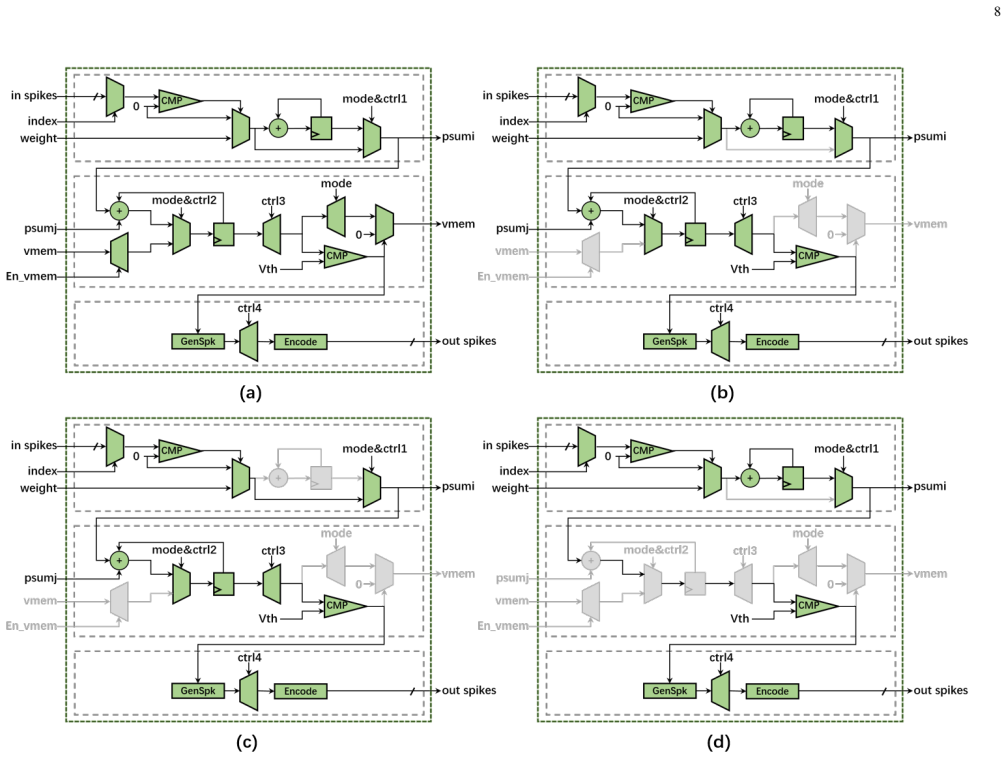
The load-bearing mechanism is the pairing of temporal pruning based on the TET loss with an output-stationary (OS) dataflow. TET reweights the loss over every timestep, which keeps neuron firing rates stable when the timestep count is cut to one, and this is what lets a network trained at six timesteps infer at one without an accuracy collapse. The OS dataflow assigns each output pixel's accumulated weighted spike sum to a register inside a PE and only writes it out once all input channels are done, so at one timestep the membrane potential never leaves the compute array and no Vmem buffer is needed. The compressed and sorted spike representation packs all channels at one spatial location into a single vector that the line buffer shifts through the PE rows, and a multi-mode PE switches between standard, depthwise, and pointwise convolution by changing whether partial sums are accumulated across channels. Together these mechanisms remove membrane-potential storage and memory access while keeping the array flexible across network architectures.
What would settle it
Run the SCNN5 implementation on the actual FPGA board while processing the same CIFAR10 samples at one and two timesteps, measuring board power with a physical power meter and checking output accuracy; if the energy per sample is not roughly half, or if single-step accuracy falls materially below the reported 90.31%, the paper's central claim is disproved.
Extended reading notes
Core claim
The discovery the paper is trying to establish is that the main obstacle to low-latency, low-energy SNN hardware is not spike irregularity but the multi-timestep workflow itself, and that removing it by training is sufficient. The authors show that training with the TET loss, which supervises every timestep rather than only the last, produces networks whose firing rates survive a reduction from six timesteps down to one, so inference accuracy stays competitive; direct single-timestep training under the standard loss collapses. With only one timestep, the OS dataflow in the compute array accumulates all input-channel contributions in PE-held membrane-potential registers, so no partial sums or membrane potentials are written back to memory, and the line buffer feeds compressed, channel-sorted spike vectors to the PEs with one off-chip read. The reported results are that SCNN5 saves 126 KB of on-chip storage, single-step inference uses about half the energy of two-step inference on the same samples, and layer-wise pipelining plus output-channel parallelism raises inference speed by 3.91x and 4x and efficiency by 3.64x and 3.49x for SCNN3 and SCNN5, reaching 0.19 and 0.14 GOPS/W/PE respectively.
Load-bearing premise
The paper's headline energy numbers come from post-implementation power estimates in the FPGA vendor toolchain, not from a power meter on the board, so the claim that one-timestep inference halves energy rests on those estimates being close to real chip power.
Editorial extensions
If this is right
- Single-timestep inference removes the membrane-potential read and write traffic that scales with timestep count, so SNN inference energy should scale almost linearly with timesteps rather than with spike count alone.
- The TET-based temporal pruning offers a low-training-overhead path to one-timestep SNNs, making temporal sparsity methods that need complex hardware units unnecessary in this accuracy regime.
- An OS dataflow with PE-local membrane registers generalizes to any network whose activations fit in registers, so the same accelerator can serve standard, depthwise, and pointwise convolutions without a separate membrane-potential memory.
- Layer-wise pipelining plus output-channel parallelism makes the critical path a single convolution layer, so further gains come from balancing per-layer parallel factors against logic and power budgets.
Reading between the lines
- An extension the paper leaves implicit is that the OS dataflow would also save energy in multi-timestep inference if each layer's membrane potentials stayed in PE registers and only the final state were spilled, rather than reading and writing Vmem every timestep.
- Because the reported efficiency is per PE, comparisons across accelerators on different FPGAs and PE counts should be read as design-point data rather than chip-level efficiency rankings; normalizing by board-level power would be a stricter test.
- The 60.75% Tiny ImageNet single-step result suggests the method may extend beyond toy datasets, and a natural next experiment is ImageNet-scale or event-stream benchmarks where temporal coding is often argued to be essential.
Editorial analysis
A structured set of objections, weighed in public.
Referee Report
Summary. This paper presents STI-SNN, an FPGA-based SNN accelerator that performs inference in a single timestep. The authors combine a temporal compression method based on the TET loss (training with 6 timesteps, then fine-tuning at T=1) with an output-stationary dataflow, a compressed and sorted spike representation cached in line buffers, a multi-mode PE supporting standard/depthwise/pointwise convolution, and inter-layer pipelining with configurable output-channel parallelism. Algorithmic experiments report competitive accuracy at T=1 on CIFAR10/100 and Tiny ImageNet. Hardware implementations on a Xilinx ZCU102 for three models (SCNN3, SCNN5, vMobileNet) show large speedups from parallelism and energy/storage reductions from the single-timestep design, with peak efficiencies of 0.19 and 0.14 GOPS/W/PE.
Significance. If the efficiency numbers hold up, the paper makes a useful contribution by demonstrating that a single-timestep directly-trained SNN can be mapped to an efficient FPGA streaming architecture with no membrane-potential storage, and by extending TET-based training to low-latency inference. The design's flexibility across convolution modes and per-layer parallel factors is a strength. The algorithm results are broadly consistent with published TET-trained SNNs, although the Tiny ImageNet number is unusually high. The main weakness is that all power/energy claims are based on Vivado post-implementation estimates without board-level measurement, so the headline efficiency figures should be treated as estimates.
major comments (4)
- [Section V-C, Table IV] The central efficiency claims (0.14 and 0.19 GOPS/W/PE, 13.46 GOPS/W, and 'energy approximately halved') are derived from Vivado post-implementation power estimates, not from board-level measurements. The paper states in Section V-C that synthesis, placement, and routing 'yielded results on resources, timing, and power,' but it never reports a physical power measurement, and the test setup in Fig. 10 contains no power analyzer or current probe. Moreover, the paper does not state whether switching activity was back-annotated from simulation (e.g., via SAIF/VCD files); without such annotation, Vivado's default toggle rates can make dynamic-power estimates optimistic by a large margin. These estimates are load-bearing because the title and abstract tout the GOPS/W/PE numbers and the halved energy. I request that the authors either report on-board power measurements or clearly and prominently label all power and energy results as post-implementation estimates, and provide a sensitivity analysis (e.g., with and without toggle-rate back-annotation).
- [Section V-B.1] The energy comparison between T1 and T2 (0.6 J versus 1.3 J for the convolution layers of SCNN5) is presented without the necessary methodology. The paper does not state over how many input samples these energies are aggregated, whether the energy is power × latency or integrated over a fixed workload, or which layers and memory components are included. Without this information, the claim that 'energy consumption decreases linearly with the timesteps' is not verifiable, and it is impossible to separate the contribution of the single-timestep design from that of the parallelization optimizations.
- [Section III-B and Appendix A] The Tiny ImageNet result is internally inconsistent. Table II reports 'Ours Tiny ImageNet STI-SNN ResNet19 60.75 1,' while Appendix A, Fig. 13(g)-(h), labels the Tiny ImageNet experiments as ResNet34. If the 60.75% number was obtained with ResNet19, the appendix labels are wrong; if it was obtained with ResNet34, Table II is wrong. In addition, 60.75% at T=1 is substantially higher than the other single-timestep results listed in Table II, yet the paper gives no training hyperparameters (epochs, batch size, learning rate, augmentation, fine-tuning schedule) for any of the algorithm experiments, which makes it difficult to assess or reproduce this result. Please resolve the inconsistency and add the missing training details.
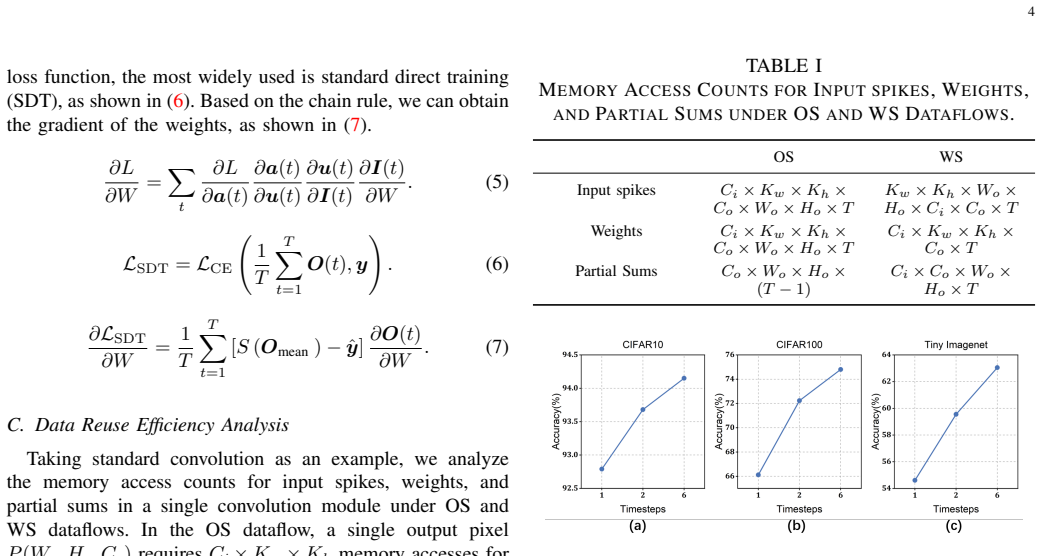
- [Section II-C and Section IV-C] The memory-access analysis conflates on-chip PE-level data delivery with off-chip memory traffic. Table I counts input/weight accesses at the granularity of individual PE operations (e.g., Ci*Kw*Kh*Co*Wo*Ho*T for OS input), whereas Table III counts per-layer off-chip accesses in units of spike vectors (Hi*Wi*T). The statement in Section IV-C that 'off-chip memory accesses for input spikes in OS dataflow are approximately reduced by Ci*Kw*Kh*Co times' is therefore not a valid direct comparison between these two tables. The qualitative conclusion that OS avoids partial-sum storage is sound, but the quantitative factor should be re-derived with clearly defined memory levels (off-chip, global buffer, PE register).
minor comments (5)
- [Section IV-E1] Eq. (10) and Eq. (11) in Section IV-E1: the quantity called T_total in Eq. (10) is the average latency per frame, not the total latency for N frames; Eq. (11) repeats the same average. The authors should rename or correct the equations.
- [Section IV-B] The text says 'the input spike vectors are sent to the rightmost PE' in the systolic-array description; based on Fig. 6 and the standard left-to-right data flow, this should probably read 'leftmost PE'.
- [Table IV] The row labels 'Ours-14', 'Ours-25', etc. appear to be missing superscripts for footnotes 4-6; the PDF text renders them as a single string. Please fix the formatting so the variant labels are unambiguous.
- [References] Reference [23] is cited as an arXiv preprint; the paper should cite the peer-reviewed version of TET if one exists.
- [Table IV] Table IV compares across different FPGA devices (Kintex-7, Zynq-100, ZCU3EG, ZCU9EG); the efficiency comparison would be more informative if the authors noted that process technology and resource availability differ, or normalized the comparison.
Circularity Check
No circularity found; accuracy results are external benchmarks and hardware efficiency numbers are empirical Vivado estimates, not derivations from their own inputs.
full rationale
I traced the derivation chain for both central claims. The single-timestep accuracy claim is an empirical benchmark against external CIFAR10/CIFAR100/Tiny ImageNet results; the TET loss [23] is an external prior loss function, and Algorithm 1 (train with T timesteps, reduce to T_de, fine-tune) is a training recipe evaluated on held-out test sets. It is not an equation whose output is defined by a fitted parameter, and Fig. 2 explicitly shows that standard SDT fails at T=1, so the claimed single-timestep result is not true by construction. The hardware claims (126 KB storage saving, 0.6 J vs 1.3 J at T1 vs T2, 3.91x/4x speedups, 0.14/0.19 GOPS/W/PE) are implementation results from the designed accelerator and Vivado post-implementation reports, not a theorem that assumes its conclusion. The latency model in Eqs. (10)-(12) is an analytic expression for the streaming pipeline, not a fitted input renamed as a prediction. I found no load-bearing self-citations: the cited neuron model, STBP/surrogate-gradient training, SpikingJelly, and TET are independent external works; no author-overlap uniqueness theorem is invoked; and the OS dataflow and compressed-sorted spike representation are presented as adaptations of prior published dataflows [21], [22] rather than as forced by a self-citation chain. The main weakness of the paper, that physical FPGA power was not measured and GOPS/W numbers rely on Vivado power estimation, is a validation/measurement risk, not a circularity. The paper is self-contained against external benchmarks and its central contributions rest on empirical evidence, so no circular step is identified.
Assumptions & free parameters
free parameters (1)
- Output-channel parallelism factors =
(4,4,2,1) for SCNN5, (4,2) for SCNN3
assumptions (4)
- domain assumption The discrete LIF neuron dynamics in Eqs. (2)-(4) accurately model the neurons used in training and hardware.
- domain assumption TET loss provides sufficient temporal robustness that firing rates and accuracy survive timestep reduction from 6 to 1.
- ad hoc to paper Vivado post-synthesis power estimates are a faithful proxy for on-board power consumption.
- standard math For a single timestep, T=1, partial sums need not be stored because each output is computed completely within a PE before being written.
Cite this review
Pith. "Pith review of STI-SNN: A 0.14 GOPS/W/PE Single-Timestep Inference FPGA-based SNN Accelerator with Algorithm and Hardware Co-Design." pith.science (2026). https://pith.science/paper/MN3QO7CS
@misc{pith2026250608842,
  author       = {Pith},
  title        = {Pith review of: STI-SNN: A 0.14 GOPS/W/PE Single-Timestep Inference FPGA-based SNN Accelerator with Algorithm and Hardware Co-Design},
  year         = {2026},
  howpublished = {\url{https://pith.science/paper/MN3QO7CS}},
  note         = {Machine review of arXiv:2506.08842}
}
read the original abstract
Brain-inspired Spiking Neural Networks (SNNs) have attracted attention for their event-driven characteristics and high energy efficiency. However, the temporal dependency and irregularity of spikes present significant challenges for hardware parallel processing and data reuse, leading to some existing accelerators falling short in processing latency and energy efficiency. To overcome these challenges, we introduce the STI-SNN accelerator, designed for resource-constrained applications with high energy efficiency, flexibility, and low latency. The accelerator is designed through algorithm and hardware co-design. Firstly, STI-SNN can perform inference in a single timestep. At the algorithm level, we introduce a temporal pruning approach based on the temporal efficient training (TET) loss function. This approach alleviates spike disappearance during timestep reduction, maintains inference accuracy, and expands TET's application. In hardware design, we analyze data access patterns and adopt the output stationary (OS) dataflow, eliminating the need to store membrane potentials and access memory operations. Furthermore, based on the OS dataflow, we propose a compressed and sorted representation of spikes, then cached in the line buffer to reduce the memory access cost and improve reuse efficiency. Secondly, STI-SNN supports different convolution methods. By adjusting the computation mode of processing elements (PEs) and parameterizing the computation array, STI-SNN can accommodate lightweight models based on depthwise separable convolutions (DSCs), further enhancing hardware flexibility. Lastly, STI-SNN also supports both inter-layer and intra-layer parallel processing. For inter-layer parallelism, we ...
Figures


Figures from the paper (9 more)




Reference graph
Works this paper leans on
-
[1]
Truenorth: Design and tool flow of a 65 mw 1 million neuron programmable neurosynaptic chip,
F. Akopyan, J. Sawada, A. Cassidy, R. Alvarez-Icaza, J. Arthur, P. Merolla, N. Imam, Y . Nakamura, P. Datta, G.-J. Namet al., “Truenorth: Design and tool flow of a 65 mw 1 million neuron programmable neurosynaptic chip,”IEEE transactions on computer- aided design of integrated circuits and systems, vol. 34, no. 10, pp. 1537–1557, 2015
work page 2015
-
[2]
Loihi: A neuromorphic manycore processor with on-chip learning,
M. Davies, N. Srinivasa, T.-H. Lin, G. Chinya, Y . Cao, S. H. Choday, G. Dimou, P. Joshi, N. Imam, S. Jainet al., “Loihi: A neuromorphic manycore processor with on-chip learning,”Ieee Micro, vol. 38, no. 1, pp. 82–99, 2018
work page 2018
-
[3]
S2n2: A fpga accelerator for streaming spiking neural networks,
A. Khodamoradi, K. Denolf, and R. Kastner, “S2n2: A fpga accelerator for streaming spiking neural networks,” inThe 2021 ACM/SIGDA International Symposium on Field-Programmable Gate Arrays, 2021, pp. 194–205. Algorithm 1:SDT and TET based Temporal Pruning. Input:initial inference timesteps (T), training epochs (E), training iterations per epoch (I t) Outpu...
work page 2021
-
[4]
Neurogrid: A mixed-analog-digital multichip system for large-scale neural simulations,
B. V . Benjamin, P. Gao, E. McQuinn, S. Choudhary, A. R. Chan- drasekaran, J.-M. Bussat, R. Alvarez-Icaza, J. V . Arthur, P. A. Merolla, and K. Boahen, “Neurogrid: A mixed-analog-digital multichip system for large-scale neural simulations,”Proceedings of the IEEE, vol. 102, no. 5, pp. 699–716, 2014
work page 2014
-
[5]
Towards artificial general intelligence with hybrid tianjic chip architecture,
J. Pei, L. Deng, S. Song, M. Zhao, Y . Zhang, S. Wu, G. Wang, Z. Zou, Z. Wu, W. Heet al., “Towards artificial general intelligence with hybrid tianjic chip architecture,”Nature, vol. 572, no. 7767, pp. 106–111, 2019
2019
-
[6]
C. Xie, Z. Shao, Z. Chen, Y . Du, and L. Du, “An energy-efficient spiking neural network accelerator based on spatio-temporal redundancy reduction,”IEEE Transactions on Very Large Scale Integration (VLSI) Systems, 2023
work page 2023
-
[7]
Seenn: Towards temporal spiking early exit neural networks,
Y . Li, T. Geller, Y . Kim, and P. Panda, “Seenn: Towards temporal spiking early exit neural networks,”Advances in Neural Information Processing Systems, vol. 36, 2024
work page 2024
-
[8]
Unleashing the potential of spik- ing neural networks with dynamic confidence,
C. Li, E. G. Jones, and S. Furber, “Unleashing the potential of spik- ing neural networks with dynamic confidence,” inProceedings of the IEEE/CVF International Conference on Computer Vision, 2023, pp. 13 350–13 360
work page 2023
Show all 42 references
-
[9]
Input-aware dynamic timestep spiking neural networks for efficient in-memory computing,
Y . Li, A. Moitra, T. Geller, and P. Panda, “Input-aware dynamic timestep spiking neural networks for efficient in-memory computing,” in2023 60th ACM/IEEE Design Automation Conference (DAC). IEEE, 2023, pp. 1–6
2023
-
[10]
Topspark: a timestep optimiza- tion methodology for energy-efficient spiking neural networks on au- tonomous mobile agents,
R. V . W. Putra and M. Shafique, “Topspark: a timestep optimiza- tion methodology for energy-efficient spiking neural networks on au- tonomous mobile agents,” in2023 IEEE/RSJ International Conference on Intelligent Robots and Systems (IROS). IEEE, 2023, pp. 3561–3567
2023
-
[11]
Diet-snn: A low-latency spiking neural network with direct input encoding and leakage and threshold optimization,
N. Rathi and K. Roy, “Diet-snn: A low-latency spiking neural network with direct input encoding and leakage and threshold optimization,” IEEE Transactions on Neural Networks and Learning Systems, vol. 34, no. 6, pp. 3174–3182, 2021
2021
-
[12]
One timestep is all you need: Training spiking neural networks with ultra low latency,
S. S. Chowdhury, N. Rathi, and K. Roy, “One timestep is all you need: Training spiking neural networks with ultra low latency,”arXiv preprint arXiv:2110.05929, 2021
2021 arXiv
-
[13]
D. Lew, H. Tang, and J. Park, “Neuron pruning in temporal domain 13 Fig. 13: The impact of SDT and TET on the neurons’ spike firing rates as well as test accuracy across various datasets and networks: (a) CIFAR10 on VGG16 (SDT), (b) CIFAR10 on VGG16 (TET), (c) CIFAR100 on VGG1...
2023
-
[14]
Spikeconverter: An efficient conversion framework zipping the gap between artificial neural networks and spiking neural networks,
F. Liu, W. Zhao, Y . Chen, Z. Wang, and L. Jiang, “Spikeconverter: An efficient conversion framework zipping the gap between artificial neural networks and spiking neural networks,” inProceedings of the AAAI Conference on Artificial Intelligence, vol. 36, no. 2, 2022, pp. 1692–1701
2022
-
[15]
Differen- tiable spike: Rethinking gradient-descent for training spiking neural networks,
Y . Li, Y . Guo, S. Zhang, S. Deng, Y . Hai, and S. Gu, “Differen- tiable spike: Rethinking gradient-descent for training spiking neural networks,”Advances in Neural Information Processing Systems, vol. 34, pp. 23 426–23 439, 2021
2021
-
[16]
Rethinking the performance comparison between snns and anns,
L. Deng, Y . Wu, X. Hu, L. Liang, Y . Ding, G. Li, G. Zhao, P. Li, and Y . Xie, “Rethinking the performance comparison between snns and anns,”Neural networks, vol. 121, pp. 294–307, 2020
2020
-
[17]
Towards spike-based machine intelligence with neuromorphic computing,
K. Roy, A. Jaiswal, and P. Panda, “Towards spike-based machine intelligence with neuromorphic computing,”Nature, vol. 575, no. 7784, pp. 607–617, 2019
2019
-
[18]
Parallel time batching: Systolic- array acceleration of sparse spiking neural computation,
J.-J. Lee, W. Zhang, and P. Li, “Parallel time batching: Systolic- array acceleration of sparse spiking neural computation,” in2022 IEEE International Symposium on High-Performance Computer Architecture (HPCA). IEEE, 2022, pp. 317–330
2022
-
[19]
Skydiver: A spiking neural network accelerator exploiting spatio-temporal workload balance,
Q. Chen, C. Gao, X. Fang, and H. Luan, “Skydiver: A spiking neural network accelerator exploiting spatio-temporal workload balance,”IEEE Transactions on Computer-Aided Design of Integrated Circuits and Systems, vol. 41, no. 12, pp. 5732–5736, 2022
2022
-
[20]
Sato: spiking neural network acceleration via temporal- oriented dataflow and architecture,
F. Liu, W. Zhao, Z. Wang, Y . Chen, T. Yang, Z. He, X. Yang, and L. Jiang, “Sato: spiking neural network acceleration via temporal- oriented dataflow and architecture,” inProceedings of the 59th ACM/IEEE Design Automation Conference, 2022, pp. 1105–1110
2022
-
[21]
Spinalflow: An architecture and dataflow tailored for spiking neural networks,
S. Narayanan, K. Taht, R. Balasubramonian, E. Giacomin, and P.- E. Gaillardon, “Spinalflow: An architecture and dataflow tailored for spiking neural networks,” in2020 ACM/IEEE 47th Annual International Symposium on Computer Architecture (ISCA). IEEE, 2020, pp. 349– 362
2020
-
[22]
Eyeriss: A spatial architecture for energy-efficient dataflow for convolutional neural networks,
Y .-H. Chen, J. Emer, and V . Sze, “Eyeriss: A spatial architecture for energy-efficient dataflow for convolutional neural networks,”ACM SIGARCH computer architecture news, vol. 44, no. 3, pp. 367–379, 2016
2016
-
[23]
Temporal efficient training of spiking neural network via gradient re-weighting,
S. Deng, Y . Li, S. Zhang, and S. Gu, “Temporal efficient training of spiking neural network via gradient re-weighting,”arXiv preprint arXiv:2202.11946, 2022
2022 arXiv
-
[24]
Dayan and L
P. Dayan and L. F. Abbott,Theoretical neuroscience: computational and mathematical modeling of neural systems. MIT press, 2005
2005
-
[25]
Spatio-temporal backpropa- gation for training high-performance spiking neural networks,
Y . Wu, L. Deng, G. Li, J. Zhu, and L. Shi, “Spatio-temporal backpropa- gation for training high-performance spiking neural networks,”Frontiers in neuroscience, vol. 12, p. 331, 2018
2018
-
[26]
Training deep spiking neural networks using backpropagation,
J. H. Lee, T. Delbruck, and M. Pfeiffer, “Training deep spiking neural networks using backpropagation,”Frontiers in neuroscience, vol. 10, p. 508, 2016
2016
-
[27]
Spikingjelly: An open-source machine learning infrastructure platform for spike-based intelligence,
W. Fang, Y . Chen, J. Ding, Z. Yu, T. Masquelier, D. Chen, L. Huang, H. Zhou, G. Li, and Y . Tian, “Spikingjelly: An open-source machine learning infrastructure platform for spike-based intelligence,”Science Advances, vol. 9, no. 40, p. eadi1480, 2023
2023
-
[28]
Adaptive smoothing gradient learning for spiking neural networks,
Z. Wang, R. Jiang, S. Lian, R. Yan, and H. Tang, “Adaptive smoothing gradient learning for spiking neural networks,” inInternational Confer- ence on Machine Learning. PMLR, 2023, pp. 35 798–35 816
2023
-
[29]
Learning multiple layers of features from tiny images,
A. Krizhevsky, G. Hintonet al., “Learning multiple layers of features from tiny images,” 2009
2009
-
[30]
Tiny imagenet visual recognition challenge,
Y . Le and X. Yang, “Tiny imagenet visual recognition challenge,”CS 231N, vol. 7, no. 7, p. 3, 2015
2015
-
[31]
Very deep convolutional networks for large-scale image recognition,
K. Simonyan and A. Zisserman, “Very deep convolutional networks for large-scale image recognition,”arXiv preprint arXiv:1409.1556, 2014
2014 arXiv
-
[32]
Deep residual learning for image recognition,
K. He, X. Zhang, S. Ren, and J. Sun, “Deep residual learning for image recognition,” inProceedings of the IEEE conference on computer vision and pattern recognition, 2016, pp. 770–778
2016
-
[33]
Going deeper with directly-trained larger spiking neural networks,
H. Zheng, Y . Wu, L. Deng, Y . Hu, and G. Li, “Going deeper with directly-trained larger spiking neural networks,” inProceedings of the AAAI conference on artificial intelligence, vol. 35, no. 12, 2021, pp. 11 062–11 070
2021
-
[34]
Optimal ann- snn conversion for high-accuracy and ultra-low-latency spiking neural networks,
T. Bu, W. Fang, J. Ding, P. Dai, Z. Yu, and T. Huang, “Optimal ann- snn conversion for high-accuracy and ultra-low-latency spiking neural networks,”arXiv preprint arXiv:2303.04347, 2023
2023 arXiv
-
[35]
Spike-thrift: Towards energy-efficient deep spiking neural networks by limiting spiking activity via attention-guided compression,
S. Kundu, G. Datta, M. Pedram, and P. A. Beerel, “Spike-thrift: Towards energy-efficient deep spiking neural networks by limiting spiking activity via attention-guided compression,” inProceedings of the IEEE/CVF winter conference on applications of computer vision, 2021, pp. 3...
2021
-
[36]
Temporal effective batch normalization in spiking neural networks,
C. Duan, J. Ding, S. Chen, Z. Yu, and T. Huang, “Temporal effective batch normalization in spiking neural networks,”Advances in Neural Information Processing Systems, vol. 35, pp. 34 377–34 390, 2022
2022
-
[37]
Snn2ann: A fast and memory-efficient training framework for spiking neural networks,
J. Tang, J. Lai, X. Xie, L. Yang, and W.-S. Zheng, “Snn2ann: A fast and memory-efficient training framework for spiking neural networks,” arXiv preprint arXiv:2206.09449, 2022
2022 arXiv
-
[38]
Encoding, model, and architecture: Systematic optimization for spiking neural network in fpgas,
H. Fang, Z. Mei, A. Shrestha, Z. Zhao, Y . Li, and Q. Qiu, “Encoding, model, and architecture: Systematic optimization for spiking neural network in fpgas,” inProceedings of the 39th International Conference on Computer-Aided Design, 2020, pp. 1–9. 14
2020
-
[39]
The implementation and optimization of neuromorphic hardware for supporting spiking neural networks with mlp and cnn topologies,
W. Ye, Y . Chen, and Y . Liu, “The implementation and optimization of neuromorphic hardware for supporting spiking neural networks with mlp and cnn topologies,”IEEE Transactions on Computer-Aided Design of Integrated Circuits and Systems, vol. 42, no. 2, pp. 448–461, 2022
2022
-
[40]
An fpga implementation of deep spiking neural networks for low-power and fast classification,
X. Ju, B. Fang, R. Yan, X. Xu, and H. Tang, “An fpga implementation of deep spiking neural networks for low-power and fast classification,” Neural computation, vol. 32, no. 1, pp. 182–204, 2020
2020
-
[41]
Cerebron: A reconfigurable architecture for spatiotemporal sparse spiking neural networks,
Q. Chen, C. Gao, and Y . Fu, “Cerebron: A reconfigurable architecture for spatiotemporal sparse spiking neural networks,”IEEE Transactions on Very Large Scale Integration (VLSI) Systems, vol. 30, no. 10, pp. 1425–1437, 2022
2022
-
[42]
Firefly: A high- throughput hardware accelerator for spiking neural networks with effi- cient dsp and memory optimization,
J. Li, G. Shen, D. Zhao, Q. Zhang, and Y . Zeng, “Firefly: A high- throughput hardware accelerator for spiking neural networks with effi- cient dsp and memory optimization,”IEEE Transactions on Very Large Scale Integration (VLSI) Systems, vol. 31, no. 8, pp. 1178–1191, 2023
2023
Reviewed August 7, 2026 · model on record in the stance chip above.
Discussion (0). Sign in to comment.