REVIEW 2 major objections 5 minor 36 references
Effects of Speaker Count, Duration, and Accent Diversity on Zero-Shot Accent Robustness in Low-Resource ASR
T0 review · 2 major / 5 minor · reviewed 2026-08-07 · deepseek-v4-flash
Pith's one-line read This paper claims that when total ASR training hours are fixed, increasing the number of speakers improves zero-shot accent robustness more than increasing the hours contributed per speaker, while adding more accents gives minimal benefit…
desk verdict Solid speaker-count result, but the accent-diversity null is confounded by singleton speakers per accent and does not support the strong recommendation. read the letter →
The pith
A machine-rendered reading of the paper's core claim, the machinery that carries it, and where it could break.
The reading
What carries the argument
The load-bearing mechanism is a controlled data-composition grid: for each language, training sets are built by independently varying the number of speakers N, the per-speaker audio duration t, and the number of unique accents K, while keeping total hours T=N*t fixed for the speaker-versus-duration comparison. This design isolates each axis's effect on the character error rate measured on accents absent from training, and it is repeated across English, Spanish, and Mandarin Chinese so the conclusions are not tied to one language.
What would settle it
A reader could rerun the accent-diversity condition with, say, three speakers drawn from each added accent while holding total speakers and hours fixed; if CER on unseen accents falls consistently as accent count grows under this manipulation, the paper's accent-diversity null result would not survive.
Extended reading notes
Core claim
The central claim is that, for a fixed amount of ASR training audio, model accuracy on out-of-distribution accents improves more when the training set contains more distinct speakers than when it contains more hours from each speaker; moreover, the benefit of additional training hours is amplified by larger speaker counts. A second claim is that varying the number of accents in training, with speaker count and duration held constant, yields no consistent improvement in zero-shot accent robustness across the three languages tested. The evidence is character error rate on held-out accents, measured after fine-tuning the same pretrained multilingual model on controlled data subsets.
Load-bearing premise
The claim that accent diversity brings minimal benefit rests on the assumption that swapping in a single speaker per extra accent is an adequate test of accent diversity, so a result obtained with one speaker per accent might not hold when each accent contributes several speakers.
Editorial extensions
If this is right
- For new languages with limited audio budgets, recruiting more speakers should come before extending recording duration per speaker.
- Scaling the number of training hours pays off more once speaker count is reasonably large; without speaker diversity, added hours mainly help seen accents.
- Explicit accent labeling may be less valuable than speaker diversity for zero-shot accent generalization in low-resource settings.
- A single speaker's data, however long, does not push down error on unseen accents, which suggests speaker count is the key lever.
Reading between the lines
- The accent-diversity null result may not generalize to designs where each added accent is represented by several speakers, because the study replaces only one dominant-accent speaker per new accent.
- If confirmed across more languages and model scales, the same pattern could inform data collection for supervised speech tasks beyond ASR, such as speaker verification or accent classification.
- A testable extension is to vary accent diversity as a continuous distributional measure (e.g., entropy over accents) rather than as a count of accents, which may show benefit only above a diversity threshold.
Editorial analysis
A structured set of objections, weighed in public.
Referee Report
Summary. The paper studies how three training-data composition factors—number of speakers, per-speaker audio duration, and accent diversity—affect zero-shot accent robustness of a fine-tuned MMS ASR model in a low-resource regime. Using English, Spanish, and Mandarin Chinese, the authors hold total training hours fixed while varying speaker count and per-speaker duration, and they vary the number of accents while holding speakers and hours fixed. They report that increasing speaker count is consistently more beneficial than increasing per-speaker duration, that more speakers amplify the benefit of added hours, and that accent diversity yields only minimal benefit when speaker count and hours are controlled. The paper concludes with practical recommendations to prioritize speaker count in ASR data collection for new languages.
Significance. The speaker-count result is a practically valuable and reasonably well-supported finding: it is observed across three languages, uses a fixed-total-hours design, and Table 2 reports standard deviations. The topline comparisons and the inclusion of both L1/L2 and regional accents are strengths. The accent-diversity null result, if established, would be an important and surprising guidance for low-resource ASR data collection. However, the accent-diversity experiment as designed does not isolate accent diversity, so the paper's most consequential recommendation currently rests on a confounded manipulation.
major comments (2)
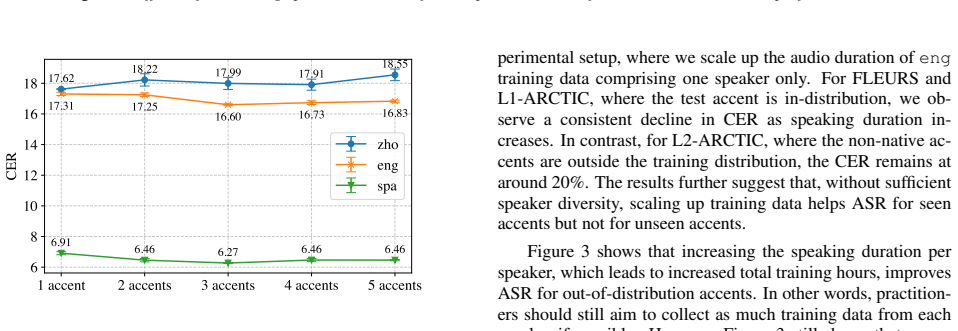
- [Section 3.1.3 and Figure 4] The accent-diversity experiment does not isolate accent diversity. With N fixed and each added accent represented by exactly one speaker, increasing K replaces one dominant-accent speaker with one speaker of a new accent, so K and the number of speakers per accent are inversely coupled. For example, at K=5 for English the training set has 16 American speakers and four non-dominant accents represented by one speaker each; at K=2 it has 19 American speakers and one singleton non-dominant speaker. The comparison is therefore not 'same speakers, different accents' but 'same speakers, with additional accents represented by singleton speakers.' A single speaker is not a reliable proxy for an accent, and the flat or non-monotonic curves in Figure 4 could reflect idiosyncratic speaker choice, loss of dominant-accent data, or insufficient per-accent samples. As a result, the conclusion in Section 4 that 'accent coverage may be less critical than previously thought' and recommendation (1) go beyond what this experiment can support. A more direct test would keep per-accent speaker depth fixed (e.g., multiple speakers per accent, with repeated random draws) or at minimum vary accents while holding the number of dominant-accent speakers constant.
- [Section 4, Figure 4] The claim of 'minimal benefits' from accent diversity is stated without any uncertainty quantification. Figure 4 shows no error bars, and the text reports no significance tests or confidence intervals, even though Section 3.1.4 says multiple training runs were performed. This matters because the Mandarin results in Figure 4 show an apparent improvement of about 0.7 CER from one accent to four accents (17.31 to 16.60), which is small but not negligible without variance estimates. The authors should report per-run variation, confidence intervals, or a formal comparison (e.g., bootstrap or paired tests) before asserting that accent diversity has minimal effect. Without these, the null result is not established.
minor comments (5)
- [Table 1 caption] The phrase 'Weboldthe accents' should read 'We bold the accents'; the caption should be cleaned of this typo.
- [Section 3.1.1 vs Figure 1] Section 3.1.1 states that for English the total-hour settings are T={5,10,15}, but Figure 1 and Section 4 refer to a 20-hour condition for English. Please clarify which total-hour values were actually used and make the text, figure legend, and experimental description consistent.
- [Section 3.2] The English test set is described as built by randomly selecting one L2-ARCTIC speaker per accent; please state explicitly that this test split was fixed once and used across all experiments so that differences across training conditions are not affected by test-set sampling.
- [Figures 2 and 3] Figures 2 and 3 likewise do not show error bars or per-seed values; please add them or state in the caption how variance was summarized, especially for Figure 3 where the claims compare the magnitude of gains across conditions.
- [Section 4] The phrase 'there is minimal benefits' is ungrammatical; it should be 'there are minimal benefits' or 'there is minimal benefit.'
Circularity Check
No circularity: the paper's findings are empirical results from controlled experiments, not derivations from their own inputs.
full rationale
This paper is a purely empirical study. It systematically varies three training-data dimensions (speaker count, per-speaker duration, accent diversity) while holding total hours fixed, trains MMS-based ASR models, and evaluates zero-shot accent robustness on held-out accent test sets. The central claims—that more speakers helps more than more hours per speaker, and that accent diversity yields minimal benefit—are read directly from the measured CER curves in Figures 1–4 and Table 2. No parameter is fitted to the target result, no quantity is defined in terms of the outcome it is supposed to predict, and no load-bearing premise is imported from a self-citation. The MMS pretrained model and training code are cited as external tools, and the evaluation uses public datasets (L2-ARCTIC, MAGICDATA, Common Voice) that are independent of the paper's fitted values. The accent-diversity experiment in Section 3.1.3 does confound accent diversity with singleton accent speakers, which is a legitimate threat to the internal validity of the null result; however, that is an experimental-design weakness, not circularity. The conclusion is not equivalent to its inputs by construction, so the circularity score is 0.
Assumptions & free parameters
assumptions (3)
- domain assumption Accent labels in LibriVox Accent Table and Common Voice are accurate enough for partitioning speakers into accents.
- domain assumption Fine-tuning a 300M-parameter MMS model on a few hours of audio is a valid proxy for low-resource ASR development.
- domain assumption CER and WER are strongly correlated (r=0.92), so conclusions based on CER transfer to WER.
Cite this review
Pith. "Pith review of Effects of Speaker Count, Duration, and Accent Diversity on Zero-Shot Accent Robustness in Low-Resource ASR." pith.science (2026). https://pith.science/paper/MNROKFRC
@misc{pith2026250604364,
  author       = {Pith},
  title        = {Pith review of: Effects of Speaker Count, Duration, and Accent Diversity on Zero-Shot Accent Robustness in Low-Resource ASR},
  year         = {2026},
  howpublished = {\url{https://pith.science/paper/MNROKFRC}},
  note         = {Machine review of arXiv:2506.04364}
}
read the original abstract
To build an automatic speech recognition (ASR) system that can serve everyone in the world, the ASR needs to be robust to a wide range of accents including unseen accents. We systematically study how three different variables in training data -- the number of speakers, the audio duration per each individual speaker, and the diversity of accents -- affect ASR robustness towards unseen accents in a low-resource training regime. We observe that for a fixed number of ASR training hours, it is more beneficial to increase the number of speakers (which means each speaker contributes less) than the number of hours contributed per speaker. We also observe that more speakers enables ASR performance gains from scaling number of hours. Surprisingly, we observe minimal benefits to prioritizing speakers with different accents when the number of speakers is controlled. Our work suggests that practitioners should prioritize increasing the speaker count in ASR training data composition for new languages.
Figures


Figures from the paper (1 more)
Reference graph
Works this paper leans on
-
[1]
Introduction Automatic speech recognition (ASR) systems have become an integral part of our daily lives, powering virtual assistants, tran- scription services, and accessibility tools [1]. However, these systems often exhibit significant performance disparities across different accents, potentially excluding or poorly serving large segments of the global ...
-
[2]
Related Work ASR systems have been found to exhibit bias towards certain accents. For instance, prior work discovered substantial word error rate (WER) differences between transcribing L1 (first language speaker) and L2 (second language speaker) English speech [5, 6]. Regional accent biases, where ASR performance for certain regional dialects or accents i...
-
[3]
Experimental Setup Our work explores how (1) number of speakers, (2) audio du- ration per speaker and (3) explicit accent diversity in training data affect ASR performance onaccents outside of the training distribution. Primarily, our work focuses on the low-resource arXiv:2506.04364v1 [cs.CL] 4 Jun 2025 Table 1:Information about accent distribution for o...
work page Pith review arXiv 2025
-
[4]
Results and Discussion We find that more speakers and more training hours improve ASR performance on out-of-distribution accents. In Figure 1, 2We observe strong correlation between CER and Word Error Rate (WER) (r= 0.92) in our evaluation, so we report CER only for brevity. 5 10 20 30 60 Speaking Duration per Speaker (minutes) 12 14 16 18CER eng 5 10 20 ...
-
[5]
Conclusion We systematically investigated how speaker count, speaking duration per speaker, and accent diversity in training data af- fect ASR robustness towards out-of-distribution accents in low- resource settings. Our work provides practical recommenda- tions on how to best allocate limited data collection resources for developing accent-robust ASR sys...
-
[6]
Per- formance disparities between accents in automatic speech recog- nition (student abstract),
A. DiChristofano, H. Shuster, S. Chandra, and N. Patwari, “Per- formance disparities between accents in automatic speech recog- nition (student abstract),”Proceedings of the AAAI Conference on Artificial Intelligence, vol. 37, 2024
work page 2024
-
[7]
End-to-end speech recognition: A survey,
R. Prabhavalkar, T. Hori, T. N. Sainath, R. Schl¨uter, and S. Watan- abe, “End-to-end speech recognition: A survey,”IEEE/ACM Transactions on Audio, Speech, and Language Processing, 2023
work page 2023
-
[8]
Racial disparities in automated speech recognition,
A. Koenecke, A. Nam, E. Lake, J. Nudell, M. Quartey, Z. Menge- sha, C. Toups, J. R. Rickford, D. Jurafsky, and S. Goel, “Racial disparities in automated speech recognition,”Proceedings of the National Academy of Sciences, vol. 117, no. 14, pp. 7684–7689, 2020
work page 2020
Show all 36 references
-
[9]
Speaking of accent: A content analysis of accent misconceptions in asr research,
K. Prinos, N. Patwari, and C. A. Power, “Speaking of accent: A content analysis of accent misconceptions in asr research,” inProceedings of the 2024 ACM Conference on Fairness, Accountability, and Transparency, ser. FAccT ’24. New York, NY , USA: Association for Computing Mach...
2024
-
[10]
Accented speech recognition: A survey,
A. Hinsvark, N. Delworth, M. Del Rio, Q. McNamara, J. Dong, R. Westerman, M. Huang, J. Palakapilly, J. Drexler, I. Pirkin et al., “Accented speech recognition: A survey,”arXiv preprint arXiv:2104.10747, 2021
2021 arXiv
-
[11]
Training and typological bias in asr performance for world englishes
M. P. Y . Chan, J. Choe, A. Li, Y . Chen, X. Gao, and N. R. Holli- day, “Training and typological bias in asr performance for world englishes.” inINTERSPEECH, 2022, pp. 1273–1277
2022
-
[12]
Comparing data augmentation and training techniques to reduce bias against non-native accents in hybrid speech recognition systems,
Y . Zhang, Y . Zhang, T. Patel, and O. Scharenborg, “Comparing data augmentation and training techniques to reduce bias against non-native accents in hybrid speech recognition systems,” inProc. 1st workshop on speech for social good (S4SG), 2022, pp. 15–19
2022
-
[13]
The edinburgh international accents of english corpus: Towards the democratization of english asr,
R. Sanabria, N. Bogoychev, N. Markl, A. Carmantini, O. Kle- jch, and P. Bell, “The edinburgh international accents of english corpus: Towards the democratization of english asr,” inICASSP 2023-2023 IEEE International Conference on Acoustics, Speech and Signal Processing (ICASS...
2023
-
[14]
The balancing act: Unmasking and alleviating ASR biases in Portuguese,
A. Kulkarni, A. Tokareva, R. Qureshi, and M. Couceiro, “The balancing act: Unmasking and alleviating ASR biases in Portuguese,” inProceedings of the Fourth Workshop on Language Technology for Equality, Diversity, Inclusion, B. R. Chakravarthi, B. B, P. Buitelaar, T. Durairaj, ...
2024
-
[15]
Mitigating bias against non-native accents,
Y . Zhang, Y . Zhang, B. M. Halpern, T. Patel, and O. Scharen- borg, “Mitigating bias against non-native accents,” inProceedings of the Annual Conference of the International Speech Communi- cation Association, INTERSPEECH, vol. 2022, 2022, pp. 3168– 3172
2022
-
[16]
Sawalha and M
M. Sawalha and M. Abu Shariah, “The effects of speakers’ gen- der, age, and region on overall performance of arabic automatic speech recognition systems using the phonetically rich and bal- anced modern standard arabic speech corpus,” inProceedings of the 2nd Workshop of Arabi...
2013
-
[17]
Towards inclusive automatic speech recognition,
S. Feng, B. M. Halpern, O. Kudina, and O. Scharenborg, “Towards inclusive automatic speech recognition,”Computer Speech & Language, vol. 84, p. 101567, 2024. [On- line]. Available: https://www.sciencedirect.com/science/article/ pii/S0885230823000864
2024
-
[18]
Leveraging native language infor- mation for improved accented speech recognition,
S. Ghorbani and J. H. Hansen, “Leveraging native language infor- mation for improved accented speech recognition,” inInterspeech 2018, 2018, pp. 2449–2453
2018
-
[19]
Ex- ploring data augmentation in bias mitigation against non-native- accented speech,
Y . Zhang, A. Herygers, T. Patel, Z. Yue, and O. Scharenborg, “Ex- ploring data augmentation in bias mitigation against non-native- accented speech,” in2023 IEEE Automatic Speech Recognition and Understanding Workshop (ASRU). IEEE, 2023, pp. 1–8
2023
-
[20]
V oice conversion can improve asr in very low-resource settings,
M. Baas and H. Kamper, “V oice conversion can improve asr in very low-resource settings,” inProceedings of the Annual Con- ference of the International Speech Communication Association, INTERSPEECH, 2022
2022
-
[21]
Synthetic cross-accent data augmentation for automatic speech recognition,
P. Klumpp, P. Chitkara, L. Sarı, P. Serai, J. Wu, I.-E. Veliche, R. Huang, and Q. He, “Synthetic cross-accent data augmentation for automatic speech recognition,”arXiv preprint arXiv:2303.00802, 2023
2023 arXiv
-
[22]
Do- main adversarial training for accented speech recognition,
S. Sun, C.-F. Yeh, M.-Y . Hwang, M. Ostendorf, and L. Xie, “Do- main adversarial training for accented speech recognition,” in 2018 IEEE international conference on acoustics, speech and sig- nal processing (ICASSP). IEEE, 2018, pp. 4854–4858
2018
-
[23]
Accented speech recognition with accent-specific codebooks,
D. Prabhu, P. Jyothi, S. Ganapathy, and V . Unni, “Accented speech recognition with accent-specific codebooks,” inProceedings of the 2023 Conference on Empirical Methods in Natural Language Processing, H. Bouamor, J. Pino, and K. Bali, Eds. Singapore: Association for Computati...
2023
-
[24]
Common voice: A massively-multilingual speech corpus,
R. Ardila, M. Branson, K. Davis, M. Kohler, J. Meyer, M. Henretty, R. Morais, L. Saunders, F. Tyers, and G. Weber, “Common voice: A massively-multilingual speech corpus,” in Proceedings of the Twelfth Language Resources and Evaluation Conference, N. Calzolari, F. B ´echet, P. ...
2020
-
[25]
End-to-end accented speech recognition
T. Viglino, P. Motlicek, and M. Cernak, “End-to-end accented speech recognition.” inInterspeech, 2019, pp. 2140–2144
2019
-
[26]
United States English
that provides accent label information for audio samples in the English Common V oice corpus [24], nearly 70% of the training data are labeled as “United States English”, closely fol- lowed by around 25% of “England English”. These two accents alone already make up nearly 95% ...
-
[27]
Speech technology for everyone: Automatic speech recognition for non-native English,
T. Shibano, X. Zhang, M. T. Li, H. Cho, P. Sullivan, and M. Abdul-Mageed, “Speech technology for everyone: Automatic speech recognition for non-native English,” inProceedings of the 4th International Conference on Natural Language and Speech Processing (ICNLSP 2021), M. Abbas ...
2021
-
[28]
More speaking or more speakers?
D. Berrebbi, R. Collobert, N. Jaitly, and T. Likhomanenko, “More speaking or more speakers?” inICASSP 2023 - 2023 IEEE Inter- national Conference on Acoustics, Speech and Signal Processing (ICASSP), 2023, pp. 1–5
2023
-
[29]
Mls: A large-scale multilingual dataset for speech research,
V . Pratap, Q. Xu, A. Sriram, G. Synnaeve, and R. Collobert, “Mls: A large-scale multilingual dataset for speech research,”ArXiv, vol. abs/2012.03411, 2020
2012 arXiv
-
[30]
Accents table,
LibriV ox, “Accents table,” accessed on September 2024. [Online]. Available: https://wiki.librivox.org/index.php/Accents Table
2024
-
[31]
Magicdata mandarin chinese read speech corpus,
L. Magic Data Technology Co., “Magicdata mandarin chinese read speech corpus,” 2019, accessed via OpenSLR 68 in November 2024. [Online]. Available: https://www.openslr.org/68/
2019
-
[32]
Globe: A high-quality english corpus with global accents for zero-shot speaker adaptive text-to- speech,
W. Wang, Y . Song, and S. Jha, “Globe: A high-quality english corpus with global accents for zero-shot speaker adaptive text-to- speech,” inInterspeech 2024, 2024, pp. 1365–1369
2024
-
[33]
Scaling speech technology to 1,000+ languages,
V . Pratap, A. Tjandra, B. Shi, P. Tomasello, A. Babu, S. Kundu, A. Elkahky, Z. Ni, A. Vyas, M. Fazel-Zarandiet al., “Scaling speech technology to 1,000+ languages,”Journal of Machine Learning Research, vol. 25, no. 97, pp. 1–52, 2024
2024
-
[34]
L2-arctic: A non- native english speech corpus,
G. Zhao, S. Sonsaat, A. Silpachai, I. Lucic, E. Chukharev- Hudilainen, J. Levis, and R. Gutierrez-Osuna, “L2-arctic: A non- native english speech corpus,” inInterspeech 2018, 2018, pp. 2783–2787
2018
-
[35]
The cmu arctic speech databases,
J. Kominek and A. W. Black, “The cmu arctic speech databases,” inFifth ISCA workshop on speech synthesis, 2004
2004
-
[36]
Fleurs: Few-shot learning evaluation of universal representations of speech,
A. Conneau, M. Ma, S. Khanuja, Y . Zhang, V . Axelrod, S. Dalmia, J. Riesa, C. Rivera, and A. Bapna, “Fleurs: Few-shot learning evaluation of universal representations of speech,” in2022 IEEE Spoken Language Technology Workshop (SLT). IEEE, 2023, pp. 798–805
2023
Reviewed August 7, 2026 · model on record in the stance chip above.
Discussion (0). Sign in to comment.