REVIEW 3 major objections 6 minor 48 references
DBMovi-GS: Dynamic View Synthesis from Blurry Monocular Video via Sparse-Controlled Gaussian Splatting
T0 review · 3 major / 6 minor · reviewed 2026-08-06 · deepseek-v4-flash
Pith's one-line read This paper argues that blurry monocular video alone is enough to synthesize sharp new views and recover camera trajectories, by densifying sparse 3D Gaussians and explaining each blurry frame as an average of a few shifted renders of the…
desk verdict A clean combination of known deblurring and pose-estimation components with a small new densification trick; the reported camera-motion results are solid, but the object-motion claim is untested and internally contradicted. read the letter →
The pith
A machine-rendered reading of the paper's core claim, the machinery that carries it, and where it could break.
The reading
What carries the argument
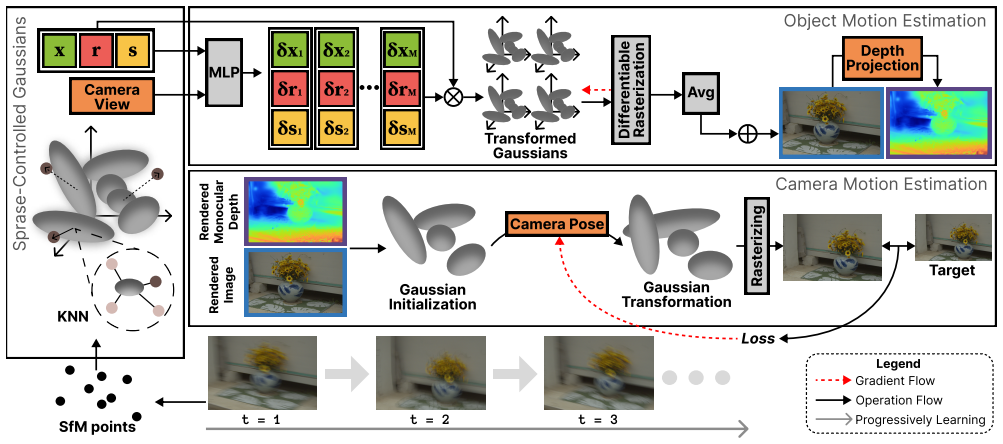
The load-bearing object is the dense 3D Gaussian scene produced by the Sparse-Controlled Gaussian Extraction module: for each SfM point, K nearest neighbors are found and new points are sampled nearby, with a distance threshold discarding points too far from any original, so the representation grows from sparse to dense before motion estimation. Two motion mechanisms ride on top of those Gaussians. Object motion is captured by an MLP that predicts M small offsets in position, rotation, and scale for each Gaussian, and the M rendered images are averaged to produce a sharp frame; this adapts the Deblurring 3DGS blur model while adding learnable rotation and scale factors. Camera motion is captured by learning an SE(3) transformation that moves the whole pretrained Gaussian set from one frame to the next, optimized by photometric loss while the Gaussian attributes are frozen. Progressive learning chains these relative poses to build a global trajectory, and the same differentiable rasterizer, depth projection, and image/depth/pose losses tie the two motions together in one optimization.
What would settle it
Render a synthetic blurry monocular sequence where a small object moves fast enough that its blur spans more than the four offset copies used in the experiments while the camera also shakes, and compare the rendered sharp frames with ground truth; if the moving object remains blurry or splits into ghost copies, the finite-offset averaging model is falsified.
Extended reading notes
Core claim
The central claim is that blur does not need a separate deblurring network or clean input frames: a Gaussian-splatting scene can be optimized directly from blurry monocular video, with each blurry observation explained as the average of M renditions of the same dense 3D Gaussians under small learned offsets, while each camera pose is a learnable SE(3) transform of the scene. To make this work, the method densifies the sparse SfM points by K-nearest-neighbor sampling around each existing point, then refines the densified Gaussians. The object-motion branch uses an MLP to output position, rotation, and scale offsets for M copies of each Gaussian; the camera branch freezes the pretrained Gaussians and optimizes an SE(3) transform per frame. Progressive learning pairs consecutive frames so relative poses accumulate into a global trajectory. At inference the MLP is disabled, so sharp novel views render at the speed of standard Gaussian splatting. The paper reports that this joint formulation outperforms the compared baselines on real blurred video and remains competitive on camera-pose error.
Load-bearing premise
The central assumption is that every blur, including object motion and defocus, can be reproduced by averaging a few shifted copies of the same 3D Gaussians; if real blur combines continuous camera motion with fast independently moving objects and defocus, this mixture model may not hold.
Editorial extensions
If this is right
- A blurry monocular video can yield sharp novel views and camera trajectories without a separate structure-from-motion and pose-estimation stage.
- Densifying the sparse SfM point cloud before optimization makes the scene representation less sensitive to poor initialization from blurry frames.
- The same Gaussian rasterizer renders sharp images at inference time because the object-motion MLP is switched off.
- Jointly optimizing pose and blur produces pose estimates comparable to dedicated pose-estimation baselines on real indoor and outdoor scenes.
- Combining image deblurring and view synthesis in one pipeline extends Gaussian splatting to dynamic, multi-object blurry scenes.
Reading between the lines
- The M-offset averaging model would be tested most sharply on synthetic data with fast independently moving objects, since the paper's real benchmarks are camera-motion-centric; a failure there would localize the limit of the blur model.
- The KNN densification plus color-inheritance step is modular and could be transplanted into other Gaussian-splatting systems that suffer from sparse or noisy SfM initialization.
- Real-time sharp rendering at inference suggests on-device applications such as video cleanup or refocusing, which the paper does not evaluate.
- The progressive pose-learning scheme makes the method a candidate for online video processing, where poses arrive frame by frame; the paper leaves that setting unexplored.
Editorial analysis
A structured set of objections, weighed in public.
Referee Report
Summary. The paper presents DBMovi-GS, a 3D Gaussian Splatting method for novel view synthesis from blurry monocular video. It densifies sparse SfM point clouds via KNN-based sampling, models object-motion blur by averaging M Gaussian sets with MLP-predicted offsets (Eq. 1), and estimates camera poses with a learnable SE(3) transformation in a progressive training loop. Experiments on ExBluRF and Tanks and Temples report PSNR/SSIM/LPIPS improvements over five baselines and pose errors comparable to or better than COLMAP-Free. The supplementary material provides pseudocode, hyperparameters, baseline preprocessing details, and ablations of loss terms and point density.
Significance. If the central claim is fully supported, this would be a useful contribution: it combines deblurring, pose estimation, and dynamic view synthesis in a single 3DGS pipeline with real-time rendering, while explicitly targeting sparse SfM initialization and reporting reproducible implementation details. The clearest strengths are the KNN densification module, the joint optimization of pose and scene, and the transparent supplementary documentation of training configurations. However, the paper's headline claim of handling object motion blur is not validated on any benchmark with known independently moving objects, the ExBluRF evaluation omits two of the eight stated scenes, and the blur model's core averaging assumption is not tested in the combined camera-motion/object-motion/defocus setting. These gaps are load-bearing for the dynamic-scene claims and need to be addressed before the paper can be accepted.
major comments (3)
- [§4, Tables 2–3; Supp. §8.1 and Fig. 3] The central claim that DBMovi-GS handles object motion blur is not tested on a benchmark with verifiable independently moving objects. Table 3 uses Tanks and Temples, whose sequences are described in Supp. Table 5 as camera-rotation sequences (static scenes), and Table 2 uses ExBluRF, which Supp. §8.1 describes as random 6-DOF camera-motion trajectories; the only statement that ExBluRF contains significant object motion appears in the caption of Supp. Fig. 3 and directly contradicts §8.1. Since the object-motion module (Eq. 1) is inherited from Deblurring 3DGS and is never ablated or validated on a scene with known object motion, the reported gains could in principle come entirely from KNN densification and camera-pose optimization. Please add an evaluation on a dataset or synthetic sequence with ground-truth object motion, or narrow the paper's claims to camera-motion blur.
- [Table 2; Supp. §8.1] ExBluRF is stated to contain eight scenes, but Table 2 reports results for only six (Camellia, Bench, Dragon, Sunflowers, Jars1, Jars2) with no explanation. If the two omitted scenes have different difficulty, the reported averages are not representative of the full benchmark. Please report all eight scenes or justify the exclusion in the text.
- [§3.2, Eq. (1)] The blur model assumes that a blurred frame equals the average of M sharp renders of Gaussians with small per-point offsets, an assumption inherited from Deblurring 3DGS. This approximation is not validated for combined continuous camera motion, independently moving objects, and defocus, which is exactly the setting the paper claims to address. The deblurring quality on such combinations is therefore unproven. A synthetic experiment with known blur parameters and a moving object would provide a concrete, falsifiable test of this assumption.
minor comments (6)
- [Table 2, COLMAP-Free row] The reported SSIM value 4.46 exceeds the theoretical maximum of 1 and is likely a typo; please correct it to a valid value.
- [§4, Tables 2–4] All reported metrics are single-run with no variance or repeated trials; given the manual preprocessing described for baselines in Supp. §9, please report multiple seeds or confidence intervals for the main quantitative comparisons.
- [Supp. §9.2] For GS on the Move, the text states that extracting feature points from blurry images 'often required multiple attempts'; please specify how many attempts and whether the selection of the successful reconstruction was made without looking at the test metrics.
- [§3.1 and Algorithm 1] No ablation isolates the effect of the hyperparameters N_p, K, and t_d on final rendering quality; the current ablation only measures point counts and training time, so please report sensitivity of PSNR/SSIM/LPIPS to these choices.
- [Abstract and §4] The phrase 'sets a new benchmark' overstates the evidence, since results are reported on only two benchmarks; consider wording such as 'achieving state-of-the-art results on the evaluated benchmarks.'
- [Table 1] The table header row is garbled in the manuscript ('Defocus Camera Mot- Object Mot- Camera Pose ModelBlur ion Blur ion Blur Trajectory'), and the abbreviations 'id' and 'vs' are used before they are defined; please clean up the table and define the abbreviations in the caption.
Circularity Check
No significant circularity: DBMovi-GS is an empirical synthesis pipeline whose reported metrics are held-out evaluations, not quantities defined by the model's inputs.
full rationale
DBMovi-GS does not offer a formal derivation of its outputs from its inputs; it is an empirical system combining KNN-based point densification, an MLP blur-offset model (Eq. 1, explicitly attributed to Lee et al. [16]), and SE(3) pose optimization (explicitly following Fu et al. [9]). The reported predictions—novel-view PSNR/SSIM/LPIPS on held-out sharp test frames and ATE/RPE against ground-truth poses—are not constructed from the training objective: during training the blur model averages M renders to match the blurry input, while the sharp test images are unseen and pose errors are measured against external ground truth. No fitted parameter is renamed as a prediction, and no equation reduces to its own input by definition. There are also no self-citations: every load-bearing component is cited to external prior work ([5], [16], [31], [9], [3]), so there is no self-citation chain and no imported uniqueness theorem. The substantive concerns raised by the paper itself are empirical validity issues, not circularity: the claimed handling of object motion blur is never directly validated on a benchmark with known object motion (Tanks and Temples is static; ExBluRF is described in Sec. 8.1 as camera-motion induced, while the Fig. 3 caption later claims significant object motion in ExBluRF), and Table 2 reports only six of the eight ExBluRF scenes without explanation. These concerns affect how strongly the results support the headline claim, but they do not reduce any derivation to its inputs.
Assumptions & free parameters
free parameters (7)
- N_p (number of sampled new points per sparse point) =
not specified
- K (KNN neighbors) =
4
- t_d (distance threshold) =
2
- M (number of blur samples / views) =
4
- lambda_depth, lambda_pose, lambda =
0.01, 1, 0.2
- epsilon_pose =
not specified
- rho_r, rho_s (learnable rotation and scale multipliers) =
learned
assumptions (4)
- domain assumption 3D Gaussian Splatting provides a differentiable scene representation with covariance decomposed as R S S^T R^T (Sec 10.1, Eq. 5-6).
- ad hoc to paper A blurred frame can be approximated by the average of M sharp renders of Gaussians with per-point offsets (Sec 3.2, Eq. 1).
- domain assumption Camera pose can be recovered as a global SE(3) transform of all Gaussians per frame under a smooth-trajectory assumption (Sec 3.3).
- domain assumption Depth rendering from Eq. (2) yields a valid depth map for supervision (Sec 10.5).
Cite this review
Pith. "Pith review of DBMovi-GS: Dynamic View Synthesis from Blurry Monocular Video via Sparse-Controlled Gaussian Splatting." pith.science (2026). https://pith.science/paper/MNSJWHJA
@misc{pith2026250620998,
  author       = {Pith},
  title        = {Pith review of: DBMovi-GS: Dynamic View Synthesis from Blurry Monocular Video via Sparse-Controlled Gaussian Splatting},
  year         = {2026},
  howpublished = {\url{https://pith.science/paper/MNSJWHJA}},
  note         = {Machine review of arXiv:2506.20998}
}
read the original abstract
Novel view synthesis is a task of generating scenes from unseen perspectives; however, synthesizing dynamic scenes from blurry monocular videos remains an unresolved challenge that has yet to be effectively addressed. Existing novel view synthesis methods are often constrained by their reliance on high-resolution images or strong assumptions about static geometry and rigid scene priors. Consequently, their approaches lack robustness in real-world environments with dynamic object and camera motion, leading to instability and degraded visual fidelity. To address this, we propose Motion-aware Dynamic View Synthesis from Blurry Monocular Video via Sparse-Controlled Gaussian Splatting (DBMovi-GS), a method designed for dynamic view synthesis from blurry monocular videos. Our model generates dense 3D Gaussians, restoring sharpness from blurry videos and reconstructing detailed 3D geometry of the scene affected by dynamic motion variations. Our model achieves robust performance in novel view synthesis under dynamic blurry scenes and sets a new benchmark in realistic novel view synthesis for blurry monocular video inputs.
Figures


Reference graph
Works this paper leans on
-
[1]
Matryodshka: Real-time 6dof video view synthesis using multi-sphere images
Benjamin Attal, Selena Ling, Aaron Gokaslan, Christian Richardt, and James Tompkin. Matryodshka: Real-time 6dof video view synthesis using multi-sphere images. In European Conference on Computer Vision, pages 441–459. Springer, 2020. 2
work page 2020
-
[2]
4d visualization of dynamic events from unconstrained multi-view videos
Aayush Bansal, Minh V o, Yaser Sheikh, Deva Ramanan, and Srinivasa Narasimhan. 4d visualization of dynamic events from unconstrained multi-view videos. InProceedings of the IEEE/CVF Conference on Computer Vision and Pattern Recognition, pages 5366–5375, 2020. 2
work page 2020
-
[3]
Nope-nerf: Optimising neu- ral radiance field with no pose prior
Wenjing Bian, Zirui Wang, Kejie Li, Jia-Wang Bian, and Victor Adrian Prisacariu. Nope-nerf: Optimising neu- ral radiance field with no pose prior. InProceedings of the IEEE/CVF Conference on Computer Vision and Pattern Recognition, pages 4160–4169, 2023. 1, 4, 2, 3
work page 2023
-
[4]
Minh-Quan Viet Bui, Jongmin Park, Jihyong Oh, and Munchurl Kim. Dyblurf: Dynamic deblurring neural ra- diance fields for blurry monocular video.arXiv preprint arXiv:2312.13528, 2023. 2
arXiv 2023
-
[5]
Wenbo Chen and Ligang Liu. Deblur-gs: 3d gaussian splat- ting from camera motion blurred images.Proceedings of the ACM on Computer Graphics and Interactive Techniques, 7 (1):1–15, 2024. 1, 2, 4
work page 2024
-
[6]
Neural radiance flow for 4d view syn- thesis and video processing
Yilun Du, Yinan Zhang, Hong-Xing Yu, Joshua B Tenen- baum, and Jiajun Wu. Neural radiance flow for 4d view syn- thesis and video processing. InCVF International Confer- ence on Computer Vision (ICCV), pages 14304–14314, 2021. 2
work page 2021
-
[7]
4d gaussian splatting: Towards efficient novel view synthesis for dynamic scenes
Yuanxing Duan, Fangyin Wei, Qiyu Dai, Yuhang He, Wen- zheng Chen, and Baoquan Chen. 4d gaussian splatting: Towards efficient novel view synthesis for dynamic scenes. arXiv preprint arXiv:2402.03307, 2024. 1, 2
arXiv 2024
-
[8]
Evaluating alternatives to sfm point cloud ini- tialization for gaussian splatting, 2024
Yalda Foroutan, Daniel Rebain, Kwang Moo Yi, and Andrea Tagliasacchi. Evaluating alternatives to sfm point cloud ini- tialization for gaussian splatting, 2024. 1, 3
work page 2024
Show all 48 references
-
[9]
Efros, and Xiaolong Wang
Yang Fu, Sifei Liu, Amey Kulkarni, Jan Kautz, Alexei A. Efros, and Xiaolong Wang. Colmap-free 3d gaussian splat- ting, 2024. 1, 2, 3, 4
2024
-
[10]
Understanding the diffi- culty of training deep feedforward neural networks
Xavier Glorot and Yoshua Bengio. Understanding the diffi- culty of training deep feedforward neural networks. InPro- ceedings of the Thirteenth International Conference on Ar- tificial Intelligence and Statistics, pages 249–256, Chia La- guna Resort, Sardinia, Italy, 2010. PMLR. 3
2010
-
[11]
Scope of va- lidity of psnr in image/video quality assessment.Electronics letters, 44(13):800–801, 2008
Quan Huynh-Thu and Mohammed Ghanbari. Scope of va- lidity of psnr in image/video quality assessment.Electronics letters, 44(13):800–801, 2008. 4
2008
-
[12]
Neo 360: Neural fields for sparse view synthesis of outdoor scenes, 2023
Muhammad Zubair Irshad, Sergey Zakharov, Katherine Liu, Vitor Guizilini, Thomas Kollar, Adrien Gaidon, Zsolt Kira, and Rares Ambrus. Neo 360: Neural fields for sparse view synthesis of outdoor scenes, 2023. 2
2023
-
[13]
Ramesh Jain, Rangachar Kasturi, and Brian G. Schunck. Machine vision. McGraw-Hill, Inc., USA, 1995. 2
1995
-
[14]
3d gaussian splatting for real-time radiance field rendering, 2023
Bernhard Kerbl, Georgios Kopanas, Thomas Leimk ¨uhler, and George Drettakis. 3d gaussian splatting for real-time radiance field rendering, 2023. 1, 2
2023
-
[15]
Tanks and temples: benchmarking large-scale scene reconstruction.ACM Trans
Arno Knapitsch, Jaesik Park, Qian-Yi Zhou, and Vladlen Koltun. Tanks and temples: benchmarking large-scale scene reconstruction.ACM Trans. Graph., 36(4), 2017. 4, 1
2017
-
[16]
Deblurring 3d gaussian splatting.arXiv preprint arXiv:2401.00834, 2024
Byeonghyeon Lee, Howoong Lee, Xiangyu Sun, Usman Ali, and Eunbyung Park. Deblurring 3d gaussian splatting.arXiv preprint arXiv:2401.00834, 2024. 1, 2, 4
2024 arXiv
-
[17]
Dp-nerf: Deblurred neural radiance field with physical scene priors
Dogyoon Lee, Minhyeok Lee, Chajin Shin, and Sangyoun Lee. Dp-nerf: Deblurred neural radiance field with physical scene priors. InProceedings of the IEEE/CVF Conference on Computer Vision and Pattern Recognition, pages 12386– 12396, 2023. 2
2023
-
[18]
Exblurf: Efficient radiance fields for extreme motion blurred images
Dongwoo Lee, Jeongtaek Oh, Jaesung Rim, Sunghyun Cho, and Kyoung Mu Lee. Exblurf: Efficient radiance fields for extreme motion blurred images. InProceedings of the IEEE/CVF International Conference on Computer Vision, pages 17639–17648, 2023. 2, 4, 1
2023
-
[19]
Neural 3d video synthesis from multi-view video
Tianye Li, Mira Slavcheva, Michael Zollhoefer, Simon Green, Christoph Lassner, Changil Kim, Tanner Schmidt, Steven Lovegrove, Michael Goesele, Richard Newcombe, et al. Neural 3d video synthesis from multi-view video. In Proceedings of the IEEE/CVF Conference on Computer Vi- si...
2022
-
[20]
Neural scene flow fields for space-time view synthesis of dy- namic scenes
Zhengqi Li, Simon Niklaus, Noah Snavely, and Oliver Wang. Neural scene flow fields for space-time view synthesis of dy- namic scenes. InProceedings of the IEEE/CVF Conference on Computer Vision and Pattern Recognition, pages 6498– 6508, 2021. 2
2021
-
[21]
Spacetime gaus- sian feature splatting for real-time dynamic view synthesis
Zhan Li, Zhang Chen, Zhong Li, and Yi Xu. Spacetime gaus- sian feature splatting for real-time dynamic view synthesis. InProceedings of the IEEE/CVF Conference on Computer Vision and Pattern Recognition, pages 8508–8520, 2024. 1, 2
2024
-
[22]
3d geometry-aware deformable gaussian splatting for dynamic view synthesis
Zhicheng Lu, Xiang Guo, Le Hui, Tianrui Chen, Min Yang, Xiao Tang, Feng Zhu, and Yuchao Dai. 3d geometry-aware deformable gaussian splatting for dynamic view synthesis. InProceedings of the IEEE/CVF Conference on Computer Vision and Pattern Recognition, pages 8900–8910, 2024. 1
2024
-
[23]
Dynamic 3d gaussians: Tracking by persistent dynamic view synthesis.arXiv preprint arXiv:2308.09713, 2023
Jonathon Luiten, Georgios Kopanas, Bastian Leibe, and Deva Ramanan. Dynamic 3d gaussians: Tracking by persistent dynamic view synthesis.arXiv preprint arXiv:2308.09713, 2023. 2
2023 arXiv
-
[24]
Deblur-nsff: Neural scene flow fields for blurry dynamic scenes
Achleshwar Luthra, Shiva Souhith Gantha, Xiyun Song, Heather Yu, Zongfang Lin, and Liang Peng. Deblur-nsff: Neural scene flow fields for blurry dynamic scenes. InPro- ceedings of the IEEE/CVF Winter Conference on Applica- tions of Computer Vision, pages 3658–3667, 2024. 2
2024
-
[25]
Deblur-nerf: Neural radiance fields from blurry images
Li Ma, Xiaoyu Li, Jing Liao, Qi Zhang, Xuan Wang, Jue Wang, and Pedro V Sander. Deblur-nerf: Neural radiance fields from blurry images. InProceedings of the IEEE/CVF Conference on Computer Vision and Pattern Recognition, pages 12861–12870, 2022. 2
2022
-
[26]
Nerf: Representing scenes as neural radiance fields for view syn- thesis.Communications of the ACM, 65(1):99–106, 2021
Ben Mildenhall, Pratul P Srinivasan, Matthew Tancik, Jonathan T Barron, Ravi Ramamoorthi, and Ren Ng. Nerf: Representing scenes as neural radiance fields for view syn- thesis.Communications of the ACM, 65(1):99–106, 2021. 2
2021
-
[27]
Multidiff: Consistent novel view synthesis from a single image
Norman M ¨uller, Katja Schwarz, Barbara R ¨ossle, Lorenzo Porzi, Samuel Rota Bul `o, Matthias Nießner, and Peter Kontschieder. Multidiff: Consistent novel view synthesis from a single image. InProceedings of the IEEE/CVF Con- ference on Computer Vision and Pattern Recognition,...
2024
-
[28]
Point-dynrf: Point- based dynamic radiance fields from a monocular video
Byeongjun Park and Changick Kim. Point-dynrf: Point- based dynamic radiance fields from a monocular video. In Proceedings of the IEEE/CVF Winter Conference on Appli- cations of Computer Vision, pages 3171–3181, 2024. 2
2024
-
[29]
K-nearest neighbor.Scholarpedia, 4:1883,
Leif Peterson. K-nearest neighbor.Scholarpedia, 4:1883,
-
[30]
Structure- from-motion revisited
Johannes L Schonberger and Jan-Michael Frahm. Structure- from-motion revisited. InProceedings of the IEEE con- ference on computer vision and pattern recognition, pages 4104–4113, 2016. 1
2016
-
[31]
Gaussian splatting on the move: Blur and rolling shut- ter compensation for natural camera motion, 2024
Otto Seiskari, Jerry Ylilammi, Valtteri Kaatrasalo, Pekka Rantalankila, Matias Turkulainen, Juho Kannala, and Arno Solin. Gaussian splatting on the move: Blur and rolling shut- ter compensation for natural camera motion, 2024. 1, 4, 2
2024
-
[32]
Seitz, and Richard Szeliski
Noah Snavely, Steven M. Seitz, and Richard Szeliski. Photo tourism: exploring photo collections in 3d.ACM Trans. Graph., 25(3):835–846, 2006. 1
2006
-
[33]
Bad-nerf: Bundle adjusted deblur neural radiance fields
Peng Wang, Lingzhe Zhao, Ruijie Ma, and Peidong Liu. Bad-nerf: Bundle adjusted deblur neural radiance fields. In Proceedings of the IEEE/CVF Conference on Computer Vi- sion and Pattern Recognition, pages 4170–4179, 2023. 1, 2
2023
-
[34]
Image quality assessment: from error visibility to structural similarity.IEEE transactions on image processing, 13(4):600–612, 2004
Zhou Wang, Alan C Bovik, Hamid R Sheikh, and Eero P Si- moncelli. Image quality assessment: from error visibility to structural similarity.IEEE transactions on image processing, 13(4):600–612, 2004. 4
2004
-
[35]
Novel view synthesis with diffusion models.arXiv preprint arXiv:2210.04628, 2022
Daniel Watson, William Chan, Ricardo Martin-Brualla, Jonathan Ho, Andrea Tagliasacchi, and Mohammad Norouzi. Novel view synthesis with diffusion models.arXiv preprint arXiv:2210.04628, 2022. 1
2022 arXiv
-
[36]
3d-aware image generation using 2d diffusion mod- els
Jianfeng Xiang, Jiaolong Yang, Binbin Huang, and Xin Tong. 3d-aware image generation using 2d diffusion mod- els. InProceedings of the IEEE/CVF International Confer- ence on Computer Vision, pages 2383–2393, 2023. 1
2023
-
[37]
Application of deep learn- ing in blind motion deblurring: Current status and future prospects.arXiv preprint arXiv:2401.05055, 2024
Yawen Xiang, Heng Zhou, Chengyang Li, Fangwei Sun, Zhongbo Li, and Yongqiang Xie. Application of deep learn- ing in blind motion deblurring: Current status and future prospects.arXiv preprint arXiv:2401.05055, 2024. 3
2024 arXiv
-
[38]
Real-time photorealistic dynamic scene representa- tion and rendering with 4d gaussian splatting.arXiv preprint arXiv:2310.10642, 2023
Zeyu Yang, Hongye Yang, Zijie Pan, Xiatian Zhu, and Li Zhang. Real-time photorealistic dynamic scene representa- tion and rendering with 4d gaussian splatting.arXiv preprint arXiv:2310.10642, 2023. 2
2023 arXiv
-
[39]
The unreasonable effectiveness of deep features as a perceptual metric
Richard Zhang, Phillip Isola, Alexei A Efros, Eli Shecht- man, and Oliver Wang. The unreasonable effectiveness of deep features as a perceptual metric. InProceedings of the IEEE conference on computer vision and pattern recogni- tion, pages 586–595, 2018. 4
2018
-
[40]
Dyn- point: Dynamic neural point for view synthesis.Advances in Neural Information Processing Systems, 36, 2024
Kaichen Zhou, Jia-Xing Zhong, Sangyun Shin, Kai Lu, Yiyuan Yang, Andrew Markham, and Niki Trigoni. Dyn- point: Dynamic neural point for view synthesis.Advances in Neural Information Processing Systems, 36, 2024. 2 DBMovi-GS: Dynamic View Synthesis from Blurry Monocular Video v...
2024
-
[41]
Sparse-Controlled Gaussian Pseudocode Algorithm 1Sparse-Controlled Gaussian Initialization Require:Sparse pointsP sparse Require:Number of new pointsN p Require:KNN parameterK Require:Distance thresholdt d Ensure:Dense pointsP dense 1:foreach pointp∈ P sparse do 2:Uniformly sa...
-
[42]
Implementation Details 7.1. Motion Estimation The positional encoding utilized for the scaling factors dur- ing object motion estimation incorporates two key features: multi-frequency representation and dimensionality expan- sion. We adopt a sinusoidal positional encoding foll...
-
[43]
ExBluRF ExBluRF [18] presents challenging motion-blurred images by incorporating random 6-DOF camera motion trajecto- ries
Dataset Details 8.1. ExBluRF ExBluRF [18] presents challenging motion-blurred images by incorporating random 6-DOF camera motion trajecto- ries. Each scene in this dataset comprises 29 blurry train- ing images and 5 sharp test images. The real datasets from ExBluRF were acquir...
-
[44]
Technical specifications are also detailed
Baseline Details We outline the preprocessing and setup procedures applied to the baseline models, including the additional adaptations required to align them with our experimental conditions. Technical specifications are also detailed. Scene Type Frame rate (fps) Max. rotatio...
-
[45]
Preliminaries 3D Gaussian Splatting.3DGS [14] represents a volumetric scene as a set of 3D Gaussians
Method Details 10.1. Preliminaries 3D Gaussian Splatting.3DGS [14] represents a volumetric scene as a set of 3D Gaussians. A scene is parameterized as a set of Gaussian points with center positionµ, opacityσ, and sphere harmonics coefficientsh. Each 3D Gaussian is defined by a...
-
[46]
2 and 3, respectively
Qualitative Results We provide quantitative results on dynamic view synthesis and camera motion estimation in Figs. 2 and 3, respectively
-
[47]
Before” refers to the sparse Gaussian points initialized from the original 3DGS, while “After
Ablation Studies We conduct two ablation studies to verify the effectiveness and efficiency of our proposed components. 12.1. Loss Functions To evaluate the contribution of each loss component, we conduct an ablation by systematically isolating each loss term and assessing its...
-
[48]
Future Work In future work, we aim to enhance our approach to novel view synthesis by improving its adaptability and practi- cal applicability, specifically extending 3DGS to dynamic scenes through advanced pose optimization. These im- provements are expected to further enhanc...
Reviewed August 6, 2026 · model on record in the stance chip above.
Discussion (0). Sign in to comment.