ArabiGEE: A Hierarchical Taxonomy for Arabic Grammatical Error Explanation
Pith reviewed 2026-06-27 13:35 UTC · model grok-4.3
The pith
ArabiGEE introduces a hierarchical taxonomy of 27 error types to structure Arabic grammatical error explanations.
A machine-rendered reading of the paper's core claim, the machinery that carries it, and where it could break.
Core claim
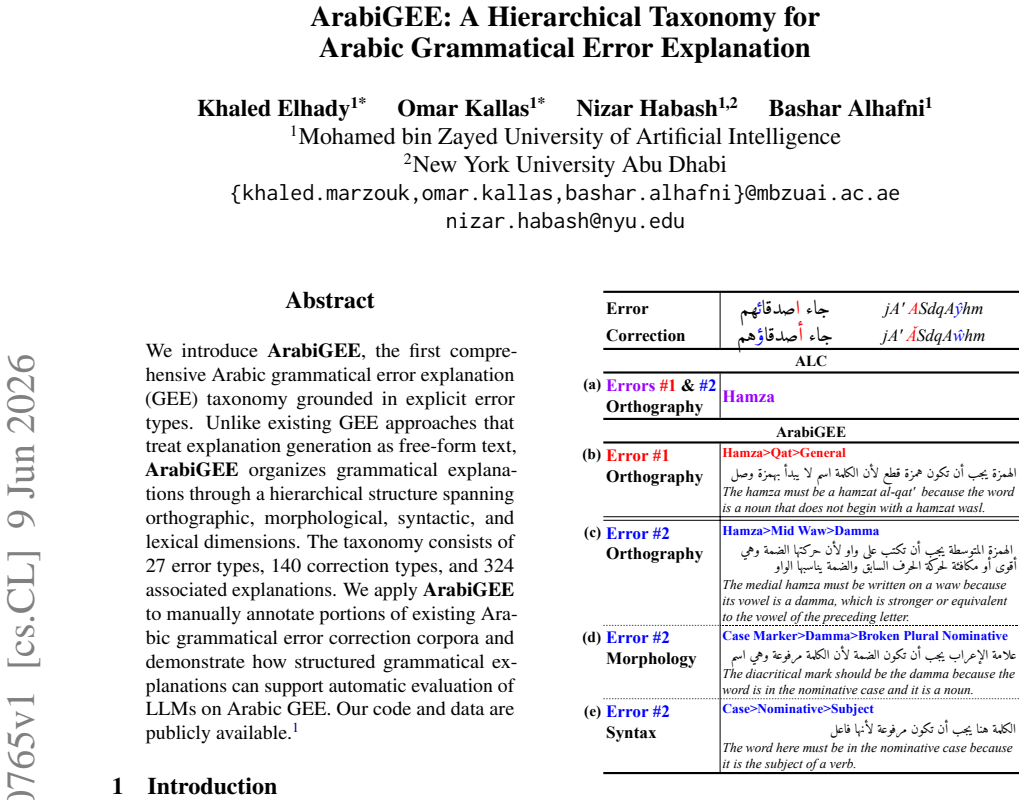
We introduce ArabiGEE, the first comprehensive Arabic grammatical error explanation (GEE) taxonomy grounded in explicit error types. Unlike existing GEE approaches that treat explanation generation as free-form text, ArabiGEE organizes grammatical explanations through a hierarchical structure spanning orthographic, morphological, syntactic, and lexical dimensions. The taxonomy consists of 27 error types, 140 correction types, and 324 associated explanations. We apply ArabiGEE to manually annotate portions of existing Arabic grammatical error correction corpora and demonstrate how structured grammatical explanations can support automatic evaluation of LLMs on Arabic GEE.
What carries the argument
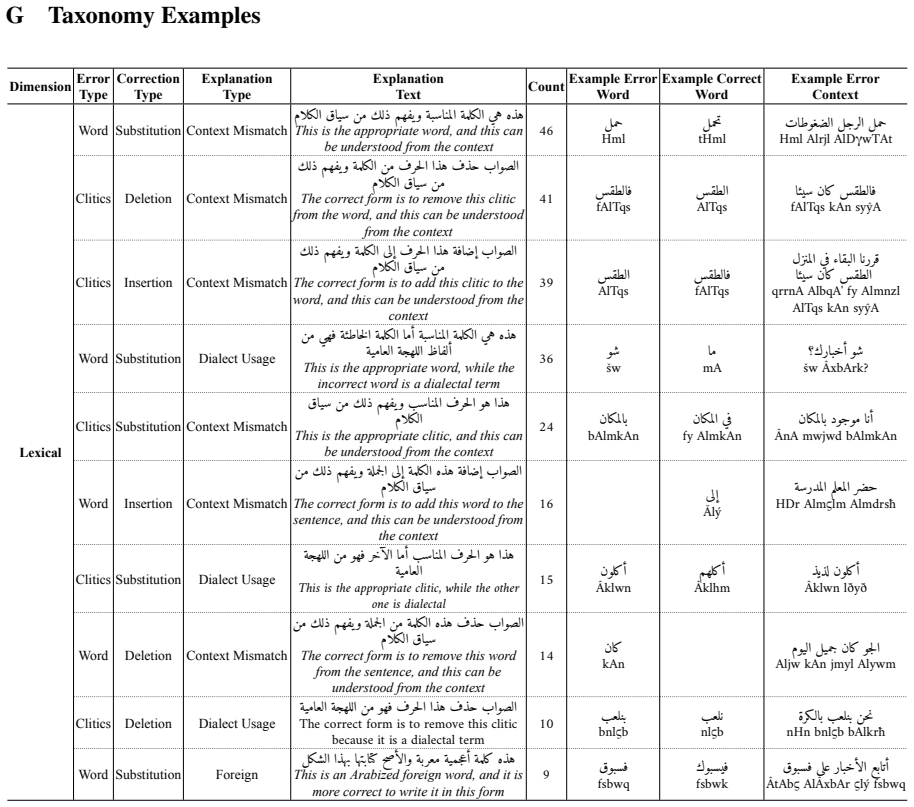
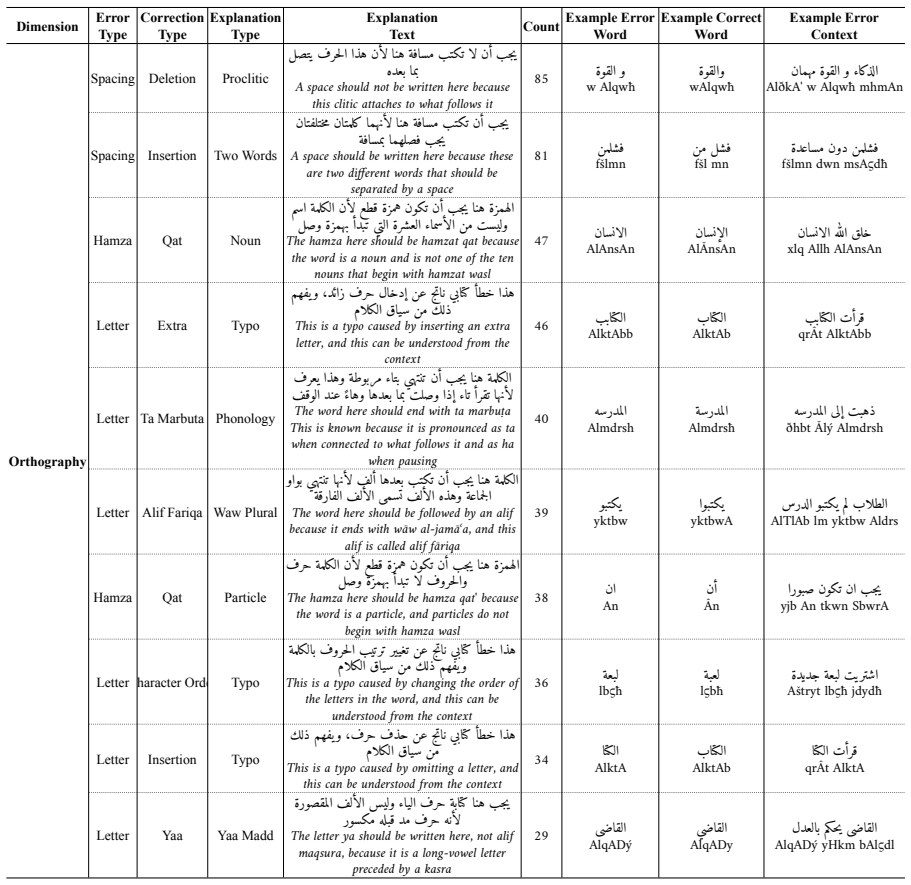
The ArabiGEE taxonomy: a four-dimension hierarchy that maps each of 27 error types to 140 correction types and 324 fixed explanations.
If this is right
- Structured labels allow automatic scoring of LLM-generated Arabic GEE outputs without relying on free-form text comparison.
- The taxonomy supplies a shared vocabulary that can be applied consistently across different Arabic GEC datasets.
- Explanations become comparable across systems because each error is tied to one of 324 predefined explanation strings.
- The hierarchy supports fine-grained analysis by letting researchers examine performance separately at the orthographic, morphological, syntactic, or lexical level.
Where Pith is reading between the lines
- The same hierarchical approach could be tested on other morphologically rich languages to see whether 27 error types remain sufficient.
- If the taxonomy proves stable, it could be embedded directly into learner-facing tools so that every correction is accompanied by one of the 324 explanations.
- Future annotation projects could measure whether the explicit hierarchy reduces the time needed to produce usable labels compared with open-ended explanation writing.
Load-bearing premise
That manually labeling existing Arabic error-correction data with the new taxonomy produces reliable labels that support automatic evaluation.
What would settle it
An experiment in which multiple independent annotators apply the taxonomy to the same set of sentences and obtain low agreement on error type or explanation labels.
Figures



read the original abstract
We introduce ArabiGEE, the first comprehensive Arabic grammatical error explanation (GEE) taxonomy grounded in explicit error types. Unlike existing GEE approaches that treat explanation generation as free-form text, ArabiGEE organizes grammatical explanations through a hierarchical structure spanning orthographic, morphological, syntactic, and lexical dimensions. The taxonomy consists of 27 error types, 140 correction types, and 324 associated explanations. We apply ArabiGEE to manually annotate portions of existing Arabic grammatical error correction corpora and demonstrate how structured grammatical explanations can support automatic evaluation of LLMs on Arabic GEE. Our code and data are publicly available.
Editorial analysis
A structured set of objections, weighed in public.
Referee Report
Summary. The paper introduces ArabiGEE, the first comprehensive hierarchical taxonomy for Arabic grammatical error explanation (GEE) spanning orthographic, morphological, syntactic, and lexical dimensions. It consists of 27 error types, 140 correction types, and 324 explanations. The taxonomy is applied to manually annotate portions of existing Arabic GEC corpora, and the structured explanations are used to demonstrate support for automatic evaluation of LLMs on Arabic GEE tasks, with code and data released publicly.
Significance. If the taxonomy construction and annotations prove reliable, this would represent a meaningful advance in Arabic NLP by shifting GEE from free-form text to a structured, hierarchical framework that enables more precise and reproducible LLM assessment. The public release of code and data is a clear strength supporting reproducibility.
major comments (2)
- [Annotation process] Annotation process: The manuscript describes manual annotation of existing Arabic GEC corpora with the 27/140/324 taxonomy but reports no inter-annotator agreement statistics, no double-annotation subset size, and no external validation (e.g., expert review or comparison to prior Arabic GEC categorizations). This directly undermines the reliability of the labels used to support the downstream claim of enabling automatic LLM evaluation.
- [Taxonomy construction] Taxonomy development: Limited details are provided on the methodology for constructing the hierarchical taxonomy, including how the specific counts of 27 error types, 140 correction types, and 324 explanations were derived or validated against linguistic criteria.
minor comments (1)
- [Abstract] The abstract and introduction could specify the exact Arabic GEC corpora used and the volume of annotated data to allow better assessment of representativeness.
Simulated Author's Rebuttal
We thank the referee for the constructive feedback on ArabiGEE. The comments correctly identify areas where additional methodological transparency is needed. We address each point below and will revise the manuscript to incorporate the requested details.
read point-by-point responses
-
Referee: [Annotation process] Annotation process: The manuscript describes manual annotation of existing Arabic GEC corpora with the 27/140/324 taxonomy but reports no inter-annotator agreement statistics, no double-annotation subset size, and no external validation (e.g., expert review or comparison to prior Arabic GEC categorizations). This directly undermines the reliability of the labels used to support the downstream claim of enabling automatic LLM evaluation.
Authors: We agree that the current manuscript lacks inter-annotator agreement (IAA) statistics and details on double annotation or external validation. The annotations were carried out by the authors using the taxonomy guidelines, but no multi-annotator subset was created at the time. In the revised manuscript we will add a new subsection on the annotation protocol that specifies the exact procedure, annotator background, and any overlap performed. We will also report IAA on a newly double-annotated sample of at least 200 sentences and include a comparison of our categories against prior Arabic GEC error taxonomies from the literature. revision: yes
-
Referee: [Taxonomy construction] Taxonomy development: Limited details are provided on the methodology for constructing the hierarchical taxonomy, including how the specific counts of 27 error types, 140 correction types, and 324 explanations were derived or validated against linguistic criteria.
Authors: We acknowledge that the manuscript provides only high-level information on taxonomy construction. The hierarchy was built iteratively by analyzing attested Arabic grammatical errors drawn from linguistic references and existing GEC corpora, then organizing them along the four dimensions with explicit correction and explanation slots. In the revision we will expand the taxonomy section with a step-by-step account of the derivation process, the linguistic sources consulted for validation, and the rationale for arriving at the final counts of 27 error types, 140 correction types, and 324 explanations. revision: yes
Circularity Check
No circularity: taxonomy is newly constructed and applied
full rationale
The paper defines a new hierarchical taxonomy (27 error types, 140 correction types, 324 explanations) spanning orthographic/morphological/syntactic/lexical dimensions and manually annotates existing GEC corpora with it to support LLM evaluation. No equations, fitted parameters, predictions, or self-citations appear in the derivation chain. The central claims rest on explicit construction and annotation rather than any reduction to prior inputs by definition or self-reference. This matches the default expectation of no significant circularity for a taxonomy paper.
Axiom & Free-Parameter Ledger
axioms (2)
- domain assumption Arabic grammatical errors are best organized along orthographic, morphological, syntactic, and lexical dimensions.
- domain assumption A hierarchical taxonomy with explicit error types improves automatic evaluation of LLMs on GEE compared to free-form explanations.
Reference graph
Works this paper leans on
-
[1]
Error annotation of the Arabic learner corpus. In Language Processing and Knowledge in the Web, pages 14–22. Springer. Bashar Alhafni and Nizar Habash. 2025. Enhancing text editing for grammatical error correction: Arabic as a case study. In Proceedings of the 63rd Annual Meet- ing of the Association for Computational Linguistics (Volume 1: Long Papers), ...
work page internal anchor Pith review Pith/arXiv arXiv 2025
-
[2]
In Proceed- ings of the 55th Annual Meeting of the Association for Computational Linguistics (Volume 1: Long Papers), pages 793–805, Vancouver, Canada
Automatic annotation and evaluation of error types for grammatical error correction. In Proceed- ings of the 55th Annual Meeting of the Association for Computational Linguistics (Volume 1: Long Papers), pages 793–805, Vancouver, Canada. Association for Computational Linguistics. Christopher Bryant, Zheng Yuan, Muhammad Reza Qorib, Hannan Cao, Hwee Tou Ng,...
-
[3]
Computational Linguistics , 49(3):643–701
Grammatical error correction: A survey of the state of the art. Computational Linguistics , 49(3):643–701. Leshem Choshen, Dmitry Nikolaev, Yevgeni Berzak, and Omri Abend. 2020. Classifying syntactic errors in learner language. In Proceedings of the 24th Con- ference on Computational Natural Language Learn- ing, pages 97–107, Online. Association for Compu...
2020
-
[4]
Building a large annotated corpus of learner English: The NUS corpus of learner English. In Pro- ceedings of the Eighth Workshop on Innovative Use of NLP for Building Educational Applications, pages 22–31, Atlanta, Georgia. Association for Computa- tional Linguistics. DeepSeek-AI, Aixin Liu, Bei Feng, Bing Xue, Bingx- uan Wang, Bochao Wu, Chengda Lu, Chen...
work page internal anchor Pith review Pith/arXiv arXiv 2025
-
[5]
On Arabic Transliteration. In A. van den Bosch and A. Soudi, editors, Arabic Computational Morphology: Knowledge-based and Empirical Meth- ods, pages 15–22. Springer, Netherlands. Nizar Y Habash. 2010. Introduction to Arabic natural language processing, volume 3. Morgan & Claypool Publishers. Albert Q. Jiang, Alexandre Sablayrolles, Arthur Men- sch, Chris...
work page internal anchor Pith review Pith/arXiv arXiv 2010
-
[6]
Behrang Mohit, Alla Rozovskaya, Nizar Habash, Wa- jdi Zaghouani, and Ossama Obeid
How ready are generative pre-trained large language models for explaining bengali grammatical errors? Preprint, arXiv:2406.00039. Behrang Mohit, Alla Rozovskaya, Nizar Habash, Wa- jdi Zaghouani, and Ossama Obeid. 2014. The first QALB shared task on automatic text correction for Arabic. In Proceedings of the EMNLP 2014 Workshop on Arabic Natural Language P...
-
[7]
In Proceedings of the 14th International Conference on Natural Language Gen- eration, pages 320–324, Aberdeen, Scotland, UK
Shared task on feedback comment generation for language learners. In Proceedings of the 14th International Conference on Natural Language Gen- eration, pages 320–324, Aberdeen, Scotland, UK. Association for Computational Linguistics. Ryo Nagata, Kentaro Inui, and Shin’ichiro Ishikawa
-
[8]
In Proceedings of the Twelfth Lan- guage Resources and Evaluation Conference, pages 340–345, Marseille, France
Creating corpora for research in feedback com- ment generation. In Proceedings of the Twelfth Lan- guage Resources and Evaluation Conference, pages 340–345, Marseille, France. European Language Re- sources Association. Jakub Náplava, Milan Straka, Jana Straková, and Alexandr Rosen. 2022. Czech grammar error cor- rection with a large and diverse corpus. Tr...
2022
-
[9]
arXiv preprint arXiv:2308.16149 , year=
The second QALB shared task on automatic text correction for Arabic. In Proceedings of the Second Workshop on Arabic Natural Language Pro- cessing, pages 26–35, Beijing, China. Association for Computational Linguistics. Alla Rozovskaya and Dan Roth. 2019. Grammar error correction in morphologically rich languages: The case of Russian. Transactions of the ...
-
[10]
tier": "orth
A new dataset and method for automatically grading ESOL texts. In Proceedings of the 49th Annual Meeting of the Association for Computational Linguistics: Human Language Technologies, pages 180–189, Portland, Oregon, USA. Association for Computational Linguistics. Jingheng Ye, Shang Qin, Yinghui Li, Xuxin Cheng, Libo Qin, Hai-Tao Zheng, Ying Shen, Peng Xi...
2025
-
[11]
Annotate every input aligned pair exactly once, and preserve each `alignment_id` exactly as given
-
[12]
If one pair contains multiple distinct errors, return multiple error objects for that pair
Be exhaustive. If one pair contains multiple distinct errors, return multiple error objects for that pair
-
[13]
One error may need several tiers, but do not force all tiers and do not omit an applicable tier
For each distinct error, inspect all four tiers and include every tier that truly explains that error. One error may need several tiers, but do not force all tiers and do not omit an applicable tier
-
[14]
Use a broad explanation or a generic letter-change explanation only if no more specific rule fits
Inside each relevant tier, choose the most specific explanation from the most relevant category. Use a broad explanation or a generic letter-change explanation only if no more specific rule fits
-
[15]
Select at most one explanation per tier for the same distinct error
-
[16]
Do not combine explanations whose values conflict with each other or with the correction
Respect chaining constraints: `morpho_orthographic` and `morpho_syntactic` are compatibility constraints, not output fields. Do not combine explanations whose values conflict with each other or with the correction
-
[17]
Use only the allowed tier names `lexical`, `orth`, `morph`, `synt`, and only codes that appear in the provided tier taxonomies
-
[18]
annotations
Do not output explanation text, examples, categories, linking fields, or any extra commentary. Output Format { "annotations": [ { "alignment_id": 4, "errors": [ { "explanations": [ {"tier": "morph", "code": "ex42"}, {"tier": "synt", "code": "ex34"} ] }, { "explanations": [ {"tier": "orth", "code": "ex35"} ] } ] } ] } D Matching Algorithm When a single sou...
2014
discussion (0)
Sign in with ORCID, Apple, or X to comment. Anyone can read and Pith papers without signing in.