REVIEW 3 major objections 4 minor 45 references
Efficient Resource Allocation for Mobile-Edge Computing Networks with NOMA: Completion Time and Energy Minimization
T0 review · 3 major / 4 minor · reviewed 2026-08-14 · deepseek-v4-flash
Pith's one-line read The paper claims that a nonconvex NOMA mobile-edge-computing resource-allocation problem can be reformulated exactly and solved by low-complexity alternating optimization, with optimal solutions for two important special cases.
desk verdict The multi-group NOMA-MEC model is a real extension and the completion-time result is clean, but the central Lemma 1 equivalence fails when power caps bind, and the general and infinite-cloud algorithms inherit that break. read the letter →
The pith
A machine-rendered reading of the paper's core claim, the machinery that carries it, and where it could break.
The reading
What carries the argument
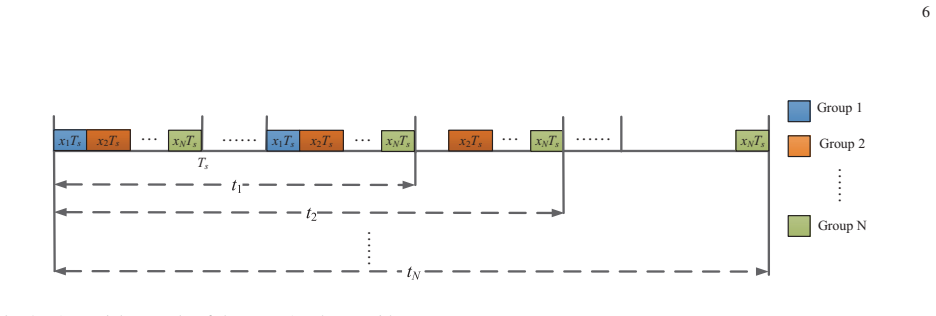
The load-bearing mechanism is the substitution $\tau_i = x_i t_i$ together with the cumulative sum-rate reformulation $B\tau_i \log_2\left(1 + \frac{\sum_{l=j}^{M_i} p_{il} h_{il}}{\sigma^2 B}\right) \ge \sum_{l=j}^{M_i} d_{il}$. This substitution separates the time-sharing variable $x_i$ from the transmission duration $t_i$ and makes the rate constraints convex in the power variables and in the new rate variables. The second central mechanism is a recursive power formula, equation (22), that for fixed data and time computes the minimum per-group transmit time needed to respect each user's maximum power; it turns the completion-time feasibility problem into the convex set (20) with closed-form feasibility checks. The third is the perspective function from convex analysis, which converts the infinite-capacity problem into a convex one. These mechanisms together carry the proof that the hard-looking nonconvex problems become solvable.
What would settle it
Take a small network with two users in one group, set their maximum powers just barely high enough to meet the data-rate constraints, and compare the optimum of the original nonconvex Problem (10), found by exhaustive grid search, with the solution produced by the proposed iterative method on the reformulated Problem (11). If the reformulated solution has a strictly lower completion time or energy than anything feasible in Problem (10), the claimed equivalence has failed.
Extended reading notes
Core claim
On the paper's own terms, the discovery is that the joint optimization of how much data each user offloads, how long each group transmits, how the edge's CPU capacity is split, and what power each user uses can be reorganized into a tractable form. The key step (Lemma 1) replaces the variable pair of transmit time and time-sharing fraction by a product variable, $\tau_i = x_i t_i$, and replaces individual data-rate equality constraints by cumulative-rate inequalities; the paper proves that at an optimum these inequalities are active, so the reformulation loses nothing. The resulting Problem (11) is then solved by alternating between two convex blocks: allocating $\boldsymbol{\tau}, \mathbf{f}, T$ with data and powers fixed, and allocating data, time-sharing, and powers with $\boldsymbol{\tau}, \mathbf{f}, T$ fixed. For completion-time-only minimization the paper derives an equivalent convex feasibility set and two closed-form feasibility conditions, making the bisection search optimal. For infinite edge-cloud capacity, a perspective-function transformation turns the whole problem into a convex problem whose global optimum can be obtained by standard dual methods.
Load-bearing premise
The equivalence proof assumes each user has enough spare transmit power that, when one message's power is reduced to keep a rate constraint tight, the earlier (stronger) user in the decoding order can compensate by raising its power; if that headroom is absent, the reformulated problem may not be equivalent to the original.
Editorial extensions
If this is right
- For the completion-time-only case, the optimal minimum time can be found by bisection over $T$, checking only two closed-form feasibility conditions rather than solving the full nonconvex problem.
- With an infinite-capacity edge cloud, the global optimum of the weighted time-energy objective is computable by convex optimization, and at that optimum all available transmission time is used because longer transmission lowers required power and energy.
- In the general finite-capacity case, the proposed alternating algorithm converges because each block update is optimal and the objective is bounded below, with per-step closed-form or dual solutions whose complexity grows linearly with the number of users.
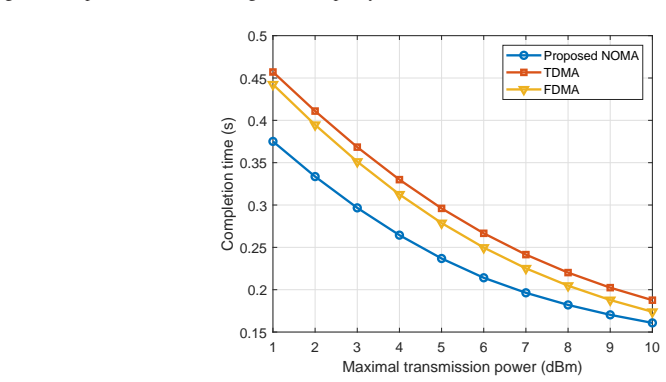
- NOMA outperforms TDMA and FDMA in the reported numerical regime, with the largest gains at high edge-cloud capacity and low maximal transmit power.
- The BS can run the algorithms centrally with overhead growing linearly in the number of users, making the scheme implementable as users join or leave.
Reading between the lines
- Inference: The equivalence proof leans on a power-headroom assumption; a testable extension is exhaustive search on small instances with tight power caps to check whether the reformulation ever understates the true optimum.
- Inference: The closed-form feasibility conditions (23) and (24) could be reused as a fast admission or scheduling test for dynamic edge networks, independently of the full optimization.
- Inference: The principle that transmitting with maximal time saves energy suggests that the energy-delay tradeoff frontier is governed by the product of time and power, so other schedulers for NOMA-MEC should exhibit the same decreasing energy-versus-time shape.
- Inference: The numerical finding that strong-strong pairing works best among the compared methods, while one big group is best when decoding complexity is ignored, points toward joint user-grouping-and-resource-allocation design as a natural next step.
Signed reviews
Editorial analysis
A structured set of objections, weighed in public.
Referee Report
Summary. The paper considers an uplink NOMA-based mobile-edge computing network in which users are partitioned into groups that share time via TDMA, and within each group users transmit simultaneously using NOMA with SIC at the base station. The objective is to minimize a weighted sum of the completion time and the total energy consumption, including offloading transmission energy and local computation energy, subject to local latency, offloading rate, time-sharing, power, and edge-cloud capacity constraints. The main contributions are: (i) a transformation of the nonconvex problem into a supposedly equivalent relaxed form and an iterative algorithm with closed-form per-step solutions; (ii) a bisection algorithm that is claimed to find the optimal completion time for the special case with only completion-time minimization (omega=1); and (iii) a proof that for infinite edge-cloud capacity the problem is equivalent to a convex problem whose global optimum can be found. Numerical results compare the proposed scheme with TDMA, FDMA, and exhaustive-search variants under two-user-per-group NOMA.
Significance. If the central equivalence were valid, the paper would provide a useful and fairly general resource-allocation framework for multi-group NOMA-based MEC, with the attractive feature of closed-form updates in the iterative algorithm and global optimality guarantees in two special cases. The derivations in Lemmas 4 and 6, the perspective-function convexity argument in Appendix G, and the bisection feasibility conditions are largely sound and are presented carefully. However, the load-bearing equivalence in Lemma 1 is not correct under binding maximal-power constraints, and both the general iterative algorithm and the infinite-cloud convex equivalence depend on it. The special-case results for omega=1 are built on the original formulation and appear to survive this issue, but the general claims and the infinite-cloud convex equivalence need substantial repair before the paper's headline conclusions are supported.
major comments (3)
- [Section III-A, Lemma 1 and Appendix A (Eqs. (10d), (11d))] The claimed equivalence of Problem (10) and Problem (11) is not established when maximal-power constraints bind. The proof lowers p_ij and, for j>1, raises p_{i(j-1)} by (h_ij/h_{i(j-1)})epsilon, but this operation requires p_{i(j-1)} < P_{i(j-1)}; footnote 2 merely assumes the maximal power is large enough, while Lemma 1 is stated unconditionally. The failure is concrete: take one group with B = sigma^2 B = 1, h1 = h2 = 1, x1 = t1 = 1, d1 = log2(1.5), d2 = log2(2), P1 = 0.5, and P2 = 1.5. The original equalities (10d) force p2 = 1 and then p1 = 1, violating P1, so Problem (10) is infeasible. The relaxed inequalities (11d) are feasible with p1 = 0.5 and p2 = 1.5. Thus Problem (11) is a strict relaxation rather than an equivalent problem in the power-limited regime. Since Algorithm 1 solves Problem (11)/(17) and reconstructs t_i = tau_i/x_i only after optimization, the output can violate the original equality constraints (10d).
- [Section III-C, Theorem 2 and Appendix G] The convex equivalence for infinite edge-cloud capacity inherits the unsupported equivalence of Lemma 1. Theorem 2 is proved by starting from Problem (11), replacing p_ij with q_ij = tau_i p_ij, and dropping the individual constraints tau_i <= T x_i in favor of sum_i tau_i <= T. If Problem (11) is a strict relaxation of Problem (10) under power caps, then an optimal point of the convex problem (25) need not correspond to a feasible point of the original Problem (10). Therefore the assertion that solving Problem (25) yields the global optimum of Problem (10) with F = infinity is not supported unless Lemma 1 is repaired or an independent proof of equivalence is supplied.
- [Algorithm 1 and Section III-A] Algorithm 1 requires an initial feasible solution of Problem (10), but no procedure for obtaining one is given. In the power-limited regime where the strict-relaxation failure of Lemma 1 occurs, finding such a feasible starting point is nontrivial, and the monotone-convergence argument only applies if every iterate is feasible for Problem (10). The manuscript should either provide an initialization method, prove that a feasible point always exists under stated assumptions, or explicitly acknowledge that the algorithm is only defined when a feasible point is available.
minor comments (4)
- [Algorithm 2, step 3] The infeasible branch of the bisection update should read 'set Tmin = T', not 'set T = Tmin'; as written, the algorithm would not shrink the interval correctly.
- [Eq. (20d)] The constraint in the convex feasibility set is written as sum_{i=1}^N sum_{j=1}^2 f_ij <= F, but group i contains M_i users in the general model; the upper limit should be M_i unless the authors intend to restrict the setup to two users per group.
- [Appendix F] The appendix is titled 'Proof of Lemma 5', but it proves Lemma 6; the numbering should be corrected.
- [Throughout] There are several typographical errors, e.g., 'To concur the nonconvexity' should be 'To circumvent the nonconvexity', 'ther are some examples' should be 'there are some examples', and 'spacial case' should be 'special case'. These do not affect the technical content.
Circularity Check
No circularity: the optimization derivations follow from the stated model, and the conference-paper self-citation is not load-bearing; the Lemma 1 power-cap caveat is a correctness risk, not a circular step.
full rationale
The paper's derivation chain is self-contained. Problem (10) is transformed into Problem (11) by the explicit substitution tau_i = x_i t_i and by summing the rate equalities (10d); the claimed equivalence is then argued by a contradiction argument in Appendix A. This is a mathematical derivation from the stated model, not an input that is renamed as an output. The iterative Algorithm 1 alternates between solving two convex subproblems (13) and (17), and the convergence claim rests on monotonic nonincrease of the objective, not on fitting any parameter to a target result. The omega = 1 bisection Algorithm 2 is built directly on feasibility conditions (23)-(24) derived in Appendices E and F, and the infinite-cloud Theorem 2 uses a standard perspective-function convexity argument. The self-cited conference paper [35] appears only as a contrast in the introduction ('Different from our conference paper [35], this paper considers multiple users in different groups'), and no theorem, uniqueness claim, or ansatz is imported from it. The numerical comparisons against TDMA, FDMA, and exhaustive-search variants are external benchmarks and do not close a fit-to-prediction loop. One limitation should be flagged explicitly: Lemma 1's proof in Appendix A relies on footnote 2, 'It is assumed that the maximal transmit power of each user is large enough such that the power of user j - 1 can be increased'; if power caps bind, the claimed equivalence between Problems (10) and (11) may fail. That is a correctness and robustness concern, not circularity, because the assumption is not derived from the result it is used to prove. Overall, no circular step is present in the derivation chain.
Assumptions & free parameters
assumptions (5)
- domain assumption The BS has perfect information of uplink channels, local computation capabilities, power limits, and input data sizes; channels are block-fading.
- domain assumption User grouping into N groups is fixed in advance; grouping optimization is outside the paper's scope.
- ad hoc to paper Maximal transmit power is large enough to support the power-transfer argument in Lemma 1's proof.
- domain assumption Uplink rates follow Shannon capacity with perfect SIC, and downlink result transmission time is negligible.
- standard math The perspective operation preserves concavity for the rate functions in Theorem 2.
Cite this review
Pith. "Pith review of Efficient Resource Allocation for Mobile-Edge Computing Networks with NOMA: Completion Time and Energy Minimization." pith.science (2026). https://pith.science/paper/MO7V2SZ3
@misc{pith2026190804689,
  author       = {Pith},
  title        = {Pith review of: Efficient Resource Allocation for Mobile-Edge Computing Networks with NOMA: Completion Time and Energy Minimization},
  year         = {2026},
  howpublished = {\url{https://pith.science/paper/MO7V2SZ3}},
  note         = {Machine review of arXiv:1908.04689}
}
read the original abstract
This paper investigates an uplink non-orthogonal multiple access (NOMA)-based mobile-edge computing (MEC) network. Our objective is to minimize a linear combination of the completion time of all users' tasks and the total energy consumption of all users including transmission energy and local computation energy subject to computation latency, uploading data rate, time sharing and edge cloud capacity constraints. This work can significantly improve the energy efficiency and end-to-end delay of the applications in future wireless networks. For the general minimization problem, it is first transformed into an equivalent form. Then, an iterative algorithm is accordingly proposed, where closed-form solution is obtained in each step. For the special case with only minimizing the completion time, we propose a bisection-based algorithm to obtain the optimal solution. Also for the special case with infinite cloud capacity, we show that the original minimization problem can be transformed into an equivalent convex one. Numerical results show the superiority of the proposed algorithms compared with conventional algorithms in terms of completion time and energy consumption.
Figures


Figures from the paper (6 more)




Reference graph
Works this paper leans on
-
[1]
A sur vey on mobile edge computing: The communication perspective,
Y . Mao, C. Y ou, J. Zhang, K. Huang, and K. B. Letaief, “A sur vey on mobile edge computing: The communication perspective,” IEEE Commun. Surveys Tut. , vol. 19, no. 4, pp. 2322–2358, Fourthquarter 2017
work page 2017
-
[2]
A Vision of 6G Wireless Systems: Applications, Trends, Technologies, and Open Research Problems
W. Saad, M. Bennis, and M. Chen, “A vision of 6G wireless sy stems: Applications, trends, technologies, and open resea rch problems,” arXiv preprint arXiv:1902.10265 , 2019
work page Pith review arXiv 1902
-
[3]
A. Al-Shuwaili and O. Simeone, “Energy-efficient resour ce allocation for mobile edge computing-based augmented re ality applications,” IEEE Wireless Commun. Lett. , vol. 6, no. 3, pp. 398–401, June 2017
work page 2017
-
[4]
Q.-V . Pham, F. Fang, V . N. Ha, M. Le, Z. Ding, L. B. Le, and W. -J. Hwang, “A survey of multi-access edge computing in 5G and beyond: Fundamentals, technology integration, an d state-of-the-art,” arXiv preprint arXiv:1906.08452 , 2019
work page Pith review arXiv 1906
-
[5]
Efficient resource a llocation in mobile-edge computation offloading: Completi on time minimization,
H. Q. Le, H. Al-Shatri, and A. Klein, “Efficient resource a llocation in mobile-edge computation offloading: Completi on time minimization,” in Proc. IEEE Int. Symp. Inf. Theory , Aachen, Germany, June 2017, pp. 2513–2517
work page 2017
-
[6]
Energy-efficient resource allocation for mobile-edge computation offloadin g,
C. Y ou, K. Huang, H. Chae, and B. H. Kim, “Energy-efficient resource allocation for mobile-edge computation offloadin g,” IEEE Trans. Wireless Commun. , vol. 16, no. 3, pp. 1397–1411, Mar. 2017
work page 2017
-
[7]
Fair energ y-efficient scheduling in wireless powered full-duplex mobile-edge computing systems,
S. Mao, S. Leng, K. Yang, X. Huang, and Q. Zhao, “Fair energ y-efficient scheduling in wireless powered full-duplex mobile-edge computing systems,” in Proc. IEEE Global Commun. Conf. , Singapore, Dec. 2017, pp. 1–6
work page 2017
-
[8]
C. Wang, C. Liang, F. R. Y u, Q. Chen, and L. Tang, “Computat ion offloading and resource allocation in wireless cellular networks with mobile edge computing,” IEEE Trans. Wireless Commun. , vol. 16, no. 8, pp. 4924–4938, Aug. 2017
work page 2017
Show all 45 references
-
[9]
Computation offloadin g and resource allocation in mixed fog/cloud computing systems with min-max fairness guarantee,
J. Du, L. Zhao, J. Feng, and X. Chu, “Computation offloadin g and resource allocation in mixed fog/cloud computing systems with min-max fairness guarantee,” IEEE Trans. Commun. , vol. 66, no. 4, pp. 1594–1608, Apr. 2018
2018
-
[10]
Mult iobjective optimization for computation offloading in fog computing,
L. Liu, Z. Chang, X. Guo, S. Mao, and T. Ristaniemi, “Mult iobjective optimization for computation offloading in fog computing,” IEEE Internet Things J. , vol. 5, no. 1, pp. 283–294, Feb. 2018
2018
-
[11]
Multiuser resource allocation for mobile-edge computation offloading,
C. Y ou and K. Huang, “Multiuser resource allocation for mobile-edge computation offloading,” in Proc. IEEE Global Commun. Conf. , Washington, DC, USA, Dec. 2016, pp. 1–6
2016
-
[12]
Task offloading for mobile edge compu ting in software defined ultra-dense network,
M. Chen and Y . Hao, “Task offloading for mobile edge compu ting in software defined ultra-dense network,” IEEE J. Sel. Areas Commun. , vol. 36, no. 3, pp. 587–597, Mar. 2018
2018
-
[13]
Energy-optimal mobile cloud computing under stochastic wireless channel,
W. Zhang, Y . Wen, K. Guan, D. Kilper, H. Luo, and D. O. Wu, “ Energy-optimal mobile cloud computing under stochastic wireless channel,” IEEE Trans. Wireless Commun. , vol. 12, no. 9, pp. 4569–4581, Sept. 2013
2013
-
[14]
Exploiting non-causal CPU-state i nformation for energy-efficient mobile cooperative comput ing,
C. Y ou and K. Huang, “Exploiting non-causal CPU-state i nformation for energy-efficient mobile cooperative comput ing,” IEEE Trans. Wireless Commun. , vol. 17, no. 6, pp. 4104–4117, June 2018
2018
-
[15]
Ene rgy efficient task caching and offloading for mobile edge computing,
Y . Hao, M. Chen, L. Hu, M. S. Hossain, and A. Ghoneim, “Ene rgy efficient task caching and offloading for mobile edge computing,” IEEE Access , vol. 6, pp. 11 365–11 373, 2018
2018
-
[16]
Edge computing aware NOMA for 5G networks,
A. Kiani and N. Ansari, “Edge computing aware NOMA for 5G networks,” IEEE Internet Things J. , vol. 5, no. 2, pp. 1299–1306, Apr. 2018
2018
-
[17]
E nergy-efficient admission of delay-sensitive tasks for mob ile edge computing,
X. Lyu, H. Tian, W. Ni, Y . Zhang, P . Zhang, and R. P . Liu, “E nergy-efficient admission of delay-sensitive tasks for mob ile edge computing,” IEEE Trans. Commun. , vol. 66, no. 6, pp. 2603–2616, June 2018
2018
-
[18]
V aezi, Z
M. V aezi, Z. Ding, and H. V . Poor, Multiple Access Techniques for 5G Wireless Networks and Bey ond. Springer, 2018
2018
-
[19]
Interplay between NOMA and other emerging technologies: A survey,
M. V aezi, G. Amarasuriya, Y . Liu, A. Arafa, F. Fang, and Z . Ding, “Interplay between NOMA and other emerging technologies: A survey,” arXiv preprint arXiv:1903.10489 , 2019
1903 arXiv
-
[20]
A survey on non-orthogonal multiple ac cess for 5G networks: Research challenges and future trends,
Z. Ding, X. Lei, G. K. Karagiannidis, R. Schober, J. Y uan , and V . K. Bhargava, “A survey on non-orthogonal multiple ac cess for 5G networks: Research challenges and future trends,” IEEE J. Sel. Areas Commun. , vol. 35, no. 10, pp. 2181–2195, Oct. 2017. 29
2017
-
[21]
On the optimal ity of power allocation for NOMA downlinks with individual QoS constraints,
Z. Yang, W. Xu, C. Pan, Y . Pan, and M. Chen, “On the optimal ity of power allocation for NOMA downlinks with individual QoS constraints,” IEEE Commun. Lett. , vol. 21, no. 7, pp. 1649–1652, July 2017
2017
-
[22]
Non- orthogonal multiple access for 5G: Solutions, challenges, opportunities, and future research trends,
L. Dai, B. Wang, Y . Y uan, S. Han, C. l. I, and Z. Wang, “Non- orthogonal multiple access for 5G: Solutions, challenges, opportunities, and future research trends,” IEEE Commun. Mag. , vol. 53, no. 9, pp. 74–81, Sept. 2015
2015
-
[23]
User assoc iation in non-orthogonal multiple access networks,
K. Wang, Y . Liu, Z. Ding, and A. Nallanathan, “User assoc iation in non-orthogonal multiple access networks,” in Proc. IEEE Int. Conf. Commun. , Kansas City, MO, USA, May 2018, pp. 1–6
2018
-
[24]
Cooperative non-orthogonal layered multicast multipl e access for heterogeneous networks,
L. Yang, Q. Ni, L. Lv, J. Chen, X. Xue, H. Zhang, and H. Jian g, “Cooperative non-orthogonal layered multicast multipl e access for heterogeneous networks,” IEEE Trans. Commun. , 2018
2018
-
[25]
Energy efficient NOMA-based mobile edge computing offloading,
Y . Pan, M. Chen, Z. Yang, N. Huang, and M. Shikh-Bahaei, “ Energy efficient NOMA-based mobile edge computing offloading,” IEEE Commun. Lett. , vol. 23, no. 2, pp. 310–313, Feb. 2019
2019
-
[26]
Resource allocation in NOMA-based fog radio access networks,
H. Zhang, Y . Qiu, K. Long, G. K. Karagiannidis, X. Wang, a nd A. Nallanathan, “Resource allocation in NOMA-based fog radio access networks,” IEEE Wireless Commun. , vol. 25, no. 3, pp. 110–115, June 2018
2018
-
[27]
Message-aware uplink tran smit power level partitioning for non-orthogonal multiple access (NOMA),
T. Park, G. Lee, and W. Saad, “Message-aware uplink tran smit power level partitioning for non-orthogonal multiple access (NOMA),” in Proc. IEEE Global Commun. Conf. , Abu Dhabi, UAE, Dec. 2018, pp. 1–6
2018
-
[28]
Power control for multi-cell networks with non-orthogonal multiple access,
Z. Yang, C. Pan, W. Xu, Y . Pan, M. Chen, and M. Elkashlan, “ Power control for multi-cell networks with non-orthogonal multiple access,” IEEE Trans. Wireless Commun. , vol. 17, no. 2, pp. 927–942, Feb. 2018
2018
-
[29]
Joint time allo cation and power control in multicell networks with load coupling: Energy saving and rate improvement,
Z. Yang, C. Pan, W. Xu, H. Xu, and M. Chen, “Joint time allo cation and power control in multicell networks with load coupling: Energy saving and rate improvement,” IEEE Trans. V eh. Technol., vol. 66, no. 11, pp. 10 470–10 485, Nov. 2017
2017
-
[30]
Optimized multiuser comput ation offloading with multi-antenna NOMA,
F. Wang, J. Xu, and Z. Ding, “Optimized multiuser comput ation offloading with multi-antenna NOMA,” in Proc. IEEE Global Commun. Conf. W orkshops , Singapore, Dec. 2017, pp. 1–7
2017
-
[31]
Impact of non-orthogona l multiple access on the offloading of mobile edge computing,
Z. Ding, P . Fan, and H. V . Poor, “Impact of non-orthogona l multiple access on the offloading of mobile edge computing, ” IEEE Trans. Commun. , pp. 1–1, 2018
2018
-
[32]
Delay min imization for NOMA-MEC offloading,
Z. Ding, D. W. K. Ng, R. Schober, and H. V . Poor, “Delay min imization for NOMA-MEC offloading,” IEEE Signal Process. Lett. , vol. 25, no. 12, pp. 1875–1879, Dec. 2018
2018
-
[33]
Joint power and t ime allocation for NOMA-MEC offloading,
Z. Ding, J. Xu, O. A. Dobre, and V . Poor, “Joint power and t ime allocation for NOMA-MEC offloading,” IEEE Trans. V eh. Technol., pp. 1–1, 2019
2019
-
[34]
O n multiple users scheduling using superposition coding ove r rayleigh fading channels,
A. Zafar, M. Shaqfeh, M. S. Alouini, and H. Alnuweiri, “O n multiple users scheduling using superposition coding ove r rayleigh fading channels,” IEEE Commun. Lett. , vol. 17, no. 4, pp. 733–736, Apr. 2013
2013
-
[35]
Energy effic ient resource allocation for mobile-edge computation netw orks with NOMA,
Z. Yang, J. Hou, and M. S.-B. Shikh-Bahaei, “Energy effic ient resource allocation for mobile-edge computation netw orks with NOMA,” in Proc. IEEE Global Commun. Conf. W orkshops , Abu Dhabi, UAE, Dec. 2018
2018
-
[36]
Energy-e fficient resource allocation for downlink non-orthogonal multiple access network,
F. Fang, H. Zhang, J. Cheng, and V . C. M. Leung, “Energy-e fficient resource allocation for downlink non-orthogonal multiple access network,” IEEE Trans. Commun. , vol. 64, no. 9, pp. 3722–3732, Sep. 2016
2016
-
[37]
Impact of user pairing on 5G nonorthogonal multiple-access downlink transmissions ,
Z. Ding, P . Fan, and H. V . Poor, “Impact of user pairing on 5G nonorthogonal multiple-access downlink transmissions ,” IEEE Trans. V eh. Technol., vol. 65, no. 8, pp. 6010–6023, Aug. 2016
2016
-
[38]
EdgeIoT: Mobile edge computing fo r the internet of things,
X. Sun and N. Ansari, “EdgeIoT: Mobile edge computing fo r the internet of things,” IEEE Commun. Mag. , vol. 54, no. 12, pp. 22–29, Dec. 2016
2016
-
[39]
Multi-use r proportional fair scheduling for uplink non-orthogonal m ultiple access (NOMA),
X. Chen, A. Benjebbour, A. Li, and A. Harada, “Multi-use r proportional fair scheduling for uplink non-orthogonal m ultiple access (NOMA),” in Proc. IEEE V eh. Technol. Conf. Seoul, Korea, May. 2014, pp. 1–5
2014
-
[40]
On power and rate allocation for coded uplink N OMA in a multicarrier system,
J. Choi, “On power and rate allocation for coded uplink N OMA in a multicarrier system,” IEEE Trans. Commun. , vol. 66, no. 6, pp. 2762–2772, June 2018
2018
-
[41]
On user pairing in uplink NOMA,
M. A. Sedaghat and R. R. Mller, “On user pairing in uplink NOMA,” IEEE Trans. Wireless Commun. , vol. 17, no. 5, pp. 3474–3486, May 2018. 30
2018
-
[42]
Boyd and L
S. Boyd and L. V andenberghe, Convex Optimization. Cambridge University Press, 2004
2004
-
[43]
Outage cons trained robust transmit optimization for multiuser MISO downlinks: Tractable approximations by conic optimizatio n,
K. Wang, A. M. So, T. Chang, W. Ma, and C. Chi, “Outage cons trained robust transmit optimization for multiuser MISO downlinks: Tractable approximations by conic optimizatio n,” IEEE Trans. Signal Process. , vol. 62, no. 21, pp. 5690–5705, Nov. 2014
2014
-
[44]
Furthe r advancements for E-UTRA physical layer aspects, 3GPP TS 36 .814,
Access, Evolved Universal Terrestrial Radio, “Furthe r advancements for E-UTRA physical layer aspects, 3GPP TS 36 .814,” V9. 0.0 , Mar. 2010
2010
-
[45]
D. P . Bertsekas, Convex Optimization Theory . Athena Scientific Belmont, 2009
2009
Reviewed August 14, 2026 · model on record in the stance chip above.
Discussion (0). Continue with ORCID to comment.