REVIEW 4 major objections 4 minor 82 references
Boundary-enhanced time series data imputation with long-term dependency diffusion models
T0 review · 4 major / 4 minor · reviewed 2026-08-10 · deepseek-v4-flash
Pith's one-line read The paper proposes DSDI, a diffusion-based framework that imputes missing values in multivariate time series by injecting autoregressive forecasts into the reverse diffusion process with a decaying weight, and by replacing the…
desk verdict A workmanlike incremental diffusion-imputation paper whose central injection heuristic is plausible but unverified, with one hyperparameter explanation that is backwards. read the letter →
The pith
A machine-rendered reading of the paper's core claim, the machinery that carries it, and where it could break.
The reading
What carries the argument
The two load-bearing mechanisms are the weight-reducing injection (Eqs. 17-18) and the multi-scale TemS4-based U-Net. The injection rule $h(t-1)=1-N_0 e^{-\lambda(t-1)}$ sets a convex combination between the autoregressive prediction $z_{\mathrm{ar}}$ and the diffusion-generated value $\tilde{x}_{t-1}$; it encodes the paper's assumption that AR forecasts are more reliable early in reverse diffusion and less reliable later. TemS4 is a denoising U-Net in which structured state-space sequence (S4) layers are placed in blocks at several resolutions and connected by skip connections, letting the model integrate local and long-horizon information. The reverse update in Eq. (18) runs this combination for $T=100$ iterations and returns the final imputed sample $x_0$.
What would settle it
Take a dataset with held-out ground truth, run the reverse diffusion, and at each step $t$ compare the error of the autoregressive prediction $z_{\mathrm{ar}}$ with the error of the diffusion-generated values $\tilde{x}_{t-1}$ before injection. If the AR prediction is not consistently more accurate during early steps, or not consistently less accurate during late steps, then the monotonic exponential schedule in Eq. (17) is not justified. A simpler ablation replaces $h(t-1)$ with a constant or learned weight and checks whether final MAE or RMSE improves or degrades.
Extended reading notes
Core claim
On its own terms, the paper's discovery is that the boundary disharmony in diffusion imputation can be reduced by a deterministic mixing rule rather than by changing the training objective. A pretrained autoregressive model supplies an early estimate $z_{\mathrm{ar}}$ for the missing points; at each reverse step $t$, the update combines the diffusion-generated values for missing points with this estimate as $h(t-1)\,z_{\mathrm{ar}} + (1-h(t-1))\,\tilde{x}_{t-1}$, where $h(t-1)=1-N_0 e^{-\lambda(t-1)}$. The decreasing weight makes the autoregressive estimate dominant during the early noisy steps and lets the diffusion output take over as it sharpens, easing the transition between known and reconstructed regions. The paper further claims that replacing the convolutional U-Net with a multi-scale TemS4 U-Net improves the model's ability to exploit information beyond long blocks of consecutive missing points. Together these mechanisms are reported to outperform all compared baselines on the three tested datasets.
Load-bearing premise
The method assumes that an autoregressive forecast of the missing points is more accurate than the diffusion model's own generated values in the early reverse-diffusion steps and less accurate in the later steps, so that a monotonically decreasing injection weight always improves the output. If that accuracy crossover does not hold, the injection would push worse estimates into the reverse process.
Editorial extensions
If this is right
- On DACMI, ETT, and AQI, DSDI reports the lowest MAE and RMSE across all compared RNN-, VAE-, GAN-, and diffusion-based baselines for point, block, and simulated missing patterns.
- Ablation results indicate that the weight-reducing injection is the largest single contributor to the improvement, supporting the paper's diagnosis that boundary disharmony is a first-order error source.
- The multi-scale TemS4 U-Net improves accuracy over the base diffusion model and is especially relevant when missing values appear as long consecutive blocks.
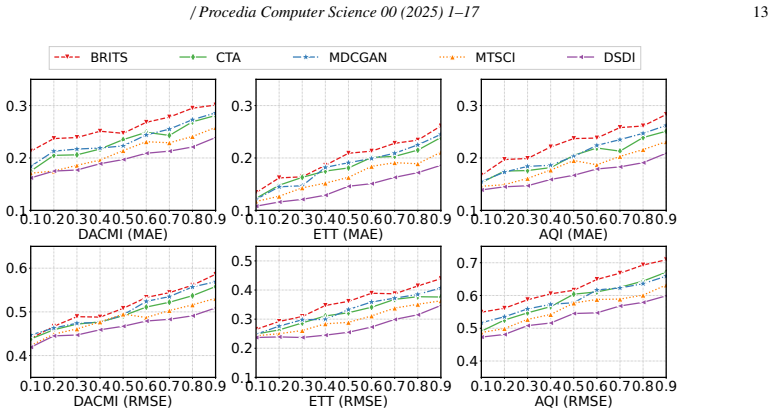
- As the missing rate rises from 10% to 90%, DSDI's error grows more slowly than the compared baselines BRITS, CTA, MDCGAN, and MTSCI.
- Because training still uses the standard DDPM noise-prediction objective, the method can be layered on existing diffusion imputation pipelines without changing how the denoiser is trained.
Reading between the lines
- Inference: the injection schedule is a plug-in component; any sufficiently accurate predictor, such as a linear, recurrent, or graph-based model, could replace the transformer-AR head, since only the early-versus-late accuracy ordering is assumed.
- Inference: the boundary-disharmony story predicts that DSDI's largest error reductions are concentrated at the edges of missing blocks; a boundary-localized error metric (for example, error on the first and last few points of each gap) would test that mechanism more directly than global MAE or RMSE.
- Inference: the exponential schedule has a single hyperparameter $\lambda$; a learned or confidence-weighted schedule could adapt the crossover point per dataset and may further improve imputation, especially if the AR-versus-diffusion accuracy ordering varies across channels.
Signed reviews
Editorial analysis
A structured set of objections, weighed in public.
Referee Report
Summary. The paper proposes DSDI, a diffusion-model-based framework for multivariate time series imputation. The architecture combines a conditional DDPM with (i) a weight-reducing injection strategy that blends estimates from a pretrained transformer-style autoregressive model into the reverse diffusion process with an exponentially decaying weight, and (ii) a multi-scale U-Net denoising backbone built on temporal S4 layers. The method is evaluated on DACMI, ETT, and AQI under point, block, and simulated missing patterns against 13 baselines, with reported MAE/RMSE improvements and ablations over the three design components.
Significance. If the reported results are reproducible, DSDI would offer a simple plug-in mechanism for improving diffusion-based time series imputation: guiding early reverse-step samples with an external predictive model and strengthening the backbone with S4 layers. The paper has useful strengths: it uses several public datasets, a broad baseline set, an ablation study, and a hyperparameter sensitivity analysis. However, the central mechanism of the injection schedule is supported only by a stated but unmeasured accuracy-crossover assumption, the AR training objective in Eq. (16) is inconsistent with its stated purpose, and the main results table is corrupted by repeated concatenated values. The empirical contribution is therefore not yet established at the level required for publication.
major comments (4)
- [§4.2, Eq. (17)] The entire weight-reducing injection mechanism rests on the assumption that AR predictions z_ar are more accurate than the diffusion-generated values in early reverse steps and less accurate later. This accuracy crossover is asserted but never measured. No experiment reports per-step MAE of z_ar versus the denoised estimate, and no ablation reverses the schedule or replaces it with a constant weight. If the crossover does not occur, Eq. (18) injects worse estimates into the reverse process and the reported gains would have to come from another unstated mechanism. Please add direct per-step error comparisons and ablations over schedule direction and constant-weight injection.
- [§4.2, Eq. (16)] The AR model is trained with L_ar = ||x0_known - z_ar||^2, which supervises the known positions only, yet the text says z_ar predicts the missing points that are injected in Eq. (18). As written, the model is not trained with any supervision on the positions it is meant to impute, which is a direct reproducibility problem. Please clarify whether the missing positions receive any supervision, or provide a corrected training objective that actually trains the injection estimates for their stated role.
- [Table 2, DSDI row] The main comparison table is not usable in its current form. The DSDI row contains concatenated repeated strings such as "0.162±0.0020.162±0.0020.162±0.002" instead of distinct entries, so the MAE/RMSE values and their mapping to the ten table columns cannot be recovered. Since the central claim is that DSDI outperforms all baselines, the table must be regenerated with one value per cell, and the number of independent runs behind each mean and standard deviation should be stated.
- [Algorithm 1 and §5.4] There are two correctness-related issues. First, Algorithm 1 computes x_{t-1}^{known} once before the reverse loop, although Eq. (19) depends on t through \bar{\alpha}_t; the pseudo-code should recompute or sample the noised known values at each iteration, or define them as a function of t used inside the loop. Second, the discussion of \lambda in §5.4 is inconsistent with Eq. (17): for fixed t, a larger \lambda makes h(t-1) closer to 1, and as t decreases the weight drops to 1-N0 more steeply, not more slowly. Please correct the explanation and also state explicitly whether \lambda is selected on a validation split or on the test set.
minor comments (4)
- [§4.2, Eq. (11)] The sampling distribution is written as z∼(0,I); it should be z∼N(0,I).
- [§2.2 and §4.2] The notation for \bar{\alpha}_t and \alpha_t is used inconsistently across Eqs. (5), (7), (10), and (19); please define both quantities once and use them consistently.
- [Figure 4] The ablation figure would be easier to read with explicit legends or labels indicating which metric (MAE or RMSE) is shown in each panel, since the current captions are minimal.
- [§5.2] The text says DSDI's performance under hybrid missing scenarios falls between point and block cases, but no hybrid results table or figure is actually shown; please add the missing numbers or remove the claim.
Circularity Check
No significant circularity: DSDI's imputation is a composition of independently trained components, and the only tuned element is a hyperparameter, not a fitted prediction.
full rationale
The derivation chain is self-contained. The imputation is produced by a conditional DDPM (Eqs. 8-11), an AR-based weight-reducing injection (Eqs. 12-18), and a TemS4-based U-Net (Eq. 20). No step defines the output in terms of the reported evaluation metric, and no reported MAE/RMSE is the training objective of the tested components. The AR model is trained on observed positions through Eq. 16, the diffusion denoiser is trained with the standard noise-prediction objective in Eq. 8, and the injection schedule in Eq. 17 depends only on the tuned hyperparameter lambda and the diffusion step, not on any fitted imputation result. The cited prior works by the authors [65, 66, 69] support general capability claims but are not load-bearing for the central derivation; the S4 backbone rests on external work [20]. The paper's genuine weaknesses, such as the unverified early-AR/late-diffusion accuracy ordering and the confusing lambda discussion in Sec. 5.4, are correctness and reproducibility concerns rather than circular reductions. No equation reduces to another by construction, and no fitted parameter is renamed as a prediction.
Assumptions & free parameters
free parameters (4)
- lambda (injection weight decay, Eq. 17) =
tuned per dataset; evaluated values 0.001, 0.003, 0.005, 0.007, 0.009 (Fig. 6)
- N0 (initial quantity in Eq. 17) =
not reported; implicitly 1
- Diffusion steps T =
100 (chosen from {10,50,100,150,200}, Fig. 5)
- AR model configuration (projection dim d, heads H, layers) =
not specified
assumptions (4)
- standard math DDPM forward/reverse process and Gaussian noise schedule (Eqs. 1-7).
- ad hoc to paper The AR model, trained on observed values, produces estimates of missing points that are more accurate than diffusion-generated values in early reverse steps (Eqs. 16-17).
- ad hoc to paper As reverse diffusion proceeds, generated values monotonically approach ground truth and become better than AR predictions (Section 4.2).
- domain assumption Long-range dependencies captured by S4 improve imputation for consecutive missing blocks (Section 4.3).
Cite this review
Pith. "Pith review of Boundary-enhanced time series data imputation with long-term dependency diffusion models." pith.science (2026). https://pith.science/paper/MOANBKB2
@misc{pith2026250106585,
  author       = {Pith},
  title        = {Pith review of: Boundary-enhanced time series data imputation with long-term dependency diffusion models},
  year         = {2026},
  howpublished = {\url{https://pith.science/paper/MOANBKB2}},
  note         = {Machine review of arXiv:2501.06585}
}
read the original abstract
Data imputation is crucial for addressing challenges posed by missing values in multivariate time series data across various fields, such as healthcare, traffic, and economics, and has garnered significant attention. Among various methods, diffusion model-based approaches show notable performance improvements. However, existing methods often cause disharmonious boundaries between missing and known regions and overlook long-range dependencies in missing data estimation, leading to suboptimal results. To address these issues, we propose a Diffusion-based time Series Data Imputation (DSDI) framework. We develop a weight-reducing injection strategy that incorporates the predicted values of missing points with reducing weights into the reverse diffusion process to mitigate boundary inconsistencies. Further, we introduce a multi-scale S4-based U-Net, which combines hierarchical information from different levels via multi-resolution integration to capture long-term dependencies. Experimental results demonstrate that our model outperforms existing imputation methods.
Figures


Figures from the paper (3 more)


Reference graph
Works this paper leans on
-
[1]
R. Wu, S. D. Hamshaw, L. Yang, D. W. Kincaid, R. Etheridge, A. Ghasemkhani, Data imputation for multivariate time series sensor data with large gaps of missing data, IEEE Sensors Journal 22 (11) (2022) 10671–10683
2022
-
[2]
Adhikari, W
D. Adhikari, W. Jiang, J. Zhan, Z. He, D. B. Rawat, U. Aickelin, H. A. Khorshidi, A comprehensive survey on imputation of missing data in internet of things, ACM Computing Surveys 55 (7) (2022) 1–38
2022
- [3]
-
[4]
X. Miao, Y . Wu, L. Chen, Y . Gao, J. Yin, An experimental survey of missing data imputation algorithms, IEEE Transactions on Knowledge and Data Engineering 35 (7) (2023) 6630–6650
work page 2023
-
[5]
J. Wu, Y . Tan, Z. Chen, M. Zhao, Decision based on big data research for non-small cell lung cancer in medical artificial system in developing country, Computer Methods and Programs in Biomedicine 159 (2018) 87–101
work page 2018
-
[6]
Y . Wang, X. Xu, L. Hu, J. Fan, M. Han, A time series continuous missing values imputation method based on generative adversarial networks, Knowledge-Based Systems 283 (2024) 111215
work page 2024
-
[7]
Q. M. et al., End-to-end incomplete time-series modeling from linear memory of latent variables, IEEE Transactions on Cyber- netics 50 (12) (2020) 4908–4920
work page 2020
- [8]
Show all 82 references
-
[9]
X. Chen, Z. He, L. Sun, A bayesian tensor decomposition approach for spatiotemporal tra ffic data imputation, Transportation research part C: emerging technologies 98 (2019) 73–84
2019
-
[10]
J. Wang, W. Du, W. Cao, K. Zhang, W. Wang, Y . Liang, Q. Wen, Deep learning for multivariate time series imputation: A survey, arXiv preprint arXiv:2402.04059 (2024) 1–9
2024 arXiv
-
[11]
W. Du, D. C ˆot´e, Y . Liu, Saits: Self-attention-based imputation for time series, Expert Systems with Applications 219 (2023) 119619
2023
-
[12]
R. Wu, A. Zhang, I. Ilyas, T. Rekatsinas, Attention-based learning for missing data imputation in holoclean, in: Proceedings of Machine Learning and Systems, 2020, pp. 307–325
2020
-
[13]
J. L. Alcaraz, N. Strodtho ff, Diffusion-based time series imputation and forecasting with structured state space models, Transac- tions on Machine Learning Research (2023) 1–36
2023
-
[14]
Tashiro, J
Y . Tashiro, J. Song, Y . Song, S. Ermon, Csdi: Conditional score-based diffusion models for probabilistic time series imputation, in: Advances in Neural Information Processing Systems, 2021, pp. 24804–24816
2021
-
[15]
L. Lin, Z. Li, R. Li, X. Li, J. Gao, Di ffusion models for time-series applications: a survey, Frontiers of Information Technology & Electronic Engineering 25 (2023) 19–41
2023
-
[16]
X. Wang, H. Zhang, P. Wang, Y . Zhang, B. Wang, Z. Zhou, Y . Wang, An observed value consistent diffusion model for imputing missing values in multivariate time series, in: Proceedings of the ACM SIGKDD Conference on Knowledge Discovery and Data Mining, 2023, pp. 2409–2418
2023
-
[17]
Lugmayr, M
A. Lugmayr, M. Danelljan, A. Romero, F. Yu, R. Timofte, L. Van Gool, Repaint: Inpainting using denoising diffusion probabilis- tic models, in: Proceedings of the IEEE/CVF Conference on Computer Vision and Pattern Recognition, 2022, pp. 11461–11471
2022
-
[18]
L. Shen, J. Kwok, Non-autoregressive conditional di ffusion models for time series prediction, in: International Conference on Machine Learning, 2023, pp. 31016–31029
2023
-
[19]
Ronneberger, P
O. Ronneberger, P. Fischer, T. Brox, U-net: Convolutional networks for biomedical image segmentation, in: Medical Image Computing and Computer-Assisted Intervention, 2015, pp. 234–241
2015
-
[20]
A. Gu, K. Goel, C. Re, Efficiently modeling long sequences with structured state spaces, in: International Conference on Learning Representations, 2022
2022
-
[21]
A. Gu, K. Goel, A. Gupta, C. R ´e, On the parameterization and initialization of diagonal state space models, in: Advances in Neural Information Processing Systems, 2022, pp. 35971–35983
2022
-
[22]
J. Ho, A. Jain, P. Abbeel, Denoising di ffusion probabilistic models, in: Advances in Neural Information Processing Systems, 2020, pp. 6840–6851
2020
-
[23]
M. M. Islam, G. Bertasius, Long movie clip classification with state-space video models, in: European Conference on Computer Vision, Springer, 2022, pp. 87–104
2022
-
[24]
Dhariwal, A
P. Dhariwal, A. Nichol, Di ffusion models beat gans on image synthesis, in: Advances in Neural Information Processing Systems, 2021, pp. 8780–8794
2021
-
[25]
J. Liu, P. Musialski, P. Wonka, J. Ye, Tensor completion for estimating missing values in visual data, IEEE transactions on pattern analysis and machine intelligence 35 (1) (2012) 208–220
2012
-
[26]
X. Chen, L. Sun, Low-rank autoregressive tensor completion for multivariate time series forecasting, arXiv preprint arXiv:2006.10436 (2020) 1–16
2020 arXiv
-
[27]
S. Fang, Q. Wen, Y . Luo, S. Zhe, L. Sun, Bayotide: Bayesian online multivariate time series imputation with functional decom- position, in: Forty-first International Conference on Machine Learning, 2024
2024
-
[28]
Obata, K
K. Obata, K. Kawabata, Y . Matsubara, Y . Sakurai, Mining of switching sparse networks for missing value imputation in multi- variate time series, in: Proceedings of the 30th ACM SIGKDD Conference on Knowledge Discovery and Data Mining, 2024, pp. 2296–2306
2024
-
[29]
Z. Han, J. Zhao, H. Leung, K. F. Ma, W. Wang, A review of deep learning models for time series prediction, IEEE Sensors Journal 21 (6) (2019) 7833–7848
2019
-
[30]
L. Fang, W. Xiang, Y . Zhou, J. Fang, L. Chi, Z. Ge, Dual-branch cross-dimensional self-attention-based imputation model for multivariate time series, Knowledge-Based Systems 279 (2023) 110896
2023
-
[31]
Z. Che, S. Purushotham, K. Cho, D. Sontag, Y . Liu, Recurrent neural networks for multivariate time series with missing values, Scientific Reports 8 (1) (2018) 6085. 16 / Procedia Computer Science 00 (2025) 1–17
2018
-
[32]
J. Yoon, W. R. Zame, M. van der Schaar, Estimating missing data in temporal data streams using multi-directional recurrent neural networks, IEEE Transactions on Biomedical Engineering 66 (5) (2018) 1477–1490
2018
-
[33]
W. Cao, D. Wang, J. Li, H. Zhou, L. Li, Y . Li, Brits: Bidirectional recurrent imputation for time series, in: Advances in Neural Information Processing Systems, 2018, pp. 6776–6786
2018
-
[34]
C. Ma, S. Tschiatschek, K. Palla, J. M. Hern ´andez-Lobato, S. Nowozin, C. Zhang, Eddi: E fficient dynamic discovery of high- value information with partial vae, in: International Conference on Machine Learning, 2019, pp. 4234–4243
2019
-
[35]
D. J. Rezende, S. Mohamed, D. Wierstra, Stochastic backpropagation and approximate inference in deep generative models, in: International Conference on Machine Learning, 2014, pp. 1278–1286
2014
-
[36]
Mattei, J
P.-A. Mattei, J. Frellsen, Leveraging the exact likelihood of deep latent variable models, in: Advances in Neural Information Processing Systems, 2018, pp. 3859–3870
2018
-
[37]
J. Li, R. Li, L. Xu, Multi-stage deep residual collaboration learning framework for complex spatial–temporal tra ffic data imputa- tion, Applied Soft Computing 147 (2023) 110814
2023
-
[38]
X. Kong, W. Zhou, G. Shen, W. Zhang, N. Liu, Y . Yang, Dynamic graph convolutional recurrent imputation network for spa- tiotemporal traffic missing data, Knowledge-Based Systems 261 (2023) 110188
2023
-
[39]
G. Shen, W. Zhou, W. Zhang, N. Liu, Z. Liu, X. Kong, Bidirectional spatial–temporal tra ffic data imputation via graph attention recurrent neural network, Neurocomputing 531 (2023) 151–162
2023
-
[40]
N. U. Okafor, D. T. Delaney, Missing data imputation on iot sensor networks: Implications for on-site sensor calibration, IEEE Sensors Journal 21 (20) (2021) 22833–22845
2021
-
[41]
C. Ma, W. Gong, J. M. Hern ´andez-Lobato, N. Koenigstein, S. Nowozin, C. Zhang, Partial vae for hybrid recommender system, in: NIPS Workshop on Bayesian Deep Learning, 2018
2018
-
[42]
Mattei and J
P.-A. Mattei and J. Frellsen, Miwae: Deep generative modelling and imputation of incomplete data sets, in: International Con- ference on Machine Learning, 2019, pp. 4413–4423
2019
-
[43]
Burda, R
Y . Burda, R. Grosse, R. Salakhutdinov, Importance weighted autoencoders, in: International Conference on Learning Represen- tations, 2016
2016
-
[44]
Nazabal, P
A. Nazabal, P. M. Olmos, Z. Ghahramani, I. Valera, Handling incomplete heterogeneous data using vaes, Pattern Recognition 107 (2020) 107501
2020
-
[45]
F. P. Casale, A. Dalca, L. Saglietti, J. Listgarten, N. Fusi, Gaussian process prior variational autoencoders, in: Advances in Neural Information Processing Systems, 2018, pp. 10390–10401
2018
-
[46]
M. Choi, C. Lee, Conditional information bottleneck approach for time series imputation, in: The Twelfth International Confer- ence on Learning Representations, 2024
2024
-
[47]
Z. Lai, D. Zhang, H. Li, D. Zhang, H. Lu, C. S. Jensen, Rectsi: Resource-efficient correlated time series imputation via decoupled pattern learning and completeness-aware attentions, in: Proceedings of the 30th ACM SIGKDD Conference on Knowledge Discovery and Data Mining, 2024...
2024
-
[48]
A. Cini, I. Marisca, C. Alippi, et al., Filling the g ap s: Multivariate time series imputation by graph neural networks, in: ICLR, 2022, pp. 1–20
2022
-
[49]
Marisca, A
I. Marisca, A. Cini, C. Alippi, Learning to reconstruct missing data from spatiotemporal graphs with sparse observations, in: Advances in Neural Information Processing Systems, 2022, pp. 32069–32082
2022
-
[50]
D. Wang, Y . Yan, R. Qiu, Y . Zhu, K. Guan, A. Margenot, H. Tong, Networked time series imputation via position-aware graph enhanced variational autoencoders, in: Proceedings of the 29th ACM SIGKDD Conference on Knowledge Discovery and Data Mining, 2023, pp. 2256–2268
2023
-
[51]
Y . Liu, R. Yu, S. Zheng, E. Zhan, Y . Yue, Naomi: Non-autoregressive multiresolution sequence imputation, in: Advances in Neural Information Processing Systems, 2019, pp. 11238–11248
2019
-
[52]
Y . Luo, X. Cai, Y . Zhang, J. Xu, et al., Multivariate time series imputation with generative adversarial networks, in: Advances in Neural Information Processing Systems, 2018, pp. 1603–1614
2018
-
[53]
Y . Luo, Y . Zhang, X. Cai, X. Yuan, E2gan: End-to-end generative adversarial network for multivariate time series imputation, in: Proceedings of the International Joint Conference on Artificial Intelligence, 2019, pp. 3094–3100
2019
-
[54]
T. W. Richardson, W. Wu, L. Lin, B. Xu, E. A. Bernal, Mcflow: Monte carlo flow models for data imputation, in: Proceedings of the IEEE/CVF Conference on Computer Vision and Pattern Recognition, 2020, pp. 14205–14214
2020
-
[55]
X. Miao, Y . Wu, J. Wang, Y . Gao, X. Mao, J. Yin, Generative semi-supervised learning for multivariate time series imputation, in: Proceedings of the AAAI Conference on Artificial Intelligence, 2021, pp. 8983–8991
2021
-
[56]
H. Qin, X. Zhan, Y . Li, X. Yang, Y . Zheng, Network-wide traffic states imputation using self-interested coalitional learning, in: Proceedings of the ACM SIGKDD Conference on Knowledge Discovery & Data Mining, 2021, pp. 1370–1378
2021
-
[57]
Liang, P
G. Liang, P. Tiwari, S. Nowaczyk, S. Byttner, Higher-order spatio-temporal physics-incorporated graph neural network for mul- tivariate time series imputation, in: Proceedings of the 33rd ACM International Conference on Information and Knowledge Management, 2024, pp. 1356–1366
2024
-
[58]
B. Yang, Y . Kang, Y . Yuan, X. Huang, H. Li, St-lbagan: Spatio-temporal learnable bidirectional attention generative adversarial networks for missing traffic data imputation, Knowledge-Based Systems 215 (2021) 106705
2021
-
[59]
J. Li, R. Li, L. Xu, J. Liu, Self-supervised generative adversarial learning with conditional cyclical constraints towards missing traffic data imputation, Knowledge-Based Systems 284 (2024) 111233
2024
-
[60]
S. W. Park, K. Lee, J. Kwon, Neural markov controlled sde: Stochastic optimization for continuous-time data, in: International Conference on Learning Representations, 2022
2022
-
[61]
Rasul, C
K. Rasul, C. Seward, I. Schuster, R. V ollgraf, Autoregressive denoising diffusion models for multivariate probabilistic time series forecasting, in: International Conference on Machine Learning, 2021, pp. 8857–8868
2021
-
[62]
Z. Kong, W. Ping, J. Huang, K. Zhao, B. Catanzaro, Di ffwave: A versatile diffusion model for audio synthesis, in: International Conference on Learning Representations, 2021. / Procedia Computer Science 00 (2025) 1–17 17
2025
-
[63]
M. Liu, H. Huang, H. Feng, L. Sun, B. Du, Y . Fu, Pristi: A conditional di ffusion framework for spatiotemporal imputation, in: IEEE International Conference on Data Engineering, 2023, pp. 1927–1939
2023
-
[64]
J. Xu, F. Lyu, P. C. Yuen, Density-aware temporal attentive step-wise di ffusion model for medical time series imputation, in: Proceedings of the ACM International Conference on Information and Knowledge Management, 2023, pp. 2836–2845
2023
-
[65]
C. Xiao, Y . Han, W. Yang, Y . Hou, F. Shi, K. Chetty, Diffusion-model-based contrastive learning for human activity recognition, IEEE Internet of Things Journal 11 (20) (2024) 33525–33536
2024
-
[66]
C. Xiao, S. Pang, X. Xu, X. Li, G. Trajcevski, F. Zhou, Counterfactual data augmentation with denoising di ffusion for graph anomaly detection, IEEE Transactions on Computational Social Systems
-
[67]
Y . Nie, N. H. Nguyen, P. Sinthong, J. Kalagnanam, A time series is worth 64 words: Long-term forecasting with transformers, in: International Conference on Learning Representations, 2023
2023
-
[68]
Zagoruyko, N
S. Zagoruyko, N. Komodakis, Wide residual networks, in: British Machine Vision Conference, 2016
2016
-
[69]
C. Xiao, Z. Gou, W. Tai, K. Zhang, F. Zhou, Imputation-based time-series anomaly detection with conditional weight-incremental diffusion models, in: Proceedings of the ACM SIGKDD Conference on Knowledge Discovery and Data Mining, 2023, pp. 2742– 2751
2023
-
[70]
Tsuchida, T
R. Tsuchida, T. Pearce, C. van der Heide, F. Roosta, M. Gallagher, Avoiding kernel fixed points: Computing with elu and gelu infinite networks, in: Proceedings of the AAAI Conference on Artificial Intelligence, 2021, pp. 9967–9977
2021
-
[71]
Luo, Evaluating the state of the art in missing data imputation for clinical data, Briefings in Bioinformatics 23 (1) (2022) bbab489
Y . Luo, Evaluating the state of the art in missing data imputation for clinical data, Briefings in Bioinformatics 23 (1) (2022) bbab489
2022
-
[72]
H. e. Zhou, Informer: Beyond e fficient transformer for long sequence time-series forecasting, in: Proceedings of the AAAI Conference on Artificial Intelligence, 2021, pp. 11106–11115
2021
-
[73]
Zhang, M
H. Zhang, M. Cisse, Y . N. Dauphin, D. Lopez-Paz, Mixup: Beyond empirical risk minimization, in: International Conference on Learning Representations, 2018
2018
-
[74]
A. E. Johnson, T. J. Pollard, L. Shen, L.-w. H. Lehman, M. Feng, M. Ghassemi, B. Moody, P. Szolovits, L. Anthony Celi, R. G. Mark, Mimic-iii, a freely accessible critical care database, Scientific data 3 (1) (2016) 1–9
2016
-
[75]
Fortuin, D
V . Fortuin, D. Baranchuk, G. R¨atsch, S. Mandt, Gp-vae: Deep probabilistic time series imputation, in: International Conference on Artificial Intelligence and Statistics, 2020, pp. 1651–1661
2020
-
[76]
Y . Li, X. Lu, Y . Wang, D. Dou, Generative time series forecasting with diffusion, denoise, and disentanglement, in: Advances in Neural Information Processing Systems, 2022, pp. 23009–23022
2022
-
[77]
H. Wi, Y . Shin, N. Park, Continuous-time autoencoders for regular and irregular time series imputation, in: Proceedings of the 17th ACM International Conference on Web Search and Data Mining, 2024, pp. 826–835
2024
-
[78]
Y . Wang, D. Li, X. Li, M. Yang, Pc-gain: Pseudo-label conditional generative adversarial imputation networks for incomplete data, Neural Networks 141 (2021) 395–403
2021
-
[79]
L. Li, Y . Wang, H. Wang, S. Hu, T. Wei, An efficient architecture for imputing distributed datasets of iot networks, IEEE Internet of Things Journal 10 (2023) 15100–15114
2023
-
[80]
J. Zhou, J. Li, G. Zheng, X. Wang, C. Zhou, Mtsci: A conditional di ffusion model for multivariate time series consistent im- putation, in: Proceedings of the 33rd ACM International Conference on Information and Knowledge Management, 2024, pp. 3474–3483
2024
-
[81]
D. P. Kingma, J. Ba, Adam: A method for stochastic optimization, in: International Conference on Learning Representations, 2015
2015
-
[82]
X. Yi, Y . Zheng, J. Zhang, T. Li, St-mvl: filling missing values in geo-sensory time series data, in: Proceedings of the Twenty- Fifth International Joint Conference on Artificial Intelligence, 2016, pp. 2704–2710
2016
Reviewed August 10, 2026 · model on record in the stance chip above.
Discussion (0). Continue with ORCID to comment.