REVIEW 2 major objections 4 minor 14 references
Excited states of the odd-odd nucleus 158Eu from the (d,alpha) reaction
T0 review · 2 major / 4 minor · reviewed 2026-08-14 · deepseek-v4-flash
Pith's one-line read The 160Gd(d,α)158Eu reaction assigns 58 excited states in 158Eu up to about 1.6 MeV, and the thirteen levels below 0.35 MeV place the nucleus on the falling level-density trend of the odd-odd europium isotopes.
desk verdict Solid new spectroscopy for an odd-odd Eu nucleus; the trend claim is plausible but leans on an argued, not demonstrated, completeness of the low-energy level count. read the letter →
The pith
A machine-rendered reading of the paper's core claim, the machinery that carries it, and where it could break.
The reading
What carries the argument
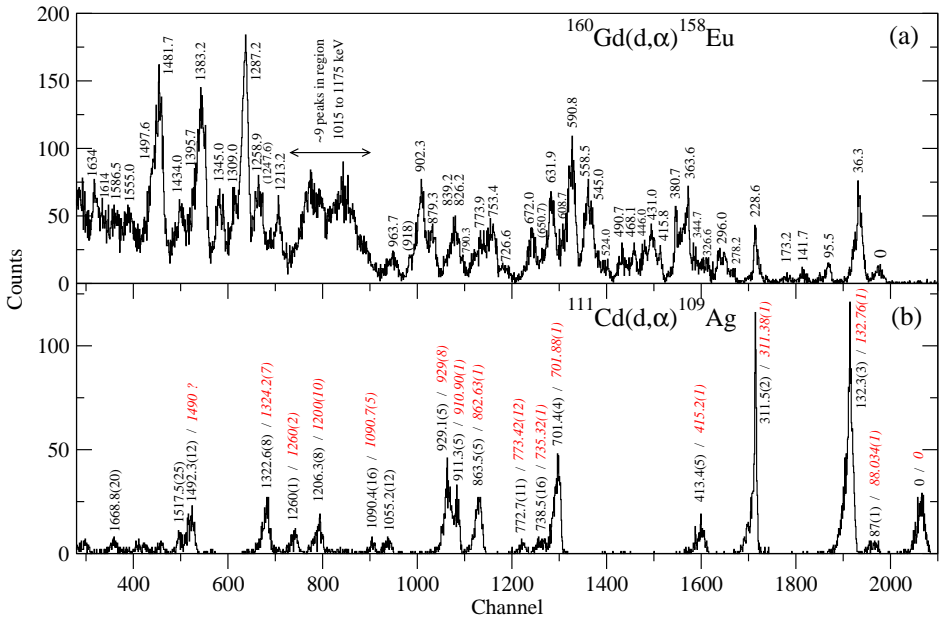
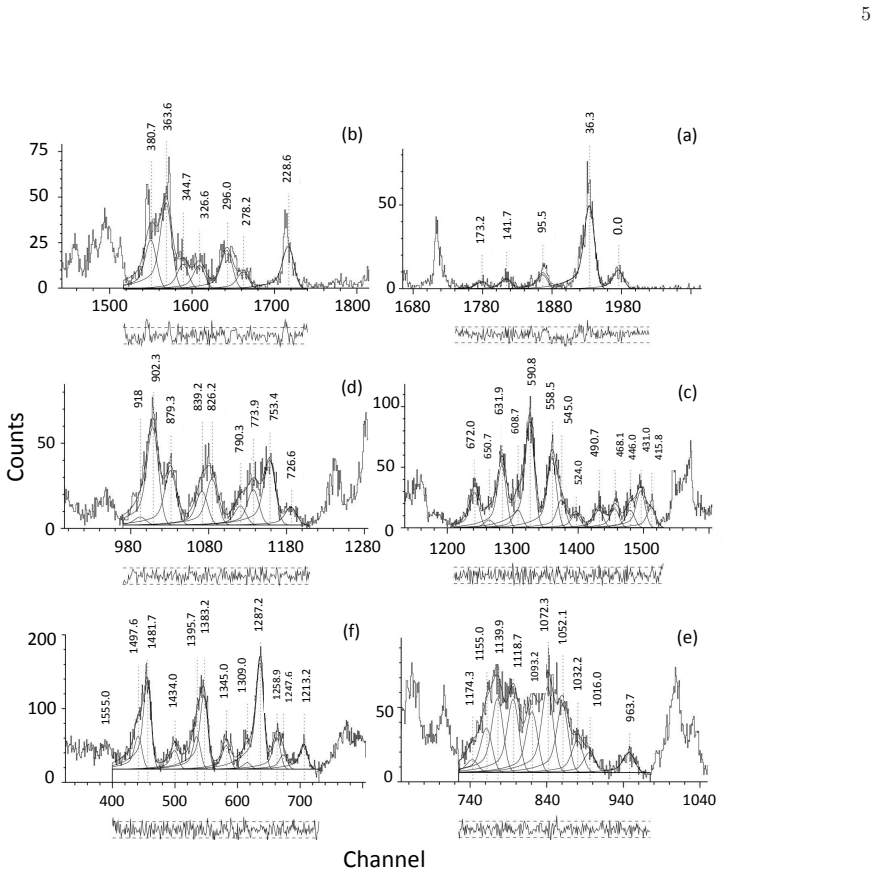
The load-bearing tool is the (d,α) transfer reaction on a 0+ even-even target, which populates a limited spin window in the odd-odd product nucleus; here the 160Gd(d,α)158Eu reaction, at one angle of 10 degrees, populates states up to roughly 6 units of spin, with high-spin states favored. The spectrum is recorded with a Q3D magnetic spectrograph and a focal-plane detector that identifies alpha particles, calibrated in excitation energy through a 111Cd(d,α)109Ag run with well-known 109Ag levels, and decomposed with a peak-fitting program. The level-density comparison then uses the raw number of levels below 0.35 MeV together with the back-shifted Fermi gas parameter a fitted for the lighter odd-odd Eu isotopes.
What would settle it
A spin-sensitive measurement, such as (d,α) angular distributions at two or more angles or a high-statistics beta-decay study of 158Sm, that revealed substantially more than thirteen 158Eu levels below 0.35 MeV would falsify the near-completeness assumption and weaken the level-density trend conclusion.
Extended reading notes
Core claim
The central discovery is that a (d,α) transfer reaction on an even-even rare-earth target can produce a near-complete low-lying level scheme for an odd-odd nucleus that previously had essentially no adopted excited states. In 158Eu the experiment finds 58 excited states up to about 1.6 MeV, with five tentative, and uses the thirteen levels below 0.35 MeV as a low-energy level-density point at N=95. That point continues the declining trend of the odd-odd Eu isotopes and, together with the N=87 point from 150Eu, frames the maximum of the low-energy level density at N=89.
Load-bearing premise
The trend conclusion rests on the assumption that the thirteen levels counted below 0.35 MeV are nearly all of the 158Eu states in the spin range covered by the two experiments; the paper infers this from spin windows without measuring any spins.
Editorial extensions
If this is right
- 158Eu now has a 58-level scheme up to about 1.6 MeV, giving the first adopted-level basis for this nucleus and a reference for future spin-parity measurements.
- The N=95 level count fills a gap in odd-odd Eu systematics, showing the low-energy level density falling smoothly away from its N=89 maximum.
- The fourteen candidate matches with beta-decay states connect the (d,α) and beta-decay data into a common level set, strengthening confidence in both.
- The measured Q-value of 10035.5 ± 1.6 keV improves the precision of the ground-state Q-value of the 160Gd(d,α)158Eu reaction over the earlier value.
- The same single-angle (d,α) approach can be applied to other stable even-even targets in the rare-earth region to extend odd-odd level schemes and density systematics.
Reading between the lines
- Because only one angle was measured and no spins were assigned, the near-completeness below 0.35 MeV is inferred from spin windows rather than demonstrated; a second angle or a spin-sensitive experiment would test whether the 13-level count is truly complete.
- If completeness is confirmed, 158Eu becomes a useful benchmark for statistical level-density models in odd-odd nuclei far from the shape-transition region, where such data are scarce.
- The energy calibration relies on extrapolation above about 1.23 MeV, so the highest states in the table likely carry larger systematic energy uncertainties than the quoted statistical errors; a calibration reaction with a heavier target would pin those energies down.
- The paper's strategy, if applied to neighboring Gd, Sm, and Nd isotope chains, would fill the odd-odd level-scheme gaps that remain in this mass region and could reveal how the N≈90 phase transition modulates level density in odd-odd nuclei.
Signed reviews
Editorial analysis
A structured set of objections, weighed in public.
Referee Report
Summary. The paper reports a measurement of the 160Gd(d,α)158Eu reaction at a single angle (10°) using the Munich Q3D spectrograph. From the background-free α-particle spectrum, the authors assign 58 excited states in 158Eu up to about 1.6 MeV excitation, of which five are tentative, and find that 14 of these states coincide within 3 keV with states previously observed in the β− decay of 158Sm. The main physics conclusion is that the number of known levels below 0.35 MeV (13 levels) in 158Eu lies below the corresponding numbers in the lighter odd-odd Eu isotopes (83, 60, and 24 for N=89, 91, 93), which is interpreted as a continuation of the decreasing low-energy level-density trend as N moves away from the critical point N≈90. A simplified level-density indicator, N0.35/0.35, is introduced and compared with the back-shifted Fermi-gas level-density parameter a. The paper also improves the Q-value of the 160Gd(d,α)158Eu reaction to 10035.5±1.6 keV.
Significance. If the low-energy level counting is reliable, the paper fills a gap in the odd-odd Eu systematics and provides a new data point for the level-density trend that has been connected to the shape phase transition near N=90. The experiment itself is clean: the α-particle identification is unambiguous, the resolution is good (about 15 keV), and the comparison with β-decay data provides a useful cross-check for 14 states. The improved Q-value is a concrete by-product. The central trend conclusion, however, rests on the assumption that the combined (d,α) and β-decay level scheme below 0.35 MeV is nearly complete, and this assumption is not established by the data as presented. Because only one angle was measured and no spins or parities were assigned, the spin coverage argument is based entirely on reaction systematics from other nuclei.
major comments (2)
- [Section III and Table I] The claim that the combined (d,α) and β-decay level scheme of 158Eu below 0.35 MeV is 'close to completeness' is the load-bearing assumption for the main conclusion. Section III states that 'No spin and parity values were assigned to any of these levels' and that the spin window of the (d,α) reaction (up to about 6 ħ) is taken from systematics in Ref. [9], not from a measured angular distribution. With a single angle and no spin assignments, the (d,α) data alone cannot establish that no class of states is missed; and if both experiments miss a common class of low-spin states, the count of 13 is a lower limit. The margin to the N=93 value (24 levels) is large: a true count of 20–25 would be fully consistent with the trend being flatter or absent. The paper contains two independent low-energy datasets, so the completeness assumption can be tested without new data. From Table I, below 0.35 MeV there are about 6 levels seen in both experiments, 3 seen only in (d,α), and 3 seen only in β-decay; an overlap-based completeness estimate (e.g., 1 - (miss rate)^2) should be reported. This test is necessary to support the 'close to completeness' statement and the resulting density trend.
- [Section II, energy calibration] The energy calibration is a second-degree polynomial determined from the 111Cd(d,α)109Ag reaction and is stated to be accurate to better than 1.5 keV up to an excitation energy of 1.32 MeV in 109Ag, corresponding to about 1.23 MeV in 158Eu. Above that the calibration is extrapolated, and the text acknowledges that deviations 'larger than the specified statistical error' are expected. No quantitative estimate of this extrapolation uncertainty is given. Since the abstract and the conclusion highlight that nearly 60 excited states were determined up to about 1.6 MeV, the reader cannot judge the reliability of the states above 1.23 MeV. Please quantify the extrapolated systematic uncertainty (for example, by comparing the fitted calibration with a third-degree polynomial or with known states in the high-energy region), or restrict the unambiguous level-scheme claim to the calibrated region. This issue is not central to the low-energy density count, but it bears on the overall claim of the paper.
minor comments (4)
- [Section III, Fig. 4] The simplified level-density indicator N0.35/0.35 is 'arbitrarily normalized such as its logarithm approximately scales as the a parameter'. This normalization makes the apparent agreement between the two quantities in Fig. 4 partly constructed. The raw level numbers (83, 60, 24, 13, 13) already show the trend; please present them explicitly in the text and clarify that the trend conclusion does not depend on the arbitrary normalization factor.
- [General] There is a typographical error in the acknowledgments: 'aknowledged' should be 'acknowledged'.
- [Section II and Fig. 2] The discussion of the 95.5 keV and 228.6 keV peaks ('their shape did not reach stability yet' and 'attempts to fit the 228.6 keV peak by a doublet failed') is difficult to evaluate. Please specify what stability criterion was used and what tests were performed before adopting the single-peak fits.
- [Section III] The phrase 'close to completeness' is used without a quantitative definition. Since the subsequent argument depends on this notion, a concrete statement of the confidence level or a completeness estimate would be helpful.
Circularity Check
No significant circularity: the level count and trend rest on independent experimental data; the only self-citations are bibliographic, not load-bearing.
full rationale
The paper's central claim is experimental: 58 excited states in 158Eu were observed with the (d,alpha) reaction, and 13 levels are counted below 0.35 MeV. This count is taken directly from the measured spectrum and beta-decay data, not derived from any fitted model. The comparison with BSFG a parameters from Refs. [10, 11] is explicitly illustrative and arbitrarily normalized The paper states the rough level density N0.35/0.35 is 'arbitrarily normalized such as its logarithm approximately scales as the a parameter,' so no predictive claim is being extracted by fitting. The completeness assumption below 0.35 MeV is an interpretation, not a circular construction. The self-citations (Refs. [10, 11] include author Bucurescu) provide the BSFG parameters and the prior level-density systematics, but the new data point at N=95 is measured here and independently counted. No equation is redefined, no fitted parameter is renamed as a prediction, and no unique theory is imported from the authors' prior work. The trend conclusion is therefore self-contained with respect to the experimental spectrum, though it inherits the stated completeness caveat.
Assumptions & free parameters
free parameters (4)
- Calibration polynomial coefficients (second-degree fit) =
Not quoted; reproduces 109Ag energies to <1.5 keV over fit range
- Fixed tail fraction in peak-shape model =
Chosen by hand to avoid doublet fits
- Allowed FWHM range for overlapping region (1015-1175 keV) =
Constrained to values from adjacent regions
- Arbitrary normalization for the simplified level-density indicator N0.35/0.35 =
Chosen so its logarithm approximately scales with the BSFG a parameter
assumptions (5)
- domain assumption Alpha events in the delta-E vs E plot are correctly identified, with the spectrum treated as background-free.
- domain assumption The calibration from 111Cd(d,alpha)109Ag, transformed by kinematics, remains valid for 160Gd(d,alpha)158Eu, including extrapolation above the last calibration point.
- domain assumption The Gaussian-plus-left-exponential-tail peak shape with a fixed tail fraction describes all real peaks.
- domain assumption The 158Eu level scheme up to 0.35 MeV is close to complete when combining beta-decay and single-angle (d,alpha) data.
- domain assumption Levels from the two experiments differing by less than 3 keV are the same state.
Cite this review
Pith. "Pith review of Excited states of the odd-odd nucleus 158Eu from the (d,alpha) reaction." pith.science (2026). https://pith.science/paper/MOBY4OAL
@misc{pith2026190802148,
  author       = {Pith},
  title        = {Pith review of: Excited states of the odd-odd nucleus 158Eu from the (d,alpha) reaction},
  year         = {2026},
  howpublished = {\url{https://pith.science/paper/MOBY4OAL}},
  note         = {Machine review of arXiv:1908.02148}
}
read the original abstract
Excited states in the 158Eu nucleus have been determined with the 160Gd(d, alpha)158Eu reaction, studied at an incident energy of 18.0 MeV with the Munich tandem and the Q3D spectrograph. More than 50 excited states have been determined up to 1.6 MeV excitation, some of them corresponding to states previously observed in the beta-decay of 158Sm. The number of levels found in this nucleus at low excitation energies follows the systematic trend of the level densities in the other isotopes with mass 152-156.
Figures

Figures from the paper (1 more)

Reference graph
Works this paper leans on
- [9]
-
[1]
D. Bucurescu, E. Dr˘ agulescu, S. Pascu, H-F. Wirth, D. Filipescu, G. C˘ ata-Danil, I. C˘ ata-Danil, D. Deleanu, K. Eppinger, T. Faestermann, D.G. Ghit ¸˘ a, T. Glodariu, R. Hertenberger, M. Iva¸ scu, R. Kruecken, N. M˘ arginean, R. M˘ arginean, C. Mihai, A. Negret, T. Sava. L. Stroe, K. Wimmer, and N.V. Zamfir, Phys. Rev. C85, 017304 (2012)
work page 2012
- [2]
-
[3]
R.C. Greenwood, R.G. Helmer, M.H. Putnam, and K.D. Watts, Nucl Instr. Meth. A390, 95 (1997)
work page 1997
-
[4]
M. L¨ offler, H.J. Scheerer, and H. Vonach, Nucl. Instr. and Meth. 111, 1 (1973)
work page 1973
- [5]
- [6]
-
[7]
Riess, Beschleunigerlaboratorium M¨ unchen, Annual Report, 1991, p
F. Riess, Beschleunigerlaboratorium M¨ unchen, Annual Report, 1991, p. 168
work page 1991
Show all 14 references
-
[8]
Audi, F.G
Meng Wang, G. Audi, F.G. Kondev, W.J. Huang, S. Naimi, and Xing Xu, Chinese Physics C41(3), 030003 (2017)
2017
-
[10]
Bucurescu and N.V
D. Bucurescu and N.V. Zamfir, Phys. Rev. C98, 024301 (2017)
2017
-
[11]
von Egidy and D
T. von Egidy and D. Bucurescu, Phys. Rev. C80, 054310 (2009)
2009
-
[12]
Evaluated Nuclear Structure Data File (ENSDF), main- tained by the National Nuclear Data Center, Brookhaven National Laboratory, http://www.nndc.bnl.gov/ensdf
-
[95]
Partial support for this work within the TE67/2018 project with the UEFISCDI Romanian research funding Agency is aknowledged
The low-energy level density determined for 158Eu smoothly continues the decreasing trend of the lighter isotopes. Partial support for this work within the TE67/2018 project with the UEFISCDI Romanian research funding Agency is aknowledged. The authors thank the techni- cal st...
2018
-
[156]
For this, we will directly compare the number of levels known in these nuclei up to an excitation energy of 0.35 MeV
In order to examine the available data from a larger N region we adopt here a simplified procedure. For this, we will directly compare the number of levels known in these nuclei up to an excitation energy of 0.35 MeV. This excitation energy range was chosen because it is common...
Reviewed August 14, 2026 · model on record in the stance chip above.
Discussion (0). Continue with ORCID to comment.