REVIEW 5 major objections 5 minor 37 references
Optimal Control in Nearly-Adiabatic Two-Level Quantum Systems via Time-Dependent Resonance
T0 review · 5 major / 5 minor · reviewed 2026-08-10 · deepseek-v4-flash
Pith's one-line read Adding a weak oscillation whose frequency matches the instantaneous energy gap of a two-level system suppresses nonadiabatic transitions to zero, and the analytically derived amplitude matches the numerically optimal control.
desk verdict A genuinely new analytic result for optimal control in the Landau-Zener problem, but the n=3 derivation hinges on an unquantified approximation that needs a careful check. read the letter →
The pith
A machine-rendered reading of the paper's core claim, the machinery that carries it, and where it could break.
The reading
What carries the argument
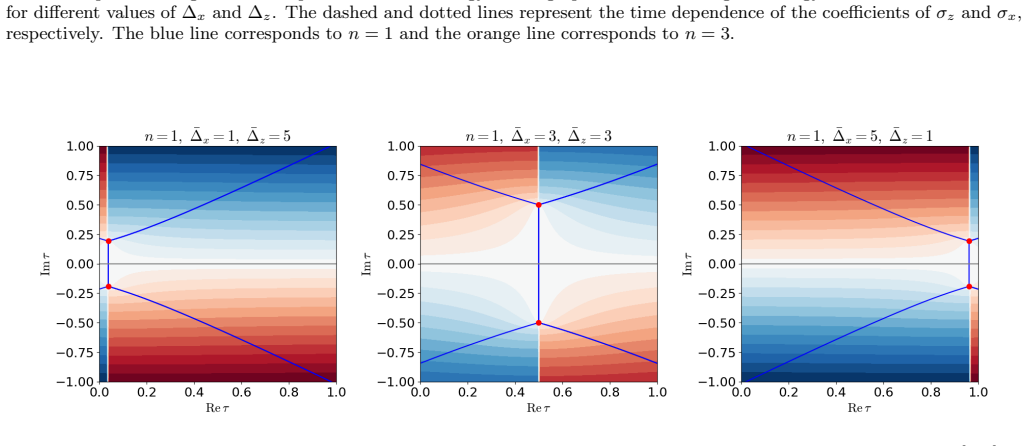
The central object is the time-dependent resonant Hamiltonian: an added control term whose instantaneous frequency $\dot{\phi}_n(t,t_0)=2E_n(t)$ equals the time-dependent energy gap of the base Hamiltonian. The argument works in the Furry picture, the interaction picture with the unperturbed evolution as the reference; there the oscillation phase $e^{i\phi}$ cancels the dynamical phase of the free adiabatic evolution, leaving a slowly varying integral that is evaluated using the DDP/WKB expression for the free transition amplitude. Equating that first-order perturbative term with the free amplitude gives an algebraic condition for zero total transition probability, producing the analytic amplitudes $\tilde{\alpha}_{k,\mathrm{opt}}$. The Stokes-line intersection times $\tau_{r,k}$ enter both the phases and the exponents, and in finite-time problems only the Stokes lines that cross the real-time interval contribute.
What would settle it
For the $n=1$ case with $\tilde{\Delta}=1$, compute the exact transition probability as a function of $\tilde{\alpha}$ including second-order and counter-rotating terms; if the zero moves away from $\tilde{\alpha}_{0,\mathrm{opt}}=2e^{-\pi/2}/\pi$ by more than a few percent, the first-order cancellation condition is not exact.
Extended reading notes
Core claim
The central claim is that a control Hamiltonian of the form $H_n(t) = (v_{n+1} t^n + \sum_k A_{n,k}(t) \sin\phi_n(t,t_{r,k})) \sigma_z + \Delta \sigma_x$, with $A_{n,k}(t) = -\alpha_k / E_n(t)$ and phase $\phi_n(t,t_0)=2\int_{t_0}^{t} E_n(s)\,ds$, suppresses nonadiabatic transitions once the amplitudes take the analytically derived values $\tilde{\alpha}_{k,\mathrm{opt}}$. For $n=1$ this amplitude decays exponentially as $(2/\pi)e^{-\pi \tilde{\Delta}^2/2}$, and for $n=3$ it is given in closed form in terms of the gap and gamma functions. Treating the oscillatory term as a first-order perturbation around the free evolution and using the DDP/WKB formula for the free transition amplitude, the paper obtains a condition under which the perturbative and free amplitudes cancel exactly, making the transition probability zero. Numerically optimized controls for the cost functional (8) agree with this protocol in the nearly adiabatic regime.
Load-bearing premise
The whole argument assumes that the first-order perturbative treatment of the added oscillation, together with the DDP/WKB formula for the unperturbed sweep, remains accurate when the control is present, so the neglected counter-rotating and higher-order terms do not shift the cancellation condition.
Editorial extensions
If this is right
- For polynomial sweeps, an analytic optimal control exists in the nearly adiabatic limit, so no numerical search is required in that regime.
- The optimal amplitude decreases as the gap parameter grows, so more adiabatic processes require weaker control oscillations.
- Time-dependent resonance suppresses transitions with smaller amplitude than a constant-frequency harmonic drive, making it more efficient for state operations in the nearly adiabatic regime.
- In quantum-annealing-type time dependence, only the Stokes lines that intersect the finite time interval matter, and the amplitudes for the other turning points vanish.
- For multi-level systems the construction suppresses transitions to the first excited state but not to higher states, so it is optimal only when transitions to higher levels are initially zero.
Reading between the lines
- The same cancellation mechanism may explain the oscillatory structure seen in numerical optimal control of quantum annealing: those oscillations may be the control resonantly tracking the instantaneous gap rather than numerical artifacts.
- A testable prediction is that for any smooth base sweep the optimal control in the nearly adiabatic regime should oscillate at the local gap with an amplitude set by the WKB exponent; fitting the numerically optimal amplitude against the gap parameter would extract that exponent.
- For finite-time anneal schedules, the analysis suggests that control effort can be concentrated in the short time window around the Stokes-line crossing rather than spread over the whole sweep, which could simplify pulse design.
- The multi-level limitation suggests a possible cascade strategy: add separate time-dependent resonances tuned to each energy gap to suppress transitions to successively higher excited states.
Editorial analysis
A structured set of objections, weighed in public.
Referee Report
Summary. The manuscript proposes that a 'time-dependent resonance' control protocol, whose oscillatory frequency tracks the instantaneous energy gap of a nearly adiabatic two-level Hamiltonian and whose amplitude is set to an analytically derived value alpha~_{k,opt}, cancels the leading nonadiabatic transition amplitude. The analysis is based on the exact WKB/DDP formula for the free dynamics plus first-order perturbation theory in the Furry picture, leading to Eq. (5) and the closed-form optimal amplitudes (6)-(7) for n=1 and n=3. The authors then compare these predictions with numerical optimal control results (Figs. 4-8, 12-13) and claim that the time-dependent resonance Hamiltonian coincides with the numerically optimal control in the nearly adiabatic regime. Appendices extend the discussion to quantum-annealing-type time dependence and to multilevel systems.
Significance. If the central claim holds, the paper would provide an analytically tractable characterization of optimal control in a simple but nontrivial two-level problem in the nearly adiabatic regime, potentially useful for qubit control and quantum annealing. The paper has a noncircular structure: alpha~_{k,opt} is derived from a zero-transition condition and subsequently compared with independently obtained numerical optimal control. The numerical comparisons in Figs. 5, 6, 12, and 13 are suggestive and give the work practical interest. However, the paper's central derivation is compressed, and the decisive perturbative reduction from Eq. (3) to Eq. (4) is delegated to a Supplemental Material that is not included in the arXiv submission, so the strength of the result cannot be fully assessed from the manuscript alone.
major comments (5)
- [Sec. II, Eq. (4)] The transition from Eq. (3) to Eq. (4) is the load-bearing step: the Furry-picture first-order integral is reduced to a single resonant term by dropping the counter-rotating term via the DDP formula and omitting 'terms negligible in the adiabatic regime.' No quantitative condition on the smallness of the dropped terms is provided. This is not merely a presentation issue, because for n=3 the derived optimal amplitude in Eq. (7) is only algebraically small, alpha~_{k,opt} ~ Delta~^{-2/3}, and at the parameters of Figs. 2 and 6 it is O(0.1-1). At such amplitudes the discarded counter-rotating integral, second-order terms in alpha~, and nonadiabatic corrections to the interaction-picture evolution can be comparable to the retained first-order term. The paper needs an explicit bound or error estimate showing that the neglected terms are subleading for the parameter ranges where optimality is claimed.
- [Sec. II, Eqs. (5) and (7)] The derivation of the cancellation condition and the resulting values alpha~_{k,opt} in Eqs. (6) and (7) depends on the exact WKB/DDP formula (2) being quantitatively accurate for the polynomial Hamiltonians with n=3. The paper refers to Ref. [25] and the author's own exact WKB results [35], but does not compare Eq. (2) directly with numerical free-evolution transition amplitudes in the relevant finite-time or long-time parameter regime. Since the optimality claim rests on this formula, a quantitative validation of Eq. (2) for the n=3 case, e.g., a plot of the free transition probability versus the exact WKB prediction, should be added or referenced explicitly.
- [Secs. II and III, relation between the analytic optimum and numerical optimal control] The paper asserts that the numerical optimal control 'coincides with' or 'agrees well with' the time-dependent resonance control, but the comparison in Fig. 5 is based on fitting the amplitude of a prescribed functional form, while Fig. 6 compares the full control functions only through the difference u_opt(t)-u_0(t) for n=3. There is no quantitative error metric, and the parameter range shown is narrow. In particular, the claim that the analytically derived n=3 control is optimal for the values in Fig. 6 (Delta~ = 3/2, 2, 5/2) needs a statement of the fitting procedure, the fit residuals, and the sensitivity to the algebraic rather than exponential smallness of alpha~_{k,opt}.
- [Sec. II, Fig. 2 and text after Eq. (7)] The comparison in Fig. 2 is described as agreeing 'well in the region of small amplitude,' but the analytical cancellation point alpha~_{opt} for n=3 is not exponentially small. The figure's black dashed line marks alpha~_{0,opt} for n=1, but for n=3 the optimal alpha~_k values are not marked, and the plot apparently fixes alpha~_1 and alpha~_2 at their optimal values. The reader cannot tell from the figure how accurate Eq. (5) is at the cancellation point itself, which is exactly the point of interest. The authors should report the numerical value of P_e at the analytically predicted optimum and compare it with the exact numerical solution for the same Hamiltonian.
- [Supplemental Material [29]] The manuscript repeatedly delegates key derivations and numerical details to 'Supplemental Material [29]', which is not present in the arXiv submission: these include the full derivation of Eq. (4), the detailed optimal-control conditions, the analysis of finite-time cases, and the multilevel discussion. At minimum, the paper should state in the text whether the Supplemental Material is available, and the derivation of Eq. (4) should be summarized in the main text or appendix with the principal intermediate expressions, because the correctness of the central claim cannot be checked otherwise.
minor comments (5)
- [Throughout] The manuscript has several typographical errors and duplications: 'ANAL YSIS' and 'SUMMAR Y' in section headings, and the sentence introducing 'The eigenstates of the Hamiltonian H_n(t)' is repeated immediately afterward, with one instance evidently meant to read H_n(t) instead of H_n(t). These should be corrected.
- [Sec. II, notation] The notation H_n(t), H_n(t), and H_n(t) is highly confusable; the free and perturbed Hamiltonians should be distinguished by unambiguous symbols throughout, including in the captions of Figs. 4-8 and in Appendix C.
- [Sec. II, Eq. (3)] The statement that 'the amplitude is sufficiently small at tau = tau_0 and tau_f, allowing the approximation |E_{n,pm}(tau)> ~ |E_{n,pm}(tau)>' is unclear, since the free and perturbed eigenstates are related through the oscillatory control term; a precise explanation of this approximation and its validity condition should be given.
- [Sec. III and Appendix C] The phrase 'experimental results are summarized in [29]' appears to refer to numerical rather than experimental results; if no experiment is reported, the wording should be changed to 'numerical results.'
- [Appendix D] In the multilevel discussion, the claim that the time-dependent resonance control 'may not be suitable' for more than two states is stated without a worked example or quantitative criterion; if this is a known limitation, a citation or a brief demonstration would help.
Circularity Check
The analytic amplitude is derived from a zero-transition cancellation condition and checked against independently optimized numerics; no step reduces the claim to its inputs.
full rationale
No circular reduction found. The paper's central analytic quantity, alpha~_k,opt, is determined by imposing the zero-transition condition on the perturbative transition amplitude in Eq. (5), not by fitting it to the optimal-control output. The optimal-control problem is defined independently by the cost functional (8) and solved numerically over u(t) with u0(t)=tau^n; the later match between the numerically optimized control and the time-dependent-resonance ansatz is therefore a genuine, externally falsifiable comparison. The exact-WKB free-transition amplitude (2) is imported from the author's earlier work [35] and Supplemental Material [29], but it is a parameter-free formula with stated assumptions and is benchmarked against direct numerical Schrodinger evolution in Fig. 2; it does not assume the optimality of time-dependent resonance. The approximations in Eq. (4) (dropping counter-rotating terms and terms 'negligible in the adiabatic regime') and the absence of the Supplemental Material are derivation and validity gaps, not circularity: they do not make the output equal to the input by construction. Accordingly, no step reduces a predicted quantity to a fitted parameter or to a self-citation chain.
Assumptions & free parameters
assumptions (4)
- domain assumption The Dykhne-Davis-Pechukas formula and exact WKB Stokes-line analysis give accurate transition amplitudes for polynomial two-level Hamiltonians in the nearly adiabatic limit.
- domain assumption The oscillatory control term can be treated perturbatively to first order, with the free Hamiltonian as the Furry-picture generator.
- domain assumption Counter-rotating terms in the perturbative integral are negligible in the adiabatic regime, justified by the DDP formula.
- domain assumption The numerical optimizer used for the optimal control problem reaches the global minimum of the cost functional (8).
Cite this review
Pith. "Pith review of Optimal Control in Nearly-Adiabatic Two-Level Quantum Systems via Time-Dependent Resonance." pith.science (2026). https://pith.science/paper/MOXB47QX
@misc{pith2026250100293,
  author       = {Pith},
  title        = {Pith review of: Optimal Control in Nearly-Adiabatic Two-Level Quantum Systems via Time-Dependent Resonance},
  year         = {2026},
  howpublished = {\url{https://pith.science/paper/MOXB47QX}},
  note         = {Machine review of arXiv:2501.00293}
}
read the original abstract
In this study, we theoretically analyzed a control protocol based on ``time-dependent resonance" in nearly adiabatic two-level quantum systems, demonstrating that it exhibits properties equivalent to adiabatic control. This protocol is based on ``time-dependent resonance", where the frequency corresponds to the time-dependent energy gap. Through numerical calculations, we showed that this protocol serves as an optimal control protocol. This approach enables efficient and high-precision transitions to the target state. Our findings provide a new perspective on quantum optimal control theory and suggest potential applications in qubit controls and quantum information processing.
Figures


Figures from the paper (11 more)




Reference graph
Works this paper leans on
-
[20]
T. Albash and D. A. Lidar, Adiabatic quantum computation, Reviews of Modern Physics 90, 015002 (2018)
work page 2018
-
[29]
A. M. Dykhne, Adiabatic perturbation of discrete spectrum states, Sov. Phys. JETP 14, 1 (1962)
work page 1962
-
[25]
E. C. G. St¨ uckelberg, Theory of inelastic collisions between atoms(theory of inelastic collisions between atoms, using two simultaneous differential equations), Helv. Phys. Acta 5, 369 (1932)
work page 1932
-
[35]
T. Suzuki and K. Iwamura, Kibble-zurek scaling in the quantum ising chain with a time-periodic perturbation, Physical Review B 108, 014110 (2023)
work page 2023
-
[1]
(B1), |x(t)⟩ represents the time-evolved state from the specified initial state
Setting The condition for the variation of the functional (8) to be zero is given by i d dt |x(t)⟩ = H(t) |x(t)⟩ , (B1) i d dt |k(t)⟩ = H(t) |k(t)⟩ , (B2) |k(T )⟩ = HC |x(T )⟩ , (B3) 0 = −i ⟨k(t)| σz |x(t)⟩ + c.c., (B4) From Eq. (B1), |x(t)⟩ represents the time-evolved state from the specified initial state. On the other hand, from Eqs. (B2) and (B3), |k(...
-
[2]
Results of numerical calculation Next, we compare the behavior of the optimal control as it approaches the adiabatic limit. The results are shown in Fig. 7. As ˜∆ increases and approaches the adiabatic limit, the oscillation amplitude of the optimal control decreases. This reflects the fact that as the system approaches the adiabatic limit, the dynamics u...
-
[3]
J. Werschnik and E. Gross, Quantum optimal control theory, Journal of Physics B: Atomic, Molecular and Optical Physics 40, R175 (2007)
work page 2007
-
[4]
J. Geng, Y. Wu, X. Wang, K. Xu, F. Shi, Y. Xie, X. Rong, and J. Du, Experimental time-optimal universal control of spin qubits in solids, Physical review letters 117, 170501 (2016)
work page 2016
Show all 37 references
-
[5]
Rembold, N
P. Rembold, N. Oshnik, M. M. M¨ uller, S. Montangero, T. Calarco, and E. Neu, Introduction to quantum optimal control for quantum sensing with nitrogen-vacancy centers in diamond, A VS Quantum Science 2, 024701 (2020)
2020
-
[6]
Ansel, E
Q. Ansel, E. Dionis, F. Arrouas, B. Peaudecerf, S. Gu´ erin, D. Gu´ ery-Odelin, and D. Sugny, Introduction to theoretical and experimental aspects of quantum optimal control, Journal of Physics B: Atomic, Molecular and Optical Physics 57, 133001 (2024)
2024
-
[7]
Kadowaki and H
T. Kadowaki and H. Nishimori, Quantum annealing in the transverse ising model, Physical Review E 58, 5355 (1998)
1998
-
[8]
Farhi, J
E. Farhi, J. Goldstone, S. Gutmann, J. Lapan, A. Lundgren, and D. Preda, A quantum adiabatic evolution algorithm applied to random instances of an np-complete problem, Science 292, 472 (2001)
2001
-
[9]
Farhi, J
E. Farhi, J. Goldstone, and S. Gutmann, A quantum approximate optimization algorithm, arXiv preprint arXiv:1411.4028 (2014)
2014 arXiv
-
[10]
Z.-C. Yang, A. Rahmani, A. Shabani, H. Neven, and C. Chamon, Optimizing variational quantum algorithms using pontryagin’s minimum principle, Physical Review X 7, 021027 (2017)
2017
-
[11]
L. T. Brady, C. L. Baldwin, A. Bapat, Y. Kharkov, and A. V. Gorshkov, Optimal protocols in quantum annealing and quantum approximate optimization algorithm problems, Physical Review Letters 126, 070505 (2021)
2021
-
[12]
Gu´ ery-Odelin, A
D. Gu´ ery-Odelin, A. Ruschhaupt, A. Kiely, E. Torrontegui, S. Mart ´ ınez-Garaot, and J. G. Muga, Shortcuts to adiabaticity: Concepts, methods, and applications, Reviews of Modern Physics 91, 045001 (2019)
2019
-
[13]
Caneva, M
T. Caneva, M. Murphy, T. Calarco, R. Fazio, S. Montangero, V. Giovannetti, and G. E. Santoro, Optimal control at the quantum speed limit, Physical review letters 103, 240501 (2009)
2009
-
[14]
C.-K. Hu, A. C. Santos, J.-M. Cui, Y.-F. Huang, M. S. Sarandy, C.-F. Li, and G.-C. Guo, Adiabatic quantum dynamics under decoherence in a controllable trapped-ion setup, Physical Review A 99, 062320 (2019)
2019
-
[15]
Y. P. Kandel, H. Qiao, S. Fallahi, G. C. Gardner, M. J. Manfra, and J. M. Nichol, Adiabatic quantum state transfer in a semiconductor quantum-dot spin chain, Nature communications 12, 2156 (2021)
2021
-
[16]
Kr´ al, I
P. Kr´ al, I. Thanopulos, and M. Shapiro, Colloquium: Coherently controlled adiabatic passage, Reviews of modern physics 79, 53 (2007)
2007
-
[17]
P. C. Costa, D. An, Y. R. Sanders, Y. Su, R. Babbush, and D. W. Berry, Optimal scaling quantum linear-systems solver via discrete adiabatic theorem, PRX quantum 3, 040303 (2022)
2022
-
[18]
L. K. Kovalsky, F. A. Calderon-Vargas, M. D. Grace, A. B. Magann, J. B. Larsen, A. D. Baczewski, and M. Sarovar, Self-healing of trotter error in digital adiabatic state preparation, Physical Review Letters 131, 060602 (2023)
2023
-
[19]
K. Xu, T. Xie, Z. Li, X. Xu, M. Wang, X. Ye, F. Kong, J. Geng, C. Duan, F. Shi, et al., Experimental adiabatic quantum factorization under ambient conditions based on a solid-state single spin system, Physical review letters118, 130504 (2017). 15
2017
-
[21]
J. Wen, X. Kong, S. Wei, B. Wang, T. Xin, and G. Long, Experimental realization of quantum algorithms for a linear system inspired by adiabatic quantum computing, Physical Review A 99, 012320 (2019)
2019
-
[22]
L. T. Brady, L. Kocia, P. Bienias, A. Bapat, Y. Kharkov, and A. V. Gorshkov, Behavior of analog quantum algorithms, arXiv preprint arXiv:2107.01218 (2021)
2021 arXiv
-
[23]
Landau, On the theory of transfer of energy at collisions ii, Z
L. Landau, On the theory of transfer of energy at collisions ii, Z. Sowjetunion 2, 46 (1932)
1932
-
[24]
Zener, Non-adiabatic crossing of energy levels, Proc
C. Zener, Non-adiabatic crossing of energy levels, Proc. R. Soc. A 137, 696 (1932)
1932
-
[26]
Majorana, Atomi orientati in campo magnetico variabile, Nuovo Cimento 9, 43 (1932)
E. Majorana, Atomi orientati in campo magnetico variabile, Nuovo Cimento 9, 43 (1932)
1932
-
[27]
Vitanov and K.-A
N. Vitanov and K.-A. Suominen, Nonlinear level-crossing models, Physical Review A 59, 4580 (1999)
1999
-
[28]
Lehto and K.-A
J. Lehto and K.-A. Suominen, Superparabolic level-glancing models for two-state quantum systems, Physical Review A—Atomic, Molecular, and Optical Physics 86, 033415 (2012)
2012
-
[30]
J. P. Davis and P. Pechukas, Nonadiabatic transitions induced by a time-dependent Hamiltonian in the semiclassi- cal/adiabatic limit: The two-state case, J. Chem. Phys. 64, 3129 (1976)
1976
-
[31]
See Supplemental Material. The Supplemental Material has four sections: (i) a brief introduction to the exact WKB analysis; (ii) detailed information on the numerical calculations for optimal control; (iii) an analysis of the dynamics for quantum annealing-type time dependence...
-
[32]
S. N. Shevchenko, S. Ashhab, and F. Nori, Landau–zener–st¨ uckelberg interferometry, Physics Reports 492, 1 (2010)
2010
-
[33]
Suzuki and H
T. Suzuki and H. Nakazato, Generalized adiabatic impulse approximation, Physical Review A 105, 022211 (2022)
2022
-
[34]
Furry, On bound states and scattering in positron theory, Physical Review 81, 115 (1951)
W. Furry, On bound states and scattering in positron theory, Physical Review 81, 115 (1951)
1951
-
[36]
Taya, Dynamically assisted schwinger mechanism and chirality production in parallel electromagnetic field, Physical Review Research 2, 023257 (2020)
H. Taya, Dynamically assisted schwinger mechanism and chirality production in parallel electromagnetic field, Physical Review Research 2, 023257 (2020)
2020
-
[37]
Suzuki, E
T. Suzuki, E. Taniguchi, and K. Iwamura, Exact wkb analysis for adiabatic discrete-level hamiltonians, Physical Review A 109, 022225 (2024)
2024
Reviewed August 10, 2026 · model on record in the stance chip above.
Discussion (0). Continue with ORCID to comment.