REVIEW 2 major objections 2 minor 1 cited by
Identification of MHD equilibrium $\beta$ limits for CFQS plasmas
T0 review · 2 major / 2 minor · reviewed 2026-06-26 · grok-4.3
Pith's one-line read CFQS stellarator equilibria maintain ordered magnetic surfaces up to 1.5 percent average beta.
desk verdict CFQS gets a 1.5% beta limit from standard MHD numerics on island overlap, with the usual limits on how the metrics are validated. read the letter →
The pith
A machine-rendered reading of the paper's core claim, the machinery that carries it, and where it could break.
The reading
What carries the argument
Numerical metrics including fractal dimension, weighted Birkhoff average, and effective volume of parallel diffusion to detect the onset of rapid destruction of nested flux surfaces.
What would settle it
Observation or simulation showing that nested flux surfaces remain intact with low fractal dimension and no proliferation of stochastic lines at beta values significantly above 1.5 percent would indicate the limit is higher.
Extended reading notes
Core claim
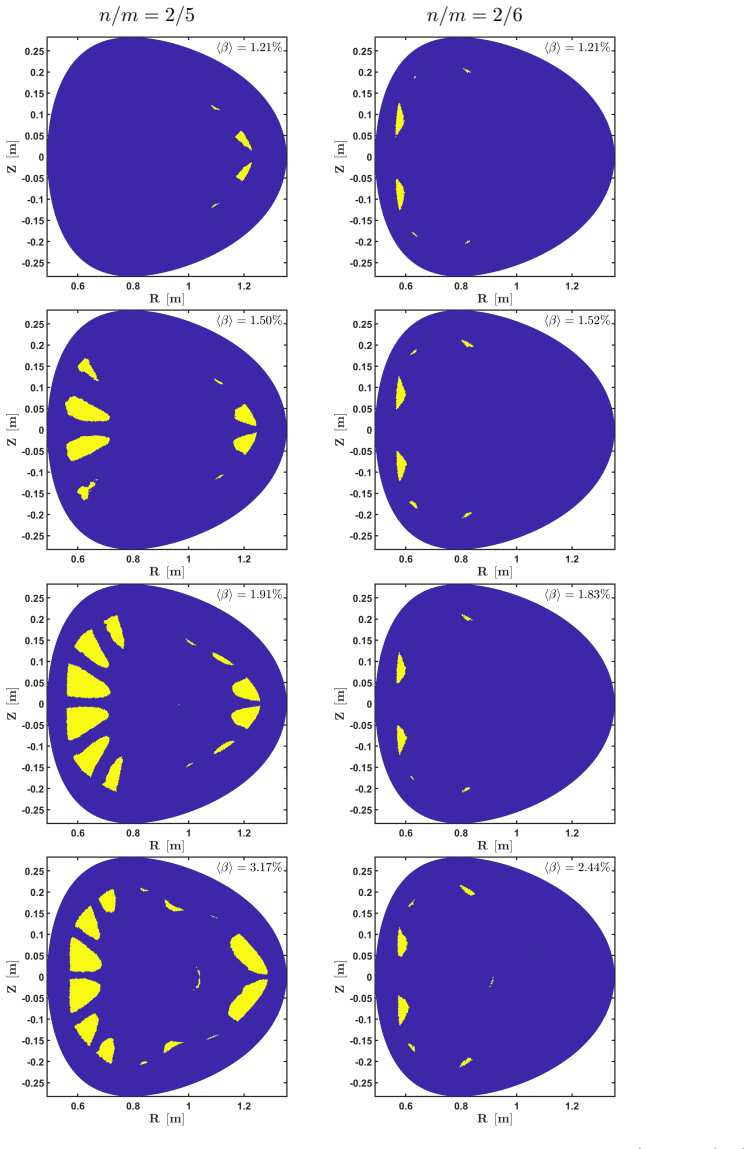
In the standard configuration, the net-current-free and the bootstrap-current-carrying equilibria can sustain well-ordered magnetic surfaces up to ⟨β⟩≈1.5%. The proliferation of stochastic field lines starts after the critical overlap between the internal major islands and the high-order island chains. The equilibrium β limit is identified upon the onset of the rapid destruction of nested flux surfaces by evaluating several numerical metrics, including the fractal dimension, weighted Birkhoff average, and effective volume of parallel diffusion. In two types of divertor island configurations based on net-current-free equilibria, edge islands may transition into open field lines at low ⟨β⟩ val
Load-bearing premise
The assumption that the rapid destruction of nested flux surfaces, as measured by the chosen numerical metrics, marks the true equilibrium beta limit for the device.
Editorial analysis
A structured set of objections, weighed in public.
Referee Report
Summary. The manuscript uses the NTEC code to compute MHD equilibria in the CFQS stellarator for both standard and divertor-island configurations. The equilibrium β limit is identified as the point at which nested flux surfaces undergo rapid destruction, diagnosed via three numerical metrics (fractal dimension, weighted Birkhoff average, and effective volume of parallel diffusion). In the standard configuration the authors report that both net-current-free and bootstrap-current equilibria maintain well-ordered surfaces up to ⟨β⟩≈1.5 %, after which stochastic regions proliferate due to overlap between internal major islands and high-order island chains. In the divertor configurations the edge islands open at lower ⟨β⟩, shrinking the last closed flux surface while the inner-surface degradation threshold remains comparable to the standard case.
Significance. If the reported thresholds are robust, the work supplies concrete numerical guidance on the accessible β range for the CFQS device and illustrates how island-overlap criteria can be used to locate the onset of stochasticity in quasi-axisymmetric stellarators. The multi-metric diagnostic approach is a positive feature that reduces reliance on any single indicator.
major comments (2)
- [Abstract, §3] Abstract and §3 (results on standard configuration): the central claim that ⟨β⟩≈1.5 % marks the equilibrium limit rests on the assertion that the chosen metrics detect the physical onset of surface destruction, yet no calibration, analytic benchmark, or comparison against an independently known destruction threshold is presented. Without such grounding the reported numerical value remains tied to the post-hoc choice of “rapid destruction” criterion.
- [§4] §4 (divertor-island cases): the statement that edge islands transition to open field lines at low ⟨β⟩ is supported only by the same three metrics; the manuscript does not show that the observed shrinkage of the last closed flux surface is converged with respect to grid resolution or that the metrics remain reliable once the topology changes from closed to open.
minor comments (2)
- Notation for the three diagnostics is introduced without a compact table summarizing their definitions and normalization; a short table would improve readability.
- The bootstrap-current profile is stated to be self-consistent, but the iteration tolerance and convergence criterion are not quantified.
Simulated Author's Rebuttal
We thank the referee for the careful and constructive review of our manuscript. Below we respond point-by-point to the major comments, indicating where revisions will be made.
read point-by-point responses
-
Referee: [Abstract, §3] Abstract and §3 (results on standard configuration): the central claim that ⟨β⟩≈1.5 % marks the equilibrium limit rests on the assertion that the chosen metrics detect the physical onset of surface destruction, yet no calibration, analytic benchmark, or comparison against an independently known destruction threshold is presented. Without such grounding the reported numerical value remains tied to the post-hoc choice of “rapid destruction” criterion.
Authors: We acknowledge that the manuscript does not present an explicit analytic benchmark or calibration against an independently known destruction threshold. The three metrics are established within the NTEC code and have been cross-validated in prior applications to other stellarator configurations, where the detected onset of stochasticity is consistent with independent MHD analyses. The rapid-destruction threshold is defined objectively as the β value at which all three metrics exhibit a simultaneous sharp transition; this multi-metric consistency is intended to reduce arbitrariness. We will revise the abstract and §3 to include a concise justification referencing these prior validations of the NTEC metrics. revision: partial
-
Referee: [§4] §4 (divertor-island cases): the statement that edge islands transition to open field lines at low ⟨β⟩ is supported only by the same three metrics; the manuscript does not show that the observed shrinkage of the last closed flux surface is converged with respect to grid resolution or that the metrics remain reliable once the topology changes from closed to open.
Authors: The divertor-island runs use the identical grid resolution as the standard-configuration cases, for which internal convergence checks were performed during code development. The effective-volume-of-parallel-diffusion metric is formulated to remain well-defined for both closed and open topologies. Nevertheless, we agree that the manuscript does not explicitly demonstrate grid convergence or metric reliability after the topology change. We will add a short discussion in §4 describing the resolution employed and the applicability of the metrics to open field lines. revision: partial
Circularity Check
No significant circularity
full rationale
The paper identifies the equilibrium β limit operationally as the β value at which numerical metrics (fractal dimension, weighted Birkhoff average, effective parallel diffusion volume) first indicate rapid destruction of nested flux surfaces. This is a computational diagnostic procedure rather than a derivation chain in which a claimed result reduces by construction to its own inputs, a fitted parameter, or a self-citation. No self-definitional equations, predictions forced by prior fits, or load-bearing self-citations appear in the abstract or described methodology. The study is self-contained as a numerical scan of equilibria produced by the NTEC code.
Assumptions & free parameters
Cite this review
Pith. "Pith review of Identification of MHD equilibrium $\beta$ limits for CFQS plasmas." pith.science (2026). https://pith.science/paper/MP7BAH62
@misc{pith2026260626675,
  author       = {Pith},
  title        = {Pith review of: Identification of MHD equilibrium $\beta$ limits for CFQS plasmas},
  year         = {2026},
  howpublished = {\url{https://pith.science/paper/MP7BAH62}},
  note         = {Machine review of arXiv:2606.26675}
}
abstract
The magnetohydrodynamic (MHD) equilibrium $\beta$ limits in the Chinese First QuasiAxisymmetric Stellarator (CFQS) are investigated using the NTEC code, for both the standard and the magnetic island configurations. The equilibrium $\beta$ limit is identified upon the onset of the rapid destruction of nested flux surfaces by evaluating several numerical metrics, including the fractal dimension, weighted Birkhoff average, and effective volume of parallel diffusion. In the standard configuration, the net-current-free and the bootstrap-current-carrying equilibria can sustain well-ordered magnetic surfaces up to $\langle\beta\rangle\approx1.5\%$. The proliferation of stochastic field lines starts after the critical overlap between the internal major islands and the high-order island chains. Two types of divertor island configurations are studied based on net-current-free equilibria. It is found that the edge islands may transition into open field lines at low $\langle\beta\rangle$ values and lead to a drastic shrinkage of the last closed flux surface. Meanwhile, the threshold $\langle\beta\rangle$ value of the degradation of inner flux surfaces is similar to the standard configuration.
Figures


Figures from the paper (16 more)



Forward citations
Cited by 1 Pith paper
-
Laskar's frequency map analysis revisited
Frequency map analysis converges with error O(e^{-cT^ζ}) for analytic quasi-periodic functions and with super-polynomial rates for Brjuno and almost-periodic cases.
Reference graph
Works this paper leans on
-
[1]
M. P. Gryaznevich, T. C. Hender, D. F. Howell, C. D. Challis, H. R. Koslowski, S. Gerasimov, E. Joffrin, Y. Q. Liu, S. Saarelma, and JET-EFDA contributors. Ex- perimental studies of stability and beta limit in JET.Plasma Phys. Control. Fusion, 50(12):124030, 2008
2008
-
[2]
Helander, C
P. Helander, C. D. Beidler, T. M. Bird, M. Drevlak, Y. Feng, R. Hatzky, F. Jenko, R. Kleiber, J. H. E. Proll, Yu. Turkin, and P. Xanthopoulos. Stellarator and tokamak plasmas: a comparison.Plasma Phys. Control. Fusion, 54(12):124009, 2012
2012
-
[3]
S. R. Hudson and N. Nakajima. Pressure and chaotic magnetic fields and and magne- tohydrodynamic equilibria.Phys. Plasmas, 17(5):052511, 2010
2010
-
[4]
Landreman and P
M. Landreman and P. J. Catto. Omnigenity as generalized quasisymmetry.Phys. Plasmas, 19(5):056103, 2012
2012
-
[5]
A. H. Boozer. Transport and isomorphic equilibria.Phys. Fluids, 26(2):496–499, 1983
1983
-
[6]
Iiyoshi, M
A. Iiyoshi, M. Fujiwara, O. Motojima, N. Ohyabu, and K. Yamazaki. Design study for the large helical device.Fusion Technol., 17(1):169–187, 1990
1990
-
[7]
Sakakibara, K
S. Sakakibara, K. Watanabe, Y. Suzuki, Y. Narushima, S. Ohdachi, N. Nakajima, F. Watanabe, L. Garcia, A. Weller, K. Toi, I. Yamada, K. Tanaka, T. Tokuzawa, K. Ida, H. Yamada, A. Komori, O. Motojima, and LHD Experiment Group. MHD study of the reactor-relevant high-beta regime in the Large Helical Device.Plasma Phys. Control. Fusion, 50(12):124014, 2008
2008
-
[8]
Sakakibara, K
S. Sakakibara, K. Y. Watanabe, H. Funaba, Y. Suzuki, S. Ohdachi, K. Ida, K. Tanaka, T. Tokuzawa, T. Morisaki, M. Osakabe, Y. Takeiri, and LHD Experiment Group. Extension of high-beta plasma operation to low-collisionality regime.Nucl. Fusion, 57(6):066007, 2017
2017
Show all 42 references
-
[9]
Suzuki, K
Y. Suzuki, K. Y. Watanabe, S. Sakakibara, N. Nakajima, and N. Ohyabu. Theoretical studies of equilibrium beta limit in heliotron plasmas. In22th IAEA Fusion Energy Conference, pages TH/P9–19, Geneva, Switzerland, October 2008
2008
-
[10]
Suzuki, K
Y. Suzuki, K. Y. Watanabe, and S. Sakakibara. Theoretical studies of equilibrium beta limit in LHD plasmas.Phys. Plasmas, 27(10):102502, 2020
2020
-
[11]
Hirsch, J
M. Hirsch, J. Baldzuhn, C. Beidler, R. Brakel, R. Burhenn, A. Dinklage, H. Ehmler, M. Endler, V. Erckmann, Y. Feng, J. Geiger, L. Giannone, G. Grieger, P. Grigull, H.-J. Hartfuß, D. Hartmann, R. Jaenicke, R. K¨ onig, H.P. Laqua, H. Maaßberg, K. Mc- Cormick, F. Sardei, E. Speth...
2008
-
[12]
Weller, J
A. Weller, J. Geiger, A. Werner, M. C. Zarnstorff, C. N¨ uhrenberg, E. Sallander, J. Baldzuhn, R. Brakel, R. Burhenn, A. Dinklage, E. Fredrickson, F. Gadelmeier, L. Gi- annone, P. Grigull, D. Hartmann, R. Jaenicke, S. Klose, J. P. Knauer, A. K¨ onies, Ya. I. Kolesnichenko, H. ...
2003
-
[13]
Reiman, M.C
A. Reiman, M.C. Zarnstorff, D. Monticello, A. Weller, J. Geiger, and the W7-AS Team. Pressure-induced breaking of equilibrium flux surfaces in the W7AS stellarator.Plasma Phys. Control. Fusion, 47(7):572, 2007
2007
-
[14]
Ramasamy, K
R. Ramasamy, K. Aleynikova, N. Nikulsin, F. Hindenlang, I. Holod, E. Strumberger, M. Hoelzl, and the JOREK team. Nonlinear MHD modeling of softβlimits in W7-AS. Nucl. Fusion, 64(8):086030, 2024
2024
-
[15]
Grieger, W
G. Grieger, W. Lotz, P. Merkel, J. N¨ uhrenberg, J. Sapper, E. Strumberger, H. Wobig, R. Burhenn, V. Erckmann, U. Gasparino, L. Giannone, H. J. Hartfuss, R. Jaenicke, G. K¨ uhner, H. Ringler, A. Weller, F. Wagner, the W7-X Team, and the W7-AS Team. Physics optimization of stel...
-
[16]
Grulke and the Wendelstein 7-X Team
O. Grulke and the Wendelstein 7-X Team. Overview of wendelstein 7-x high- performance operation. In30th IAEA Fusion Energy Conference (FEC 2025), Chengdu, 2025
2025
-
[17]
Y. Zhou, K. Aleynikova, C. Liu, and N. M. Ferraro. Benign Saturation of Ideal Bal- looning Instability in a High-Performance Stellarator.Phys. Rev. Lett., 133(13):135102, 2024
2024
-
[18]
H. Liu, A. Shimizu, M. Isobe, S. Okamura, S. Nishimura, C. Suzuki, Y. Xu, X. Zhang, B. Liu, J. Huang, X. Wang, H. Liu, C. Tang, D. Yin, Y. Wan, and CFQS team. Mag- netic Configuration and Modular Coil Design for the Chinese First Quasi-Axisymmetric Stellarator.Plasma Fusion Re...
2018
-
[19]
X. Liu, H. Liu, Y. Cao, Y. Xu, J. Zhang, A. Shimizu, M. Shoji, M. Isobe, J. Cheng, X. Wang, J. Huang, H. Liu, X. Zhang, J. Shen, J. Hu, Y. Li, W. Xuan, and C. Tang. Influence of stochastic coil perturbations on magnetic configurations in Chinese First Quasi-axisymmetric Stella...
2025
-
[20]
H. Liu, A. Shimizu, Y. Xu, S. Okamura, S. Kinoshita, M. Isobe, Y. Li, G. Xiong, X. Wang, J. Huang, J. Cheng, H. Liu, X. Zhang, D. Yin, Y. Wang, T. Murase, S. Nakagawa, and C. Tang. Configuration characteristics of the Chinese First Quasi- axisymmetric Stellarator.Nucl. Fusion,...
2020
-
[21]
H. Liu, J. Zhang, Y. Xu, A. Shimizu, W. A. Cooper, S. Okamura, M. Isobe, X. Wang, J. Huang, J. Cheng, H. Liu, X. Zhang, and C. Tang. Effects of bootstrap current on magnetic configuration in Chinese First Quasi-axisymmetric Stellarator.Nucl. Fusion, 63(2):026018, 2023. 12
2023
-
[22]
X. Wang, Y. Xu, A. Shimizu, M. Isobe, S. Okamura, Y. Todo, H. Wang, H. Liu, J. Huang, X. Zhang, H. Liu, J. Cheng, C. Tang, and the CFQS team. The three- dimensional equilibrium with magnetic islands and MHD instabilities in the CFQS quasi-axisymmetric stellarator.Nucl. Fusion,...
2021
-
[23]
X. Su, X. Wang, Y. Xu, S. Okamura, A. Shimizu, M. Isobe, J. Cheng, H. Liu, J. Huang, X. Zhang, H. Liu, Y. Luo, J. Shen, J. Hu, and C. Tang. Controlling three-dimensional magnetic island appearance with external current drive in the Chinese First Quasi- axisymmetric Stellarator...
2024
-
[24]
T. Fu, X. Wang, X. Su, Y. Xu, S. Okamura, A. Shimizu, M. Isobe, J. Cheng, H. Liu, J. Huang, X. Zhang, H. Liu, and C. Tang. Suppression of equilibrium magnetic is- lands by density profile effect in quasi-axisymmetric stellarator plasmas.Plasma Phys. Control. Fusion, 66(6):065026, 2024
2024
-
[25]
K. C. Shaing, E. C. Crume, J. S. Tolliver, S. P. Hirshman, and W. I. van Rij. Bootstrap current and parallel viscosity in the low collisionality regime in toroidal plasmas.Phys. Fluids B, 1(1):148–152, 1989
1989
-
[26]
Zhang, P
J. Zhang, P. Zhu, and C. C. Hegna. Numerical solutions of resistive finite-pressure magnetohydrodynamic equilibria for stellarator and non-axisymmetric toroidal plasmas. Comput. Phys. Commun., 320:109961, 2026
2026
-
[27]
Falconer.Fractal geometry: Mathematical foundations and applications
K. Falconer.Fractal geometry: Mathematical foundations and applications. John Wiley & Sons, 2013
2013
-
[28]
Loizu, S
J. Loizu, S. R. Hudson, C. N¨ uhrenberg, J. Geiger, and P. Helander. Equilibriumβ-limits in classical stellarators.J. Plasma Phys., 83(6):715830601, 2017
2017
-
[29]
Tong and Y
Z. Tong and Y. Li. Exponential convergence of the weighted Birkhoff average.J. Math. Pures Appl., 188:470–492, 2024
2024
-
[30]
Tong and Y
Z. Tong and Y. Li. Weighted Birkhoff averages: Deterministic and probabilistic per- spectives.Math. Ann., 394(1):18, 2026
2026
-
[31]
Z. Gui, P. Zhu, and D. F. Escande. Hamiltonian estimation of island width threshold for stochasticity onset on edge pedestal top in the presence of a resonant magnetic perturbation.Phys. Plasmas, 33(2):022502, 2026
2026
-
[32]
Y. Suzuki. Anisotropic heat diffusion in stochastic magnetic fields.Contrib. Plasma Phys., 64(7-8):e202300143, 2024
2024
-
[33]
E. J. Paul, S. R. Hudson, and P. Helander. Heat conduction in an irregular magnetic field. Part 2. Heat transport as a measure of the effective non-integrable volume.J. Plasma Phys., 88(1):905880107, 2022
2022
-
[34]
Baillod, J
A. Baillod, J. Loizu, Z. S. Qu, H. P. Arbez, and J. P. Graves. Equilibriumβ-limits depen- dence on bootstrap current in classical stellarators.J. Plasma Phys., 89(5):905890508, 2023. 13
2023
-
[35]
Y. Suzuki. Effect of pressure profile on stochasticity of magnetic field in a conventional stellarator.Plasma Phys. Control. Fusion, 62(10):104001, 2020
2020
-
[36]
Von Luxburg
U. Von Luxburg. A tutorial on spectral clustering.Stat. Comput., 17(4):395–416, 2007
2007
-
[37]
Civit-Bertran, S
A. Civit-Bertran, S. Futatani, Y. Suzuki, and J. Dominguez-Palacios. 3D non-linear MHD simulations of core density collapse event in LHD plasma.Plasma Phys. Control. Fusion, 67(8):085031, 2025
2025
-
[38]
M. C. Zarnstorff, A. Weller, J. Geiger, A. Reiman, A. Dinklage, E. Fredrickson, G.- Y. Fu, S. Hudson, J. Knauer, L.P. Ku, D. Monticello, C. N¨ uhrenberg, A. Werner, the W7-AS Team, and NBI-Group. Equilibrium and stability of high-beta plasmas in wendelstein 7-as. In20th IAEA F...
2004
-
[39]
Landreman, S
M. Landreman, S. Buller, and M. Drevlak. Optimization of quasi-symmetric stellara- tors with self-consistent bootstrap current and energetic particle confinement.Phys. Plasmas, 29(8):082501, 2022
2022
-
[40]
Y. Lang, M. Isobe, A. Shimizu, H. Yamaguchi, K. Ogawa, H. Liu, and Y. Xu. Ef- fect of finite beta on neoclassical transport characteristics in CFQS quasi-axisymmetric stellarator.J. Phys. Commun., 9(7):075004, 2025
2025
-
[41]
Okamura, K
S. Okamura, K. Matsuoka, S. Nishimura, M. Isobe, C. Suzuki, A. Shimuzu, K. Ida, A. Fujisawa, S. Murakami, M. Yokoyama, K. Itoh, T. Hayashi, N. Nakajima, H. Sugama, M. Wakatani, Y. Nakamura, and W. A. Cooper. Confinement characteristics of the quasi-axisymmetric stellarator CHS...
2004
-
[42]
Saxena, N
S. Saxena, N. M. Ferraro, M. F. Martin, and A. Wright. Bootstrap current modeling in M3D-C1.J. Plasma Phys., 91(5):E141, 2025. 14 Figure 1: Poincar´ e plots of the net-current-free finite-βequilibria in the standard configura- tion at two cross sectionsϕ= 0 (red) andπ/2 (blue)...
2025
Reviewed June 26, 2026 · model on record in the stance chip above.
Discussion (0). Sign in to comment.