REVIEW 3 major objections 4 minor 122 references
Neutrino pair annihilation driven jets from black-hole torus systems
T0 review · 3 major / 4 minor · reviewed 2026-08-07 · deepseek-v4-flash
Pith's one-line read This paper argues that neutrino pair annihilation over a black-hole accretion torus can launch relativistic outflows energetic enough to explain faint short gamma-ray bursts and GRB precursors, but not the brightest ones.
desk verdict Solid, honest simulation study that supports pair-annihilation-driven fireballs for faint sGRBs, but the 30% fitting-formula accuracy is an in-sample statistic and the BH-NS extrapolation is unverified. read the letter →
The pith
A machine-rendered reading of the paper's core claim, the machinery that carries it, and where it could break.
The reading
What carries the argument
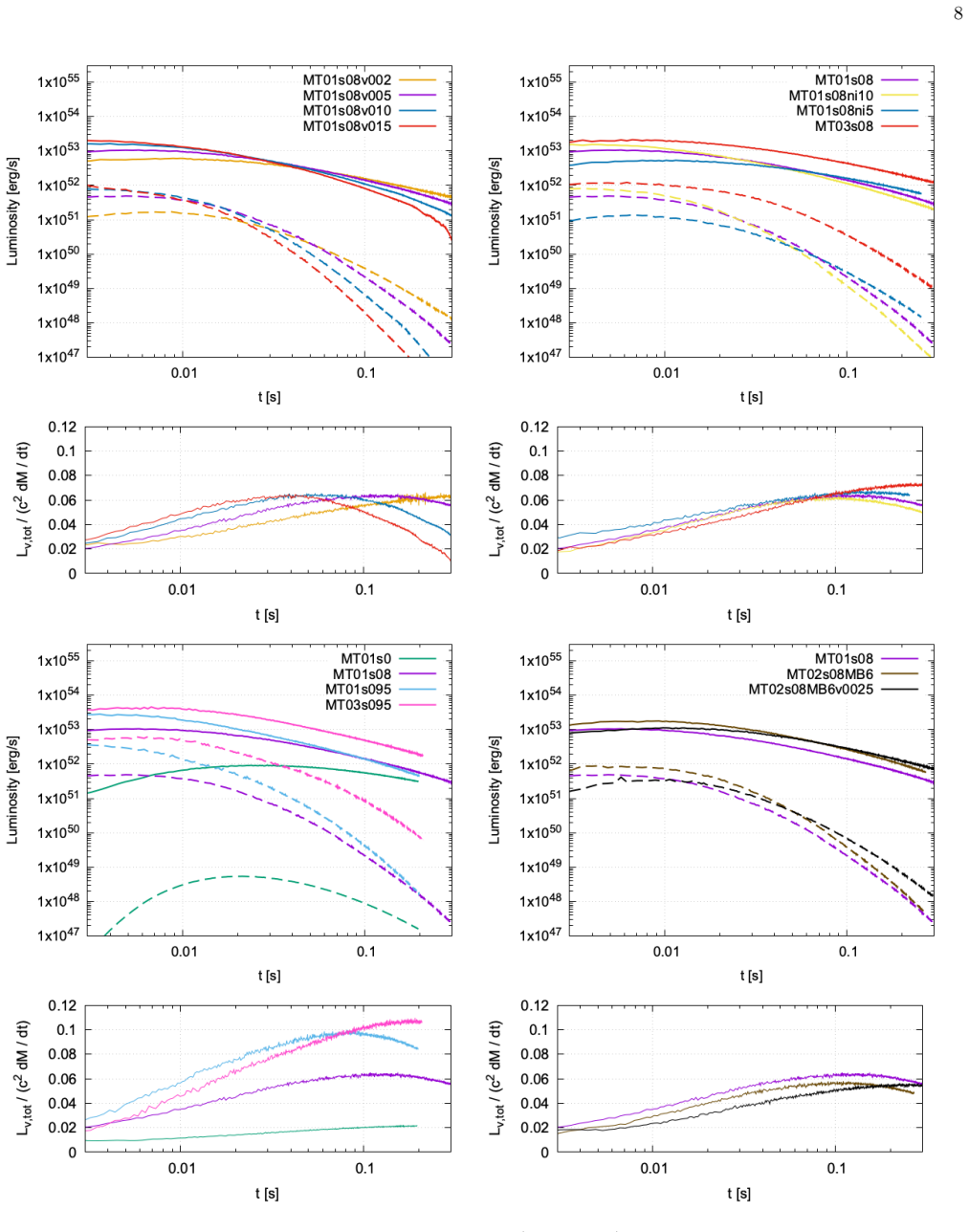
The central quantity is the pair-annihilation energy deposition rate $L_{\rm pair}$, obtained by solving the Boltzmann equation for neutrino transport with a Monte-Carlo method and including non-thermal electron- and heavy-lepton-neutrino spectra. It sets the energy available to create an over-pressured fireball along the rotation axis; whether that fireball becomes a relativistic outflow is decided by how much baryon-rich matter from the torus resides in the funnel. The argument is carried by the scaling $L_{\rm pair} \propto \dot{M}^{9/4} r_{\rm ms}^{-39/8} M_{\rm BH}^{-3/2}$ and the fitting formula $L^{\rm fit}_{\rm pair}(\dot{M})$ with ignition and trapping accretion rates $\dot{M}_1$ and $\dot{M}_2$ that depend on the viscous parameter, black-hole spin, and black-hole mass.
What would settle it
Repeat the fiducial run with a polar-axis gas envelope of density comparable to post-merger ejecta (for instance, $10^7$-$10^8\,{\rm g/cm^3}$ out to $\sim 100\,{\rm km}$): if no component reaches $hw>100$, then pair annihilation alone does not launch relativistic fireballs under realistic merger conditions. A complementary observational check is a redshift-complete sample of compact-merger short GRBs: events above $E_{\rm iso}\sim 10^{51}\,{\rm erg}$ with durations well over 0.2 s would sit above the paper's ceiling.
Extended reading notes
Core claim
The paper's central claim is that neutrino-antineutrino pair annihilation alone can launch relativistic outflows from most black-hole-torus systems formed in compact-object mergers. In the simulations, the annihilation energy deposited in the low-density polar funnel creates a fireball that accelerates matter to terminal Lorentz factors above 100, with an engine duration near 0.1-0.2 s and isotropic-equivalent energies up to roughly $10^{51}$ erg. The exceptions are a non-spinning black hole and a high-viscosity torus, where matter blown off the torus pollutes the funnel. The authors also establish a nearly universal relation between the total annihilation power and the mass accretion rate, $\dot{M}^{9/4}$ at $\dot{M} \lesssim 1\,M_\odot/{\rm s}$, steeply increasing with black-hole spin through the ISCO radius and decreasing with black-hole mass, and package it in a fitting formula with about 30% accuracy.
Load-bearing premise
The polar region above the black hole is taken to be nearly empty of gas because the simulation starts with only a black hole and a torus, with no surrounding merger ejecta; the authors call this the optimal condition for jet launching and note that a realistic dense envelope would suppress the fireball.
Editorial extensions
If this is right
- Faint short gamma-ray bursts with isotropic gamma-ray energy near or below $10^{50}$ erg can be produced by pair-annihilation-driven outflows if torus mass, spin, and black-hole mass are favorable and gamma-ray efficiency is around 10%.
- GRB precursors with energies and timescales of about $10^{49}$-$10^{50}$ erg and about 0.1 s are a natural signature of this engine; the same engine cannot account for the bright short-GRB population.
- The pair-annihilation engine duration of about 0.2 s, if radial stretching lengthens the observed burst by an order of magnitude, remains consistent with observed short-GRB durations; without stretching, only bursts shorter than about 0.2 s would be explained.
- The fitting formula for $L_{\rm pair}(\dot{M})$ can be used as a cheap proxy for annihilation heating in three-dimensional MHD simulations where full neutrino transport is computationally prohibitive.
- Equal-mass binary neutron star mergers with prompt black-hole formation and small tori are unlikely to power energetic pair-annihilation outflows; low-mass, rapidly spinning black-hole-neutron-star mergers are the more likely hosts.
Reading between the lines
- If the claimed robustness of the isotropic energy is right, a population-level test follows: low-luminosity compact-merger short GRBs should show an upper envelope near $10^{51}$ erg in $E_{\rm iso}$, and events above that require a magnetic or otherwise additional engine.
- The simulations' early polar blow-up is partly an artifact of relaxing idealized initial data, so the natural next test is to initialize from a full merger simulation; if merger ejecta keeps the polar density high, fireball energies would drop and the viable parameter space would shrink.
- The same pair-annihilation mechanism acting around a long-lived massive neutron star remnant could provide a sustained energy injection and may connect the model to delayed precursor or extended emission features, although the paper does not simulate that phase.
Editorial analysis
A structured set of objections, weighed in public.
Referee Report
Summary. The manuscript presents axisymmetric general-relativistic viscous-hydrodynamics simulations of black-hole torus systems with Monte-Carlo Boltzmann neutrino transport, surveying black-hole spin, torus mass, viscosity parameter, and angular-momentum profile. It reports that neutrino-antineutrino pair annihilation launches relativistic fireballs in most models, with isotropic-equivalent energies ≲1e51 erg and durations ≲0.2 s, except for models with low BH spin or high viscosity. It also fits an updated scaling relation L_pair(Ṁ) (Eq. 13) claiming ~30% accuracy, and argues that pair-annihilation-driven outflows can account for faint short GRBs and GRB precursors but not the brightest sGRBs. Resolution and floor-density effects are assessed in Appendix A.
Significance. The study is, to my knowledge, the first systematic sweep of BH-torus parameter space with full Boltzmann neutrino transport that dynamically includes pair annihilation. Its main quantitative deliverables—isotropic-equivalent outflow energy and launching duration—are tested against resolution and floor-density variations and show roughly 20% stability, which is a genuine strength. The paper is also unusually candid about its limitations, including the idealized initial condition and the factor-of-2 resolution errors in intrinsic outflow energy and opening angle. If the fitting formula and its extrapolation are properly validated or reframed, the paper will provide a useful community resource: a semi-empirical L_pair(Ṁ) fitting formula, a falsifiable statement that pair annihilation alone cannot explain bright sGRBs, and a concrete target for the faint sGRB and GRB-precursor populations.
major comments (3)
- [V C, Eqs. (13)–(16); VI A] The claimed 30% accuracy of Eq. (13) is an in-sample fit statistic, not a predictive validation. The text states that the remaining exponents in L0, Ṁ1, and Ṁ2 are 'assigned as simple rational numbers that approximately reproduce the numerical fits' and then reports that the formula reproduces the simulations within 30%; no holdout model or cross-validation is presented. This matters because Sec. VI A extrapolates the formula to BH-NS configurations (M_BH=3.7 Msun, χ≈0.9, M_torus≈0.3 Msun) outside the simulated grid and concludes that the spin enhancement and mass suppression 'approximately compensate.' In-sample agreement cannot bound the error of that extrapolation. Please add an out-of-sample test (e.g., leave-one-model-out fits or one additional simulation at a new parameter point), or explicitly restate the BH-NS estimate as an unvalidated interpolation/extrapolation with an order-of-magnitude uncertainty rather than a quantitative prediction.
- [IV; V C; Fig. 4] For MT01s095 and MT03s095, L_pair is computed only in regions with ρ ≤ 1e11 g/cm3, yet Eq. (13) is presented as the total pair-annihilation deposition rate and these models are used in the fit shown in Fig. 4. The excluded high-density region is asserted not to contribute to driving relativistic outflows, but no estimate is given for its contribution to the total L_pair. Because these are the highest-spin models and are central to the spin-scaling part of Eq. (13), the fitting formula is calibrated to a truncated quantity for them. Please quantify the excluded fraction and show that the fit is insensitive to the cutoff, or relabel Eq. (13) as applying to the low-density, outflow-relevant deposition rate.
- [VI B; Abstract; VII] The initial data contain a bare BH-torus system with no surrounding merger-ejecta envelope, and Sec. VI B correctly calls this an 'optimal condition' for fireball formation. Since the polar density is the controlling factor for baryon loading (cf. MT01s08v015, where high viscosity shuts off the outflow), the statements that 'pair annihilation leads to the formation of relativistic fireballs in most cases' and that E_iso values are reliable within an order of magnitude should be presented as upper-limit results under idealized conditions, not as generic predictions for BNS or BH-NS remnants. The abstract and Sec. VII should carry this qualifier explicitly; currently only Sec. VI B does.
minor comments (4)
- [Abstract; Table II] MT03s08 has t90^iso = 0.23 s for hw > 100, while the abstract says durations are ≲0.2 s; the wording should be harmonized (e.g., 'about 0.2 s' or quoting 0.23 s).
- [V C, Eq. (14)] The exponent on αvis,0.05 in Eq. (14) is not written explicitly; please write αvis,0.05^{1} or otherwise clarify that the linear dependence is intended.
- [V C] The analytic estimate L_pair ∝ r^{-39/8} M^{27/8} Ṁ^{9/4} folds in f ∝ rhat^{-1/2} measured from Fig. 3; please label the resulting power-law as a consistency check rather than an independent derivation, since the same simulation set supplies f.
- [VI A] The claim that the spin enhancement and BH-mass suppression 'approximately compensate' for the BH-NS case should cite the uncertainty in the fitted exponents (e.g., the difference between the numerical r^{-5} and the analytic r^{-39/8}) and be tied to the validation issue raised in Major Comment 1.
Circularity Check
No significant circularity: Eq. (13) is an in-sample fit, but it is explicitly labeled as a fitting formula and the main fireball/outflow conclusions rest on direct simulation outputs with independent comparisons.
full rationale
The closest thing to a circular step is the 30% accuracy statement for Eq. (13) in Sec. V C, since L0, Mdot1, and Mdot2 are fit parameters and 'the results of the simulations ... are reproduced within 30% error by Eq. (13)' is an in-sample residual, not a holdout prediction. However, the paper consistently calls Eq. (13) a fitting formula and does not base the central claim of pair-annihilation-driven relativistic fireballs on it; that claim is established by direct simulation measurements of Lpair and Ljet,>Gamma (Eqs. 6 and 7) and by the control without pair annihilation cited from the authors' prior work [89], which is a legitimate numerical result rather than a uniqueness theorem or ansatz smuggled through self-citation. The Sec. VI A application to BH-NS remnants is an extrapolation using the fitted scaling exponents, and the paper flags the idealized initial profile as the optimal condition, acknowledging that realistic polar envelopes would suppress the outflow; this is a stated limitation, not a definitional loop. Comparisons to the independent works [76] and [98] for neutrino luminosity and pair-annihilation scaling provide external anchors. The remaining self-citations ([88,89]) introduce the numerical method and are not load-bearing in the sense of forbidding alternatives. Thus no derivation in the paper reduces to its own inputs by construction.
Assumptions & free parameters
free parameters (5)
- L0, Mdot1, Mdot2 fitting parameters of Eq. (13) =
L0 = 4.2e52 erg/s * alpha_vis,0.05 * r_ms,0.8^(5/8) * M_BH,3; Mdot1 = 0.020 M_sun/s * alpha_vis,0.05^(5/3) *…
- Effective alpha-viscosity parameter alpha_vis =
0.05 default; varied 0.02, 0.05, 0.1, 0.15
- Numerical floor density rho_floor,0 =
1 g/cm^3 (and 0.1 g/cm^3 in MT01s08DF01)
- Initial torus entropy per baryon =
6 k_B
- MC packet target Ntrg =
120 (36 for MT01s095, MT03s095)
assumptions (7)
- standard math Fixed Kerr-Schild background metric for the black hole
- domain assumption Axisymmetry and equatorial plane symmetry
- domain assumption Alpha-viscosity prescription for angular momentum transport
- domain assumption Neutrino interaction rates from Bruenn (1985) and Horowitz (2002)
- ad hoc to paper Idealized initial condition: isolated torus without merger ejecta envelope
- ad hoc to paper Restriction of Lpair integral to rho <= 10^11 g/cm^3 for MT01s095 and MT03s095
- ad hoc to paper Use of f proportional to r_ms^(-1/2) from their own Fig. 3 in the analytic scaling estimate
Cite this review
Pith. "Pith review of Neutrino pair annihilation driven jets from black-hole torus systems." pith.science (2026). https://pith.science/paper/MPLQS2JJ
@misc{pith2026250601679,
  author       = {Pith},
  title        = {Pith review of: Neutrino pair annihilation driven jets from black-hole torus systems},
  year         = {2026},
  howpublished = {\url{https://pith.science/paper/MPLQS2JJ}},
  note         = {Machine review of arXiv:2506.01679}
}
abstract
We perform axisymmetric general relativistic radiation-viscous hydrodynamics simulations of black hole (BH)-torus systems with full Boltzmann Monte-Carlo neutrino transport to investigate the role of neutrino-antineutrino pair annihilation in launching relativistic outflows. Our models span a wide range of BH spins, torus masses, and viscosity parameters. We find that the pair annihilation leads to the formation of relativistic fireballs in most cases, except for those with low black-hole spin and high viscosity. The isotropic-equivalent energies of these outflows reach $\lesssim 10^{51}\,{\rm erg}$ with durations $\lesssim 0.2\,{\rm s}$. While this is insufficient to explain the brightest short gamma-ray bursts (sGRBs), our results suggest that the pair annihilation may account for some low-luminosity sGRBs and GRB precursors. We also provide updated scaling relations for the pair annihilation energy deposition rate as a function of accretion rate, and discuss the sensitivity of outflow properties to numerical resolution and floor density.
Figures


Figures from the paper (11 more)


Reference graph
Works this paper leans on
-
[89]
K. Kawaguchi, S. Fujibayashi, and M. Shibata, Phys. Rev. D 111, 023015 (2025), arXiv:2410.02380 [astro- ph.HE]
arXiv 2025
-
[1]
Paczynski, ApJ 308, L43 (1986)
B. Paczynski, ApJ 308, L43 (1986)
1986
-
[2]
Goodman, ApJ 308, L47 (1986)
J. Goodman, ApJ 308, L47 (1986)
1986
-
[3]
W. Fong, E. Berger, and D. B. Fox, ApJ 708, 9 (2010), arXiv:0909.1804 [astro-ph.HE]
arXiv 2010
-
[4]
W.-f. Fong, A. E. Nugent, Y. Dong, E. Berger, K. Pa- terson, R. Chornock, A. Levan, P. Blanchard, K. D. Alexander, J. Andrews, B. E. Cobb, A. Cucchiara, D. Fox, C. L. Fryer, A. C. Gordon, C. D. Kilpatrick, R. Lunnan, R. Margutti, A. Miller, P. Milne, M. Nicholl, D. Perley, J. Rastinejad, A. R. Escorial, G. Schroeder, N. Smith, N. Tanvir, and G. Terreran, ...
arXiv 2022
-
[5]
A. E. Nugent, W.-F. Fong, Y. Dong, J. Leja, E. Berger, M. Zevin, R. Chornock, B. E. Cobb, L. Z. Kelley, C. D. Kilpatrick, A. Levan, R. Margutti, K. Paterson, D. Per- ley, A. R. Escorial, N. Smith, and N. Tanvir, ApJ 940, 57 (2022), arXiv:2206.01764 [astro-ph.GA]
arXiv 2022
-
[6]
B. O’Connor, E. Troja, S. Dichiara, P. Beniamini, S. B. Cenko, C. Kouveliotou, J. B. Gonz´ alez, J. Durbak, P. Gatkine, A. Kutyrev, T. Sakamoto, R. S´ anchez- Ram ´ ırez, and S. Veilleux, MNRAS515, 4890 (2022), arXiv:2204.09059 [astro-ph.HE]
arXiv 2022
-
[7]
K. Iwamoto, P. A. Mazzali, K. Nomoto, H. Umeda, T. Nakamura, F. Patat, I. J. Danziger, T. R. Young, T. Suzuki, T. Shigeyama, T. Augusteijn, V. Doublier, J.-F. Gonzalez, H. Boehnhardt, J. Brewer, O. R. Hain- aut, C. Lidman, B. Leibundgut, E. Cappellaro, M. Tu- ratto, T. J. Galama, P. M. Vreeswijk, C. Kouveliotou, J. van Paradijs, E. Pian, E. Palazzi, and F...
arXiv 1998
Show all 122 references
-
[8]
K. Z. Stanek, T. Matheson, P. M. Garnavich, P. Mar- tini, P. Berlind, N. Caldwell, P. Challis, W. R. Brown, R. Schild, K. Krisciunas, M. L. Calkins, J. C. Lee, N. Hathi, R. A. Jansen, R. Windhorst, L. Echevarria, D. J. Eisenstein, B. Pindor, E. W. Olszewski, P. Hard- ing, S. T...
2003 arXiv
-
[9]
A. I. MacFadyen and S. E. Woosley, ApJ 524, 262 (1999), astro-ph/9810274
1999 arXiv
-
[10]
Shibata, S
M. Shibata, S. Fujibayashi, S. Wanajo, K. Ioka, A. T.-L. Lam, and Y. Sekiguchi, arXiv (2025), arXiv:2502.02077 [astro-ph.HE]
2025 arXiv
-
[11]
Nakar, Phys
E. Nakar, Phys. Rept. 442, 166 (2007), arXiv:astro- ph/0701748
2007
-
[12]
Berger, Ann
E. Berger, Ann. Rev. Astron. Astrophys. 52, 43 (2014), arXiv:1311.2603 [astro-ph.HE]
2014 arXiv
-
[13]
B. P. Gompertz et al., Nature Astron. 7, 67 (2023), arXiv:2205.05008 [astro-ph.HE]
2023 arXiv
-
[14]
J. C. Rastinejad et al., Nature 612, 223 (2022), arXiv:2204.10864 [astro-ph.HE]
2022 arXiv
-
[15]
Troja et al., Nature 612, 228 (2022), arXiv:2209.03363 [astro-ph.HE]
E. Troja et al., Nature 612, 228 (2022), arXiv:2209.03363 [astro-ph.HE]
2022 arXiv
-
[16]
A. J. Levan et al. (JWST), Nature 626, 737 (2024), arXiv:2307.02098 [astro-ph.HE]
2024 arXiv
-
[17]
R. D. Blandford and D. G. Payne, Mon. Not. Roy. As- tron. Soc. 199, 883 (1982)
1982
-
[18]
S. S. Komissarov, Mon. Not. Roy. Astron. Soc. 359, 801 (2005), arXiv:astro-ph/0501599
2005 arXiv
-
[19]
J. C. McKinney, Mon. Not. Roy. Astron. Soc. 368, 1561 (2006), arXiv:astro-ph/0603045
2006 arXiv
-
[20]
M. V. Barkov and S. S. Komissarov, Mon. Not. Roy. Astron. Soc. 385, 28 (2008), arXiv:0710.2654 [astro-ph]
2008 arXiv
-
[21]
S. S. Komissarov and M. V. Barkov, Monthly Notices of the Royal Astronomical Society 397, 1153–1168 (2009)
2009
-
[22]
Tchekhovskoy, R
A. Tchekhovskoy, R. Narayan, and J. C. McKin- ney, Mon. Not. Roy. Astron. Soc. 418, L79 (2011), arXiv:1108.0412 [astro-ph.HE]
2011 arXiv
-
[23]
Bromberg and A
O. Bromberg and A. Tchekhovskoy, Mon. Not. Roy. As- tron. Soc. 456, 1739 (2016), arXiv:1508.02721 [astro- ph.HE]
2016 arXiv
-
[24]
Gottlieb, A
O. Gottlieb, A. Lalakos, O. Bromberg, M. Liska, and A. Tchekhovskoy, Mon. Not. Roy. Astron. Soc. 510, 4962 (2022), arXiv:2109.14619 [astro-ph.HE]
2022 arXiv
-
[25]
Hayashi, K
K. Hayashi, K. Kiuchi, K. Kyutoku, Y. Sekiguchi, and M. Shibata, (2024), arXiv:2410.10958 [astro-ph.HE]
2024 arXiv
-
[26]
B. D. Metzger, D. Giannios, T. A. Thompson, N. Buc- ciantini, and E. Quataert, MNRAS 413, 2031 (2011), arXiv:1012.0001 [astro-ph.HE]. 21
2011 arXiv
-
[27]
M¨ osta, D
P. M¨ osta, D. Radice, R. Haas, E. Schnetter, and S. Bernuzzi, Astrophys. J. Lett. 901, L37 (2020), arXiv:2003.06043 [astro-ph.HE]
2020 arXiv
-
[28]
E. R. Most and E. Quataert, Astrophys. J. Lett. 947, L15 (2023), arXiv:2303.08062 [astro-ph.HE]
2023 arXiv
-
[29]
Kiuchi, A
K. Kiuchi, A. Reboul-Salze, M. Shibata, and Y. Sekiguchi, Nature Astron. 8, 298 (2024), arXiv:2306.15721 [astro-ph.HE]
2024 arXiv
-
[30]
Meszaros and M
P. Meszaros and M. J. Rees, ApJ 405, 278 (1993)
1993
-
[31]
Jaroszynski, A&A 305, 839 (1996), arXiv:astro- ph/9506062 [astro-ph]
M. Jaroszynski, A&A 305, 839 (1996), arXiv:astro- ph/9506062 [astro-ph]
1996
-
[32]
Popham, S
R. Popham, S. E. Woosley, and C. Fryer, ApJ 518, 356 (1999), arXiv:astro-ph/9807028 [astro-ph]
1999 arXiv
-
[33]
Shibata and K
M. Shibata and K. Hotokezaka, Ann. Rev. Nucl. Part. Sci. 69, 41 (2019), arXiv:1908.02350 [astro-ph.HE]
2019 arXiv
-
[34]
Kyutoku, M
K. Kyutoku, M. Shibata, and K. Taniguchi, Living Rev. Rel. 24, 5 (2021), arXiv:2110.06218 [astro-ph.HE]
2021 arXiv
-
[35]
Shibata, S
M. Shibata, S. Fujibayashi, K. Hotokezaka, K. Kiuchi, K. Kyutoku, Y. Sekiguchi, and M. Tanaka, Phys. Rev. D96, 123012 (2017), arXiv:1710.07579 [astro-ph.HE]
2017 arXiv
-
[36]
Fujibayashi, K
S. Fujibayashi, K. Kiuchi, N. Nishimura, Y. Sekiguchi, and M. Shibata, Astrophys. J. 860, 64 (2018), arXiv:1711.02093 [astro-ph.HE]
2018 arXiv
-
[37]
Fujibayashi, M
S. Fujibayashi, M. Shibata, S. Wanajo, K. Kiuchi, K. Kyutoku, and Y. Sekiguchi, Phys. Rev. D 101, 083029 (2020), arXiv:2001.04467 [astro-ph.HE]
2020 arXiv
-
[38]
Hayashi, S
K. Hayashi, S. Fujibayashi, K. Kiuchi, K. Kyutoku, Y. Sekiguchi, and M. Shibata, Phys. Rev. D106, 023008 (2022), arXiv:2111.04621 [astro-ph.HE]
2022 arXiv
-
[39]
Hayashi, K
K. Hayashi, K. Kiuchi, K. Kyutoku, Y. Sekiguchi, and M. Shibata, Phys. Rev. D 107, 123001 (2023), arXiv:2211.07158 [astro-ph.HE]
2023 arXiv
-
[40]
Kiuchi, S
K. Kiuchi, S. Fujibayashi, K. Hayashi, K. Kyutoku, Y. Sekiguchi, and M. Shibata, Phys. Rev. Lett. 131, 011401 (2023), arXiv:2211.07637 [astro-ph.HE]
2023 arXiv
-
[41]
O. Just, V. Vijayan, Z. Xiong, S. Goriely, T. Soulta- nis, A. Bauswein, J. Guilet, H. T. Janka, H.-T. Janka, and G. Mart ´ ınez-Pinedo, Astrophys. J. Lett.951, L12 (2023), arXiv:2302.10928 [astro-ph.HE]
2023 arXiv
-
[42]
Shibata, S
M. Shibata, S. Fujibayashi, and Y. Sekiguchi, Phys. Rev. D 104, 063026 (2021), arXiv:2109.08732 [astro-ph.HE]
2021 arXiv
-
[43]
Shibata, S
M. Shibata, S. Fujibayashi, and Y. Sekiguchi, Phys. Rev. D 103, 043022 (2021), arXiv:2102.01346 [astro-ph.HE]
2021 arXiv
-
[44]
Muller, H.-T
B. Muller, H.-T. Janka, and H. Dimmelmeier, Astro- phys. J. Suppl. 189, 104 (2010), arXiv:1001.4841 [astro- ph.SR]
2010 arXiv
-
[45]
Fujibayashi, K
S. Fujibayashi, K. Takahashi, Y. Sekiguchi, and M. Shi- bata, Astrophys. J. 919, 80 (2021), arXiv:2102.04467 [astro-ph.HE]
2021 arXiv
-
[46]
Fujibayashi, Y
S. Fujibayashi, Y. Sekiguchi, M. Shibata, and S. Wanajo, Astrophys. J. 956, 100 (2023), arXiv:2212.03958 [astro-ph.HE]
2023 arXiv
-
[47]
Fujibayashi, A
S. Fujibayashi, A. T.-L. Lam, M. Shibata, and Y. Sekiguchi, Phys. Rev. D 109, 023031 (2024), arXiv:2309.02161 [astro-ph.HE]
2024 arXiv
-
[48]
Shibata, S
M. Shibata, S. Fujibayashi, A. T.-L. Lam, K. Ioka, and Y. Sekiguchi, Phys. Rev. D 109, 043051 (2024), arXiv:2309.12086 [astro-ph.HE]
2024 arXiv
-
[49]
Kuroda and M
T. Kuroda and M. Shibata, Mon. Not. Roy. Astron. Soc. 526, 152 (2023), arXiv:2307.06192 [astro-ph.HE]
2023 arXiv
-
[50]
Shibagaki, T
S. Shibagaki, T. Kuroda, K. Kotake, T. Takiwaki, and T. Fischer, Mon. Not. Roy. Astron. Soc. 531, 3732 (2024), arXiv:2309.05161 [astro-ph.HE]
2024 arXiv
-
[51]
Kuroda and M
T. Kuroda and M. Shibata, Mon. Not. Roy. Astron. Soc. 533, L107 (2024), arXiv:2404.02792 [astro-ph.HE]
2024 arXiv
-
[52]
D. Issa, O. Gottlieb, B. Metzger, J. Jacquemin-Ide, M. Liska, F. Foucart, G. Halevi, and A. Tchekhovskoy, (2024), arXiv:2410.02852 [astro-ph.HE]
2024 arXiv
-
[53]
S. W. Bruenn, Astrophys. J. Suppl. 58, 771 (1985)
1985
-
[54]
Stellar Collapse (Springer Netherlands, 2004)
2004
-
[55]
Galeazzi, W
F. Galeazzi, W. Kastaun, L. Rezzolla, and J. A. Font, Phys. Rev. D 88, 064009 (2013), arXiv:1306.4953 [gr- qc]
2013 arXiv
-
[56]
Neilsen, S
D. Neilsen, S. L. Liebling, M. Anderson, L. Lehner, E. O’Connor, and C. Palenzuela, Phys. Rev. D 89, 104029 (2014), arXiv:1403.3680 [gr-qc]
2014 arXiv
-
[57]
H. R. Takahashi and K. Ohsuga, ApJ 772, 127 (2013), arXiv:1306.0049 [astro-ph.HE]
2013 arXiv
-
[58]
Sadowski, R
A. Sadowski, R. Narayan, J. C. McKinney, and A. Tchekhovskoy, MNRAS 439, 503 (2014), arXiv:1311.5900 [astro-ph.HE]
2014 arXiv
-
[59]
J. C. McKinney, A. Tchekhovskoy, A. Sadowski, and R. Narayan, MNRAS441, 3177 (2014), arXiv:1312.6127 [astro-ph.CO]
2014 arXiv
-
[60]
Sadowski, R
A. Sadowski, R. Narayan, A. Tchekhovskoy, D. Abarca, Y. Zhu, and J. C. McKinney, MNRAS 447, 49 (2015), arXiv:1407.4421 [astro-ph.HE]
2015 arXiv
-
[61]
Sekiguchi, K
Y. Sekiguchi, K. Kiuchi, K. Kyutoku, and M. Shi- bata, Phys. Rev. D91, 064059 (2015), arXiv:1502.06660 [astro-ph.HE]
2015 arXiv
-
[62]
Foucart, E
F. Foucart, E. O’Connor, L. Roberts, M. D. Duez, R. Haas, L. E. Kidder, C. D. Ott, H. P. Pfeiffer, M. A. Scheel, and B. Szilagyi, Phys. Rev. D91, 124021 (2015), arXiv:1502.04146 [astro-ph.HE]
2015 arXiv
-
[63]
Sekiguchi, K
Y. Sekiguchi, K. Kiuchi, K. Kyutoku, M. Shibata, and K. Taniguchi, Phys. Rev. D93, 124046 (2016), arXiv:1603.01918 [astro-ph.HE]
2016 arXiv
-
[64]
Radice, F
D. Radice, F. Galeazzi, J. Lippuner, L. F. Roberts, C. D. Ott, and L. Rezzolla, Mon. Not. Roy. Astron. Soc. 460, 3255 (2016), arXiv:1601.02426 [astro-ph.HE]
2016 arXiv
-
[65]
Radice, S
D. Radice, S. Bernuzzi, A. Perego, and R. Haas, Mon. Not. Roy. Astron. Soc. 512, 1499 (2022), arXiv:2111.14858 [astro-ph.HE]
2022 arXiv
-
[66]
Kiuchi, L
K. Kiuchi, L. E. Held, Y. Sekiguchi, and M. Shi- bata, arXiv e-prints , arXiv:2205.04487 (2022), arXiv:2205.04487 [astro-ph.HE]
2022 arXiv
-
[67]
L. Sun, M. Ruiz, S. L. Shapiro, and A. Tsokaros, Phys. Rev. D 105, 104028 (2022), arXiv:2202.12901 [astro- ph.HE]
2022 arXiv
-
[68]
L. R. Werneck et al., Phys. Rev. D 107, 044037 (2023), arXiv:2208.14487 [gr-qc]
2023 arXiv
-
[69]
Foucart, P
F. Foucart, P. C.-K. Cheong, M. D. Duez, L. E. Kid- der, H. P. Pfeiffer, and M. A. Scheel, arXiv (2024), arXiv:2407.15989 [astro-ph.HE]
2024 arXiv
-
[70]
Ruffert and H
M. Ruffert and H. T. Janka, Astron. Astrophys. 344, 573 (1999), arXiv:astro-ph/9809280
1999 arXiv
-
[71]
Setiawan, M
S. Setiawan, M. Ruffert, and H.-T. Janka, Mon. Not. Roy. Astron. Soc. 352, 753 (2004), arXiv:astro- ph/0402481
2004
-
[72]
Setiawan, M
S. Setiawan, M. Ruffert, and H. T. Janka, Astron. As- trophys. 458, 553 (2006), arXiv:astro-ph/0509300
2006 arXiv
-
[73]
Richers, D
S. Richers, D. Kasen, E. O’Connor, R. Fern´ andez, and C. D. Ott, Astrophys. J. 813, 38 (2015), arXiv:1507.03606 [astro-ph.HE]
2015 arXiv
-
[74]
Perego, H
A. Perego, H. Yasin, and A. Arcones, J. Phys. G 44, 084007 (2017), arXiv:1701.02017 [astro-ph.HE]. 22
2017 arXiv
-
[75]
Sumiyoshi, S
K. Sumiyoshi, S. Fujibayashi, Y. Sekiguchi, and M. Shi- bata, Astrophys. J. 907, 92 (2021), arXiv:2010.10865 [astro-ph.HE]
2021 arXiv
-
[76]
O. Just, M. Obergaulinger, H. T. Janka, A. Bauswein, and N. Schwarz, Astrophys. J. Lett. 816, L30 (2016), arXiv:1510.04288 [astro-ph.HE]
2016 arXiv
-
[77]
Fujibayashi, Y
S. Fujibayashi, Y. Sekiguchi, K. Kiuchi, and M. Shibata, Astrophys. J. 846, 114 (2017), arXiv:1703.10191 [astro- ph.HE]
2017 arXiv
-
[78]
Abdikamalov, A
E. Abdikamalov, A. Burrows, C. D. Ott, F. L¨ offler, E. O’Connor, J. C. Dolence, and E. Schnetter, ApJ755, 111 (2012), arXiv:1203.2915 [astro-ph.SR]
2012 arXiv
- [79]
-
[80]
B. R. Ryan, J. C. Dolence, and C. F. Gammie, ApJ807, 31 (2015), arXiv:1505.05119 [astro-ph.HE]
2015 arXiv
-
[82]
J. M. Miller, B. R. Ryan, J. C. Dolence, A. Burrows, C. J. Fontes, C. L. Fryer, O. Korobkin, J. Lippuner, M. R. Mumpower, and R. T. Wollaeger, Phys. Rev. D 100, 023008 (2019), arXiv:1905.07477 [astro-ph.HE]
2019 arXiv
-
[83]
J. M. Miller, B. R. Ryan, and J. C. Dolence, ApJS 241, 30 (2019), arXiv:1903.09273 [astro-ph.IM]
2019 arXiv
-
[84]
Foucart, M
F. Foucart, M. D. Duez, F. Hebert, L. E. Kidder, H. P. Pfeiffer, and M. A. Scheel, Astrophys. J. Lett. 902, L27 (2020), arXiv:2008.08089 [astro-ph.HE]
2020 arXiv
-
[85]
Foucart, M
F. Foucart, M. D. Duez, F. H´ ebert, L. E. Kidder, P. Ko- varik, H. P. Pfeiffer, and M. A. Scheel, ApJ 920, 82 (2021), arXiv:2103.16588 [astro-ph.HE]
2021 arXiv
-
[86]
N. Roth, P. Anninos, P. B. Robinson, J. L. Peterson, B. Polak, T. K. Mangan, and K. Beyer, ApJ 933, 226 (2022), arXiv:2206.01760 [astro-ph.IM]
2022 arXiv
-
[87]
M. R. Izquierdo, J. F. Abalos, and C. Palenzuela, Phys. Rev. D 109, 043044 (2024), arXiv:2312.09275 [astro- ph.HE]
2024 arXiv
-
[88]
Kawaguchi, S
K. Kawaguchi, S. Fujibayashi, and M. Shibata, Phys. Rev. D 107, 023026 (2023), arXiv:2209.12472 [astro- ph.HE]
2023 arXiv
-
[90]
J. A. Font, J. M. Ib´ a˜ nez, and P. Papadopoulos, ApJ 507, L67 (1998), arXiv:astro-ph/9805269 [astro-ph]
1998 arXiv
-
[91]
Shibata, K
M. Shibata, K. Kiuchi, and Y.-i. Sekiguchi, Phys. Rev. D 95, 083005 (2017), arXiv:1703.10303 [astro-ph.HE]
2017 arXiv
-
[92]
S. A. Balbus and J. F. Hawley, Rev. Mod. Phys. 70, 1 (1998)
1998
-
[93]
N. I. Shakura and R. A. Sunyaev, A&A 24, 337 (1973)
1973
-
[94]
C. J. Horowitz, Phys. Rev. D 65, 043001 (2002), arXiv:astro-ph/0109209
2002 arXiv
-
[95]
Meszaros and M
P. Meszaros and M. J. Rees, Astrophys. J. 530, 292 (2000), arXiv:astro-ph/9908126
2000 arXiv
-
[96]
B. D. Metzger, A. L. Piro, and E. Quataert, Mon. Not. Roy. Astron. Soc.390, 781 (2008), arXiv:0805.4415 [astro-ph]
2008 arXiv
-
[97]
Chen and A
W.-X. Chen and A. M. Beloborodov, Astrophys. J. 657, 383 (2007), arXiv:astro-ph/0607145
2007 arXiv
-
[98]
Zalamea and A
I. Zalamea and A. M. Beloborodov, Mon. Not. Roy. Astron. Soc. 410, 2302 (2011), arXiv:1003.0710 [astro- ph.HE]
2011 arXiv
-
[99]
Agarwal, D
A. Agarwal, D. M. Siegel, B. D. Metzger, and C. Nagele, arXiv (2025), arXiv:2503.15729 [astro-ph.HE]
2025 arXiv
-
[100]
M. A. Aloy, H. T. Janka, and E. Muller, eConf C041213, 0109 (2004), arXiv:astro-ph/0408291
2004 arXiv
-
[101]
Birkl, M
R. Birkl, M. A. Aloy, H. T. Janka, and E. Mueller, Astron. Astrophys. 463, 51 (2007), arXiv:astro- ph/0608543
2007
-
[102]
Liu, F.-W
Z.-Y. Liu, F.-W. Zhang, and S.-Y. Zhu, Research in As- tronomy and Astrophysics 21, 254 (2021)
2021
-
[103]
Janka, P
H.-T. Janka, P. A. Mazzali, M. A. Aloy, and E. Pian, As- trophys. J. 645, 1305 (2006), arXiv:astro-ph/0509722
2006 arXiv
-
[104]
Troja, S
E. Troja, S. Rosswog, and N. Gehrels, ApJ 723, 1711 (2010), arXiv:1009.1385 [astro-ph.HE]
2010 arXiv
-
[105]
Xiao et al., Astrophys
S. Xiao et al., Astrophys. J. 970, 6 (2024), arXiv:2205.02186 [astro-ph.HE]
2024 arXiv
-
[106]
Kiuchi, Y
K. Kiuchi, Y. Sekiguchi, M. Shibata, and K. Taniguchi, Phys. Rev. D80, 064037 (2009), arXiv:0904.4551 [gr- qc]
2009 arXiv
-
[107]
Dietrich, M
T. Dietrich, M. Ujevic, W. Tichy, S. Bernuzzi, and B. Bruegmann, Phys. Rev. D95, 024029 (2017), arXiv:1607.06636 [gr-qc]
2017 arXiv
-
[108]
Schianchi, M
F. Schianchi, M. Ujevic, A. Neuweiler, H. Gieg, I. Markin, and T. Dietrich, Phys. Rev. D 109, 123011 (2024), arXiv:2402.16626 [astro-ph.HE]
2024 arXiv
-
[109]
Karakas, R
B. Karakas, R. Matur, and M. Ruffert, arXiv (2024), arXiv:2405.13687 [astro-ph.HE]
2024
-
[110]
Hotokezaka, K
K. Hotokezaka, K. Kiuchi, K. Kyutoku, T. Muranushi, Y.-i. Sekiguchi, M. Shibata, and K. Taniguchi, Phys. Rev. D 88, 044026 (2013), arXiv:1307.5888 [astro- ph.HE]
2013 arXiv
-
[111]
Kiuchi, K
K. Kiuchi, K. Kyutoku, M. Shibata, and K. Taniguchi, Astrophys. J. 876, L31 (2019), arXiv:1903.01466 [astro- ph.HE]
2019 arXiv
-
[112]
Gottlieb, S
O. Gottlieb, S. Moseley, T. Ramirez-Aguilar, A. Murguia-Berthier, M. Liska, and A. Tchekhovskoy, Astrophys. J. Lett. 933, L2 (2022), arXiv:2205.01691 [astro-ph.HE]
2022 arXiv
-
[113]
Foucart, Mon
F. Foucart, Mon. Not. Roy. Astron. Soc. 475, 4186 (2018), arXiv:1708.08452 [astro-ph.HE]
2018 arXiv
-
[114]
Kyutoku, K
K. Kyutoku, K. Ioka, H. Okawa, M. Shibata, and K. Taniguchi, Phys. Rev. D92, 044028 (2015), arXiv:1502.05402 [astro-ph.HE]
2015 arXiv
-
[115]
Kyutoku, H
K. Kyutoku, H. Okawa, M. Shibata, and K. Taniguchi, Phys. Rev. D 84, 064018 (2011), arXiv:1108.1189 [astro- ph.HE]
2011 arXiv
-
[116]
Rosswog, Astrophys
S. Rosswog, Astrophys. J. 634, 1202 (2005), arXiv:astro-ph/0508138 [astro-ph]
2005 arXiv
-
[117]
Shibata and K
M. Shibata and K. Taniguchi, Phys. Rev. D77, 084015 (2008), arXiv:0711.1410 [gr-qc]
2008 arXiv
-
[118]
Z. B. Etienne, Y. T. Liu, S. L. Shapiro, and T. W. Baumgarte, Phys. Rev. D79, 044024 (2009), arXiv:0812.2245 [astro-ph]
2009 arXiv
-
[119]
Lovelace, M
G. Lovelace, M. D. Duez, F. Foucart, L. E. Kidder, H. P. Pfeiffer, M. A. Scheel, and B. Szilegyi, Class. Quant. Grav. 30, 135004 (2013), arXiv:1302.6297 [gr-qc]
2013 arXiv
-
[120]
Foucart, T
F. Foucart, T. Hinderer, and S. Nissanke, Phys. Rev. D98, 081501 (2018), arXiv:1807.00011 [astro-ph.HE]
2018 arXiv
-
[121]
Fern´ andez, A
R. Fern´ andez, A. Tchekhovskoy, E. Quataert, F. Fou- cart, and D. Kasen, Mon. Not. Roy. Astron. Soc. 482, 3373 (2019), arXiv:1808.00461 [astro-ph.HE]
2019 arXiv
-
[122]
I. M. Christie, A. Lalakos, A. Tchekhovskoy, R. Fern´ andez, F. Foucart, E. Quataert, and D. Kasen, Mon. Not. Roy. Astron. Soc. 490, 4811 (2019), arXiv:1907.02079 [astro-ph.HE]
2019 arXiv
-
[123]
Fujibayashi, M
S. Fujibayashi, M. Shibata, S. Wanajo, K. Kiuchi, K. Kyutoku, and Y. Sekiguchi, Phys. Rev. D 102, 23 123014 (2020), arXiv:2009.03895 [astro-ph.HE]. Appendix A: Grid resolution and density floor effects The finite grid resolution and presence of floor density in the simulations...
2020 arXiv
Reviewed August 7, 2026 · model on record in the stance chip above.
Discussion (0). Sign in to comment.