REVIEW 1 major objections 5 minor 6 references
Hill's equation, tire tracks and rolling cones
T0 review · 1 major / 5 minor · reviewed 2026-08-14 · deepseek-v4-flash
Pith's one-line read For nonzero-potential Hill's equation, the solution is a rolling of curves in the hyperbolic plane, decomposed into parallel transport and one accumulated rotation.
desk verdict A clean extension of Levi's rolling-cones theorem to SL2(R) that gives a geometric reading of Hill's equation when q≠0, with the caveat explicit and the mathematics checking out. read the letter →
The pith
A machine-rendered reading of the paper's core claim, the machinery that carries it, and where it could break.
The reading
What carries the argument
The load-bearing object is the unit pseudo-sphere $\Sigma$ in the Lie algebra $\mathfrak{sl}_2(\mathbb R)$, equipped with the Ad-invariant inner product $\langle a,b\rangle=2\operatorname{tr}(ab)$, which makes it Minkowski space $\mathbb R^{2,1}$: vectors with negative square form the two-sheeted hyperboloid $H^2$, and vectors with positive square form the one-sheeted hyperboloid $H^{1,1}$. The rolling is carried by the body and space angular-velocity curves $N(t)$ and $n(t)$, and the identity that does the work is the curvature shift $K=k-|a|/|\dot n|$ together with the decomposition $\operatorname{Ad}_{g(t)}=P_n\circ R[\Phi]\circ P_N^{-1}$; this allows the noncommuting family $a(t)$ to be integrated by parallel transport along $N$, a rotation through the accumulated angle $\Phi=\int_0^t|a|\,d\tau$, and parallel transport along $n$.
What would settle it
Numerically integrate $\dot g=a g$ for Hill's equation $\ddot x+q(t)x=0$ with $q(t)=1+\varepsilon\cos t$ and $\varepsilon<1$, compute $n=a/|a|$, $N=g^{-1}a/|g^{-1}a|$, the parallel transports along them, and $\Phi(t)=\int_0^t|a|\,d\tau$, then test the identity $\operatorname{Ad}_{g(t)}=P_n(t)\circ R[\Phi(t)]\circ P_N(t)^{-1}$ at $t=2\pi$: any residual beyond numerical error would disprove the theorem. Since the paper leaves the null-crossing case open, testing $q(t)=\cos t$, where $|a|$ vanishes at isolated instants, would show whether the rolling description survives outside the theorem's hypothesis.
Extended reading notes
Core claim
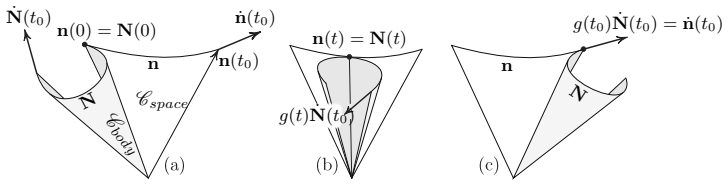
The central claim is that the phase flow of the linear system $\dot x=a(t)x$, with $a(t)\in\mathfrak{sl}_2(\mathbb R)$ and $|a(t)|=2\sqrt{|\det a(t)|}$ never zero, is exactly a rolling without slipping of curves on the unit pseudo-sphere in the three-dimensional Minkowski space $\mathfrak{sl}_2(\mathbb R)\simeq\mathbb R^{2,1}$. Writing $A(t)=g(t)^{-1}a(t)$ for the body angular velocity, the two normalized curves $N(t)=A/|A|$ and $n(t)=a/|a|$ satisfy the contact and no-slip conditions $\operatorname{Ad}_{g(t)}N(t)=n(t)$ and $\operatorname{Ad}_{g(t)}\dot N(t)=\dot n(t)$. The reconstruction formula says the geodesic curvatures are linked by $K=k-|a|/|\dot n|$, and the decomposition formula says $\operatorname{Ad}_{g(t)}=P_n(t)\circ R[\Phi(t)]\circ P_N(t)^{-1}$, where $P_N,P_n$ are parallel transports along the respective curves and $R[\Phi(t)]$ is the pseudo-rotation about the fixed axis $a(0)$ through the accumulated angle $\Phi(t)=\int_0^t|a(\tau)|\,d\tau$. When $a(t)=\begin{pmatrix}0&1\\ -q(t)&0\end{pmatrix}$, this is Hill's equation $\ddot x+q(t)x=0$, so for potentials that never vanish the solutions are described by a rolling of curves in the hyperbolic plane $H^2$ or its Lorentzian analogue $H^{1,1}$.
Load-bearing premise
The entire rolling description requires $|a(t)|\neq 0$ for all time; for Hill's equation this means the potential $q(t)$ never vanishes, and the paper explicitly leaves the case where $q(t)$ crosses zero as an open question.
Editorial extensions
If this is right
- Hill's equation with a nowhere-zero potential can be solved geometrically: reconstruct the body curve by prescribing geodesic curvature $K=k-|a|/|\dot n|$, then read off the fundamental solution from the rolling map.
- The noncommutativity of the matrices $a(t)$ does not prevent a formula containing a cumulative rotation angle; the correction is exactly parallel transport along the two pseudo-spherical curves.
- For the bicycle equation, the geodesic curvature of the body curve is $-1/(\ell\kappa)$; for a closed convex front track, small bicycle length gives hyperbolic monodromy and an unbounded body curve asymptotic to a null line, while large length gives elliptic monodromy and a bounded quasi-periodic ribbon.
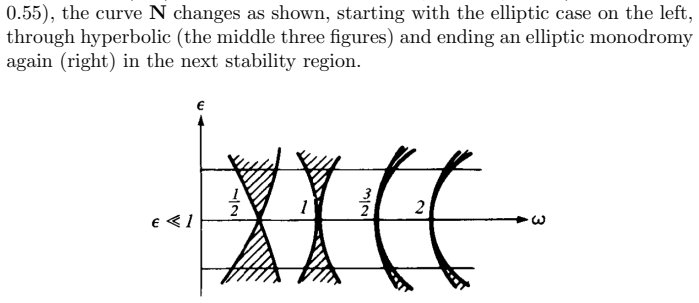
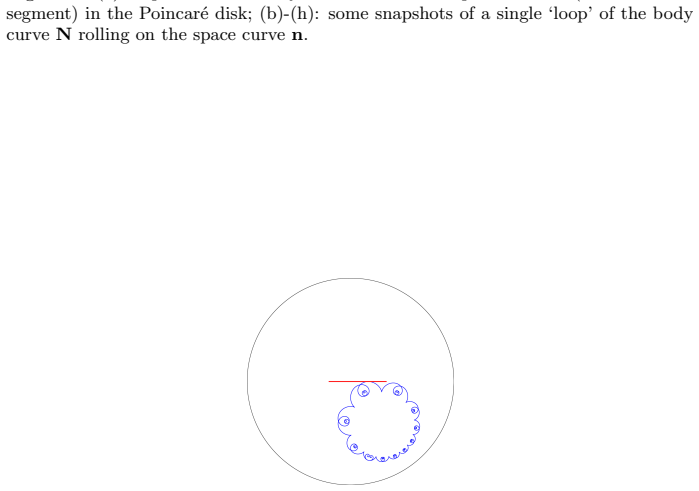
- For the Mathieu equation with $|\epsilon|<1$, stability of the period map is reflected in whether the body curve on $H^2$ is bounded or reaches the circle at infinity, with cusps at $t=n\pi$.
- The decomposition supplies an explicit correction to the naive formula $g(t)=\exp\left(\int_0^t a(\tau)\,d\tau\right)$, making precise how parallel transport accounts for the missing commutators.
Reading between the lines
- The rolling picture suggests a direct numerical stability test for periodic potentials: reconstruct $N$ from $K=-|a|/|\dot n|$ and check whether it stays bounded; boundedness of $N$ should reproduce the elliptic versus hyperbolic dichotomy of the monodromy without first solving the ODE.
- If the null-crossing case $q(t_0)=0$ could be handled through a limiting transition between $H^2$ and $H^{1,1}$, the rolling description would cover the general Hill equation; the paper's Mathieu example already shows cusps where $\dot n$ vanishes, so a mildly singular rolling may be the right language.
- The bicycle relation $K=-1/(\ell\kappa)$, derived in the paper by computation, likely has a geometric explanation connected to the decomposition formula and to the planimeter area formula, so the same machinery may give a synthetic proof of the Prytz-area effect.
- The appearance of the integrated norm $\int|a|$ as the rotation angle suggests that for any linear flow with a non-null generator, the exact solution operator is always parallel transport, one rotation by the accumulated generator norm, and inverse parallel transport; this structure should persist in higher-dimensional symmetric spaces.
Signed reviews
Editorial analysis
A structured set of objections, weighed in public.
Referee Report
Summary. The paper extends Poinsot's classical rolling-cones description of rigid body motion from the orthogonal group SO(3) to the Möbius group PSL2(R) ≃ SO(2,1), using the adjoint action on the Minkowski space sl(2,R). For a smooth curve a(t) in sl(2,R) with |a(t)| ≡ 2√|det a(t)| nonzero, and the fundamental solution g(t) of g' = a g, g(0) = I, the authors define normalized space and body angular velocities n(t) = a/|a| and N(t) = g^{-1}a/|g^{-1}a|, and prove that Ad_{g(t)} rolls N along n without slipping on the unit pseudo-sphere Σ ⊂ sl(2,R) (either the hyperbolic plane H^2 or its Lorentzian analog H^{1,1}). They establish the geodesic curvature relation K = k − |a|/|ṅ| and the decomposition Ad_g = P_n ∘ R[Φ] ∘ P_N^{-1} with Φ = ∫ |a|. As an application, Hill's equation ẍ + q(t)x = 0 is interpreted as rolling without slipping of curves in the hyperbolic plane when q(t) never vanishes. Two examples are worked out in detail: the Mathieu equation (timelike a, H^2) and the planar bicycle equation (spacelike a, H^{1,1}); the latter connects the geodesic curvature of the body curve to the front-wheel track curvature and to the Prytz planimeter formula.
Significance. The paper is a significant contribution to the geometric theory of linear ODEs. The main result is a genuine generalization of Poinsot's theorem to the pseudo-Riemannian setting, and the resulting interpretation of Hill's equation as rolling on the hyperbolic plane appears to be new. The proofs are concise, self-contained, and checkable; they are built on standard facts about parallel transport and geodesic curvature, with careful handling of the indefinite signature. The assumptions are stated honestly: the construction requires |a(t)| ≠ 0, equivalently q(t) ≠ 0 for Hill's equation, and the null-crossing case is explicitly left open. The examples (Mathieu and bicycle) illustrate the theory with clear figures and correct computations, and the side remark on the Prytz formula adds further appeal. Overall, the paper should be well received by readers of differential geometry and dynamical systems.
major comments (1)
- [Section 5, Theorem 3(3)] The decomposition formula is stated without repeating the hypothesis '|ṅ| nonzero' that is used in its proof. The proof invokes equation (26) and Lemma 4.8, both of which require non-vanishing |ṅ|. As stated, the theorem claims the decomposition at points where the curves have cusps or stationary points (e.g., t = nπ in the Mathieu example of Section 6), for which the given proof does not apply. The statement should either add 'If |ṅ| is non-vanishing' to part (3) or include this condition in the theorem's global hypotheses.
minor comments (5)
- [Section 5, Theorem 3, first sentence] The hypothesis says 'non-vanishing |Ǥ|', but the subsequent construction of n and N requires |a|, not |Ǥ|; this appears to be a typographical error.
- [Section 3, Theorem 2, parts (2) and (3)] The symbol |ω| is used in the curvature formula and in the definition of Φ(t), but |ω| is not defined in this theorem; it should be |a|, as defined in the theorem's preamble.
- [Abstract and Section 3] The Hill equation interpretation assumes q(t) ≠ 0 (Remark 3.1), but this caveat is not mentioned in the abstract or in the opening claim of Section 3; a qualifying clause would prevent overstatement.
- [Section 4.2, equation (18)] The phrase 'radial projections' is potentially ambiguous in the indefinite-signature setting; 'normalized curves' or 'projections onto Σ along rays' would be clearer.
- [Section 7] The statement that the geodesic curvatures of N(t)∈H^{1,1} and the front track F(t)∈R^2 are 'reciprocal, up to a factor' is imprecise, since the exact relation is K = −1/(ℓκ); consider rewording to avoid implying a simple signless reciprocal.
Circularity Check
No significant circularity: the central rolling-cone theorems are proved directly from the definitions, and the only self-citations are non-load-bearing.
full rationale
Theorem 3 is self-contained. The no-slip condition follows from Lemma 4.5's identity [a,γ]=0, which is derived from the definitions of a and the conjugation action; the curvature formula (26) is obtained by differentiating \dot n = Ad_g \dot N and decomposing \ddot n modulo span{n,\dot n}; and the decomposition formula follows from Lemma 4.8 together with (26). None of these steps assumes a quantity equal to the target result, and no fitted parameter is renamed as a prediction. The self-citations are [4], used only as motivation and then reproven in the unified proof of Theorem 3, and [2], used only through Prytz's formula in the side-remark Lemma 7.1; neither carries the main claim. Remark 3.1 honestly restricts the result to |a(t)|≠0, which for Hill's equation means q(t)≠0, so the claimed geometric interpretation is not overextended to the null-crossing case. The omission of the |\dot n|≠0 hypothesis in the statement of Theorem 3(3) and the typo '|\dot a|' in the first sentence of Theorem 3 are presentational blemishes, not circular reductions.
Assumptions & free parameters
assumptions (4)
- standard math The standard existence and uniqueness theory for linear ODEs with smooth coefficients, used to define g(t) via g' = a g.
- standard math The properties of parallel transport and geodesic curvature on pseudo-Riemannian manifolds (or on the level sets of the Minkowski quadratic form), as used in Section 4.
- domain assumption The assumption that the given a(t) is smooth and that |a(t)| and |n_dot(t)| are nonvanishing, stated as hypotheses in Theorem 3 and Remark 3.1.
- standard math Poinsot's theorem and Levi's 1996 result are used only as motivation; the paper reproves them in a unified framework and does not rely on them as unproved inputs.
Cite this review
Pith. "Pith review of Hill's equation, tire tracks and rolling cones." pith.science (2026). https://pith.science/paper/MPMDIWUZ
@misc{pith2026190804965,
  author       = {Pith},
  title        = {Pith review of: Hill's equation, tire tracks and rolling cones},
  year         = {2026},
  howpublished = {\url{https://pith.science/paper/MPMDIWUZ}},
  note         = {Machine review of arXiv:1908.04965}
}
abstract
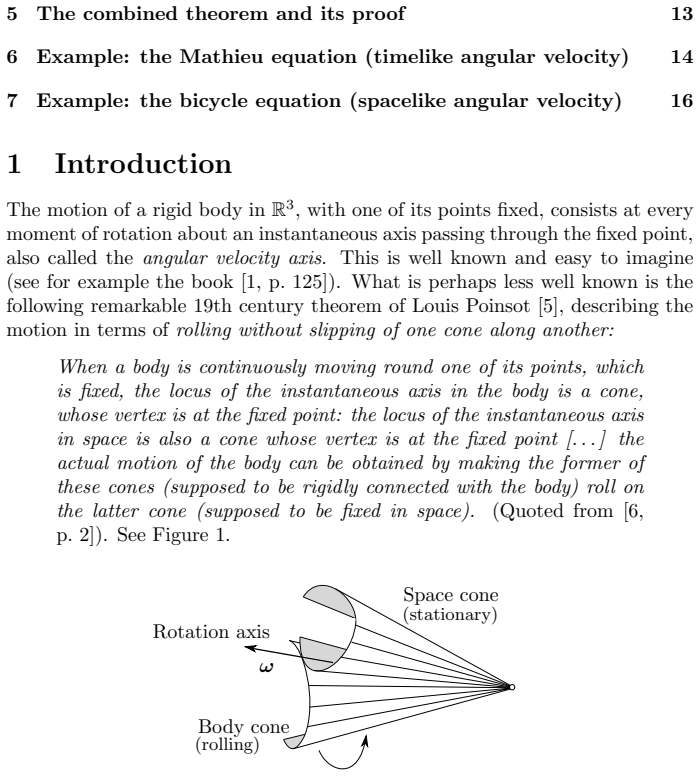
Louis Poinsot has shown in 1854 that the motion of a rigid body, with one of its points fixed, can be described as the rolling without slipping of one cone, the 'body cone', along another, the 'space cone', with their common vertex at the fixed point. This description has been further refined by the second author in 1996, relating the geodesic curvatures of the spherical curves formed by intersecting the cones with the unit sphere in Euclidean $\mathbb{R}^3$, thus enabling a reconstruction of the motion of the body from knowledge of the space cone together with the (time dependent) magnitude of the angular velocity vector. In this article we show that a similar description exists for a time dependent family of unimodular $ 2 \times 2 $ matrices in terms of rolling cones in 3-dimensional Minkowski space $\mathbb{R}^{2,1}$ and the associated 'pseudo spherical' curves, in either the hyperbolic plane $H^2$ or its Lorentzian analog $H^{1,1}$. In particular, this yields an apparently new geometric interpretation of Schr\"odinger's (or Hill's) equation $ \ddot x + q(t) x =0 $ in terms of rolling without slipping of curves in the hyperbolic plane.
Figures

Figures from the paper (11 more)





Reference graph
Works this paper leans on
-
[1]
Arnol’d, Mathematical methods of classical mechanics
V.I. Arnol’d, Mathematical methods of classical mechanics. Vol. 60. Springer Science & Business Media, 2013
work page 2013
-
[2]
G. Bor, M. Levi, R. Perline, S. Tabachnikov, Tire Tracks and Integrable Curve Evolution, Int. Math. Res. Not. IMRN (2018)
work page 2018
-
[3]
Foote, Geometry of the Prytz planimeter, Rep
R. Foote, Geometry of the Prytz planimeter, Rep. Math. Phys. 42 (1998), 249–71
work page 1998
-
[4]
Levi, Composition of rotations and parallel transport
M. Levi, Composition of rotations and parallel transport . Nonlinearity 9.2 (1996), 413
work page 1996
-
[5]
Poinsot, Th´ eorie nouvelle de la rotation des corps
L. Poinsot, Th´ eorie nouvelle de la rotation des corps. Bachelier (1854)
-
[6]
Whittaker, A treatise on the analytical dynamics of particles and rigid bodies
E.T. Whittaker, A treatise on the analytical dynamics of particles and rigid bodies. Cambridge University Press, 2nd edition (1917). 22
work page 1917
Reviewed August 14, 2026 · model on record in the stance chip above.
Discussion (0). Continue with ORCID to comment.