REVIEW 4 major objections 5 minor 102 references
Stellar Physics with High-Resolution UV Spectropolarimetry
T0 review · 4 major / 5 minor · reviewed 2026-08-14 · deepseek-v4-flash
Pith's one-line read UV spectropolarimetry is the missing probe of stellar magnetism.
desk verdict A competent and honest advocacy white paper for UV spectropolarimetry, but the central promise of 3D magnetic mapping is never backed by polarization SNR estimates. read the letter →
The pith
A machine-rendered reading of the paper's core claim, the machinery that carries it, and where it could break.
The reading
What carries the argument
The load-bearing mechanism is the polarization of ultraviolet spectral lines: circular polarization from the Zeeman effect, which encodes magnetic field strength and direction, and linear polarization from scattering, which encodes the geometry of an asymmetric, extended atmosphere or circumstellar structure. In the UV these lines can be formed at high temperatures and low densities, so they probe the very regions—winds, magnetospheres, chromospheres, accretion columns—that optical photospheric lines cannot reach. With high spectral resolution, the line-of-sight velocity shifts the polarization signatures of different spatial regions into different wavelengths, enabling a tomographic reconstruction of the three-dimensional magnetic and thermodynamic structure of the stellar environment.
What would settle it
If, for a magnetic B star whose surface field is already known from optical spectropolarimetry, a UV spectropolarimeter with the proposed sensitivity measured the Stokes V profile of the C IV 1548 Å wind line and found no detectable polarization (or a signal requiring an implausibly different field geometry), the claim that UV wind lines trace the magnetic confinement of stellar winds would be refuted.
Extended reading notes
Core claim
The central claim is that high-resolution UV spectropolarimetry (spectral resolving power of roughly 30,000 or more, over the 90–400 nm range) is the only way to obtain direct, three-dimensional diagnostics of stellar magnetism where it acts on the environment: in winds, magnetospheres, chromospheres, transition regions, and accretion shocks. Unlike optical or near-IR spectropolarimetry, which samples photospheric fields, UV lines form at the low densities and high temperatures of the outer atmosphere and wind, and the paper argues that polarimetry of these lines will deliver the magnetic field geometry of these regions for the first time. It also claims that UV linear polarimetry extends interferometry-like information about deviations from spherical symmetry to objects that are too faint or too small for direct imaging, and that this capability, combined with circular polarization from the Zeeman effect, provides the measurements needed to quantify magnetic braking, mass-loss quenching, and star-planet interaction.
Load-bearing premise
The entire science case presupposes that the predicted ultraviolet polarization signals—Zeeman circular polarization in wind and chromospheric lines, and scattering linear polarization in asymmetric structures—will be strong enough to detect and that their inversion to three-dimensional magnetic and thermodynamic structure will be unambiguous; the paper itself notes that polarization in UV wind-sensitive lines has never been measured and that reflective polarimeters below 123 nm have never flown.
Editorial extensions
If this is right
- Hot-star wind lines measured in circular and linear polarization would give the first 3D maps of magnetospheres, directly testing the confinement of wind material along field lines and the net reduction of mass loss.
- Quantifying how fossil fields brake rotation and quench winds in hot stars would determine whether magnetic massive stars are the progenitors of heavy black holes and pair-instability supernovae.
- For cool stars, time-series UV spectropolarimetry of chromospheric and transition-region lines connects magnetic topology to heating, wind, and UV output, providing an empirical basis for revising the habitable zone.
- Observations of T Tauri stars with the same technique would map accretion shocks and the star-disk interface in 3D, constraining how angular momentum is regulated during star and planet formation.
- Simultaneous UV and visible measurements would link surface spots and field footpoints to coronal mass ejections, winds, and disk structures in one coherent picture.
Reading between the lines
- Should the polarimetric inversion codes be validated on well-mapped stars, the same technique could be extended to metal-poor massive stars in nearby galaxies, covering the metallicity regime where magnetic fields may most strongly alter final fates.
- The paper's emphasis on linear polarization as a probe of asphericity suggests a natural extension: using UV scattering polarization to trace large-scale convective cells and outflows in evolved cool supergiants, complementing optical linear polarimetry with lines that form higher in the atmosphere.
- A testable near-term experiment is to compare UV scattering and Zeeman signals with existing optical Zeeman-Doppler maps for a small sample of active stars; a positive correlation would confirm that UV lines carry the same field information as photospheric lines.
- If time-domain survey data become available at the proposed cadence, one could search directly for cyclic changes in the 3D wind and magnetosphere topology, linking magnetic cycles to mass-loss variability.
Signed reviews
Editorial analysis
A structured set of objections, weighed in public.
Referee Report
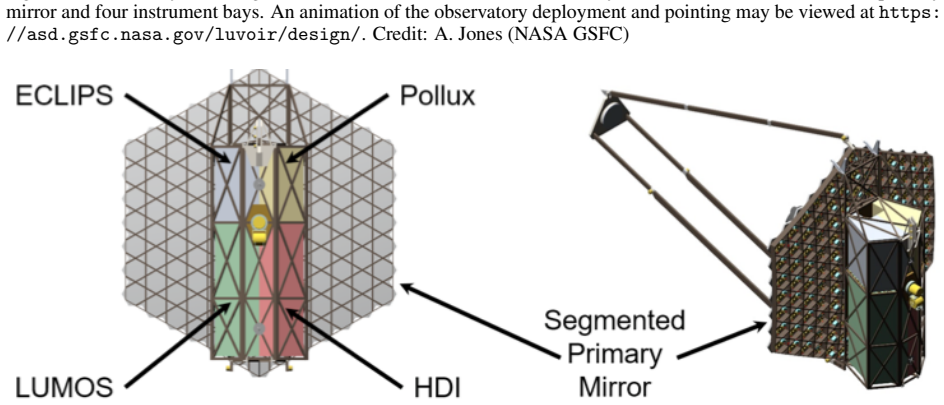
Summary. This Voyage 2050 white paper argues that high-resolution spectropolarimetry at ultraviolet wavelengths is mandatory for major progress in stellar physics. It reviews the key open questions for hot stars (fossil magnetic fields, mass-loss, magnetic braking, evolution) and cool stars (chromospheric and coronal heating, winds, star-planet interactions, pre-main-sequence accretion), identifies UV spectral lines that probe these processes, and describes several proposed instruments: POLLUX on LUVOIR, the Arago M-class mission, the PSS spectropolarimeter on CETUS, and the EUVO concept. The central claim, stated in Section 1, is that UV spectropolarimetry provides unique and decisive diagnostics of stellar magnetic fields and their interaction with winds, magnetospheres, and planets.
Significance. The scientific questions addressed are central to stellar physics, and the paper provides a comprehensive and well-referenced synthesis of the current state of knowledge. Its strengths include a clear identification of specific unanswered questions, a direct link between those questions and concrete UV diagnostics, and the presentation of instrument concepts that have undergone industrial Phase 0 feasibility studies. If the promised measurements can be made and interpreted, UV spectropolarimetry would indeed open a new observational window. However, the core scientific case rests on two unquantified premises: that the polarization amplitudes in the relevant UV lines are large enough to measure, and that the resulting Stokes profiles can be inverted to recover the claimed 3D magnetic and thermodynamic structures. These premises are not demonstrated in the manuscript, which limits the force of the central argument.
major comments (4)
- [Section 4.2] The only quantitative signal-to-noise estimates in the paper are for intensity spectra (SNR>100 for hot stars and SNR=10 for cool-star chromospheric lines). The central scientific case requires measuring circular and linear polarization, but no corresponding Stokes Q, U, or V SNR estimates or expected polarization amplitudes are given anywhere. Please add a quantitative sensitivity analysis or explicit scaling relations for representative UV lines (e.g., C IV, Mg II, Si IV) demonstrating that the polarization signals exceed the detection threshold, or revise the claim that these measurements will provide the advocated diagnostics.
- [Sections 2, 3.2-3.3] The paper repeatedly promises '3D mapping of the magnetized environment' from UV polarimetry (Section 2) and reconstruction of the '3D magnetic and thermodynamic structure' of chromospheres and accretion shocks (Sections 3.2 and 3.3). For unresolved stellar disks, such maps require Doppler tomography and Zeeman/Hanle inversion, which demand high polarization SNR on individual line features and a well-understood line-formation model. The manuscript does not demonstrate that the proposed UV lines, many of which form in optically thick winds and dynamic chromospheres, can be inverted to yield the claimed 3D structure. Please provide forward-modeled Stokes profiles for at least one representative target per stellar class, or moderate the claims to 'constraints on' rather than 'maps of' the 3D structure.
- [Sections 1-2] The paper does not address depolarization and dilution effects that can severely reduce the polarization signal in the very lines it proposes to measure. Resonance-scattered lines in optically thick winds and magnetospheres can be strongly depolarized, and Zeeman circular polarization in broadened wind lines can be diluted below detectability. Since the novelty claim rests on measuring polarization in UV wind-sensitive lines, the authors should include a quantitative discussion of these effects and show that the expected signals remain measurable for representative hot-star wind lines such as C IV and Si IV.
- [Section 4.5] The assertion that the reflective polarimeter below 123 nm, which 'has never flown,' is feasible because it is 'composed of mirrors only' (Section 4.5) is an unsupported technical-risk assessment. Given that the FUV channel is crucial for the wind-line diagnostics (Section 2) and is proposed on both POLLUX and EUVO, the paper should either provide laboratory or heritage evidence for such a polarimeter or identify a dedicated technology-development path with milestones.
minor comments (5)
- [Section 1] The phrase 'It contains forest of lines' should read 'It contains a forest of lines.'
- [Section 3.1] There is a duplicated article in 'the the magnetospheric accretion of matter'; it should read 'the magnetospheric accretion of matter.'
- [Section 3.3] 'one the main mechanisms' should read 'one of the main mechanisms.'
- [Section 4.3] The typo 'Deacadal' should be 'Decadal,' and 'FUV amd NUV' should be 'FUV and NUV.'
- [Section 4.1.2] The sentence 'POLLUX will of course also allow us to study many stellar physics issues described above' would benefit from a cross-reference to the specific subsections where those issues are discussed.
Circularity Check
No circularity: the paper is a science-case proposal for new UV spectropolarimetric measurements, not a derivation from fitted inputs or self-citations.
full rationale
The paper's central claim is that high-resolution UV spectropolarimetry is mandatory for progress in stellar magnetism. This is an advocacy claim based on the diagnostic value of UV lines and on the absence of previous UV polarimetric measurements; it is not derived from any fitted parameter, inverted dataset, or self-citation chain. No equation is fitted and then renamed as a prediction. The repeated promises of '3D mapping' of stellar atmospheres, winds, and accretion shocks are programmatic statements about what future observations might enable, not outputs of a derivational chain that reduce to their inputs. Many cited works include members of the proposing team, but the load-bearing logic does not depend on those citations as unexplained premises; they are empirical results or modeling studies that stand independently. The paper itself flags the relevant limitations: Section 2 states that 'measuring polarisation directly in UV wind-sensitive lines has never been done,' Section 4.5 notes that a reflective polarimeter below 123 nm 'has never flown,' and Section 4.2 quotes signal-to-noise ratios for intensity spectra only, without corresponding Stokes Q/U/V sensitivity estimates. These are feasibility and support limitations, not circularity. There is no uniqueness theorem imported from the authors, no ansatz smuggled in via citation, and no renaming of a known result as a new organization. The central recommendation therefore has independent content, and the circularity score is 0.
Assumptions & free parameters
assumptions (3)
- domain assumption Magnetic fields of fossil origin are long-lived and structured on global scales in about 10% of hot stars.
- domain assumption High-resolution UV spectropolarimetry can be built with sufficient sensitivity and spectral resolution (R>=30000 for Arago, R>=120000 for POLLUX) to detect stellar polarization signals.
- domain assumption UV Zeeman and scattering polarization diagnostics can be inverted to recover 3D magnetic and thermodynamic structures of stellar atmospheres and winds.
Cite this review
Pith. "Pith review of Stellar Physics with High-Resolution UV Spectropolarimetry." pith.science (2026). https://pith.science/paper/MQD4RRWW
@misc{pith2026190801545,
  author       = {Pith},
  title        = {Pith review of: Stellar Physics with High-Resolution UV Spectropolarimetry},
  year         = {2026},
  howpublished = {\url{https://pith.science/paper/MQD4RRWW}},
  note         = {Machine review of arXiv:1908.01545}
}
read the original abstract
Current burning issues in stellar physics, for both hot and cool stars, concern their magnetism. In hot stars, stable magnetic fields of fossil origin impact their stellar structure and circumstellar environment, with a likely major role in stellar evolution. However, this role is complex and thus poorly understood as of today. It needs to be quantified with high-resolution UV spectropolarimetric measurements. In cool stars, UV spectropolarimetry would provide access to the structure and magnetic field of the very dynamic upper stellar atmosphere, providing key data for new progress to be made on the role of magnetic fields in heating the upper atmospheres, launching stellar winds, and more generally in the interaction of cool stars with their environment (circumstellar disk, planets) along their whole evolution. UV spectropolarimetry is proposed on missions of various sizes and scopes, from POLLUX on the 15-m telescope LUVOIR to the Arago M-size mission dedicated to UV spectropolarimetry.
Figures

Figures from the paper (8 more)




Reference graph
Works this paper leans on
-
[1]
J. S. Vink, A. de Koter, and H. J. G. L. M. Lamers. Mass-loss predictions for O and B stars as a function of metallicity. A&A, 369:574–588, April 2001
2001
-
[2]
N. Langer. Presupernova Evolution of Massive Single and Binary Stars.ARA&A, 50:107–164, September 2012
2012
-
[3]
Groh, Georges Meynet, Cyril Georgy, and Sylvia Ekström
Jose H. Groh, Georges Meynet, Cyril Georgy, and Sylvia Ekström. Fundamental properties of core-collapse supernova and GRB progenitors: predicting the look of massive stars before death. A&A, 558:A131, Oct 2013
2013
-
[4]
Oksala, and Aurore Blazère
Coralie Neiner, Bram Buysschaert, Mary E. Oksala, and Aurore Blazère. Discovery of two new bright magnetic B stars: i Car and Atlas. MNRAS, 454(1):L56–L60, Nov 2015
2015
-
[5]
Grunhut and Coralie Neiner
Jason H. Grunhut and Coralie Neiner. Magnetic fields in early-type stars. In K. N. Nagendra, Stefano Bagnulo, Rebecca Centeno, and María. Jesús Martínez González, editors, Polarimetry, volume 305 of IAU Symposium, pages 53–60, Oct 2015
2015
-
[6]
Blazère, P
A. Blazère, P. Petit, F. Lignières, M. Aurière, J. Ballot, T. Böhm, C. P. Folsom, M. Gaurat, L. Jouve, A. Lopez Ariste, C. Neiner, and G. A. Wade. Detection of ultra-weak magnetic fields in Am stars: β Ursae Majoris and θ Leonis. A&A, 586:A97, Feb 2016
2016
-
[7]
Maeder and G
A. Maeder and G. Meynet. Stellar evolution with rotation and magnetic fields. I. The relative importance of rotational and magnetic effects. A&A, 411:543–552, Dec 2003
2003
-
[8]
H. F. Song, G. Meynet, A. Maeder, S. Ekström, and P. Eggenberger. Massive star evolution in close binaries. Conditions for homogeneous chemical evolution. A&A, 585:A120, Jan 2016
2016
Show all 102 references
-
[9]
Stellar magnetism
Leon Mestel. Stellar magnetism. Oxford University Press, Oxford, 1999
1999
-
[10]
Heger, S
A. Heger, S. E. Woosley, and H. C. Spruit. Presupernova Evolution of Differentially Rotating Massive Stars Including Magnetic Fields. ApJ, 626(1):350–363, Jun 2005
2005
-
[11]
Mathis and J
S. Mathis and J. P. Zahn. Transport and mixing in the radiation zones of rotating stars. II. Axisymmetric magnetic field. A&A, 440(2):653–666, Sep 2005
2005
-
[12]
Asif ud-Doula and Stanley P. Owocki. Dynamical Simulations of Magnetically Channeled Line-driven Stellar Winds. I. Isothermal, Nonrotating, Radially Driven Flow. ApJ, 576(1):413–428, Sep 2002
2002
-
[13]
Owocki, and Richard H
Asif Ud-Doula, Stanley P. Owocki, and Richard H. D. Townsend. Dynamical simulations of magnetically channelled line-driven stellar winds - II. The effects of field-aligned rotation. MNRAS, 385(1):97–108, Mar 2008
2008
-
[14]
Owocki, and Richard H
Asif Ud-Doula, Stanley P. Owocki, and Richard H. D. Townsend. Dynamical simulations of magnetically chan- nelled line-driven stellar winds - III. Angular momentum loss and rotational spin-down.MNRAS, 392(3):1022– 1033, Jan 2009
2009
-
[15]
Meynet, P
G. Meynet, P. Eggenberger, and A. Maeder. Massive star models with magnetic braking. A&A, 525:L11, Jan 2011
2011
-
[16]
R. H. D. Townsend, M. E. Oksala, D. H. Cohen, S. P. Owocki, and A. ud-Doula. Discovery of Rotational Braking in the Magnetic Helium-strong Star Sigma Orionis E. ApJ, 714(2):L318–L322, May 2010
2010
-
[17]
Petermann, N
I. Petermann, N. Langer, N. Castro, and L. Fossati. Blue supergiants as descendants of magnetic main sequence stars. A&A, 584:A54, Dec 2015
2015
-
[18]
Magnetic Braking of Stellar Cores in Red Giants and Supergiants
André Maeder and Georges Meynet. Magnetic Braking of Stellar Cores in Red Giants and Supergiants. ApJ, 793(2):123, Oct 2014
2014
-
[19]
Alecian, C
E. Alecian, C. Neiner, G. A. Wade, S. Mathis, D. Bohlender, D. Cébron, C. Folsom, J. Grunhut, J. B. Le Bouquin, V . Petit, H. Sana, A. Tkachenko, and A. ud-Doula. The BinaMIcS project: understanding the origin of magnetic fields in massive stars through close binary systems. In...
2015
-
[20]
Collapse of Massive Magnetized Dense Cores Using Radiation Magnetohydrodynamics: Early Fragmentation Inhibition
Benoît Commerçon, Patrick Hennebelle, and Thomas Henning. Collapse of Massive Magnetized Dense Cores Using Radiation Magnetohydrodynamics: Early Fragmentation Inhibition. ApJ, 742(1):L9, Nov 2011
2011
-
[21]
Blazère, C
A. Blazère, C. Neiner, A. Tkachenko, J. C. Bouret, and Th. Rivinius. The magnetic field of ζ Orionis A. A&A, 582:A110, Oct 2015
2015
-
[22]
Fossati, F
L. Fossati, F. R. N. Schneider, N. Castro, N. Langer, S. Simón-Díaz, A. Müller, A. de Koter, T. Morel, V . Petit, H. Sana, and G. A. Wade. Evidence of magnetic field decay in massive main-sequence stars. A&A, 592:A84, Aug 2016. 20 ESA V OYAGE 2050 W HITE PAPER STELLAR PHYSICS W...
2016
-
[23]
Shultz, J
M. Shultz, J. B. Le Bouquin, Th Rivinius, G. A. Wade, O. Kochukhov, E. Alecian, V . Petit, O. Pfuhl, M. Karl, F. Gao, R. Grellmann, C. C. Lin, P. Garcia, S. Lacour, MiMeS Collaboration, and BinaMIcS Collaboration. NU Ori: a hierarchical triple system with a strongly magnetic B...
2019
-
[24]
Featherstone, Matthew K
Nicholas A. Featherstone, Matthew K. Browning, Allan Sacha Brun, and Juri Toomre. Effects of Fossil Mag- netic Fields on Convective Core Dynamos in A-type Stars. ApJ, 705(1):1000–1018, Nov 2009
2009
-
[25]
Aurière, G
M. Aurière, G. A. Wade, F. Lignières, J. D. Land street, J. F. Donati, A. Hui Bon Hoa, I. Iliev, P. Petit, T. Roudier, J. Silvester, and S. Theado. Weak magnetic fields in CP stars. Contributions of the Astronomical Observatory Skalnate Pleso, 38(2):211–216, Apr 2008
2008
-
[26]
Neiner, A
C. Neiner, A. Martin, G. Wade, and M. Oksala. The magnetic field of evolved hot stars. In SF2A-2018: Proceedings of the Annual meeting of the French Society of Astronomy and Astrophysics, page Di, Dec 2018
2018
-
[27]
Keszthelyi, G
Z. Keszthelyi, G. Meynet, C. Georgy, G. A. Wade, V . Petit, and A. David-Uraz. The effects of surface fossil magnetic fields on massive star evolution: I. Magnetic field evolution, mass-loss quenching, and magnetic braking. MNRAS, 485(4):5843–5860, Jun 2019
2019
-
[28]
Martins and A
F. Martins and A. Palacios. A comparison of evolutionary tracks for single Galactic massive stars. A&A, 560:A16, December 2013
2013
-
[29]
Christopher Bard and Richard H. D. Townsend. Effect of a magnetic field on massive-star winds - I. Mass-loss and velocity for a dipole field. MNRAS, 462(4):3672–3688, Nov 2016
2016
-
[30]
ud-Doula, J
A. ud-Doula, J. O. Sundqvist, S. P. Owocki, V . Petit, and R. H. D. Townsend. First 3DMHD simulation of a massive-star magnetosphere with application to Hα emission fromθ1 Ori C. MNRAS, 428(3):2723–2730, Jan 2013
2013
-
[31]
Petit, Z
V . Petit, Z. Keszthelyi, R. MacInnis, D. H. Cohen, R. H. D. Townsend, G. A. Wade, S. L. Thomas, S. P. Owocki, J. Puls, and A. ud-Doula. Magnetic massive stars as progenitors of ‘heavy’ stellar-mass black holes. MNRAS, 466(1):1052–1060, Apr 2017
2017
-
[32]
Wade, Véronique Petit, Zsolt Keszthelyi, and Raphael Hirschi
Cyril Georgy, Georges Meynet, Sylvia Ekström, Gregg A. Wade, Véronique Petit, Zsolt Keszthelyi, and Raphael Hirschi. Possible pair-instability supernovae at solar metallicity from magnetic stellar progenitors. A&A, 599:L5, Mar 2017
2017
-
[33]
B. P. Abbott, R. Abbott, T. D. Abbott, M. R. Abernathy, LIGO Scientific Collaboration, and Virgo Collaboration. Observation of gravitational waves from a binary black hole merger.Phys. Rev. Lett., 116(6):061102, Feb 2016
2016
-
[34]
B. P. Abbott, R. Abbott, T. D. Abbott, F. Acernese, K. Ackley, C. Adams, T. Adams, P. Addesso, LIGO Scientific Collaboration, and Virgo Collaboration. GW170817: Observation of Gravitational Waves from a Binary Neutron Star Inspiral. Phys. Rev. Lett., 119(16):161101, Oct 2017
2017
-
[35]
B. P. Abbott, R. Abbott, T. D. Abbott, F. Acernese, K. Ackley, C. Adams, T. Adams, P. Addesso, (LIGO Scientific Collaboration, and Virgo Collaboration. GW170608: Observation of a 19 Solar-mass Binary Black Hole Coalescence. ApJ, 851(2):L35, Dec 2017
2017
-
[36]
Gänsicke
Lilia Ferrario, Domitilla de Martino, and Boris T. Gänsicke. Magnetic White Dwarfs. Space Sci. Rev., 191(1- 4):111–169, Oct 2015
2015
-
[37]
D. T. Wickramasinghe and Lilia Ferrario. The origin of the magnetic fields in white dwarfs. MNRAS, 356(4):1576–1582, Feb 2005
2005
-
[38]
C. A. Tout, D. T. Wickramasinghe, J. Liebert, L. Ferrario, and J. E. Pringle. Binary star origin of high field magnetic white dwarfs. MNRAS, 387(2):897–901, Jun 2008
2008
-
[39]
Briggs, Lilia Ferrario, Christopher A
Gordon P. Briggs, Lilia Ferrario, Christopher A. Tout, Dayal T. Wickramasinghe, and Jarrod R. Hurley. Merging binary stars and the magnetic white dwarfs. MNRAS, 447(2):1713–1723, Feb 2015
2015
-
[40]
Valyavin, D
G. Valyavin, D. Shulyak, G. A. Wade, K. Antonyuk, S. V . Zharikov, G. A. Galazutdinov, S. Plachinda, S. Bag- nulo, L. Fox Machado, M. Alvarez, D. M. Clark, J. M. Lopez, D. Hiriart, Inwoo Han, Young-Beom Jeon, C. Zurita, R. Mujica, T. Burlakova, T. Szeifert, and A. Burenkov. Su...
2014
-
[41]
The Saturation of SASI by Parasitic Instabilities
Jérôme Guilet, Jun’ichi Sato, and Thierry Foglizzo. The Saturation of SASI by Parasitic Instabilities. ApJ, 713(2):1350–1362, Apr 2010
2010
-
[42]
Burrows, L
A. Burrows, L. Dessart, E. Livne, C. D. Ott, and J. Murphy. Simulations of Magnetically Driven Supernova and Hypernova Explosions in the Context of Rapid Rotation. ApJ, 664(1):416–434, Jul 2007
2007
-
[43]
Ott, David Radice, Luke F
Philipp Mösta, Christian D. Ott, David Radice, Luke F. Roberts, Erik Schnetter, and Roland Haas. A large-scale dynamo and magnetoturbulence in rapidly rotating core-collapse supernovae.Nature, 528(7582):376–379, Dec 2015. 21 ESA V OYAGE 2050 W HITE PAPER STELLAR PHYSICS WITH H...
2015
-
[44]
Couch and Christian D
Sean M. Couch and Christian D. Ott. Revival of the Stalled Core-collapse Supernova Shock Triggered by Precollapse Asphericity in the Progenitor Star. ApJ, 778(1):L7, Nov 2013
2013
-
[45]
Couch, Emmanouil Chatzopoulos, W
Sean M. Couch, Emmanouil Chatzopoulos, W. David Arnett, and F. X. Timmes. The Three-dimensional Evo- lution to Core Collapse of a Massive Star. ApJ, 808(1):L21, Jul 2015
2015
-
[46]
Müller and H
B. Müller and H. Th. Janka. Non-radial instabilities and progenitor asphericities in core-collapse supernovae. MNRAS, 448(3):2141–2174, Apr 2015
2015
-
[47]
Blondin and Anthony Mezzacappa
John M. Blondin and Anthony Mezzacappa. Pulsar spins from an instability in the accretion shock of super- novae. Nature, 445(7123):58–60, Jan 2007
2007
-
[48]
Effect of Rotation on the Stability of a Stalled Cylindrical Shock and Its Consequences for Core-Collapse Supernovae
Tatsuya Yamasaki and Thierry Foglizzo. Effect of Rotation on the Stability of a Stalled Cylindrical Shock and Its Consequences for Core-Collapse Supernovae. ApJ, 679(1):607–615, May 2008
2008
-
[49]
Parametric Study of Flow Patterns behind the Stand- ing Accretion Shock Wave for Core-Collapse Supernovae
Wakana Iwakami, Hiroki Nagakura, and Shoichi Yamada. Parametric Study of Flow Patterns behind the Stand- ing Accretion Shock Wave for Core-Collapse Supernovae. ApJ, 786(2):118, May 2014
2014
-
[50]
Nakamura
Satoshi X. Nakamura. Neutrino Emissivities from Deuteron-Breakup and Formation in Supernovae. In Journal of Physics Conference Series, volume 569, page 012057, Dec 2014
2014
-
[51]
Three-dimensional simulations of rapidly rotating core- collapse supernovae: finding a neutrino-powered explosion aided by non-axisymmetric flows
Tomoya Takiwaki, Kei Kotake, and Yudai Suwa. Three-dimensional simulations of rapidly rotating core- collapse supernovae: finding a neutrino-powered explosion aided by non-axisymmetric flows. MNRAS, 461(1):L112–L116, Sep 2016
2016
-
[52]
Asplund, N
M. Asplund, N. Grevesse, A. J. Sauval, C. Allende Prieto, and D. Kiselman. Line formation in solar granulation. IV . [O I], O I and OH lines and the photospheric O abundance.A&A, 417:751–768, Apr 2004
2004
-
[53]
Landstreet
Leon Mestel and John D. Landstreet. Stellar Magnetic Fields, pages 183–218. Springer Berlin Heidelberg, Berlin, Heidelberg, 2005
2005
-
[54]
J. F. Donati and J. D. Landstreet. Magnetic Fields of Nondegenerate Stars. ARA&A, 47(1):333–370, Sep 2009
2009
-
[55]
A. A. Vidotto, S. G. Gregory, M. Jardine, J. F. Donati, P. Petit, J. Morin, C. P. Folsom, J. Bouvier, A. C. Cameron, G. Hussain, S. Marsden, I. A. Waite, R. Fares, S. Jeffers, and J. D. do Nascimento. Stellar magnetism: empirical trends with age and rotation. MNRAS, 441(3):236...
2014
-
[56]
Giulio Del Zanna and Helen E. Mason. Solar UV and X-ray spectral diagnostics. Living Reviews in Solar Physics, 15(1):5, Aug 2018
2018
-
[57]
Pagano, J
I. Pagano, J. L. Linsky, J. Valenti, and D. K. Duncan. HST/STIS high resolution echelle spectra of <ASTROBJ>α Centauri A</ASTROBJ> (G2 V). A&A, 415:331–348, Feb 2004
2004
-
[58]
I. Busà, I. Pagano, M. Rodonò, J. E. Neff, and A. C. Lanzafame. Chromospheric imaging of the active binary system V 711 Tauri = HR 1099 in December 1992. A&A, 350:571–581, Oct 1999
1992
-
[59]
Testa, B
P. Testa, B. De Pontieu, and V . H. Hansteen. Properties of moss emission from joint FeXII IRIS and Hinode observations of active region plasma. In AGU Fall Meeting Abstracts, volume 2015, pages SH31D–06, Dec 2015
2015
-
[60]
B. E. Wood, H. R. Müller, G. P. Zank, J. L. Linsky, and S. Redfield. New Mass-Loss Measurements from Astrospheric Lyα Absorption. ApJ, 628(2):L143–L146, Aug 2005
2005
-
[61]
S. C. Marsden, P. Petit, S. V . Jeffers, J. Morin, R. Fares, A. Reiners, J. D. do Nascimento, M. Aurière, J. Bouvier, B. D. Carter, C. Catala, B. Dintrans, J. F. Donati, T. Gastine, M. Jardine, R. Konstantinova-Antova, J. Lanoux, F. Lignières, A. Morgenthaler, J. C. Ramìrez-Vè...
2014
-
[62]
V . See, M. Jardine, A. A. Vidotto, J.-F. Donati, C. P. Folsom, S. Boro Saikia, J. Bouvier, R. Fares, S. G. Gregory, G. Hussain, S. V . Jeffers, S. C. Marsden, J. Morin, C. Moutou, J. D. do Nascimento, P. Petit, L. Rosén, and I. A. Waite. The energy budget of stellar magnetic ...
2015
-
[63]
A. A. Vidotto, J. F. Donati, M. Jardine, V . See, P. Petit, I. Boisse, S. Boro Saikia, E. Hébrard, S. V . Jeffers, S. C. Marsden, and J. Morin. Could a change in magnetic field geometry cause the break in the wind-activity relation? MNRAS, 455(1):L52–L56, Jan 2016
2016
-
[64]
Boro Saikia, T
S. Boro Saikia, T. Lueftinger, S. V . Jeffers, C. P. Folsom, V . See, P. Petit, S. C. Marsden, A. A. Vidotto, J. Morin, A. Reiners, M. Guedel, and BCool Collaboration. Direct evidence of a full dipole flip during the magnetic cycle of a sun-like star. A&A, 620:L11, Dec 2018
2018
-
[65]
Morin, J
J. Morin, J. F. Donati, P. Petit, X. Delfosse, T. Forveille, L. Albert, M. Aurière, R. Cabanac, B. Dintrans, R. Fares, T. Gastine, M. M. Jardine, F. Lignières, F. Paletou, J. C. Ramirez Velez, and S. Théado. Large-scale magnetic topologies of mid M dwarfs. MNRAS, 390(2):567–58...
2008
-
[66]
Newton, Jonathan Irwin, David Charbonneau, Zachory K
Elisabeth R. Newton, Jonathan Irwin, David Charbonneau, Zachory K. Berta-Thompson, Jason A. Dittmann, and Andrew A. West. The Rotation and Galactic Kinematics of Mid M Dwarfs in the Solar Neighborhood.ApJ, 821(2):93, Apr 2016
2016
-
[67]
Delfosse, J
X. Delfosse, J. F. Donati, D. Kouach, G. Hébrard, R. Doyon, E. Artigau, F. Bouchy, I. Boisse, A. S. Brun, P. Hennebelle, T. Widemann, J. Bouvier, X. Bonfils, J. Morin, C. Moutou, F. Pepe, S. Udry, J. D. do Nascimento, S. H. P. Alencar, B. V . Castilho, E. Martioli, S. Y . Wang,...
2013
-
[68]
P. K. G. Williams, B. A. Cook, and E. Berger. Trends in Ultracool Dwarf Magnetism. I. X-Ray Suppression and Radio Enhancement. ApJ, 785(1):9, Apr 2014
2014
-
[69]
Lanza, R
Kevin France, Nicole Arulanantham, Luca Fossati, Antonino F. Lanza, R. O. Parke Loyd, Seth Redfield, and P. Christian Schneider. Far-ultraviolet Activity Levels of F, G, K, and M Dwarf Exoplanet Host Stars. ApJS, 239(1):16, Nov 2018
2018
-
[70]
Gallet, C
F. Gallet, C. Charbonnel, L. Amard, S. Brun, A. Palacios, and S. Mathis. Impacts of stellar evolution and dynamics on the habitable zone: The role of rotation and magnetic activity. A&A, 597:A14, Jan 2017
2017
-
[71]
Lederer, Laetitia Delrez, Julien de Wit, Artem Burdanov, Valérie Van Grootel, Adam J
Michaël Gillon, Emmanuël Jehin, Susan M. Lederer, Laetitia Delrez, Julien de Wit, Artem Burdanov, Valérie Van Grootel, Adam J. Burgasser, Amaury H. M. J. Triaud, Cyrielle Opitom, Brice-Olivier Demory, Devendra K. Sahu, Daniella Bardalez Gagliuffi, Pierre Magain, and Didier Quel...
2016
-
[72]
J. Bouvier. The magnetospheric accretion/ejection process in young stellar objects: open issues and perspec- tives. In European Physical Journal Web of Conferences , volume 64 of European Physical Journal Web of Conferences, page 09001, Jan 2014
2014
-
[73]
Accretion onto Pre-Main-Sequence Stars.ARA&A, 54:135– 180, Sep 2016
Lee Hartmann, Gregory Herczeg, and Nuria Calvet. Accretion onto Pre-Main-Sequence Stars.ARA&A, 54:135– 180, Sep 2016
2016
-
[74]
Constraints to the magnetospheric properties of T Tauri stars - I
Fatima López-Martínez and Ana Inés Gómez de Castro. Constraints to the magnetospheric properties of T Tauri stars - I. The C II], Fe II] and Si II] ultraviolet features. MNRAS, 442(4):2951–2962, Aug 2014
2014
-
[75]
J. R. Najita, S. Edwards, G. Basri, and J. Carr. Spectroscopy of Inner Protoplanetary Disks and the Star-Disk Interface. In V . Mannings, A. P. Boss, and S. S. Russell, editors, Protostars and Planets IV , page 457, May 2000
2000
-
[76]
Gómez de Castro, Boris Gaensicke, Coralie Neiner, and Martin A
Ana I. Gómez de Castro, Boris Gaensicke, Coralie Neiner, and Martin A. Barstow. Reflections on the discov- ery space for a large ultraviolet-visible telescope: inputs from the European-led EUVO exercise. Journal of Astronomical Telescopes, Instruments, and Systems, 2:041215, Oct 2016
2016
-
[77]
Ryuichi Kurosawa and M. M. Romanova. Spectral variability of classical T Tauri stars accreting in an unstable regime. MNRAS, 431(3):2673–2689, May 2013
2013
-
[78]
S. H. P. Alencar, J. Bouvier, J. F. Donati, E. Alecian, C. P. Folsom, K. Grankin, G. A. J. Hussain, C. Hill, A. M. Cody, A. Carmona, C. Dougados, S. G. Gregory, G. Herczeg, F. Ménard, C. Moutou, L. Malo, M. Takami, and Matysse Collaboration. Inner disk structure of the classic...
2018
-
[79]
S. G. Gregory, J. F. Donati, J. Morin, G. A. J. Hussain, N. J. Mayne, L. A. Hillenbrand, and M. Jardine. Can We Predict the Global Magnetic Topology of a Pre-main-sequence Star from Its Position in the Hertzsprung-Russell Diagram? ApJ, 755(2):97, Aug 2012
2012
-
[80]
C. A. Hill, C. P. Folsom, J. F. Donati, G. J. Herczeg, G. A. J. Hussain, S. H. P. Alencar, S. G. Gregory, and Matysse Collaboration. Magnetic topologies of young suns: the weak-line T Tauri stars TW A 6 and TW A 8A. MNRAS, 484(4):5810–5833, Apr 2019
2019
-
[81]
Villebrun, E
F. Villebrun, E. Alecian, G. Hussain, J. Bouvier, C. P. Folsom, Y . Lebreton, L. Amard, C. Charbonnel, F. Gallet, L. Haemmerlé, T. Böhm, C. Johns-Krull, O. Kochukhov, S. C. Marsden, J. Morin, and P. Petit. Magnetic fields of intermediate-mass T Tauri stars. I. Magnetic detectio...
2019
-
[82]
Origin and Evolution of Magnetic Field in PMS Stars: Influ- ence of Rotation and Structural Changes
Constance Emeriau-Viard and Allan Sacha Brun. Origin and Evolution of Magnetic Field in PMS Stars: Influ- ence of Rotation and Structural Changes. ApJ, 846(1):8, Sep 2017
2017
-
[83]
Zanni and J
C. Zanni and J. Ferreira. MHD simulations of accretion onto a dipolar magnetosphere. II. Magnetospheric ejections and stellar spin-down. A&A, 550:A99, Feb 2013. 23 ESA V OYAGE 2050 W HITE PAPER STELLAR PHYSICS WITH HR UV SPECTROPOLARIMETRY
2013
-
[84]
Edwin Bergin, Nuria Calvet, Paola D’Alessio, and Gregory J. Herczeg. The Effects of UV Continuum and Lyα Radiation on the Chemical Equilibrium of T Tauri Disks. ApJ, 591(2):L159–L162, Jul 2003
2003
-
[85]
Fraschetti, J
F. Fraschetti, J. J. Drake, O. Cohen, and C. Garraffo. Mottled Protoplanetary Disk Ionization by Magnetically Channeled T Tauri Star Energetic Particles. ApJ, 853(2):112, Feb 2018
2018
-
[86]
Alexander, I
R. Alexander, I. Pascucci, S. Andrews, P. Armitage, and L. Cieza. The Dispersal of Protoplanetary Disks. In Henrik Beuther, Ralf S. Klessen, Cornelis P. Dullemond, and Thomas Henning, editors,Protostars and Planets VI, page 475, Jan 2014
2014
-
[87]
Salyk, G
C. Salyk, G. A. Blake, A. C. A. Boogert, and J. M. Brown. High-resolution 5 µm Spectroscopy of Transitional Disks. ApJ, 699(1):330–347, Jul 2009
2009
-
[88]
D. E. Trilling, J. I. Lunine, and W. Benz. Orbital migration and the frequency of giant planet formation. A&A, 394:241–251, Oct 2002
2002
-
[89]
Baruteau, A
C. Baruteau, A. Crida, S. J. Paardekooper, F. Masset, J. Guilet, B. Bitsch, R. Nelson, W. Kley, and J. Papaloizou. Planet-Disk Interactions and Early Evolution of Planetary Systems. In Henrik Beuther, Ralf S. Klessen, Cor- nelis P. Dullemond, and Thomas Henning, editors, Proto...
2014
-
[90]
A. K. Dupree, A. Lobel, P. R. Young, T. B. Ake, J. L. Linsky, and S. Redfield. A Far-Ultraviolet Spectroscopic Survey of Luminous Cool Stars. ApJ, 622(1):629–652, Mar 2005
2005
-
[91]
Isabel Pérez Martínez, K
M. Isabel Pérez Martínez, K. P. Schröder, and M. Cuntz. The basal chromospheric Mg II h+k flux of evolved stars: probing the energy dissipation of giant chromospheres. MNRAS, 414(1):418–427, Jun 2011
2011
-
[92]
Josselin and B
E. Josselin and B. Plez. Atmospheric dynamics and the mass loss process in red supergiant stars. A&A, 469(2):671–680, Jul 2007
2007
-
[93]
Magnetic fields in single late-type giants in the Solar vicinity: How common is magnetic activity on the giant branches? In Pascal Petit, Moira Jardine, and Hendrik C
Renada Konstantinova-Antova, Michel Aurière, Corinne Charbonnel, Natalia Drake, Gregg Wade, Svetla Tsvetkova, Pascal Petit, Klaus-Peter Schröder, and Agnes Lèbre. Magnetic fields in single late-type giants in the Solar vicinity: How common is magnetic activity on the giant bran...
2014
-
[94]
Aurière, R
M. Aurière, R. Konstantinova-Antova, C. Charbonnel, G. A. Wade, S. Tsvetkova, P. Petit, B. Dintrans, N. A. Drake, T. Decressin, N. Lagarde, J. F. Donati, T. Roudier, F. Lignières, K. P. Schröder, J. D. Landstreet, A. Lèbre, W. W. Weiss, and J. P. Zahn. The magnetic fields at th...
2015
-
[95]
Charbonnel, T
C. Charbonnel, T. Decressin, N. Lagarde, F. Gallet, A. Palacios, M. Aurière, R. Konstantinova-Antova, S. Mathis, R. I. Anderson, and B. Dintrans. The magnetic strip(s) in the advanced phases of stellar evolu- tion. Theoretical convective turnover timescale and Rossby number fo...
2017
-
[96]
The shock-heated atmosphere of an asymptotic giant branch star resolved by ALMA
Wouter Vlemmings, Theo Khouri, Eamon O’Gorman, Elvire De Beck, Elizabeth Humphreys, Boy Lankhaar, Matthias Maercker, Hans Olofsson, Sofia Ramstedt, Daniel Tafoya, and Aki Takigawa. The shock-heated atmosphere of an asymptotic giant branch star resolved by ALMA. Nature Astronomy...
2017
-
[97]
Gioia Rau, Jr. Montez, Rodolfo, Kenneth Carpenter, Markus Wittkowski, Sara Bladh, Margarita Karovska, Vladimir Airapetian, Tom Ayres, Martha Boyer, Andrea Chiavassa, Geoffrey Clayton, William Danchi, Orsola De Marco, Andrea K. Dupree, Tomasz Kaminski, Joel H. Kastner, Franz Ke...
2019
-
[98]
López Ariste, P
A. López Ariste, P. Mathias, B. Tessore, A. Lèbre, M. Aurière, P. Petit, N. Ikhenache, E. Josselin, J. Morin, and M. Montargès. Convective cells in Betelgeuse: imaging through spectropolarimetry. A&A, 620:A199, Dec 2018
2018
-
[99]
Kervella, W
P. Kervella, W. Homan, A. M. S. Richards, L. Decin, I. McDonald, M. Montargès, and K. Ohnaka. ALMA observations of the nearby AGB star L2 Puppis. I. Mass of the central star and detection of a candidate planet. A&A, 596:A92, Dec 2016
2016
-
[100]
Ertley, O
C. Ertley, O. Siegmund, J. Vallerga, A. Tremsin, N. Darling, J. Hull, J. Tedesco, T. Curtis, and C. Paw U. Microchannel plate detectors for future NASA UV observatories. In Proc. SPIE, volume 10699 of Society of Photo-Optical Instrumentation Engineers (SPIE) Conference Series,...
2018
-
[101]
Hicks, James Wiley, Nicholas Kruczek, Nicholas Erickson, and Kevin France
Brian Fleming, Manuel Quijada, John Hennessy, Arika Egan, Javier Del Hoyo, Brian A. Hicks, James Wiley, Nicholas Kruczek, Nicholas Erickson, and Kevin France. Advanced environmentally resistant lithium fluoride mirror coatings for the next generation of broadband space observat...
2017
-
[102]
Jewell, Michael E
Shouleh Nikzad, April D. Jewell, Michael E. Hoenk, Todd J. Jones, John Hennessy, Tim Goodsall, Alexan- der G. Carver, Charles Shapiro, Samuel R. Cheng, Erika T. Hamden, Gillian Kyne, D. Christopher Martin, David Schiminovich, Paul Scowen, Kevin France, Stephan McCand liss, and...
2017
Reviewed August 14, 2026 · model on record in the stance chip above.
Discussion (0). Continue with ORCID to comment.