Toward a Unified Security and Privacy Framework for AI-Native 6G Networks
Pith reviewed 2026-07-02 10:24 UTC · model grok-4.3
The pith
Fragmented security and privacy approaches across technologies and architectures require a unified cross-layer framework for AI-native 6G networks.
A machine-rendered reading of the paper's core claim, the machinery that carries it, and where it could break.
Core claim
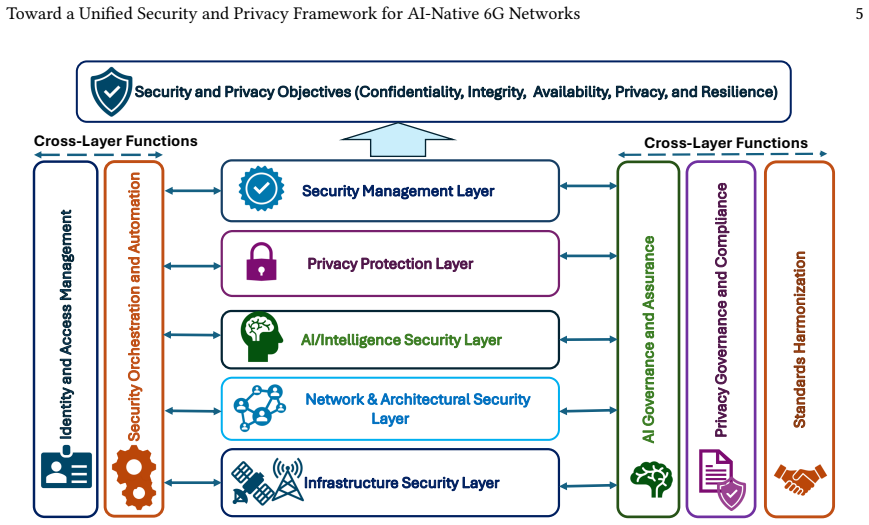
The paper establishes that AI-native 6G networks generate a heterogeneous security and privacy landscape that cannot be addressed through isolated, technology-specific solutions, and therefore advances a unified cross-layer framework that includes a threat taxonomy across five domains and maps those threats to corresponding countermeasures, with standards harmonization treated as one security function, while also identifying research gaps for secure and interoperable ecosystems.
What carries the argument
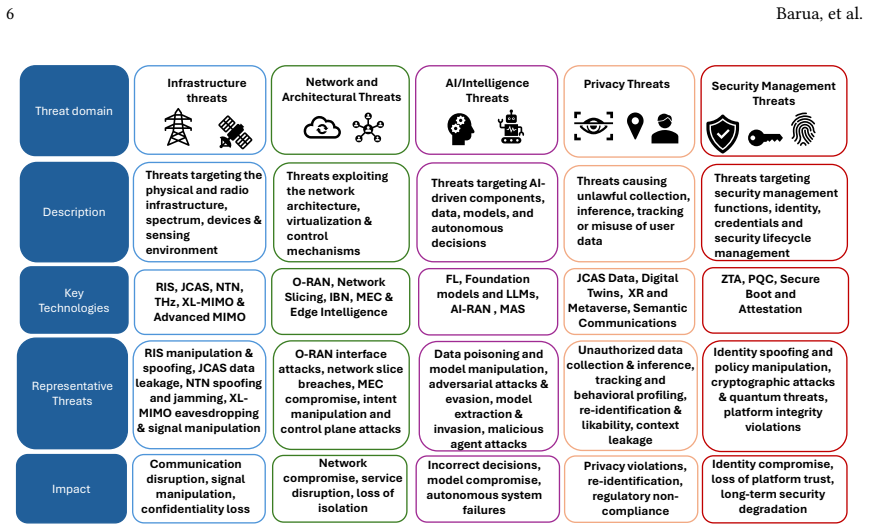
The unified security and privacy framework, built from a cross-layer threat taxonomy that organizes threats in infrastructure, network, AI, privacy, and management domains and links them to countermeasures.
If this is right
- The cross-layer threat taxonomy allows systematic analysis of threats across infrastructure, network and architectural, AI, privacy, and security management domains.
- Mapping threats to countermeasures supports the inclusion of standards harmonization as an explicit security function.
- Identification of critical research gaps directs future priorities toward secure, interoperable, and trustworthy AI-native 6G ecosystems.
- The framework supplies a foundation for the design, evaluation, and deployment of privacy-preserving and resilient 6G networks.
Where Pith is reading between the lines
- The taxonomy could be applied to evaluate security in pre-6G or non-AI-native networks to test its generality.
- Standards harmonization as a function might reduce overlap among separate standardization bodies working on 6G components.
- Future work could validate the mapped countermeasures through simulation of integrated AI-native 6G scenarios.
- The framework's emphasis on global interoperability points to potential alignment with regional privacy regulations.
Load-bearing premise
Isolated technology-specific solutions cannot adequately address the heterogeneous security and privacy landscape created by AI-native 6G integration.
What would settle it
An empirical testbed demonstration in which a collection of isolated, technology-specific solutions successfully mitigates the full range of representative threats identified in the taxonomy would falsify the premise that a unified framework is required.
Figures
read the original abstract
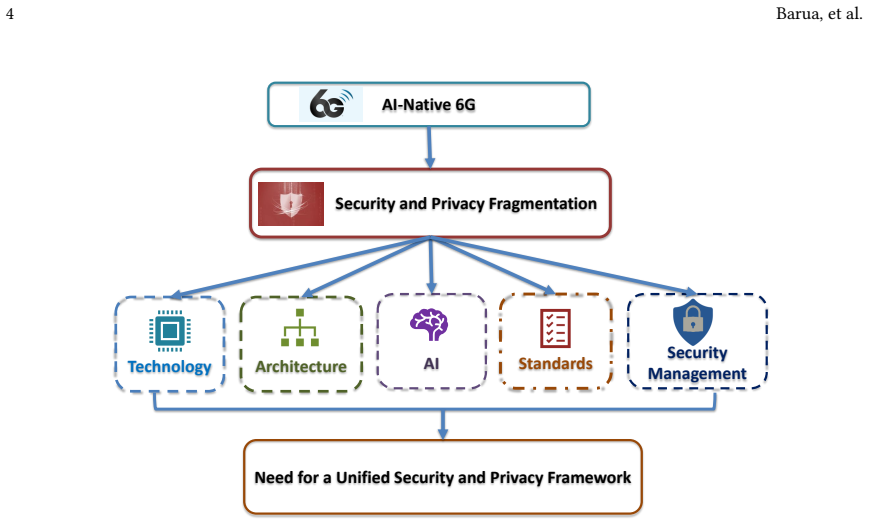
Sixth Generation (6G) communication networks are expected to evolve into AI-native, highly autonomous ecosystems that integrate communication, computing, sensing, and artificial intelligence. While these capabilities enable unprecedented connectivity and intelligent services, they also create a highly heterogeneous security and privacy landscape that cannot be addressed through isolated, technology-specific solutions. This paper presents a comprehensive survey of security and privacy in AI-native 6G networks from a cross-layer perspective. We first examine the fragmentation of existing security and privacy approaches across emerging technologies, network architectures, AI systems, and standardization efforts, motivating the need for a unified security and privacy framework. Building upon this framework, we develop a cross-layer threat taxonomy encompassing infrastructure, network and architectural, AI, privacy, and security management domains, and analyze representative threats across key AI-native 6G technologies. Furthermore, we map these threats to corresponding cross-layer countermeasures, including standards harmonization as a security function, and identify critical research gaps and future priorities for secure, interoperable, and trustworthy AI-native 6G ecosystems. Finally, we discuss future research directions toward realizing secure, privacy-preserving, resilient, and globally interoperable 6G networks. This survey provides researchers, practitioners, and standardization communities with a holistic foundation for the design, evaluation, and deployment of trustworthy AI-native 6G systems.
Editorial analysis
A structured set of objections, weighed in public.
Referee Report
Summary. The paper is a literature survey claiming that security and privacy approaches for AI-native 6G networks are fragmented across emerging technologies, network architectures, AI systems, and standardization efforts. This fragmentation motivates a unified cross-layer framework. The authors develop a threat taxonomy spanning infrastructure, network/architectural, AI, privacy, and security management domains; map threats to countermeasures (including standards harmonization as a security function); and identify research gaps and future priorities for trustworthy 6G ecosystems.
Significance. If the literature synthesis proves representative, the cross-layer taxonomy and mapping provide a useful organizing structure for researchers and standards bodies working on AI-native 6G security, highlighting interactions that technology-specific solutions may miss.
major comments (1)
- [section examining fragmentation of existing approaches] The section examining fragmentation of existing approaches: the central motivation—that isolated, technology-specific solutions cannot adequately address the heterogeneous landscape—is load-bearing for the call to unification, yet the paper provides no explicit inclusion criteria, search methodology, or scope statement for the surveyed literature, preventing assessment of selection bias or completeness.
minor comments (1)
- [Abstract] The abstract states that standards harmonization is treated 'as a security function' but does not preview how this function is operationalized in the taxonomy or mapping; a brief clarifying sentence would improve readability.
Simulated Author's Rebuttal
We thank the referee for the constructive comment on the survey methodology. We address this point directly below.
read point-by-point responses
-
Referee: [section examining fragmentation of existing approaches] The section examining fragmentation of existing approaches: the central motivation—that isolated, technology-specific solutions cannot adequately address the heterogeneous landscape—is load-bearing for the call to unification, yet the paper provides no explicit inclusion criteria, search methodology, or scope statement for the surveyed literature, preventing assessment of selection bias or completeness.
Authors: We agree that the absence of an explicit methodology section limits the ability to assess the survey's scope and potential biases, and that this is important given the central role of the fragmentation analysis. In the revised manuscript we will insert a dedicated subsection (placed immediately after the introduction) that specifies: (1) the databases and repositories searched (IEEE Xplore, ACM DL, arXiv, 3GPP/ETSI/ITU documents), (2) the keyword combinations and Boolean strings employed, (3) the time window (primarily 2020–2024 with selected foundational works), (4) inclusion criteria (peer-reviewed journal/conference papers and official standards documents that explicitly address security or privacy in AI-integrated or AI-native 6G contexts), and (5) exclusion criteria (purely theoretical works without 6G relevance, non-English sources, and duplicate entries). The subsection will also describe how the collected corpus was thematically coded to identify fragmentation patterns. This addition will make the selection process transparent without altering the existing analysis or conclusions. revision: yes
Circularity Check
No significant circularity
full rationale
The paper is a literature survey whose central claim is the existence of fragmentation across technologies, architectures, AI systems, and standards, which motivates (rather than derives) a cross-layer taxonomy. No equations, derivations, fitted parameters, or self-referential constructions appear anywhere in the manuscript. All load-bearing statements rest on external citations rather than reducing to the paper's own inputs by definition or construction. This is the standard structure for a survey paper and meets the criteria for a self-contained analysis against external benchmarks.
Axiom & Free-Parameter Ledger
axioms (1)
- domain assumption Existing security and privacy approaches across technologies, architectures, AI systems, and standardization are fragmented and cannot be addressed through isolated solutions.
Reference graph
Works this paper leans on
-
[1]
Shimaa A Abdel Hakeem, Hanan H Hussein, and HyungWon Kim. 2022. Security requirements and challenges of 6g technologies and applications. Sensors, 22, 5, 1969
2022
-
[2]
EU Artificial Intelligence Act. 2024. The eu artificial intelligence act.European Union
2024
-
[3]
Ijaz Ahmad, Shahriar Shahabuddin, Tanesh Kumar, Jude Okwuibe, Andrei Gurtov, and Mika Ylianttila. 2019. Security for 5g and beyond.IEEE Communications Surveys & Tutorials, 21, 4, 3682–3722
2019
-
[4]
NIST AI. 2023. Artificial intelligence risk management framework (ai rmf 1.0).URL: https://nvlpubs. nist. gov/nistpubs/ai/nist. ai, 100–1
2023
- [5]
-
[6]
Gorjan Alagic et al. 2020. Status Report on the Second Round of the NIST Post-Quantum Cryptography Standardization Process. NIST Intera- gency/Internal Report (NISTIR) 8309. National Institute of Standards and Technology. doi:10.6028/NIST.IR.8309
-
[7]
Gorjan Alagic et al. 2022. Status Report on the Third Round of the NIST Post-Quantum Cryptography Standardization Process. NIST Intera- gency/Internal Report (NISTIR) 8413. National Institute of Standards and Technology. doi:10.6028/NIST.IR.8413. Manuscript submitted to ACM 28 Barua, et al
-
[8]
Sebastien Andreina, Giorgia Azzurra Marson, Helen Möllering, and Ghassan Karame. 2021. Baffle: backdoor detection via feedback-based federated learning. In2021 IEEE 41st International Conference on Distributed Computing Systems (ICDCS), 852–863. doi:10.1109/ICDCS51616.2021.00086
-
[9]
Chafika Benzaid and Tarik Taleb. 2020. Zsm security: threat surface and best practices.IEEE Network, 34, 3, 124–133
2020
-
[10]
Ferhat Ozgur Catak, Murat Kuzlu, Evren Catak, Umit Cali, and Devrim Unal. 2022. Security concerns on machine learning solutions for 6g networks in mmwave beam prediction.Physical Communication, 52, 101626
2022
-
[11]
Xu Chen, Wei Feng, Ning Ge, and Yan Zhang. 2023. Zero trust architecture for 6g security.IEEE Network, 38, 4, 224–232
2023
-
[12]
Guanjie Cheng, Yan Chen, Shuiguang Deng, Honghao Gao, and Jianwei Yin. 2021. A blockchain-based mutual authentication scheme for collaborative edge computing.IEEE Transactions on Computational Social Systems, 9, 1, 146–158
2021
-
[13]
Kanza Cherkaoui Dekkaki, Igor Tasic, and Maria-Dolores Cano. 2024. Exploring post-quantum cryptography: review and directions for the transition process.Technologies, 12, 12, 241. doi:10.3390/technologies12120241
-
[14]
Arsenia Chorti, André Noll Barreto, Stefan Köpsell, Marco Zoli, Marwa Chafii, Philippe Sehier, Gerhard Fettweis, and H Vincent Poor. 2022. Context-aware security for 6g wireless: the role of physical layer security.IEEE Communications Standards Magazine, 6, 1, 102–108
2022
-
[15]
Alexander Clemm, Mohamed Faten Zhani, and Raouf Boutaba. 2020. Network management 2030: operations and control of network 2030 services. Journal of Network and Systems Management, 28, 4, 721–750
2020
-
[16]
Mingyao Cui, Linglong Dai, Zhaocheng Wang, Shidong Zhou, and Ning Ge. 2022. Near-field rainbow: wideband beam training for xl-mimo.IEEE Transactions on Wireless Communications, 22, 6, 3899–3912
2022
-
[17]
2019.EU personal data protection in policy and practice
Bart Custers, Alan M Sears, Francien Dechesne, Ilina Georgieva, Tommaso Tani, and Simone Van der Hof. 2019.EU personal data protection in policy and practice. Vol. 29. Springer
2019
-
[18]
Badhan Chandra Das, M Hadi Amini, and Yanzhao Wu. 2025. Security and privacy challenges of large language models: a survey.ACM Computing Surveys, 57, 6, 1–39
2025
-
[19]
Prajnamaya Dass, Sonika Ujjwal, Jiri Novotny, Yevhen Zolotavkin, Zakaria Laaroussi, and Stefan Köpsell. 2024. Addressing privacy concerns in joint communication and sensing for 6g networks: challenges and prospects. InAnnual Privacy Forum. Springer, 87–111
2024
-
[20]
Avani Dave, Nilanjan Banerjee, and Chintan Patel. 2020. Sracare: secure remote attestation with code authentication and resilience engine. In 2020 IEEE international conference on embedded software and systems (ICESS). IEEE, 1–8
2020
-
[21]
Chamitha De Alwis, Pawani Porambage, Kapal Dev, Thippa Reddy Gadekallu, and Madhusanka Liyanage. 2023. A survey on network slicing security: attacks, challenges, solutions and research directions.IEEE Communications Surveys & Tutorials
2023
-
[22]
Cynthia Dwork, Aaron Roth, et al. 2014. The algorithmic foundations of differential privacy.Foundations and Trends®in Theoretical Computer Science, 9, 3–4, 211–407
2014
-
[23]
Antonio Matencio Escolar, Jorge Bernal Bernabe, Jose Maria Alcaraz Calero, Qi Wang, and Antonio Skarmeta. 2024. Network slicing as 6g security mechanism to mitigate cyber-attacks: the rigourous approach. In2024 IEEE 10th International Conference on Network Softwarization (NetSoft). IEEE, 387–392
2024
-
[24]
Eslam Farsimadan, Leila Moradi, and Francesco Palmieri. 2025. A review on security challenges in v2x communications technology for vanets. IEEE Access
2025
-
[25]
Alexey K. Fedorov. 2023. Deploying hybrid quantum-secured infrastructure for applications: when quantum and post-quantum can work together. Frontiers in Quantum Science and Technology, 2, 1164428. doi:10.3389/frqst.2023.1164428
-
[26]
Hailin Feng, Thippa Reddy Gadekallu, Yuchao Xia, Yongkang Zhao, Zhihao Wen, Jijing Cai, Pronaya Bhattacharya, Kai Fang, and Madhusanka Liyanage. 2026. Agentic ai security in 6g networks: a survey of emerging attack vectors, vulnerabilities, and defenses.IEEE Open Journal of the Communications Society
2026
-
[27]
Mohamed Amine Ferrag, Othmane Friha, Burak Kantarci, Norbert Tihanyi, Lucas Cordeiro, Merouane Debbah, Djallel Hamouda, Muna Al- Hawawreh, and Kim-Kwang Raymond Choo. 2023. Edge learning for 6g-enabled internet of things: a comprehensive survey of vulnerabilities, datasets, and defenses.IEEE Communications Surveys & Tutorials, 25, 4, 2654–2713
2023
-
[28]
European Union Agency for Cybersecurity (ENISA). 2021. Post-Quantum Cryptography: Current State and Quantum Mitigation. Tech. rep. ENISA. https://www.enisa.europa.eu/publications/post-quantum-cryptography-current-state-and-quantum-mitigation
2021
-
[29]
Xenofon Foukas, Georgios Patounas, Ahmed Elmokashfi, and Mahesh K Marina. 2017. Network slicing in 5g: survey and challenges.IEEE communications magazine, 55, 5, 94–100
2017
-
[30]
Framework and overall objectives of the future development of IMT for 2030 and beyond
2023. Framework and overall objectives of the future development of IMT for 2030 and beyond. Tech. rep. Recommendation ITU-R M.2160. International Telecommunication Union, Radiocommunication Sector (ITU-R). https://www.itu.int/en/ITU-R/Pages/default.aspx
2023
-
[31]
Wenjie Fu, Huandong Wang, Chen Gao, Guanghua Liu, Yong Li, and Tao Jiang. 2024. Membership inference attacks against fine-tuned large language models via self-prompt calibration.Advances in Neural Information Processing Systems, 37, 134981–135010
2024
-
[32]
Sandro Rodriguez Garzon, Hakan Yildiz, and Axel Küpper. 2022. Decentralized identifiers and self-sovereign identity in 6g.IEEE Network, 36, 4, 142–148
2022
-
[33]
Jiahui Geng, Yongli Mou, Qing Li, Feifei Li, Oya Beyan, Stefan Decker, and Chunming Rong. 2023. Improved gradient inversion attacks and defenses in federated learning.IEEE Transactions on Big Data, 1–13. doi:10.1109/TBDATA.2023.3239116
-
[34]
Mir Ghoraishi et al. [n. d.] Itrust6g: zero-trust security for 6g networks.methods, 5, 6. Manuscript submitted to ACM Toward a Unified Security and Privacy Framework for AI-Native 6G Networks 29
-
[35]
Harald Gjermundrød, Ioanna Dionysiou, and Kyriakos Costa. 2016. Privacytracker: a privacy-by-design gdpr-compliant framework with verifiable data traceability controls. InCurrent Trends in Web Engineering: ICWE 2016 International Workshops, DUI, TELERISE, SoWeMine, and Liquid Web, Lugano, Switzerland, June 6-9, 2016. Revised Selected Papers 16. Springer, 3–15
2016
-
[36]
Explaining and Harnessing Adversarial Examples
Ian J. Goodfellow, Jonathon Shlens, and Christian Szegedy. 2015. Explaining and harnessing adversarial examples. (2015). https://arxiv.org/abs/14 12.6572 arXiv: 1412.6572[stat.ML]
work page internal anchor Pith review Pith/arXiv arXiv 2015
-
[37]
Joshua Groen, Salvatore D’Oro, Utku Demir, Leonardo Bonati, Michele Polese, Tommaso Melodia, and Kaushik Chowdhury. 2024. Implementing and evaluating security in o-ran: interfaces, intelligence, and platforms.IEEE Network, 39, 1, 227–234
2024
-
[38]
Onur Günlü, Matthieu Bloch, Rafael F Schaefer, and Aylin Yener. 2022. Secure joint communication and sensing. In2022 IEEE International Symposium on Information Theory (ISIT). IEEE, 844–849
2022
-
[39]
Shaolong Guo, Yuntao Wang, Ning Zhang, Zhou Su, Tom H Luan, Zhiyi Tian, and Xuemin Shen. 2024. A survey on semantic communication networks: architecture, security, and privacy.IEEE communications surveys & tutorials, 27, 5, 2860–2894
2024
-
[40]
Ehsan Hallaji, Roozbeh Razavi-Far, and Mehrdad Saif. 2022. Federated and transfer learning: a survey on adversaries and defense mechanisms. In Federated and Transfer Learning. Springer, 29–55
2022
-
[41]
Ehsan Hallaji, Roozbeh Razavi-Far, Mehrdad Saif, and Enrique Herrera-Viedma. 2023. Label noise analysis meets adversarial training: a defense against label poisoning in federated learning.Knowledge-Based Systems, 266, 110384. doi:https://doi.org/10.1016/j.knosys.2023.110384
-
[42]
Eric Hanselman. 2020. Security Benefits of Open Virtualized RAN. Tech. rep. 451 Research, (May 2020). https://www.cisco.com/c/dam/en/us/solu tions/service-provider/pdfs/5g-network-architecture/white-paper-sp-open-vran-security-benefits.pdf
2020
-
[43]
Asim Ul Haq, Seyed Salar Sefati, Syed Junaid Nawaz, Albena Mihovska, and Michail J. Beliatis. 2025. Need of uavs and physical layer security in next-generation non-terrestrial wireless networks: potential challenges and open issues.IEEE Open Journal of Vehicular Technology, 6, 554–595. doi:10.1109/OJVT.2025.3525781
-
[44]
Hexa-X-II Consortium. 2023. Deliverable D1.2 – 6G Use Cases and Requirements. Technical Report D1.2. Hexa-X-II Project, (Dec. 2023). https://hexa-x-ii.eu/wp-content/uploads/2024/01/Hexa-X-II_D1.2.pdf
2023
-
[45]
Iqbal, M
A. Iqbal, M. L. Tham, Y. J. Wong, A. A. Al-Habashna, G. Wainer, Y. X. Zhu, and T. Dagiuklas. 2023. Empowering non-terrestrial networks with artificial intelligence: a survey.IEEE Access, 11, 100986–101006
2023
-
[46]
Fauzia Irram, Mudassar Ali, Muhammad Naeem, and Shahid Mumtaz. 2022. Physical layer security for beyond 5g/6g networks: emerging technologies and future directions.Journal of Network and Computer Applications, 206, 103431
2022
-
[47]
ISG ZSM Activity Report 2023
2023. ISG ZSM Activity Report 2023. Tech. rep. ETSI ISG ZSM. https://www.etsi.org/committee-activity/activity-report-zsm
2023
- [48]
-
[49]
Waqas Khalid, Muhammad Atif Ur Rehman, Trinh Van Chien, Zeeshan Kaleem, Howon Lee, and Heejung Yu. 2023. Reconfigurable intelligent surface for physical layer security in 6g-iot: designs, issues, and advances.IEEE Internet of Things Journal, 11, 2, 3599–3613
2023
-
[50]
Akmal Khan, Amini Hikmatullah, and Masud Jabir. 2026. Hybrid 5g 6g atomic laser networks for quantum resilient non terrestrial connectivity. Discover Quantum Science, 2, 1, 9
2026
-
[51]
Latif U Khan, Zhu Han, Walid Saad, Ekram Hossain, Mohsen Guizani, and Choong Seon Hong. 2022. Digital twin of wireless systems: overview, taxonomy, challenges, and opportunities.IEEE Communications Surveys and Tutorials, 24, 4, 2230–2254
2022
-
[52]
Siyavushkhon Kholmatov, Seongsik Cho, Song Chong, and Kyunghan Lee. 2026. Toward ai-on-ran: enabling on-ran edge intelligence for ai-native 6g networks.IEEE Network
2026
-
[53]
Myoungsu Kim, Insu Oh, Kangbin Yim, Mahdi Sahlabadi, and Zarina Shukur. 2023. Security of 6g-enabled vehicle-to-everything communication in emerging federated learning and blockchain technologies.IEEE Access, 12, 33972–34001
2023
-
[54]
Joonas Kokkoniemi, Alexandros-Apostolos A Boulogeorgos, Mubarak Aminu, Janne Lehtomäki, Angeliki Alexiou, and Markku Juntti. 2020. Impact of beam misalignment on thz wireless systems.Nano Communication Networks, 24, 100302
2020
-
[55]
Ilia Lebedev, Kyle Hogan, and Srinivas Devadas. 2018. Secure boot and remote attestation in the sanctum processor. In2018 IEEE 31st Computer Security Foundations Symposium (CSF). IEEE, 46–60
2018
-
[56]
Aris Leivadeas and Matthias Falkner. 2022. A survey on intent-based networking.IEEE Communications Surveys & Tutorials, 25, 1, 625–655
2022
-
[57]
Peng Li and Jianing Du. 2025. Brand design data security and privacy protection under 6g network slicing architecture.International Journal of Network Management, 35, 2, e70009
2025
- [58]
-
[59]
Yang Liu, Yan Kang, Tianyuan Zou, Yanhong Pu, Yuanqin He, Xiaozhou Ye, Ye Ouyang, Ya-Qin Zhang, and Qiang Yang. 2024. Vertical federated learning: concepts, advances, and challenges.IEEE Transactions on Knowledge and Data Engineering
2024
-
[60]
Madhusanka Liyanage, An Braeken, Shahriar Shahabuddin, and Pasika Ranaweera. 2023. Open ran security: challenges and opportunities. Journal of Network and Computer Applications, 214, 103621
2023
-
[61]
Shihang Lu et al. 2024. Integrated sensing and communications: recent advances and ten open challenges.IEEE Internet of Things Journal, 11, 11, 19094–19120
2024
-
[62]
Xiaozhen Lu, Liang Xiao, Pengmin Li, Xiangyang Ji, Chenren Xu, Shui Yu, and Weihua Zhuang. 2023. Reinforcement learning-based physical cross-layer security and privacy in 6g.IEEE Communications Surveys & Tutorials, 25, 1, 425–466. doi:10.1109/COMST.2022.3224279. Manuscript submitted to ACM 30 Barua, et al
-
[63]
Bomin Mao, Jiajia Liu, Yingying Wu, and Nei Kato. 2023. Security and privacy on 6g network edge: a survey.IEEE communications surveys & tutorials, 25, 2, 1095–1127
2023
- [64]
-
[65]
Jämes Ménétrey, Christian Göttel, Anum Khurshid, Marcelo Pasin, Pascal Felber, Valerio Schiavoni, and Shahid Raza. 2022. Attestation mechanisms for trusted execution environments demystified. InIFIP International Conference on Distributed Applications and Interoperable Systems. Springer, 95–113
2022
-
[66]
Miroslav Mitev, Arsenia Chorti, H Vincent Poor, and Gerhard P Fettweis. 2023. What physical layer security can do for 6g security.IEEE Open Journal of Vehicular Technology, 4, 375–388
2023
-
[67]
Michele Mosca. 2018. Cybersecurity in an era with quantum computers: will we be ready?IEEE Security & Privacy, 16, 5, 38–41
2018
-
[68]
Lorenzo Mucchi et al. 2021. Physical-layer security in 6g networks.IEEE Open Journal of the Communications Society, 2, 1901–1914
2021
-
[69]
Hyeran Mun, Kyusuk Han, Ernesto Damiani, Hyun Ku Yeun, Tae-Yeon Kim, Luigi Martino, and Chan Yeob Yeun. 2025. A comprehensive survey on digital twin: focusing on security threats and requirements.IEEE Access, 13, 73362–73390. doi:10.1109/ACCESS.2025.3563621
-
[70]
Faisal Naeem, Mansoor Ali, Georges Kaddoum, Chongwen Huang, and Chau Yuen. 2023. Security and privacy for reconfigurable intelligent surface in 6g: a review of prospective applications and challenges.IEEE Open Journal of the Communications Society, 4, 1196–1217
2023
-
[71]
Nurun Nahar, Karl Andersson, Olov Schelén, and Saguna Saguna. 2024. A survey on zero trust architecture: applications and challenges of 6g networks.IEEE Access
2024
-
[72]
William Newhouse et al. 2023. Migration to Post-Quantum Cryptography: Preparation and Strategy. NIST Special Publication 1800-38B. Preliminary Draft. National Institute of Standards and Technology, (Dec. 2023). https://www.nccoe.nist.gov/sites/default/files/2023-12/pqc-migr ation-nist-sp-1800-38b-preliminary-draft.pdf
2023
-
[73]
Cong T Nguyen et al. 2024. Emerging technologies for 6g non-terrestrial-networks: from academia to industrial applications.IEEE Open Journal of the Communications Society
2024
-
[74]
Dinh C Nguyen, Ming Ding, Pubudu N Pathirana, Aruna Seneviratne, Jun Li, and H Vincent Poor. 2021. Federated learning for internet of things: a comprehensive survey.IEEE Communications Surveys & Tutorials, 23, 3, 1622–1658
2021
-
[75]
Huan X Nguyen, Ramona Trestian, Duc To, and Mallik Tatipamula. 2021. Digital twin for 5g and beyond.IEEE Communications Magazine, 59, 2, 10–15
2021
-
[76]
Tam Nguyen, Moses Ndebugre, and Dheeraj Arremsetty. 2026. Security considerations for multi-agent systems.arXiv preprint arXiv:2603.09002
work page internal anchor Pith review Pith/arXiv arXiv 2026
-
[77]
Van-Linh Nguyen, Po-Ching Lin, Bo-Chao Cheng, Ren-Hung Hwang, and Ying-Dar Lin. 2021. Security and privacy for 6g: a survey on prospective technologies and challenges.IEEE Communications Surveys & Tutorials, 23, 4, 2384–2428
2021
-
[78]
Nonso Okika, Gift Aruchi Nwatuzie, Hamed Salam Olarinoye, Augustine A Nwaka, Emmanuel Igba, and Roland Dunee. 2025. Assessing the vulnerability of traditional and post-quantum cryptographic systems through penetration testing and strengthening cyber defenses with zero trust security in the era of quantum computing.International Journal of Innovative Scien...
2025
-
[79]
OPPO. 2025. 6g security architecture: intelligent security built on zero trust. https://www.oppo.com/content/dam/oppo/common/mkt/footer /OPPO-6G-Security-WhitePaper-EN.pdf
2025
-
[80]
Diana Pamela Moya Osorio, Ijaz Ahmad, José David Vega Sánchez, Andrei Gurtov, Johan Scholliers, Matti Kutila, and Pawani Porambage. 2022. Towards 6g-enabled internet of vehicles: security and privacy.IEEE Open Journal of the Communications Society, 3, 82–105
2022
discussion (0)
Sign in with ORCID, Apple, or X to comment. Anyone can read and Pith papers without signing in.