REVIEW 4 major objections 6 minor 23 references
A Simple and Effective Approach for Fine Tuning Pre-trained Word Embeddings for Improved Text Classification
T0 review · 4 major / 6 minor · reviewed 2026-08-14 · deepseek-v4-flash
Pith's one-line read Class labels as context sharpen word embeddings for classification
desk verdict A simple, plausible trick for supervised embedding fine-tuning that mostly works, but never isolates whether the class label is what helps. read the letter →
The pith
A machine-rendered reading of the paper's core claim, the machinery that carries it, and where it could break.
The reading
What carries the argument
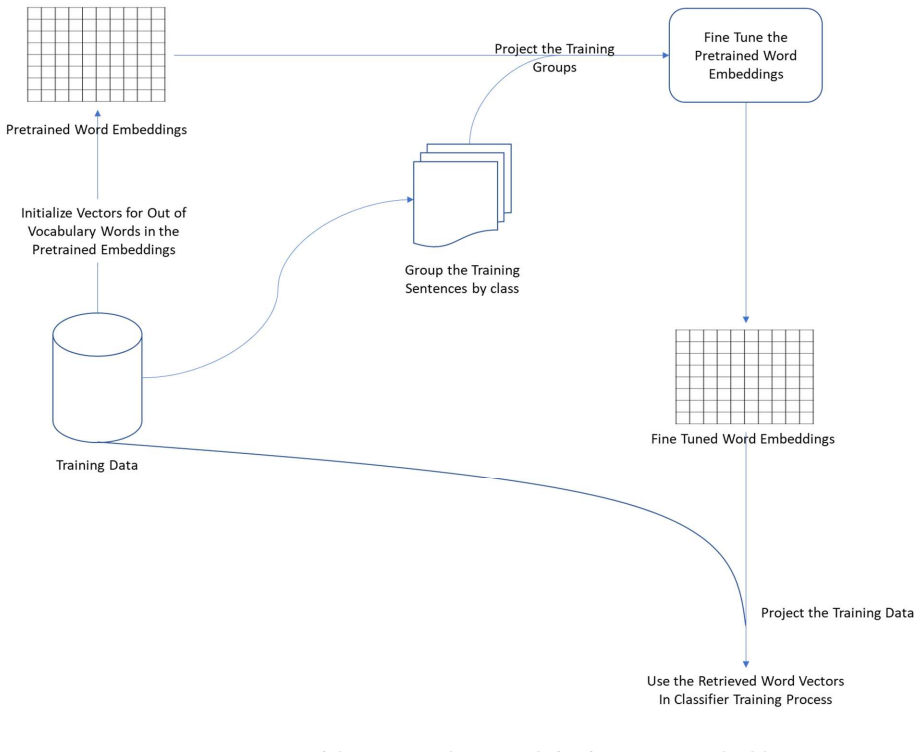
The machinery is Doc2Vec, an extension of Word2Vec that learns a vector for each document alongside word vectors by using the document vector as an additional context in the word-prediction task. The paper repurposes that document vector as a class vector: all training instances with the same label are treated as one pseudo-document, and the class identifier, not a per-instance identifier, is what gets averaged with the context words. Training starts from pretrained word vectors, randomly initializes vectors for words missing from the pretrained vocabulary, and runs for a small number of epochs (set to 10 here) so the pretrained geometry is adjusted rather than overwritten. The class vector is the mechanism that carries the argument, because it is the only added information beyond the ordinary local word context.
What would settle it
Shuffle the class labels used only during fine-tuning, keeping the downstream training labels unchanged; if accuracy still rises about as much as with true labels, the gain is not caused by the class-context mechanism but by in-domain fine-tuning itself.
Extended reading notes
Core claim
The central claim is that the class label, when fed into a Doc2Vec training loop as though it were a document identifier, is a useful extra context signal for fine-tuning word embeddings. During fine-tuning, each training text is paired with its class vector, and the model learns to predict words using both the surrounding words and the class vector; after training, only the word vectors are kept. Words appearing exclusively in one class are strongly reshaped by that class, words spread across classes are only weakly affected, and words appearing in several classes are pulled toward the class in which they occur most often. Empirically, this 'class2Vec' fine-tuning raised accuracy on the Arabic emotion dataset from 0.717 with unmodified pretrained embeddings to 0.741, on SST-1 from 0.466 to 0.493, on SST-2 from 0.863 to 0.877, and on the SemEval 2017 Arabic sentiment test from an F1 of 0.535 to 0.621. On the SemEval 2018 multilabel Arabic emotion task, the fine-tuned embeddings scored 0.498 Jaccard versus 0.501 without fine-tuning, the one observed decrease.
Load-bearing premise
The load-bearing assumption is that a single shared class vector can represent the context of every training text in that class, so Doc2Vec learns a coherent class-specific signal rather than fitting noise from individual examples.
Editorial extensions
If this is right
- Single-label text classifiers can inherit in-domain discrimination from off-the-shelf embeddings with no change to the downstream architecture.
- The method is language-neutral: the same recipe improved Arabic and English datasets in the reported experiments.
- Words unseen in the training data still keep their pretrained vectors, so the fine-tuned model does not lose coverage on small training sets.
- The observed failure on one multilabel task implies that the approach should be expected to help mainly when classes are mutually exclusive.
- Because the fine-tuned vectors are conditioned on a specific label set, they become domain- and task-specific rather than general-purpose.
Reading between the lines
- The method could be tested as a cheap alternative to full fine-tuning of large contextual models in low-resource settings, since it only needs the training labels and a few epochs.
- A controlled comparison against fine-tuning with per-document Doc2Vec vectors would separate the contribution of the class signal from the contribution of in-domain fine-tuning itself.
- The class-vector idea could be extended to hierarchical labels, multi-task labels, or metadata such as author or time, turning any categorical variable into a context vector.
- The small-epoch setting suggests a regularizing interpretation: brief fine-tuning on in-domain data may denoise the pretrained vectors, which is an alternative explanation for part of the gain.
Signed reviews
Editorial analysis
A structured set of objections, weighed in public.
Referee Report
Summary. The paper proposes a method for fine-tuning pre-trained word embeddings for text classification: it trains a Doc2Vec model on the target task's training data, using the class label of each text instance as the 'document' ID, and then uses the resulting word vectors as input to a simple LSTM classifier. The method is evaluated on three Arabic datasets (emotion detection, SemEval 2017 Arabic sentiment, SemEval 2018 Arabic emotion) and two English datasets (SST-1, SST-2), comparing RNNs initialized with raw pre-trained embeddings (AraVec or Google News) against RNNs initialized with the proposed fine-tuned embeddings. The authors report accuracy or F1 improvements in four of the five tasks and a small degradation on the multilabel Arabic emotion task, which they attribute to the method being less suited to multilabel classification.
Significance. If the central mechanism were established, the method would be a simple and useful recipe for adapting generic embeddings to low-resource classification tasks, and the public code release and inclusion of a negative multilabel result are strengths. However, the experimental design does not currently isolate the proposed class-conditioning mechanism from generic in-domain fine-tuning, and the reported claims of 'significant' improvement are not supported by statistical testing. The paper's significance is therefore conditional on adding the missing control experiments and embedding-space analyses. The honest reporting of the multilabel failure is commendable and provides a falsifiable boundary for the method.
major comments (4)
- [Section 4, steps 6-8; Tables 2-5] The experiments compare only 'pre-trained embeddings' against 'pre-trained embeddings fine-tuned with the proposed class-as-document approach'. There is no control condition in which Doc2Vec is trained on the same target-domain text for the same number of epochs without using the class label, e.g., with a single shared document ID for all instances or with unique per-instance document IDs. Because the fine-tuning procedure also trains on the target-domain corpus for 10 epochs, the observed improvements in Tables 2-5 could be wholly due to standard domain adaptation of the embeddings to the in-domain vocabulary and style. This is the load-bearing weakness: the experiments are consistent with the proposed explanation but equally consistent with a simpler domain-adaptation explanation. Please add the missing controls for at least the Arabic emotion dataset (Table 2) and SST-2 (Table 4).
- [Section 5, Experiments 1-5] All experimental results are reported as single runs without error bars, confidence intervals, or statistical significance tests. The statement in Experiment 1 that 'fine-tuned AraVec significantly improves the results' is therefore not supported, and the cross-system comparisons in Tables 3 and 5 (e.g., claiming that the proposed method outperforms published systems) are not accompanied by any measure of variance. Please report means and standard deviations over multiple random seeds (at least 5) and, where feasible, a paired significance test between the baseline and proposed conditions.
- [Section 4, Observations 1-3] Observations 1-3 assert that exclusive class words become more affected by their class, that shared words are less affected, and that higher-frequency classes dominate; these are central to the proposed mechanism but are never directly verified. The paper provides no intrinsic evaluation showing that class-distinctive words actually move closer to each other in the embedding space after fine-tuning. Please add a direct embedding-space analysis, such as measuring the change in average cosine distance between class-distinctive word pairs (or nearest-neighbor overlap) before and after fine-tuning, for one or two datasets. This would also help distinguish the class-conditioning explanation from the domain-adaptation alternative.
- [Tables 3-5] Comparisons against previously published systems are not apples-to-apples with respect to the classifier architecture, training data (e.g., the SST-1 training set is augmented with phrases in Experiment 2), or hyperparameters. The claim in Experiment 2 that 'the proposed method outperforms all the systems cited' is a claim about the combination of the proposed embeddings and the authors' RNN, not about the embeddings alone. Please either include baselines using the same RNN architecture with standard fine-tuned embeddings (e.g., the classifier itself fine-tuning the embeddings during training, as in Kim's non-static CNN) or temper the claim accordingly.
minor comments (6)
- [Section 2] In the second paragraph, 'Doc2Vec is a similar approach that was introduces' should read 'was introduced'.
- [Equation 1] Equation 1 is rendered with garbled symbols and fractions; please typeset it properly and define all variables in the surrounding text.
- [Section 5, Experiment 4] The sentence 'The baseline experiment results with AraVec were not as good as the top performer model in task 4 – subtask A (NileTMRG [22]), but the proposed methodology achieved an improvement with a 0.621 F1 average score (in SemEval.' is incomplete and appears to be missing a closing parenthesis and end-of-sentence punctuation.
- [Table 5] Table 5 contains an unfinished parenthetical '(in SemEval.' in the paragraph above the table; please correct the sentence.
- [Figure 1] Figure 1 is not explicitly referenced in the text and its caption ('CBOW like Doc2Vec') would benefit from a hyphen ('CBOW-like') and a clearer explanation of how the class ID enters the prediction.
- [References] Reference formatting is inconsistent (e.g., [10] lacks proper title formatting, and several references omit venue details); please unify the bibliography style.
Circularity Check
No circularity: the paper is an empirical method paper whose claims are evaluated against held-out test sets and external baselines.
full rationale
The paper makes no derivation that reduces to its own inputs: the proposed approach is a heuristic fine-tuning procedure (Doc2Vec with class identifiers as document tags), and the claimed contribution, improved classification accuracy, is measured on held-out test splits of five datasets against published baselines and non-fine-tuned embeddings. The only self-citations are to the authors' own AraVec embeddings, the Arabic emotions dataset, and the NileTMRG SemEval system; these are used as resources or comparison points, not as evidence for the method's correctness. Although the experiments lack a control that isolates the class-conditioning mechanism from general in-domain fine-tuning, that is an experimental-confound concern, not circular reasoning: the results are not forced by construction, and the method's outputs are not defined in terms of the reported accuracies. No step in the paper fits a parameter and then relabels that fit as a prediction, nor does any load-bearing claim depend on an unverified self-citation. The finding is therefore no significant circularity.
Assumptions & free parameters
free parameters (1)
- number_of_epochs (Doc2Vec fine-tuning) =
10
assumptions (3)
- domain assumption Pretrained word embeddings capture general semantic relationships
- ad hoc to paper Doc2Vec can learn meaningful representations when the 'document' id is a class label
- ad hoc to paper Words appearing distinctively in a class will be moved closer together by the class-conditioned training
Cite this review
Pith. "Pith review of A Simple and Effective Approach for Fine Tuning Pre-trained Word Embeddings for Improved Text Classification." pith.science (2026). https://pith.science/paper/MQLJ77T2
@misc{pith2026190802579,
  author       = {Pith},
  title        = {Pith review of: A Simple and Effective Approach for Fine Tuning Pre-trained Word Embeddings for Improved Text Classification},
  year         = {2026},
  howpublished = {\url{https://pith.science/paper/MQLJ77T2}},
  note         = {Machine review of arXiv:1908.02579}
}
read the original abstract
This work presents a new and simple approach for fine-tuning pretrained word embeddings for text classification tasks. In this approach, the class in which a term appears, acts as an additional contextual variable during the fine tuning process, and contributes to the final word vector for that term. As a result, words that are used distinctively within a particular class, will bear vectors that are closer to each other in the embedding space and will be more discriminative towards that class. To validate this novel approach, it was applied to three Arabic and two English datasets that have been previously used for text classification tasks such as sentiment analysis and emotion detection. In the vast majority of cases, the results obtained using the proposed approach, improved considerably.
Figures
Reference graph
Works this paper leans on
-
[1]
Recent Trends in Deep Learning Based Natural Language Processing [Review Article]
Young T, Hazarika D, Poria S, Cambria E. Recent Trends in Deep Learning Based Natural Language Processing [Review Article]. IEEE Computational Intelligence Magazine. 2018 Aug; 13(3)
work page 2018
-
[2]
Wang, J. Xu, B. Xu, Liu, Zhang, Wang, Hao. Semantic Clustering and Convolutional Neural Network for Short Text Categorization. In Proceedings of the 53rd Annual Meeting of the Association for Computational Linguistics and the 7th International Joint Conference on Natural Language Processing (Short Papers); 2015; Beijing. p. 352–357
work page 2015
-
[3]
Efficient estimation of word representations in vector space
Mikolov, Chen, Corrado, Dean. Efficient estimation of word representations in vector space. In arXiv preprint arXiv:1301.3781; 2013 January
arXiv 2013
-
[4]
Glove: Global Vectors for Word Representation
Pennington J, Socher R, Manning C. Glove: Global Vectors for Word Representation. In Proceedings of the 2014 Conference on Empirical Methods in Natural Language Processing (EMNLP); 2014; Doha, Qatar. p. 1532–1543
work page 2014
-
[5]
Distributed Representations of Sentences and Documents
Le, Mikolov. Distributed Representations of Sentences and Documents. In Proceedings of the 31 st International Conference on Machine Learning; 2014; Beijing
work page 2014
-
[6]
AraVec: A set of Arabic Word Embedding Models for use in Arabic NLP
Soliman, Eisa, El-Beltagy. AraVec: A set of Arabic Word Embedding Models for use in Arabic NLP. In proceedings of the 3rd International Conference on Arabic Computational Linguistics (ACLing 2017); 2017; Dubai, UAE
work page 2017
-
[7]
Pan and Yang. A Survey on Transfer Learning. IEEE Transactions on Knowledge and Data Engineering. 2010; 22
work page 2010
-
[8]
Supervised Fine Tuning for Word Embedding with Integrated Knowledge
Yang, Mao. Supervised Fine Tuning for Word Embedding with Integrated Knowledge. In arXiv:1505.07931; 29 May 2015
work page Pith review arXiv 2015
Show all 23 references
-
[9]
Re-embeddingWords
Labutov, Lipson. Re-embeddingWords. In Proceedings of the 51st Annual Meeting of the Association for Computational Linguistics; 2013; Sofia, Bulgaria. p. 489–493
2013
-
[10]
Adjusting Word Embeddings by Deep Neural Networks
Gao, Ichise. Adjusting Word Embeddings by Deep Neural Networks. In Proceedings of the 9th International Conference on Agents and Artificial Intelligence (ICAART 2017); 2017; Porto, Portugal. p. 398-406
2017
-
[11]
Morph-fitting: Fine-Tuning Word Vector Spaces with Simple Language-Specific Rules
Vulic, Mrkšic, Reichart, Séaghdha, Young, Korhonen. Morph-fitting: Fine-Tuning Word Vector Spaces with Simple Language-Specific Rules. In Proceedings of the 55th Annual Meeting of the Association for Computational Linguistics (Volume 1: Long Papers); 2017; Vancouver, Canada. p. 56–68
2017
-
[12]
Semantic Specialization of Distributional Word Vector Spaces using Monolingual and Cross-Lingual Constraints
Mrkšić, Vulic, Séaghdha, Reichart, Gašic, Korhonen, Young. Semantic Specialization of Distributional Word Vector Spaces using Monolingual and Cross-Lingual Constraints. Transactions of the Association for Computational Linguistics. 2017; 5(1)
2017
-
[13]
Fellbaum. WordNet. 1998. https://mitpress.mit.edu/books/wordnet
1998
-
[14]
PPDB: The Paraphrase Database
Ganitkevitch, Van Durme, Callison-Burch. PPDB: The Paraphrase Database. In Proceedings of NAACL-HLT; 2013; Atlanta, Georgia. p. 758–764
2013
-
[15]
Long Short-Term Memory
Hochreiter S, Schmidhuber J. Long Short-Term Memory. Neural Computation. 1997 November; 9(8)
1997
-
[16]
Emotional Tone Detection in Arabic Tweets
Al-Khatib, El-Beltagy. Emotional Tone Detection in Arabic Tweets. In Proceedings of 18th International Conference on Computational Linguistics and Intelligent Text Processing; 2017; Budapest
2017
-
[17]
Tackling the Poor Assumptions of Naive Bayes Text Classifiers
Rennie, Shih, Teevan, Karger. Tackling the Poor Assumptions of Naive Bayes Text Classifiers. In Proceedings of the Twentieth International Conference Machine Learning; 2003; Washington D.C. p. 616-623
2003
-
[18]
Recursive Deep Models for Semantic Compositionality Over a Sentiment Treebank
Socher R, Perelygin A, Wu J, Chuang J, Manning CD, Ng A, et al. Recursive Deep Models for Semantic Compositionality Over a Sentiment Treebank. In Proceedings of the 2013 Conference on Empirical Methods in Natural Language Processing; 2013; Seattle. p. 1631–1642
2013
-
[19]
Convolutional Neural Networks for Sentence Classification
Kim. Convolutional Neural Networks for Sentence Classification. In Proceedings of the 2014 Conference on Empirical Methods in Natural Language Processing (EMNLP); 2014; Doha. p. 1746– 1751
2014
-
[20]
A Convolutional Neural Network for Modelling Sentences
Kalchbrenner, Grefenstette, Blunsom. A Convolutional Neural Network for Modelling Sentences. In Proceedings of the 52nd Annual Meeting of the Association for Computational Linguistics; 2014; Baltimore. p. 655–665
2014
-
[21]
Deep Convolutional Neural Networks for Sentiment Analysis of Short Texts
dos Santos, Gatti. Deep Convolutional Neural Networks for Sentiment Analysis of Short Texts. In Proceedings of COLING 2014, the 25th International Conference on Computational Linguistics: Technical Papers; 2014; Dublin. p. 69-78
2014
-
[22]
NileTMRG at SemEval-2017 Task 4: Arabic Sentiment Analysis
El-Beltagy SR, El Kalamawy M, Soliman AB. NileTMRG at SemEval-2017 Task 4: Arabic Sentiment Analysis. In Proceedings of the 11th International Workshop on Semantic Evaluation (SemEval-2017); 2017; Vancouver, Canada. p. 790–795
2017
-
[23]
SemEval-2018 Task 1: Affect in Tweets
Mohammad, Bravo-Marquez, Salameh, Kiritchenko. SemEval-2018 Task 1: Affect in Tweets. In Proceedings of International Workshop on Semantic Evaluation (SemEval-2018); 2018; New Orleans, LA, USA
2018
Reviewed August 14, 2026 · model on record in the stance chip above.
Discussion (0). Continue with ORCID to comment.