REVIEW 4 major objections 5 minor 63 references
Physics-informed neural networks for solving moving interface flow problems using the level set approach
T0 review · 4 major / 5 minor · reviewed 2026-08-09 · deepseek-v4-flash
Pith's one-line read PirateNet-based physics-informed neural networks solve the level set transport equation for Zalesak's disk and time-reversed vortex flow to relative $L^2$ errors of 0.14% and 0.85%, without upwind stabilization or mass-conservation schemes.
desk verdict Credible demonstration of PirateNet for level set benchmarks, but the headline L2 errors are measured against an unvalidated in-house FEM reference and partly in-sample, so the 'state-of-the-art' numbers are provisional. read the letter →
The pith
A machine-rendered reading of the paper's core claim, the machinery that carries it, and where it could break.
The reading
What carries the argument
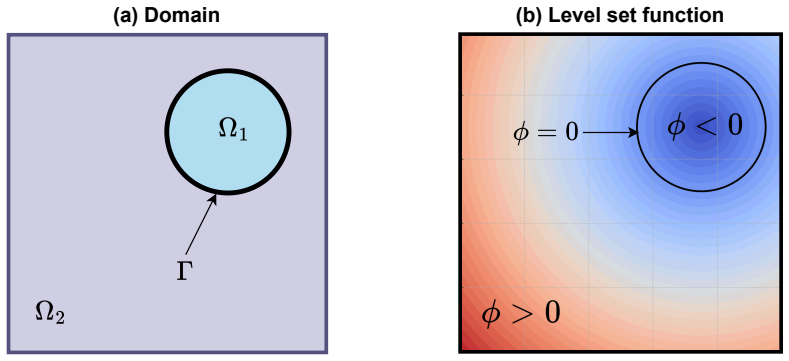
The machinery that carries the argument is the PirateNet architecture: a residual network whose adaptive skip connections are controlled by trainable parameters $\alpha^{(l)}$ that start at zero (each residual block is an identity map) and grow during training, so the effective depth of the network increases only when nonlinearity is needed. Around this core, the pipeline assembles random Fourier feature embeddings of $(x,t)$ coordinates, random weight factorization, physics-informed initialization (the final linear layer is fit by least squares to the initial condition), causal training (residual losses on later time chunks are weighted down until earlier chunks are learned), gradient-normalization loss balancing, and sequence-to-sequence training that divides $[0,T]$ into windows, feeding each window's initial condition from the previous window's prediction. The level set function $\phi(x,t)$ is a signed distance function whose zero contour is the interface, transported by the advection equation; the Eikonal property $\|\nabla\phi\|=1$ appears only as an optional regularization term. For the dam-break case, a geometric reinitialization using the Euclidean distance transform restores the signed-distance property between windows while leaving the zero level set in place.
What would settle it
Run the trained 'Sota' model on the time-reversed vortex flow and compare its prediction at $t=T$, when the flow has reversed and the initial circle should be recovered exactly, against the known circular interface: if the returned interface deviates from the circle by far more than the reported $0.85\%$ $L^2$ error, or if the same error persists when measured against an independent high-order reference instead of the paper's finite-element solution, the central claim is falsified.
Extended reading notes
Core claim
On the paper's own terms, the discovery is that the level set advection equation $\partial \phi/\partial t + \mathbf{u}\cdot\nabla\phi = 0$ can be learned end-to-end by a PirateNet-based PINN even when the velocity field is strongly vortical and the interface is heavily stretched, without the upwind stabilization or reinitialization that classical discretizations typically require. The error tables carry the argument: for Zalesak's disk, PirateNet gives $L^2=0.35\%$ versus $2.96\%$ for the improved PINN and $4.18\%$ for the original PINN, and a hyperparameter-tuned 'Sota' configuration reaches $0.14\%$; for the time-reversed vortex flow, the same ordering gives $5.24\%$, $20.86\%$, and $51.20\%$, with Sota at $0.85\%$. The authors interpret this as the first PINN-based level set solution in a complex, varying, vortical velocity field. They also show that adding an Eikonal loss ($\|\nabla\phi\|=1$) or a Monte-Carlo mass-loss term does not improve accuracy on these benchmarks and can freeze the interface or fail to converge when the weight is too large. For the coupled level set–Navier-Stokes dam-break problem, where the signed-distance property decays during training, they embed a geometric reinitialization step between sequence-to-sequence windows—resetting the level set to its signed distance while keeping the zero contour fixed—and report $L^2=5.6\%$ with no growing error pattern.
Load-bearing premise
The reported error numbers are computed against the authors' own finite-element reference solution, so the central claim assumes that reference is accurate enough to serve as ground truth; if it is not, the low $L^2$ values and the conclusion that no upwind stabilization or mass conservation is needed do not follow.
Editorial extensions
If this is right
- If the reported errors are representative, level-set advection in strongly deforming flows can be solved by PINNs without upwind stabilization, so the classical artificial-diffusion burden of transport schemes does not transfer to this neural formulation.
- Architecture and training recipe matter: on both benchmarks the PirateNet configuration reduces the relative $L^2$ error by roughly an order of magnitude compared with the original PINN, with the widest gap on the strongly stretching vortex flow ($0.85\%$ versus $51.20\%$).
- The Eikonal and mass-loss regularizations tested here are not needed for the conservative benchmarks and can degrade accuracy or fail to converge, so the default recommendation is to omit them unless a specific case requires them.
- For the coupled level set–Navier-Stokes dam-break problem, embedding a geometric reinitialization between sequence-to-sequence windows gives stable long-time inference at $L^2=5.6\%$, but at substantially higher wall-clock cost than the finite-element reference (16 hours on a V100 GPU versus 1.25 hours on a laptop CPU).
- The paper's claim is about interface-position accuracy, not mass conservation: the PINN's mean absolute percent mass error is $1.18\%$ on the vortex test versus $0.07\%$ for the finite-element solver.
Reading between the lines
- A natural next check, not run in the paper, would compare the tuned network on the time-reversed vortex against the exact final state (the flow returns the circle to its initial position), separating architecture performance from the accuracy of the finite-element reference.
- The geometric reinitialization turns the coupled solver into a hybrid: the PINN no longer solves the full space-time problem in one shot, so the mesh-free advantage is partially traded against a discrete reset; whether a learned reinitialization could replace the Euclidean distance transform remains untested.
- The observed tendency of a strong Eikonal weight to freeze the interface suggests that a dynamic schedule—Eikonal weight high at early times and relaxed once the interface starts to deform—might recover both signed-distance quality and stretching, an ablation the paper does not report.
- Because mass conservation is the main quantitative gap, the most promising next step is a differentiable mass-loss term evaluated during training rather than the separately trained second network, which the paper observes fails to converge; such a formulation could close the gap without the overhead the paper measured.
Editorial analysis
A structured set of objections, weighed in public.
Referee Report
Summary. The paper proposes a physics-informed neural network framework based on the PirateNet architecture, extended with causal training, sequence-to-sequence learning, random weight factorization, and Fourier feature embeddings, for solving level set transport equations in moving interface problems. The method is tested on Zalesak's rotating disk and the time-reversed vortex flow, with reported relative L2 errors of 0.14% and 0.85% against a SUPG-stabilized finite element reference, and on a coupled level set–Navier-Stokes dam break problem with a proposed geometric reinitialization step. The central claim is that PirateNet-based PINNs can solve level set problems with complex interface deformation without upwind stabilization or explicit mass conservation, and that the reported errors are state-of-the-art.
Significance. If the quantitative claims hold, this is a useful contribution: it shows that modern PINN training techniques can handle the transport of sharp interfaces in highly deforming flows, and it provides a careful ablation of Eikonal and mass-loss regularizers, concluding that they do not help in most tested cases. The paper also demonstrates a practical geometric reinitialization strategy for long-time coupled simulations. The main empirical finding that PirateNet outperforms plain and default PINNs is supported by the reported experiments, and the honesty in reporting negative results for mass and Eikonal losses is a strength. However, the state-of-the-art error numbers are not yet anchored because the reference solution is an unvalidated in-house FEM result in cases where exact solutions exist, and the headline comparison is confounded by asymmetric hyperparameter tuning. Reproducibility is limited by the statement that code is available only upon request.
major comments (4)
- [Secs. 4.1.2, 4.2, and Eq. (40); Tables 1 and 3] The headline L2 errors are computed against a SUPG/T6 FEM reference generated by the authors (Fahsi and Soulaimani, 2017) on 10,470 elements, with no mesh-convergence study and no independent validation of that reference. This is load-bearing because for both benchmarks the exact final state is known analytically: the velocity (41) is a rigid rotation of the initial condition, and the stream function (43) makes phi(x,T) = phi(x,0). The paper should report the L2 error of both the PINN and the FEM reference relative to these exact states, or validate the FEM reference against an independent high-resolution solver, before claiming 0.14% and 0.85% as state-of-the-art. Without this, the low error numbers may partly reflect agreement with a diffused or phase-shifted reference rather than the true solution.
- [Sec. 4, Table B.11, Table B.12, Tables 1 and 3] The 'Sota' configuration is selected by a Bayesian hyperparameter sweep (WandB) on the same test benchmark whose error is then reported, while 'Plain', 'Default', and 'PirateNet' use fixed default hyperparameters without an equivalent sweep. In addition, Table B.11 shows that Sota for Zalesak's disk trains for 80,000 steps versus 20,000 for the other configurations. This asymmetric tuning means the comparisons in Tables 1 and 3 do not isolate the architecture's contribution and make the reported Sota error partly in-sample. Please either apply the same sweep to all configurations, or clearly label the Sota results as test-set-selected and provide a like-for-like fixed-hyperparameter comparison.
- [Tables 1, 3, A.6, A.7] All reported errors come from single runs without multiple seeds or error bars. PINN training is initialization- and optimizer-dependent, so claims such as 'PirateNet performs better than Default' and the 2.49% vs 2.52% difference in Table A.8 cannot be assessed for statistical significance. At least a small number of seeds with mean plus/minus standard deviation should be reported for the main comparisons.
- [Sec. 4.3.4 and Sec. 4.3.1] The dam break error statement says 'the frames considered in this error calculation are only the ones subjected to the reinitialization step,' which is ambiguous and potentially selective; if error is evaluated only on a subset of frames chosen after the fact, the reported L2 = 5.6% is not a representative full-time error. Please specify exactly which frames are included and also report the error over all time frames. Further, the momentum residuals (56)-(57) drop all viscous terms involving derivatives of mu, with the justification that residuals are not computed exactly on the interface; a quantitative argument for why these terms are negligible in the loss for this two-phase problem would strengthen the methodology.
minor comments (5)
- [Sec. 4.1.1] The text states that 'no enhancements to PINN training, as discussed in Section 3.2, were applied in this example,' but the same paragraph adopts a sequence-to-sequence approach, which is introduced as an enhancement in Section 3.2.5; please clarify what 'no enhancements' means in this context.
- [Code availability] The code is described as 'available upon request'; for a computational journal paper, providing a permanent repository link would substantially improve reproducibility.
- [Sec. 3.3.2, Eq. (35)] The Monte Carlo area estimator uses a uniform random sample, but no variance reduction or number of points N is specified in the main text; please state the sample sizes used for the mass loss computations in Sections 4.1.2 and 4.2.
- [Throughout] There are several typographical issues and formatting inconsistencies, for example 'PirateNets'' in the introduction, 'W andB’s' in the text, and inconsistent use of 'PirateNet' versus 'PirateNets'; a careful copyedit is recommended.
- [Sec. 4.1.2, Figure 5] The mass error comparison between Sota and FEM is informative, but the figure would be clearer if the two curves were on a common axis with confidence intervals or repeated runs, given the stated high variance of the PINN mass error.
Circularity Check
Headline L2 errors are partly in-sample (Sota hyperparameters selected on the same benchmarks) and are measured against an unvalidated, self-cited FEM reference, though the core PINN derivation itself is not circular.
-
fitted input called prediction
[Sec. 4.1.2 (Zalesak's disk), Sec. 4.2 (time-reversed vortex), Tables 1 and 3, Tables B.11 and B.12]
"With the PirateNet architecture, we then performed a Bayesian hyperparameter sweep using Wandb's sweep module [59]. Table B.11's Sota configuration summarizes the optimal hyperparameters, allowing us to lower the error down to L2 Sota = 0.14%."
The 'Sota' configuration is selected by minimizing the same relative L2 error of Eq. (40) on the very benchmark whose error is then reported as the headline result. The same procedure is repeated in Sec. 4.2: 'With the PirateNet architecture, we then performed a Bayesian hyperparameter sweep ... With Sota, we were able to reduce the error down to L2 Sota = 0.85%.' Thus the reported accuracy is an in-sample selection score: the hyperparameters are effectively fitted to the reported quantity, so the low error is partly forced by the selection procedure rather than being an independent prediction.
-
self citation load bearing
[Sec. 4.1.2, Sec. 4.2, Sec. 4.3.4, Eq. (40), Refs. [45] and [10]]
"The reference solution was obtained using the SUPG-stabilized finite element method, with a quadratic approximation for the level set function on unstructured triangular elements (T6) and a third-order explicit strong–stability–preserving Runge–Kutta (SSP–RK) time integration scheme [45] implemented with MATLAB."
Every headline error is defined against this reference via Eq. (40): 'Relative L2 Error = ‖uPINN − ureference‖2 / ‖ureference‖2.' The reference solver is [45] (Fahsi and Soulaimani), i.e., the same research group's FEM code; the contribution statement confirms 'Adil Fahsi: FEM code, validation, review.' For both benchmarks exact terminal states are available (rigid rotation for Zalesak's disk; time-reversed stream function gives φ(x,T)=φ(x,0) for the vortex), but the paper never anchors the reference to these states. Consequently the 'state-of-the-art' numbers are deviations from an unvalidated, self-cited simulation rather than from an externally established solution, making the central accuracy claim load-bearing on a self-citation.
full rationale
The paper's mathematical core is not circular. The PINN loss in Eqs. (29)-(30) is the level set PDE residual plus the initial condition; no reference data enter the loss, and the solution is produced by minimizing that residual. The Burgers' validation in Appendix A uses external references (Chebfun, finite differences) and shows the same qualitative architecture comparisons. The two flagged issues affect the quantitative 'state-of-the-art' claim, not the derivation itself. First, the Sota hyperparameters are selected by a Bayesian sweep that minimizes the same Eq. (40) error on the same benchmark later reported, so the 0.14% and 0.85% figures are in-sample selection scores rather than out-of-sample predictions. Second, the reference solution used in Eq. (40) for both level set benchmarks is generated by the authors' own FEM solver (Ref. [45], with co-author Adil Fahsi listed as the FEM-code contributor), and the paper does not validate that reference against the known exact terminal states. These are genuine independence problems for the headline error numbers, but they do not make the PDE-solving procedure equivalent to its inputs by definition. Score 4 reflects partial circularity in the accuracy claim while acknowledging that the central methodological content retains independent substance.
Assumptions & free parameters
free parameters (5)
- Sota hyperparameters for Zalesak's disk =
8 residual blocks, Swish, Fourier scale 1.0, causal tolerance 1.0, RWF (1.0, 0.1), 80k steps
- Sota hyperparameters for time-reversed vortex flow =
8 residual blocks, Swish, Fourier scale 2.0, causal tolerance 1.5, RWF (1.0, 0.1), 20k steps per window
- Eikonal regularization weight =
scanned 1e-4 to 1.0
- Mass loss weight =
Method 1 with 0.1 to 100, Method 2 with 1000 iterations
- S2S windows and reinitialization schedule for dam break =
16 windows, reinitialization between windows, 20k steps per window (40k for first)
assumptions (5)
- standard math The level set transport equation (Eq. 6) with the given incompressible velocity fields fully describes the interface evolution for the benchmarks.
- domain assumption The authors' own SUPG-stabilized FEM solver (ref [45]) produces reference solutions accurate enough to serve as ground truth for the relative L2 error.
- domain assumption The signed distance property (Eikonal) is a useful target and can be restored by geometric reinitialization without moving the zero contour.
- ad hoc to paper In the coupled dam break equations, derivatives of viscosity are dropped because residuals are not computed exactly on the sharp interface (Sec. 4.3.1).
- domain assumption The neural network can represent the level set solution with sufficient accuracy over the whole spatial domain and time windows; optimization via Adam or SOAP reaches a good local minimum.
Cite this review
Pith. "Pith review of Physics-informed neural networks for solving moving interface flow problems using the level set approach." pith.science (2026). https://pith.science/paper/MRLMUMFM
@misc{pith2026250202440,
  author       = {Pith},
  title        = {Pith review of: Physics-informed neural networks for solving moving interface flow problems using the level set approach},
  year         = {2026},
  howpublished = {\url{https://pith.science/paper/MRLMUMFM}},
  note         = {Machine review of arXiv:2502.02440}
}
abstract
This paper advances the use of physics-informed neural networks (PINNs) architectures to address moving interface problems via the level set method. Originally developed for other PDE-based problems, we particularly leverage PirateNet's features, including causal training, sequence-to-sequence learning, random weight factorization, and Fourier feature embeddings, and tailor them to handle problems with complex interface dynamics. Numerical experiments validate this framework on benchmark problems such as Zalesak's disk rotation and time-reversed vortex flow. We demonstrate that PINNs can efficiently solve level set problems exhibiting significant interface deformation without the need for upwind numerical stabilization, as generally required by classic discretization methods, or additional mass conservation schemes. However, incorporating an Eikonal regularization term in the loss function with an appropriate weight can further enhance results in specific scenarios. Our results indicate that PINNs with the PirateNet architecture surpass conventional PINNs in accuracy, achieving state-of-the-art error rates of $L^2=0.14\%$ for Zalesak's disk and $L^2=0.85 \%$ for the time-reversed vortex flow problem, as compared to reference solutions. Additionally, for a complex two-phase flow dam break problem coupling the level set with the Navier-Stokes equations, we propose a geometric reinitialization method embedded within the sequence-to-sequence training scheme to ensure long-term stability and accurate inference of the level set field.
Figures


Figures from the paper (10 more)


Reference graph
Works this paper leans on
-
[1]
S. Cheng, M. Yang, C. Li, H. Xu, C. Chen, D. Shu, Y. Jiang, Y. Gui, N. Dong, An Improved Coupled Hydrologic- Hydrodynamic Model for Urban Flood Simulations Under Varied Scenarios, Water Resources Management (Aug. 2024). doi:10.1007/s11269-024-03914-9 . URL https://doi.org/10.1007/s11269-024-03914-9
-
[2]
Research, Flood Forecasting - Google Research (2023)
G. Research, Flood Forecasting - Google Research (2023). URL https://sites.research.google/floodforecasting/ 30
work page 2023
-
[3]
F. H. Harlow, J. E. Welch, Numerical Calculation of Time-Dependent Viscous Incompressible Flow of Fluid with Free Surface, The Physics of Fluids 8 (12) (1965) 2182–2189. doi:10.1063/1.1761178. URL https://doi.org/10.1063/1.1761178
-
[5]
W. F. Noh, P. Woodward, SLIC (Simple Line Interface Calculation), in: A. I. van de Vooren, P. J. Zandbergen (Eds.), Proceedings of the Fifth International Conference on Numerical Methods in Fluid Dynamics June 28 – July 2, 1976 Twente University, Enschede, Springer, Berlin, Heidelberg, 1976, pp. 330–340. doi:10.1007/ 3-540-08004-X_336
work page 1976
-
[7]
R. Malladi, J. Sethian, B. Vemuri, Shape Modeling with Front Propagation: A Level Set Approach, IEEE Transactions on Pattern Analysis and Machine Intelligence 17 (2) (1995) 158–175. doi:10.1109/34.368173
-
[8]
M. Y. Wang, X. Wang, D. Guo, A level set method for structural topology optimization, Computer Methods in Applied Mechanics and Engineering 192 (1) (2003) 227–246. doi:10.1016/S0045-7825(02)00559-5 . URL https://www.sciencedirect.com/science/article/pii/S0045782502005595
- [9]
-
[10]
M. K. Tour´ e, A. Soula ¨ ımani, Stabilized finite element methods for solving the level set equation without reinitial- ization, Computers & Mathematics with Applications 71 (8) (2016) 1602–1623. doi:10.1016/j.camwa.2016. 02.028. URL https://www.sciencedirect.com/science/article/pii/S0898122116300827
Show all 63 references
-
[11]
Raissi, P
M. Raissi, P. Perdikaris, G. E. Karniadakis, Physics-informed neural networks: A deep learning framework for solving forward and inverse problems involving nonlinear partial differential equations, Journal of Computational Physics 378 (2019) 686–707. doi:10.1016/j.jcp.2018.10....
2019 doi
-
[12]
A. G. Baydin, B. A. Pearlmutter, A. A. Radul, J. M. Siskind, Automatic differentiation in machine learning: a survey, J. Mach. Learn. Res. 18 (1) (2017) 5595–5637
2017
-
[13]
Z. Fang, J. Zhan, Deep Physical Informed Neural Networks for Metamaterial Design, IEEE Access 8 (2020) 24506–24513, conference Name: IEEE Access. doi:10.1109/ACCESS.2019.2963375. URL https://ieeexplore.ieee.org/document/8946546/?arnumber=8946546
2020
-
[14]
Goswami, M
S. Goswami, M. Yin, Y. Yu, G. Karniadakis, A physics-informed variational DeepONet for predicting the crack path in brittle materials, Computer Methods in Applied Mechanics and Engineering 391 (2022) 114587, arXiv:2108.06905 [cs, math]. doi:10.1016/j.cma.2022.114587. URL http:...
2022 arXiv
-
[15]
S. Liu, B. B. Kappes, B. Amin-ahmadi, O. Benafan, X. Zhang, A. P. Stebner, Physics-informed machine learning for composition – process – property design: Shape memory alloy demonstration, Applied Materials Today 22 (2021) 100898. doi:10.1016/j.apmt.2020.100898. URL https://www...
2021
-
[16]
Salvati, A
E. Salvati, A. Tognan, L. Laurenti, M. Pelegatti, F. De Bona, A defect-based physics-informed machine learning framework for fatigue finite life prediction in additive manufacturing, Materials & Design 222 (2022) 111089. doi:10.1016/j.matdes.2022.111089. URL https://www.scienc...
2022
-
[17]
G. Cho, D. Zhu, J. J. Campbell, M. Wang, An LSTM-PINN Hybrid Method to Estimate Lithium-Ion Battery Pack Temperature, IEEE Access 10 (2022) 100594–100604, conference Name: IEEE Access. doi:10.1109/ ACCESS.2022.3208103. URL https://ieeexplore.ieee.org/abstract/document/9895422
2022
-
[18]
D. V. Pombo, H. W. Bindner, S. V. Spataru, P. E. Sørensen, P. Bacher, Increasing the Accuracy of Hourly Multi- Output Solar Power Forecast with Physics-Informed Machine Learning, Sensors 22 (3) (2022) 749, number: 3 Publisher: Multidisciplinary Digital Publishing Institute. do...
2022 doi
-
[19]
K. Liu, K. Luo, Y. Cheng, A. Liu, H. Li, J. Fan, S. Balachandar, Surrogate modeling of parameterized multi- 31 dimensional premixed combustion with physics-informed neural networks for rapid exploration of design space, Combustion and Flame 258 (2023) 113094. doi:10.1016/j.com...
2023
-
[20]
Masclans, F
N. Masclans, F. V´ azquez-Novoa, M. Bernades, R. M. Badia, L. Jofre, Thermodynamics-informed neural network for recovering supercritical fluid thermophysical information from turbulent velocity data, International Journal of Thermofluids 20 (2023) 100448. doi:10.1016/j.ijft.20...
2023
-
[21]
S. Dazzi, Physics-Informed Neural Networks for the Augmented System of Shallow Water Equa- tions With Topography, Water Resources Research 60 (10) (2024) e2023WR036589, eprint: https://onlinelibrary.wiley.com/doi/pdf/10.1029/2023WR036589. doi:10.1029/2023WR036589. URL https://...
2024 doi
-
[22]
Donnelly, A
J. Donnelly, A. Daneshkhah, S. Abolfathi, Physics-informed neural networks as surrogate models of hydro- dynamic simulators, Science of The Total Environment 912 (2024) 168814. doi:10.1016/j.scitotenv.2023. 168814. URL https://linkinghub.elsevier.com/retrieve/pii/S0048969723074430
2024 doi
-
[23]
Y. Li, Q. Sun, J. Wei, C. Huang, An Improved PINN Algorithm for Shallow Water Equations Driven by Deep Learning, Symmetry 16 (10) (2024) 1376, number: 10 Publisher: Multidisciplinary Digital Publishing Institute. doi:10.3390/sym16101376. URL https://www.mdpi.com/2073-8994/16/10/1376
2024 doi
-
[24]
X. Qi, G. A. M. de Almeida, S. Maldonado, Physics-informed neural networks for solving flow problems modeled by the 2D Shallow Water Equations without labeled data, Journal of Hydrology 636 (2024) 131263. doi: 10.1016/j.jhydrol.2024.131263. URL https://www.sciencedirect.com/sc...
2024
-
[25]
Kamil, A
H. Kamil, A. Soula ¨ ımani, A. Beljadid, A transfer learning physics-informed deep learning framework for modeling multiple solute dynamics in unsaturated soils, Computer Methods in Applied Mechanics and Engineering 431 (2024) 117276. doi:10.1016/j.cma.2024.117276. URL https:/...
2024
-
[26]
Rahaman, A
N. Rahaman, A. Baratin, D. Arpit, F. Draxler, M. Lin, F. Hamprecht, Y. Bengio, A. Courville, On the Spectral Bias of Neural Networks, in: Proceedings of the 36th International Conference on Machine Learning, PMLR, 2019, pp. 5301–5310, iSSN: 2640-3498. URL https://proceedings.m...
2019
-
[27]
S. Wang, H. Wang, P. Perdikaris, On the eigenvector bias of Fourier feature networks: From regression to solving multi-scale PDEs with physics-informed neural networks, Computer Methods in Applied Mechanics and Engineering 384 (2021) 113938. doi:10.1016/j.cma.2021.113938. URL ...
2021
-
[28]
S. Wang, Y. Teng, P. Perdikaris, Understanding and Mitigating Gradient Flow Pathologies in Physics-Informed Neural Networks, SIAM J. Sci. Comput. 43 (5) (2021) A3055–A3081. doi:10.1137/20M1318043. URL https://doi.org/10.1137/20M1318043
2021 doi
-
[29]
S. Wang, X. Yu, P. Perdikaris, When and why PINNs fail to train: A neural tangent kernel perspective, Journal of Computational Physics 449 (2022) 110768. doi:10.1016/j.jcp.2021.110768. URL https://www.sciencedirect.com/science/article/pii/S002199912100663X
2022
-
[30]
S. Wang, S. Sankaran, P. Perdikaris, Respecting causality is all you need for training physics-informed neural networks (Mar. 2022). URL https://arxiv.org/abs/2203.07404v1
2022 arXiv
-
[31]
Tancik, P
M. Tancik, P. Srinivasan, B. Mildenhall, S. Fridovich-Keil, N. Raghavan, U. Singhal, R. Ramamoorthi, J. Bar- ron, R. Ng, Fourier Features Let Networks Learn High Frequency Functions in Low Dimensional Domains, in: Advances in Neural Information Processing Systems, Vol. 33, Cur...
2020
- [32]
- [33]
-
[34]
C. Wu, M. Zhu, Q. Tan, Y. Kartha, L. Lu, A comprehensive study of non-adaptive and residual-based adaptive sampling for physics-informed neural networks, Computer Methods in Applied Mechanics and Engineering 403 (2023) 115671. doi:10.1016/j.cma.2022.115671. URL https://www.sci...
2023
- [35]
-
[36]
Bengio, J
Y. Bengio, J. Louradour, R. Collobert, J. Weston, Curriculum learning, in: Proceedings of the 26th Annual International Conference on Machine Learning, ICML ’09, Association for Computing Machinery, New York, NY, USA, 2009, pp. 41–48. doi:10.1145/1553374.1553380. URL https://d...
2009
- [37]
- [38]
-
[39]
S. Wang, B. Li, Y. Chen, P. Perdikaris, PirateNets: Physics-informed Deep Learning with Residual Adaptive Networks, Journal of Machine Learning Research 25 (2025) 1–51. URL http://arxiv.org/abs/2402.00326
2025 arXiv
-
[40]
R. M. Silva, M. Grave, A. L. G. A. Coutinho, A PINN-based level-set formulation for reconstruction of bubble dynamics, Archive of Applied Mechanics 94 (9) (2024) 2667–2682. doi:10.1007/s00419-024-02622-5 . URL https://doi.org/10.1007/s00419-024-02622-5
2024 doi
-
[41]
W. Zhou, S. Miwa, K. Okamoto, Self-adaptive and time divide-and-conquer physics-informed neural networks for two-phase flow simulations using interface tracking methods, Physics of Fluids 36 (7) (2024) 073305. doi: 10.1063/5.0214646. URL https://doi.org/10.1063/5.0214646
2024 doi
-
[42]
M. Tang, Z. Xin, L. Wang, Physics-Informed neural network for level set method in vapor condensation, Inter- national Journal of Heat and Fluid Flow 110 (2024) 109651. doi:10.1016/j.ijheatfluidflow.2024.109651. URL https://www.sciencedirect.com/science/article/pii/S0142727X2400376X
2024
-
[43]
S. T. Zalesak, Fully multidimensional flux-corrected transport algorithms for fluids, Journal of Computational Physics 31 (3) (1979) 335–362. doi:10.1016/0021-9991(79)90051-2 . URL https://www.sciencedirect.com/science/article/pii/0021999179900512
1979
-
[44]
Sussman, P
M. Sussman, P. Smereka, S. Osher, A Level Set Approach for Computing Solutions to Incompressible Two-Phase Flow, Journal of Computational Physics 114 (1) (1994) 146–159. doi:10.1006/jcph.1994.1155. URL https://www.sciencedirect.com/science/article/pii/S0021999184711557
1994
-
[45]
Fahsi, A
A. Fahsi, A. Soula ¨ ımani, Numerical investigations of the XFEM for solving two-phase incompressible flows, International Journal of Computational Fluid Dynamics 31 (3) (2017) 135–155, publisher: IAHR Websiteeprint: https://doi.org/10.1080/10618562.2017.1322200. doi:10.1080/1...
2017
-
[46]
R. F. Ausas, E. A. Dari, G. C. Buscaglia, A geometric mass-preserving redistancing scheme for the level set function | Request PDF, International Journal for Numerical Methods in Fluids 65 (8) (2011) 989–1010. doi:10.1002/fld.2227. URL https://www.researchgate.net/publication/...
2011
-
[47]
J. A. Sethian, A fast marching level set method for monotonically advancing fronts, Proceedings of the National Academy of Sciences 93 (4) (1996) 1591–1595, publisher: Proceedings of the National Academy of Sciences. doi:10.1073/pnas.93.4.1591. URL https://www.pnas.org/doi/abs...
1996 doi
-
[48]
Sethian, Theory, algorithms, and applications of level set methods for propagating interfaces, Acta Numerica 5 (1996) 309–395
J. Sethian, Theory, algorithms, and applications of level set methods for propagating interfaces, Acta Numerica 5 (1996) 309–395. doi:10.1017/S0962492900002671
1996 doi
-
[49]
C. Li, C. Xu, C. Gui, M. Fox, Level set evolution without re-initialization: a new variational formulation, in: 2005 IEEE Computer Society Conference on Computer Vision and Pattern Recognition (CVPR’05), Vol. 1, 2005, pp. 430–436 vol. 1, iSSN: 1063-6919. doi:10.1109/CVPR.2005....
2005
-
[50]
S. P. van der Pijl, A. Segal, C. Vuik, P. Wesseling, A mass-conserving Level-Set method for modelling of multi-phase flows, International Journal for Numerical Methods in Fluids 47 (4) (2005) 339–361, eprint: https://onlinelibrary.wiley.com/doi/pdf/10.1002/fld.817. doi:10.1002...
2005 doi
-
[51]
Olsson, G
E. Olsson, G. Kreiss, A conservative level set method for two phase flow, Journal of Computational Physics 210 (1) (2005) 225–246. doi:10.1016/j.jcp.2005.04.007. URL https://www.sciencedirect.com/science/article/pii/S0021999105002184
2005 doi
-
[52]
Olsson, G
E. Olsson, G. Kreiss, S. Zahedi, A conservative level set method for two phase flow II, Journal of Computational Physics 225 (1) (2007) 785–807. doi:10.1016/j.jcp.2006.12.027. URL https://www.sciencedirect.com/science/article/pii/S0021999107000046
2007 doi
-
[53]
Penwarden, A
M. Penwarden, A. D. Jagtap, S. Zhe, G. E. Karniadakis, R. M. Kirby, A unified scalable framework for causal sweeping strategies for Physics-Informed Neural Networks (PINNs) and their temporal decompositions, Journal of Computational Physics 493 (2023) 112464, arXiv:2302.14227 ...
2023 arXiv
-
[54]
Glorot, Y
X. Glorot, Y. Bengio, Understanding the difficulty of training deep feedforward neural networks, in: Proceed- ings of the Thirteenth International Conference on Artificial Intelligence and Statistics, JMLR Workshop and Conference Proceedings, 2010, pp. 249–256, iSSN: 1938-7228...
2010
-
[55]
Mattey, S
R. Mattey, S. Ghosh, A novel sequential method to train physics informed neural networks for Allen Cahn and Cahn Hilliard equations, Computer Methods in Applied Mechanics and Engineering 390 (2022) 114474. doi:10.1016/j.cma.2021.114474. URL https://www.sciencedirect.com/scienc...
2022
-
[56]
S. Wang, A. K. Bhartari, B. Li, P. Perdikaris, Gradient Alignment in Physics-informed Neural Networks: A Second-Order Optimization Perspective, arXiv:2502.00604 [cs] (Feb. 2025). doi:10.48550/arXiv.2502.00604. URL http://arxiv.org/abs/2502.00604
2025 doi
- [57]
-
[58]
Bradbury, R
J. Bradbury, R. Frostig, P. Hawkins, M. J. Johnson, C. Leary, D. MacLaurin, G. Necula, A. Paszke, J. Vander- Plas, S. Wanderman-Milne, Q. Zhang, JAX: composable transformations of Python+NumPy programs (2018). URL http://github.com/jax-ml/jax
2018
-
[59]
Biewald, C
L. Biewald, C. Van Pelt, Weights & Biases: The AI Developer Platform (2020). URL https://wandb.ai/site/
2020
-
[60]
J. D. Hunter, Matplotlib: A 2D Graphics Environment, Computing in Science & Engineering 9 (3) (2007) 90–95, conference Name: Computing in Science & Engineering. doi:10.1109/MCSE.2007.55. URL https://ieeexplore.ieee.org/document/4160265
2007
-
[61]
J. M. Burgers, A Mathematical Model Illustrating the Theory of Turbulence, in: R. Von Mises, T. Von K´ arm´ an (Eds.), Advances in Applied Mechanics, Vol. 1, Elsevier, 1948, pp. 171–199. doi:10.1016/S0065-2156(08) 70100-5. URL https://www.sciencedirect.com/science/article/pii/...
1948 doi
-
[62]
W. J. Rider, D. B. Kothe, Reconstructing Volume Tracking, Journal of Computational Physics 141 (2) (1998) 112–152. doi:10.1006/jcph.1998.5906. URL https://www.sciencedirect.com/science/article/pii/S002199919895906X
1998
-
[63]
Virtanen, R
P. Virtanen, R. Gommers, T. E. Oliphant, M. Haberland, T. Reddy, D. Cournapeau, E. Burovski, P. Peterson, W. Weckesser, J. Bright, S. J. van der Walt, M. Brett, J. Wilson, K. J. Millman, N. Mayorov, A. R. J. Nelson, E. Jones, R. Kern, E. Larson, C. J. Carey, I. Polat, Y. Feng,...
2020
-
[64]
T. A. Driscoll, N. Hale, L. N. Trefethen, Chebfun guide, pafnuty publications Edition, Oxford, 2014
2014
-
[65]
M. S. Mathias, W. P. de Almeida, M. R. de Barros, J. F. Coelho, L. P. de Freitas, F. M. Moreno, C. F. D. Netto, F. G. Cozman, A. H. R. Costa, E. A. Tannuri, E. S. Gomi, M. Dottori, Augmenting a Physics-Informed Neural Network for the 2D Burgers Equation by Addition of Solution...
2022 arXiv
Reviewed August 9, 2026 · model on record in the stance chip above.
Discussion (0). Continue with ORCID to comment.