A primal-dual splitting algorithm for monotone inclusions with applications
Pith reviewed 2026-06-29 03:33 UTC · model grok-4.3
The pith
A primal-dual splitting algorithm solves structured monotone inclusions with a single resolvent evaluation per iteration.
A machine-rendered reading of the paper's core claim, the machinery that carries it, and where it could break.
Core claim
We propose a novel primal-dual splitting algorithm for solving such inclusions, which accommodates multiple monotone operators and cocoercive terms, as well as a composite monotone operator involving the linear map. The algorithm combines forward evaluations for the cocoercive components with backward resolvent steps for the monotone operators and employs a dual update for the linear composition term. It generalizes and unifies several existing methods, while requiring only a single resolvent or operator evaluation per iteration. We prove weak convergence of the iterates under standard assumptions on monotonicity and cocoercivity. Furthermore, we establish strong convergence under a mild reg
What carries the argument
The primal-dual splitting scheme that performs forward evaluations on cocoercive terms, resolvent steps on monotone operators, and a dual update for the linear composition.
If this is right
- The algorithm generalizes and unifies several existing primal-dual splitting methods.
- Only one resolvent or operator evaluation is needed per iteration.
- The iterates converge weakly under standard monotonicity and cocoercivity assumptions.
- Strong convergence holds when a uniform monotonicity condition is added.
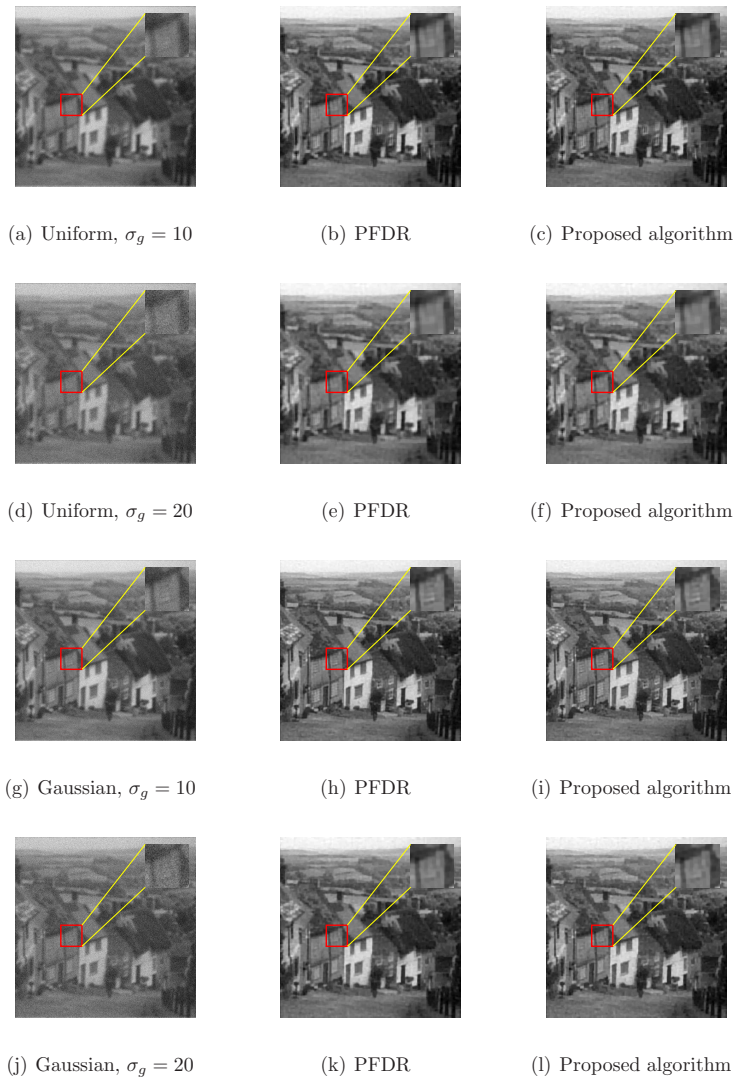
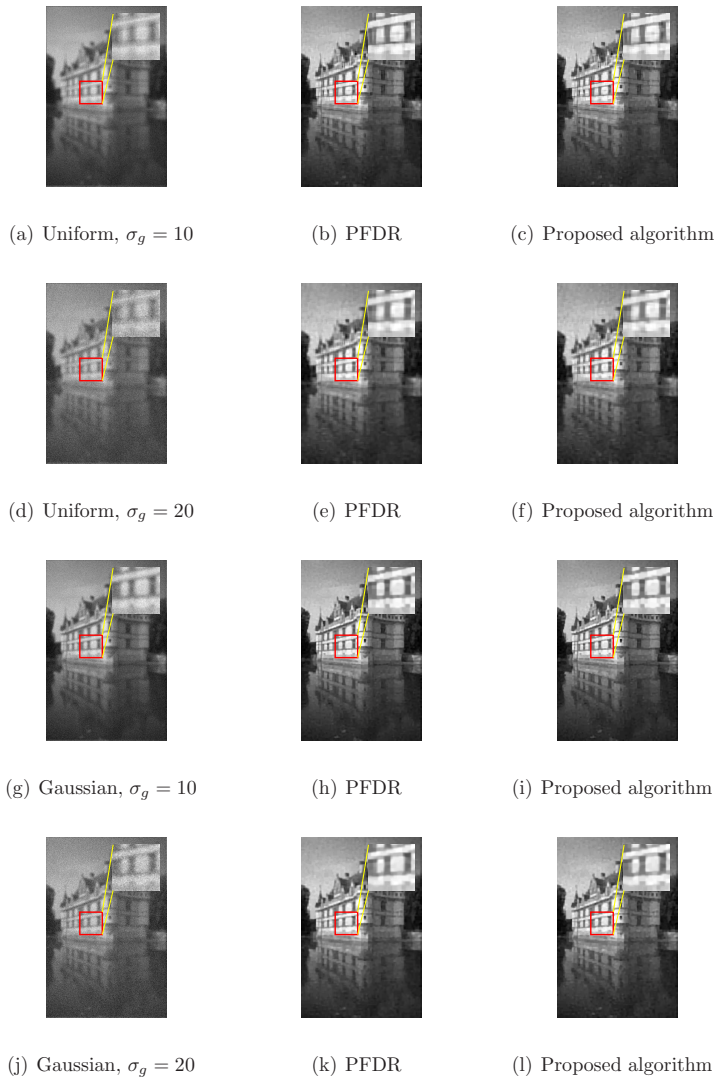
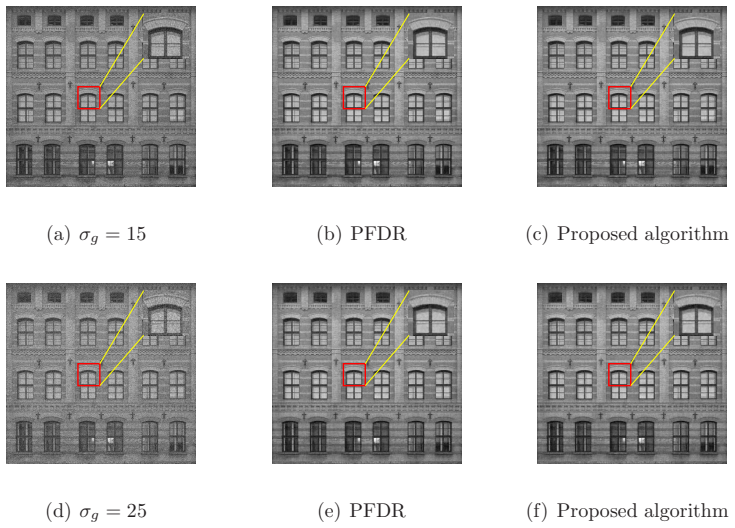
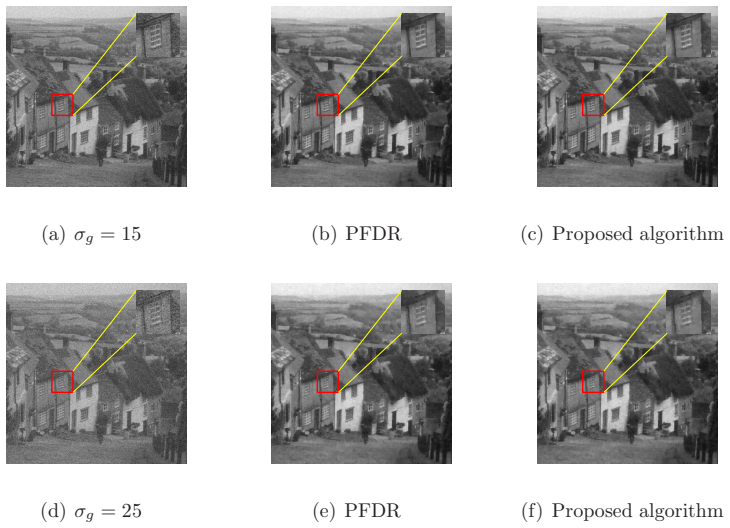
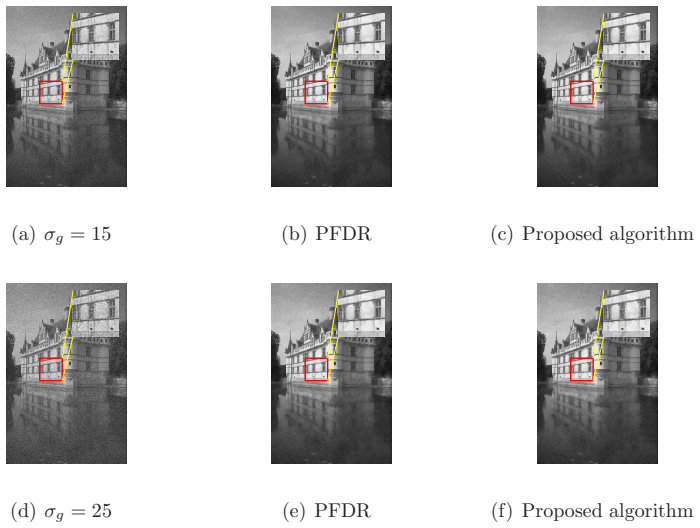
- The method applies directly to image deblurring and denoising problems.
Where Pith is reading between the lines
- The single-evaluation structure may reduce computational cost in high-dimensional inverse problems where resolvents are the dominant expense.
- The unification suggests that many prior algorithms are special cases obtained by choosing particular cocoercive or linear terms.
- Extensions to time-varying or stochastic monotone inclusions could follow by replacing fixed resolvents with approximate or sampled versions.
- Performance on other inverse problems such as tomography or phase retrieval would test the claimed flexibility beyond the reported imaging examples.
Load-bearing premise
The involved operators must be monotone and the cocoercive terms must satisfy the cocoercivity condition.
What would settle it
Apply the algorithm to a problem where at least one operator violates monotonicity and check whether the sequence of iterates fails to approach a solution set.
Figures
read the original abstract
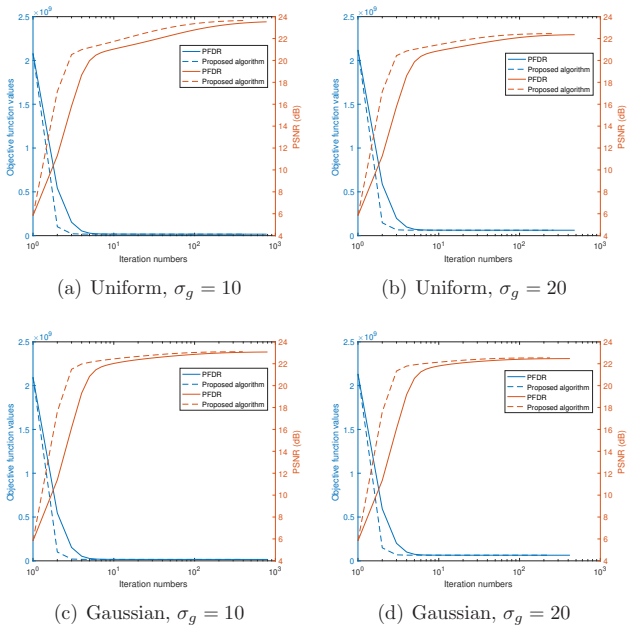
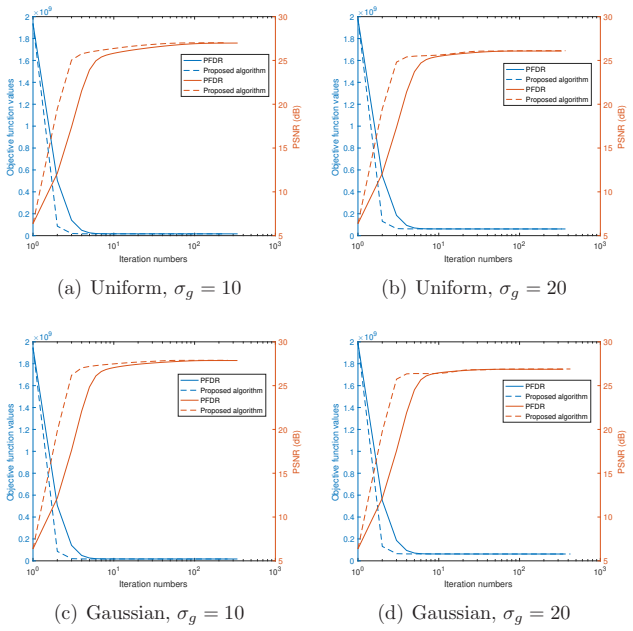
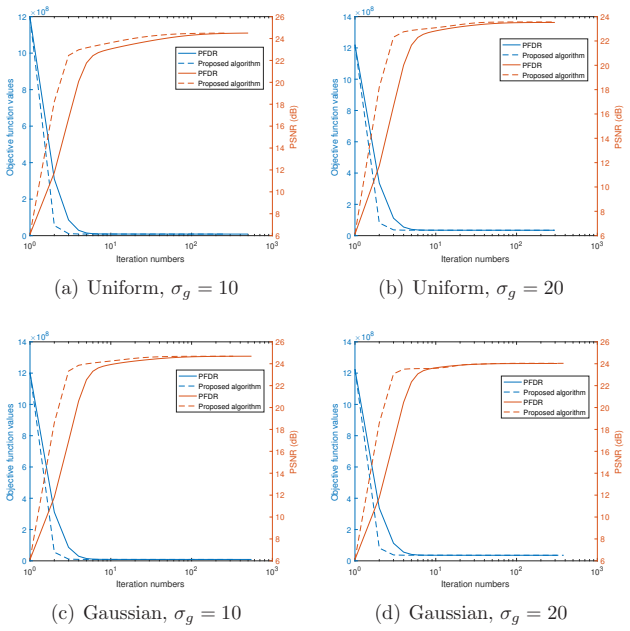
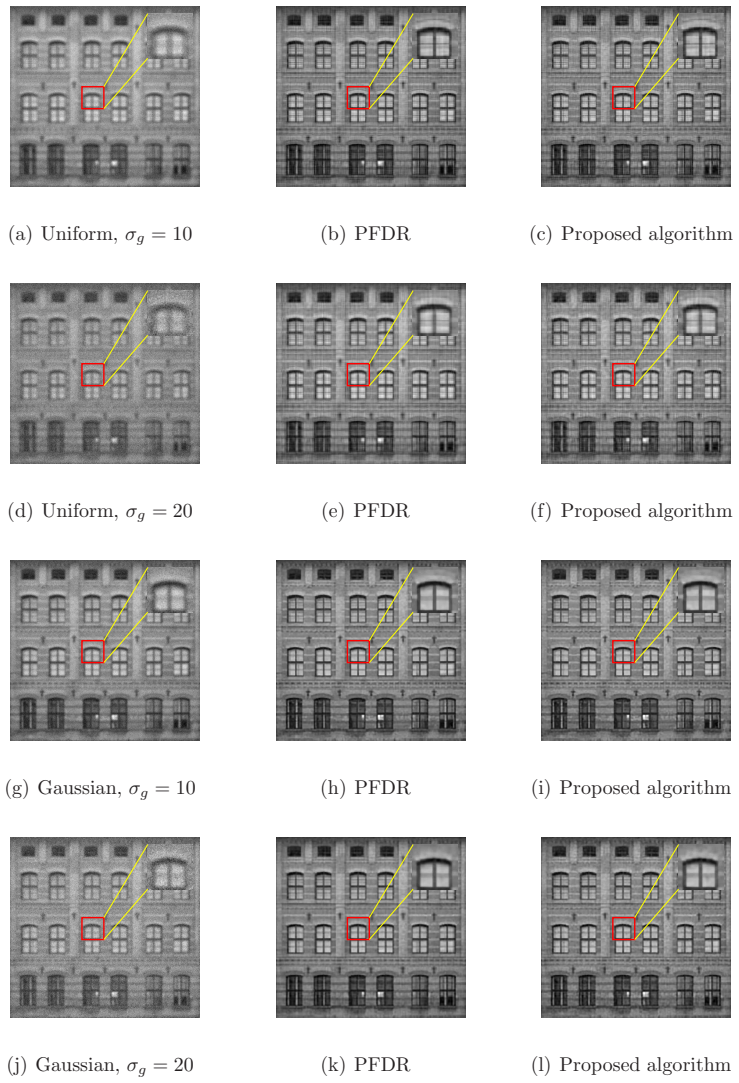
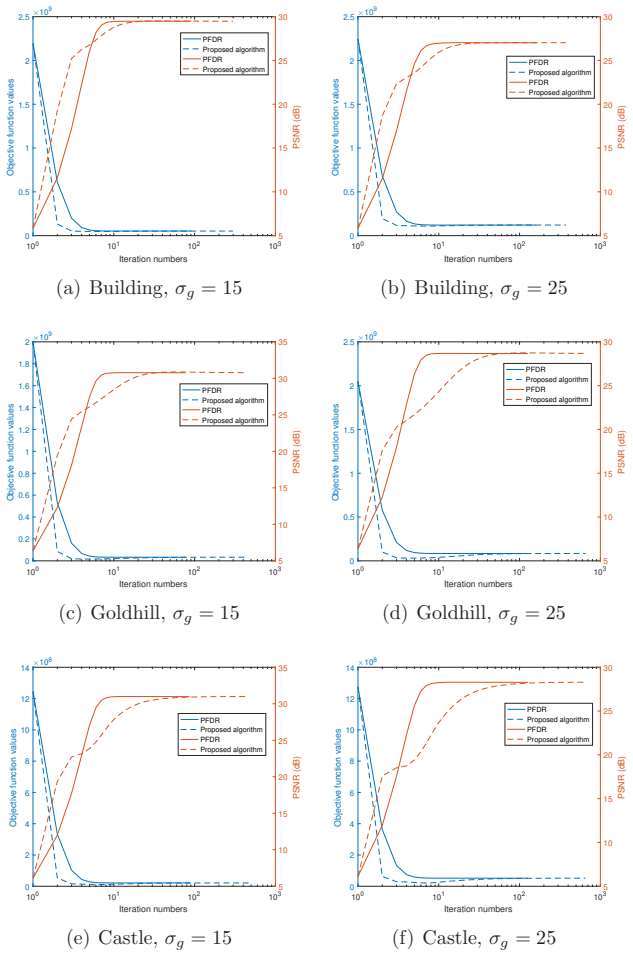
In this paper, we study a broad class of structured monotone inclusion problems in real Hilbert spaces. We propose a novel primal-dual splitting algorithm for solving such inclusions, which accommodates multiple monotone operators and cocoercive terms, as well as a composite monotone operator involving the linear map. The algorithm combines forward evaluations for the cocoercive components with backward resolvent steps for the monotone operators and employs a dual update for the linear composition term. It generalizes and unifies several existing methods, while requiring only a single resolvent or operator evaluation per iteration. We prove weak convergence of the iterates under standard assumptions on monotonicity and cocoercivity. Furthermore, we establish strong convergence under a mild regularity condition, such as uniform monotonicity. Numerical experiments on image deblurring and denoising problems demonstrate the efficiency and flexibility of the proposed algorithm.
Editorial analysis
A structured set of objections, weighed in public.
Referee Report
Summary. The manuscript proposes a novel primal-dual splitting algorithm for solving structured monotone inclusion problems in real Hilbert spaces. The algorithm handles multiple monotone operators, cocoercive terms, and a composite monotone operator involving a linear map; it performs forward steps on cocoercive components and backward resolvent steps on monotone operators, with a dual update for the linear term. It is claimed to require only a single resolvent or operator evaluation per iteration, to generalize and unify several existing methods, to converge weakly under standard monotonicity and cocoercivity assumptions, and to converge strongly under an additional mild regularity condition such as uniform monotonicity. Numerical experiments on image deblurring and denoising illustrate practical performance.
Significance. If the convergence analysis holds, the work supplies a flexible, computationally light framework that unifies primal-dual splitting schemes under minimal per-iteration cost. This could streamline implementation for inverse problems and structured optimization tasks where multiple operator types appear simultaneously.
minor comments (3)
- [Abstract, §1] Abstract and §1: the unification claim would be strengthened by an explicit table or subsection that maps the new algorithm to the specific prior methods it recovers (e.g., by setting certain operators to zero or choosing particular step-size rules).
- [Theorem on strong convergence] The strong-convergence statement invokes 'a mild regularity condition, such as uniform monotonicity'; the precise hypothesis used in the proof (e.g., which theorem or lemma) should be stated verbatim in the theorem statement rather than only in the abstract.
- [Numerical experiments] Numerical section: the manuscript should report the precise step-size choices, the number of iterations, and quantitative metrics (PSNR/SSIM or residual norms) together with direct comparisons against at least two standard baselines so that the efficiency claim can be assessed.
Simulated Author's Rebuttal
We thank the referee for the positive summary and recommendation of minor revision. No specific major comments were provided in the report, so we have no points to address point-by-point at this stage. The manuscript stands as submitted.
Circularity Check
No significant circularity
full rationale
The paper introduces a primal-dual splitting algorithm for structured monotone inclusions and establishes weak convergence via Fejér monotonicity and Opial's lemma (or equivalent arguments) under the external hypotheses of monotonicity of the operators and cocoercivity of the forward terms; strong convergence follows from an additional mild regularity condition such as uniform monotonicity. These assumptions are standard operator properties independent of the algorithm's iterates or outputs. The claim of generalizing existing methods is a direct comparison of iteration structures rather than a self-referential derivation. No self-definitional steps, fitted inputs renamed as predictions, load-bearing self-citations, imported uniqueness theorems, or smuggled ansatzes appear in the derivation chain. The analysis therefore remains self-contained against external benchmarks.
Axiom & Free-Parameter Ledger
axioms (1)
- domain assumption The operators are monotone and the cocoercive terms satisfy the cocoercivity inequality.
Reference graph
Works this paper leans on
-
[1]
Condat, G
L. Condat, G. Malinovsky, and P. Richtarik. Distributed proximal splitting algorithms with rates and acceleration. Front. Signal Process, 1(776825), 2022
2022
-
[2]
Condat, D
L. Condat, D. Kitahara, A. Contreras, and A. Hirabayashi. Pro ximal splitting algorithms for convex optimization: a tour of recent advances, wit h new twists. SIAM Review , 65(2):375–435, 2023
2023
-
[3]
Combettes
P.L. Combettes. The geometry of monotone operator splitting m ethods. Acta Numer., 33:487–632, 2024
2024
-
[4]
Lions and B
P.L. Lions and B. Mercier. Splitting algorithms for the sum of two no nlinear operators. SIAM J. Numer. Anal. , 16(6):964–979, 1979
1979
-
[5]
Combettes and J.-C
P.L. Combettes and J.-C. Pesquet. A Douglas-Rachford splitting approach to nonsmooth convex variational signal recovery. IEEE J. Sel. Top. Signal Process , 1(4):564–574, 2007
2007
-
[6]
P. Tseng. A modified forward-backward splitting method for max imal monotone mappings. SIAM J. Control Optim. , 38(2):431–446, 2000. 40
2000
-
[7]
Lorenz and T
D.A. Lorenz and T. Pock. An inertial forward-backward algorith m for monotone inclusions. J. Math. Imaging Vis. , 51:311–325, 2015
2015
-
[8]
Bot ¸, E.R
R.I. Bot ¸, E.R. Csetnek, and C. Hendrich. Inertial Douglas-Rac hford splitting for monotone inclusion problems. Appl. Math. Comput. , 256:472–487, 2015
2015
-
[9]
Attouch and A
H. Attouch and A. Cabot. Convergence rates of inertial forwa rd-backward algorithms. SIAM J. Optim. , 28(1):849–874, 2018
2018
-
[10]
Brice˜ no-Arias and P.L
L.M. Brice˜ no-Arias and P.L. Combettes. A monotone+skew split ting splitting model for composite monotone inclusions in duality. SIAM J. Control Optim. , 21(4):1230–1250, 2011
2011
-
[11]
P. L. Combettes and J.C. Pesquet. Primal-dual splitting algorith m for solv- ing inclusions with mixtures of composite, lipschitzian, and parallel-sum type monotone operators. Set-Valued Var. Anal., 20(2):307–330, 2012
2012
-
[12]
L. Condat. A primal-dual splitting method for convex optimizatio n involving lipschitzian, proximable and linear composite terms. J. Optim. Theory Appl. , 158:460–479, 2013
2013
-
[13]
B.C. V˜ u. A splitting algorithm for dual monotone inclusions involvin g cocoer- cive operators. Adv. Comput. Math. , 38:667–681, 2013
2013
-
[14]
Valkonen
T. Valkonen. A primal-dual hybrid gradient method for nonlinear operators with applications to MRI. Inverse Probl. , 30:055012, 2014
2014
-
[15]
Bot ¸ and E.R
R.I. Bot ¸ and E.R. Csetnek. An inertial forward-backward-fo rward primal-dual splitting algorithm for solving monotone inclusion problems. Numer. Algo- rithms, 71:519–540, 2016
2016
-
[16]
Combettes and J
P.L. Combettes and J. Eckstein. Asynchronous block-iterativ e primal-dual de- composition methods for monotone inclusions. Math. Program., 168:645–672, 2018
2018
-
[17]
Gao, X.C
Y. Gao, X.C. Pan, and C. Chen. An extended primal-dual algorith m framework for nonconvex problems:application to image reconstruction in spec tral CT. Inverse Probl. , 38:085011, 2022
2022
-
[18]
V.C. Bang, D. Papadimitriou, and V.X. Nham. A primal-dual backwa rd re- flected forward splitting algorithm for strutured monotone inclusio ns. Acta Math. Vietnam. , 49(2):159–172, 2024
2024
-
[19]
Aragon-Artacho, Y
F.J. Aragon-Artacho, Y. Malitsky, M.K. Tam, and D. Torregros a-Belen. Dis- tributed forward-backward methods for ring networks. Comput. Optim. Appl. , 86:845–870, 2023. 41
2023
-
[20]
Davis and W.T
D. Davis and W.T. Yin. A three-operator splitting scheme and its o ptimization applications. Set-Valued Var. Anal., 25(4):829–858, 2017
2017
-
[21]
Malitsky and M.K
Y. Malitsky and M.K. Tam. Resolvent splitting for sums of monoton e operators with minimal lifting. Math. Program., 201:231–262, 2023
2023
-
[22]
Arag´ on-Artacho, R
F.J. Arag´ on-Artacho, R. Campoy, and C. L´ opez-Pastor. F orward-backward algorithms devised by graphs. SIAM J. Optim. , 35(4):2423–2451, 2025
2025
-
[23]
Bredies, E
K. Bredies, E. Chenchene, and E. Naldi. Graph and distribued ex tensions of the Douglas-Rachford method. SIAM J. Optim. , 34(2):1569–1594, 2024
2024
-
[24]
M. N. Dao, M. K. Tam, and T. D. Truong. A general approach to distributed operator splitting. arXiv:2504.14987, 2025
Pith/arXiv arXiv 2025
-
[25]
Bredies, E
K. Bredies, E. Chenchene, and D.A. Lorenz. Degenerate prec onditioned proxi- mal point algorithms. SIAM J. Optim. , 32(3):2376–2401, 2022
2022
-
[26]
Raguet, J
H. Raguet, J. Fadili, and G. Peyr´ e. A generalized forward-bac kward splitting. SIAM J. Imaging Sci. , 6(3):1199–1226, 2013
2013
-
[27]
A. Akerman, E. Chenchene, P. Giselsson, and E. Naldi. Splitting t he forward- backward algorithm: a full characterization. arXiv:2504.10999v1, 2025
arXiv 2025
-
[28]
Aragon-Artacho, R.I
F.J. Aragon-Artacho, R.I. Bot, and D. Torregrosa-Belen. A p rimal-dual split- ting algorithm for composite monotone inclusions with minimal lifting. Numer. Algorithms, 93:103–130, 2023
2023
-
[29]
S. Banert. A relaxed forward-backward splitting algorithm for inclusions of sums of monotone operators. Master’s thesis, 2012
2012
-
[30]
Brice˜ no-Arias
L.M. Brice˜ no-Arias. Foward-partial inverse forward splitting for solving mono- tone inclusions. J. Optim. Theory Appl. , 166:391–413, 2015
2015
-
[31]
Raguet and L
H. Raguet and L. Landrieu. Preconditioning of a generalized for ward-backward splitting and application to optimization on graphs. SIAM J. Imaging Sci. , 8(4):2706–2739, 2015
2015
-
[32]
Brice˜ no-Arias
L.M. Brice˜ no-Arias. Forward-Douglas-Rachford splitting and forward-partial inverse method for solving monotone inclusions. Optim., 64:1239–1261, 2015
2015
-
[33]
H. Raguet. A note on the forward-Douglas-Rachford splitting for monotone inclusion and convex optimization. Optim. Lett., 13(4):717–740, 2019
2019
-
[34]
Y.C. Tang, M. Wen, and T.Y. Zeng. Preconditioned three-opera tor splitting algorithm with applications to image restoration. J. Sci. Comput. , 92:106, 2022. 42
2022
-
[35]
Yang, Y.C
Y.X. Yang, Y.C. Tang, M. Wen, and T.Y. Zeng. Preconditioned Dou glas- Rachford type primal-dual method for solving composite monotone inclusion problems with applications. Inverse Probl. Imaging , 15(4):787–825, 2021
2021
-
[36]
Zong, Y.C
C.X. Zong, Y.C. Tang, and G.F. Zhang. Solving monotone inclusions involving the sum of three maximally monotone operators and a cocoercive op erator with applications. Set-Valued Var. Anal., 31:16, 2023
2023
-
[37]
Zhang and P.C
H.M. Zhang and P.C. Duan. Inertial four-operator splitting algo rithm for solv- ing monotone inclusion problems. J. Appl. Numer. Optim. , 7(2):253–274, 2025
2025
-
[38]
Tang, L.Q
Y.C. Tang, L.Q. Qin, G. Gibali, and J.G. Peng. A new splitting algorithm for monotone inclusion problems involving three maximally monotone opera tors and a cocoercive operator. Optimization, 2025
2025
-
[39]
Cao, Y.H
Y. Cao, Y.H. Wang, H. Rehman, and Y. Shehu. Convergence ana lysis of a new forward-reflected-backward algorithm for four operator witho ut cocoercivity. J. Optimiz. Theory App. , 203(1):256–284, 2024
2024
-
[40]
Bauschke and P.L
H.H. Bauschke and P.L. Combettes. Convex Analysis and Monotone Operator Theory in Hilbert Spaces . Springer, London, second edition, 2017
2017
-
[41]
Selesnick, A
I. Selesnick, A. Lanza, S. Morigi, and F. Sgallari. Nonconvex tot al variation regularization for convex denoising of signals. J. Math. Imaging Vision , 62:825– 841, 2020
2020
-
[42]
Matsushita
S.-Y. Matsushita. On the convergence rate of the Krasnosels ki-Mann iteration. Bull. Aust. Math. Soc , 96(1):162–170, 2017
2017
-
[43]
Wang, A.C
Z. Wang, A.C. Bovik, H.R. Sheikh, and E.P. Simoncelli. Image quality a s- sessment: From error visibility to structural similarity. IEEE Trans. Image Process., 13(4):600–612, 2004
2004
-
[44]
Micchelli, L
C.A. Micchelli, L. Shen, and Y. Xu. Proximity algorithms for image mo dels: denoising. Inverse Probl. , 27:045009, 2011. 43
2011
discussion (0)
Sign in with ORCID, Apple, or X to comment. Anyone can read and Pith papers without signing in.