REVIEW 2 major objections 3 minor 42 references
The longest increasing subsequence of Brownian separable permutons
T0 review · 2 major / 3 minor · reviewed 2026-08-15 · deepseek-v4-flash
Pith's one-line read For every p in (0,1), the longest increasing subsequence of a permutation sampled from the Brownian separable permuton has an almost-sure scaling law with exponent fixed by a Gamma-function equation, and the rescaled limit is a…
desk verdict Exact exponent for LIS in Brownian separable permutons, with a plausible a.s. scaling limit; the provided text is missing the proof of Lemma 9.2 that underpins the almost-sure step. read the letter →
The pith
A machine-rendered reading of the paper's core claim, the machinery that carries it, and where it could break.
The reading
What carries the argument
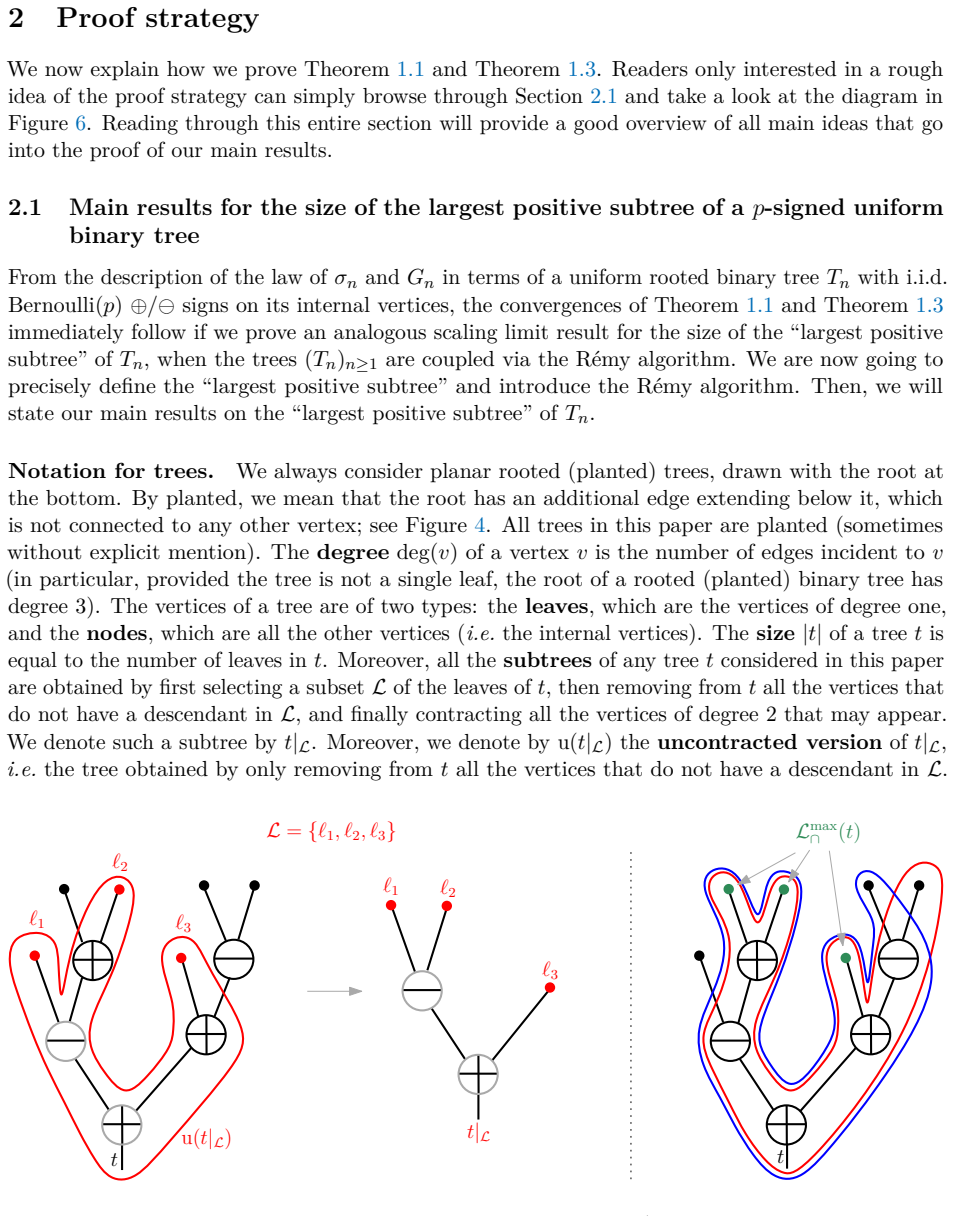
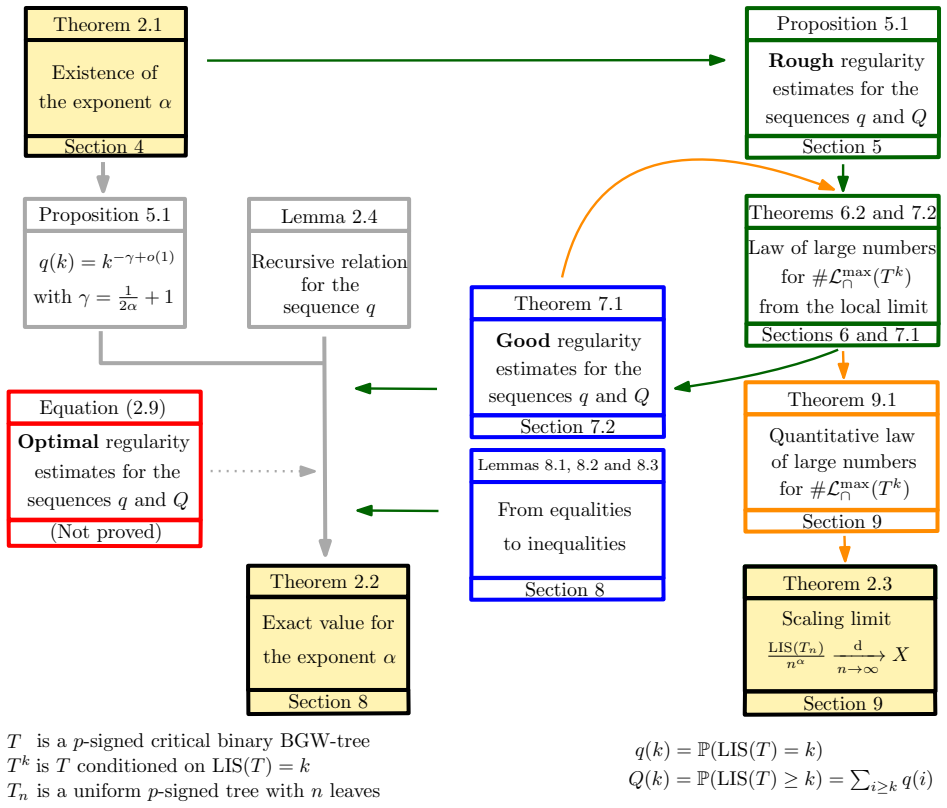
The central object is the pair of sequences $q(k)=\mathbb{P}(\operatorname{LIS}(T)=k)$ and $Q(k)=\mathbb{P}(\operatorname{LIS}(T)\ge k)$, where $T$ is the $p$-signed critical binary branching tree; these sequences satisfy an exact recursive relation obtained by splitting $T$ at the root according to the root sign and the LIS values of the two subtrees. The recursion determines $q$, but is too sensitive to initial conditions to read the exponent off directly. The argument therefore studies the conditioned tree $T_k$ with $\operatorname{LIS}(T)=k$, and a decreasing Markov chain that records, along the spine from the root to a uniformly chosen leaf of the leftmost maximal positive subtree, the size of the distinguished subtree and the sizes of the sibling subtrees. A black-and-golden coupling built from the transition probabilities shows that chains started at large $k$ and $k'$ merge quickly; from this local convergence one obtains $$\frac{\#L_{\max}^{\cap}(T_k)}{k} \xrightarrow[k\to\infty]{\mathbb{P}} \$\lambda$\in(0,1),$$ where $L_{\max}^{\cap}$ is the set of leaves belonging to all maximal positive subtrees. Re-running the tail estimate with $\lambda$ in place of the crude bound identifies $\lambda=\alpha$, upgrades the tail asymptotics to regular variation $$q(k)=$k^{{-1-1/(2\alpha)}}$\varphi(k),\qquad Q(k)=$k^{{-1/(2\alpha)}}$\Phi(k)$$ with slowly varying $\varphi,\Phi$, and then a comparison with power-law test sequences in the recursion forces the Gamma equation. The final scaling limit is obtained by writing the rescaled process as a backward martingale plus a remainder that is controlled by the quantitative law of large numbers for $\#L_{\max}^{\cap}$.
What would settle it
Run the recursion (2.8) at $p=1/2$ with $q(1)=(1+\sqrt{p})^{-1}$, compute $q(k)$ for $k$ up to $10^6$, and estimate the local exponent $-\log q(k)/\log k$; if it does not approach $\gamma=1+1/(2\alpha(1/2))\approx 1.6134$, the exponent identification in Theorem 2.2 fails. In parallel, simulate the coupled trees up to size $10^7$ and check that $n^{-\alpha(1/2)}\operatorname{LIS}(T_n)$ remains bounded away from $0$ and $\infty$ and that repeated independent simulations of the limit do not all produce the same constant.
Extended reading notes
Core claim
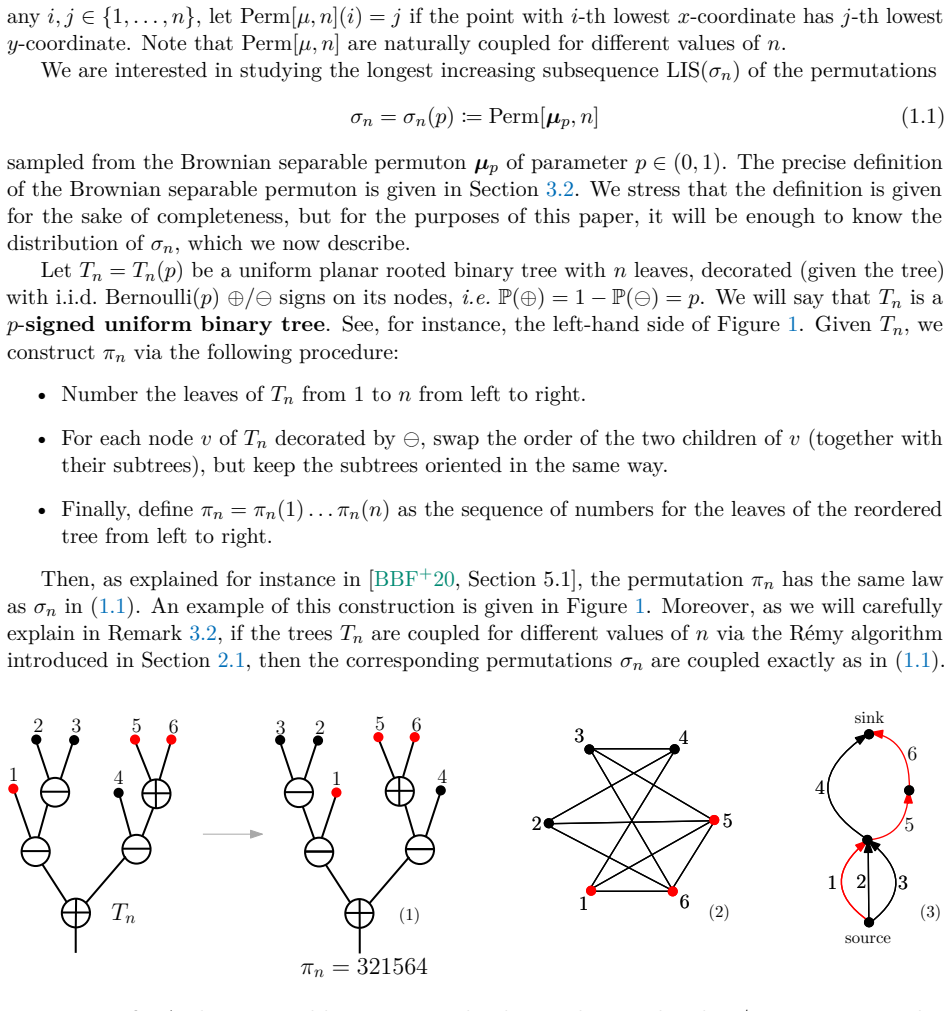
For fixed $p\in(0,1)$, sample $\sigma_n$ from the Brownian separable permuton $\mu_p$ under the natural coupling coming from the growth algorithm on the $p$-signed uniform binary tree $T_n$. The paper's central claim is that, with $\operatorname{LIS}(T_n)$ denoting the maximal number of leaves of a subtree all of whose internal nodes carry the $\oplus$ sign, $\operatorname{LIS}(\sigma_n)=\operatorname{LIS}(T_n)$ and $$\frac{\operatorname{LIS}(T_n)}{$n^{{\alpha(p)}}$} \xrightarrow[n\to\infty]{\mathrm{a.s.}} X(p),$$ where $\alpha(p)$ is the unique solution in $(1/2,1)$ of the Gamma equation $$\frac{1}{$4^{{1/(2\alpha)}}$\sqrt{\pi}}\,\frac{\Gamma(1/2-1/(2\$\alpha$))}{\Gamma(1-1/(2\$\alpha$))}=\frac{p}{p-1},$$ and $X(p)$ is almost surely positive and finite, is not deterministic, and is a deterministic measurable function of $\mu_p$. Because the same tree construction generates the Brownian cographon $W_p$, the identical result holds for the largest clique of a graph sampled from $W_p$, while the largest independent set is governed by $\alpha(1-p)$. This is an exact almost-sure scaling limit: neither a logarithmic correction nor a range of possible exponents is left open.
Load-bearing premise
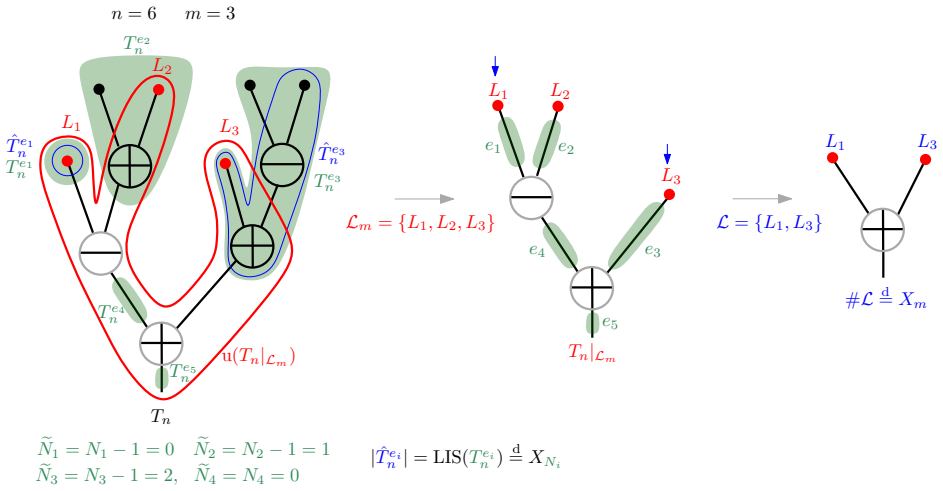
The whole derivation rests on one exact combinatorial decomposition: after picking $m$ uniform leaves of the random tree, the sizes of the leftover regions around those leaves have a symmetric joint law with all parameters $1/2$ and are independent of the reduced tree; if that were not exact, the exponent could not be pinned to the Gamma equation.
Editorial extensions
If this is right
- For every $p\in(0,1)$, $\operatorname{LIS}(\sigma_n)$ grows as $n^{\alpha(p)}$ almost surely, with no multiplicative logarithmic corrections.
- The exponent $\alpha(p)$ increases continuously from $1/2$ to $1$ as $p$ goes from $0$ to $1$, with $\alpha(1/2)\approx 0.815226$ in the separable-permutation case; larger $p$ means more $\oplus$ nodes and hence longer increasing subsequences.
- The same exponent and the same limiting variable govern the largest clique of the Brownian cographon, while the largest independent set is governed by $(\alpha(1-p),X(1-p))$.
- The limiting variable $X(p)$ is a deterministic measurable function of the Brownian separable permuton, so the whole sequence of longest increasing subsequence lengths is coupled to a single continuum object.
- The leftmost maximal positive subtree of the conditioned tree $T_k$, rescaled by $\varphi(k)/k^{\gamma-1}$, converges in the Gromov-Hausdorff sense to a self-similar fragmentation tree.
Reading between the lines
- If the main theorem is correct, the same exponent should govern uniform separable permutations and uniform cographs, with a constant factor of order $0.901$ as the paper conjectures; this would make the Brownian model the exact-exponent representative of the whole universality class.
- The proof mechanism suggests a testable general principle: on random recursive trees where a natural exploration along a marked leaf converges locally, the size of the largest almost-monochromatic subtree has an exponent read off from the tail of the subtree-size distribution via a regular-variation index, rather than from the mean-field shape.
- The paper's conjectures connecting $\alpha(p)$ to the Hausdorff dimension of the largest increasing subset of the permuton support and to a directed version of critical Liouville quantum gravity become quantitative predictions that can be checked independently once those objects are constructed.
- One could test the robustness of the exponent by perturbing the tree signs to introduce short-range correlations; the method should break exactly where the symmetric region-size independence fails, predicting a different exponent.
Signed reviews
Editorial analysis
A structured set of objections, weighed in public.
Referee Report
Summary. The paper studies the longest increasing subsequence (LIS) of permutations sampled from the Brownian separable permuton μ_p, and the largest clique of graphs sampled from the Brownian cographon W_p. The main result, Theorem 1.1, asserts that for every p∈(0,1), with the natural Rémy coupling, LIS(σ_n)/n^{α(p)} converges almost surely to a non-deterministic, almost surely positive and finite random variable X(p) that is a deterministic measurable function of μ_p, where α(p) is the unique solution in (1/2,1) of the Gamma-function equation (1.3). The proof proceeds by translating the problem into a statement about the largest positive subtree of a p-signed uniform binary tree: existence of the exponent is proved by supermultiplicativity (Section 4), rough regularity of the sequences q and Q is established in Section 5, a local convergence and a law of large numbers for the intersection of maximal positive subtrees are proved in Sections 6–7, the exact exponent is extracted in Section 8, and the almost-sure scaling limit is claimed to follow in Section 9 via a backward-martingale decomposition with remainder control. The paper also announces a scaling limit for the leftmost maximal positive subtree (Theorem 2.6) and states analogous clique/independent-set results for the Brownian cographon.
Significance. If the claimed results hold, this is a substantial contribution. Prior to this work, even the existence of the exponent α(p) for LIS of Brownian separable permutons was open; the paper not only proves existence but identifies α(p) exactly through a simple Gamma-function equation and upgrades the earlier polynomial-factor bounds of BDSG24 to an almost-sure scaling limit with an explicit random variable. The same exponent governs the largest clique of the Brownian cographon, unifying the permuton and graphon settings. The proof strategy is impressive and self-contained: the exponent is first produced by a supermultiplicativity argument, the constant λ from the law of large numbers for #L^max_∩(T_k) is later identified with α a posteriori, and the final identification of α uses regularly varying sequences and a comparison with test sequences. The paper also connects the exponent to the spectral zeta function and gives a by-product scaling limit of the leftmost maximal positive subtree. The main caveat is completeness: the final almost-sure convergence step is not actually present in the submitted text, so the central claim cannot currently be verified.
major comments (2)
- [Section 9.3, Lemma 9.2 and Eq. (9.3)] The proof of Lemma 9.2 is absent. The text states Lemma 9.2 and says it follows from Lemmas 9.3–9.6, but the manuscript breaks off in Section 9.3 immediately after Eq. (9.12), before any of those lemmas or their proofs appear. Lemma 9.2 is load-bearing: it is the estimate Σ_{n≥n0}|R_n| ≤ n0^{-ε} that turns the quantitative law of large numbers for the conditioned model T_k (Theorem 9.1) into control of the remainder R_n in the backward-martingale decomposition (9.3) for the unconditioned Rémy tree T_n. Without this argument, the almost-sure convergence of n^{-α}LIS(T_n) in Theorem 2.3, and hence the main scaling limit in Theorem 1.1, is not demonstrated in the available text.
- [Sections 9.4 and 9.5] Sections 9.4 and 9.5 are announced in the table of contents but their content is not present in the submitted manuscript. Section 9.4 is needed to conclude the martingale argument and establish Theorem 2.3, while Section 9.5 is the only place where the statement that X is a deterministic measurable function of the Brownian separable permuton is justified; that measurability is part of the statement of Theorem 1.1. Section 9.6, which contains the proof of Theorem 2.6, is also missing. The final theorems are therefore not verifiable from the version under review, and this is not a presentation issue but a gap in the proof of the central claim.
minor comments (3)
- [Section 6.3.3, Definition 6.10] The definition of good scales in Definition 6.10 depends on a constant C coming from Lemma 6.9, but the relation between this C and the constants in Lemma 6.12 is not made explicit; adding a sentence stating that the C is fixed and universal throughout Section 6 would improve readability.
- [Section 9.2, proof of Theorem 9.1] In the display after Eq. (9.7), the radical expression is typeset awkwardly with 'radicaltp/radicalvertex' artifacts; the intended expression is the square root of δ2(k)-2αδ1(k). This is a typesetting issue but should be corrected.
- [Page 5, Figure 3] The caption says 'Left: The graph of the functions α*(p), α(p) and β*(p)' but the figure contains two panels and the right panel shows α(p)-α*(p); the caption's first 'Left' appears to describe both panels. Clarify the panel labels.
Circularity Check
No significant circularity: the exact exponent is derived from a self-contained recursive analysis; the only flagged issue is a missing proof of the remainder Lemma 9.2, which is an incompleteness concern rather than a circular step.
full rationale
The derivation chain is self-contained rather than circular. The exponent alpha is first shown to exist in Theorem 2.1 via a supermultiplicativity argument (Lemma 4.2) whose only input is the standard Dirichlet-multinomial decomposition of a uniform binary tree into random regions (Lemma 3.8). No fitted constant enters this step. The exact value of alpha is then obtained in Theorem 2.2 by combining the exact recursive relation for q(k)=P(LIS(T)=k) (Lemma 2.4) with the regular-variation estimates of Theorem 7.1. Those estimates are themselves proved from the law of large numbers for #Lmax_intersect(T_k) (Theorem 7.2), and the constant lambda appearing there is afterwards identified with alpha by comparing two independently obtained exponents (Remark 7.9 and the proof of Theorem 7.1); this is a post-hoc identification, not an assumption of the value of alpha. The scaling limit Theorem 2.3 is proved via a backward martingale decomposition plus control of remainder terms; this is a standard style of argument and does not reduce to any of its inputs by construction. The paper does cite prior work by overlapping authors, notably [BDSG24, Theorem 1.1], but this citation is used only for crude initial bounds and for the fact that alpha lies in (1/2,1), not for the exact Gamma-function equation; it is parameter-free and external to the present derivation, so it does not constitute load-bearing self-citation. One genuine gap is present in the provided text: Section 9.3 states Lemma 9.2 (control of the remainder sum) and says it follows from Lemmas 9.3, 9.4, 9.5 and 9.6, but the supplied manuscript breaks off before those lemmas and their proofs appear. This is an omitted proof or incompleteness in the text as provided, and it matters for the almost-sure convergence claim, but it is not a circularity: there is no indication in the visible text that Lemma 9.2 is equivalent to its own assumptions or that any fitted value is renamed as a prediction. No self-definitional relation, no fitted-input-called-prediction step, and no author-imported uniqueness theorem were found in the presented derivation.
Assumptions & free parameters
assumptions (5)
- domain assumption A critical binary Bienaymé-Galton-Watson tree T conditioned to have n leaves is distributed as a uniform planar rooted binary tree with n leaves, and the Brownian separable permuton sampling is equivalent to leaf-reading of a p-signed uniform binary tree.
- standard math Rémy's algorithm gives a coupling of T_n across n such that T_{n-1} is obtained by removing a uniform leaf and contracting the parent node.
- standard math Lemma 3.8: conditional component sizes in a uniform binary tree are Dirichlet-multinomial with parameters 1/2, and attached regions are independent copies of T_{N_i}.
- standard math Karamata's characterization theorem, the uniform convergence theorem and Potter bounds for regularly varying functions.
- standard math Monotonicity of the spectral zeta / Gamma expression in Lemma 8.3, with digamma bounds log x − 1/x ≤ ψ(x) ≤ log x − 1/(2x).
Cite this review
Pith. "Pith review of The longest increasing subsequence of Brownian separable permutons." pith.science (2026). https://pith.science/paper/MRYL5YRU
@misc{pith2026250619123,
  author       = {Pith},
  title        = {Pith review of: The longest increasing subsequence of Brownian separable permutons},
  year         = {2026},
  howpublished = {\url{https://pith.science/paper/MRYL5YRU}},
  note         = {Machine review of arXiv:2506.19123}
}
abstract
We establish a scaling limit result for the length $\operatorname{LIS}(\sigma_n)$ of the longest increasing subsequence of a permutation $\sigma_n$ of size $n$ sampled from the Brownian separable permuton $\boldsymbol{\mu}_p$ of parameter $p\in(0,1)$, which is the universal limit of pattern-avoiding permutations. Specifically, we prove that \[\frac{\operatorname{LIS}(\sigma_n)}{n^\alpha}\;\underset{n\to\infty}{\overset{\mathrm{a.s.}}{\longrightarrow}}\; X,\] where $\alpha=\alpha(p)$ is the unique solution in the interval $(1/2,1)$ to the equation \[\frac{1}{4^{\frac{1}{2\alpha}}\sqrt{\pi}}\,\frac{\Gamma\big(\tfrac{1}{2}-\tfrac{1}{2\alpha}\big)}{\Gamma\big(1-\tfrac{1}{2\alpha}\big)}=\frac{p}{p-1},\] and $X=X(p)$ is a non-deterministic and a.s. positive and finite random variable, which is a measurable function of the Brownian separable permuton. Notably, the exponent $\alpha(p)$ is an increasing continuous function of $p$ with $\alpha(0^+)=1/2$, $\alpha(1^-)=1$ and $\alpha(1/2)\approx0.815226$, which corresponds to the permuton limit of uniform separable permutations. We prove analogous results for the size of the largest clique of a graph sampled from the Brownian cographon of parameter $p\in(0,1)$.
Figures


Figures from the paper (9 more)




Reference graph
Works this paper leans on
-
[1]
write newline
" write newline "" before.all 'output.state := FUNCTION output.nonempty.mrnumber duplicate missing pop "" 'skip if duplicate empty 'pop " " swap * " " * write if FUNCTION fin.entry add.period write mrnumber output.nonempty.mrnumber newline FUNCTION new.block output.state before.all = 'skip after.block 'output.state := if FUNCTION new.sentence output.state...
-
[2]
The scaling limit of random 2-connected series-parallel maps
D. Amankwah, J. Bj \"o rnberg, S. \"O . Stef \'a nsson, B. Stufler, and J. Turunen. The scaling limit of random 2-connected series-parallel maps. ArXiv e-prints , 2025, arXiv:2503.19705
work page Pith review arXiv 2025
-
[3]
A. Auffinger and D. Cable. Pemantle's min-plus binary tree. ArXiv e-prints , 2017, arXiv:1709.07849
arXiv 2017
-
[4]
R. Aguech. Limit theorems for random triangular urn schemes. Journal of applied probability , 46(3):827--843, 2009
work page 2009
-
[5]
H. Alzer. On some inequalities for the G amma and P si functions. Mathematics of computation , 66(217):373--389, 1997
work page 1997
-
[6]
D. Aldous and H. Thorisson. Shift-coupling. Stochastic P rocesses and Their A pplications , 44(1):1--14, 1993
work page 1993
-
[7]
F. Bassino, M. Bouvel, M. Drmota, V. F \'e ray, L. Gerin, M. Maazoun, and A. Pierrot. Linear-sized independent sets in random cographs and increasing subsequences in separable permutations. Comb. Theory , 2(3):35, 2022, arXiv:2104.07444. Id/No 15
work page Pith review arXiv 2022
-
[8]
The Brownian limit of separable permutations
F. Bassino, M. Bouvel, V. F\' e ray, L. Gerin, and A. Pierrot. The B rownian limit of separable permutations. Ann. Probab. , 46(4):2134--2189, 2018, arXiv:1602.04960. 3813988
work page Pith review arXiv 2018
Show all 42 references
-
[9]
Bassino, M
F. Bassino, M. Bouvel, V. F\' e ray, L. Gerin, M. Maazoun, and A. Pierrot. Universal limits of substitution-closed permutation classes. J. Eur. Math. Soc. (JEMS) , 22(11):3565--3639, 2020, arXiv:1706.08333. 4167015
2020 arXiv
-
[10]
Bassino, M
F. Bassino, M. Bouvel, V. F \'e ray, L. Gerin, M. Maazoun, and A. Pierrot. Random cographs: Brownian graphon limit and asymptotic degree distribution. Random Structures & Algorithms , 60(2):166--200, 2022, arXiv:1907.08517
2022 arXiv
-
[11]
Bassino, M
F. Bassino, M. Bouvel, V. F \'e ray, L. Gerin, M. Maazoun, and A. Pierrot. Scaling limits of permutation classes with a finite specification: a dichotomy. Advances in Mathematics , 405:108513, 2022, arXiv:1903.07522
2022 arXiv
-
[12]
Bonichon, M
N. Bonichon, M. Bousquet-M \'e lou, and \'E . Fusy. Baxter permutations and plane bipolar orientations. S\'em. Lothar. Combin. , 61A:Art. B61Ah, 29, 2009/11, arXiv:arXiv:0805.4180
2009 arXiv
-
[13]
Borga, W
J. Borga, W. Da Silva, and E. Gwynne. Power-law bounds for increasing subsequences in B rownian separable permutons and homogeneous sets in B rownian cographons. Advances in Mathematics , 439:109480, 2024, arXiv:2303.17030
2024 arXiv
-
[14]
Bateman and A
H. Bateman and A. Erd \'e lyi. Higher transcendental functions. Bateman M anuscript P roject M c G raw- H ill B ook C ompany , Vol. I, 1953
1953
-
[15]
Borga and E
J. Borga and E. Gwynne. Reconstructing SLE -decorated L iouville quantum gravity surfaces from random permutons. ArXiv e-prints , 2024, arXiv:2409.15494
2024 arXiv
-
[16]
Borga , E
J. Borga , E. Gwynne , and X. Sun . Permutons, meanders, and SLE-decorated Liouville quantum gravity . Journal of the European Mathematical Society , to appear, 2025, arXiv:2207.02319
2025 arXiv
-
[17]
N. H. Bingham, C. M. Goldie, and J. L. Teugels. Regular variation . Number 27. Cambridge university press, 1989
1989
-
[18]
Borga, N
J. Borga, N. Holden, X. Sun, and P. Yu. Baxter permuton and Liouville quantum gravity. Probab. Theory Relat. Fields , 186(3-4):1225--1273, 2023, arXiv:2203.12176
2023 arXiv
-
[19]
Borga and M
J. Borga and M. Maazoun. Scaling and local limits of B axter permutations and bipolar orientations through coalescent-walk processes. Ann. Probab. , 50(4):1359--1417, 2022, arXiv:2008.09086. 4420422
2022 arXiv
-
[20]
J. Borga . Random Permutations -- A geometric point of view . ArXiv e-prints (PhD thesis) , July 2021, arXiv:2107.09699
2021 arXiv
-
[21]
J. Borga. The skew Brownian permuton: A new universality class for random constrained permutations. Proc. Lond. Math. Soc. (3) , 126(6):1842--1883, 2023, arXiv:2112.00156
2023 arXiv
-
[22]
L. Devroye. Nonuniform random variate generation. Handbooks in operations research and management science , 13:83--121, 2006
2006
-
[23]
F. M. Dekking and G. R. Grimmett. Superbranching processes and projections of random cantor sets. Probability Theory and Related Fields , 78:335--355, 1988
1988
-
[24]
R. Durrett. Probability: theory and examples , volume 49. Cambridge university press, 2019
2019
-
[25]
Friedli and A
F. Friedli and A. Karlsson. Spectral zeta functions of graphs and the R iemann zeta function in the critical strip. Tohoku Mathematical Journal, Second Series , 69(4):585--610, 2017, arXiv:1410.8010
2017 arXiv
-
[26]
F\'eray and K
V. F\'eray and K. Rivera-Lopez. The permuton limit of random recursive separable permutations. Confluentes Mathematici , 15:45--82, 2023, arXiv:2306.04278
2023 arXiv
-
[27]
\'E . Ghys. A singular mathematical promenade. ArXiv e-prints , 2016, arXiv:1612.06373
2016 arXiv
-
[28]
Haas and G
B. Haas and G. Miermont. Scaling limits of M arkov branching trees with applications to G alton– W atson and random unordered trees. Annals of Probability , 40:2589--2666, 2012, arXiv:1003.3632
2012 arXiv
-
[29]
Karlsson
A. Karlsson. Spectral zeta functions. Discrete and Continuous Models in the Theory of Networks , pages 199--211, 2020, arXiv:1907.01832
2020 arXiv
-
[30]
Karlsson and M
A. Karlsson and M. Pallich. Volumes of spheres and special values of zeta functions of Z and Z /n Z . ArXiv e-prints , 2022, arXiv:2209.03590
2022 arXiv
-
[31]
Kesten and B
H. Kesten and B. P. Stigum. A limit theorem for multidimensional G alton- W atson processes. The Annals of Mathematical Statistics , 37(5):1211--1223, 1966
1966
-
[32]
J.-F. Le Gall . Random trees and applications. Probab. Surv. , 2:245--311, 2005, arXiv:math/0511515. 2203728 (2007h:60078)
2005 arXiv
-
[33]
T. Lenoir. Graph classes with few P_4 's: U niversality and B rownian graphon limits. arXiv e-prints , 2023, arXiv:2301.13607
2023 arXiv
-
[34]
T. Lenoir. Subgraph densities and scaling limits of random graphs with a prescribed modular decomposition. ArXiv e-prints , 2023, arXiv:2310.01318
2023 arXiv
-
[35]
Lov \'a sz
L. Lov \'a sz. Large networks and graph limits , volume 60. American Mathematical Soc., 2012
2012
-
[36]
D. A. Levin and Y. Peres. Markov chains and mixing times , volume 107. American Mathematical Soc., 2017
2017
-
[37]
M. Maazoun. On the B rownian separable permuton. Combin. Probab. Comput. , 29(2):241--266, 2020, arXiv:1711.08986. 4079636
2020 arXiv
-
[38]
J. Pitman. Combinatorial stochastic processes: Ecole d' \'e t \'e de probabilit \'e s de Saint-Flour XXXII-2002 . Springer Science & Business Media, 2006
2002
-
[39]
V. V. Prelov. Coupling of several random variables. Problems of I nformation T ransmission , 58(4):300--305, 2022
2022
-
[40]
R \'e my
J.-L. R \'e my. Un proc \'e d \'e it \'e ratif de d \'e nombrement d'arbres binaires et son application \`a leur g \'e n \'e ration al \'e atoire. RAIRO . I nformatique th \'e orique , 19(2):179--195, 1985
1985
-
[41]
B. Stufler. Limits of random tree-like discrete structures. Probability Surveys , 17:318--477, 2020, arXiv:1612.02580
2020 arXiv
-
[42]
B. Stufler. Graphon convergence of random cographs. Random Structures & Algorithms , 59(3):464--491, 2021, arXiv:1906.10355
2021 arXiv
Reviewed August 15, 2026 · model on record in the stance chip above.
Discussion (0). Continue with ORCID to comment.